Mary, Untier of Knots: The Baroque Painting Pope Francis Made Famous
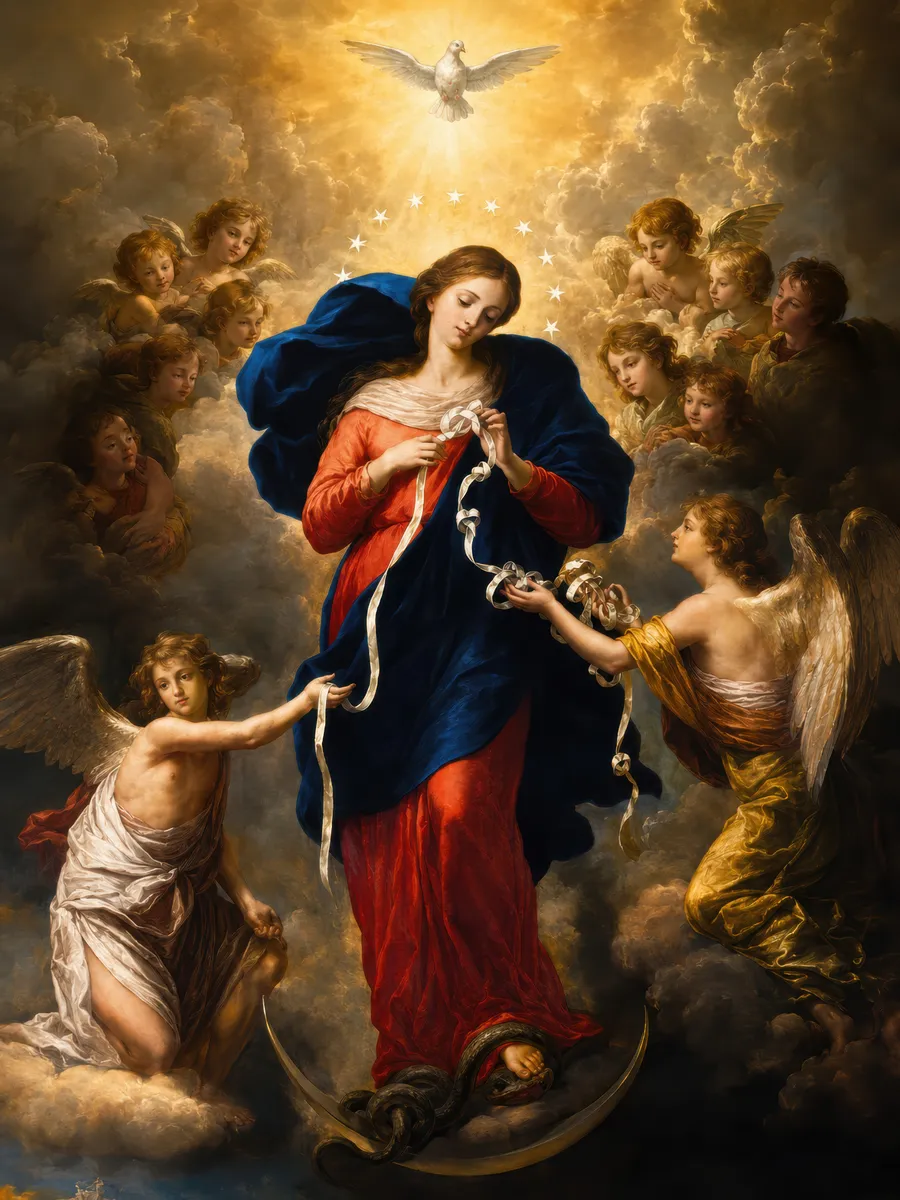
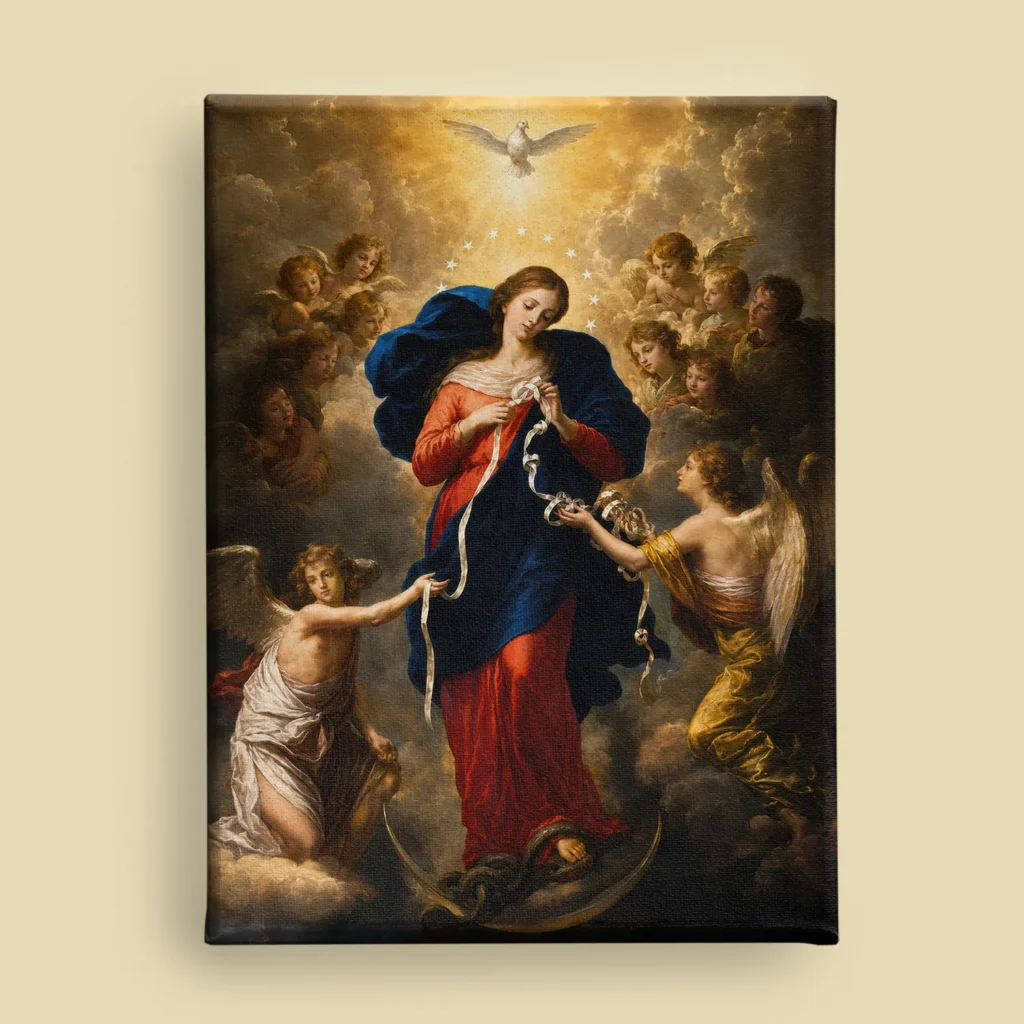
Mary, Untier of Knots, also known as Our Lady, Undoer of Knots, is both a Baroque painting and the Marian devotion that grew out of it. The picture was made around 1700 by the German painter Johann Georg Melchior Schmidtner and still hangs where it was first placed, in the church of St. Peter am Perlach in Augsburg, Bavaria. Its medium is oil on panel, and it shows the Virgin Mary calmly working loose the knots of a long white ribbon while two angels hold out its ends.
For almost three hundred years it was a local treasure, known to the people of Augsburg and little noticed beyond them. Then a young Argentine priest saw it, carried the image home, and set in motion one of the most rapid Marian revivals of modern times. This is the story of the painting, what every part of it means, and how it went from a quiet side altar to prayer cards on every continent.
The Painting Pope Francis Found in Augsburg
The reason the whole world now knows this image can be told in one name: Jorge Mario Bergoglio, the future Pope Francis. In 1986 he was in Germany working on his doctoral studies, and while in Augsburg he saw Schmidtner’s painting of Mary undoing knots. The image struck him deeply. He bought postcards and a reproduction and took them back to Argentina.
In Buenos Aires he promoted the devotion with real energy, and it spread quickly through the parishes there before travelling across Latin America under the Spanish name Maria Desatanudos. What had been a Bavarian devotion for almost three centuries became, within a generation, one of the most requested images of Mary in the Spanish-speaking world. When Bergoglio was elected pope in 2013, that quiet Augsburg altarpiece suddenly stood behind the most watched man in the Catholic Church, and interest in the original painting rose everywhere at once.
It is a rare thing for a single viewer to change the fortune of a picture so completely. Most of the great Marian images were famous from the start, painted by celebrated masters for grand settings. This one waited three hundred years for the one visitor who would carry it out into the world.
The Story Behind the Painting: A Marriage Saved
The painting was born from a real family crisis. In the early seventeenth century a nobleman of Augsburg, Wolfgang Langenmantel, and his wife Sophia were close to separating. Wolfgang travelled to the town of Ingolstadt to seek the counsel of a Jesuit priest, Father Jakob Rem, over several visits. During one of these meetings, in 1615, Father Rem took the couple’s wedding ribbon, the band used in their marriage rite, and slowly untied its knots as he prayed, asking the Virgin to smooth out everything that had tangled their life together. The marriage was saved, and the family never forgot it.
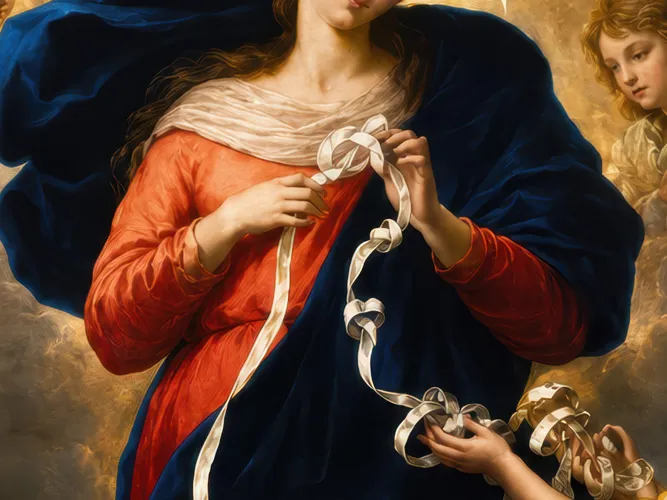
Some decades later the couple’s grandson, a canon named Hieronymus Ambrosius Langenmantel, commissioned Schmidtner to paint an altarpiece in thanksgiving for that grace. The painter took the small private act of untying a ribbon and lifted it into heaven, giving Mary herself the ribbon and the patient work of loosening its knots. The finished panel was placed in St. Peter am Perlach around 1700, where it has remained ever since. The knots in the ribbon stand for the tangled problems of ordinary life, the ones that seem to have no loose end to pull.
Reading the Painting: Mary and the Ribbon of Knots
The composition is built around a single quiet action. Mary stands at the centre in a red robe and a deep blue mantle, her head bowed in concentration, her hands raised to the ribbon. One angel offers her the heavily knotted end, thick with tangles; the other receives the ribbon below, now smooth and free. The eye follows the white band from tangle to release, and the whole meaning of the image is carried in that single line of cloth.
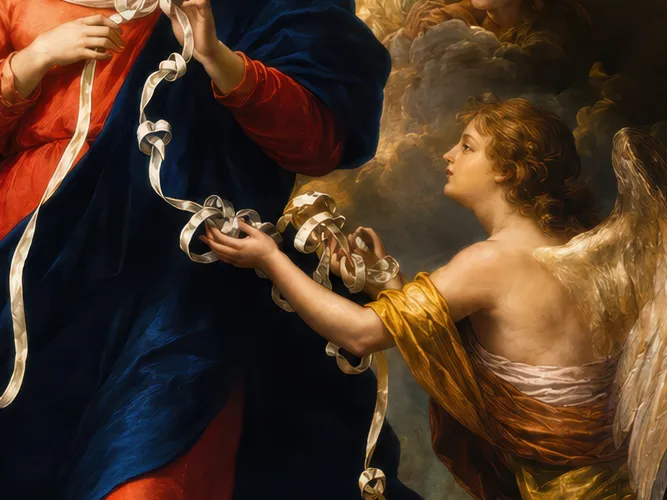
Schmidtner surrounds her with a crowd of cherubs whose faces press out of the golden clouds, a Baroque device that fills the picture with warmth and movement. Nothing about the scene is hurried. Mary does not tear at the knots or force them; she works each one loose with the calm of someone who has all the time in the world. That patience is the emotional core of the painting and the reason people in difficulty return to it. The devotion promises not a sudden magic solution but a steady, trustworthy untangling.
The Woman Clothed with the Sun
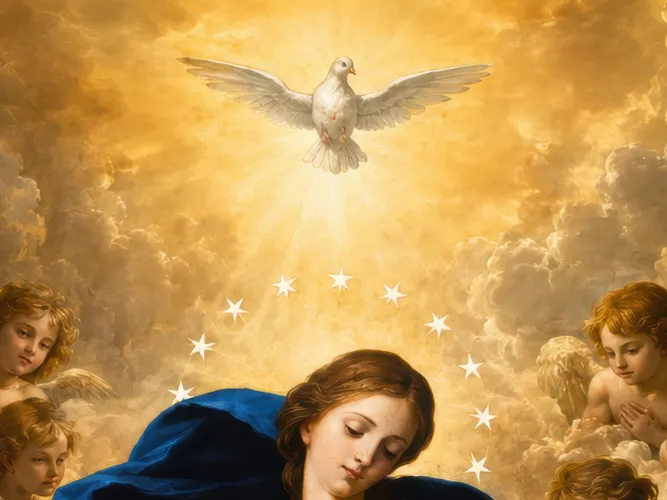
Above Mary’s head shines the dove of the Holy Spirit, pouring light down through the clouds, and around her hair is set a crown of twelve stars. These are not decorative additions. They identify Mary with the great sign described in the Book of Revelation, “a woman clothed with the sun, with the moon under her feet, and on her head a crown of twelve stars.”
At the bottom of the panel the same vision continues. Mary stands on a pale crescent moon, and beneath her foot a dark serpent is crushed, its head pinned down. This is the language of the Immaculate Conception, the belief that Mary was preserved from sin from the first moment of her life, and it is the same imagery that Spanish masters such as Murillo used in his Immaculate Conception paintings. Schmidtner fuses two ideas into one image: the sinless Virgin who defeats the serpent, and the merciful mother who unties our knots.
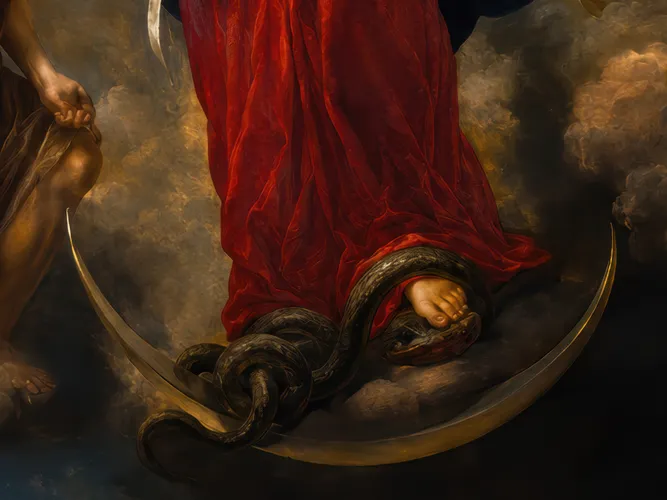
For a wider look at how these signs, the blue mantle, the crown of stars, the crescent moon and the crushed serpent, recur across the tradition, see our guide to Marian iconography and our gallery of famous Virgin Mary paintings.
An Ancient Idea: Mary Undoes the Knot of Eve
The picture may date from 1700, but the idea inside it is far older. In the second century, Saint Irenaeus of Lyon wrote that “the knot of Eve’s disobedience was untied by the obedience of Mary; what the virgin Eve bound by her unbelief, the Virgin Mary loosed by her faith.” Schmidtner’s ribbon is that ancient sentence turned into paint. Eve tied the knot; Mary unties it.
This is why the devotion feels both very new and very old. The painting that Pope Francis carried out of Augsburg gave a fresh, tender face to a teaching the Church had held since its earliest centuries. It also placed Mary in a role that ordinary people instantly understood. Everyone has a knot somewhere, a broken relationship, a worry that will not resolve, a situation with no visible way out, and the image says simply that there are patient hands willing to work at it.
Conclusion
Mary, Untier of Knots is a modest Baroque panel that has done extraordinary things. It turned one family’s saved marriage into a picture, held a quiet corner of a German church for three centuries, and then, through a single traveller who became pope, spread to homes and parishes around the world. Its power lies in how little it asks the viewer to understand: a woman, a ribbon, a knot coming loose.
The original still hangs in St. Peter am Perlach in Augsburg, where visitors come to pray before it and leave their own tangles behind. Whether met in that church, on a prayer card, or as a reproduction on a wall at home, the image keeps making the same gentle promise, that no knot is beyond the patience of the Mother of God.
Artwork Information
| Artwork | Artist | Date | Medium | Current Location |
|---|---|---|---|---|
| Mary, Untier of Knots (Our Lady, Undoer of Knots) | Johann Georg Melchior Schmidtner | c. 1700 | Oil on panel | St. Peter am Perlach, Augsburg |
Five Facts About Mary, Untier of Knots
- It was painted around 1700 by Johann Georg Melchior Schmidtner for the church of St. Peter am Perlach in Augsburg, Germany.
- It was commissioned by the canon Hieronymus Ambrosius Langenmantel in thanksgiving for the saved marriage of his grandparents.
- The Virgin is shown untying a knotted ribbon between two angels, standing on a crescent moon and crushing a serpent.
- The image behind it goes back to Saint Irenaeus, who wrote that Mary’s obedience untied the knot of Eve’s disobedience.
- It became world famous after Jorge Bergoglio, the future Pope Francis, discovered it in 1986 and spread the devotion in Argentina.
FAQ
Where is the original painting of Our Lady, Undoer of Knots?
The original is in the church of St. Peter am Perlach in Augsburg, Bavaria, Germany, where it has hung since about 1700. It is an oil painting on panel, roughly six feet high, set above a side altar, and pilgrims still come to pray before it.
What is the story behind Our Lady, Undoer of Knots?
In 1615 a Jesuit priest, Father Jakob Rem, helped save the failing marriage of Wolfgang and Sophia Langenmantel by praying over their wedding ribbon and untying its knots. Decades later their grandson, Hieronymus Ambrosius Langenmantel, commissioned Schmidtner to paint the scene in thanksgiving, giving the ribbon to the Virgin Mary herself.
Who painted Mary, Untier of Knots?
The painter was Johann Georg Melchior Schmidtner, a German Baroque artist active around Augsburg. This altarpiece, made around 1700, is by far his best known work, and it is often his only work that most people can name.
Why is Mary called the Undoer of Knots?
The title comes from the painting, where Mary loosens the knots of a ribbon that stand for the tangled problems of life. Its deeper root is a saying of Saint Irenaeus in the second century, that the knot of Eve’s disobedience was untied by the obedience of Mary.
What problems does Mary, Undoer of Knots help with?
The devotion is turned to for situations that seem to have no solution: discord in a family, a marriage in trouble, estrangement between parents and children, or any worry that feels impossible to untangle. The image invites the faithful to hand these knots to Mary and trust her patient work.
Where can I buy a Mary, Untier of Knots print?
You can buy a Mary, Untier of Knots canvas at jesuschrist.pictures, a faithful reproduction of Schmidtner’s Baroque original printed as ready to hang wall art. The shop also offers other Marian canvases and posters, so the Undoer of Knots can join a wider prayer corner at home.