This article is accompanied by a short podcast episode that offers an audio overview of the main themes and artworks discussed below.
Introduction
The episode of Emmaus (Luke 24:13–35) recounts how two disciples encounter the risen Christ without recognizing Him. Only during the meal, when He blesses and breaks the bread, do their eyes open. At that precise moment of recognition, Christ vanishes. The scene combines everyday hospitality with one of the most profound revelations of the Resurrection.
This tension between the ordinary and the divine explains why The Supper at Emmaus paintings became so important in Christian art. Artists were drawn to a subject that allowed faith to be expressed through gesture, light, and silence rather than spectacle. Some emphasized sudden recognition and movement, others restraint, humility, and interior prayer.
From the Renaissance to the nineteenth century, painters repeatedly returned to this moment, each adapting it to their own visual language. To explore the theme visually across periods and styles, you can visit our dedicated page:
The Supper at Emmaus Paintings Gallery.
For a deeper look at the tradition of sacred meals in Christian art, you may also explore our article on the Last Supper: 13 Most Famous Jesus’ Last Supper Paintings.
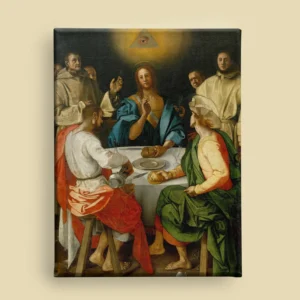
Pontormo’s version (painted for the Certosa del Galluzzo near Florence) belongs to the uneasy beauty of early sixteenth-century Mannerism. The scene does not rely on theatrical movement. Instead, it produces spiritual intensity through posture, spacing, and an atmosphere that feels suspended. Christ appears gentle, almost fragile, while the disciples seem caught between hospitality and alarm. The setting is simple, but the emotional temperature is high, as if the room itself is holding its breath.
The Supper at Emmaus by PontormoSave
Titian’s painting, also known as Pilgrims at Emmaus, is preserved in the Louvre and offers a Venetian answer to the theme: color, gravity, and human warmth. Christ is present with a calm authority. Titian’s gift is to make the sacred appear in a believable interior, without losing majesty. The table becomes a stage for recognition, but a stage built from everyday materials: cloth, bread, simple vessels. The disciples’ reactions are readable without exaggeration, and the viewer senses that the miracle enters the world quietly, rather than shattering it.
The Supper at Emmaus by TitianSave
The Supper at Emmaus by Paolo Veronese (about 1559)
Veronese, whose sacred banquets often unfold in grand architectural settings, approaches Emmaus with the elegance of Venetian painting. The Louvre lists a Supper at Emmaus by Veronese, and the scene fits his interest in ordered space, luminous color, and a refined social world. In this tradition, the revelation is not primarily fearsome. It is radiant and structured. Christ’s presence anchors the composition, while the surrounding figures and details give the viewer a sense of inhabited reality. Theological meaning is carried by harmony: recognition appears as an opening of the eyes within a world that remains coherent.
The Supper at Emmaus by Paolo VeroneseSave
Baroque Light and the Shock of Recognition
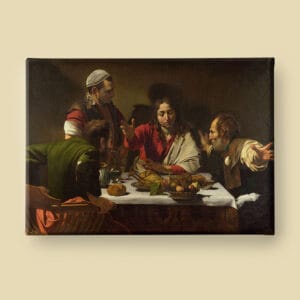
The Supper at Emmaus by Caravaggio (1601)
Caravaggio’s 1601 version (National Gallery, London) is the most famous Supper at Emmaus painting because it transforms recognition into an event that feels physically immediate. The disciples react with sudden force: a chair tilts, arms open wide, bodies lean forward as if the room cannot contain what is happening. Christ is calm, yet the gesture of blessing triggers a wave of astonishment. Caravaggio’s naturalism intensifies the experience: hands look rough, food looks real, and the inn feels like a place the viewer might enter.
The use of light is decisive. It does not merely illuminate objects. It defines the miracle. The darkness surrounding the table becomes a spiritual void, and the light that falls on faces and bread becomes the language of revelation. Caravaggio makes the viewer a silent guest at the table, close enough to feel the shock. In doing so, he also links Emmaus to Eucharistic theology: recognition is tied to bread, blessing, and a presence that is both concrete and mysterious.
The Supper at Emmaus by CaravaggioSave
The Supper at Emmaus by Jacopo Bassano (about 1538)
Bassano’s interpretation, represented by the version at the Kimbell Art Museum, places Emmaus in a world of humble domestic life. The miracle occurs among ordinary textures: coarse cloth, simple crockery, working hands. Bassano’s art often brings sacred history into the register of village experience. Here, that choice becomes a theological statement. The Resurrection is not far away in a distant gold heaven. It meets the disciples at a table that could belong to any household.
The Supper at Emmaus by Jacopo BassanoSave
The Supper at Emmaus by Matthias Stom (about 1620–1640)
Stom, a Northern painter active in Italy, is one of the most intense heirs of Caravaggio’s chiaroscuro. A documented version is kept at the Museum of Grenoble, and another is in the Thyssen-Bornemisza Museum in Madrid. Stom often places a candle or concentrated light source at the heart of the scene, so that illumination becomes almost tactile. Faces emerge from darkness with an urgency that suits Luke’s narrative: recognition is sudden, and the room seems to change at the same instant as the disciples’ vision.
The Supper at Emmaus by Matthias StomSave
Northern Interior Faith
The Supper at Emmaus by Rembrandt (1648)
The Rembrandt you uploaded is the Louvre painting of 1648, and it is one of the most moving interpretations of the theme because it refuses spectacle. Christ is present, but not as a theatrical hero. The light is gentle, concentrated, and spiritual rather than sensational. The architecture and shadow dominate the space, and the figures appear small inside it, as if human perception is always dwarfed by divine reality.
Rembrandt’s strength is psychological truth. Recognition is not performed. It dawns. The disciple closest to Christ seems to realize what is happening with a kind of inward trembling rather than an outward cry. The servant figure, often included by Baroque painters, becomes a witness not only to the event, but to the mystery of faith itself: some see, others remain uncertain, and the painting holds that tension without resolving it cheaply.
This is also a profoundly Eucharistic image. The table is modest, the bread is simple, and yet the light makes that simplicity radiant. The miracle is shown as a transformation of perception. The viewer is invited to consider that Christ may be recognized not through loud signs, but through humble gestures and a heart made attentive.
The Supper at Emmaus by RembrandtSave
The Supper at Emmaus by the Le Nain Brothers (about 1645)
A Supper at Emmaus associated with the Le Nain circle is preserved in the Louvre (often linked to Louis or Mathieu Le Nain, and sometimes presented under the broader family attribution). In this tradition of French realism, the scene is sober and grounded. Clothing, faces, and the plain interior all insist on poverty and humility. The disciples look like ordinary men of their time, and the sacred arrives without changing the world’s material truth. That choice aligns with the spiritual climate of seventeenth-century France, where devotion often valued simplicity, moral seriousness, and the quiet dignity of everyday life.
The Supper at Emmaus by Antoine, Louis and Matthieu Le NainSave
Essential Works Beyond the Best Known Names
The Supper at Emmaus by Filippo Tarchiani (early 17th century)
Tarchiani’s La Cena di Emmaus, documented in Los Angeles, shows how the subject circulated within the Italian Baroque beyond the most famous masters. His work belongs to a world shaped by Caravaggio’s example, where strong contrasts, close figures, and a direct approach to sacred narrative help the viewer feel present. In these paintings, Emmaus becomes a test of perception: the viewer must look closely, as the disciples do, until recognition becomes unavoidable.
The Supper at Emmaus by Filippo TarchianiSave
The Supper at Emmaus by William Etty (19th century, after Titian)
In nineteenth-century Britain, biblical scenes often returned with new moral and emotional intensity. William Etty painted a Supper at Emmaus after Titian, documented by Art UK in York Art Gallery. Rather than competing with Baroque drama, this approach looks back to Renaissance models with reverence, adapting them to a later era that valued historical painting and spiritual reflection. Etty’s presence in this list is important because it shows that Emmaus did not belong to one period. The subject remained meaningful wherever Christians continued to ponder the mystery of recognition, presence, and the breaking of bread.
The Supper at Emmaus by William EttySave
The road to Emmaus was one of several encounters with the risen Christ; another, when doubt gave way to belief, fills our guide to Doubting Thomas paintings.
Conclusion
Across centuries and schools of painting, The Supper at Emmaus has remained one of the most spiritually resonant episodes in Christian art. From the poised elegance of the Renaissance to the dramatic chiaroscuro of the Baroque and the inward silence of Rembrandt, artists have returned again and again to this intimate meal. Each version reflects not only a style, but a theological sensitivity: recognition through bread, revelation through gesture, faith awakened in an ordinary setting.
What makes the Emmaus scene so enduring is its quiet universality. It does not take place in a temple or on a mountain, but at a table. It reminds believers that Christ is encountered not only in moments of public glory, but in shared meals, humble interiors, and attentive hearts. Painters understood that this narrative allowed them to explore light, presence, doubt, and awakening without spectacle.
In contemplating these masterpieces, we are invited to place ourselves among the disciples, asking whether we too recognize Him in the breaking of the bread. That question, posed visually across five centuries, remains as living today as it was in Luke’s Gospel.
Summary Infographic of Supper at Emmaus paintings
✦ Free Christian & Catholic Printables
Looking for free Christian & Catholic printables? Our complete collection of illuminated prayer cards & Scripture verses — the Memorare, Psalm 23, Psalm 91 and more — is ready to print, free, in one place.
Frequently Asked Questions about the Supper at Emmaus Paintings
What is the Supper at Emmaus in Christian art?
The Supper at Emmaus is a biblical episode from the Gospel of Luke in which the risen Jesus shares a meal with two disciples. They recognize Him only when He breaks the bread. In Christian art, the scene symbolizes spiritual recognition, resurrection faith, and the Eucharist.
Why did so many artists paint the Supper at Emmaus?
Artists were drawn to the Supper at Emmaus because it combines resurrection, recognition, and the Eucharist in a single intimate moment. The scene allows painters to explore faith through gesture, light, and human reaction rather than public miracle.
Which Supper at Emmaus painting is the most famous?
The most famous Supper at Emmaus painting is Caravaggio’s version from 1601, housed in the National Gallery in London. It is widely regarded as one of the masterpieces of Baroque religious art.
What does Caravaggio’s Supper at Emmaus represent?
Caravaggio’s Supper at Emmaus represents the precise moment when the disciples recognize the risen Christ through the gesture of blessing and breaking bread. The painting emphasizes human surprise, physical presence, and the Eucharistic meaning of the scene. Light and gesture work together to reveal Christ’s identity.
Who was the Italian Baroque artist of the Supper at Emmaus?
The most famous Italian Baroque artist associated with the Supper at Emmaus is Caravaggio. His dramatic use of light, realism, and expressive gesture made his versions of the subject foundational for later Baroque painters.
What is Caravaggio’s Supper at Emmaus from 1606?
Caravaggio painted a second version of the Supper at Emmaus around 1606, now in Milan. Compared to the 1601 painting, this version is darker and more restrained, focusing less on dramatic movement and more on gravity, humility, and mystery.
How is Rembrandt’s Supper at Emmaus different from Caravaggio’s?
Rembrandt’s Supper at Emmaus focuses on silence and interior light rather than dramatic action. Recognition appears as a spiritual realization rather than a physical shock, reflecting Rembrandt’s interest in inner faith and contemplation.
Is the Supper at Emmaus connected to the Last Supper?
Yes. The Supper at Emmaus is closely connected to the Last Supper through the act of breaking bread. In Christian theology and art, this gesture echoes the Eucharist and reinforces Christ’s continued presence after the Resurrection.
Where can I buy Supper at Emmaus paintings on canvas?
You can buy Supper at Emmaus paintings on canvas at jesuschrist.pictures. The canvas reproduction is in our shop, printed on premium canvas and shipped worldwide.