Adoration of the Shepherds in 10 Luminous Paintings
The Adoration of the Shepherds is the moment in Saint Luke’s Gospel when the first visitors reach the newborn Christ. They are not kings or priests but men keeping watch over their flocks by night outside Bethlehem. An angel appears to them, the glory of the Lord shines round about them, and they hear the news before anyone else on earth: unto you is born this day in the city of David a Saviour. They go “with haste” and find Mary, Joseph, and the Child lying in a manger, then return glorifying God for all they had seen (Luke 2:8-20).
For centuries painters folded the shepherds into the larger Nativity, or let them watch from a hillside while the Magi took the foreground. In the fifteenth century the scene became a subject of its own, and it gave artists something the arrival of the kings never could: poor men, rough hands, real animals, and a night lit by a promise. The ten paintings below follow one thread through two hundred years. At first the light falls from an open sky. Then, little by little, it moves into the stable, until it comes from the Child alone.
If you are looking for the wider story of Christmas in art, our selection of famous Nativity paintings gathers Giotto, Botticelli, Correggio and Geertgen tot Sint Jans, and the kings have their own gallery in our Adoration of the Magi paintings. None of the works below appears in either.
1. The Adoration of the Shepherds by Andrea Mantegna (shortly after 1450)
Andrea Mantegna was barely twenty when he painted this small picture, and it already has the hard, bright precision that made his name. The Virgin kneels in prayer before the Child, who lies on a fold of her blue mantle surrounded by tiny red and blue cherubim. On the left Joseph has fallen asleep, his head resting on his hand. On the right two shepherds arrive, one with his hands joined, the other holding his hat, their stockings torn and their feet bare.
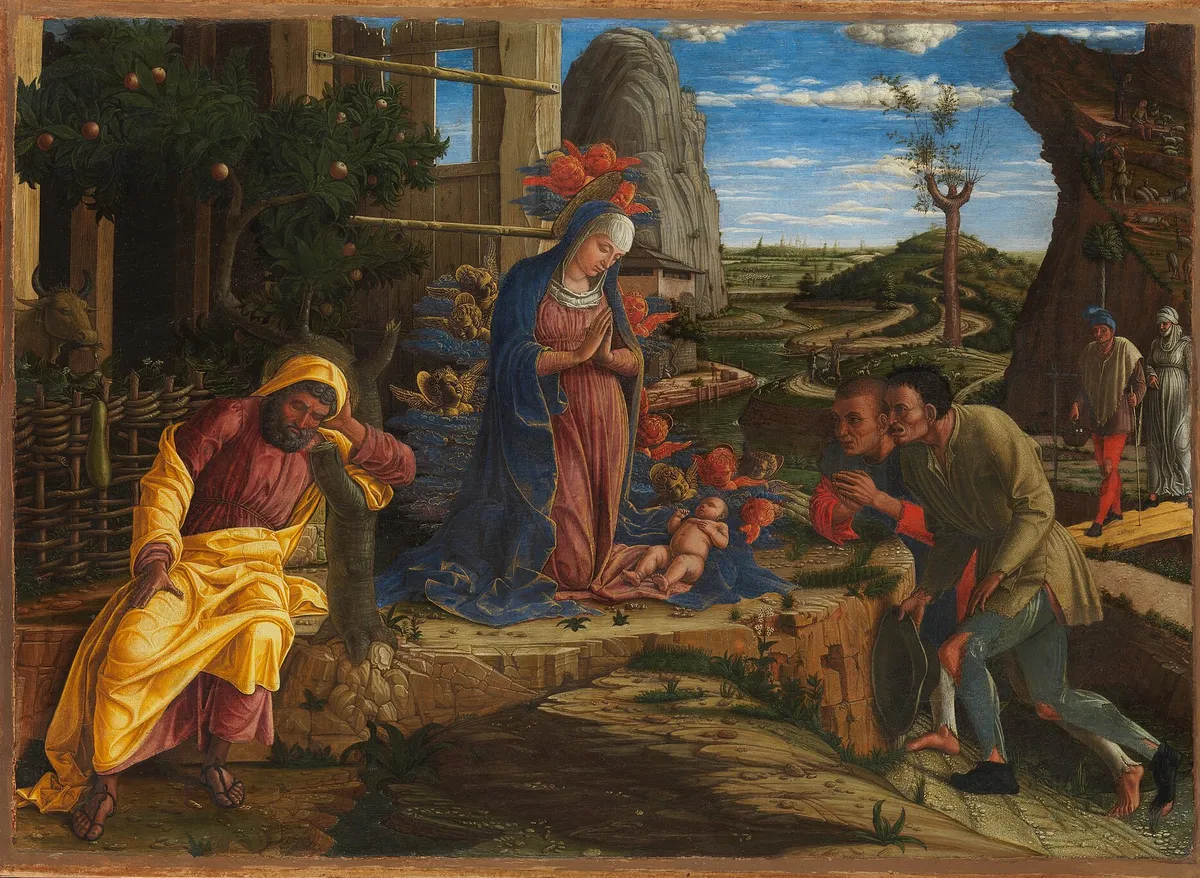
The light here is plain daylight, sharp enough to pick out every stone, branch and fruit in the landscape behind. Mantegna gives the shepherds the same care as the saints, a sign of how seriously the Renaissance began to take these humble witnesses. The painting hangs at The Metropolitan Museum of Art in New York.
2. The Adoration of the Shepherds by Giorgione (1505 to 1510)
Fifty years later in Venice, Giorgione turned the same scene into a meditation on landscape. The Holy Family waits at the mouth of a dark cave on the right, the Child lying on a cloth on the bare ground. One shepherd kneels before him, his hat on the ground, while a second stands behind, leaning on his staff. On the left the world opens out into a soft valley, with a river, a village and distant blue hills.
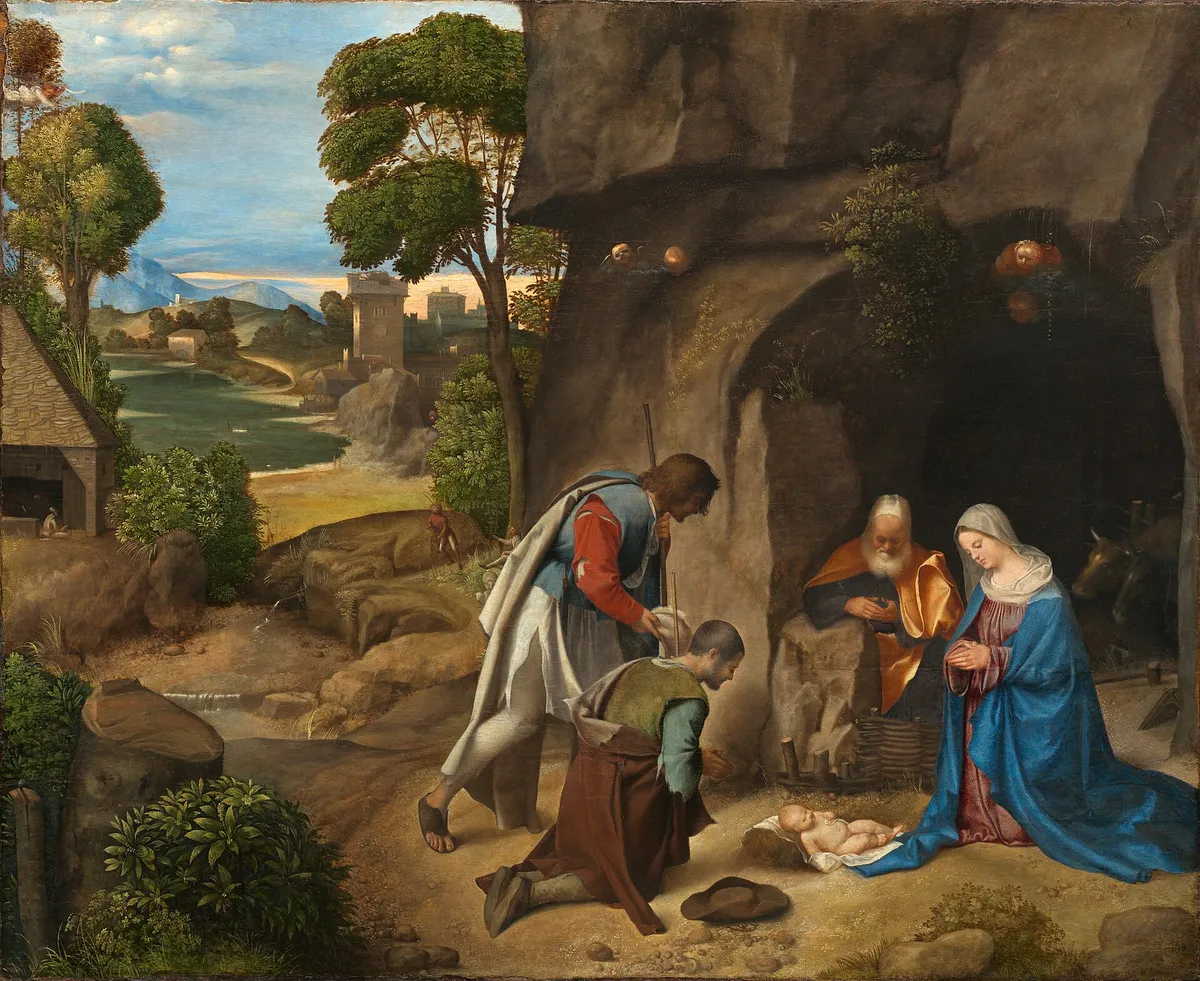
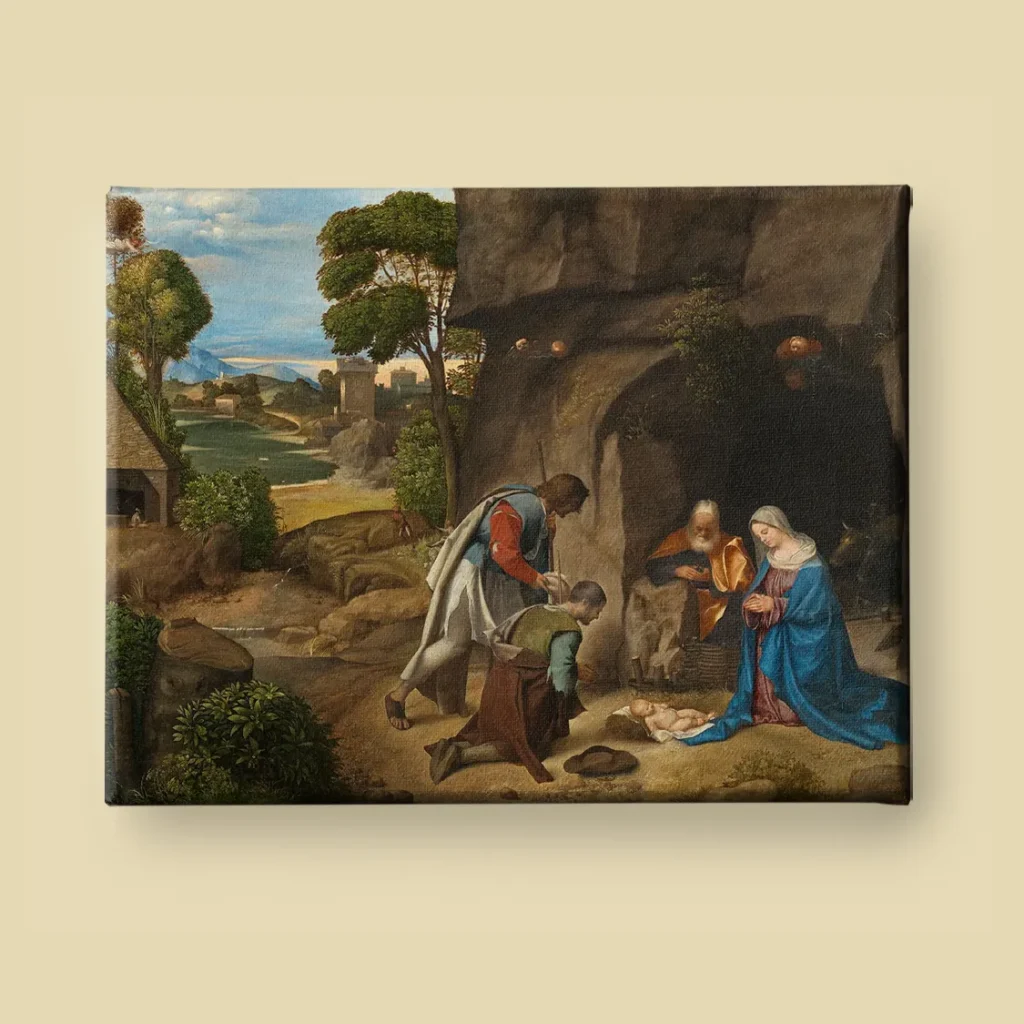
The painting is known as the Allendale Nativity, after the English family that owned it for generations. Its attribution once ended a famous partnership: the dealer Joseph Duveen sold it as a Giorgione, while his adviser Bernard Berenson held that it was an early Titian, and the quarrel broke their long collaboration. Today the National Gallery of Art in Washington, where it hangs, catalogues it as Giorgione. Whoever painted it, few pictures make the quiet of that first night so easy to feel.
3. The Adoration of the Shepherds by Jacopo Bassano (16th century)
No painter loved shepherds more than Jacopo Bassano. Working in the small town of Bassano del Grappa, at the foot of the Alps, he filled his religious scenes with the farmers and animals he saw every day, and his sons carried the style on for another generation. In this version the composition runs on a diagonal: the Virgin holds the Child on the left, while peasants, sheep, a donkey and an ox press in from the right.
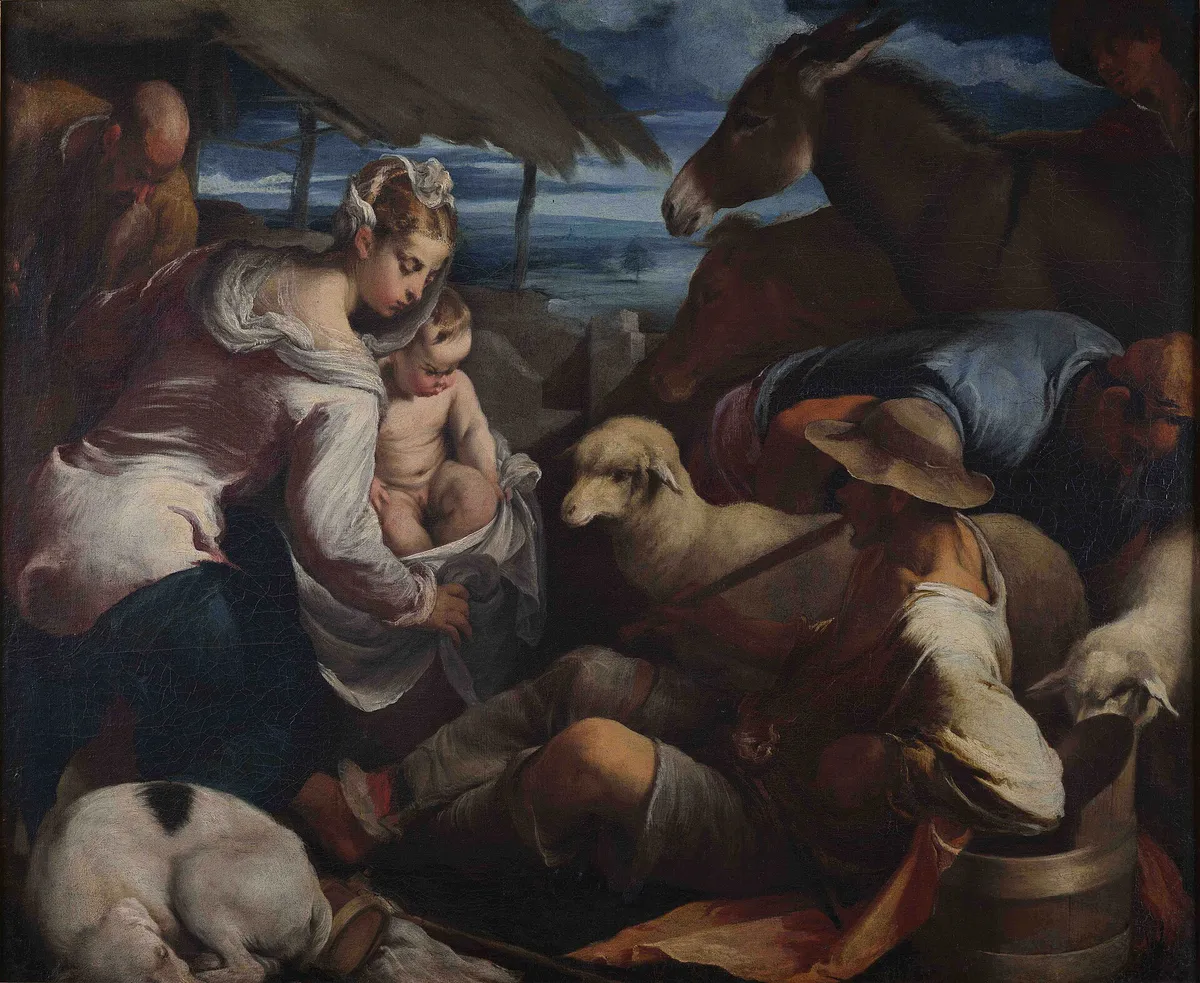
Nothing here is ceremonial. The shepherds lean in with the curiosity of neighbours, the dog sleeps in the foreground, and the light catches wool, straw and sunburnt skin. It is the Gospel told as village news. The canvas was already in the Borghese collection by 1650 and still hangs at the Galleria Borghese in Rome.
4. The Adoration of the Shepherds by El Greco (1612 to 1614)
El Greco painted this tall canvas for the altar of the chapel where he intended to be buried, in the church of Santo Domingo el Antiguo in Toledo. It is usually considered his last work: he died in April 1614. Here the turn of our story begins. The sky is dark and the angels tumble through it, but the light no longer falls from above. It rises from the Child, whom the Virgin unveils with both hands, and it catches the faces and arms of the shepherds who bend over him.
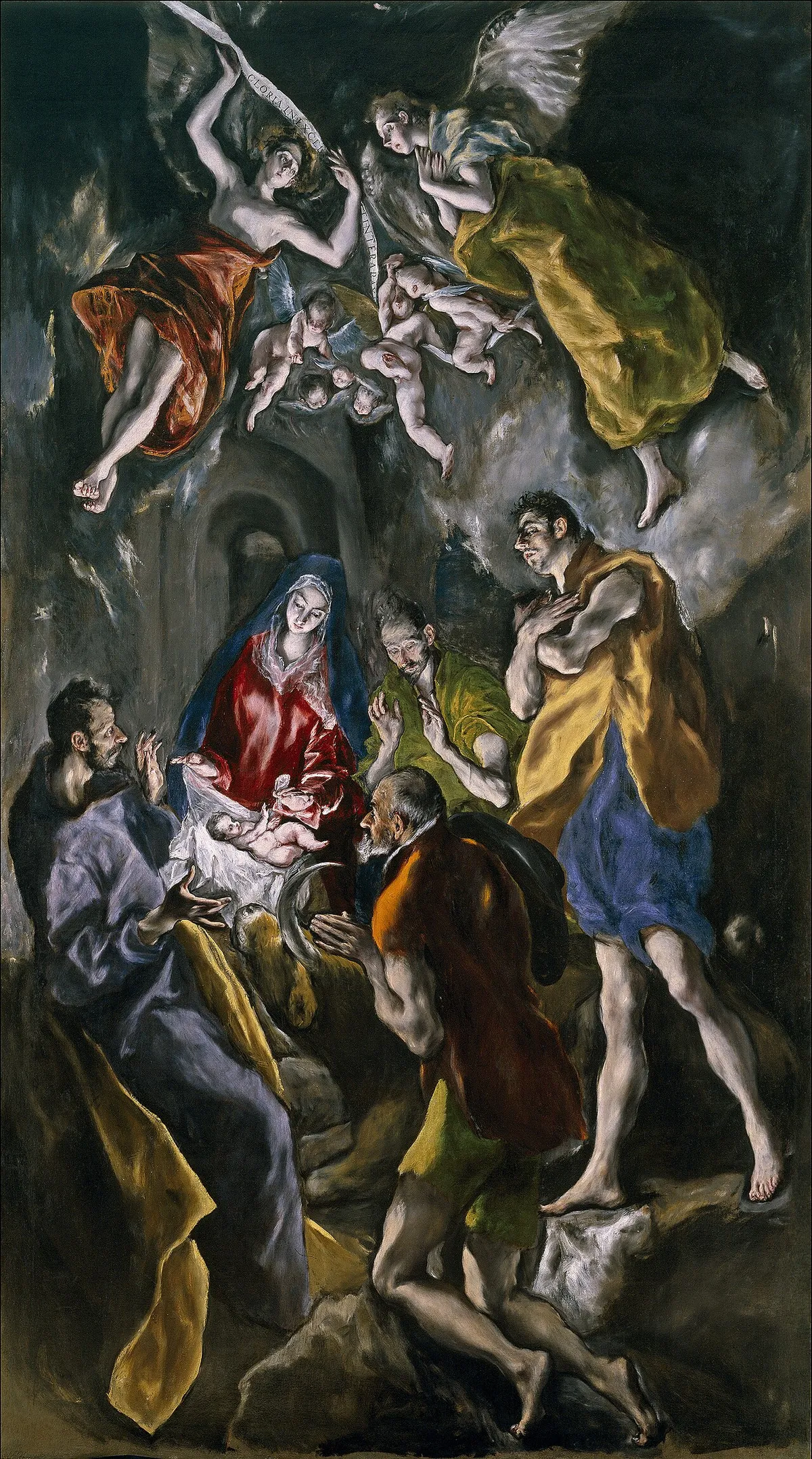
The figures are stretched and flickering, as in all of El Greco’s late work, and the whole picture seems to burn rather than shine. It is hard not to read it as a painter’s own prayer at the end of his life. The canvas stayed in Toledo until 1954, when it entered the Museo del Prado in Madrid.
5. Adoration of the Shepherds by Caravaggio (1609)
Caravaggio painted this picture while on the run. He had escaped from prison in Malta and crossed to Sicily, where the Senate of Messina commissioned the work for the church of the Capuchin friars. The stable he imagined is the poorest in Christian art: a bare wooden shed, a few planks, an ox and a donkey in the shadow. The Virgin does not kneel on a throne or a cushion. She lies on the straw, exhausted, holding the Child against her cheek.
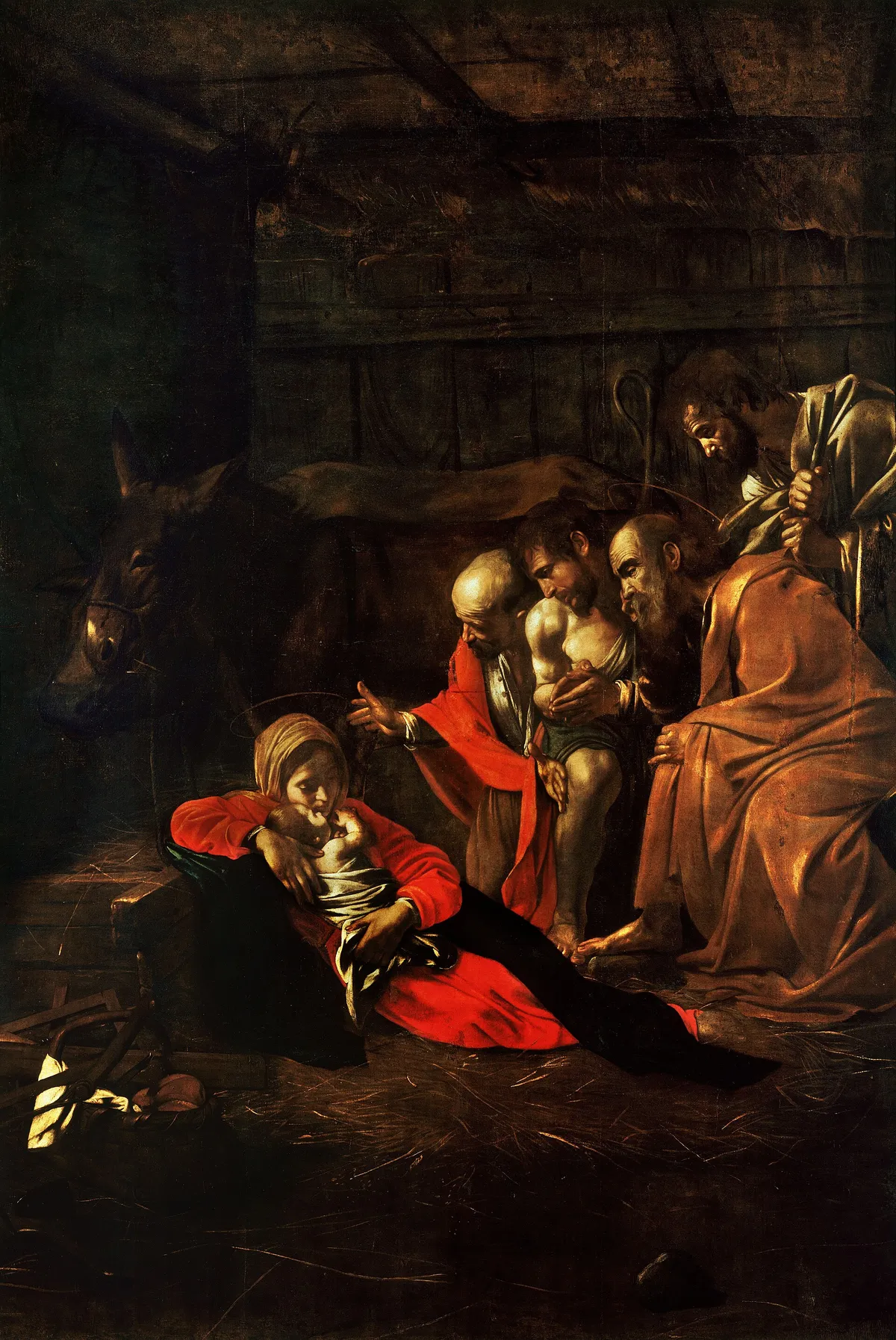
Three shepherds and Joseph lean toward her in silence, their bare feet and patched clothes painted with the same unflinching truth Caravaggio gave to the apostles in The Calling of Saint Matthew. In the foreground lie a carpenter’s tools, a loaf and a folded cloth, the whole fortune of the family. The painting is now in the Museo Regionale in Messina, one of the last great altarpieces of Caravaggio’s short life.
6. Adoration of the Shepherds by Gerard van Honthorst (1622)
The Dutch painter Gerard van Honthorst spent ten years in Rome studying Caravaggio, and the Italians nicknamed him Gherardo delle Notti, Gerard of the Nights, for his candlelit scenes. Back in Utrecht he painted this canvas, now in the Wallraf-Richartz-Museum in Cologne, and took the idea of El Greco to its end. There is no candle, no lantern, no moon. The only light in the room comes from the Child.
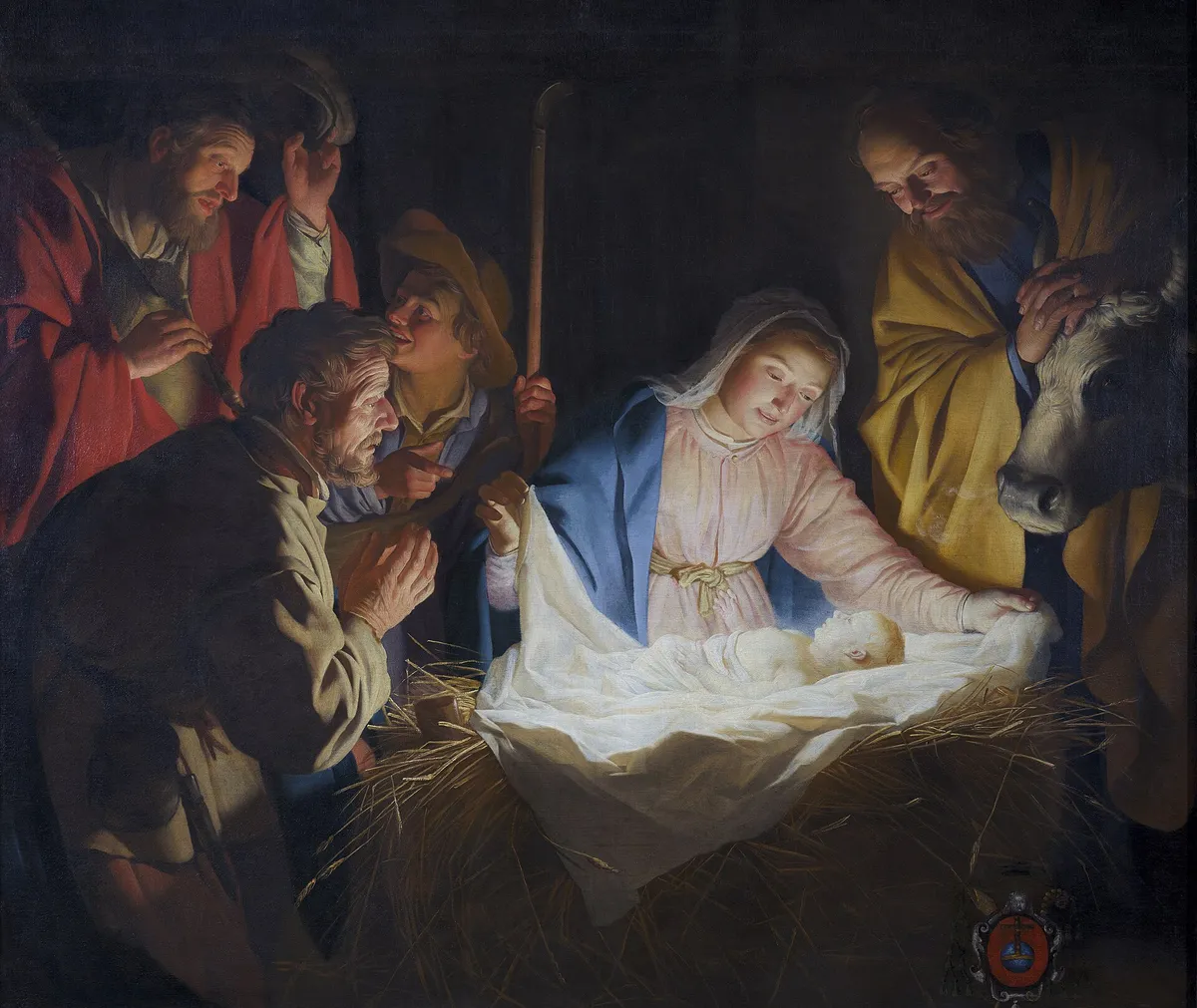
The Virgin lifts the white cloth as if opening a window, and the glow spreads upward over her face, then over the old shepherds, the smiling boy behind them and Joseph in his yellow cloak. It is one of the most loved Christmas images ever painted, still printed every year on cards. Another of Honthorst’s versions, in the Uffizi in Florence, was badly damaged by the bomb that struck the museum in 1993, which makes this one all the more precious.
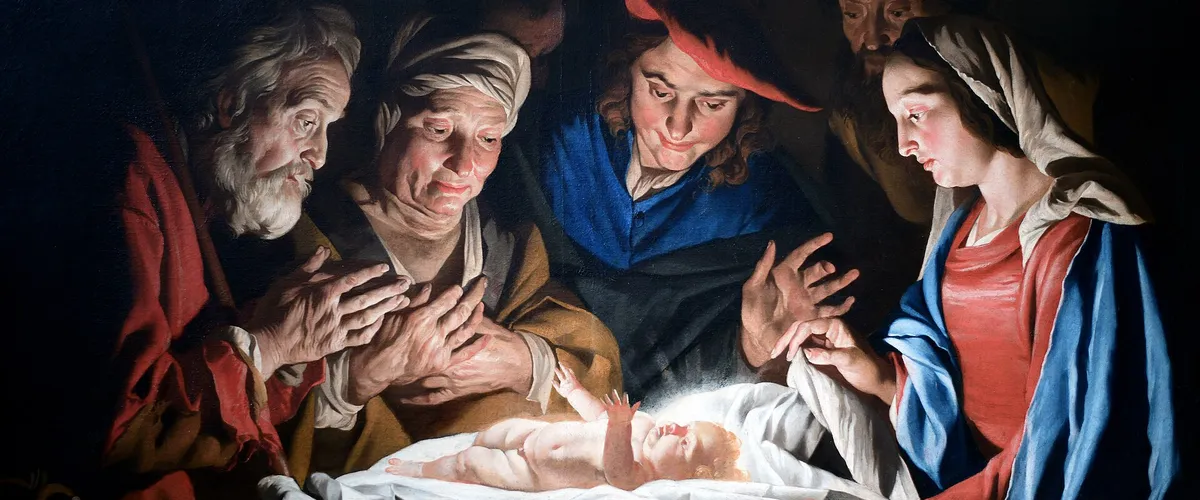
7. The Adoration of the Shepherds by Matthias Stom (second quarter of the 17th century)
Matthias Stom, born in the Low Countries and possibly a pupil of Honthorst, worked in Rome, Naples and Sicily, and painted the Adoration of the Shepherds at least eight times. This version in the Palazzo Madama in Turin is among the finest. Stom pulls the figures close to us, almost cheek to cheek, so that the picture becomes a ring of faces around a cradle.
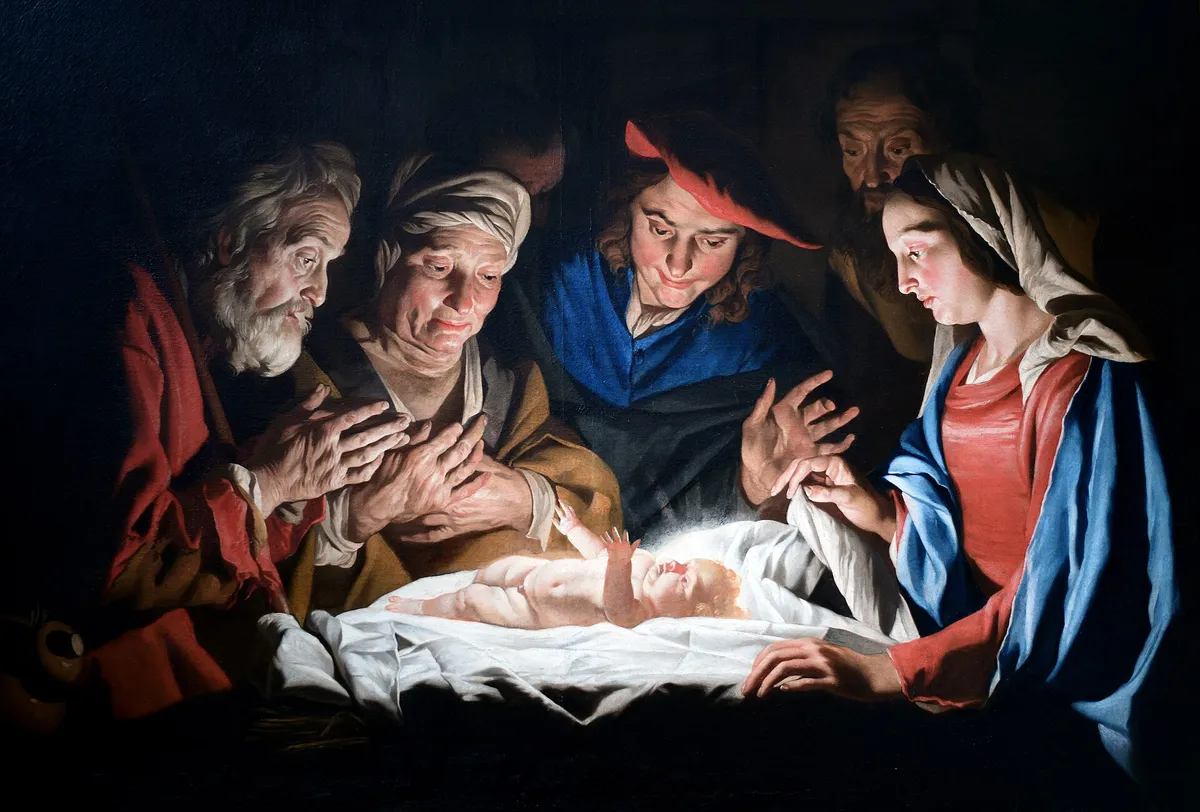
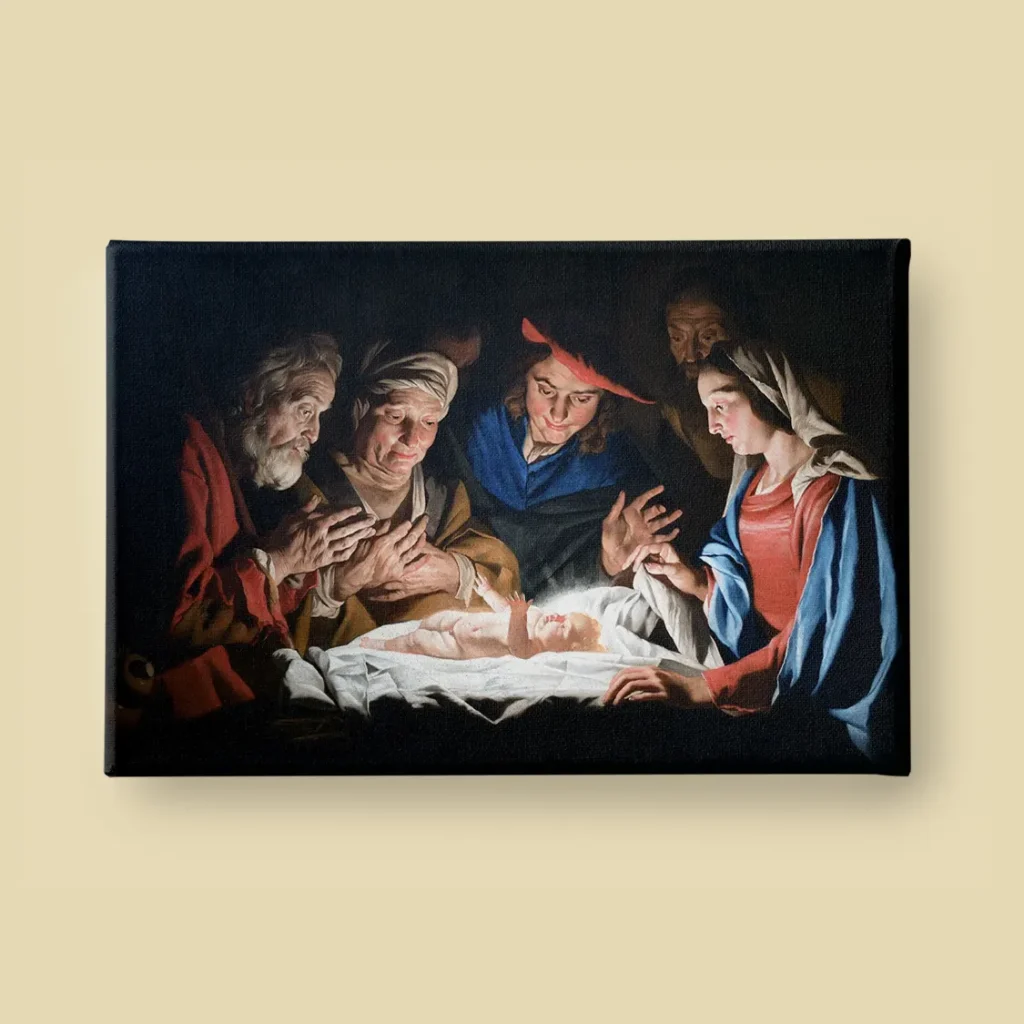
The light from the Child strikes from below and carves every wrinkle of the old man and the old woman on the left, their hands joined over the manger. A young shepherd in a red cap raises his hand in wonder, and the Virgin lifts the linen with a gesture of quiet pride. Stom has no interest in landscape or angels. Everything he wants to say is in those lit faces.
8. The Adoration of the Shepherds by Georges de La Tour (c. 1644)
Georges de La Tour worked in Lorraine and was almost completely forgotten for nearly three centuries before scholars rediscovered him in the twentieth century. His Adoration of the Shepherds, acquired by the Musee du Louvre in 1926, is a picture of absolute stillness. Joseph shields a single candle with his hand. The Virgin, in a deep red dress, joins her hands in prayer. A young woman brings a bowl, a shepherd leans on his staff, and a lamb stretches its head toward the straw.
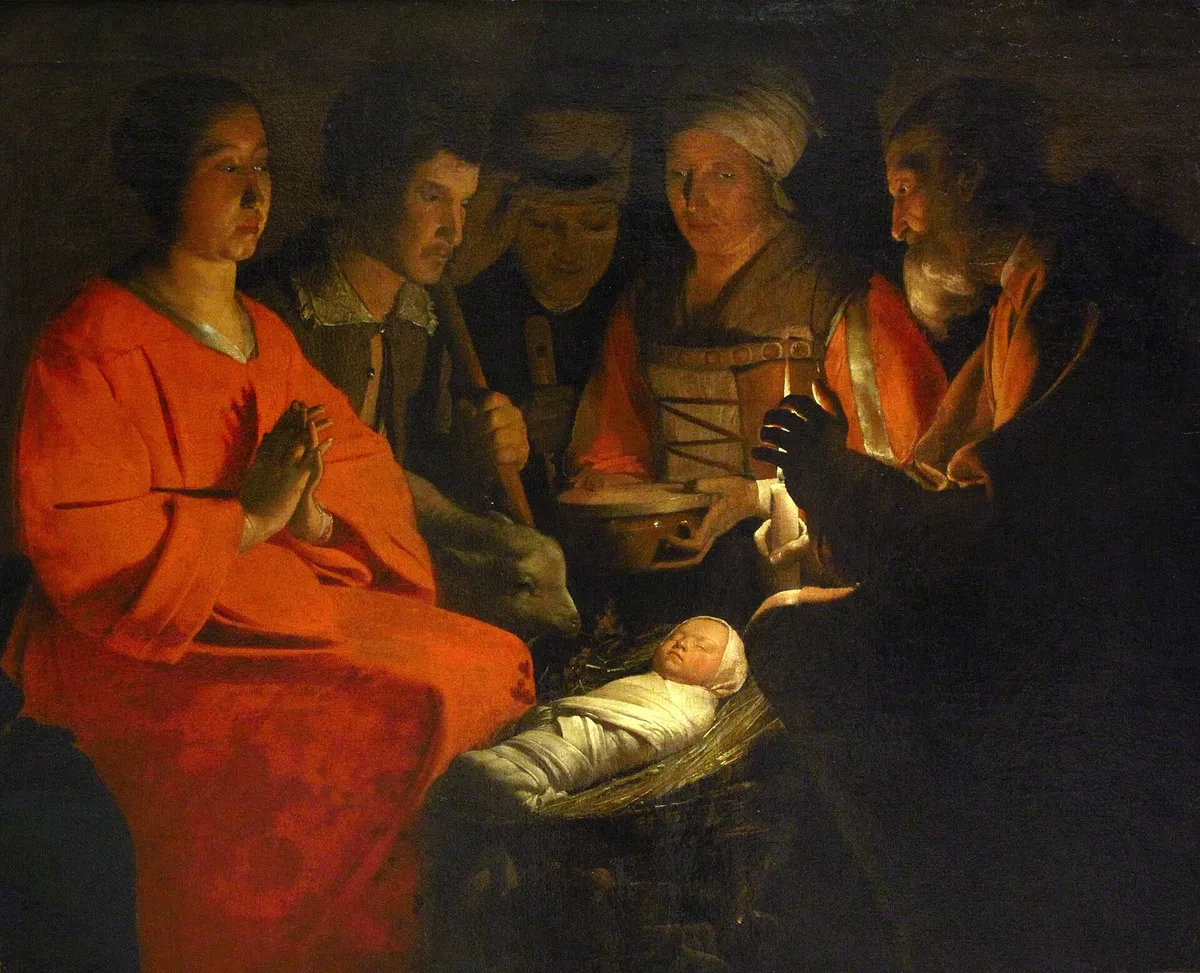
The Child sleeps in a wicker basket, tightly bound in white bands. Many viewers see in them the linen of the tomb, as if the end of the story were already present at its beginning, and the lamb beside him points the same way. As in his Magdalen with the Smoking Flame, La Tour lets one small flame hold the whole meaning of the scene.
9. The Adoration of the Shepherds by Rembrandt (1646)
In 1646 the stadtholder Frederick Henry, Prince of Orange, asked Rembrandt for two more pictures to complete the series of the Passion he had painted for him years before: an Adoration of the Shepherds and a Circumcision. The Adoration survives in the Alte Pinakothek in Munich. Rembrandt sets it in a vast Dutch barn, so dark that the beams of the roof only gradually emerge.
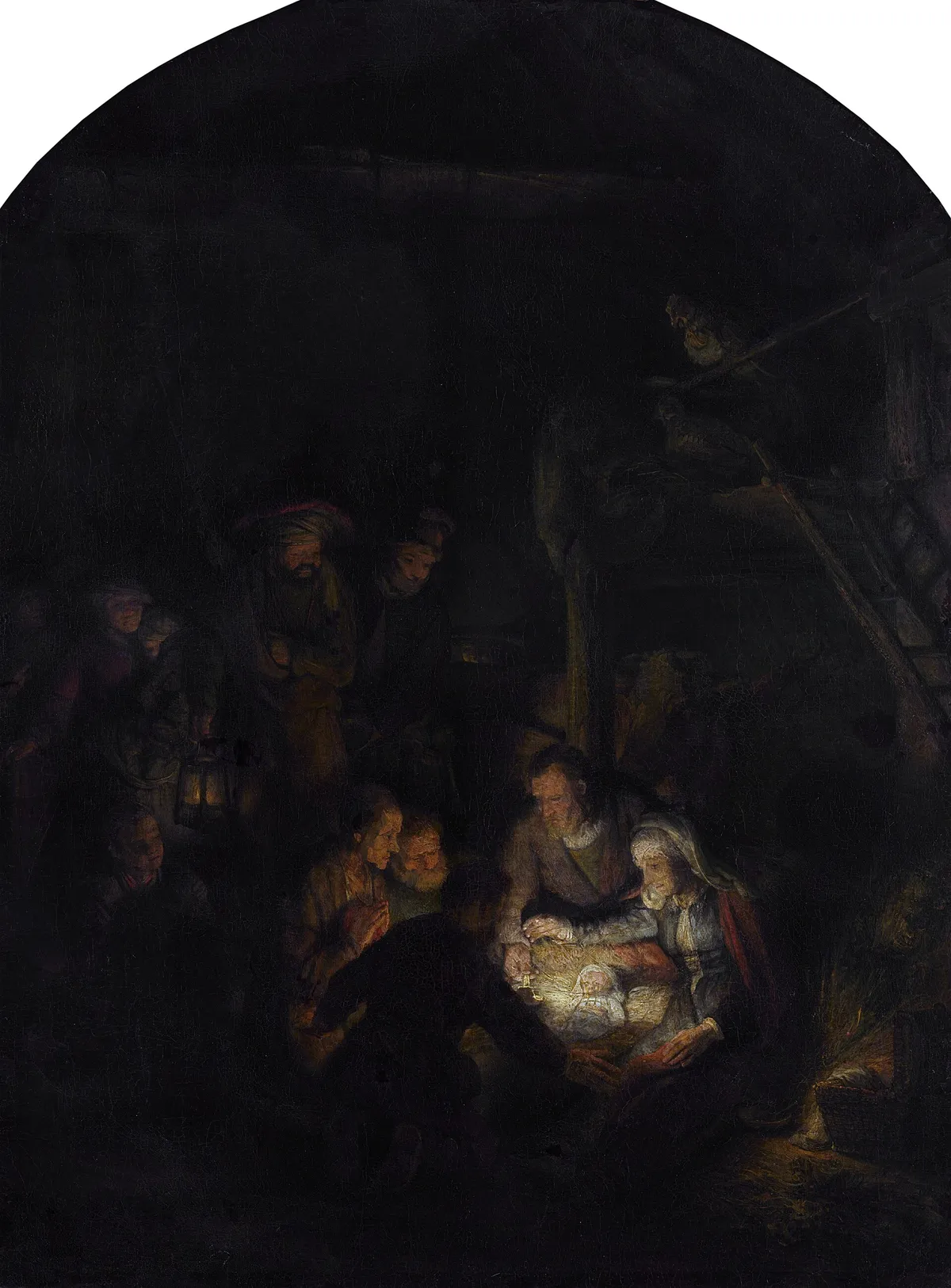
On the left a shepherd holds up a lantern, but the stronger light comes from the manger, where Mary and Joseph watch over the Child. The shepherds are small figures crowding in from the shadows, kneeling and peering like neighbours woken in the night. Few painters understood darkness as well as Rembrandt, and here it is not a threat but a shelter, the night in which God came quietly into the world, as in his tender Return of the Prodigal Son.
10. The Adoration of the Shepherds by Bartolome Esteban Murillo (c. 1650)
We end in Seville with the young Bartolome Esteban Murillo, before the soft, golden style of his later years and his famous Immaculate Conception. This large canvas in the Museo del Prado is still full of shadow and of earth. The Virgin uncovers the Child on a wooden manger, Joseph stands behind her, and the shepherds have brought what they own: a lamb, and a pair of hens laid on the floor.
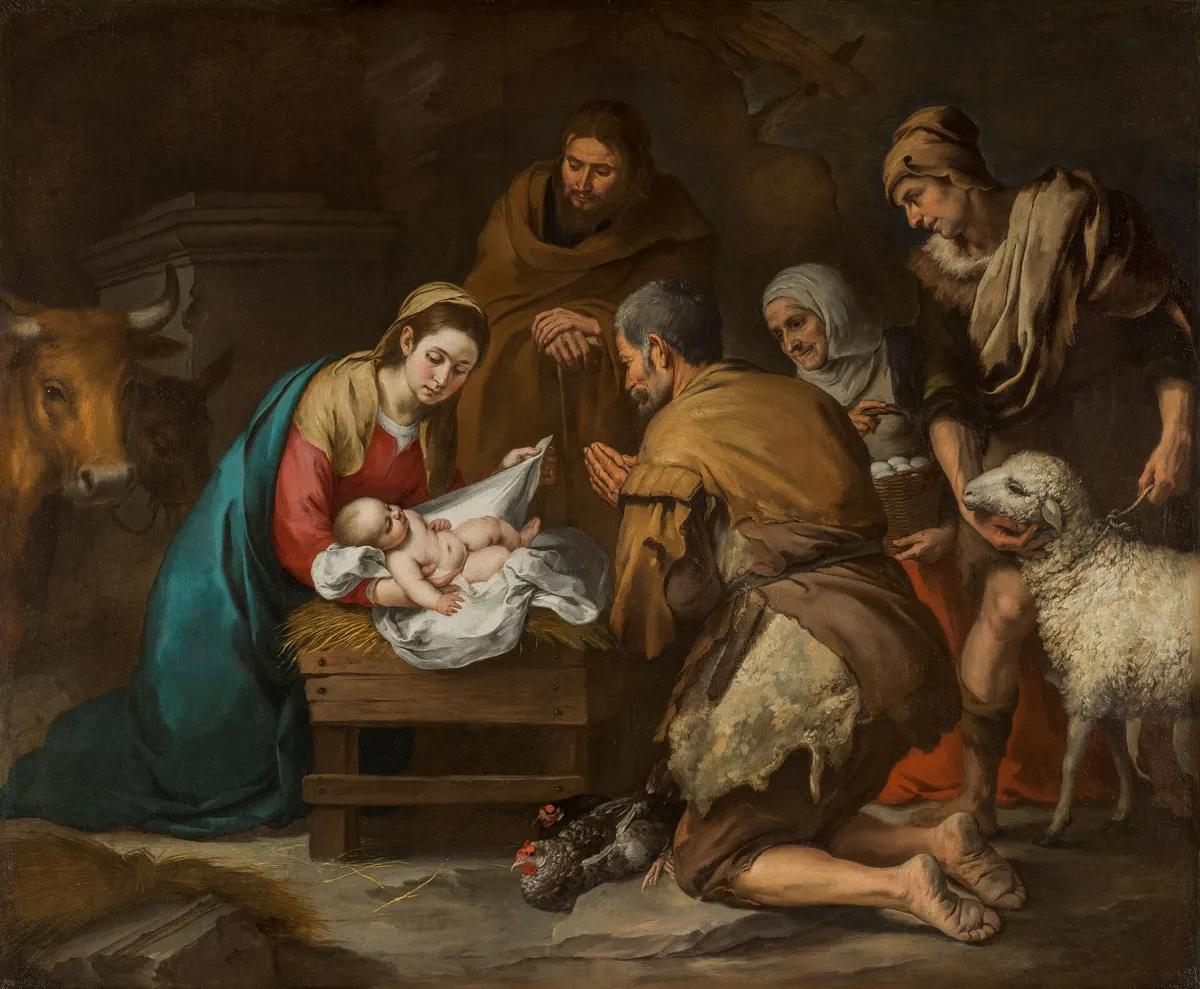
In the foreground a shepherd kneels in profile, his hands joined, wrapped in a sheepskin, and Murillo paints the soles of his bare feet, cracked and dusty from the road. It is a detail no court painter would have allowed, and it says everything about this scene. The first people to adore Christ came straight from their work, and the lamb they offered already announced the Lamb of God.
Summary of the 10 Adoration of the Shepherds Paintings
| # | Painting | Artist | Date | Museum | Light |
|---|---|---|---|---|---|
| 1 | The Adoration of the Shepherds | Andrea Mantegna | Shortly after 1450 | The Metropolitan Museum of Art, New York | Daylight |
| 2 | The Adoration of the Shepherds (Allendale Nativity) | Giorgione | 1505 to 1510 | National Gallery of Art, Washington | Open landscape |
| 3 | The Adoration of the Shepherds | Jacopo Bassano | 16th century | Galleria Borghese, Rome | Daylight on wool and straw |
| 4 | The Adoration of the Shepherds | El Greco | 1612 to 1614 | Museo del Prado, Madrid | Rising from the Child |
| 5 | Adoration of the Shepherds | Caravaggio | 1609 | Museo Regionale, Messina | A single raking light |
| 6 | Adoration of the Shepherds | Gerard van Honthorst | 1622 | Wallraf-Richartz-Museum, Cologne | The Child alone |
| 7 | The Adoration of the Shepherds | Matthias Stom | Second quarter of the 17th century | Palazzo Madama, Turin | The Child alone |
| 8 | The Adoration of the Shepherds | Georges de La Tour | c. 1644 | Musee du Louvre, Paris | One candle |
| 9 | The Adoration of the Shepherds | Rembrandt | 1646 | Alte Pinakothek, Munich | Lantern and manger |
| 10 | The Adoration of the Shepherds | Bartolome Esteban Murillo | c. 1650 | Museo del Prado, Madrid | Shadow and earth |
Conclusion: The First Witnesses of Christmas
The shepherds of Bethlehem had no gifts of gold and no learning, and that is exactly why painters returned to them so often. Through them the Gospel says that the good news was given first to the poor and the watchful. Across these ten paintings the light makes the same journey as the shepherds themselves: it leaves the open sky of Mantegna and Giorgione, enters the dark stable with El Greco and Caravaggio, and finally shines from the Child alone in Honthorst, Stom and La Tour.
The scene also links Christmas to the rest of Christ’s story. The same Child would later call himself the Good Shepherd, an image you can follow in our Good Shepherd paintings. The Northern tradition behind many of these works began with the great Portinari Altarpiece of Hugo van der Goes, whose rough shepherds astonished Florence in 1483 and inspired Domenico Ghirlandaio. In the eighteenth century Sebastiano Conca gave the subject a last Baroque glow, now available as a canvas reproduction in our shop.
For families preparing for Christmas, our free Nativity coloring pages are drawn from great paintings of the same night, and the Saint Andrew Christmas Novena offers a simple prayer to say every day of Advent.
Important Facts About the Adoration of the Shepherds
- The scene comes from the Gospel of Luke (2:8-20). Matthew tells the visit of the Magi instead, and only Luke mentions the shepherds.
- The Adoration of the Shepherds became an independent subject in Western painting in the fifteenth century. Before that the shepherds usually appeared in the background of the Nativity.
- The arrival of the Portinari Altarpiece by Hugo van der Goes in Florence in 1483 helped make the subject popular in Italy.
- El Greco’s Adoration of the Shepherds in the Prado was painted for his own burial chapel in Toledo and is considered his last work.
- Gerard van Honthorst was called Gherardo delle Notti in Italy for his night scenes, and in his Cologne Adoration the Christ Child is the only source of light.
- Caravaggio painted his Adoration of the Shepherds in Messina in 1609, after escaping from prison in Malta.
Questions and Answers
What is the meaning of the Adoration of the Shepherds?
The Adoration of the Shepherds shows the first people to worship the newborn Christ. In Luke’s Gospel an angel announces the birth to poor shepherds watching their flocks near Bethlehem, and they hurry to find the Child in a manger. The scene means that the good news was given first to the humble and the watchful. Painters also saw in the shepherds a link to Christ the Good Shepherd, and in the lambs they bring a sign of the Lamb of God who would give his life.
Where is the Adoration of the Shepherds in the Bible?
The story is told in the Gospel of Luke, chapter 2, verses 8 to 20. Shepherds keeping watch by night near Bethlehem see an angel, hear the announcement of the birth of the Saviour, and a multitude of angels sings “Glory to God in the highest.” They go with haste, find Mary, Joseph and the Child lying in a manger, and return glorifying and praising God. Matthew’s Gospel does not mention the shepherds and tells the visit of the Magi instead.
Who painted the Adoration of the Shepherds?
Many great artists painted it. Famous versions include Andrea Mantegna’s at the Metropolitan Museum of Art, Giorgione’s Allendale Nativity at the National Gallery of Art in Washington, El Greco’s last work at the Prado, Caravaggio’s 1609 altarpiece in Messina, Gerard van Honthorst’s candle-less night scene in Cologne, Georges de La Tour’s at the Louvre, Rembrandt’s 1646 version in Munich and Murillo’s at the Prado. Hugo van der Goes, Ghirlandaio, Correggio, Guido Reni and Poussin also painted celebrated versions.
Where is Caravaggio’s Adoration of the Shepherds?
Caravaggio’s Adoration of the Shepherds is in the Museo Regionale in Messina, Sicily. He painted it in 1609 for the church of the Capuchin friars in the city, commissioned by the Senate of Messina, shortly after escaping from prison in Malta. It is a large altarpiece, more than three metres high, showing the exhausted Virgin lying on the straw of a bare wooden stable with the Child, surrounded by Joseph and three shepherds.
What is the difference between the Adoration of the Shepherds and the Adoration of the Magi?
The shepherds come from Luke’s Gospel and arrive on the night of the birth, poor men guided by an angel. The Magi come from Matthew’s Gospel, arrive later from the East guided by a star, and bring gold, frankincense and myrrh. In painting, the shepherds usually bring simple gifts such as a lamb, eggs or hens and kneel in a dark stable, while the Magi appear in rich clothes with a large retinue. Together they show that Christ came for the poor of Israel and for the nations.
Can you buy Adoration of the Shepherds paintings as canvas prints?
You can buy Adoration of the Shepherds paintings at jesuschrist.pictures, in our shop, where the versions by Giorgione, Matthias Stom and Sebastiano Conca are offered as high quality canvas reproductions. They make a fitting image for a home at Christmas, a prayer corner or a parish hall. Browse our collection of Nativity and Christian art reproductions on canvas to find other masterpieces of the birth of Christ for your own walls.