Beautiful Sebastiano Conca Paintings from Baroque Rome
Sebastiano Conca is one of the most prolific religious painters of the Italian late Baroque and the Rococo transition. The Sebastiano Conca paintings that survive today fill the great churches of Rome, Naples, and Turin with a luminous, slightly sweet, deeply Catholic visual language that defined the official Roman religious painting of the early eighteenth century. He was the favourite painter of Pope Clement XI, the prince of the Accademia di San Luca, and the most reproduced sacred image-maker of his generation across Catholic Europe.
This article gathers ten of his most important religious works, the panels and altarpieces that show the full range of his Roman late Baroque production.

From Gaeta to Rome
Sebastiano Conca was born on 8 January 1680 in Gaeta, a small port city in the Kingdom of Naples, the son of a craftsman of modest background. He trained first in Naples in the workshop of Francesco Solimena, the leading Neapolitan late Baroque master, where he absorbed the lessons of Luca Giordano and the great Neapolitan tradition. In 1707 he moved to Rome, where he settled for almost the whole of his career, becoming the favourite painter of Pope Clement XI and the head of the Accademia di San Luca in 1729.
His Roman workshop produced an enormous body of religious paintings, altarpieces, and frescoes for churches and chapels across Catholic Europe. He returned briefly to Naples in 1751 and worked there until 1762 before going back to Gaeta, where he died on 1 September 1764. His manner shaped the official Roman religious painting of the early eighteenth century and prepared the visual transition from the late Baroque to the early Neoclassicism of the second half of the century.
Christ in the Garden of Gethsemane
The Gospel scene from Matthew 26 shows Christ kneeling in prayer on the Mount of Olives while the three apostles Peter, James, and John lie asleep below. An angel descends from above with the chalice of the Passion. Conca paints the scene with the dramatic Baroque vertical of his Roman manner, with the figure of Christ caught in a beam of supernatural light.

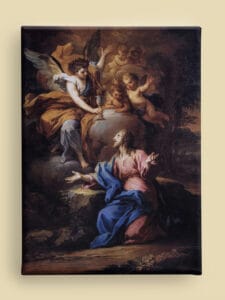
The painting is in a private collection. For a wider survey, see our article on Agony in the Garden paintings.
The Adoration of the Shepherds
Painted around 1720 to 1730, this great altarpiece shows the Virgin and Saint Joseph kneeling before the newborn Christ child in the Bethlehem stable while the shepherds gather around to adore. Conca paints the scene with the warm Baroque light of his mature Roman manner, with the angels descending from above in a flood of golden glory and the colour dominated by the rich pinks and golds of the rococo Italian style.

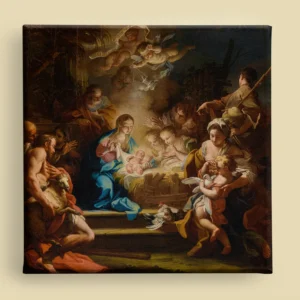
The painting is at the J. Paul Getty Museum in Los Angeles.
The Annunciation
This great altarpiece shows the Virgin kneeling at her prayer desk while the angel Gabriel descends from above with the lily of her purity. Conca paints the moment with the calm classical balance of his Roman manner, with the dove of the Holy Spirit descending in a beam of golden light and the colour dominated by deep blue and silver.

The painting is at the High Museum of Art in Atlanta.
The Deposition
The body of Christ is taken down from the cross by Joseph of Arimathea and Nicodemus while the Virgin and the holy women weep at the foot. Conca paints the scene with the warm Baroque light of his Roman manner, with the body of Christ as the bright centre of the composition against the surrounding dark.

The painting is at the Pinacoteca Vaticana.
The Immaculate Conception
The Virgin Mary stands on the crescent moon with her hands folded across her chest, her white robe and blue mantle billowing in the wind of paradise. A flight of angels surrounds her with the lilies and palms of her iconography, and the serpent of original sin lies defeated at her feet. Conca paints the figure with the calm Baroque grace of his Roman manner.

The painting is in a Portuguese church collection.
The Holy Family with Saint Anne, the Baptist and Zacharias
This great altarpiece shows the holy family together with Saint Anne, the mother of the Virgin, and the young John the Baptist with his father Zacharias. Conca paints the scene with the warm domestic intimacy of his Roman late Baroque, with the figures arranged in a calm classical composition.

The painting is at the Dulwich Picture Gallery in London.
The Holy Family with the Infant Saint John the Baptist
This smaller variant shows the Virgin and Christ child with Saint Joseph and the young John the Baptist offering a small bird or fruit to his cousin. Conca paints the composition with the warm Italian Rococo sweetness of his late Roman manner.

The painting is in a private collection.
The Madonna Appearing to Saint Philip Neri
The sixteenth century Roman saint Philip Neri, the founder of the Oratorians, kneels in his cell while the Virgin Mary appears to him in a halo of light, holding the Christ child. Conca paints the scene with the dramatic Baroque vertical of his Roman manner, with the saint at the foreground while the apparition descends from above.

The painting is at the Indianapolis Museum of Art at Newfields.
Madonna and Child with Saint John Nepomucen
The Virgin and Christ child appear in glory above the kneeling figure of Saint John Nepomucen, the fourteenth century Bohemian martyr of the seal of confession. Conca paints the moment with the calm Roman late Baroque balance, with the apparition descending in a halo of golden light.

The painting is at the Galleria Borghese in Rome.
The Miracle of Saint Turibio, Archbishop of Lima
The seventeenth century Spanish archbishop of Lima, Saint Toribio de Mogrovejo, is shown performing one of his miracles among the indigenous peoples of the Andes. Conca paints the moment with the great horizontal classical composition that he reserved for his most ambitious public altarpieces.

The painting is at the Vatican Museums in Rome.
For more context on Conca’s Italian late Baroque world, see our articles on the great Roman Baroque tradition through Caravaggio and on the wider Italian Italian Baroque Jesus paintings tradition.
Summary Table of Sebastiano Conca’s Religious Paintings
| Name | Artist | Date | Medium | Museum |
|---|---|---|---|---|
| Christ in the Garden of Gethsemane | Sebastiano Conca | c. 1746 | Oil on canvas | Private collection |
| The Adoration of the Shepherds | Sebastiano Conca | c. 1720 to 1730 | Oil on canvas | J. Paul Getty Museum, Los Angeles |
| The Annunciation | Sebastiano Conca | c. 1740 | Oil on canvas | High Museum of Art, Atlanta |
| The Deposition | Sebastiano Conca | c. 1730 | Oil on canvas | Pinacoteca Vaticana |
| The Immaculate Conception | Sebastiano Conca | c. 1740 | Oil on canvas | Portugal, church collection |
| The Holy Family with Saint Anne, the Baptist and Zacharias | Sebastiano Conca | c. 1735 | Oil on canvas | Dulwich Picture Gallery, London |
| The Holy Family with the Infant Saint John the Baptist | Sebastiano Conca | c. 1730 | Oil on canvas | Private collection |
| The Madonna Appearing to Saint Philip Neri | Sebastiano Conca | c. 1740 | Oil on canvas | Indianapolis Museum of Art at Newfields |
| Madonna and Child with Saint John Nepomucen | Sebastiano Conca | c. 1730 | Oil on canvas | Galleria Borghese, Rome |
| The Miracle of Saint Turibio, Archbishop of Lima | Sebastiano Conca | c. 1726 | Oil on canvas | Vatican Museums, Rome |
Conclusion
Conca is the great voice of the Italian late Baroque and Rococo religious painting. His Roman workshop produced an enormous body of religious altarpieces for churches across Catholic Europe, and his manner shaped the official Roman religious painting of the early eighteenth century. He worked at the moment when the great late Baroque was beginning to give way to the early Neoclassical, and his late altarpieces sit at the crossroads of two artistic worlds, retaining the warm Italian sweetness of the Baroque while preparing the calm classical compositions of the next generation.
Important Facts About Sebastiano Conca
- Sebastiano Conca was born on 8 January 1680 in Gaeta, a small port city in the Kingdom of Naples, the son of a craftsman of modest background.
- He trained first in Naples in the workshop of Francesco Solimena, the leading Neapolitan late Baroque master, before moving to Rome in 1707 where he settled for most of his career.
- Conca is one of the central figures of the Italian late Baroque and the Rococo transition, and is celebrated as the favourite painter of Pope Clement XI and the prince of the Accademia di San Luca in 1729.
- His most famous religious works are the great altarpieces of Roman churches, including the Pinacoteca Vaticana Deposition, the Vatican Saint Turibio, and the great frescoes of the Pisa Cathedral and the Santa Cecilia in Trastevere.
- He died on 1 September 1764 in his native Gaeta, having shaped the official Roman religious painting of the early eighteenth century for more than fifty years.
Questions and Answers About Sebastiano Conca Paintings
What is Sebastiano Conca’s most famous painting?
Among his religious works, the great frescoes of the apse of Santa Cecilia in Trastevere in Rome, painted in 1727, are the most often singled out. Among the easel paintings, the Adoration of the Shepherds at the Getty Museum and the Madonna and Child with Saint John Nepomucen at the Galleria Borghese are widely studied.
Where can I see Sebastiano Conca paintings today?
The Vatican Museums and the Galleria Borghese in Rome hold significant works. The J. Paul Getty Museum, the Dulwich Picture Gallery in London, the High Museum of Art in Atlanta, and the Indianapolis Museum of Art at Newfields all hold important religious paintings. Many Roman churches, including Santa Cecilia in Trastevere and the Pisa Cathedral, still preserve his original frescoes and altarpieces.
What style is Sebastiano Conca associated with?
Conca is one of the central figures of the Italian late Baroque and the Rococo transition. His mature style fuses the warm Neapolitan tradition of his Solimena training with the calm Roman classical composition and the sweet rococo colour of the early eighteenth century. He prepared the visual transition from the great late Baroque to the early Neoclassicism of the second half of the century.
Did Conca work for the popes?
Yes, he was the favourite painter of Pope Clement XI from his arrival in Rome in 1707, and he continued to work for the papal court under Innocent XIII, Benedict XIII, Clement XII, and Benedict XIV. His great frescoes of Santa Cecilia in Trastevere were commissioned by Cardinal Francesco Acquaviva d’Aragona, the patron of the Spanish national church in Rome.
How does Conca compare with Pompeo Batoni?
The two painters were the two most important religious painters of eighteenth century Rome, with Conca representing the older generation of late Baroque masters and Batoni the slightly younger Neoclassical-leaning manner. Conca trained Batoni briefly in his Roman workshop, and the older master’s warm Roman late Baroque manner shaped the younger painter’s early style before Batoni moved toward a more classical idiom in the 1750s and 1760s.
Did Conca train many pupils?
Yes, his Roman workshop was one of the largest in eighteenth century Italy. He trained Pompeo Batoni, Corrado Giaquinto, Stefano Pozzi, Gaetano Lapis, and many other important religious painters of the Italian eighteenth century. As prince of the Accademia di San Luca from 1729 onward, he also shaped the official Roman artistic teaching of his generation.
Where can I buy Sebastiano Conca paintings reproductions?
You can buy them at jesuschrist.pictures, in our shop: see all the Sebastiano Conca canvas prints, ready to hang, in several sizes.


