The Tender Paintings of Bartolomé Esteban Murillo
If Velázquez gave Spain its grandeur and Zurbarán its ascetic stillness, Bartolomé Esteban Murillo gave it its tenderness. The Bartolomé Esteban Murillo paintings that fill the Prado today are luminous, gentle, and full of an intimacy with the holy that no other seventeenth century Spaniard quite reached. He is the painter of the Immaculate Conception above all, but he is also the painter of the Christ child at play, of the Madonna with her napkin, and of the small, miraculous moments of Catholic devotion. Few artists have spoken so directly to the heart of the faithful.
This article presents twelve of his most beloved religious panels, the ones that made Seville the European capital of Marian painting in the late seventeenth century.

The Boy from Seville Who Painted the Heavens
Murillo was born in Seville in late December 1617 and baptised on 1 January 1618, the fourteenth and last child of a barber-surgeon. Orphaned at the age of nine, he was raised by his elder sister and her husband, a successful surgeon, and trained from his early teens with the painter Juan del Castillo, a distant relative. He never made the great Italian voyage of his contemporaries; his whole career unfolded in Seville, with brief visits to Madrid where he met Velázquez and studied the royal collection.
His first major commission was a cycle of paintings for the Franciscan monastery of San Francisco in Seville in 1645, a series so successful that it made him almost overnight the favourite religious painter of the city. He went on to fill the convents, the cathedral, and the great hospital churches of Seville with images of saints, Madonnas, and the mysteries of the Passion.
The Immaculate Conception of Los Venerables
This is the most famous of Murillo’s many Immaculate Conceptions. Painted around 1678 for the hospital chapel of Los Venerables Sacerdotes in Seville, it shows the Virgin standing on a crescent moon, her hands folded across her chest, her white robe and blue mantle billowing in the wind of paradise. A flight of cherubs surrounds her, bearing the lilies and palms of her iconography.

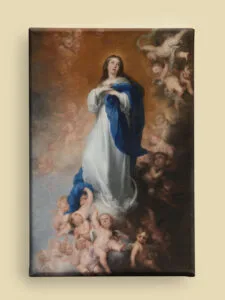
The painting was taken to France by Marshal Soult in 1813 and sold in Paris in 1852 to Napoleon III for what was then the highest price ever paid for a painting. It was returned to Spain in 1941 and now hangs at the Museo del Prado in Madrid.
The Holy Family with a Little Bird
One of the most tender domestic images of Spanish Baroque painting, this small panel shows the Christ child playing with a little bird in his hand while Saint Joseph watches with a smile. The Virgin sits at her spinning, looking up from her work. The light is soft, the colour warm, and there is nothing of the theological apparatus of an altarpiece. Everything depends on a child’s play and a father’s affection.

The painting is at the Museo del Prado, originally from the royal collection.
The Madonna of the Napkin
Painted around 1665 for the refectory of the Capuchin friary in Cádiz, this little half-length Virgin and Child was traditionally said to have been improvised by Murillo on a folded table napkin offered to him by the cook of the friary. The composition is built into a feigned oval, and the Virgin presents her infant son with both arms, looking directly at the viewer. Christ blesses with his little right hand. The colour is rich and warm, with deep red and gold tones.

The picture is now at the Museo de Bellas Artes in Seville, one of the great collections of the painter’s home city.
Virgin and Child with a Rosary
The Virgin sits in a calm landscape holding her son, who in turn holds a fine string of rosary beads. The image was meant for private devotion in a household where the rosary was prayed every day. Murillo gives the Virgin the gentle dark eyes of a Sevillian peasant girl, and the child has the unmistakable Murillo sweetness that became almost a brand in the eighteenth century.

The work is held by the Museo del Prado, originally hanging in the Royal Palace of Madrid.
The Apparition of the Virgin to Saint Bernard
The same Cistercian legend that Cano had treated in his Vision of Saint Bernard appears again here, but with a softer touch. Bernard kneels at his writing desk, the Virgin floating before him with the Christ child in her arms. Around her a host of small angels carry attributes of the abbatial office. Murillo paints the miracle as a moment of pastoral sweetness rather than wonder, and the Cistercian habit of Bernard glows white in the surrounding gold.

The painting is at the Museo del Prado, originally from the Royal Palace of Madrid.
The Vision of Saint Anthony of Padua
This great altarpiece, painted in 1656 for the chapel of Saint Anthony in Seville Cathedral, shows the Franciscan saint at the moment when the Christ child appeared to him in his cell. Saint Anthony kneels at his desk in awe while Christ descends in a flood of golden light, surrounded by a cloud of cherubs. The work was so highly regarded that when, in 1874, a thief cut Saint Anthony out of the canvas and tried to sell him in New York, the figure was eventually returned to Seville and restored to its place.

The painting still hangs in its original chapel at Seville Cathedral.
Christ Healing the Paralytic at the Pool of Bethesda
One of six large canvases Murillo painted between 1667 and 1670 for the church of the Hospital de la Caridad in Seville, this scene shows the moment from John’s Gospel when Christ heals the man who had lain by the pool for thirty-eight years. The composition is staged like a classical play, with strong horizontal architecture and figures arranged in calm clusters. Murillo had been one of the founders of the Hospital of Charity, and his images for it remain one of the most coherent statements of Catholic charity in Western art.

The painting was acquired by the National Gallery in London in 1837 and is one of its most studied seventeenth century Spanish works.
The Baptism of Christ
Painted in 1655 for the parish church of Santa María la Blanca in Seville, this serene scene of John baptising Christ in the Jordan was admired by every nineteenth century critic who passed through the city. The figures are simple and monumental, the light is silvery, and the dove of the Holy Spirit descends in a quiet halo above them. Murillo has stripped the scene of all theatrical excess. For a wider survey of the subject, see our article on famous Baptism of Christ paintings.


The painting is now at the Gemäldegalerie in Berlin.
The Martyrdom of Saint Andrew
The first apostle to be called by Christ was crucified on the X-shaped cross that bears his name. Murillo paints him at the moment of binding, his arms already roped to the wood, his face turned upward in calm prayer. Two angels descend with the crown of martyrdom. Despite the violence of the subject, the composition has the gentle balance and warm tonality of all Murillo’s mature work.

The painting is at the Museo del Prado, originally from the Royal Palace of Aranjuez.
The Conversion of Saint Paul
Saul of Tarsus lies thrown from his horse on the road to Damascus, the great Caravaggesque subject of the Italian Baroque. Murillo handles it with a Spanish quietness. The horse rears, the soldiers shield their eyes from the divine light, and Paul lies on the ground, already converted before he has risen. The strong diagonal of the composition recalls the great Conversion of Caravaggio in the Cerasi Chapel, but the tonality is unmistakably Sevillian.

The work is at the Museo del Prado, having come from the Royal Palace of Aranjuez.
Christ Crucified
Murillo painted the Crucifixion several times over his career, and this version, with Christ alone on a darkened sky, is one of his most concentrated. The body of Christ is bathed in a warm interior light against the dark ground. No Virgin, no John, no soldiers, no horizon. Only the saviour and the wood. The painting was designed for private meditation rather than public altar.

The painting is at the Museo del Prado, originally from the Royal Palace of Madrid.
Christ on the Cross
This second Crucifixion is more ample in setting. Christ hangs on the cross while light pours through the storm clouds above him. Murillo paints the body with the soft modelling and the warm tonality that distinguishes him from the harsher Crucifixions of Zurbarán and Ribera. The image is meant to invite contemplation, not horror.

The painting is in the Timken Museum of Art in San Diego.
For more context on Murillo’s Spanish contemporaries, see our articles on Francisco de Zurbarán, Jusepe de Ribera, and the towering Diego Velázquez. The broader tradition of Baroque Jesus paintings holds Murillo as its most tender voice.
Summary Table of Bartolomé Esteban Murillo’s Religious Paintings
| Name | Artist | Date | Medium | Museum |
|---|---|---|---|---|
| The Immaculate Conception of Los Venerables | Bartolomé Esteban Murillo | c. 1678 | Oil on canvas | Museo del Prado, Madrid |
| The Holy Family with a Little Bird | Bartolomé Esteban Murillo | c. 1650 | Oil on canvas | Museo del Prado, Madrid |
| The Madonna of the Napkin | Bartolomé Esteban Murillo | c. 1665 | Oil on canvas | Museo de Bellas Artes, Seville |
| Virgin and Child with a Rosary | Bartolomé Esteban Murillo | c. 1655 | Oil on canvas | Museo del Prado, Madrid |
| The Apparition of the Virgin to Saint Bernard | Bartolomé Esteban Murillo | c. 1660 | Oil on canvas | Museo del Prado, Madrid |
| The Vision of Saint Anthony of Padua | Bartolomé Esteban Murillo | 1656 | Oil on canvas | Seville Cathedral |
| Christ Healing the Paralytic at the Pool of Bethesda | Bartolomé Esteban Murillo | 1667 to 1670 | Oil on canvas | National Gallery, London |
| The Baptism of Christ | Bartolomé Esteban Murillo | 1655 | Oil on canvas | Gemäldegalerie, Berlin |
| The Martyrdom of Saint Andrew | Bartolomé Esteban Murillo | c. 1675 | Oil on canvas | Museo del Prado, Madrid |
| The Conversion of Saint Paul | Bartolomé Esteban Murillo | c. 1675 | Oil on canvas | Museo del Prado, Madrid |
| Christ Crucified | Bartolomé Esteban Murillo | c. 1670 | Oil on canvas | Museo del Prado, Madrid |
| Christ on the Cross | Bartolomé Esteban Murillo | c. 1670 | Oil on canvas | Timken Museum of Art, San Diego |
Conclusion
Murillo’s religious painting is the warm heart of the Spanish Baroque. He painted the Virgin as a young mother of his own city, the Christ child as a boy at play, the apostles and martyrs as men whose faith was tested in flesh. His soft modelling, his warm honey light, and his deep tenderness for the figures he painted shaped Catholic devotional imagination across Europe and the Americas for the next two centuries. Look at any holy card printed in Seville or Mexico City after 1700 and you are almost certainly looking at Murillo’s afterglow.
Important Facts About Bartolomé Esteban Murillo
- Bartolomé Esteban Murillo was baptised on 1 January 1618 in Seville, the youngest of fourteen children of Gaspar Esteban, a barber-surgeon, and María Pérez Murillo, from whose family he took the surname by which he is known.
- He trained from about 1633 in the workshop of the painter Juan del Castillo, a distant family relation, and learned the basics of the Sevillian school before establishing his own independent studio in the early 1640s.
- Murillo is one of the central figures of the Spanish Baroque and is celebrated above all for his Marian paintings, his tender Madonnas, his Christ children, and especially his many Immaculate Conceptions, which became the model for the subject across Catholic Europe.
- His most famous religious work is the Immaculate Conception of Los Venerables, painted around 1678 and now displayed at the Museo del Prado in Madrid, returned to Spain in 1941 after almost a century in the Louvre.
- He died on 3 April 1682 in Seville from injuries sustained when he fell from scaffolding while painting an altarpiece in Cadiz, and his manner shaped Spanish and Latin American Catholic painting for the next two centuries.
Questions and Answers About Bartolomé Esteban Murillo Paintings
What is Bartolomé Esteban Murillo’s most famous painting?
The most famous of all his works is the Immaculate Conception of Los Venerables, painted around 1678 for the Hospital of the Venerable Priests in Seville and now in the Museo del Prado. His many other Immaculate Conceptions are almost as celebrated, as is the Holy Family with a Little Bird at the same museum, perhaps the most reproduced domestic religious image of the Spanish Baroque.
Where can I see Murillo paintings today?
The greatest single collection is at the Museo del Prado in Madrid, which holds the Immaculate Conception of Los Venerables, the Holy Family with a Little Bird, and a dozen other religious works. The Museo de Bellas Artes in Seville keeps the Madonna of the Napkin and the major works from the Capuchin friary. The National Gallery in London, the Hermitage in Saint Petersburg, and the Wallace Collection also have important Murillos.
What style is Bartolomé Esteban Murillo associated with?
Murillo is the most tender voice of the Spanish Baroque. His mature style is built on soft modelling, warm honey colour, and a deep emotional intimacy with the figures he paints. His late manner, which he called his estilo vaporoso, dissolves edges in a misty atmospheric light, prefiguring the eighteenth century Rococo of Tiepolo and Boucher.
How many Immaculate Conceptions did Murillo paint?
More than twenty, in various sizes, with subtle differences in the Virgin’s age, gesture, and surrounding angels. The subject was a personal favourite of his Sevillian patrons, who lived in a city where the dogma of the Immaculate Conception had been defended with particular fervour since the late sixteenth century. The Los Venerables version is generally considered the finest, but the Walpole, the Soult, and the Aranjuez versions are also masterpieces.
What was Murillo’s relationship with Velázquez?
The two painters met in Madrid around 1648 when the younger Murillo visited the royal court. Velázquez, by then the principal painter of Philip IV, gave Murillo free access to the royal collections, where he studied the works of Titian, Veronese, and Rubens. The encounter changed Murillo’s palette and his sense of atmospheric light, and the silvery later style of Velázquez left a deep mark on his Sevillian compositions.
How did Murillo die?
In 1681, while painting an altarpiece of the Mystic Marriage of Saint Catherine for the Capuchin church of Cadiz, Murillo fell from the scaffolding and was severely injured. He was carried back to Seville, where he lingered for several months and died on 3 April 1682, aged sixty-four. He was buried in his parish church of Santa Cruz, beneath the great Crucifixion he had often come to pray before.
Can you buy Bartolomé Esteban Murillo paintings as canvas prints?
You can buy them at jesuschrist.pictures, in our shop: see all the Bartolomé Esteban Murillo canvas prints, ready to hang, in several sizes.