Murillo’s Vision of the Immaculate Conception
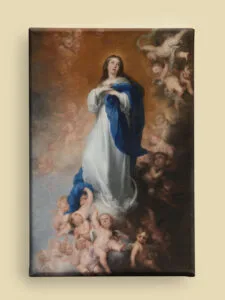
The Immaculate Conception of Los Venerables is the most celebrated of the many versions of this subject painted by Bartolome Esteban Murillo, the leading master of the Spanish Baroque in Seville. Made around 1660 to 1665, it shows the Virgin Mary lifted into the sky, dressed in white and blue, carried up through clouds and cherubs. The painting is in the Museo del Prado in Madrid. Its medium is oil on canvas.
The image is all upward movement. Mary stands on a faint crescent moon, her hands clasped at her breast, her face turned to the light that breaks behind her. Around her a crowd of small cherubs tumbles through the clouds, some carrying lilies and palms, the old signs of her purity.
The subject is the Immaculate Conception, the Catholic belief that Mary was conceived free of original sin. It is often confused with the virgin birth of Jesus, but it refers to Mary’s own conception. Murillo found a way to paint this idea of pure, sinless beginning as light, air, and weightless rising.
Few painters have shaped how the world pictures the Virgin as strongly as Murillo. Readers who want to see more can read our article on Murillo’s paintings or visit our gallery of Virgin Mary paintings.
The History of The Immaculate Conception of Los Venerables
Murillo painted this Immaculate Conception for the Hospital de los Venerables Sacerdotes in Seville, a home for elderly priests, which is how it came to be called the version of Los Venerables. He returned to the theme around twenty times across his career, but this large canvas is widely held to be the finest.

The painting has a dramatic later history. During the Napoleonic occupation of Spain, the French marshal Jean de Dieu Soult looted it and carried it to France. For decades it hung in the Louvre, and in 1852 it sold at auction for one of the highest prices ever paid for a painting at the time. It was finally returned to Spain in 1941 and has been one of the treasures of the Prado ever since.
The Meaning of the Immaculate Conception
Murillo draws on the vision in the Book of Revelation of a woman clothed with the sun, with the moon under her feet. The crescent moon beneath Mary and the golden light behind her come straight from that text, which the Church read as an image of the Virgin.

Her colors carry the meaning. The white robe stands for purity, the blue mantle for heaven. Her hands are pressed together in prayer, and her eyes lift toward the source of the light. Murillo gives the doctrine a human face, young, gentle, and full of trust, rather than a cold theological sign.
The Cherubs and the Sense of Flight
What keeps the painting from feeling static is the swarm of cherubs at the Virgin’s feet. They roll and reach through the clouds, soft and lively, and they seem to lift her upward by their sheer movement. Murillo was famous for these tender child figures, and here they turn a solemn subject into something light and joyful.

The loose, feathery brushwork adds to the effect. Edges dissolve into mist, the clouds glow with warm and cool light, and the whole canvas feels as though it is rising. This soft, atmospheric style became Murillo’s trademark and was widely imitated.
The Image That Defined a Subject
The Immaculate Conception of Los Venerables set the pattern for how the subject would be painted for generations. The young Virgin in white and blue, the crescent moon, the ring of cherubs, all became the standard image, repeated across Spain and the wider Catholic world.
It endures because it makes a difficult idea feel simple and warm. Murillo does not argue the doctrine, he shows it as beauty and light, and that is why the picture has stayed popular far beyond the world of theology.
Conclusion
In The Immaculate Conception of Los Venerables Murillo turned a point of Catholic belief into a vision of weightless grace. The Virgin rises in white and blue, the cherubs carry her, and the light receives her.
Looted, prized, and at last returned home, the painting now hangs in the Prado as the defining image of its subject. It remains one of the most loved of all paintings of the Virgin Mary.
✦ A Novena to the Immaculate Conception, Free Printable
Her feast is December 8, and the novena is prayed over the nine days before it, from November 29. It is a booklet you can print at home: eleven illuminated pages, one painting and one short reading for each day, the traditional prayer, and a line on every page to write your own intention.
Get it in the free printables library
PDF, eleven pages, US Letter or A4, with the prayer cards and the psalms.
Artwork Information
| Artwork | Artist | Date | Medium | Current Location |
|---|---|---|---|---|
| The Immaculate Conception of Los Venerables | Bartolome Esteban Murillo | c. 1660 to 1665 | Oil on canvas | Museo del Prado, Madrid |
Five Facts About Murillo’s Immaculate Conception
- The Immaculate Conception of Los Venerables is an oil painting by Murillo, made around 1660 to 1665.
- It shows the Virgin Mary, conceived without sin, standing on a crescent moon among clouds and cherubs.
- It is one of about twenty versions of the subject Murillo painted, and the most celebrated.
- It was looted by the French marshal Soult during the Napoleonic wars and later hung in the Louvre.
- It was returned to Spain in 1941 and is now in the Museo del Prado in Madrid.
FAQ
What does Murillo’s Immaculate Conception represent?
It represents the Catholic belief that the Virgin Mary was conceived free of original sin. Murillo shows her rising in light, in white and blue, as an image of pure and sinless beginning.
Is the Immaculate Conception the same as the virgin birth of Jesus?
No. The Immaculate Conception refers to Mary’s own conception, free of original sin, not to the birth of Christ. The two are often confused.
Why is the Virgin dressed in white and blue?
The white robe stands for purity and the blue mantle for heaven. These became the standard colors for the Immaculate Conception, largely through Murillo’s many versions.
What is the moon under the Virgin’s feet?
It comes from the Book of Revelation, which describes a woman clothed with the sun, with the moon under her feet. The Church read this figure as the Virgin Mary, and Murillo includes the crescent moon beneath her.
Where is Murillo’s Immaculate Conception of Los Venerables?
It is in the Museo del Prado in Madrid, after being returned to Spain in 1941.
When did Murillo paint it?
He painted it around 1660 to 1665, during his mature years in Seville.
How did the painting end up in the Louvre?
It was looted by the French marshal Soult during the Napoleonic occupation of Spain and taken to France, where it hung in the Louvre until it was returned to Spain in 1941.
Where can I buy a reproduction of Murillo’s Immaculate Conception?
You can buy a reproduction of Murillo’s Immaculate Conception at jesuschrist.pictures, in our shop: the canvas reproduction comes in several sizes, ready to hang.


