The Baptism of Christ: The Angel That Made Verrocchio Quit
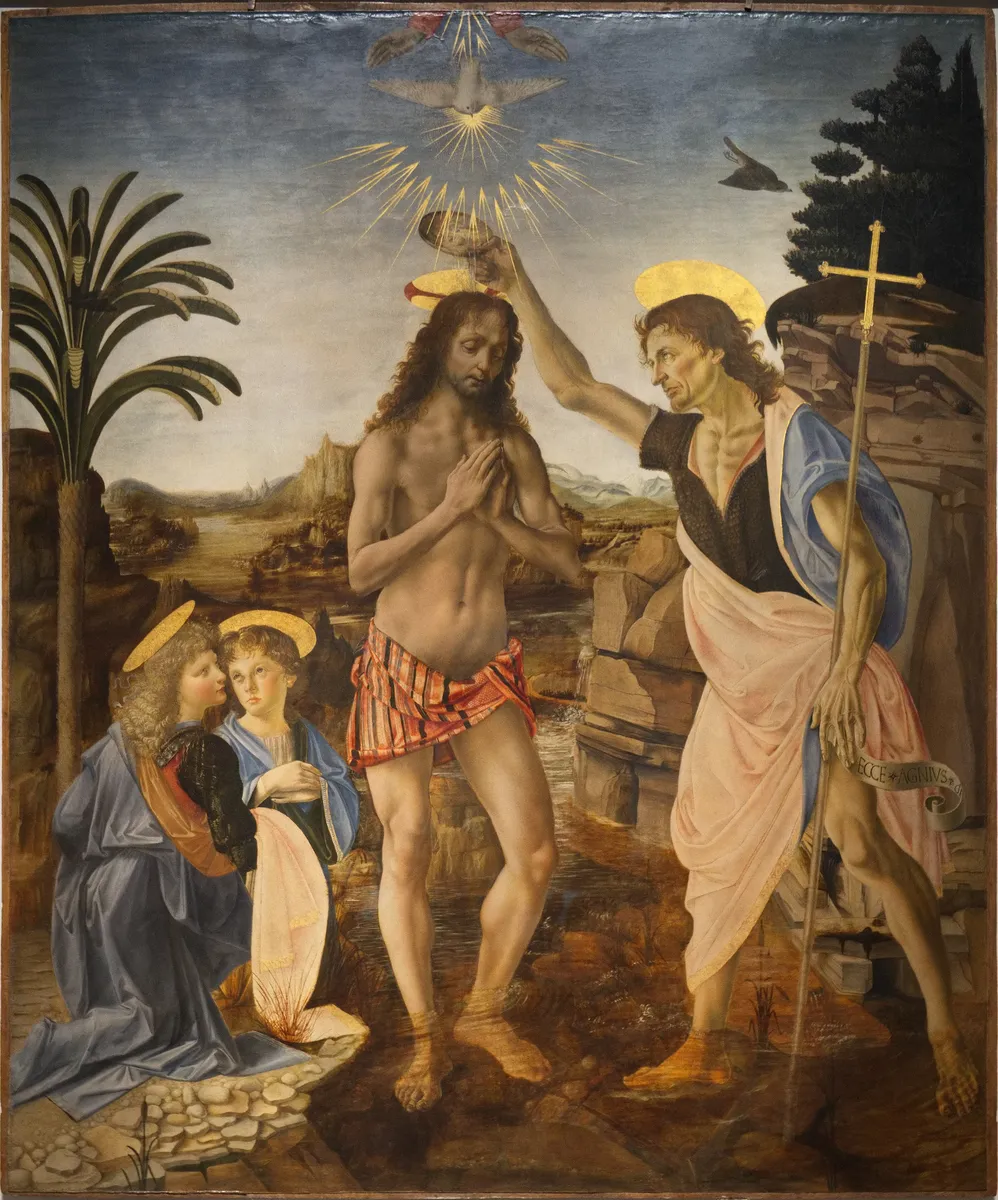
The Baptism of Christ is a panel painting made in the Florentine workshop of Andrea del Verrocchio around 1470 to 1475, and it contains the earliest surviving painting by Leonardo da Vinci. It hangs in the Galleria degli Uffizi in Florence. Most visitors walk past it on the way to the Botticellis. They should not.
The reason is the angel kneeling at the far left, holding Christ’s robe. Giorgio Vasari, writing a lifetime later, said that when Verrocchio saw what his young apprentice had done with that figure he put down his brushes and never painted again. The story is almost certainly too good to be true. What is true, and verifiable with the naked eye, is stranger: two different painters worked on this panel in two different mediums, and you can see the exact line where one gives way to the other.
The Subject: Matthew 3 in a Tuscan Valley
All four Gospels report the baptism. Jesus comes from Galilee to the Jordan, where John is baptising, and asks to be baptised himself. John resists and then submits. As Jesus comes up from the water the heavens open, the Spirit of God descends like a dove, and a voice says: this is my beloved Son, in whom I am well pleased.
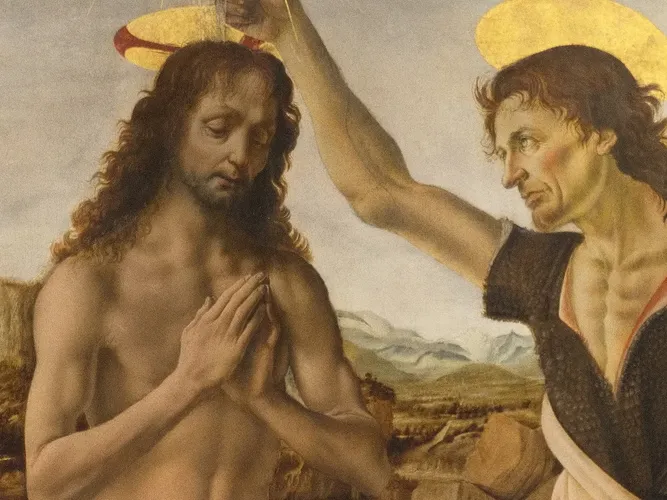
The panel gives all of it. Christ stands in the shallow river with his hands joined, head bowed, his body drawn with the hard clarity of a sculptor. John the Baptist, gaunt and sunburnt in a camel skin, tips water from a shallow bowl over his head. The dove hangs directly above, wings out. At the very top, breaking into the picture, are two hands, the Father’s, from which rays of gold come down. And at the left, kneeling on the bank, two angels hold the discarded robe.
The setting is not Palestine. It is a Tuscan river valley with a palm on the left and dry rocks behind, the kind of landscape a Florentine could walk into. That was normal practice. What is not normal is what happens to that landscape as it recedes.
Verrocchio’s Workshop, and Who Was In It
Andrea del Verrocchio was one of the most sought after masters in Florence, a goldsmith and sculptor first and a painter second, running a large workshop under Medici patronage. He was responsible for the bronze David, the Colleoni monument in Venice and the tomb of Piero and Giovanni de’ Medici. Painting was a side of the business rather than its centre, which matters for the story that follows.
The apprentices who passed through his shop are a roll call of the next generation. Leonardo entered around 1466, aged fourteen. Pietro Perugino, who would teach Raphael, was there. Domenico Ghirlandaio, who would teach Michelangelo, is associated with the circle, and so is Sandro Botticelli. Collaboration was the method, not the exception. A panel of this size was expected to pass through several pairs of hands, with the master setting the design and reserving the principal figures.
That is why the modern museum label reads Verrocchio and Leonardo, and why some scholars see a third or fourth hand in the picture as well.
The Angel on the Left
Two angels kneel at the water’s edge. Set side by side, they do not look like they come from the same century.
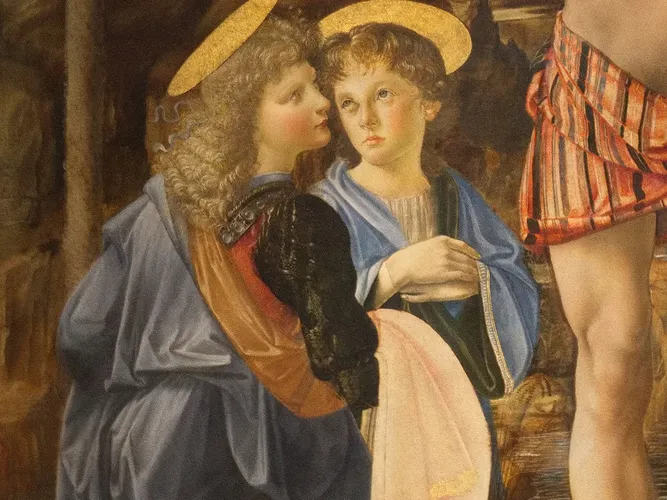
The angel on the right, Verrocchio’s, faces more or less out at us. His hair is drawn strand by strand, his features are neat and firmly outlined, and his blue mantle falls in creases that have been thought out rather than observed. He is a very good fifteenth century angel.
The angel on the left is doing something else entirely. He is seen from behind and turned, in a twisting pose that pulls the shoulder forward and the head back. The hair is not drawn in strands but massed into curls that catch light unevenly. The outline of his cheek does not exist as a line at all: the flesh simply stops being flesh and becomes air. He is looking up, past the picture, at something the other angel has not noticed.
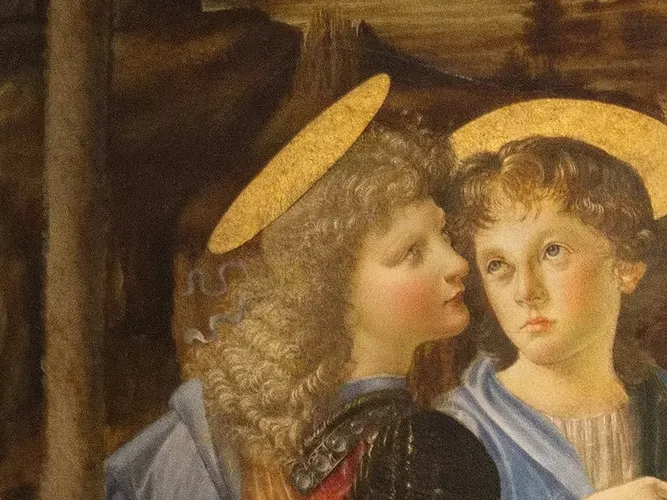
The young painter was about twenty. He had understood something his master had not, and he had understood it in a way that could not be unlearned by anyone who saw it.
Oil, and Why It Changes Everything
The difference is not only talent. It is chemistry, and this is the part that is documented rather than legendary.
Most of the panel is painted in tempera, pigment bound with egg. Tempera dries fast and stays where it is put. It gives brilliant, clean colour and crisp edges, and it makes soft gradations extremely difficult, because you cannot blend a passage that has already set.
Leonardo’s angel and the far landscape are painted in oil, a medium arriving in Florence from the north in exactly these years. Oil dries slowly. It can be pushed, feathered, glazed over in thin transparent layers, worked wet into wet for hours. Everything Leonardo would later be famous for, the smoky transitions of sfumato, the atmosphere that swallows distance, depends on that slowness.
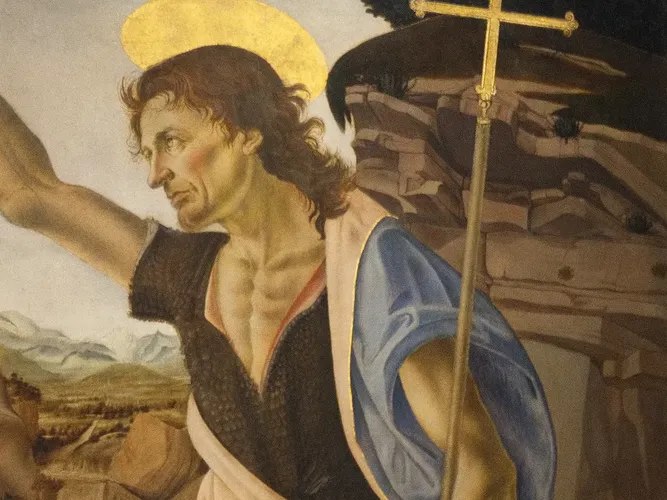
Look at the valley behind John the Baptist’s shoulder. The near rocks are sharp. Then the land turns pale, then blue, then dissolves into a haze where mountains and sky are the same substance. Nothing in Florentine tempera painting looks like that. The same eye and the same medium would produce the rocks and mists of the Virgin of the Rocks a decade later.
A restoration completed in 1998 cleaned the panel and made the boundary between the two mediums much easier to read. It also revealed that Leonardo reworked part of Christ’s body, which suggests the master let him go further than the robe and the angel.
The Legend Vasari Told
In his Lives of the Artists, first published in 1550, Giorgio Vasari wrote that Leonardo painted an angel in his master’s panel so much better than the rest that Verrocchio, in shame and resentment, resolved never to touch colours again.
It is a wonderful story and it should be treated as one. Vasari was writing roughly eighty years after the fact, he was a Florentine partisan building a narrative of art’s ascent toward Michelangelo, and this kind of anecdote is his stock in trade. There is no contemporary source for it.
The record does not support the flat claim either. Verrocchio remained enormously busy after 1475, but as a sculptor: the Colleoni monument occupied his last years and he died in Venice in 1488 with it unfinished. Whether he gave up painting from wounded pride, or simply because the sculpture commissions were larger, better paid and more to his taste, cannot be settled from the evidence.
What the legend gets right is the shock. Something in this panel visibly outruns the workshop that produced it, and Vasari was reporting the impression it made, even if he dressed it as an event.
Where the Panel Has Been
The picture was painted for the church of San Salvi in Florence, a Vallombrosan monastery just outside the walls. It stayed there until 1530, when it was moved to the convent of Santa Verdiana for safety during the siege of Florence. From there it passed in the nineteenth century to the Accademia, and finally to the Uffizi, where it hangs today. For the wider story of how painters have treated this scene across the centuries, see our gallery of famous Baptism of Christ paintings.
What to Look At, in Order
Start with the two angels, and give it a moment. The whole argument of the painting is there.
Then follow the water. Verrocchio painted the surface of the Jordan as a sheet with the stones legible beneath it, which is a goldsmith’s solution: precise, tooled, slightly hard. Then look past the rocks at the valley, and watch the picture change hands.
Then the hands at the top. They are abrupt, almost crude, cutting into the gold ground. That is not a failure. In a fifteenth century altarpiece the Father does not appear as a figure. He appears as an intervention.
Last, Christ himself, and the odd fact that the most static figure in the picture is the one everything is happening to.
Two Painters, One Panel
The Baptism of Christ is not the greatest painting in the Uffizi and it was never meant to be a landmark. It is a competent workshop altarpiece by a sculptor who painted when he had to, and it would be a footnote if a teenager in his employ had not been allowed to finish the left hand corner.
Because he was, the panel became the only place in the world where you can stand in front of one picture and see the fifteenth century and everything that came after it, painted a hand’s width apart. Whether or not Verrocchio ever picked up a brush again, he had the sense to let the boy keep going.
Artwork Information
| Artwork | Artist | Date | Medium | Current Location |
|---|---|---|---|---|
| The Baptism of Christ | Andrea del Verrocchio and Leonardo da Vinci | c. 1470 to 1475 | Tempera and oil on poplar panel, 177 x 151 cm | Galleria degli Uffizi, Florence |
Five Facts About the Baptism of Christ
- It contains the earliest surviving painting by Leonardo da Vinci: the angel kneeling at the far left, painted when he was about twenty and still an apprentice.
- Two mediums share one panel. Verrocchio worked in egg tempera, which dries fast and holds a crisp edge; Leonardo used oil, newly arrived in Florence, which dries slowly and allows blended transitions. The boundary is visible to the naked eye.
- Vasari’s story that Verrocchio never painted again after seeing the angel was written around 1550, roughly eighty years later, and has no contemporary source. Verrocchio remained busy until his death in 1488, chiefly as a sculptor.
- The panel was painted for the church of San Salvi outside Florence, moved to the convent of Santa Verdiana in 1530 during the siege of the city, and reached the Uffizi by way of the Accademia.
- The 1998 restoration made the join between the two hands far easier to read, and showed that Leonardo also reworked part of Christ’s body, not only the angel and the landscape.
FAQ
Who painted the Baptism of Christ, Verrocchio or Leonardo?
Both. The panel was produced in Andrea del Verrocchio’s Florentine workshop around 1470 to 1475, and Verrocchio was responsible for the design and for the principal figures of Christ and John the Baptist. Leonardo da Vinci, then a young apprentice, painted the angel kneeling at the far left and much of the distant landscape. Some art historians also identify other workshop hands in the picture.
Which angel did Leonardo paint in the Baptism of Christ?
The one on the left, seen from behind with the head turned and the face in near profile, holding Christ’s robe. It is distinguished from the angel beside it by the softened contours, the massed curling hair and the upward gaze. It is generally accepted as Leonardo’s earliest surviving painted work.
Is it true that Verrocchio never painted again after seeing Leonardo’s angel?
That is Vasari’s story, written around 1550, roughly eighty years after the panel was made, and there is no contemporary source for it. Verrocchio certainly remained active until his death in 1488, but chiefly as a sculptor, working on the Colleoni equestrian monument in Venice. Whether he stopped painting from wounded pride or because sculpture commissions suited him better cannot be established from the evidence.
Where is the Baptism of Christ by Verrocchio and Leonardo?
In the Galleria degli Uffizi in Florence. It was painted for the church of San Salvi outside the city walls, moved to the convent of Santa Verdiana in 1530 during the siege of Florence, passed to the Accademia in the nineteenth century, and finally entered the Uffizi collection, where it is displayed today.
What medium is the Baptism of Christ painted in?
Both tempera and oil, which is the most interesting technical fact about it. Verrocchio worked in egg tempera, which dries quickly and holds a crisp edge. Leonardo’s angel and the distant landscape are in oil, then newly arrived in Florence, which dries slowly and allows the blended transitions and atmospheric haze that tempera cannot produce. The 1998 restoration made the boundary between the two much easier to see.
What is the meaning of the Baptism of Christ painting?
It shows the moment from Matthew 3 when Jesus is baptised by John in the Jordan, the Spirit descends as a dove and the Father’s voice declares him the beloved Son. The panel makes the Trinity visible in one image: the Son in the water, the Spirit as the dove, the Father as the hands and rays entering from above. The angels holding the robe are a Florentine convention that turns the event into a liturgy.
Is there a UFO in the Baptism of Christ?
Not in this one. That claim attaches to a different painting: The Baptism of Christ by the Dutch artist Aert de Gelder, painted in 1710 and now in the Fitzwilliam Museum in Cambridge, where a disc shaped source of light casts beams down on the scene. It is a conventional Baroque way of representing divine radiance. Verrocchio and Leonardo’s panel shows the dove and the Father’s hands, and nothing else.
Where can I buy a Baptism of Christ print?
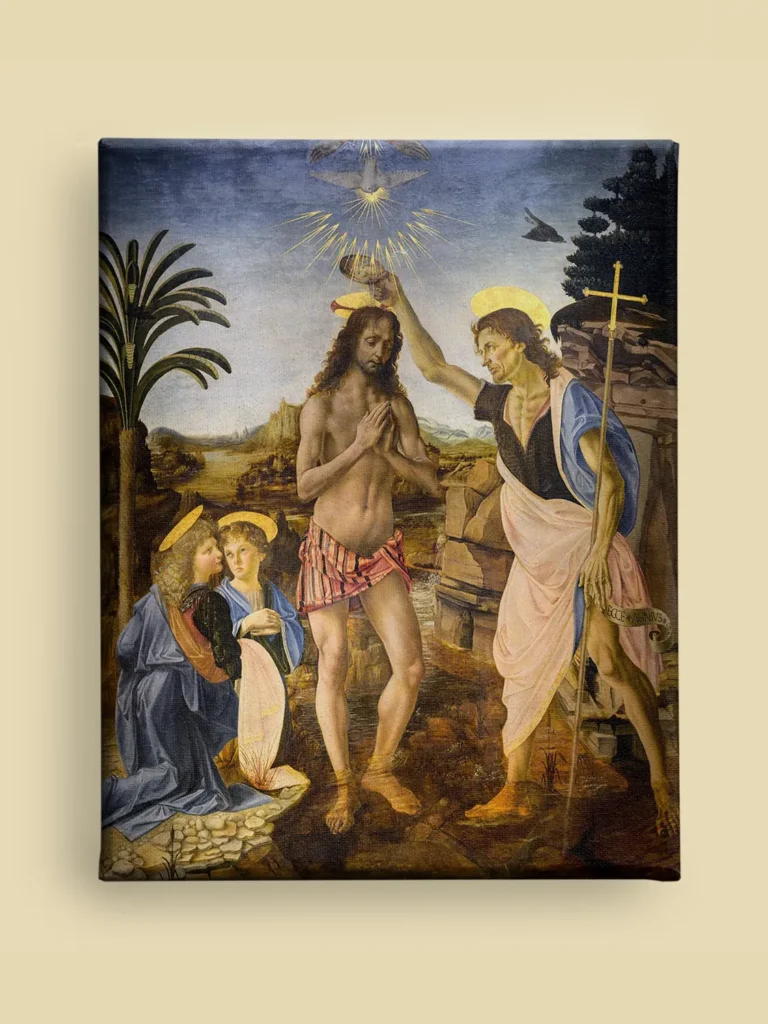
You can buy a Baptism of Christ print at jesuschrist.pictures: our Verrocchio and Leonardo canvas reproduction is printed to gallery standard from a high resolution file and ships ready to hang. It is one of the few reproductions that keeps the detail of Leonardo’s angel legible at wall size, which is the reason most people want the picture in the first place.