Caravaggio’s Calling of Saint Matthew: A Beam of Grace
The Calling of Saint Matthew is one of the great paintings of the Baroque, made by Caravaggio at the very start of the seventeenth century. Painted between 1599 and 1600, it shows the moment Christ enters a tax office and calls the collector Matthew to follow him. The painting hangs where it was made, in the Contarelli Chapel of San Luigi dei Francesi in Rome. Its medium is oil on canvas.
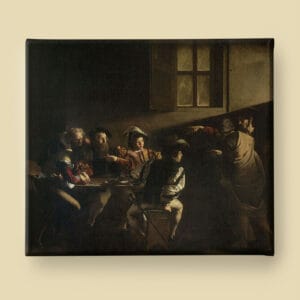
The scene is set in a plain, dark room. Five men sit around a table counting coins, dressed in the fashion of Caravaggio’s own day. Christ enters from the right, half hidden behind Saint Peter, and stretches out his hand. A shaft of light cuts across the wall above, following the line of his arm toward the men who have not yet seen him.
Caravaggio turns a single gesture into the whole drama of conversion. The light is the call, and the faces at the table show the first confusion of being chosen. There is no halo of glory, only an ordinary room suddenly broken open by grace.
That pointing hand is one of the most quoted gestures in art. Caravaggio borrowed it from the hand of Adam in Michelangelo’s Creation of Adam, so that the call of Matthew echoes the giving of life itself. Readers who want to see more of his work can also read our article on Caravaggio’s paintings.
The History of The Calling of Saint Matthew
The Calling of Saint Matthew was Caravaggio’s first great public commission. The Contarelli Chapel had been left funds by a French cardinal, Matteo Contarelli, to be decorated with scenes from the life of his name saint. With the help of his patron, Cardinal del Monte, the young Caravaggio won the work and painted two large canvases for the side walls, the Calling and the Martyrdom of Saint Matthew.

When the paintings were unveiled around 1600, they made Caravaggio famous almost overnight. Nothing quite like them had been seen. The sacred story was set among real, rough people, lit by a hard, raking light, with none of the idealized beauty of the late Renaissance. The pictures are still in the chapel today, where visitors drop coins into a light box to see them.
The Beam of Light
The most striking thing in the painting is the light. A single beam falls from the upper right, above the figure of Christ, and crosses the dark wall toward the table. It is not natural daylight, since the window in the room is shuttered. It is the light of the call itself, made visible.

Christ is almost lost in shadow, his face quiet, only his hand fully in the light. Saint Peter stands in front of him, repeating the gesture in a smaller, more human way. This is the technique that made Caravaggio famous, a strong contrast of light and dark that art historians call chiaroscuro, used here to carry the meaning of the scene.
Which Man Is Matthew?
At the table the call lands on a group of startled men. A bearded figure in the center points a hand toward his own chest, as if to ask, Who, me? For centuries he has been taken for Matthew, caught in the instant of being chosen.

Some scholars read the gesture differently and think the bearded man points past himself, toward the young man at the end of the table who keeps his head down over the coins. By this reading, Matthew is the one still absorbed in money, not yet aware that he has been called. Caravaggio leaves the question open, and that uncertainty has kept viewers looking for over four hundred years.
How One Painting Reshaped the Baroque
The Calling of Saint Matthew changed religious painting. By placing the sacred in a dark tavern room, among ordinary men with dirty feet and fashionable clothes, Caravaggio made the Gospel feel immediate and real. The message was that grace can reach anyone, in any place, at any moment.
Its influence ran through the whole of the Baroque. Painters across Europe took up the dramatic light, the everyday settings, and the sense of a story caught at its turning point. Few single works have shaped so much of what followed.
Conclusion
In The Calling of Saint Matthew Caravaggio reduced a life-changing moment to a beam of light and a pointing hand. A tax collector looks up, the room fills with meaning, and an ordinary day becomes the start of a new life.
Still hanging in its Roman chapel, lit for a moment at a time, the painting keeps doing what it shows. It calls the viewer to look, and to wonder which of the figures in the dark is the one being chosen.
Artwork Information
| Artwork | Artist | Date | Medium | Current Location |
|---|---|---|---|---|
| The Calling of Saint Matthew | Caravaggio | 1599 to 1600 | Oil on canvas | San Luigi dei Francesi, Rome |
Five Facts About The Calling of Saint Matthew
- The Calling of Saint Matthew is a Baroque oil painting by Caravaggio, made between 1599 and 1600.
- It hangs in the Contarelli Chapel of San Luigi dei Francesi in Rome, his first major public commission.
- It shows Christ entering a tax office and pointing to Matthew, calling him to follow.
- Caravaggio used dramatic chiaroscuro, a strong beam of light that follows Christ’s gesture.
- Christ’s pointing hand echoes the hand of Adam in Michelangelo’s Creation of Adam.
FAQ
What does The Calling of Saint Matthew show?
It shows the moment from the Gospel of Matthew when Christ enters a tax office, points to the collector Matthew, and calls him to follow. The startled men at the table react as a beam of light crosses the room.
Which man is Matthew in the painting?
Traditionally the bearded man pointing toward his own chest is read as Matthew, in the act of asking Who, me? Some scholars instead think he points to the young man at the end of the table, still bent over the coins. Caravaggio leaves it open.
What technique did Caravaggio use in The Calling of Saint Matthew?
He used chiaroscuro, a dramatic contrast of light and dark. A single beam of light stands for the divine call and pulls the whole scene together.
Who commissioned The Calling of Saint Matthew?
It was painted for the Contarelli Chapel, funded by the French cardinal Matteo Contarelli. Caravaggio won the commission with the support of his patron, Cardinal del Monte.
Where is The Calling of Saint Matthew?
It is still in the Contarelli Chapel of San Luigi dei Francesi in Rome, the church for which it was painted.
When did Caravaggio paint The Calling of Saint Matthew?
He painted it between 1599 and 1600, as his first major public work.
Why is The Calling of Saint Matthew important?
It is a landmark of Baroque art. By setting the Gospel in a real, dark room among ordinary people, Caravaggio made sacred painting feel immediate, and his dramatic light shaped a century of artists after him.
Where can I buy a print of Caravaggio’s Calling of Saint Matthew?
You can buy a print of Caravaggio’s Calling of Saint Matthew at jesuschrist.pictures: see the canvas reproduction in our shop, printed on museum-grade canvas and available in several sizes.


