Anthony van Dyck Paintings Beyond the Royal Court
Anthony van Dyck remains one of the most influential painters Flanders ever produced. The Anthony van Dyck paintings that survive today reveal a man who was a prodigy in Antwerp, a court favourite in Genoa, the chief painter of the English king, and one of the most refined religious artists of the seventeenth century. Trained in the workshop of Peter Paul Rubens, he absorbed all the dramatic intensity of his master and added to it a personal sweetness, a silvery elegance, and a melancholy that no other Flemish painter ever quite achieved.
This article gathers ten of his finest sacred panels, from the bloodied Christ of his early Antwerp years to the luminous Saint Rosalie of his Sicilian period.

From the Antwerp Prodigy to the English Court
Van Dyck was born on 22 March 1599 in Antwerp, the seventh child of a wealthy silk merchant. He showed his gift so early that he was apprenticed to the painter Hendrick van Balen at the age of ten and was already running his own studio at fifteen. By 1618 he was working in the workshop of Peter Paul Rubens, who called him his best pupil. After an Italian voyage that took him to Genoa, Rome, Venice, and Palermo, he returned to Antwerp briefly before being summoned to London in 1632 by Charles I, who made him principal painter to His Majesty and gave him a knighthood.
Although his portraits of the Stuart court are what most people now remember, his religious painting was at the heart of his vocation. Throughout his career he produced altarpieces and devotional panels of extraordinary refinement, often shaped by the same elongated grace and silvery palette that gave his portraits their fame.
Christ Crowned with Thorns
Painted between 1618 and 1620, when van Dyck was barely out of his teens, this canvas already shows the complete young master. The seated Christ submits to the soldiers who press the crown of thorns onto his head, his eyes closed in patient suffering. The dog at the lower edge of the picture, the mocking child with the reed, and the heavy diagonal light all owe their drama to Rubens, but the smooth, almost sculpted modelling of Christ’s body is unmistakably van Dyck’s own.

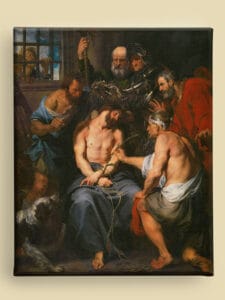
The painting hangs at the Museo del Prado in Madrid, a relic of the Spanish royal collection.
The Crown of Thorns
Closely related in composition and date, this second version of the subject is generally considered a workshop variant or a slightly later autograph reprise. The composition is more compressed, the lighting more concentrated, and Christ’s face turned slightly more toward the viewer. The two paintings together let us see how van Dyck moved across his own ideas, refining and reworking the same theme.

This canvas is also at the Museo del Prado.
Christ on the Cross Between the Two Thieves
One of the most ambitious religious compositions of van Dyck’s second Antwerp period, this Crucifixion stages the full drama of Calvary. Christ hangs in the centre, the impenitent thief writhes against his cross on the left, and the good thief, his head bowed toward the saviour, accepts the promise of paradise. The Virgin and John the Evangelist stand at the base of the cross. The colour is dramatic and the figures elongated in a Mannerist way that recalls Tintoretto.

The painting is preserved at the Royal Museum of Fine Arts in Antwerp, part of the Flemish Community art collection.
The Crucified Christ with the Virgin Mary, Saint John the Baptist and Mary Magdalene
A more intimate Crucifixion, this panel places only the Virgin, John the Baptist, and Mary Magdalene at the foot of the cross. Magdalene clings to the wood with her loose red hair falling across her shoulders, while the Virgin stands in stillness and the Baptist points with his characteristic reed. The composition has the silvery refinement of van Dyck’s Italian period and shows how completely he had absorbed the Venetian use of warm shadow.

The painting is in a private collection and has been included in several major van Dyck exhibitions.
The Lamentation over the Dead Christ
Painted around 1635, the Lamentation belongs to a small group of devotional panels van Dyck produced after his return to Antwerp from London. The dead Christ lies across the lap of the Virgin, her face turned upward in a single rising line of grief. Mary Magdalene kisses his bloodied feet, while two angels hold up his arms. The whole composition has the cool, almost monochrome quietness of late van Dyck, far from the heated drama of his Rubens years.

The painting hangs at the Royal Museum of Fine Arts in Antwerp.
Entry of Christ into Jerusalem
This rare early scene depicts Palm Sunday with a freshness that few Flemish painters of the time could match. Christ rides into the city on his donkey while the crowd presses around him, some spreading their cloaks on the road, others waving palm branches. The composition recalls Rubens’s massed compositions, but van Dyck gives it a sweeter and more youthful tonality.

The painting is now in the collection of the Indianapolis Museum of Art at Newfields.
Saint Martin and the Beggar
One of van Dyck’s most reproduced religious images, this scene from the life of Saint Martin of Tours shows the young Roman soldier on a white horse cutting his cloak in two to share it with a freezing beggar. The composition is built on a strong diagonal of horse, cloak, and arm, and the colours are kept to a few clear notes of red, silver, and gold. The painting was almost certainly conceived for the parish church of Saventhem, near Brussels, where one version still hangs.

The original is in the parish church of Saint-Martin in Zaventem, Belgium, while several other autograph and workshop versions are in collections worldwide.
Saint Rosalie Interceding for the Plague-stricken of Palermo
While in Palermo in 1624, van Dyck lived through one of the worst plague outbreaks the city had ever seen. The recently recovered relics of Saint Rosalia, the medieval hermit of Mount Pellegrino, were credited with ending the epidemic, and van Dyck painted several versions of her interceding for the city from heaven. The Metropolitan Museum panel shows her among angels and putti, looking down with serene pity on the suffering city below.

The painting is now in the collection of the Metropolitan Museum of Art in New York.
Saint Rosalia
Painted in the same Palermo years, this smaller devotional panel presents Saint Rosalia alone, kneeling on her rocky mountain, her arms crossed in prayer, her skull and crown of roses beside her. The picture’s silvery flesh tones and atmospheric Sicilian sky show how thoroughly van Dyck had absorbed the Venetian use of golden underlight.

The panel is now at the Museo del Prado in Madrid.
Mary, Lady van Dyck as the Virgin
One of the most personal works in the painter’s late religious output, this painting shows his English wife Mary Ruthven in the guise of the Virgin Mary, her hair down, her dress simple, her face filled with mild devotion. Van Dyck painted it shortly after their marriage in 1640, only a year before his death. The picture sits halfway between portrait and devotional image, a private icon of marital love and faith.

The work is held by the Museo del Prado, originally from the Royal Palace of Madrid.
For a wider context of Flemish Baroque art, see our article on Peter Paul Rubens, van Dyck’s great teacher, and on his Flemish predecessors Rogier van der Weyden and Jan van Eyck. The wider tradition of Baroque Jesus paintings holds van Dyck as one of its most refined voices.
Summary Table of Anthony van Dyck’s Religious Paintings
| Name | Artist | Date | Medium | Museum |
|---|---|---|---|---|
| Christ Crowned with Thorns | Anthony van Dyck | c. 1618 to 1620 | Oil on canvas | Museo del Prado, Madrid |
| The Crown of Thorns | Anthony van Dyck | c. 1620 | Oil on canvas | Museo del Prado, Madrid |
| Christ on the Cross Between the Two Thieves | Anthony van Dyck | c. 1627 | Oil on canvas | Royal Museum of Fine Arts, Antwerp |
| The Crucified Christ with the Virgin Mary, Saint John the Baptist and Mary Magdalene | Anthony van Dyck | c. 1625 to 1630 | Oil on canvas | Private collection |
| The Lamentation over the Dead Christ | Anthony van Dyck | c. 1635 | Oil on canvas | Royal Museum of Fine Arts, Antwerp |
| Entry of Christ into Jerusalem | Anthony van Dyck | c. 1617 | Oil on canvas | Indianapolis Museum of Art at Newfields |
| Saint Martin and the Beggar | Anthony van Dyck | c. 1620 to 1621 | Oil on canvas | Parish Church of Saint-Martin, Zaventem |
| Saint Rosalie Interceding for the Plague-Stricken of Palermo | Anthony van Dyck | 1624 | Oil on canvas | Metropolitan Museum of Art, New York |
| Saint Rosalia | Anthony van Dyck | c. 1624 | Oil on canvas | Museo del Prado, Madrid |
| Mary, Lady van Dyck as the Virgin | Anthony van Dyck | c. 1640 | Oil on canvas | Museo del Prado, Madrid |
Conclusion
If Rubens gave the seventeenth century its great public language of religious painting, van Dyck gave it the private language of devotion. His Christs are tender rather than heroic, his Madonnas are intimate rather than imperial, and his saints carry a grief that feels personal. The man who painted Charles I and the cavaliers of Whitehall never lost sight of the boy in Antwerp who had first learned to draw a Virgin Mary in the workshop of Hendrick van Balen.
Important Facts About Anthony van Dyck
- Anthony van Dyck was born on 22 March 1599 in Antwerp, the seventh of twelve children of Frans van Dyck, a wealthy silk merchant, and Maria Cuypers, in one of the great mercantile families of the city.
- He trained from the age of ten in the studio of Hendrick van Balen and from about 1618 in the workshop of Peter Paul Rubens, who described him as his best pupil and gave him an unusual degree of creative freedom.
- Van Dyck is the central figure of the Flemish Baroque after Rubens and is best remembered for fusing Flemish realism with the silvery elegance of the Venetian school, especially Titian, whom he studied at length during his Italian voyage from 1621 to 1627.
- His most famous religious painting is the Saint Rosalie Interceding for the Plague-stricken of Palermo, painted in 1624 during the great epidemic and now in the collection of the Metropolitan Museum of Art in New York.
- He died on 9 December 1641 in London, principal painter to King Charles I, and his refined courtly portraiture shaped British painting from Lely and Reynolds to Gainsborough and beyond.
Questions and Answers About Anthony van Dyck Paintings
What is Anthony van Dyck’s most famous painting?
His best known work is the equestrian portrait Charles I on Horseback at the National Gallery in London. Among his religious panels, the most reproduced is the Saint Rosalie Interceding for the Plague-stricken of Palermo at the Metropolitan Museum of Art, painted during the 1624 epidemic. His Crucifixion in Antwerp and his Christ Crowned with Thorns at the Prado are also widely studied.
Where can I see Anthony van Dyck paintings today?
The richest collections are at the Royal Museum of Fine Arts in Antwerp, the Museo del Prado in Madrid, the National Gallery in London, and the Royal Collection at Windsor and Buckingham Palace. The Genoese palaces of the Strada Nuova still hold many of his Italian portraits, while the Metropolitan Museum in New York owns several of his religious panels including Saint Rosalie of Palermo.
What style is Anthony van Dyck associated with?
Van Dyck is the chief painter of the Flemish Baroque after Rubens. His mature manner combines the dramatic light and warm colour of the Baroque with a silvery refinement and elongated elegance learned from Titian and the Venetian school. In England his work became the founding language of British court portraiture for the next two centuries.
How is van Dyck different from Rubens?
Where Rubens is muscular, public, and exuberant, van Dyck is silvery, intimate, and melancholic. Rubens fills the canvas with action and twisting bodies; van Dyck slows everything down, elongates his figures, and leaves room for silence. They share the same Flemish anatomy and the same Venetian colour, but van Dyck’s hand is finer and his temperament more reflective.
Was Anthony van Dyck Catholic?
Yes, van Dyck was a devout Catholic all his life. He was a member of the Confraternity of the Bachelors of Antwerp, dedicated to the Virgin, and his Italian and Antwerp years produced large numbers of altarpieces and devotional panels for churches and private patrons. Even at the Protestant English court he continued to paint Madonnas and Crucifixions for his Catholic friends and for himself.
Why did van Dyck go to England?
He was invited by Charles I in 1632 to serve as principal painter to His Majesty, with a substantial salary and a knighthood. Charles was building one of the finest art collections in Europe and saw in van Dyck the painter who could give his court the same kind of mythic dignity that Titian had once given the imperial court of Charles V. Van Dyck remained in London, with brief returns to Antwerp, until his death in 1641.
Where can I buy Anthony van Dyck paintings reproductions?
You can buy them at jesuschrist.pictures. All the Anthony van Dyck canvas prints are gathered in our shop, printed on premium canvas and shipped worldwide.