Striking Andrea Mantegna Paintings That Redefined Drama
Andrea Mantegna paintings are unlike those of any other Italian Renaissance master. Born in 1431 near Padua, Mantegna brought to sacred subjects a passion for ancient Rome, its sculpture, its architecture, its stone, that gave his figures a monumental hardness and his compositions a theatrical grandeur that were entirely his own. He could paint a grieving Madonna with the emotional force of a carved sarcophagus. He could place the dead body of Christ at such an extreme angle that the viewer feels the weight of mortality pressing down from the picture plane. He worked primarily for the Gonzaga court in Mantua, where he spent nearly fifty years, and he died there in 1506 having shaped the course of Italian painting as decisively as any painter of his generation.

The Sculptor’s Painter
Mantegna was apprenticed to Francesco Squarcione in Padua, a collector and dealer in classical antiquities whose workshop was less an atelier than a museum. The young Mantegna grew up surrounded by ancient Roman casts and reliefs, and their influence never left him. His figures have the weight of marble. His drapery folds with the precision of carved stone. Even his landscapes, rocky, spare, architectural, look like the ancient Italian countryside as excavated from a frieze.
He married Nicolosia, the daughter of Jacopo Bellini and sister of Giovanni Bellini, and the two brothers-in-law represent two contrasting poles of northern Italian Renaissance painting: Mantegna’s sculptural hardness against Bellini’s luminous warmth. Both were great, and both needed the other as a foil. Mantegna is also credited with one of the great technical innovations of Renaissance painting: the mastery of extreme foreshortening, the ability to paint figures seen from directly below or directly above with perfect anatomical logic.
The Agony in the Garden
The Agony in the Garden in the National Gallery in London was painted around 1458–1460, at roughly the same time as Giovanni Bellini’s version of the same subject, and the comparison between the two pictures is one of the most illuminating in all of Renaissance art. Where Bellini gives Christ a sky of tender dawn light, Mantegna gives him a landscape of blasted rock and white stone. The sleeping disciples in the foreground are carved like ancient statues. The city of Jerusalem in the background is an assemblage of Roman monuments. Judas leads the soldiers across a winding bridge. The angels who appear to Christ carry not just a cup but the entire instruments of the Passion: the cross, the crown of thorns, the column. Mantegna cannot resist archaeology even in the scene of his deepest pathos.

The Lamentation of Christ
The Lamentation of Christ in the Pinacoteca di Brera in Milan is arguably the most daring composition in all of Renaissance painting. The dead Christ lies on a marble slab, his feet toward the viewer, his body foreshortened with extraordinary precision so that the wounds in his feet are the first thing the eye meets. Behind him, the weeping figures of Mary and John are compressed into the right side of the picture, their grief contained within the impossible geometry of Mantegna’s perspective. The painting was found in Mantegna’s studio at his death and is thought to have been kept for himself, a private meditation on the Passion, too extreme and too personal to sell. It is the supreme demonstration of what foreshortening can do in the service of devotional feeling.

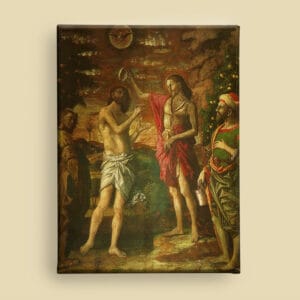
The Baptism of Christ
This majestic altarpiece, now in the Basilica of Sant’Andrea in Mantua, shows Christ standing in the Jordan as John the Baptist pours water over his head. The setting is one of Mantegna’s characteristic rocky landscapes, the stone cliffs carved with archaeological precision, the river barely visible between the banks. The figures have the solid, sculptural weight that Mantegna brought to every sacred subject, and the light falls on them with the clarity of an ancient relief. The composition is monumental and austere, appropriate to the sacramental gravity of the scene.

The Adoration Scenes
Adoration of the Shepherds
The Adoration of the Shepherds at the Metropolitan Museum of Art in New York is a small-scale devotional work of great intimacy. The infant Jesus lies on the bare ground before the kneeling Virgin, while shepherds approach with simple reverence. Behind them, Mantegna’s characteristic rocky landscape opens into a sky of pale blue. The handling is delicate and precise, the figures smaller than in his monumental altarpieces but no less firmly modeled.

The Adoration of the Magi
The Adoration of the Magi at the J. Paul Getty Museum in Los Angeles is one of Mantegna’s most original compositions. Rather than the traditional standing figures before a stable, Mantegna places the scene in a rocky grotto, the figures pressed close in an almost claustrophobic space. The three kings present their gifts in vessels of ancient Roman design, and the procession behind them extends into a landscape of carved stone. The Holy Family is at the left, the infant Christ reaching toward the golden vessel with the unselfconscious gesture of a real child.

Monumental Altarpieces
San Zeno Altarpiece
The San Zeno Altarpiece, painted between 1456 and 1459 for the Basilica of San Zeno in Verona, was Mantegna’s first great monumental commission and remains in its original location. The triptych shows the Virgin and Child enthroned in the center, surrounded by saints who inhabit a painted architectural space that continues, illusionistically, the real carved wooden frame. It was the first Italian altarpiece to use this device, and it was enormously influential. The predella panels, showing the Agony in the Garden, the Crucifixion, and the Resurrection, are now replaced by copies; the originals are in the Louvre and the Musée des Beaux-Arts in Tours.

San Luca Altarpiece
The San Luca Altarpiece, now in the Pinacoteca di Brera in Milan, was painted around 1453–1454 for the Benedictine abbey of Santa Giustina in Padua. The polyptych shows saints arranged in individual panels above a predella, in the older format that Mantegna would soon supersede with the unified compositions of the San Zeno altarpiece. The figures nonetheless already show his characteristic sculptural authority and archaeological precision.

Madonna della Vittoria
The Madonna della Vittoria, painted in 1496 and now in the Louvre, was commissioned by Francesco II Gonzaga to commemorate his dubious “victory” at the Battle of Fornovo the previous year. The Virgin and Child appear in a garden pergola, surrounded by saints and with the kneeling Gonzaga below. Mantegna orchestrates the figures with ceremonial precision, the architectural canopy of greenery and coral forming a sacred space that is simultaneously a throne room and a garden. It was carried in procession through the streets of Mantua before being installed in the church built to receive it.

Sacred Figures and Narratives
Presentation at the Temple
The Presentation at the Temple in the Gemäldegalerie in Berlin shows the infant Jesus being presented to Simeon in the Temple of Jerusalem. The scene is compressed: figures pressed close together in a shallow space, their faces individualized and their gazes directed toward the child with the concentrated attention that Mantegna gave to all sacred moments. Simeon’s face, ancient and expectant, holds the emotional weight of the image.

Death of the Virgin
The Death of the Virgin in the Museo del Prado in Madrid presents the scene of Mary’s dormition, her peaceful death surrounded by the apostles, as a frieze of ancient sculptural gravity. Behind the gathered figures, a window opens onto a harbor landscape of Mantua, with its lakes and towers, the real world intruding on the sacred scene with characteristic Mantegnesque precision. The Apostles are arranged with the formal solemnity of Roman relief sculpture, yet their grief is entirely human.

Judith and Holofernes
The Judith and Holofernes at the National Gallery of Art in Washington shows the biblical heroine in the act of placing Holofernes’ severed head into a sack held by her maidservant. Mantegna renders the scene with the coolness of a classical relief: Judith’s face is impassive, her gesture efficient. There is no horror and no triumph, only the quiet competence of a woman carrying out what has to be done. The handling of the figures in grisaille (monochrome gray imitating stone) makes the classical reference explicit.

Saint George
The panel showing Saint George at the Gallerie dell’Accademia in Venice depicts the warrior saint standing before a rocky landscape, his foot on the dragon’s severed head, his lance broken. The figure is columnar and still, armor painted with meticulous archaeological precision, the warrior’s face calm and direct. Behind him the landscape is Mantegna’s characteristic carved stone world, and in the distance the towers of a city rise against the sky. It is a portrait of Christian courage expressed through the vocabulary of ancient heroic sculpture.

Summary of Andrea Mantegna’s Paintings
| Painting | Date | Location |
|---|---|---|
| Adoration of the Shepherds | c. 1450 | Metropolitan Museum of Art, New York |
| Baptism of Christ | c. 1506 | Basilica of Sant’Andrea, Mantua |
| Death of the Virgin | c. 1462 | Museo del Prado, Madrid |
| Judith and Holofernes | c. 1495 | National Gallery of Art, Washington |
| Lamentation of Christ | c. 1480 | Pinacoteca di Brera, Milan |
| Madonna della Vittoria | 1496 | Louvre, Paris |
| Presentation at the Temple | c. 1454 | Gemäldegalerie, Berlin |
| Saint George | c. 1460 | Gallerie dell’Accademia, Venice |
| San Luca Altarpiece | c. 1453–54 | Pinacoteca di Brera, Milan |
| San Zeno Altarpiece | 1456–59 | Basilica of San Zeno, Verona |
| The Adoration of the Magi | c. 1495–1505 | J. Paul Getty Museum, Los Angeles |
| The Agony in the Garden | c. 1458–60 | National Gallery, London |
Important Facts about Andrea Mantegna
- Born: 1431 in Isola di Carturo, near Padua; apprenticed from a young age to Francesco Squarcione in Padua, where he grew up among ancient Roman casts and antiquities.
- Training: Squarcione’s workshop instilled in Mantegna a lifelong passion for classical antiquity; he was also deeply influenced by the Florentine sculptor Donatello, who worked in Padua in the 1440s and 1450s.
- Style: Distinguished by sculptural hardness of form, archaeological precision in architecture and costume, extreme foreshortening, and a palette dominated by stone-like grays and cool blues.
- Major work: The fresco decoration of the Camera degli Sposi in the Palazzo Ducale in Mantua (completed 1474) is considered his greatest achievement, the first fully illusionistic ceiling painting in Western art, with a painted oculus opening to a fictive sky.
- Death: Died in Mantua on 13 September 1506. He was court painter to the Gonzaga for nearly fifty years, and his studio in Mantua was a center of humanist learning and artistic production.
Frequently Asked Questions about Andrea Mantegna
What is foreshortening and why is Mantegna famous for it?
Foreshortening is the technique of depicting an object or figure as it would appear when seen at a sharp angle, compressing its apparent length to create a convincing illusion of depth. Mantegna mastered this technique more completely than any painter of his generation. His Lamentation of Christ is the most famous example: the dead Christ seen from directly below his feet, his body compressed into a foreshortened form that forces the viewer into a visceral confrontation with mortality. The technique requires both geometric understanding and the courage to subordinate traditional figure proportions to optical truth.
What is the Camera degli Sposi?
The Camera degli Sposi (Chamber of the Spouses) is a room in the Palazzo Ducale in Mantua that Mantegna decorated with frescoes between 1465 and 1474 for the Gonzaga family. The walls show scenes of the Gonzaga court, the marquis receiving a letter, greeting the Holy Roman Emperor, painted with a new illusionism that makes the room appear to extend beyond its physical walls. The ceiling is painted with the first fully illusionistic oculus in Western art: a circular opening to a fictive sky, from which figures and a pot of flowers peer down at the viewer. It is the ancestor of every illusionistic ceiling painted in the following three centuries.
How did Mantegna’s work influence later painters?
Mantegna’s influence was enormous and reached across Europe. His prints, he was one of the first Italian painters to make printmaking a serious part of his practice, circulated widely and introduced his compositional ideas to artists who never visited Italy. Albrecht Dürer copied his work during his Italian journeys. His foreshortening experiments were studied and extended by Correggio. His archaeological approach to ancient Rome influenced an entire tradition of history painting. And his brother-in-law Giovanni Bellini absorbed his formal severity and transformed it into Venetian warmth, one of the most productive artistic relationships of the Renaissance.
Why did Mantegna spend most of his life in Mantua?
In 1459, Ludovico Gonzaga, Marquis of Mantua, invited Mantegna to become his court painter, a position that offered security, prestige, and a steady income in exchange for loyalty and availability. Mantegna accepted and remained in Gonzaga service until his death in 1506, despite attempts by other patrons, including Pope Innocent VIII, to claim his services. The Gonzaga were demanding but generous patrons, and Mantua gave Mantegna the stability to produce his most ambitious work, including the Camera degli Sposi and the great Triumphs of Caesar series (now at Hampton Court).
What is the relationship between Mantegna and Giovanni Bellini?
They were brothers-in-law: Mantegna married Nicolosia Bellini, daughter of Jacopo Bellini and sister of Giovanni. The two painters knew each other well and almost certainly influenced each other, though they developed in contrasting directions, Mantegna toward sculptural hardness and archaeological severity, Bellini toward atmospheric warmth and luminous color. Both painted the Agony in the Garden around the same time (c. 1458–1460), and comparing the two versions reveals how different their sensibilities were, even when working from identical sources.
Can you buy Andrea Mantegna paintings as canvas prints?
You can buy them at jesuschrist.pictures, in our shop: see all the Andrea Mantegna canvas prints, ready to hang, in several sizes.


