The Assumption of the Virgin Paintings: 10 Masterpieces You Need to Know
Assumption of the Virgin paintings hold a singular place in Christian art. Few subjects called on painters to reach higher, both spiritually and technically: a woman lifted body and soul into Heaven, attended by angels, witnessed by apostles, bathed in light that no earthly sun could produce. For more than five centuries, from the tiny Flemish panel painted for Queen Isabella of Castile to the thundering altarpieces of Baroque cathedrals, artists returned to this mystery again and again, each time with a different answer to the same impossible question: what does Heaven look like? Celebrated on August 15, the Feast of the Assumption is one of the most solemn dates in the Catholic liturgical calendar. The paintings it inspired are among the most ambitious works in the history of sacred art.

What Is the Assumption? Theology, Iconography, and a 1,500-Year Tradition
The Assumption of the Virgin is the Catholic belief that Mary, at the end of her earthly life, was taken up body and soul into Heavenly glory. It is distinct from the Ascension of Christ, which was Christ’s own act of rising under his own power forty days after the Resurrection. Mary’s Assumption is a passive event: she is received, carried, welcomed. The doctrine was formally defined as Catholic dogma by Pope Pius XII in 1950, but the belief stretches back to the earliest centuries of Christianity, with written accounts appearing as early as the third and fourth centuries.
It is worth distinguishing the Western Assumption from the Eastern Orthodox Dormition, or Koimesis, which emphasizes the death of Mary and her soul being received by Christ before her body is also taken up. Western painters generally avoided depicting the death itself and concentrated instead on the moment of ascent, a choice that opened the door to compositions of extraordinary vertical energy and light.
In art, the Assumption developed a remarkably consistent visual vocabulary. Mary rises from an empty tomb, surrounded by angels and cherubs. Below, the apostles cluster around the sarcophagus in shock and awe, often finding it filled with roses where a body should be. Above, God the Father or Christ sometimes appears, ready to receive her. Over the centuries, some painters stripped this formula back, removing the apostles entirely and concentrating purely on Mary in glory. Others expanded it into vast theatrical scenes involving dozens of figures. The result is an extraordinary range of works, from intimate devotional panels to ceiling-high altarpieces.

The Renaissance: Three Visions of Heaven
Michel Sittow: The Jewel of Isabella’s Altarpiece (c. 1500)

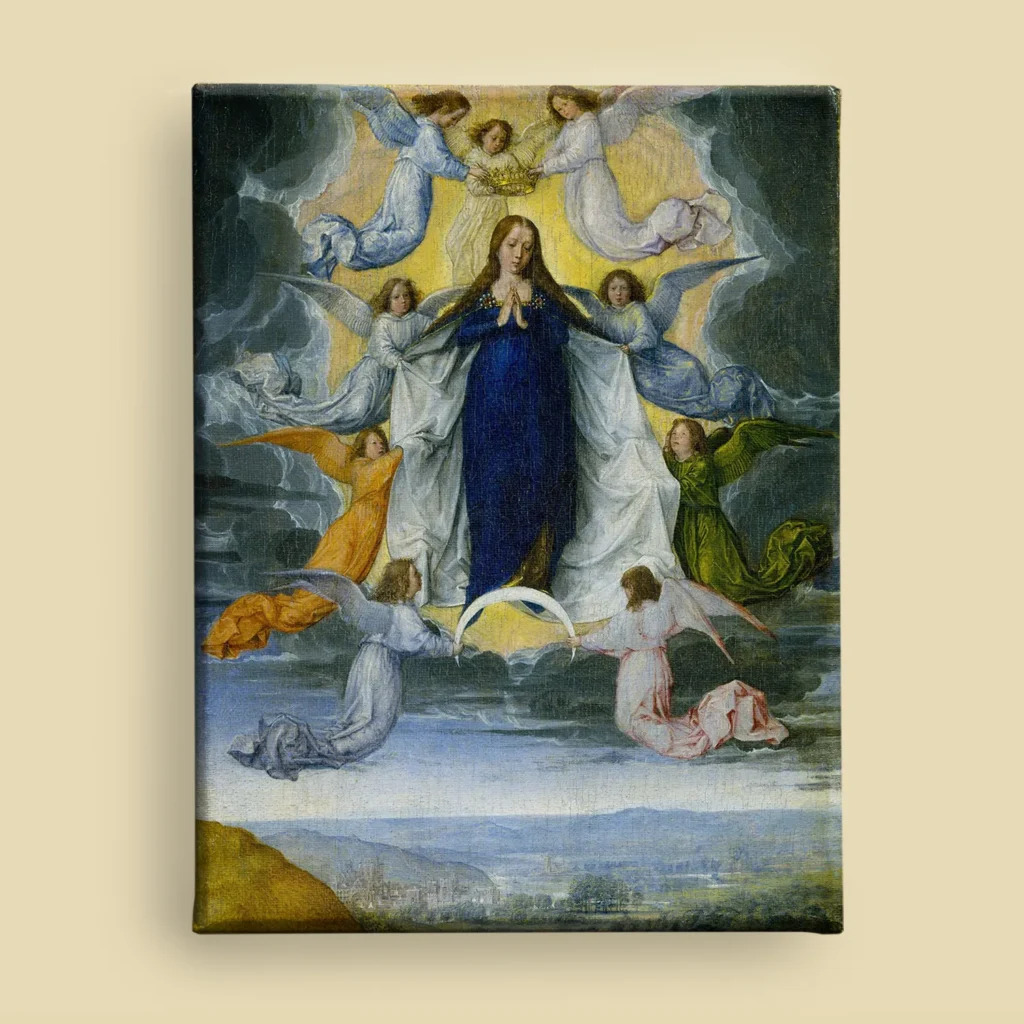
Long before Titian changed everything, a painter from Tallinn created one of the most quietly extraordinary Assumption panels in the history of art. Michel Sittow trained in Bruges under the influence of Hans Memling, then traveled to Spain to serve as court painter to Queen Isabella of Castile. Around 1500, he contributed this small panel, just 21 by 16 centimeters, to a monumental 47-part altarpiece commissioned by Isabella to commemorate the great mysteries of the life of Christ and the Virgin. After Isabella’s death in 1504, the panels were dispersed; this one eventually entered the collection of Margaret of Austria, the Habsburg Regent of the Netherlands, who prized it highly and kept it in a leather-covered frame alongside its companion, the Ascension of Christ.
The painting is now at the National Gallery of Art in Washington, D.C. Mary rises in her deep blue mantle against a stormy, cloud-filled sky, her hands pressed together in prayer, her expression turned inward with absolute serenity. Eight angels in robes of contrasting orange, green, white, and blue carry her upward, while two more above hold a golden crown in readiness. At her feet, a crescent moon curves gently on the clouds. The painting has the jewel-like precision and luminous color that define the best Flemish devotional work of this period. It is one of only two works that can be firmly attributed to Sittow’s own hand, and it remains almost impossibly beautiful for its size.
Pinturicchio: The Umbrian Mandorla (c. 1505-1510)

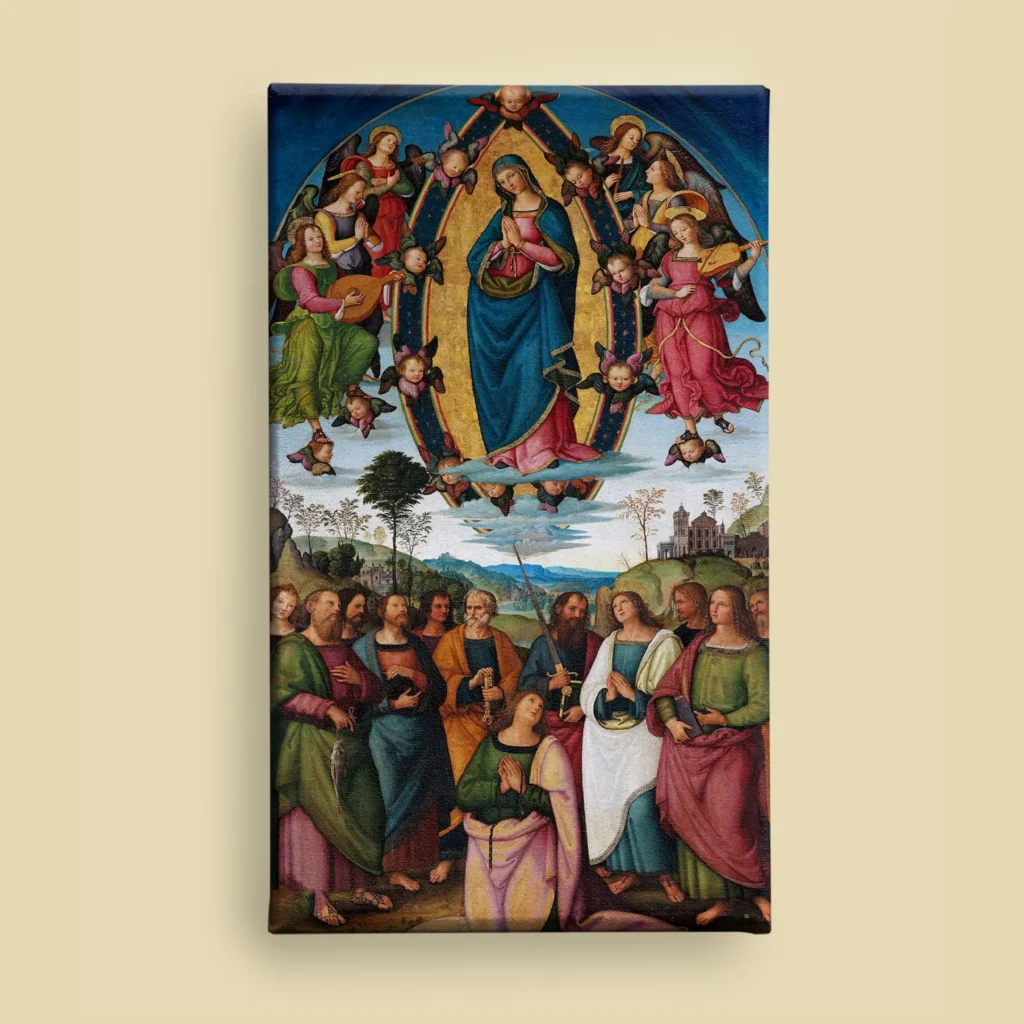
Working in central Italy at roughly the same time, Bernardino di Betto, known as Pinturicchio, painted a very different kind of Assumption. The Umbrian tradition favored the mandorla, the almond-shaped aureole of divine light surrounding the Virgin, and in this panel now at the Museo di Capodimonte in Naples, Pinturicchio built a richly decorated, star-studded version of it that frames Mary like a vision within a vision. She stands calm and vertical at the center, her hands raised in prayer. Around her, a court of music-making angels plays lutes and viols, their robes alive with bright reds, greens, and golds. Below, the apostles and saints respond with a range of gestures that reveal Pinturicchio’s feel for human storytelling. The landscape behind them, with its rolling hills and distant architecture, carries the softness of the Umbrian countryside.
This painting was executed with significant workshop participation, but the conception and the quality of the central figure are clearly the master’s. It is a work full of courtly elegance and radiant faith, characteristic of the world that the young Raphael, who trained alongside Pinturicchio under Perugino, would soon transform entirely.
Giovanni Bellini: The Last Serenity Before the Storm (c. 1510-1515)

There is a quiet irony in the fact that Giovanni Bellini painted his great Assumption just a few years before his own pupil, Titian, would upend everything that Bellini stood for. The two works now hang in the same city, separated by a short walk across Venice. They could not be more different in spirit, and that difference tells the whole story of what the Renaissance was becoming in its final decade.
Bellini’s Virgin in Glory with Saints, now at the Gallerie dell’Accademia in Venice, was painted between 1510 and 1515 for the church of Santa Maria degli Angeli on the island of Murano. At 3.5 meters tall, it is a monumental work, and the ambition of its scale is matched by the ambition of its theology. Bellini makes one striking compositional choice: he replaces the traditional apostles gathered around the empty tomb with a carefully selected group of saints. From left to right, Saint Mark, John the Evangelist, Saint Luke, Francis of Assisi, Louis of Toulouse, Anthony the Great, Augustine of Hippo, and John the Baptist stand in a solemn row, their gazes lifted toward Mary above. It is a heavenly court as much as a historical scene, and the choice reflects the Franciscan and Dominican patronage for which the painting was made.
Above them, Mary rises in her deep blue mantle against a cloud-filled sky, hands pressed together in prayer, her expression entirely still. Two pairs of rosy cherubs hover beside her, and two more appear faintly in the upper corners of the composition. There is no drama, no upward surge, no theatrical light. Bellini gives us instead a calm so complete it feels almost eternal. The landscape behind the saints, with its rolling hills, distant fortifications, and the warm afternoon light of the Venetian mainland, carries the same luminous naturalism that had made Bellini the most admired painter in Venice for half a century. Looking at this painting, and then walking to the Frari to stand before Titian’s Assunta, is one of the great experiences of art history: the before and the after, in the same city, within a few years of each other. The teacher and the student, and between them a world transformed.
Titian: The Painting That Changed Everything (1516-1518)

When the Assunta was unveiled at the Basilica di Santa Maria Gloriosa dei Frari in Venice in 1518, it stunned everyone who saw it. Nothing quite like it had existed before. At nearly seven meters tall, it was the largest altarpiece in Venice, and Titian designed every element with the scale of the building in mind, knowing that viewers would stand thirty meters away, across the long nave of the Gothic church, looking toward the high altar.
The composition divides into three horizontal bands of pure visual energy. At the base, twelve apostles surge and twist around the empty tomb, their garments blazing in red, blue, and green, their arms thrown upward in a surge of astonishment. In the middle, Mary rises on a cloud, her red dress catching the light, her arms spread wide, her face turned toward the gold of Heaven above. At the top, God the Father leans forward through a haze of golden light and cherubs, waiting to receive her. The colors are the richest Titian had yet used. When the young Oscar Wilde saw it housed temporarily at the Accademia, he called it “certainly the best picture in Italy.” More than any other single work, this painting established the visual grammar that Baroque painters would inherit and transform. To see how the Renaissance approached sacred subjects more broadly, our dedicated article covers the major works and artists of the period.
Mannerism: El Greco’s Toledo Vision (1577-1579)

When Doménikos Theotokópoulos arrived in Toledo in 1577, the Spanish city was in the grip of a profound religious seriousness. El Greco had spent years absorbing Titian’s color in Venice and the Mannerist experiments in Rome, and he combined both into an Assumption for the church of Santo Domingo el Antiguo that sits apart from every other treatment of the subject.
The painting is now one of the great works of the Art Institute of Chicago. At nearly four meters tall, it shares with the Assunta a vertical ambition and a tripartite structure, but the mood could not be more different. El Greco’s figures are elongated to an almost supernatural degree. The apostles below look like men caught between grief and rapture. Mary rises in a cloak of brilliant blue and a dress of deep crimson, surrounded by figures that are half-human and half-light. The palette is cold where Titian’s is warm, silvery where Titian’s is gold. It is not a triumphant Assumption so much as a visionary one, a moment torn from the realm of mystical experience and held, trembling, on canvas. The influence of the Byzantine icons El Greco had known in Crete as a young man is still felt here, in the elongation and the refusal to make Heaven comfortable. This was his first major commission in Spain, and it established his reputation immediately. Our article on Spanish Baroque religious painting traces how this tradition developed in the decades that followed.
The Baroque Explosion: Heaven as Theater
Peter Paul Rubens: Antwerp’s Great Altarpiece (1626)

No painter transformed the Assumption into theater more completely than Peter Paul Rubens. His altarpiece for the Cathedral of Our Lady in Antwerp, completed in 1626, is one of the most physically overwhelming works in all of Baroque art. It fills an arched frame more than five meters high with a torrent of figures, color, and movement that seems to press outward against the frame itself.
Rubens introduces a compositional detail that would be widely imitated: two women, traditionally identified as Martha and Mary of Bethany, kneel at the empty sarcophagus and hold out the white burial shroud, now filled with roses. This grounds the miraculous in the human and gives the lower half of the painting a warmth and intimacy that prevents it from becoming purely theatrical. Above, the apostles jostle and point and pray in a crowd of brilliant drapery. And above them all, Mary rises on a cloud of angels, serene amid the chaos, her golden hair loose, her blue mantle billowing, her face tilted upward with an expression of absolute trust. Rubens painted multiple versions of the Assumption throughout his career, but this remains the greatest. It still hangs in the same cathedral it was painted for. Our article on Flemish Baroque religious painting offers more context on Rubens and his circle.
Guido Reni: Serenity Against the Storm (1627)

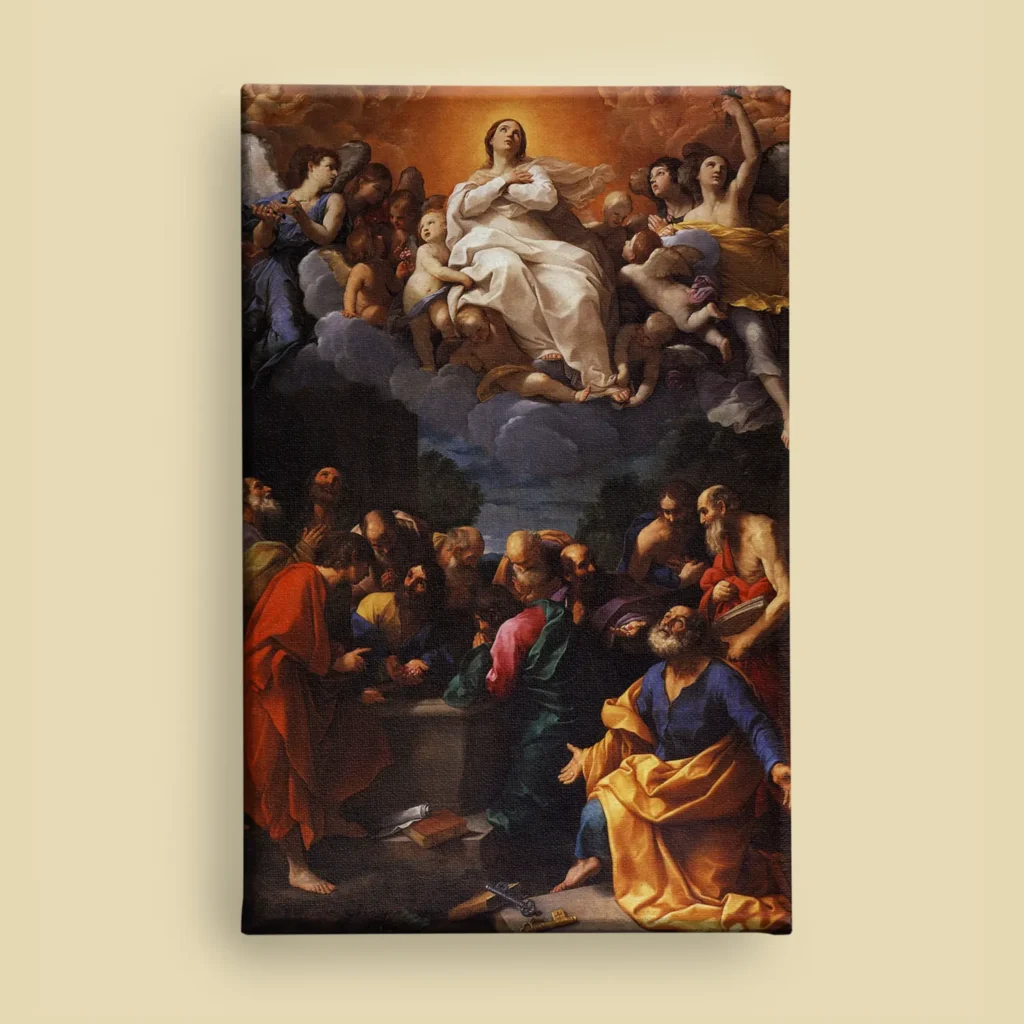
Where Rubens gives us theater, Guido Reni gives us contemplation. His Assumption, completed in 1627 for the church of Santa Maria Assunta in Castelfranco Emilia, is one of the most complete and iconographically rich treatments of the subject in the entire Baroque period. Like Titian, Reni divides his composition between the world of the apostles below and the heavenly realm above, but the emotional register is entirely his own.
Reni’s Mary sits on a cloud in white and gold, her hands folded across her chest, her gaze turned heavenward with an expression of absolute calm. She does not soar; she is received. The sky around her is a warm, stormy amber, shot through with the wings and faces of angels scattering roses. Below, the apostles react with a range of carefully observed gestures, from silent prayer to open astonishment. One can make out the keys of Saint Peter lying on the ground in the foreground. The commission was so well documented that the writer Antonio Masini recorded the miracle reportedly triggered on the day the painting was introduced to the church “with a solemn procession on 16 May.” Reni returned to this subject several times across his career, producing refined later versions now in Lyon and Munich, each one simpler, lighter, and more serene. For more on Reni and his contemporaries, see our article on Baroque religious painting.
Nicolas Poussin: A Classical Mind in Heaven (c. 1626-1632)

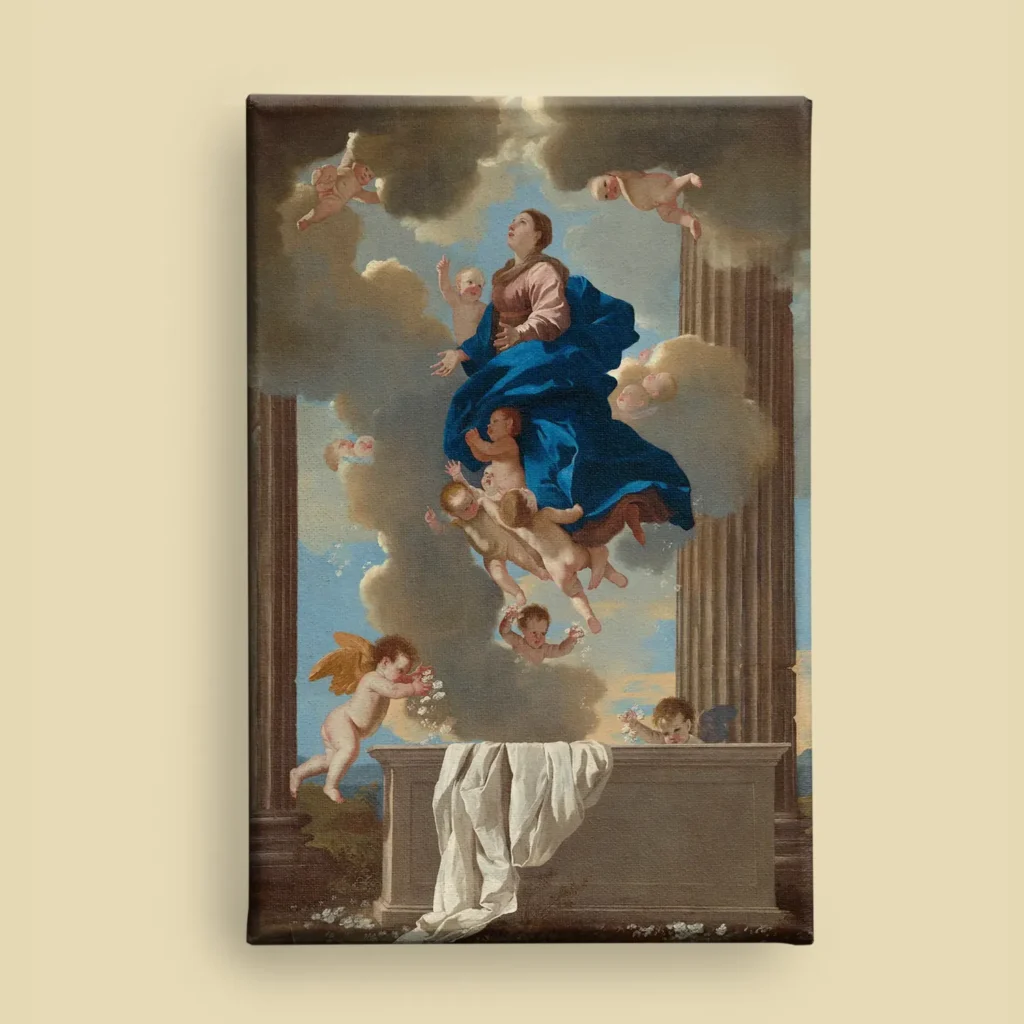
Nicolas Poussin approached the Assumption with the same rational discipline he brought to everything. His version, now at the National Gallery of Art in Washington, D.C., makes one immediately striking choice: there are no apostles. Instead of a crowd of witnesses, Poussin places a stone sarcophagus between two classical columns, a white burial cloth draped over its edge, and several putti scattering flowers on the ground. The human witnesses have, as it were, already gone home. What remains is purely the structure of the event itself.
Mary rises on a cluster of ten putti, her body angled slightly, her face lifted upward, her rose-pink dress and deep blue cloak moving in the celestial air. The palette is cooler than Titian’s or Rubens’s, more controlled and architectural. Every figure, even the weightless baby angels, carries the sculptural clarity that defines Poussin’s approach to sacred subjects. This is not a painting designed to overwhelm with emotion but to satisfy the mind with the order and rightness of its composition. It was painted during Poussin’s early years in Rome, and the influence of Raphael and ancient sculpture is everywhere present. It remains one of the most distinctive Assumption paintings in the Western tradition, precisely because of its deliberate refusal of emotional excess.
Spanish Baroque: Murillo’s Celestial Poetry (c. 1670)

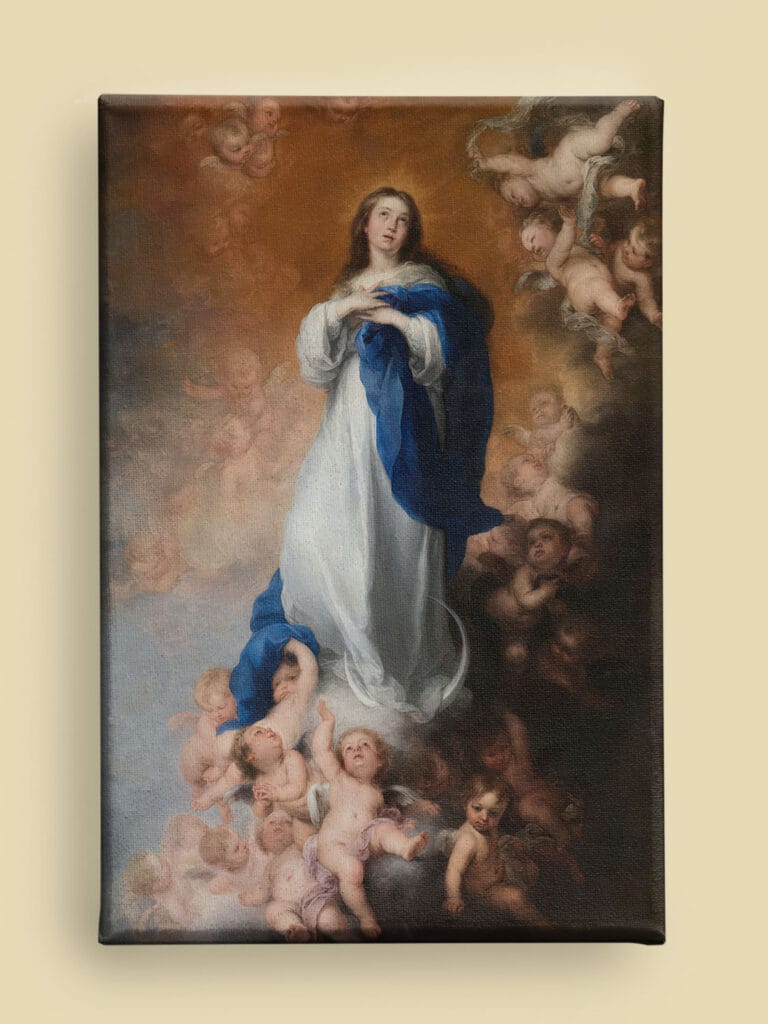
Bartolomé Esteban Murillo spent his entire working life in Seville, and Seville was, in the seventeenth century, the most intensely Marian city in Spain. The doctrine of the Immaculate Conception was a matter of passionate civic pride there, and Murillo painted it more times than almost any other Spanish artist. His approach to the Assumption draws from the same devotional world, and the result, now in the State Hermitage Museum in Saint Petersburg, is one of the most tender treatments of the subject in all of Baroque painting.
Mary rises on a cloudbank of cherubs, her white robe luminous against a sky that fades from deep shadow at the base to warm golden light above. Her deep blue mantle billows behind her. Her arms reach outward and upward, her face turned toward the source of light with an expression that Murillo captures better than almost anyone: not triumph, not ecstasy, but a kind of radiant, trembling surrender. The cherubs below are wonderfully alive, their expressions ranging from effort to adoration to wide-eyed wonder. Murillo had a rare gift for making Heaven feel close rather than remote, warm rather than terrifying. Catherine the Great purchased the painting for the Hermitage and clearly understood what she was buying: a work of extraordinary emotional intelligence, one of the finest Marian paintings of the century.
Murillo’s great Marian subjects were all expressions of the same profound devotion. If this painting has moved you, his celebrated Immaculate Conception of El Escorial works within a closely related iconographic tradition and is available as a canvas reproduction in our shop.
French Baroque: Jean-François de Troy’s Drama of Angels (c. 1720-1740)

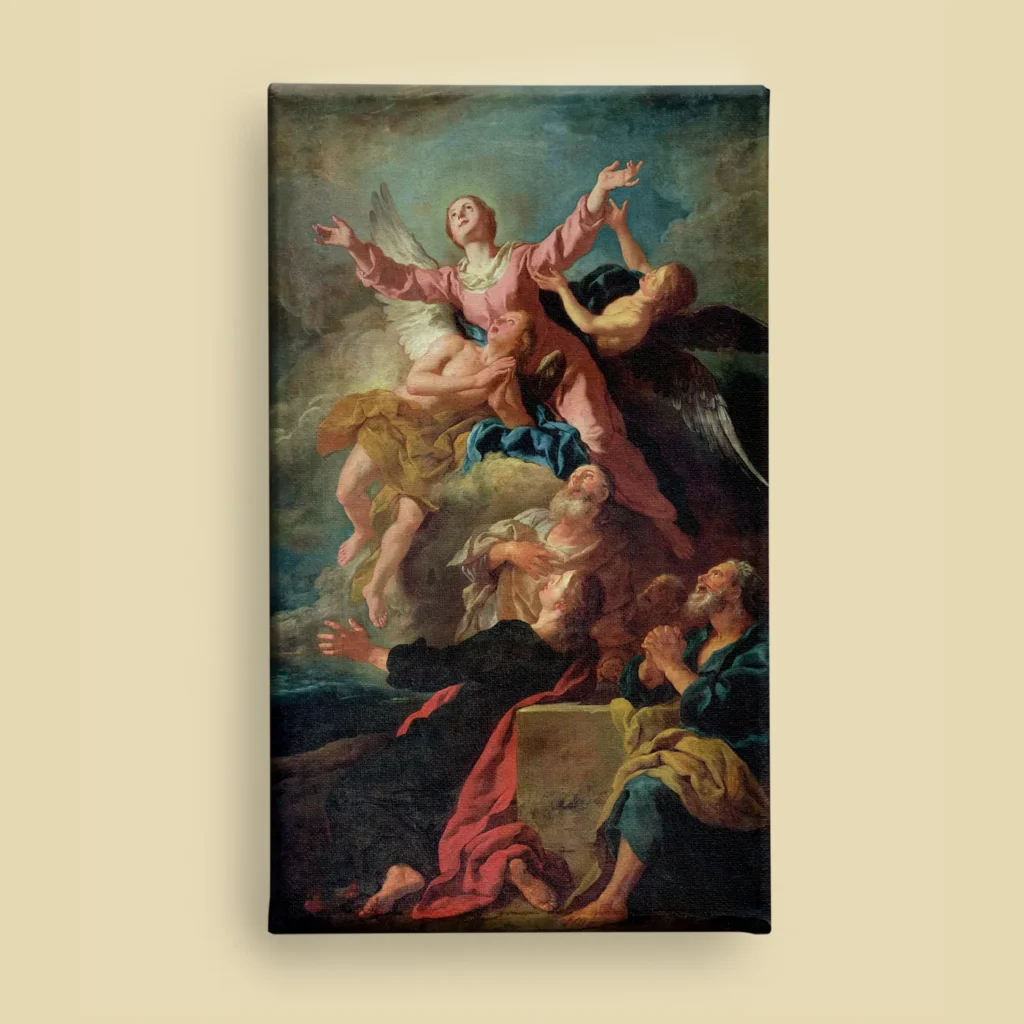
Jean-François de Troy is best remembered today for his elegant genre paintings, his tableaux de mode capturing the fashionable society of early eighteenth-century Paris. But he was also a serious history painter, a director of the Académie de France in Rome, and a painter of large-scale religious compositions that receive far less attention than they deserve. His Assumption, currently in a private collection, is a striking example of a French sensibility applied to a subject that Italians and Flemish painters had largely dominated for two centuries.
The composition is intimate and dramatically compressed. Mary in a rose-pink dress rises steeply toward the top of the canvas, her arms flung wide, her face turned upward in an expression that reads as physical and spiritual release at once. Two large dark-winged angels support and lift her on either side with an urgency that gives the painting an almost kinetic quality, as though the ascent is happening at speed. Below, a small group of figures watches from the ground with a mixture of awe and loss. The color scheme is muted, the light cool and atmospheric in the French manner, nothing like the golden heat of the Italian Baroque. It is an unusual and beautiful treatment of the subject, precisely the kind of work that exists outside the usual canon. That, in the end, is its value.
Summary of the Assumption of the Virgin Paintings Featured in This Article
| Title | Artist | Date | Medium | Museum |
|---|---|---|---|---|
| The Assumption of the Virgin | Michel Sittow | c. 1500 | Oil on panel | National Gallery of Art, Washington D.C. |
| Assumption of the Virgin | Pinturicchio and Workshop | c. 1505-1510 | Tempera on panel | Museo di Capodimonte, Naples |
| Virgin in Glory with Saints | Giovanni Bellini | c. 1510-1515 | Oil on panel | Gallerie dell’Accademia, Venice |
| Assunta (Assumption of the Virgin) | Titian | 1516-1518 | Oil on panel | Basilica di Santa Maria Gloriosa dei Frari, Venice |
| The Assumption of the Virgin | El Greco | 1577-1579 | Oil on canvas | Art Institute of Chicago |
| Assumption of the Virgin | Peter Paul Rubens | 1626 | Oil on panel | Cathedral of Our Lady, Antwerp |
| Assumption of the Virgin | Guido Reni | 1627 | Oil on canvas | Chiesa di Santa Maria Assunta, Castelfranco Emilia |
| Assumption of the Virgin | Nicolas Poussin | c. 1626-1632 | Oil on canvas | National Gallery of Art, Washington D.C. |
| The Assumption of the Virgin | Bartolomé Esteban Murillo | c. 1670 | Oil on canvas | State Hermitage Museum, Saint Petersburg |
| The Assumption of the Virgin | Jean-François de Troy | c. 1720-1740 | Oil on canvas | Private collection |
Conclusion: A Tradition of Faith, Light, and Ambition
What makes Assumption of the Virgin paintings so enduring is not only their theological subject but the artistic problems they forced painters to solve. How do you depict a body leaving the world? How do you paint Heaven without it looking merely like a very tall room? How do you balance the grief of the witnesses with the joy of the event itself? Every artist in this article answered those questions differently, and every answer teaches us something about both the painter and the world that commissioned and prayed before these works.
Sittow gives us intimacy. Pinturicchio gives us devotional beauty. Titian gives us energy and color that still feel like a revelation after five centuries. El Greco gives us mysticism. Rubens gives us humanity. Reni gives us peace. Poussin gives us order. Murillo gives us tenderness. De Troy gives us something rarer still: a personal vision that sits outside the mainstream and rewards a second look. Taken together, these nine paintings are a survey of Western religious art at its highest ambition, all focused on a single moment of Heaven opening and a woman rising to meet it.
The Assumption also sits at the heart of the broader narrative of Christian art. It follows the arc of the life of Christ in painting and echoes his own Ascension. And it was the Annunciation that began Mary’s story: the moment when Heaven first descended to meet her.
Questions and Answers
What is the Assumption of the Virgin?
The Assumption of the Virgin is the Catholic doctrine that Mary, at the end of her earthly life, was taken up body and soul into Heavenly glory. It was formally defined as a dogma of the Catholic Church by Pope Pius XII in 1950 in the apostolic constitution Munificentissimus Deus, though the belief had been present in Christian tradition for centuries before that. August 15 is celebrated as the Feast of the Assumption, a holy day of obligation in the Catholic Church.
What is the difference between the Assumption and the Ascension?
The Ascension refers specifically to Christ rising into Heaven under his own power forty days after the Resurrection. The Assumption refers to Mary being taken up into Heaven by God at the end of her earthly life. The distinction matters: Christ ascends actively, Mary is assumed passively. In painting, both subjects involve a figure rising toward Heaven with witnesses below, but the Ascension places Christ at the center, while the Assumption gives Mary that role and features the apostles gathered around her empty tomb.
Which is the most famous Assumption of the Virgin painting?
Titian’s Assunta, painted between 1516 and 1518 for the Basilica di Santa Maria Gloriosa dei Frari in Venice, is almost universally regarded as the greatest Assumption painting in the history of art. At close to seven meters tall, it was the largest altarpiece in Venice at the time of its completion, and its influence on the Baroque painters who came after it was enormous. It remains on the high altar of the Frari church, exactly where it was designed to hang, and can still be seen there today.
What is the difference between the Assumption and the Immaculate Conception in painting?
These are two distinct subjects that are sometimes confused because they share certain iconographic elements. The Assumption depicts Mary being taken up into Heaven at the end of her life, typically with an empty tomb and the apostles below. The Immaculate Conception depicts the theological belief that Mary was conceived without original sin, and shows her in a timeless heavenly space, often standing on a crescent moon. Murillo, who painted both subjects with exceptional frequency, sometimes combined iconographic elements of both, but they remain theologically and visually separate subjects.
Where can I find a Virgin Mary canvas reproduction for my home?
Our shop offers a curated selection of Virgin Mary canvas reproductions in Renaissance, Baroque, Byzantine, and Pre-Raphaelite styles. Each piece is produced on high-quality canvas and is ready to hang.
Where can I buy Assumption of the Virgin paintings on canvas?
You can buy Assumption of the Virgin paintings on canvas at jesuschrist.pictures: our shop carries museum-quality canvas reproductions, printed on artist-grade canvas and available in several sizes.