Guido Reni Paintings: Grace, Sorrow, and Baroque Beauty
Guido Reni paintings represent the ideal of Baroque sacred beauty at its most refined and most spiritually elevated. Born in Bologna in 1575, he trained in the Carracci academy that was transforming Italian painting in the 1580s and 1590s, absorbing both the classical tradition of Raphael and the new naturalism that Annibale Carracci was developing. He worked in Rome during his most productive period, where he encountered Caravaggio’s revolutionary approach to light and shadow, absorbed what was useful from it, and then moved in an entirely different direction: toward a beauty of idealized form and a grace of composition that consciously revived the Raphaelesque tradition while giving it a new emotional warmth and spiritual tenderness. His sacred paintings were among the most admired in Europe in the seventeenth century, reproduced in prints and copied by the hundreds, and they defined the standard for Catholic devotional art for generations.

Bologna, Rome, and the Carracci Tradition
Guido’s formation in the Carracci academy in Bologna, the most influential painting school in Italy in the generation after Caravaggio’s revolution, gave him a thorough grounding in both drawing from the antique and drawing from life, in the classical tradition of Raphael and Michelangelo and in the naturalistic tradition of Corregio and the Venetians. He arrived in Rome around 1600 and quickly established himself as one of the leading painters of the papal city, working for Cardinal Pietro Aldobrandini and other major patrons. The competition and contrast with Caravaggio, who was also working in Rome at this time, shaped his development: where Caravaggio’s figures emerge from darkness, Reni’s are immersed in light; where Caravaggio’s emotions are violent and immediate, Reni’s are composed and spiritually elevated. The contrast was recognized and debated in his own time, and both approaches found devoted admirers.
Adoration of the Shepherds
The Adoration of the Shepherds at the Museo Nazionale di San Martino in Naples shows the birth of Christ with the warmth and the luminous beauty that characterize Guido Reni’s approach to sacred narrative. The shepherds gather around the infant in adoration, and the quality of the light, emanating from the child himself, illuminating the faces of the worshippers, gives the scene a devotional warmth that is entirely characteristic of Reni’s sacred painting. The figures are idealized but not cold: the shepherds are real people, their wonder and tenderness genuine.

Annunciation
The Annunciation at the Louvre in Paris shows the angel Gabriel’s greeting to the Virgin Mary with a grace of composition and a luminosity of color that reflect Guido’s debt to Raphael. The two figures, angel and Virgin, are placed in a balanced compositional relationship, their interaction expressed through posture and expression with the decorous clarity that Guido inherited from the classical tradition. The quality of the light, soft and all-encompassing rather than dramatically directional, creates the serene, heavenly atmosphere that distinguishes his approach from Caravaggio‘s tenebrism.

Assumption of the Virgin Mary
The Assumption of the Virgin Mary at the Alte Pinakothek in Munich shows the Virgin rising to heaven in the warm golden light that Guido used for celestial subjects. The figure of the ascending Mary is surrounded by putti and angels, and the composition has the upward sweep and the luminous atmosphere that Guido excelled at for heavenly visions. The painting is one of the finest expressions of his mature style, combining the classical clarity of Raphael with the warm, suffused light that he developed as his own contribution to the tradition of sacred painting.


Massacre of the Innocents
The Massacre of the Innocents at the Pinacoteca Nazionale di Bologna, painted around 1611, is one of Guido Reni’s most dramatic and most technically accomplished works. The scene of Herod’s soldiers killing the infant sons of Bethlehem, a scene of violence that most painters rendered with dramatic horror, is treated by Guido with an unusual compositional calm: the figures of the mothers and soldiers are arranged in a frieze-like pattern that recalls antique relief sculpture, and the suffering is expressed through poses of classical grandeur rather than explicit agony. The result is a painting in which the horror of the subject is held in tension with a formal beauty that reflects Guido’s conviction that art should elevate even its most painful subjects.

Risen Christ
The Risen Christ shows the resurrected Lord in the moment of his triumph over death. Guido gives Christ a luminous physical presence, the body glorified, the wounds visible but no longer suffering, and the expression of the risen figure is one of composed divine authority rather than human emotion. The painting is a characteristic expression of Guido’s approach to sacred subjects: the event is real, the figure has physical presence, but the whole is elevated into an ideal realm that befits the theological significance of the Resurrection.

Saint Francis
The panel of Saint Francis at the Picture Gallery of the Girolamini in Naples shows the founder of the Franciscan order in contemplation or prayer. Francis of Assisi, the mystic whose identification with the suffering Christ led to his receiving the stigmata, the wounds of the Passion, is shown with the warmth and the spiritual tenderness that Guido brought to his treatments of the contemplative saints. The quality of the light on the figure, and the expression of interior absorption, are characteristic of Guido’s devotional paintings of individual saints.

Saint Matthew and the Angel
The Saint Matthew and the Angel at the Pinacoteca Vaticana shows the evangelist receiving divine inspiration as he writes the Gospel. The angel leans toward Matthew with the words of the divine message, and the evangelist looks up from his writing with an expression that combines the effort of intellectual work with the receptivity of divine inspiration. The composition is close to Caravaggio’s treatment of the same subject at San Luigi dei Francesi, but Guido’s approach is entirely different: where Caravaggio shows a working man with dirty feet, Reni shows an idealized figure in a luminous setting.

Saint Sebastian
The Saint Sebastian at the Capitoline Museums in Rome is one of Guido Reni’s most celebrated and most frequently reproduced images. The young Roman martyr, stripped of armor, his wrists bound above his head, his body pierced by arrows, is shown with an ideal physical beauty and a facial expression of composed spiritual transcendence that seems entirely at odds with the physical suffering he is undergoing. This paradox, beauty in the midst of suffering, spiritual peace in the midst of physical agony, is the theological content of the image, and Guido’s ability to hold the two registers simultaneously is the key to the painting’s power. Stendhal famously fainted before this painting, overcome by what he described as an excess of beauty.


St Joseph with Infant Christ in his Arms
The tender image of St Joseph with Infant Christ in his Arms at the Hermitage Museum in St. Petersburg shows the guardian father of the Holy Family holding the Christ child with the warmth and protectiveness of a real father with a real child. Joseph was a figure whose relationship to the sacred family Guido treated with particular attention: the carpenter of Nazareth, the man who protected and raised the Son of God without being his father, occupies a theologically complex position that Guido renders through the quality of the human relationship between the two figures.

The Baptism of Christ
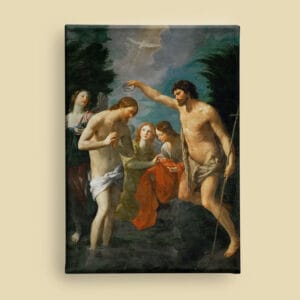
The Baptism of Christ at the Kunsthistorisches Museum in Vienna shows the moment at the Jordan River when Christ receives baptism from John and the Holy Spirit descends. Guido renders the scene with his characteristic luminosity: the light that illuminates the two central figures has a divine quality, soft and all-encompassing, that differs from both natural light and the dramatic torchlight of Caravaggio. The dove of the Holy Spirit, and the voice of God implied by the parting of the heavens, are suggested through the quality of the light rather than through explicit representation.

Summary of Guido Reni’s Paintings
| Painting | Date | Location |
|---|---|---|
| Adoration of the Shepherds | c. 1640 | Museo Nazionale di San Martino, Naples |
| Annunciation | c. 1621 | Louvre, Paris |
| Assumption of the Virgin Mary | c. 1637-42 | Alte Pinakothek, Munich |
| Massacre of the Innocents | c. 1611 | Pinacoteca Nazionale, Bologna |
| Risen Christ | c. 1618-22 | Musee des Arts, Angers |
| Saint Francis | c. 1620 | Picture Gallery of the Girolamini, Naples |
| Saint Matthew and the Angel | c. 1635-40 | Pinacoteca Vaticana, Vatican |
| Saint Sebastian | c. 1615 | Capitoline Museums, Rome |
| St Joseph with Infant Christ in his Arms | c. 1620 | Hermitage Museum, St. Petersburg |
| The Baptism of Christ | c. 1622-23 | Kunsthistorisches Museum, Vienna |
Important Facts about Guido Reni
- Born: 1575 in Bologna; trained in the Carracci academy, the most influential painting school in Italy in the generation after the High Renaissance, which gave him a thorough grounding in both classical and naturalistic approaches to painting.
- Ideal beauty: His approach to sacred subjects was based on the conviction that beauty, ideal, elevated, spiritually refined, was the appropriate medium for the representation of the divine; his figures are not realistic portraits but idealized types that aspire to a perfection beyond ordinary human appearance.
- Rome and Bologna: He divided his career between Rome, where he worked for papal patrons and competed with Caravaggio, and Bologna, where he returned repeatedly and where his influence on local painting was profound; his Aurora fresco in the Casino dell’Aurora in Rome is considered his masterpiece in that medium.
- Influence: His paintings were the most widely reproduced in seventeenth-century Europe through the print trade, and his approach to sacred beauty defined the standard for Catholic devotional art throughout the Baroque period; his influence on religious painting persisted into the nineteenth century.
- Death: Died 1642 in Bologna; his later career was complicated by a serious gambling problem that kept him in permanent financial difficulties, but his artistic output remained substantial until the end.
Frequently Asked Questions about Guido Reni
How does Guido Reni’s approach to sacred subjects differ from Caravaggio’s?
The contrast between Reni and Caravaggio is one of the defining polarities of Baroque sacred painting. Caravaggio worked from life models, showed sacred figures with the physical reality of ordinary people, used dramatic tenebrism to give his scenes the quality of observed events happening in real darkness. Reni worked from the ideal: his figures are not portraits of real people but idealized types, more beautiful, more composed, more spiritually elevated than ordinary humanity. His light is all-encompassing and soft rather than dramatically directional. His sacred figures do not suffer with physical anguish but transcend their suffering through spiritual composure. Both approaches were recognized and celebrated in their own time, and the contrast between them structured the subsequent debate about the proper nature of sacred art.
Why was the Saint Sebastian so famous?
The Saint Sebastian at the Capitoline Museums became one of the most famous images in Baroque Rome for the combination of ideal physical beauty and spiritual transcendence that Reni achieved in the central figure. Sebastian, young, physically perfect, pierced by arrows, looks upward with an expression of composed spiritual peace that seems entirely at odds with his physical situation, and this paradox is the theological content of the image: the body can be destroyed but the soul remains inviolate. The painting was reproduced in prints throughout Europe and became the standard image of the saint. Stendhal’s famous episode of aesthetic overwhelm in front of this painting contributed to the clinical coinage of “Stendhal syndrome”, the physical symptoms of being overcome by great art.
What is the Aurora fresco and why is it important?
The Aurora fresco in the Casino dell’Aurora (now Casino Rospigliosi) in Rome, painted around 1614, shows the goddess Aurora leading the chariot of the sun across the sky, preceded by the Hours and followed by the chariot of Apollo. It is Guido Reni’s most celebrated fresco and one of the key monuments of early Baroque ceiling decoration. The composition, with its clear figures against a luminous sky, was enormously influential on subsequent ceiling painting throughout Europe, and it is still in situ in the casino where it was painted, visible to visitors by appointment.
How was Guido Reni regarded after his own time?
Guido Reni was one of the most admired painters in Europe throughout the seventeenth and much of the eighteenth century; his work commanded the highest prices at auction and was reproduced in prints more widely than that of almost any other Italian artist. His reputation declined sharply in the nineteenth century, when critics influenced by Ruskin found his idealism cold and artificial, his beauty empty. The twentieth century has reassessed him more fairly: his best paintings are now recognized as genuine masterpieces of a specific tradition, works in which the aspiration to ideal spiritual beauty is achieved rather than merely attempted.
Where can the major works of Guido Reni be seen?
The most important concentration is in Bologna, where the Pinacoteca Nazionale holds major works including the Massacre of the Innocents, and several Bolognese churches retain altarpieces in their original settings. In Rome, the Capitoline Museums hold the Saint Sebastian, and the Aurora fresco is in the Casino Rospigliosi. The Louvre in Paris has several important works including the Annunciation. The Alte Pinakothek in Munich holds the Assumption of the Virgin Mary. The Kunsthistorisches Museum in Vienna has the Baptism of Christ. The Hermitage in St. Petersburg holds several panels including the St Joseph with the Infant Christ.
Where can I buy a Guido Reni painting reproduction?
You can buy them at jesuschrist.pictures: browse all the Guido Reni canvas prints in our shop, printed on museum-grade canvas and available in several sizes.