Prayer Before a Crucifix: The Full Text, Its History and Eight Paintings
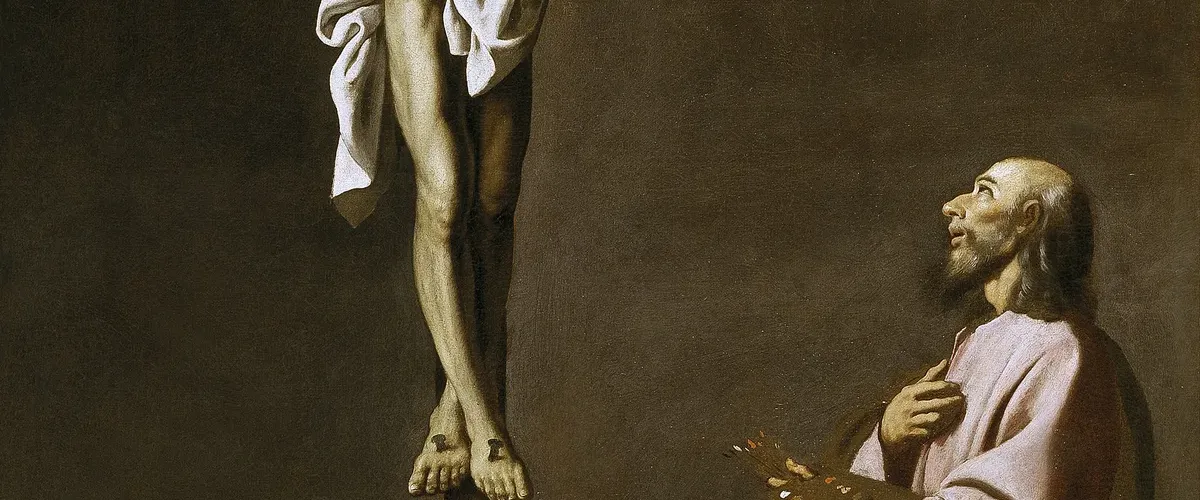
In a dark painting in the Prado, an old man with a palette in his hand kneels at the foot of a cross and looks up. He is Saint Luke, the patron of painters, and some think Zurbaran gave him his own face. He is doing exactly what the prayer before a crucifix asks: kneeling in the sight of Christ crucified, looking at his wounds, and letting what he sees reach his heart. It is one of the most loved prayers of Catholic tradition, said after Holy Communion and on the Fridays of Lent, and it fits on a single card.
This page gives the prayer before a crucifix in full, in its traditional English and in Latin, with its history, its indulgence, its meaning line by line and a free printable prayer card. Each part of the prayer is illustrated by a great painting, from Zurbaran’s Saint Luke to Velazquez’s Christ Crucified.
The Prayer Before a Crucifix: Full Text
This is the traditional American text, from The Catholic’s Pocket Prayer-Book published in New York in 1899 by Archbishop Michael Corrigan:
Behold, O kind and most sweet Jesus, I cast myself upon my knees in Thy sight, and with the most fervent desire of my soul I pray and beseech Thee that Thou wouldst impress upon my heart lively sentiments of faith, hope, and charity, with true repentance for my sins, and a firm desire of amendment, whilst with deep affection and grief of soul I ponder within myself, and mentally contemplate Thy five most precious wounds; having before my eyes that which David spake in prophecy: “They pierced my hands and my feet; they have numbered all my bones.”
Modern prayer books often use a newer translation that begins “Look down upon me, good and gentle Jesus”. The words change, the prayer does not. The older version above is the one on our printable card. The verse at the end is Psalm 21 in the Latin and Douay-Rheims numbering (Psalm 22 in the Hebrew), the psalm whose first words Jesus cried from the cross: “My God, my God, why hast thou forsaken me?”
The Prayer Before a Crucifix in Latin
The Latin text, as printed in Rome in the Raccolta, the official collection of indulgenced prayers:
En ego, O bone et dulcissime Jesu, ante conspectum tuum genibus me provolvo, ac maximo animi ardore te oro atque obtestor, ut meum in cor vividos fidei, spei et charitatis sensus, atque veram peccatorum meorum poenitentiam, eaque emendandi firmissimam voluntatem velis imprimere: dum magno animi affectu et dolore tua quinque vulnera mecum ipse considero ac mente contemplor, illud prae oculis habens, quod jam in ore ponebat suo David propheta de te, O bone Jesu: “Foderunt manus meas et pedes meos; dinumeraverunt omnia ossa mea.”
Where the Prayer Comes From
The prayer is younger than its Latin makes it sound. It was first written in Italian, “Eccomi, o mio amato e buon Gesu”, and spread through the indulgenced prayers collected in Rome in the nineteenth century, the Raccolta. The English translator of the 1857 edition printed the Italian and the Latin side by side and noted that the Latin had added several words of its own: the “most sweet” Jesus, the “lively sentiments”, the “firm desire”.
What made the prayer famous is the indulgence attached to it. The Church grants a plenary indulgence, under the usual conditions of confession, Communion and prayer for the intentions of the pope, to the faithful who devoutly recite it after Communion before an image of Christ crucified on any Friday of Lent, and a partial indulgence on the other days of the year. That is why generations of Catholics have knelt after Mass in front of the crucifix of their church with this text in their missal, and why it is searched for most in March.
It should not be confused with another prayer before a crucifix, the one Saint Francis of Assisi prayed in the ruined chapel of San Damiano around 1205: “Most high, glorious God, enlighten the darkness of my heart”. That prayer is eight centuries older and much shorter; it closes this article.
The Prayer Before a Crucifix in Eight Paintings
Each part of the prayer has been painted by a great master. Here are eight of them, in the order of the words.
1. “I Cast Myself upon My Knees in Thy Sight”: Saint Luke as a Painter before Christ on the Cross by Francisco de Zurbaran (about 1650 to 1655)

Zurbaran painted Christ alone on a plain cross, nailed with four nails against a dark, empty sky, and in the lower right corner, almost pushed out of the frame, an old painter holding his palette, his hand on his heart, looking up. Tradition made Saint Luke the first painter of the Virgin, and the patron of artists; many have seen in this face a self-portrait of Zurbaran himself, near the end of his life. There is no drama, no crowd, nothing between the man and the crucified Christ: it is the very position the prayer describes, kneeling in his sight. The canvas is in the Prado.
2. “Lively Sentiments of Faith, Hope, and Charity”: The Cardinal and Theological Virtues by Raphael (1511)
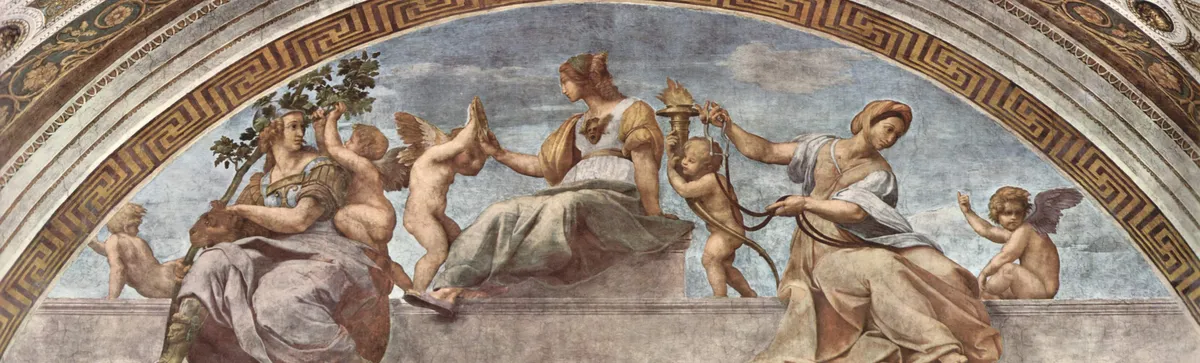
The first thing the prayer asks for is the three theological virtues, the gifts by which the soul is turned toward God. Raphael painted them in the Vatican, in the lunette above a window of the Stanza della Segnatura: three seated women stand for the cardinal virtues of Fortitude, Prudence and Temperance, while small winged children around them play the parts of Faith, Hope and Charity. It is a lesson in theology made light and graceful, painted for the library of Pope Julius II.
3. “With True Repentance for My Sins”: The Tears of Saint Peter by El Greco (about 1580 to 1589)
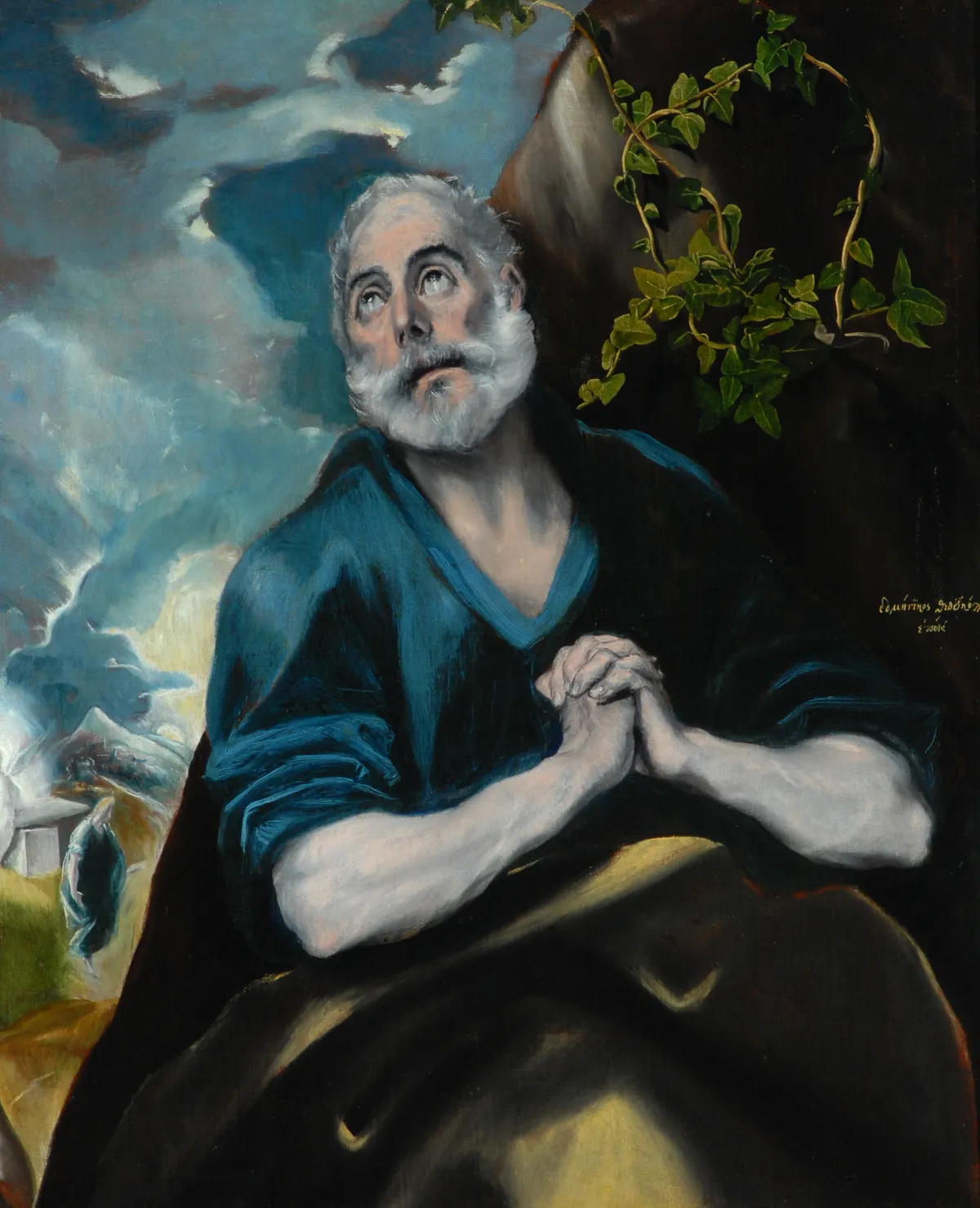
No saint wept for his sins more famously than Peter, who denied Jesus three times on the night of his arrest and, when the cock crew, “went out and wept bitterly”. El Greco painted this subject more than any other: the old apostle, his hands clasped, raises his reddened eyes to heaven, his keys hanging at his belt, while in the distance an angel announces the Resurrection to Mary Magdalene at the empty tomb. Repentance and hope in one picture. This early version is in the Bowes Museum at Barnard Castle, in England.
4. “With Deep Affection and Grief of Soul”: Christ Embracing Saint Bernard by Francisco Ribalta (about 1625 to 1627)
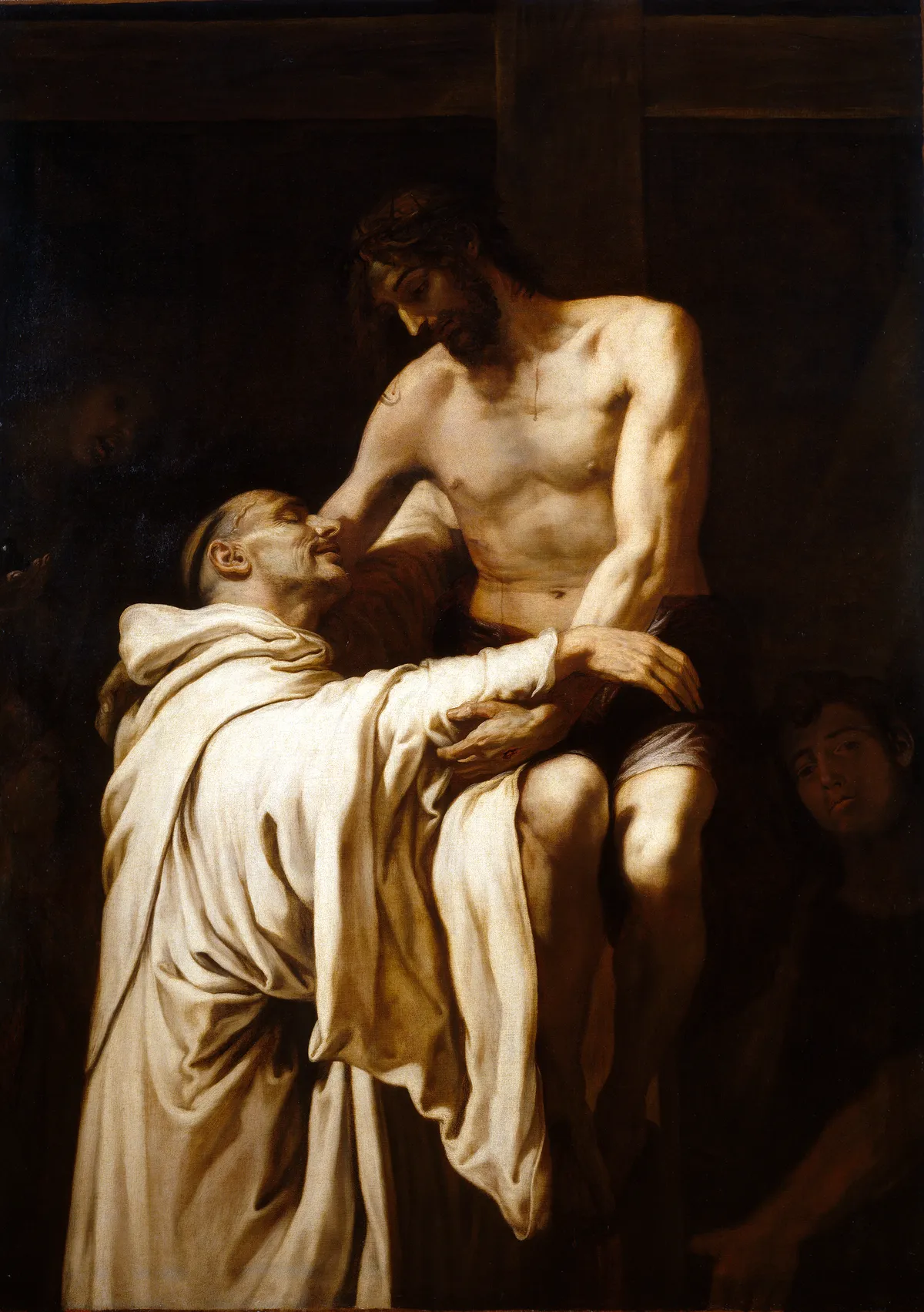
What happens when someone prays before a crucifix with all his heart? Francisco Ribalta, a Catalan painter who worked in Valencia, answered with a vision told of Saint Bernard of Clairvaux: as the monk knelt before the crucifix, Christ detached his arms from the cross and leaned down to embrace him. Ribalta paints the moment in near darkness, the white habit of the Cistercian against the pale body of Christ, the saint’s eyes closed, Christ’s head bent tenderly over him. It is the “deep affection” of the prayer answered from the cross. The canvas is in the Prado.
5. “Thy Five Most Precious Wounds”: Christ Crucified by Diego Velazquez (about 1632)
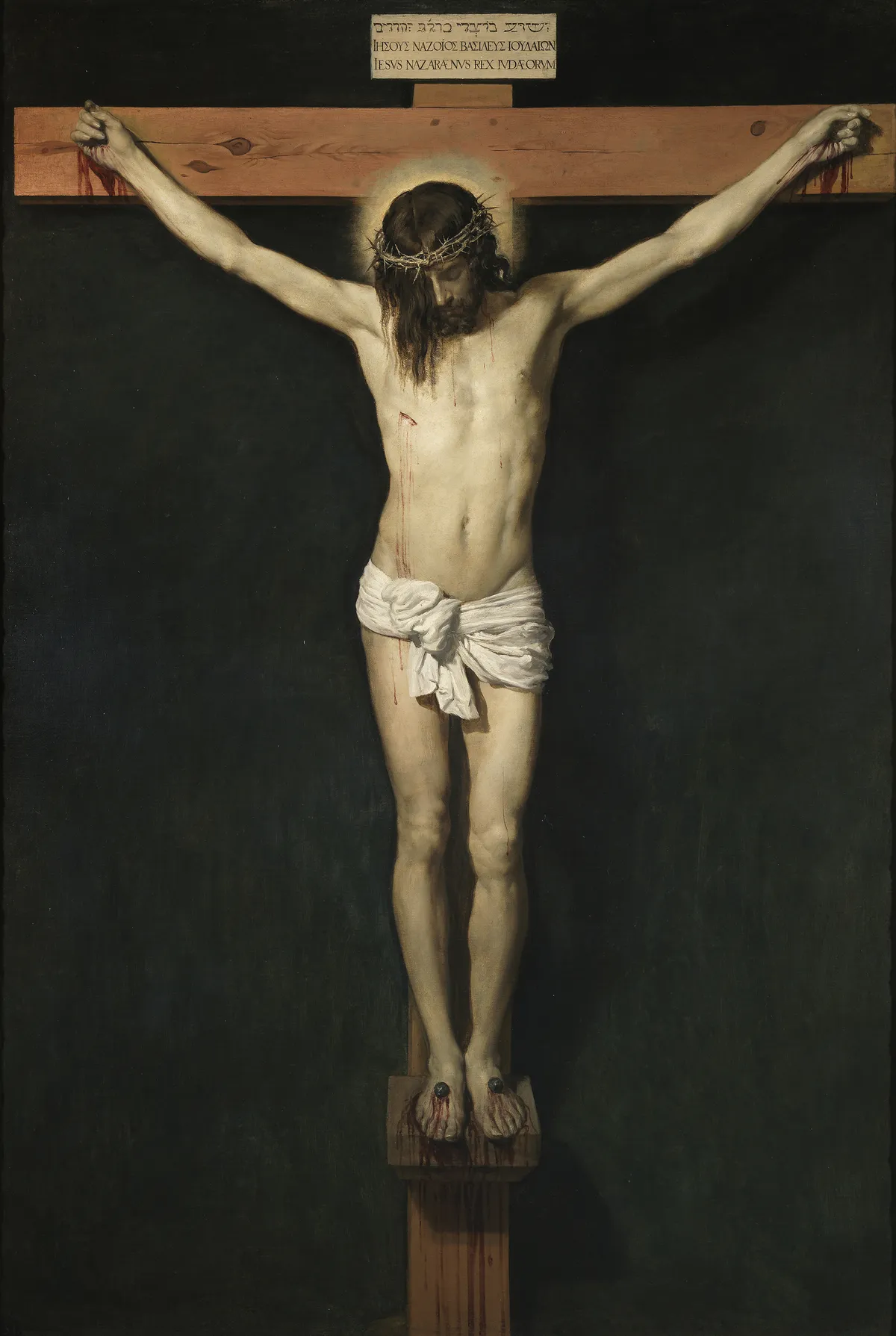
The heart of the prayer is the contemplation of the five wounds, and no painting lets us look at them more quietly than this one, the painting of our printable card. Velazquez set Christ alone against a dark ground, with four nails instead of the usual three, the feet resting on a small wooden support, the head fallen forward and half veiled by the hair. The wound in the side bleeds gently. There is no anguish in the figure, only stillness, which is exactly what makes it a picture to pray before. It was painted for the convent of San Placido in Madrid and is now in the Prado. Read the full story of Velazquez’s Christ Crucified.
6. “They Pierced My Hands and My Feet”: The Crucifixion of the Isenheim Altarpiece by Matthias Grunewald (1512 to 1516)

Velazquez shows the wounds in peace; Grunewald shows them as the psalm describes them. His Christ hangs from a cross that bends under the weight, the fingers clawed around the nails, the feet crushed one over the other by a single spike, the body covered with sores. It was painted for the hospital of the Antonite monks at Isenheim, where the sick suffering from a burning disease could see a Christ who suffered as they did. To the left, Mary faints into the arms of Saint John and Mary Magdalene kneels; to the right, Saint John the Baptist points at the cross. The altarpiece is in the Musee Unterlinden in Colmar. Discover the whole work in our article on the Isenheim Altarpiece.
7. A Prayer for After Communion: The Last Communion of Saint Jerome by Domenichino (1614)
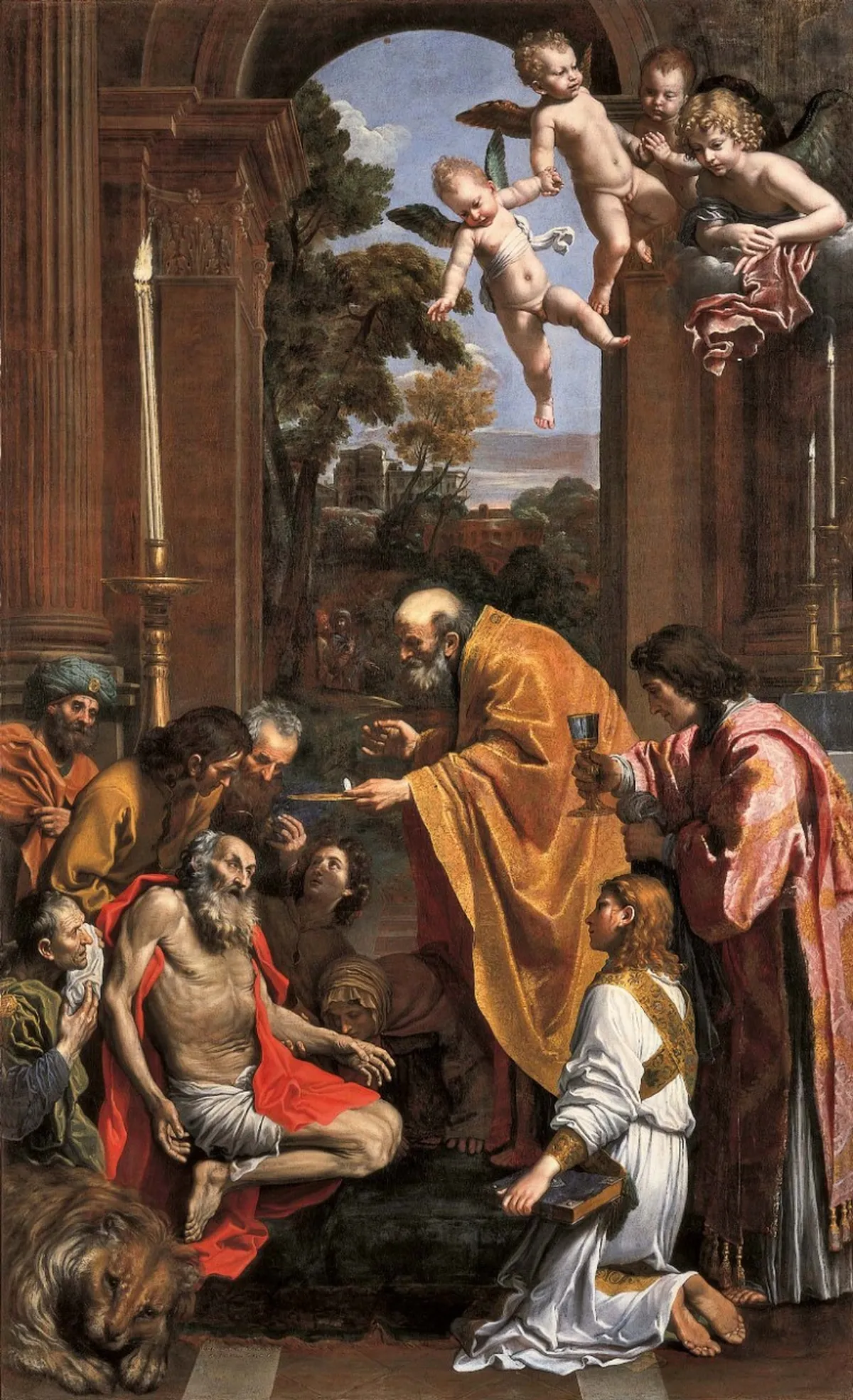
The prayer before a crucifix is above all a thanksgiving after Communion, and few paintings show the weight of that moment like this one. Domenichino painted the aged Saint Jerome, dying in Bethlehem, held up by his companions to receive the Eucharist one last time from a priest in gold vestments, while angels gather overhead and a lion, Jerome’s faithful companion, rests at his feet. The great French painter Nicolas Poussin considered it one of the finest pictures in Rome. It hangs today in the Pinacoteca of the Vatican. For another prayer said after Communion, see the Anima Christi.
8. The Other Prayer Before the Crucifix: The Miracle of the Crucifix at San Damiano, Basilica of Saint Francis, Assisi (about 1297 to 1299)
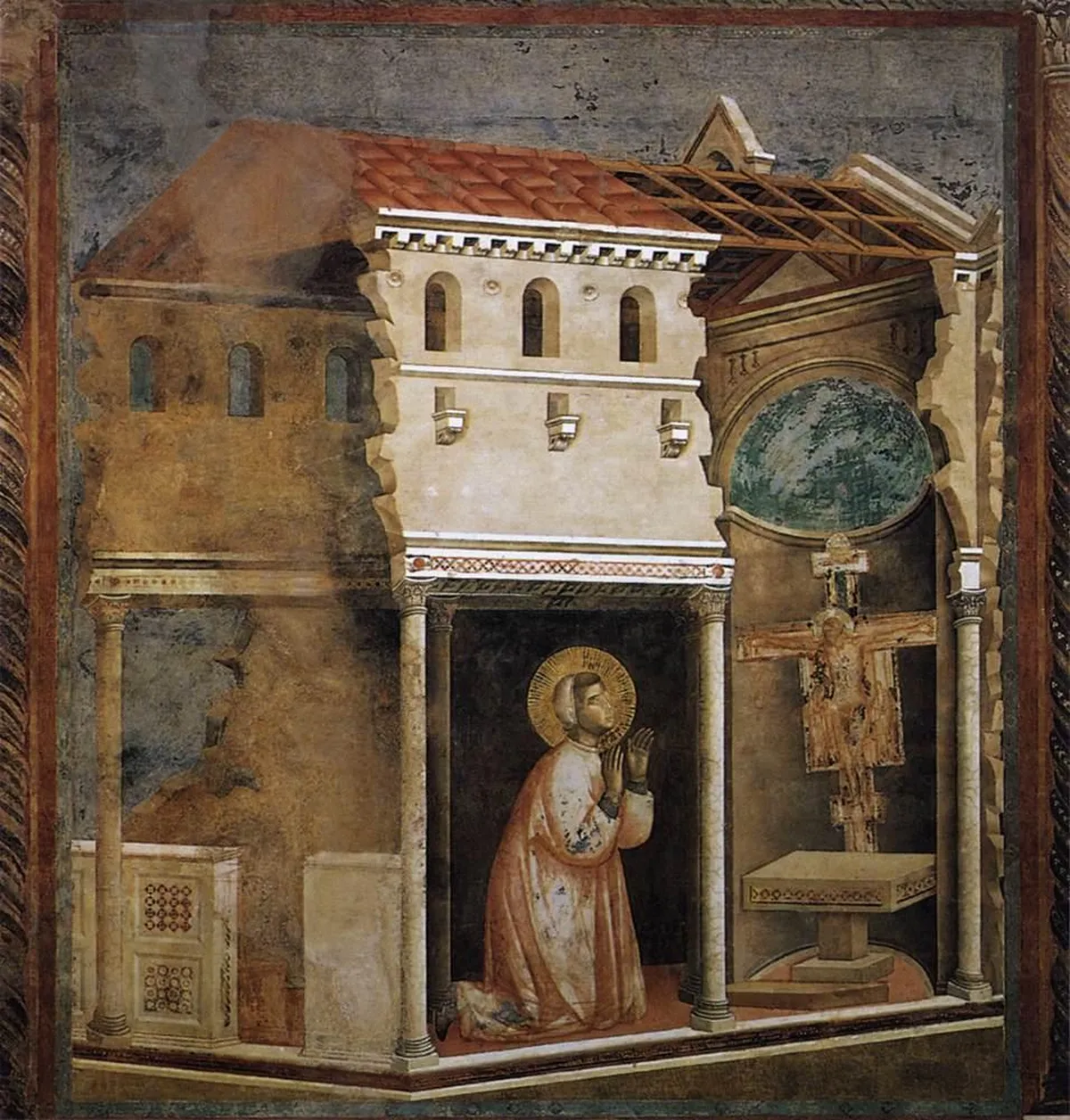
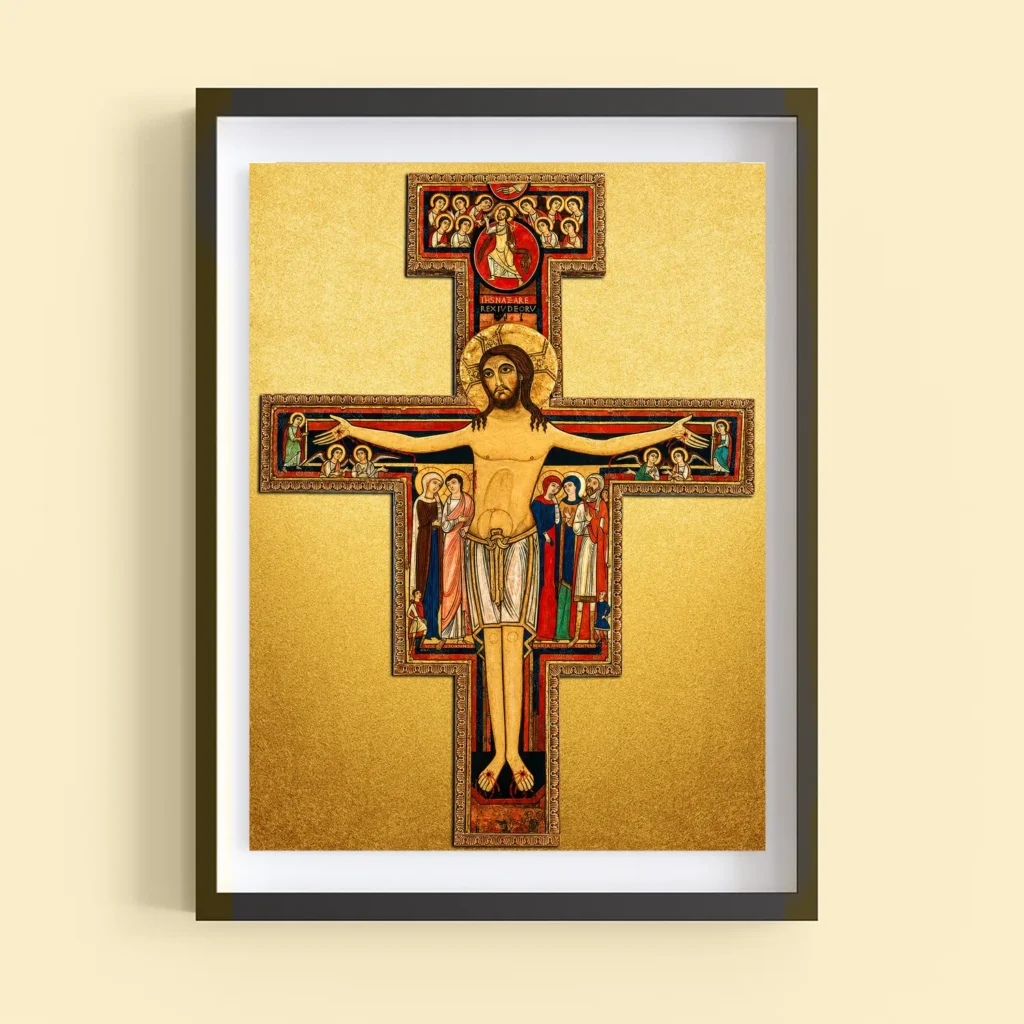
Around 1205, a young man of Assisi named Francis was praying in the half-ruined chapel of San Damiano, below the town, before a painted crucifix. The crucified Christ spoke to him: “Francis, go and repair my house, which, as you see, is falling into ruin.” The fresco of the Legend of Saint Francis in the Upper Basilica of Assisi, traditionally attributed to Giotto, shows him kneeling in the crumbling church, hands raised toward the cross. The short prayer he said there, “Most high, glorious God, enlighten the darkness of my heart”, is the other prayer before the crucifix, and the crucifix itself still hangs in Assisi. Read its story in our article on the San Damiano Cross.
What the Prayer Means, Line by Line
Behold, O kind and most sweet Jesus, I cast myself upon my knees in Thy sight. The prayer begins with the body: kneeling, in front of the crucifix, under the eyes of Christ. It is a prayer to be said looking.
That Thou wouldst impress upon my heart lively sentiments of faith, hope, and charity. To impress is to stamp, like a seal in wax. The prayer asks Christ to mark the heart with the three virtues as the nails marked his own body.
With true repentance for my sins, and a firm desire of amendment. The two parts of every good confession: sorrow for the past and a resolution for the future.
Whilst with deep affection and grief of soul I ponder within myself, and mentally contemplate Thy five most precious wounds. The wounds of the hands, the feet and the side. The prayer does not ask for anything here; it asks only to look, and to keep looking.
Having before my eyes that which David spake in prophecy: “They pierced my hands and my feet; they have numbered all my bones.” A thousand years before the crucifixion, the psalm described it. The prayer ends on Scripture, so that the one who prays sees the cross through the eyes of the prophets.
How to Pray It
- After Communion: kneel before the crucifix of your church after Mass and say it slowly as your thanksgiving.
- On the Fridays of Lent: with the indulgence, it is the classic Lenten Friday devotion, alongside the Stations of the Cross.
- At home: before the crucifix of your bedroom or your prayer corner, each evening of Lent, as part of our Lenten calendar.
- On Good Friday: at the veneration of the cross, or at three in the afternoon.
With children, start by looking at the crucifix together and counting the five wounds: two hands, two feet and the side. Then read the prayer slowly, and let them say the last line with you: “They pierced my hands and my feet.”
A Free Printable Prayer Before a Crucifix Card
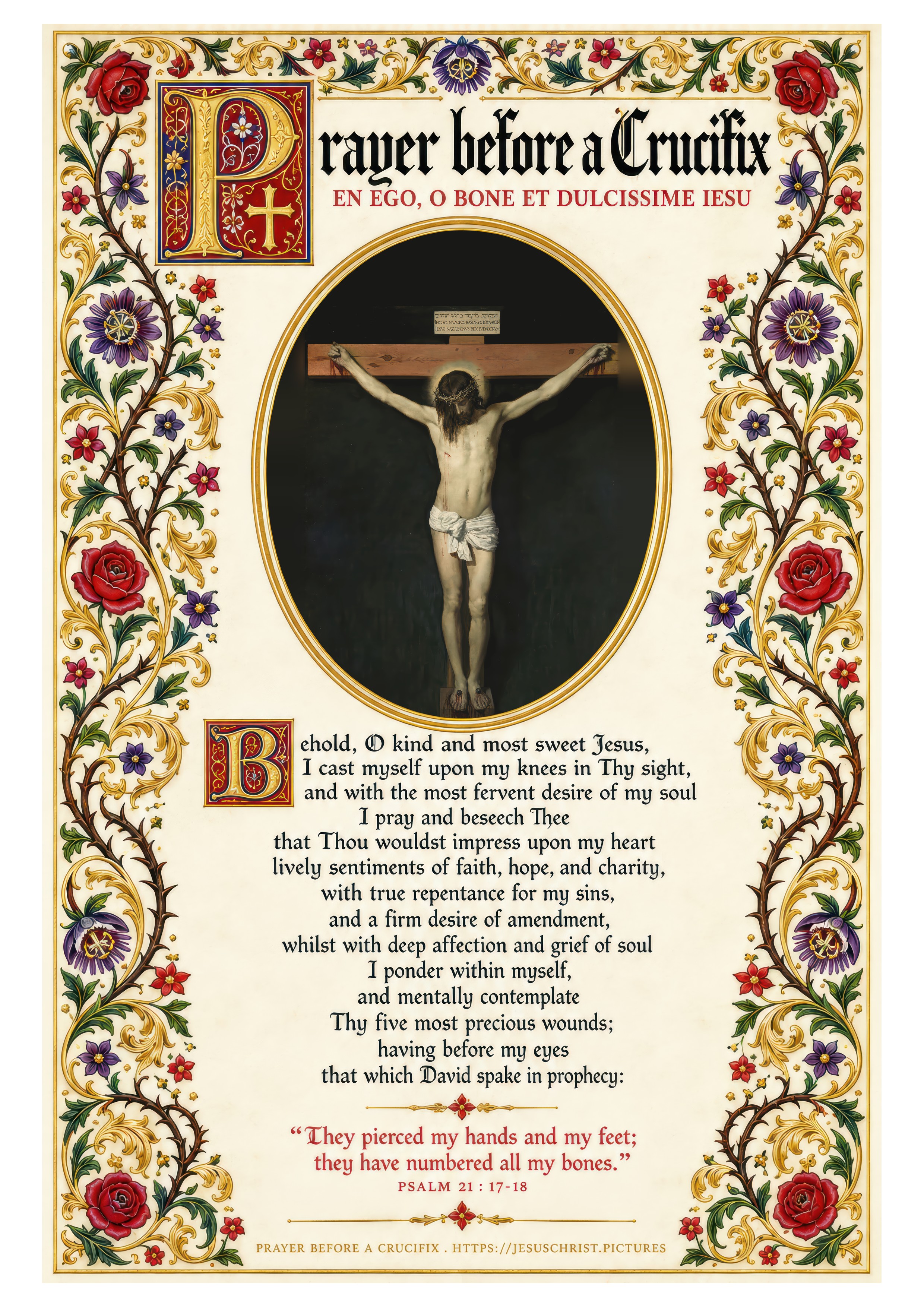
We have made the prayer into an illuminated card in the style of a Spanish book of hours: roses, passion flowers and thorns in the border, a great crimson initial P with a gold cross, Velazquez’s Christ Crucified in an oval medallion, and the verse of the psalm in red.
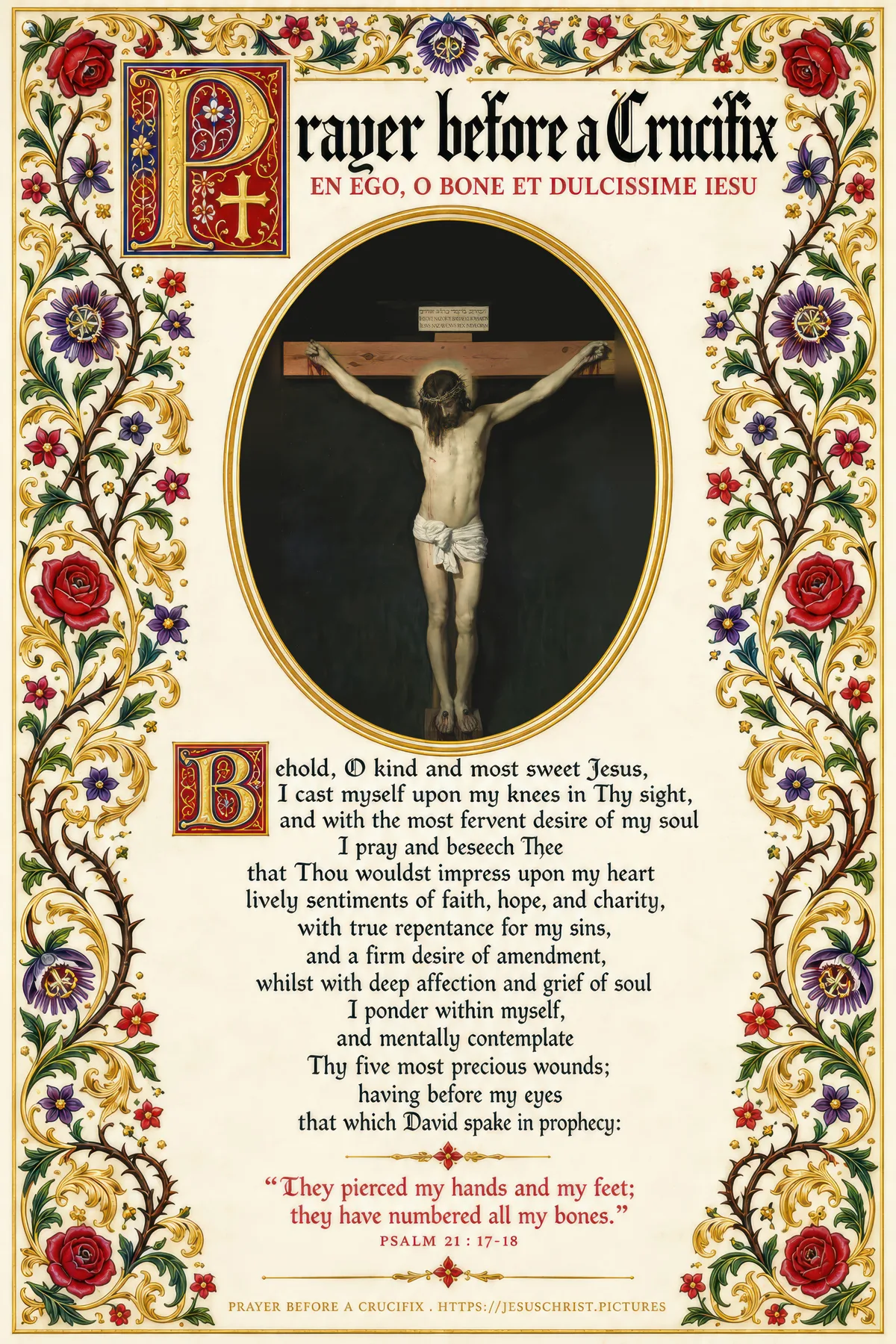
✦ Free Printable Prayer Card
Print it for your missal, your prayer corner or the Fridays of Lent. It is free, and there is nothing to fill in.
Download for US LetterDownload for A4
Also as a high resolution image.
More prayer cards, novenas and Scripture printables are gathered in our free Christian printables.
Conclusion
The prayer before a crucifix asks the simplest thing in the world: to kneel, and to look. Everything else, faith, hope, charity, sorrow and the will to change, is asked of the One being looked at. The painters understood it. Zurbaran put a kneeling painter at the foot of the cross, Raphael gave the virtues a face, El Greco painted the tears of Peter, Ribalta the embrace of Bernard, Velazquez the silent wounds, Grunewald the pierced hands and feet, Domenichino the last Communion of a saint, and the frescoes of Assisi the crucifix that spoke to Francis. Each of them painted what the prayer sees: they pierced my hands and my feet.
For more images of Christ on the cross, see our famous Crucifixion paintings.
The Paintings in This Article
| Words of the prayer | Painting | Artist | Date | Medium | Location |
|---|---|---|---|---|---|
| I cast myself upon my knees | Saint Luke as a Painter before Christ on the Cross | Francisco de Zurbaran | About 1650 to 1655 | Oil on canvas | Museo del Prado, Madrid |
| Faith, hope, and charity | The Cardinal and Theological Virtues | Raphael | 1511 | Fresco | Stanza della Segnatura, Vatican |
| True repentance for my sins | The Tears of Saint Peter | El Greco | About 1580 to 1589 | Oil on canvas | The Bowes Museum, Barnard Castle |
| Deep affection and grief of soul | Christ Embracing Saint Bernard | Francisco Ribalta | About 1625 to 1627 | Oil on canvas | Museo del Prado, Madrid |
| Thy five most precious wounds | Christ Crucified | Diego Velazquez | About 1632 | Oil on canvas | Museo del Prado, Madrid |
| They pierced my hands and my feet | The Crucifixion (Isenheim Altarpiece) | Matthias Grunewald | 1512 to 1516 | Oil on panel | Musee Unterlinden, Colmar |
| After Communion | The Last Communion of Saint Jerome | Domenichino | 1614 | Oil on canvas | Pinacoteca Vaticana, Vatican |
| The other prayer before the crucifix | The Miracle of the Crucifix (Legend of Saint Francis) | Attributed to Giotto | About 1297 to 1299 | Fresco | Basilica of Saint Francis, Assisi |
Important Facts About the Prayer Before a Crucifix
- Its Latin title is En ego, o bone et dulcissime Iesu; it was first written in Italian.
- It is traditionally said after Holy Communion, kneeling before a crucifix.
- A plenary indulgence is granted, under the usual conditions, for reciting it after Communion before a crucifix on the Fridays of Lent; a partial indulgence on other days.
- It contemplates the five wounds of Christ and ends with Psalm 21 (22): “They pierced my hands and my feet.”
- The traditional American English text is that of the Catholic’s Pocket Prayer-Book of 1899: “Behold, O kind and most sweet Jesus”.
- It is different from the short prayer Saint Francis said before the crucifix of San Damiano around 1205.
Frequently Asked Questions
What is the prayer before a crucifix?
It is a short Catholic prayer to Jesus crucified, said kneeling before a crucifix, traditionally after receiving Holy Communion. It begins “Behold, O kind and most sweet Jesus” (in Latin, “En ego, o bone et dulcissime Iesu”), asks for faith, hope, charity, repentance and amendment, and contemplates the five wounds of Christ with the words of Psalm 21: “They pierced my hands and my feet; they have numbered all my bones.”
What indulgence is attached to the prayer before a crucifix?
The Church grants a plenary indulgence, under the usual conditions, to the faithful who devoutly recite this prayer after Communion before an image of Christ crucified on any Friday of Lent, and a partial indulgence on the other days of the year.
When should you say the prayer before a crucifix?
Traditionally after Holy Communion, kneeling before a crucifix, as a thanksgiving. Many people also say it on the Fridays of Lent, on Good Friday, or each evening before the crucifix in their home.
What is the difference between a cross and a crucifix?
A cross is the bare cross; a crucifix bears the figure of Christ crucified. This prayer is said before a crucifix because it asks the one who prays to look at the body of Christ and contemplate his five wounds.
Is the prayer before a crucifix the same as Saint Francis’s prayer before the crucifix?
No. Saint Francis of Assisi prayed a different, shorter prayer before the crucifix of San Damiano around 1205, beginning “Most high, glorious God, enlighten the darkness of my heart”. The prayer before a crucifix with the indulgence is the later prayer of the five wounds, “Behold, O kind and most sweet Jesus”.
What psalm is quoted in the prayer before a crucifix?
Psalm 21 in the Latin Vulgate and the Douay-Rheims Bible (Psalm 22 in Hebrew numbering): “They pierced my hands and my feet; they have numbered all my bones.” It is the psalm whose first words Jesus cried on the cross: “My God, my God, why hast thou forsaken me?”
Can you buy crucifixion art?
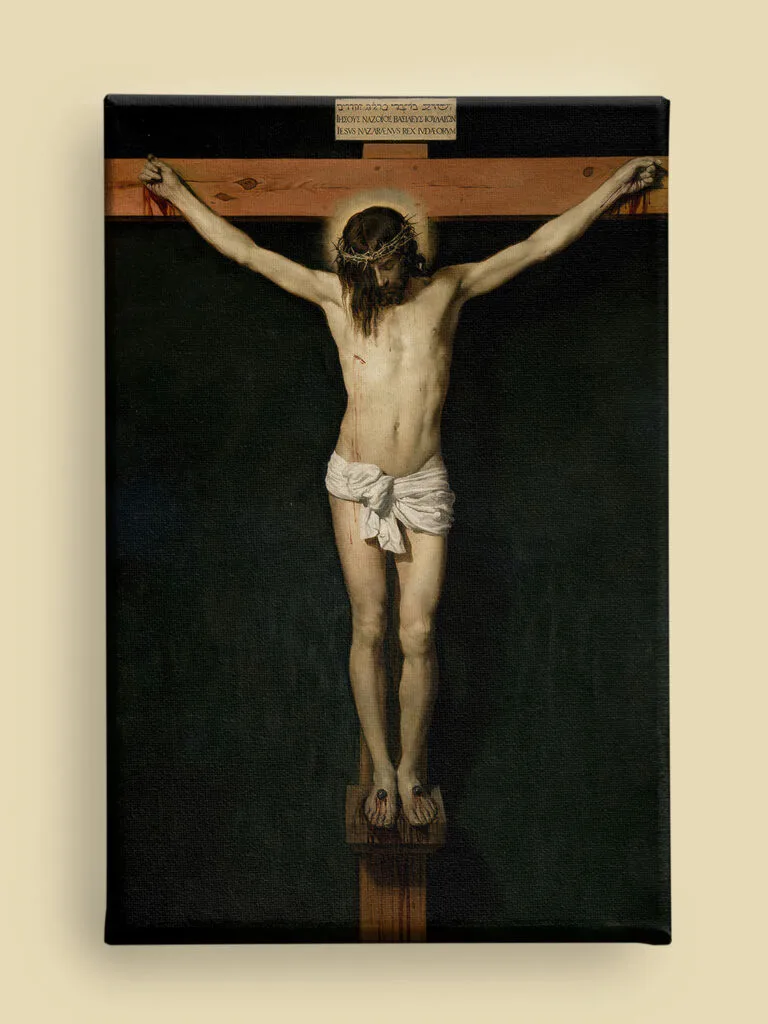
You can buy crucifixion art at jesuschrist.pictures, in our shop: Velazquez’s Christ Crucified, the painting of our printable card, is available as a canvas reproduction, alongside the San Damiano Cross of Saint Francis as a fine art poster and many other images of Christ on the cross.