The Jesse Tree: 24 Ornaments from Great Paintings
A Jesse Tree is an Advent custom that tells the story of salvation one evening at a time, from the Creation to the night in Bethlehem. Each day the family reads a short passage of Scripture and hangs one ornament on a small tree or a bare branch: Adam and Eve, Noah, Abraham, Moses, David, the prophets, and at last Mary, Joseph and the Child. This page gives the 24 days with their readings and symbols, and a free printable set of Jesse Tree ornaments in which every ornament is a detail of a great painting, from Michelangelo and Rembrandt to Fra Angelico.
✦ Jesse Tree Ornaments, Free Printable
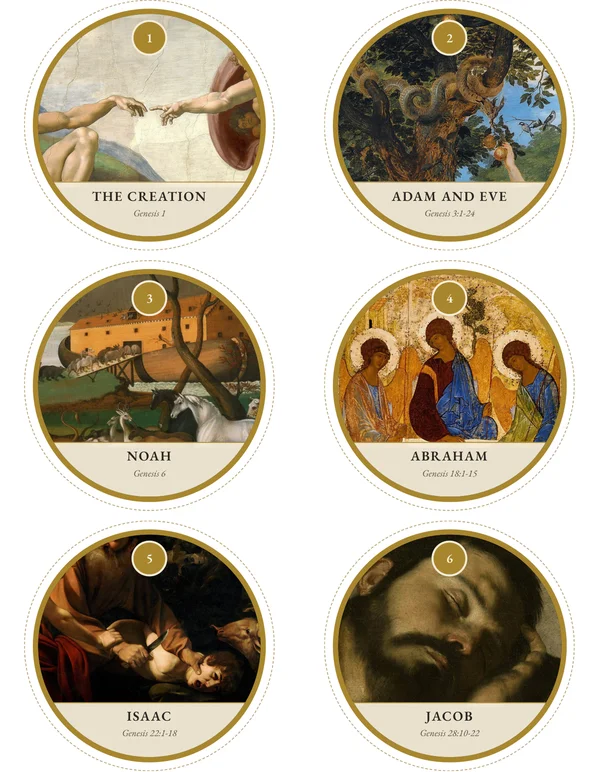
Twenty-four round ornaments to print, cut out and hang, one for each day from December 1 to 24, every one a detail of a great painting, with a two-page reading guide that gives the passage of Scripture and a question for the children. It is free, and there is nothing to fill in.
Download for US LetterDownload for A4
PDF, eight pages, print the ornaments on card stock.
What Is the Jesse Tree?
The name comes from a prophecy of Isaiah: “And there shall come forth a rod out of the stem of Jesse, and a Branch shall grow out of his roots” (Isaiah 11:1). Jesse of Bethlehem was the father of King David, and the Church has always read this verse as a promise of Christ, born of David’s family. Saint Matthew opens his Gospel with the same idea, a genealogy that runs from Abraham through David to Jesus.
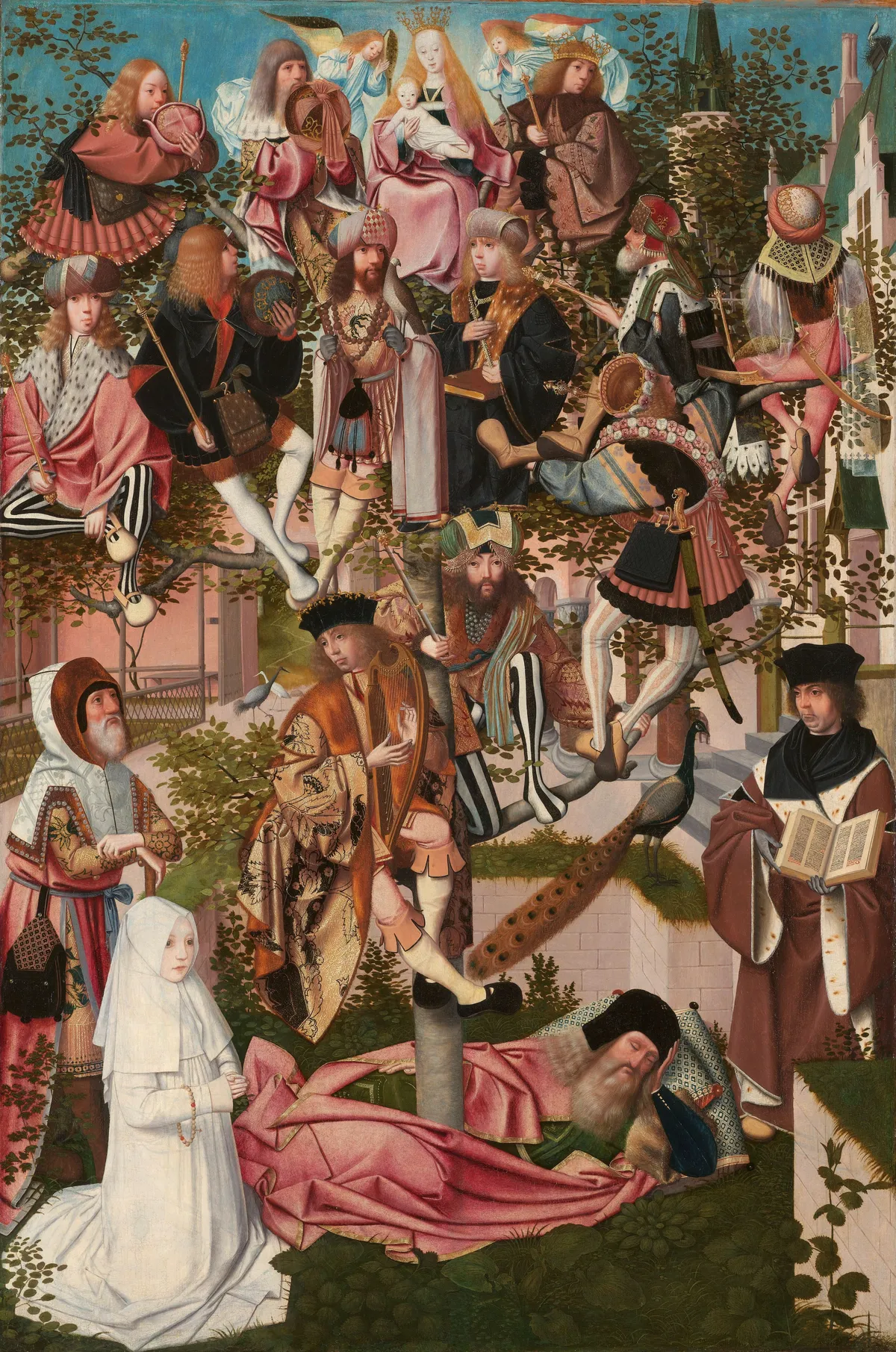
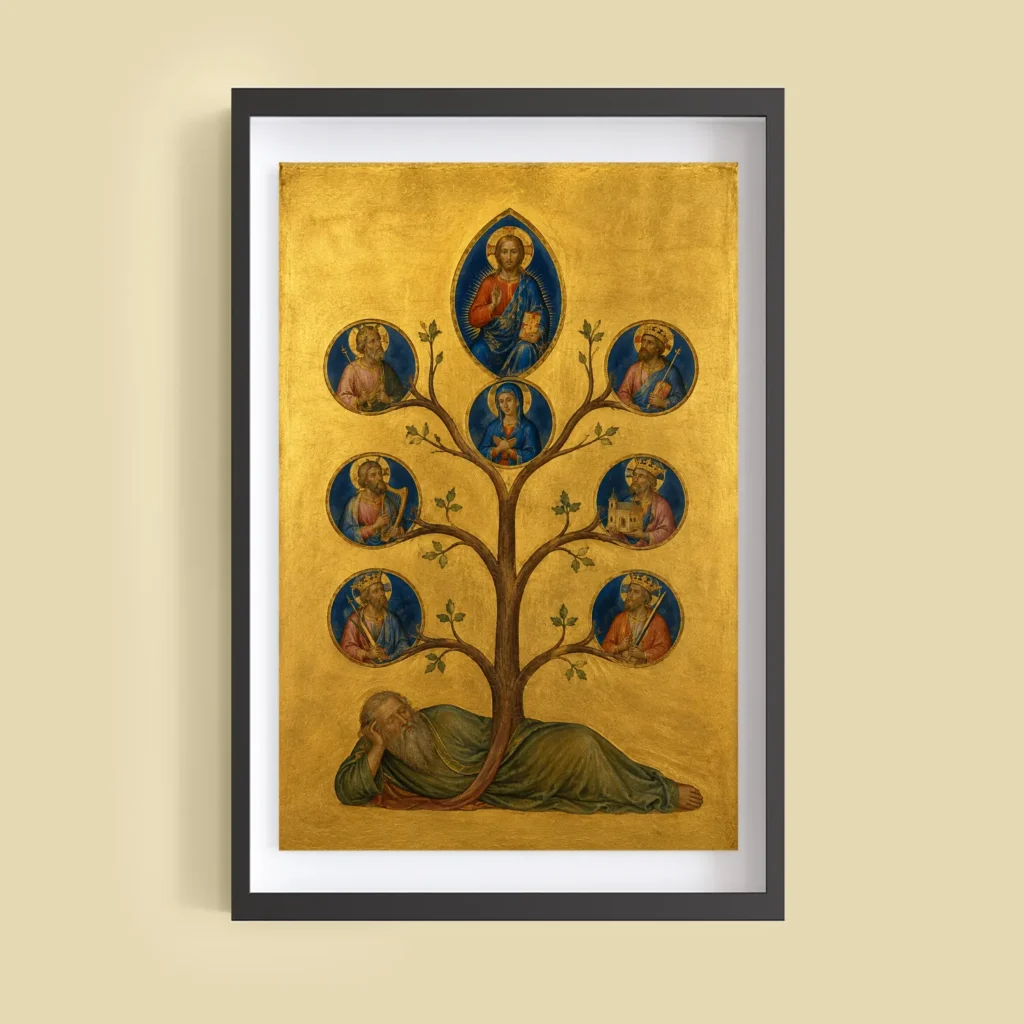
Medieval artists turned the prophecy into an image. In the great windows of Chartres and Saint-Denis, in illuminated manuscripts and on altarpieces, Jesse lies asleep while a tree grows out of his side, carrying the kings of Israel in its branches, with the Virgin and the Child at the top. The panel below, painted around 1500 in the circle of Geertgen tot Sint Jans and now in the Rijksmuseum, is a fine example. The family custom of hanging a symbol for each story during Advent is much younger, and spread widely in the twentieth century among Catholics and Protestants alike. The same prophecy is sung every year on December 19 in the antiphon O Radix Jesse, one of the O Antiphons.
How to Make a Jesse Tree at Home
You need very little. For the tree, a small artificial tree, a few bare branches in a vase, or a branch cut from the garden and set in a pot of stones all work well. For the ornaments, print the four ornament pages of the free set on white card stock, cut out each circle along the dotted line, punch a hole just above the gold number and thread a ribbon. Keep them in an envelope and take out one each evening.
Each evening from December 1, read the passage of the day together, let the children find the story in the painting, ask the question from the reading guide, and hang the ornament. Five minutes are enough. If Advent begins before December 1, as it does in 2026 when the first Sunday falls on November 29, start with the Creation on that Sunday and read two stories on some evenings: what matters is to reach the manger together. Families who also pray the Saint Andrew Christmas Novena often say it at the same moment.
The 24 Jesse Tree Ornaments and Readings
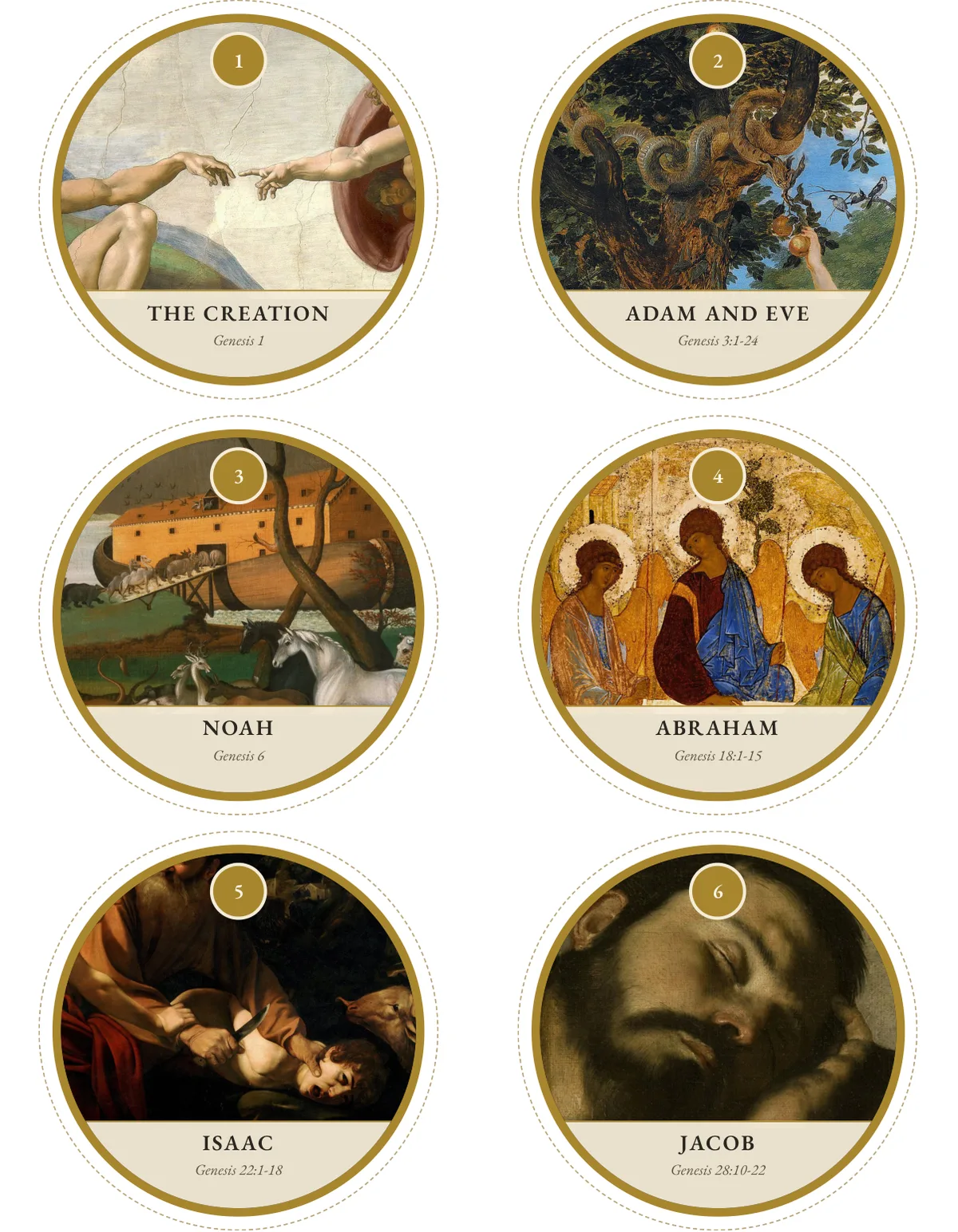
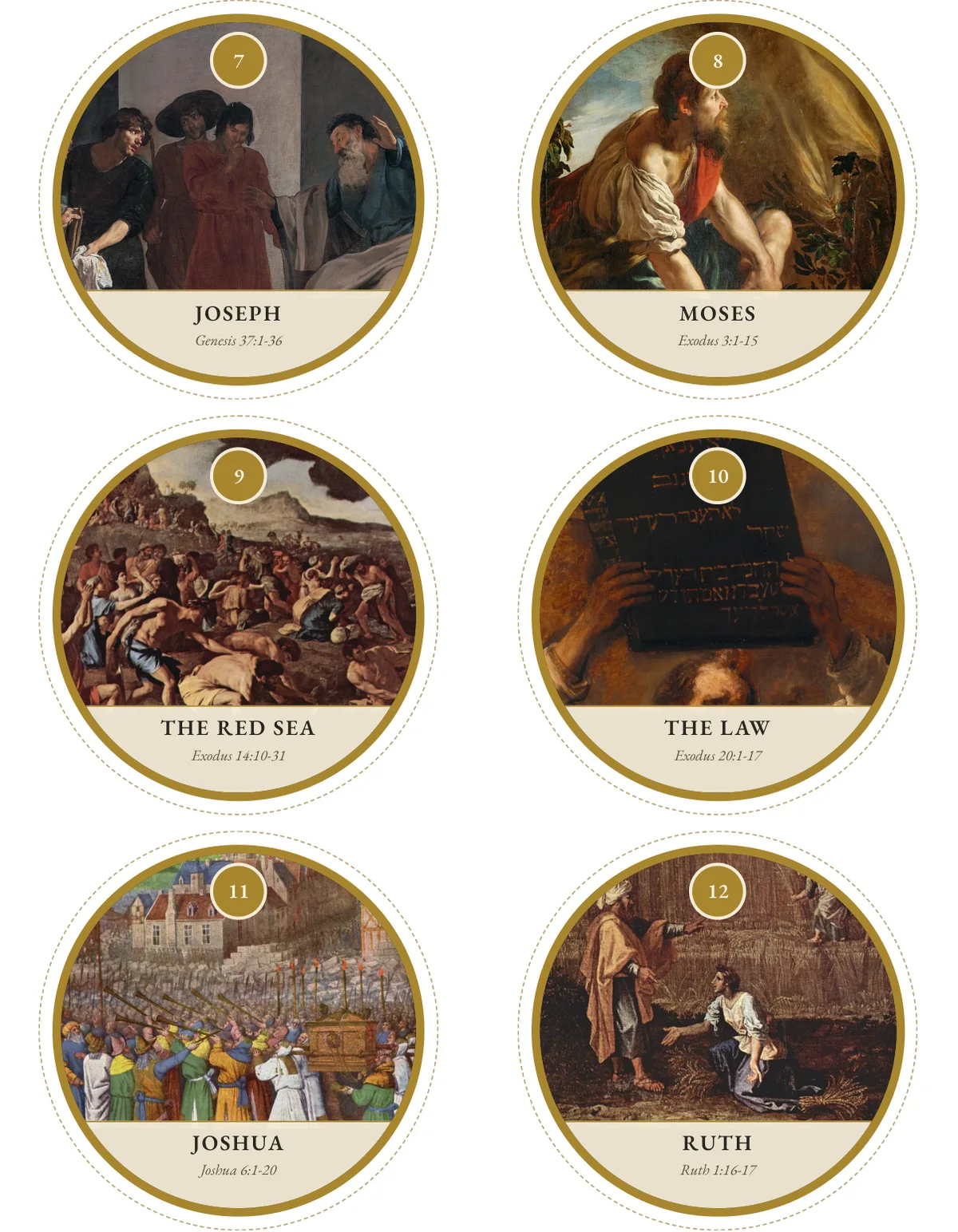
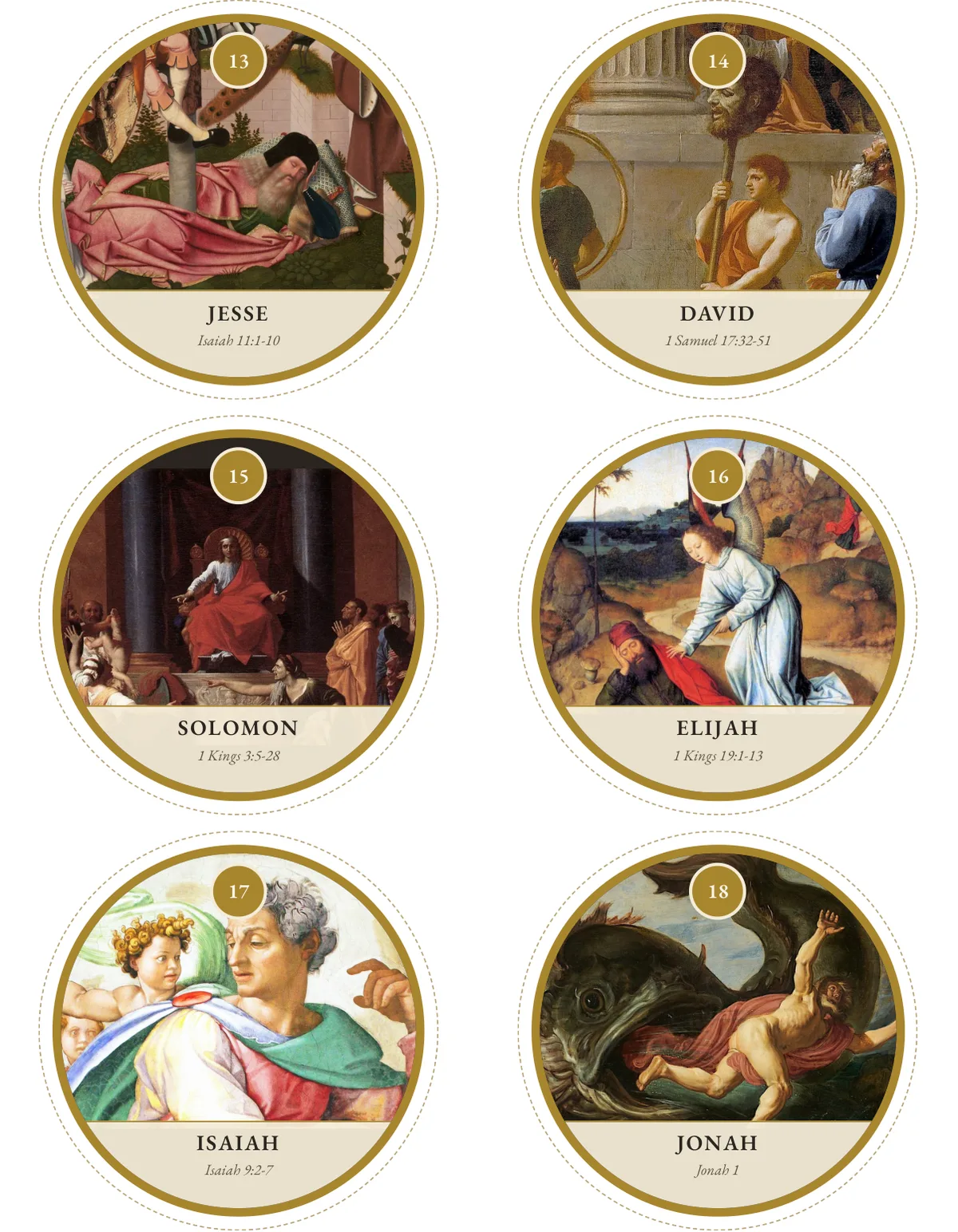
The stories follow the order of the Bible, from the Creation through the patriarchs, Moses, the kings and the prophets, to the family of Jesus. Here they are on the four printable pages, then day by day.
December 1: The Creation
Read: Genesis 1:1 to 2:3
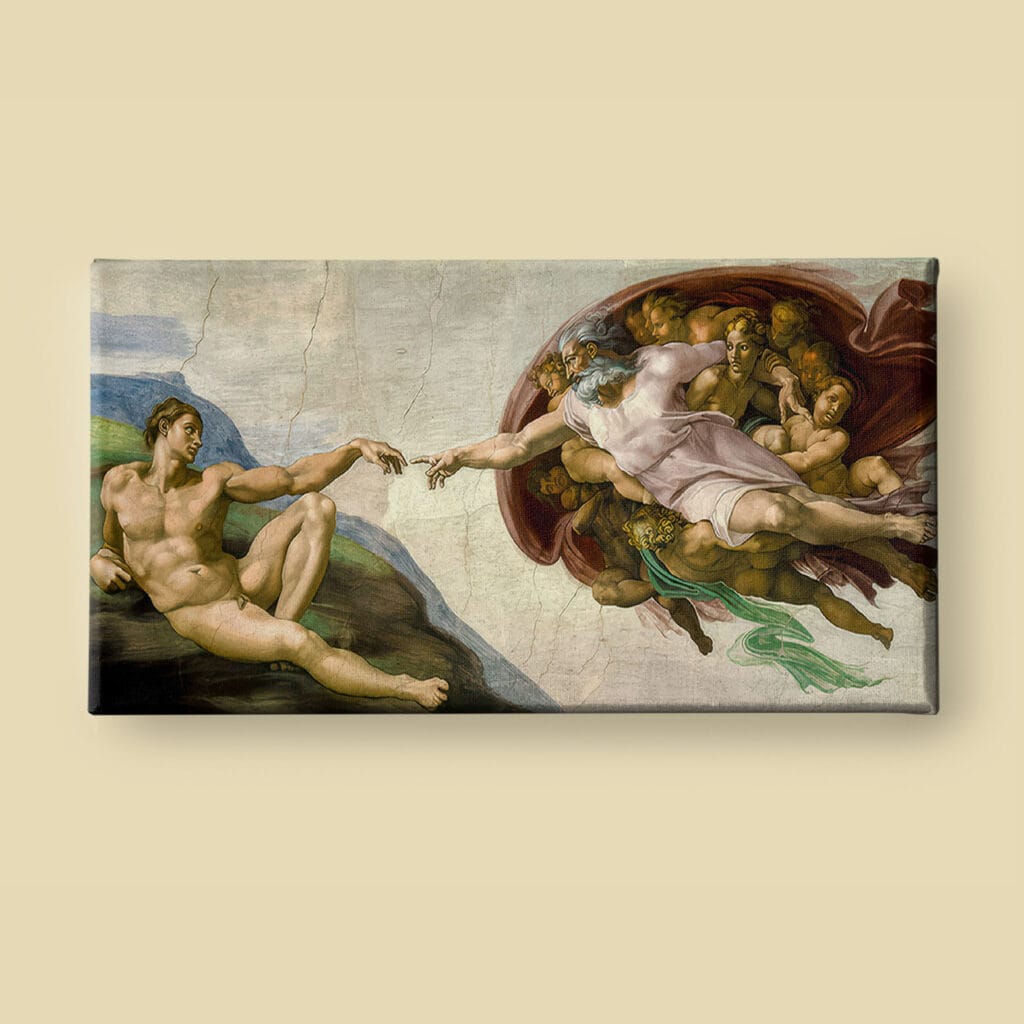
In the beginning God creates the heavens and the earth, light and darkness, sea and land, and last of all man and woman in his own image. The ornament takes the most famous detail of Michelangelo’s Creation of Adam on the Sistine Chapel ceiling: two hands, a finger’s breadth from touching.
December 2: Adam and Eve
Read: Genesis 3:1-24
The serpent tempts Eve, Adam eats too, and the first man and woman hide from God among the trees. Yet God already promises that the offspring of the woman will crush the serpent’s head (Genesis 3:15), the first hint of a Saviour. The ornament shows the serpent coiled in the tree of the Garden of Eden painted by Jan Brueghel the Elder and Rubens. More versions are gathered in our Adam and Eve paintings.
December 3: Noah
Read: Genesis 6:13 to 9:17
God tells Noah to build an ark, saves his family and the animals from the flood, and sets the rainbow in the clouds as the sign of his covenant. Edward Hicks, the Quaker painter of The Peaceable Kingdom, shows the animals walking two by two toward the ark. See also our Noah’s Ark paintings.
December 4: Abraham
Read: Genesis 18:1-15
Three visitors come to Abraham’s tent at Mamre. He runs to welcome them and serves them a meal, and they promise that old Sarah will have a son. Andrei Rublev’s icon paints the three guests seated at Abraham’s table, and the Church has long seen in them an image of the Holy Trinity.
December 5: Isaac
Read: Genesis 22:1-18
God tests Abraham, who climbs the mountain with his only son. At the last moment an angel stops his hand, and a ram caught in a thicket is offered in Isaac’s place. Christians read the story as a figure of the Father who gives his own Son. Caravaggio paints the instant the angel intervenes, with the ram already waiting.
December 6: Jacob
Read: Genesis 28:10-22
Fleeing from his brother, Jacob sleeps on a stone and dreams of a ladder set up on the earth and reaching to heaven, with the angels of God going up and down. The ornament is a detail of Jusepe de Ribera’s Jacob’s Dream in the Prado: only the sleeping face, as the dream begins.
December 7: Joseph
Read: Genesis 37:1-36
Jacob gives his favourite son a coat of many colours, and his jealous brothers sell Joseph to merchants bound for Egypt, then bring the coat back to their father stained with blood. Diego Velázquez paints the moment old Jacob recognises it.
December 8: Moses
Read: Exodus 3:1-15
Keeping the flock of his father-in-law, Moses sees a bush that burns without being consumed, and God calls him by name and reveals his own. Domenico Fetti shows Moses taking off his sandals, because the ground he stands on is holy. More of his story is in our Moses paintings.
December 9: The Red Sea
Read: Exodus 14:10-31
Pursued by Pharaoh’s army, the people of Israel cross the sea on dry ground, and the waters return behind them. Nicolas Poussin fills his canvas with the crowd of the rescued on the far shore.
December 10: The Law
Read: Exodus 20:1-17
On Mount Sinai God gives Moses the Ten Commandments, written on tablets of stone. Rembrandt paints Moses holding the tablets high above his head as he comes down from the mountain.
December 11: Joshua
Read: Joshua 6:1-20
The people march around Jericho for seven days behind the ark of the covenant, and on the seventh day the walls fall at the sound of the trumpets. Jean Fouquet painted the scene in the fifteenth century, in a manuscript of the historian Josephus, as a French town under a summer sky.
December 12: Ruth
Read: Ruth 1:16-17 and 2:1-12
Ruth, a foreigner from Moab, follows her mother-in-law Naomi to Bethlehem with the words “whither thou goest, I will go.” She gleans in the fields of Boaz, who later marries her, and their great-grandson is King David. In Poussin’s Summer, Ruth kneels before Boaz in the middle of the harvest.
December 13: Jesse
Read: Isaiah 11:1-10
Jesse of Bethlehem is the father of David, and from his family Isaiah promises a shoot that will grow from the stump, filled with the Spirit of the Lord. The ornament shows Jesse asleep at the foot of the tree, in the panel shown above.
December 14: David
Read: 1 Samuel 17:32-51
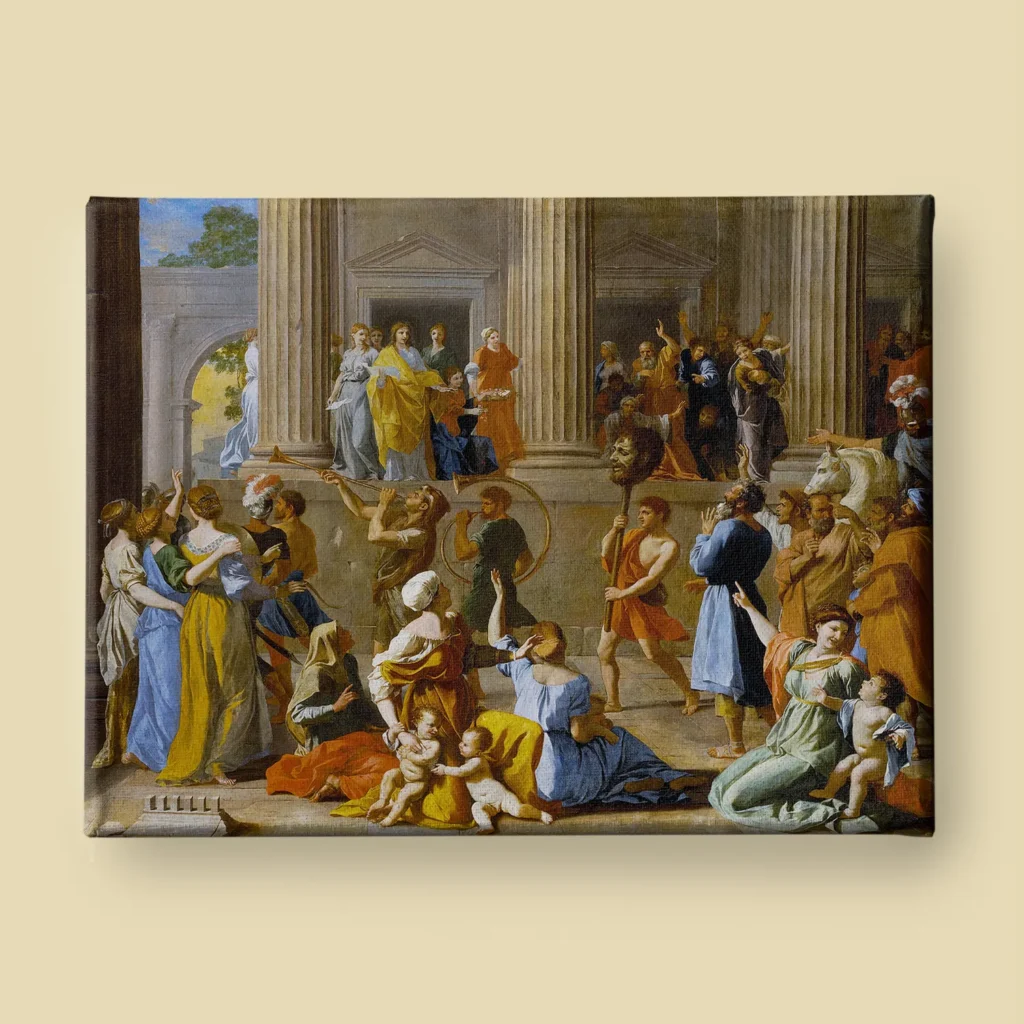
The shepherd boy faces the giant Goliath with a sling and five smooth stones, trusting in the Lord. Nicolas Poussin paints the triumph that follows, with the giant’s head carried through the city to the sound of trumpets. The whole fight is told in our David and Goliath paintings.
December 15: Solomon
Read: 1 Kings 3:5-28
David’s son Solomon asks God not for riches or long life but for an understanding heart, and soon judges between two mothers who claim the same child. Poussin’s Judgment of Solomon shows the king on his throne at the moment of decision.
December 16: Elijah
Read: 1 Kings 19:1-13
Exhausted and afraid, the prophet Elijah lies down in the desert and asks to die. An angel wakes him with bread and water, and on Mount Horeb God speaks to him not in the wind or the fire but in “a still small voice.” Dieric Bouts paints the angel touching the sleeping prophet.
December 17: Isaiah
Read: Isaiah 9:2-7
Isaiah promises a child whose name shall be called “Wonderful, Counsellor, The mighty God, The everlasting Father, The Prince of Peace.” Michelangelo painted him on the Sistine Chapel ceiling, turning from his book as if he had just heard a voice.
December 18: Jonah
Read: Jonah 1:1 to 2:10
Jonah runs away from God’s call, is thrown into the sea and swallowed by a great fish, and after three days and three nights is cast up on dry land. Jesus himself took Jonah as a sign of his death and resurrection (Matthew 12:40). Pieter Lastman, the teacher of Rembrandt, paints Jonah thrown out of the fish onto the shore.
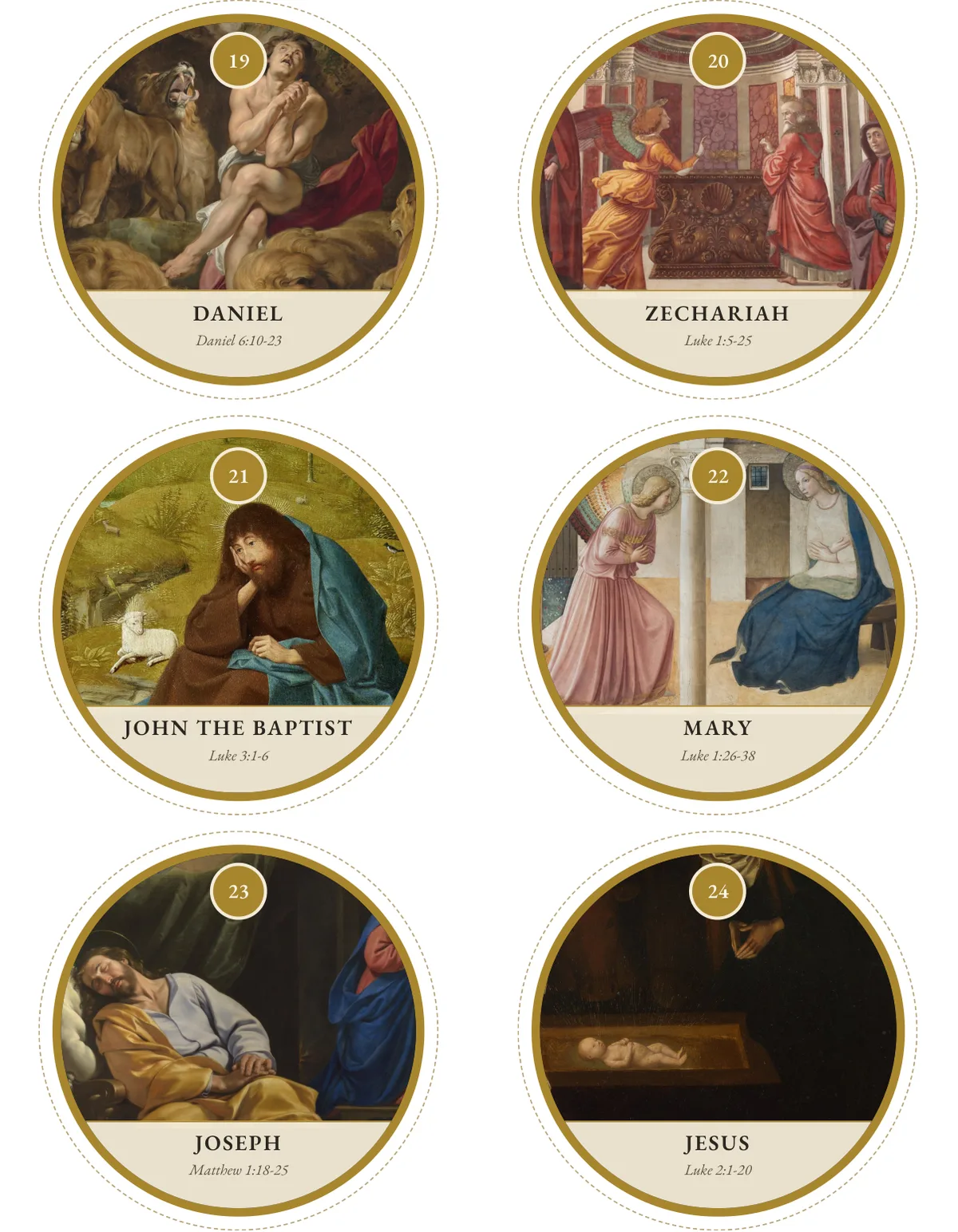
December 19: Daniel
Read: Daniel 6:10-23
Daniel goes on praying to God three times a day in spite of the king’s decree, and is thrown into the den of lions. In the morning he is found unharmed. Rubens paints him praying among the lions.
December 20: Zechariah
Read: Luke 1:5-25
The angel Gabriel appears to the priest Zechariah in the Temple and announces that his wife Elizabeth, old and childless, will bear a son, John. Zechariah doubts, and cannot speak until the child is born. Domenico Ghirlandaio paints the scene in a Florentine chapel, among portraits of the men of his own city.
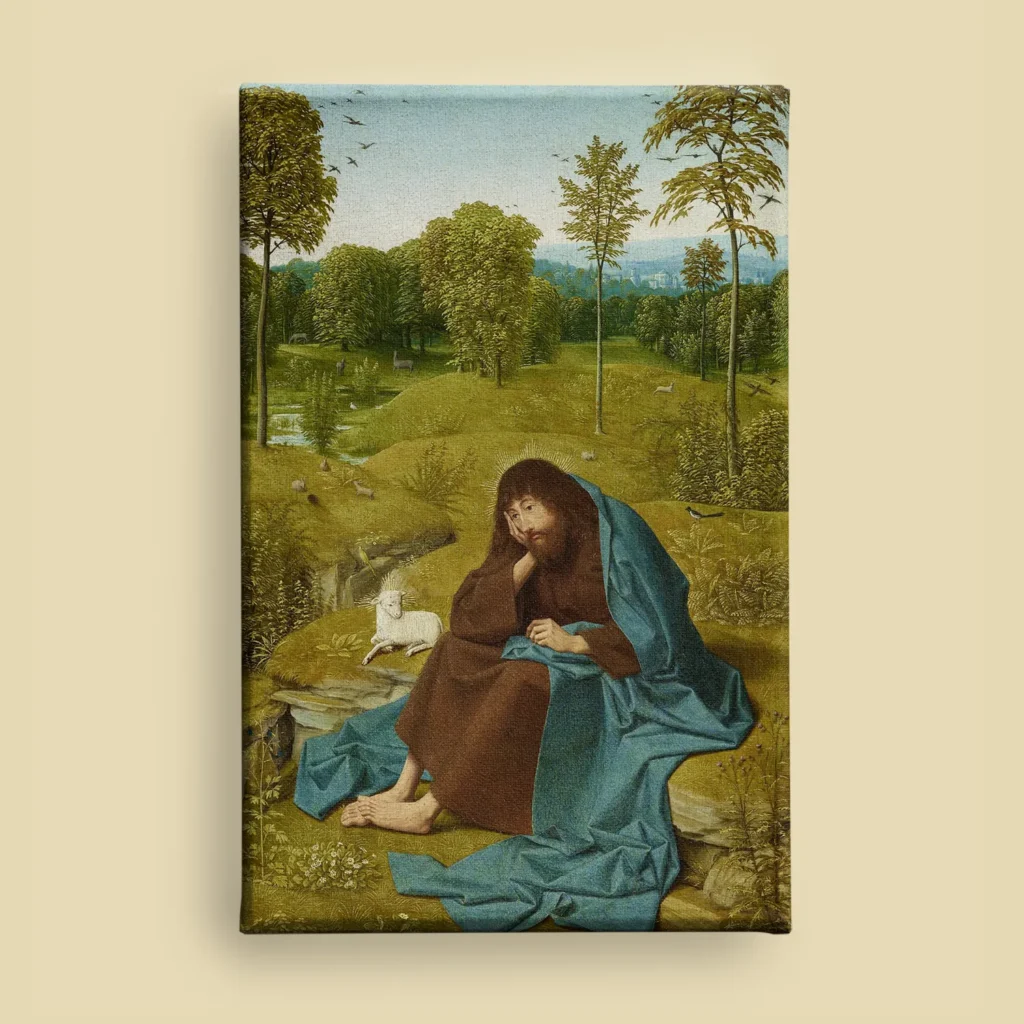
December 21: John the Baptist
Read: Luke 3:1-6
Zechariah’s son grows up in the wilderness and calls the people to prepare the way of the Lord. Geertgen tot Sint Jans paints him sitting alone in a gentle landscape, lost in thought, with the Lamb of God beside him. More of him in our John the Baptist paintings.
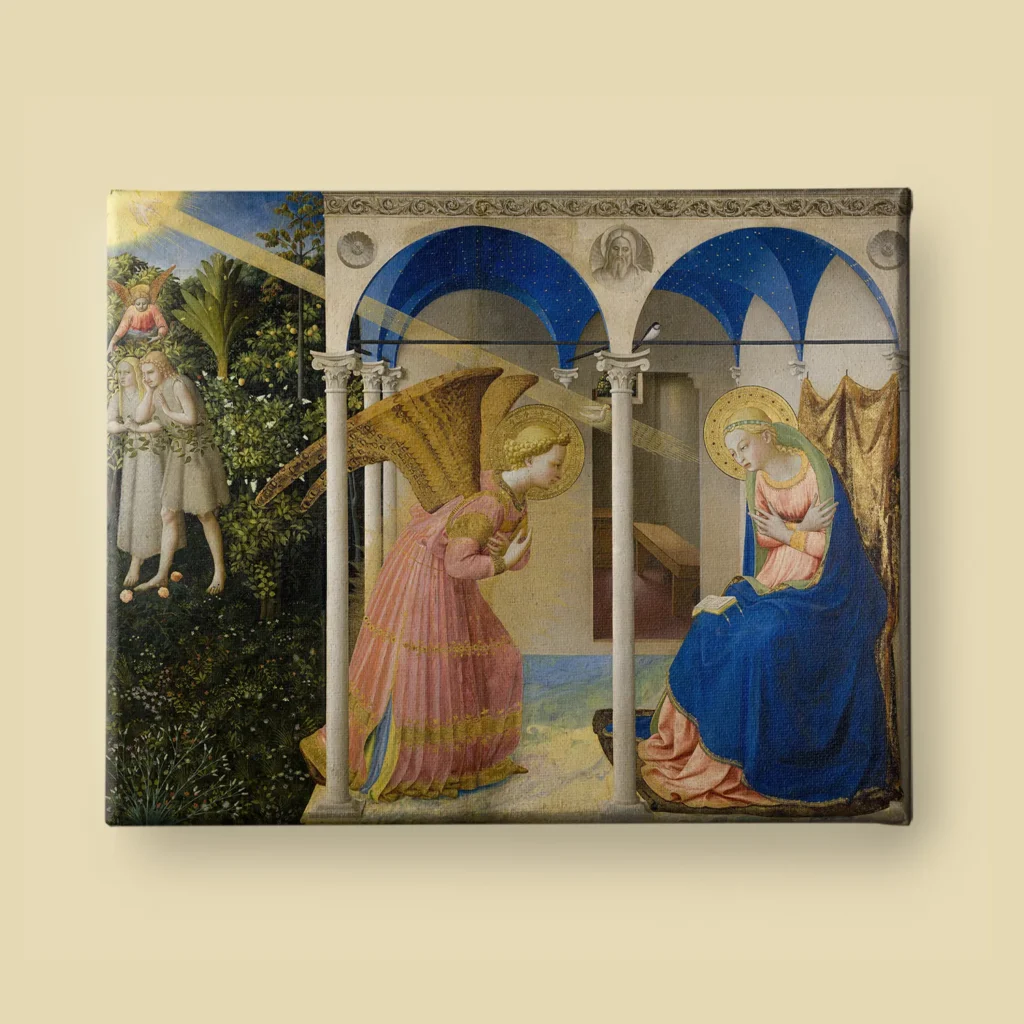
December 22: Mary
Read: Luke 1:26-38
The angel Gabriel greets Mary in Nazareth, and she answers: “be it unto me according to thy word.” Fra Angelico’s Annunciation at San Marco is one of the gentlest images of that answer.
December 23: Joseph
Read: Matthew 1:18-25
Joseph, a just man, means to send Mary away quietly, until an angel tells him in a dream to take her as his wife and to name the child Jesus. Philippe de Champaigne paints the angel appearing above the sleeping carpenter.
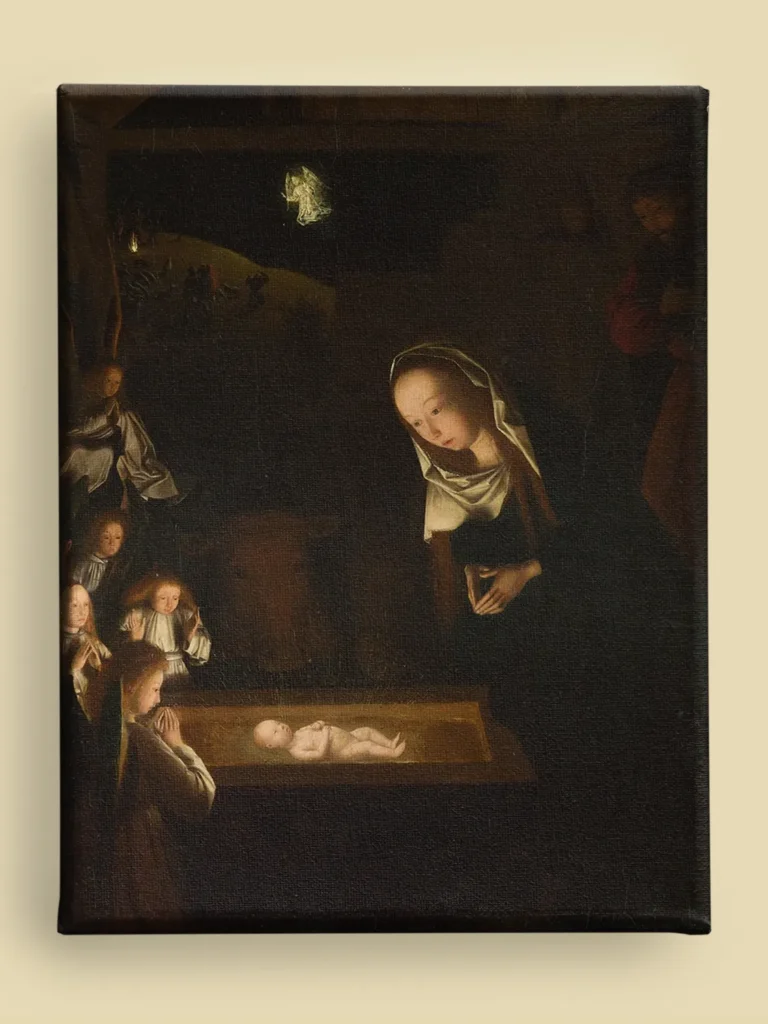
December 24: Jesus
Read: Luke 2:1-20
The Child is born in Bethlehem and laid in a manger, and shepherds come in haste to adore him. In Geertgen tot Sint Jans’ Nativity at Night, all the light in the stable comes from the Child himself. The rest of that night is in our famous Nativity paintings and our Adoration of the Shepherds paintings.
Jesse Tree Symbols
Homemade Jesse Trees use a simple symbol for each story: an apple for Adam and Eve, an ark or a rainbow for Noah, a ladder for Jacob, a harp for David. The symbols vary from one family or parish to another, and so does the number of days. Our ornaments replace the symbol with the painting, but the table below gives the traditional symbol for each day, in case your children want to draw their own.
| Day | Story | Traditional symbol | Painting on our ornament |
|---|---|---|---|
| 1 | The Creation | Sun and moon, or the globe | Michelangelo, The Creation of Adam |
| 2 | Adam and Eve | Apple and serpent | Jan Brueghel the Elder and Rubens, The Garden of Eden |
| 3 | Noah | Ark and rainbow | Edward Hicks, Noah’s Ark |
| 4 | Abraham | Tent and stars | Andrei Rublev, The Trinity |
| 5 | Isaac | Ram | Caravaggio, The Sacrifice of Isaac |
| 6 | Jacob | Ladder | Jusepe de Ribera, Jacob’s Dream |
| 7 | Joseph | Coat of many colours | Diego Velázquez, Joseph’s Bloody Coat |
| 8 | Moses | Burning bush | Domenico Fetti, Moses before the Burning Bush |
| 9 | The Red Sea | Waves and staff | Nicolas Poussin, The Crossing of the Red Sea |
| 10 | The Law | Tablets of stone | Rembrandt, Moses with the Ten Commandments |
| 11 | Joshua | Trumpet and walls | Jean Fouquet, The Taking of Jericho |
| 12 | Ruth | Sheaf of wheat | Nicolas Poussin, Summer, or Ruth and Boaz |
| 13 | Jesse | Stump with a shoot | Circle of Geertgen, The Tree of Jesse |
| 14 | David | Harp, or sling and stones | Nicolas Poussin, The Triumph of David |
| 15 | Solomon | Crown or temple | Nicolas Poussin, The Judgment of Solomon |
| 16 | Elijah | Fire, or bread and water | Dieric Bouts, Elijah in the Desert |
| 17 | Isaiah | Scroll | Michelangelo, The Prophet Isaiah |
| 18 | Jonah | Great fish | Pieter Lastman, Jonah and the Whale |
| 19 | Daniel | Lion | Peter Paul Rubens, Daniel in the Lions’ Den |
| 20 | Zechariah | Censer | Domenico Ghirlandaio, The Angel Appearing to Zechariah |
| 21 | John the Baptist | Shell or lamb | Geertgen tot Sint Jans, Saint John in the Wilderness |
| 22 | Mary | Lily | Fra Angelico, The Annunciation |
| 23 | Joseph | Carpenter’s tools | Philippe de Champaigne, The Dream of Saint Joseph |
| 24 | Jesus | Manger and star | Geertgen tot Sint Jans, The Nativity at Night |
A Jesse Tree with Children
The questions in the reading guide are meant to start a conversation, not to test anyone. Small children can simply find something in the painting: the ark, the ladder, the lion, the angel. Older ones can read the passage aloud. On December 24, when the last ornament goes up, the whole story hangs on the branch at once, and it is a good moment to look at it together from the Creation to the Child. For the days around Christmas, our free Nativity coloring pages are drawn from great paintings of the same night.
✦ Free Christian & Catholic Printables
Love this one? Find it, and our complete collection of illuminated prayer cards, novenas and Scripture printables, ready to print, free, in one place.
Browse all free printables →Frequently Asked Questions
What does a Jesse Tree represent?
A Jesse Tree represents the family tree of Jesus and the long story of God’s promise that leads to Christmas. It takes its name from Isaiah 11:1, the shoot that grows from the stem of Jesse, the father of King David. Each ornament stands for one person or event of the Old Testament, from the Creation to the prophets, and the last ones for John the Baptist, Mary, Joseph and Jesus.
What ornaments go on a Jesse Tree?
Most Jesse Trees have one ornament for each day of Advent, usually between 24 and 28. Ours has 24, from December 1 to 24: the Creation, Adam and Eve, Noah, Abraham, Isaac, Jacob, Joseph, Moses, the Red Sea, the Law, Joshua, Ruth, Jesse, David, Solomon, Elijah, Isaiah, Jonah, Daniel, Zechariah, John the Baptist, Mary, Joseph and Jesus. Traditional ornaments use a symbol, such as an apple, an ark or a harp; ours use a detail of a great painting.
Is the Jesse Tree a Catholic tradition?
The Tree of Jesse comes from the Bible and was a favourite image of medieval Catholic art, in the windows of Chartres, in manuscripts and on altarpieces. The family custom of hanging an ornament each day of Advent is more recent and is now shared by Catholics and by many Protestant churches. Nothing in it belongs to one denomination: it is a way of reading the Scriptures together before Christmas.
When do you start the Jesse Tree?
Many families start on December 1 and hang the last ornament on December 24, which keeps the same dates every year. Others begin on the first Sunday of Advent, which falls on November 29 in 2026, and add a few extra days or read two stories on some evenings.
How do I make Jesse Tree ornaments?
The simplest way is to print them. Print the ornament pages on white card stock, cut out each circle, punch a hole at the top and thread a ribbon. Our free printable gives 24 round ornaments, each a detail of a great painting with the name of the story and the Bible reference, and a reading guide with a question for the children. Families who prefer to make their own can draw the traditional symbol of each day on circles of card.
Can you buy the paintings of the Jesse Tree as canvas prints?
You can buy several paintings of the Jesse Tree at jesuschrist.pictures, in our shop: Michelangelo’s Creation of Adam, Poussin’s Triumph of David, Geertgen tot Sint Jans’ Saint John the Baptist in the Wilderness and Nativity at Night, and Fra Angelico’s Annunciation as canvas reproductions, and a Tree of Jesse as a fine art poster. They make a fitting image for a home in Advent, a prayer corner or a parish hall.


