Noah’s Ark paintings form one of the oldest and richest traditions in Christian art. The story of a righteous man, a great wooden ship, and a flood that washed the world clean has drawn painters for more than five centuries, from Florentine cloister walls to vast Romantic canvases of storm and ruin. Few biblical subjects give an artist so much at once: every animal under heaven, a scene of divine judgment, and the quiet promise of mercy that follows the rain.
The account comes from the Book of Genesis. Grieved by human violence, God sends a flood to cleanse the earth, yet spares Noah, his family, and a breeding pair of every living creature, who ride out the waters inside the ark. When the flood recedes, a rainbow seals God’s promise never again to destroy the world by water. Painters have returned to almost every moment of that narrative, and the ten works gathered here show how widely their visions differ. For more sacred stories told in paint, see our guide to famous biblical masterpieces.
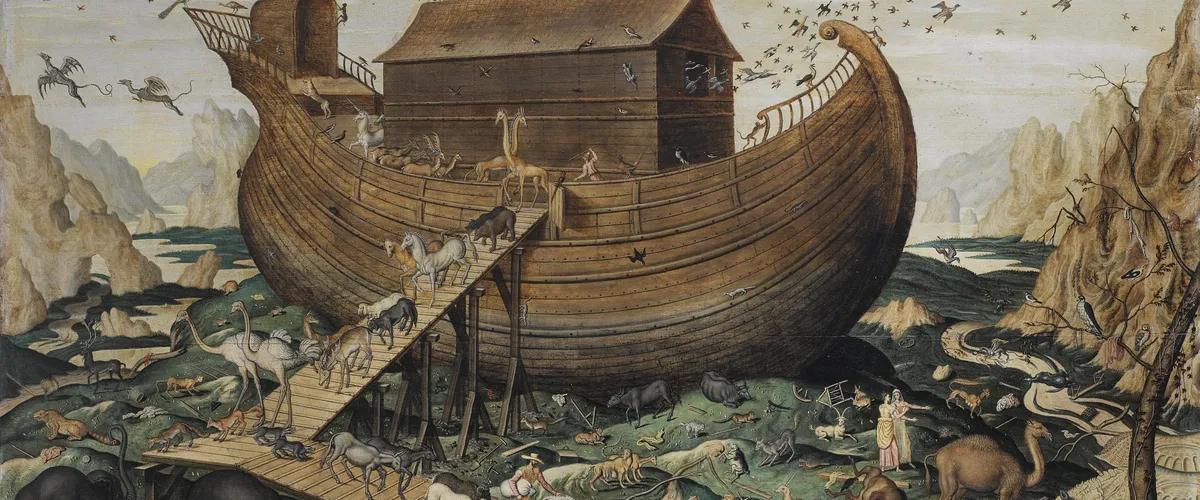
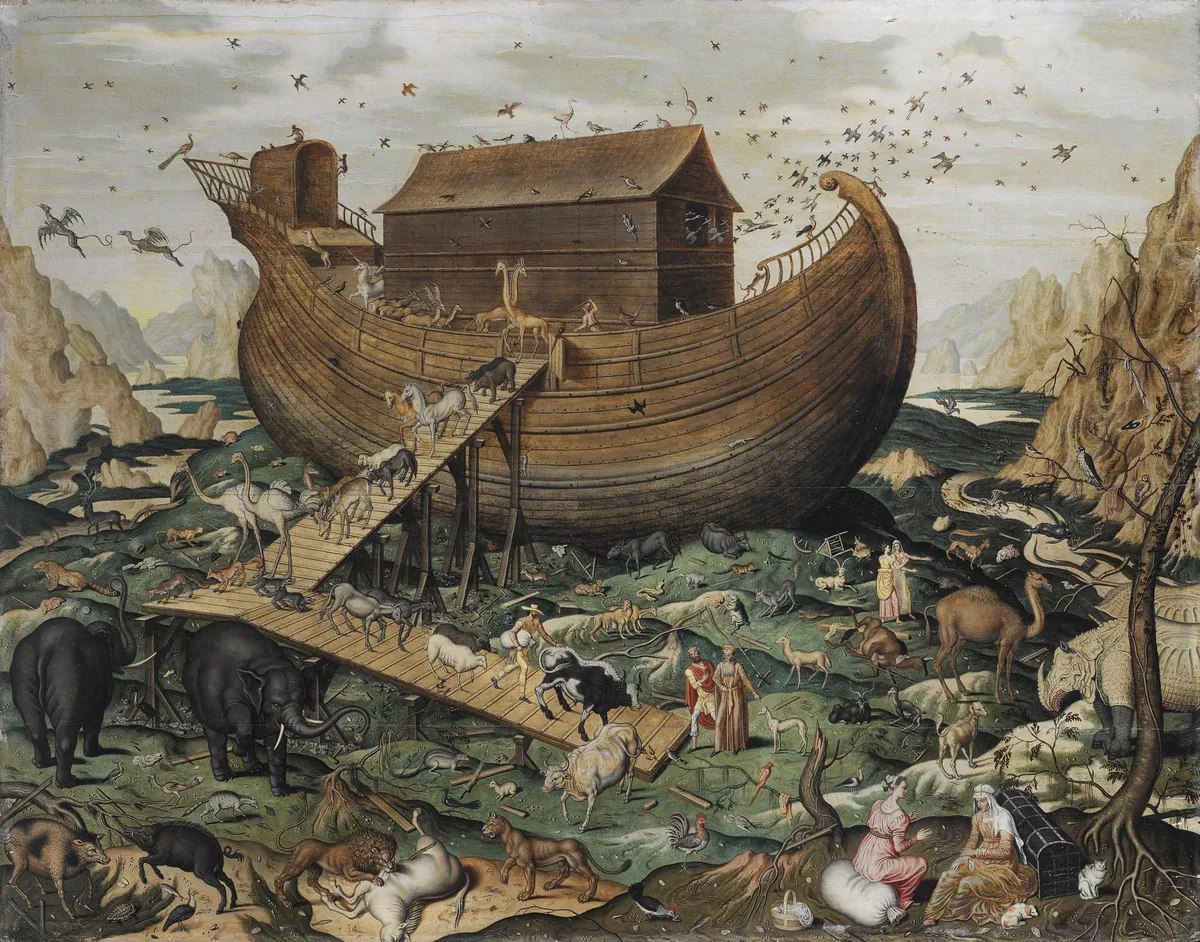
Noah’s Ark on Mount Ararat by Simon de Myle, 1570
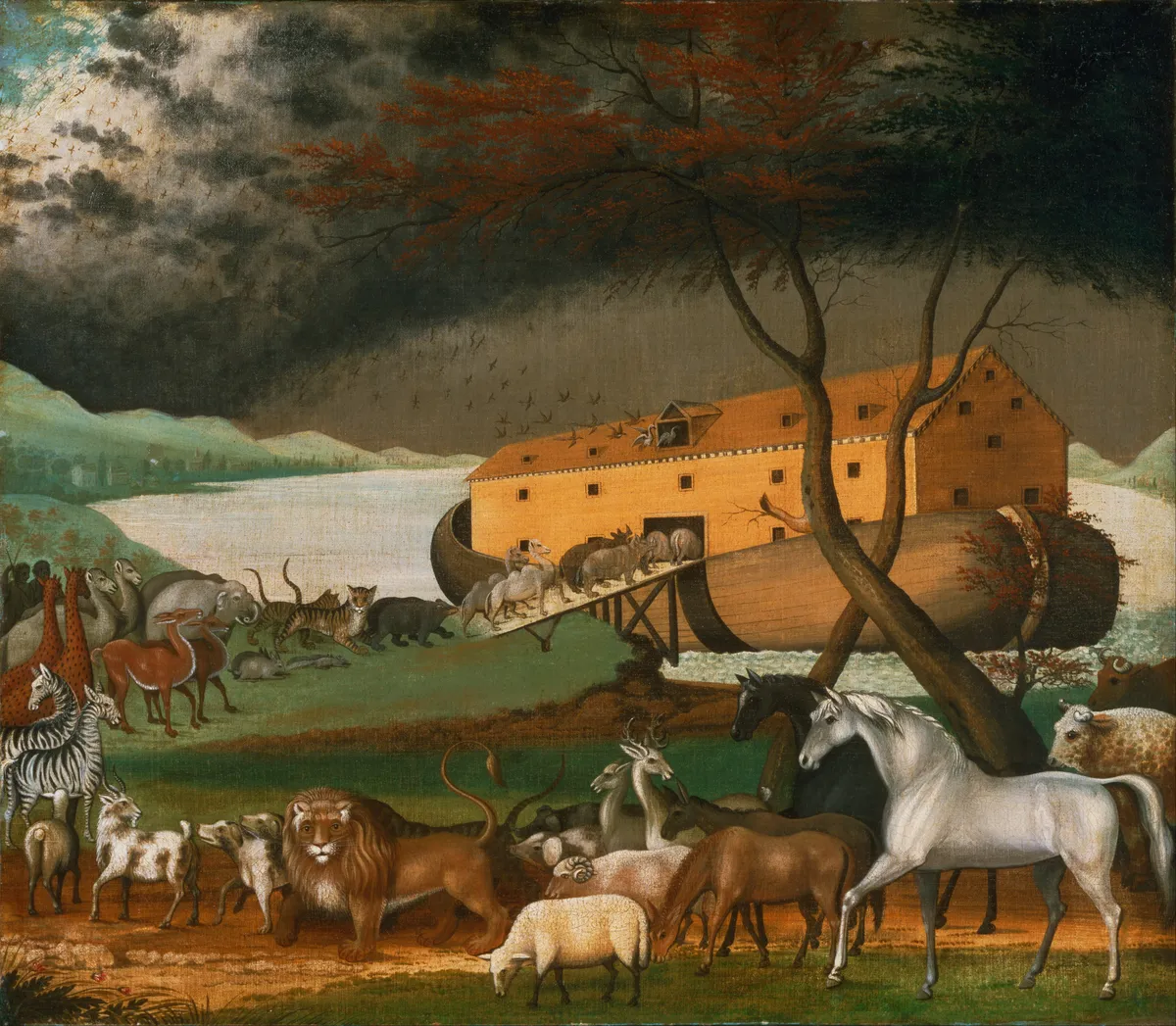
1. Noah’s Ark by Edward Hicks (1846)
Few images of the ark are as instantly loved as this one. Edward Hicks was a Quaker preacher and sign painter from Pennsylvania, and he brought a plain, tender honesty to the subject. His animals file two by two across a green meadow toward a sturdy, barn like ark, while dark clouds gather overhead and the first birds wheel away. The lion, the leopard, and the patient oxen wait their turn with an almost human calm.
Noah’s Ark by Edward Hicks, 1846. Philadelphia Museum of Art
Hicks took his composition from a popular engraving, then made it completely his own. The mood is less disaster than peaceable kingdom, the theme he returned to throughout his life. The painting now hangs in the Philadelphia Museum of Art, and it remains one of the most reproduced Noah’s Ark paintings anywhere, beloved for its warmth and its gentle, hand made charm.
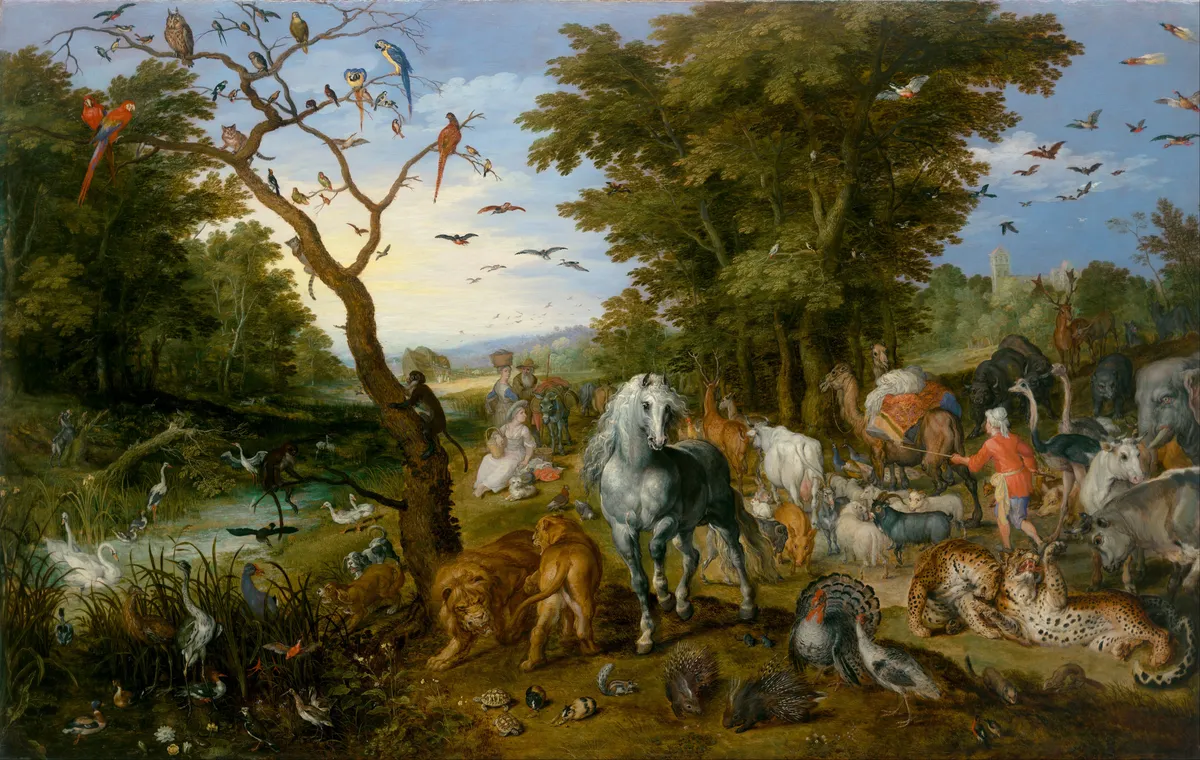
2. The Entry of the Animals into Noah’s Ark by Jan Brueghel the Elder (1613)
Jan Brueghel the Elder loved a crowd of living things, and the ark gave him the perfect reason to paint one. Parrots and songbirds perch in a bare tree, a proud white horse turns its head, lions and leopards rest in the grass, and a long line of beasts winds back toward the distant ark. Noah and his family are barely visible, dwarfed by the sheer abundance of creation.
Jan Brueghel the Elder, The Entry of the Animals into Noah’s Ark, 1613. J. Paul Getty Museum
Brueghel was known across Europe for his remarkable skill with animals and flowers, and here he treats the ark almost as a portrait of the whole natural world. Worked in jewel like detail on a wood panel, the picture is both a religious image and a celebration of nature’s variety. It belongs to the J. Paul Getty Museum in Los Angeles.
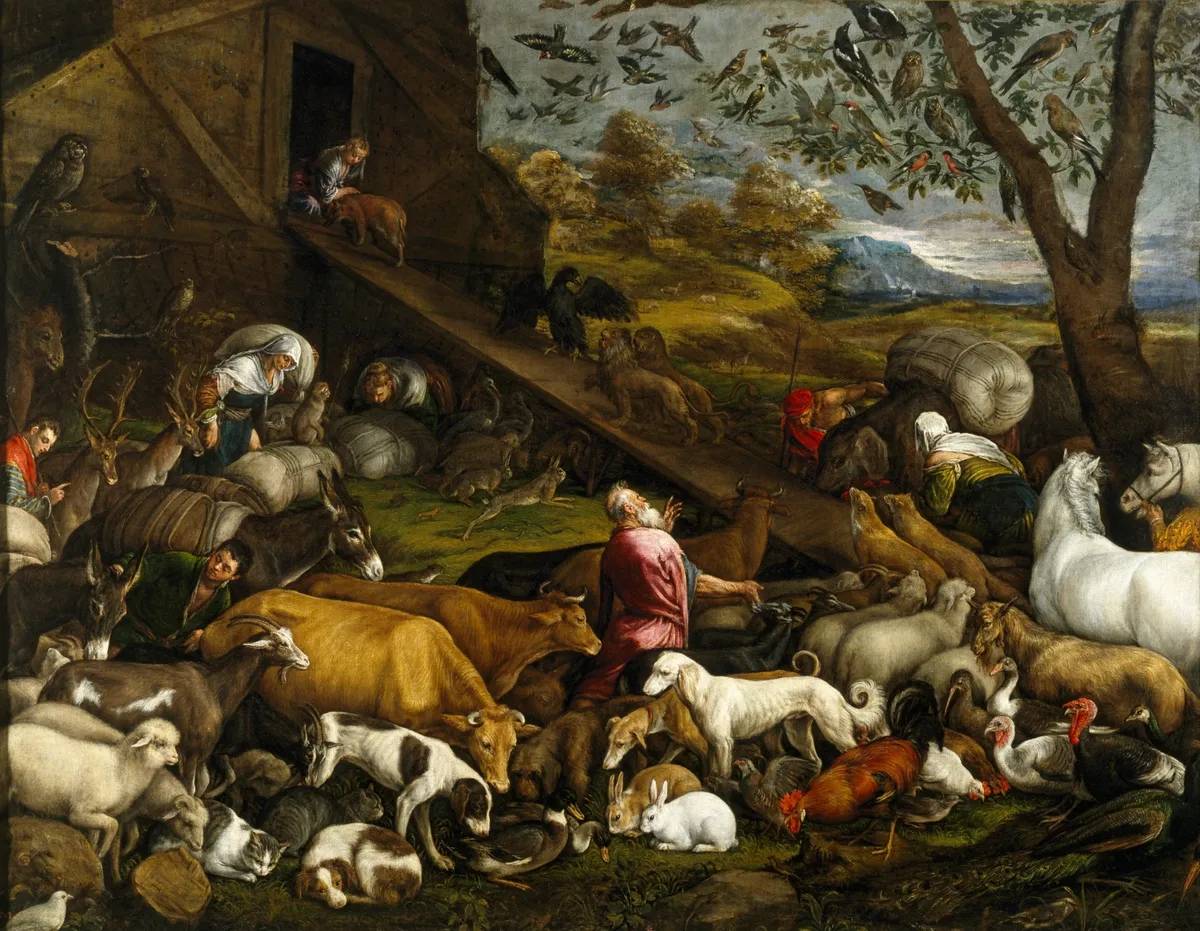
3. The Animals Entering Noah’s Ark by Jacopo Bassano (c. 1570s)
The Venetian painter Jacopo Bassano turned the ark into a scene of country life. His animals are not exotic curiosities but the cattle, sheep, dogs, and poultry of a working farm, herded toward a ramp at the edge of the canvas. Noah, in a red robe, kneels among them, while the women of his household gather pots and bundles in the warm evening light.
Jacopo Bassano, The Animals Entering Noah’s Ark, c. 1570s. Museo del Prado, Madrid
Bassano was famous for this earthy, rural manner, and the Genesis story let him fill a canvas with the textures he loved best: fur, feathers, and dusk. The version shown here, measuring more than two metres across, is his primary autograph treatment of the theme and hangs in the Museo del Prado in Madrid.
4. Noah’s Ark on Mount Ararat by Simon de Myle (1570)
This strange and wonderful panel shows a moment most painters avoided: the day the flood ended. The ark has come to rest on the rocks of Mount Ararat, and the animals stream down a wooden ramp back into a drowned world. Elephants and a lion lead the way, while the carcass of a great whale and the bodies of the drowned still litter the shore.
Simon de Myle, Noah’s Ark on Mount Ararat, 1570. Private collection
Simon de Myle is a shadowy figure, and this signed and dated work of 1570 is almost the only painting securely linked to his name. It is crammed with closely observed creatures and grim detail, a vision of life beginning again over the wreckage of judgment. The panel is held in a private collection and is rarely seen in public.
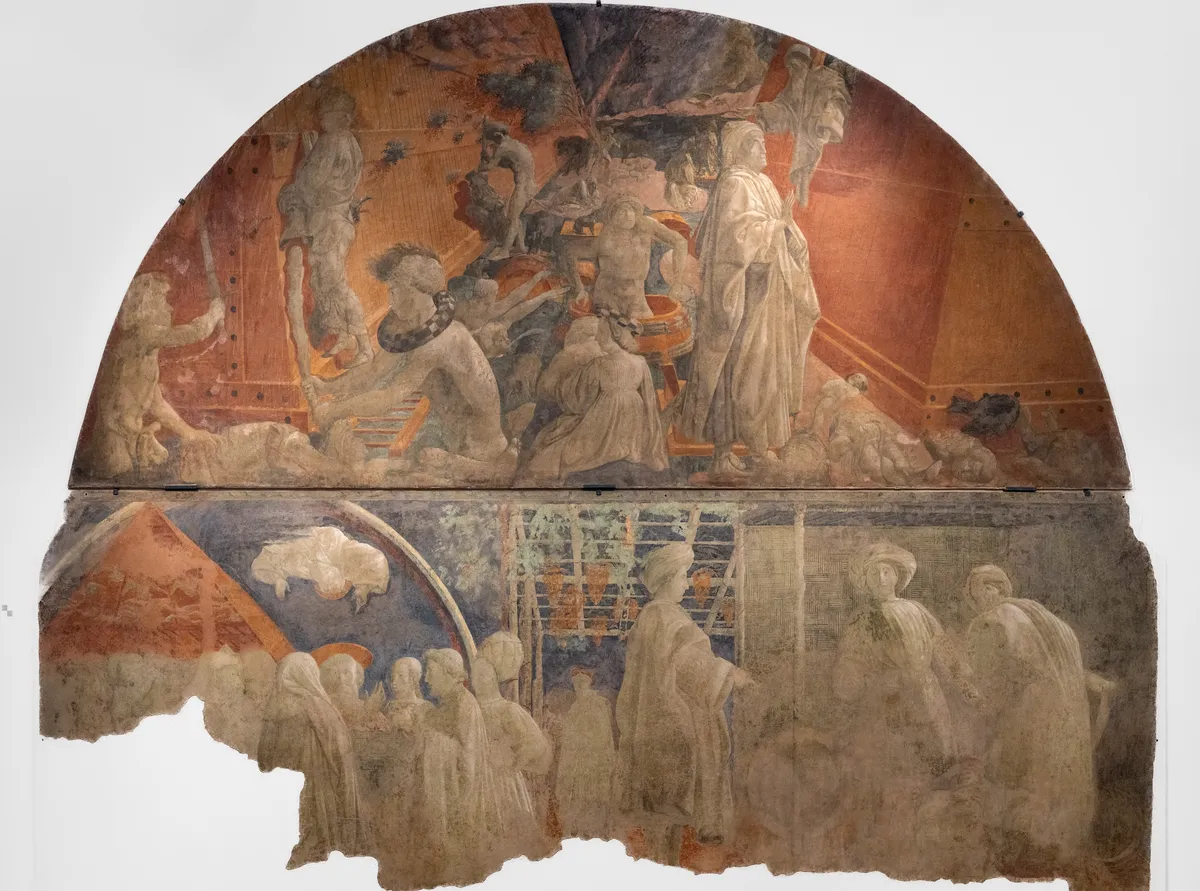
5. The Flood and the Waters Subsiding by Paolo Uccello (c. 1447)
The oldest work in this list is also the most daring. Paolo Uccello painted his Flood on the wall of the Green Cloister at Santa Maria Novella in Florence, and he used it to push the new science of perspective to its limit. Two views of the ark rush back into depth, forming a steep corridor down which the flood pours. A man with a strange ringed headdress, the mazzocchio Uccello loved to draw, stands amid drowning bodies.
Paolo Uccello, The Flood and the Waters Subsiding, c. 1447. Green Cloister, Santa Maria Novella, Florence
Centuries of damp have worn the fresco badly, yet its ambition still astonishes. This is one of the first attempts to stage a biblical drama inside a convincing, measurable space. To see more of the artist’s bold experiments, read our article on Paolo Uccello’s paintings.
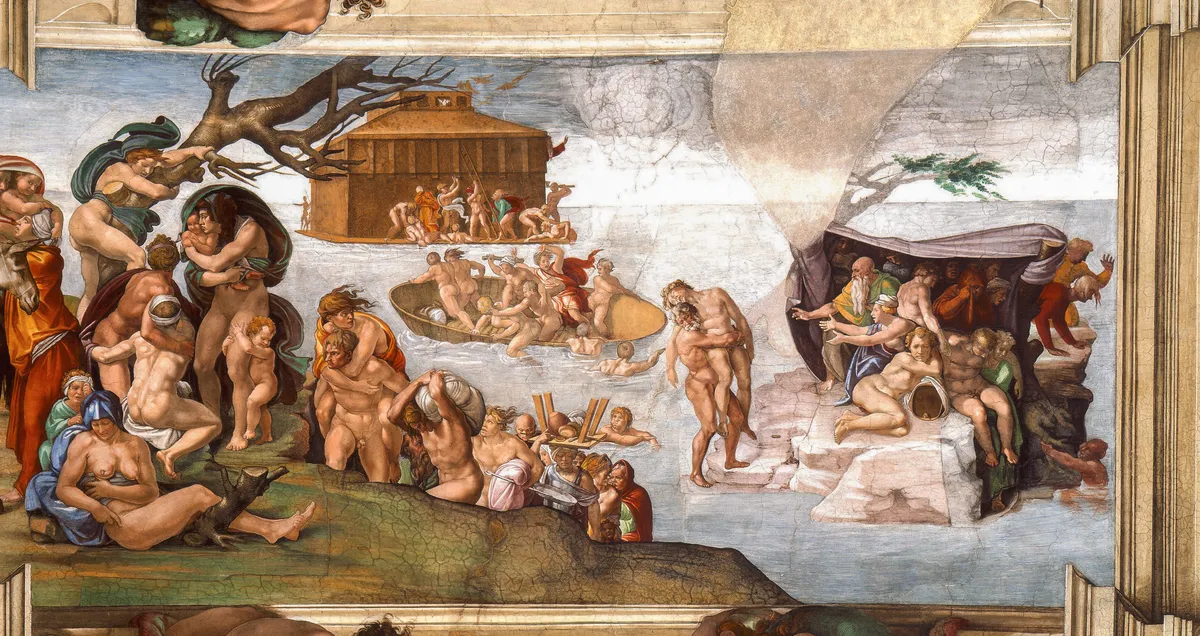
6. The Deluge by Michelangelo (1508 to 1512)
Before he painted the Creation of Adam, Michelangelo painted the Flood. The Deluge was among the first scenes he completed on the ceiling of the Sistine Chapel, and it teems with desperate humanity. Families haul their belongings up a shrinking island of land, a couple shelters beneath a wind torn tent, and a small boat tips as people fight to climb aboard. The ark itself floats calmly in the distance, closed and unreachable.
Michelangelo, The Deluge, 1508 to 1512. Sistine Chapel, Vatican
There is no comfort here, only the weight and beauty of the human body under threat. Michelangelo gives each figure the monumental power of carved stone. The scene is one panel in his vast Genesis cycle, which you can explore further in our article on the Sistine Chapel ceiling.
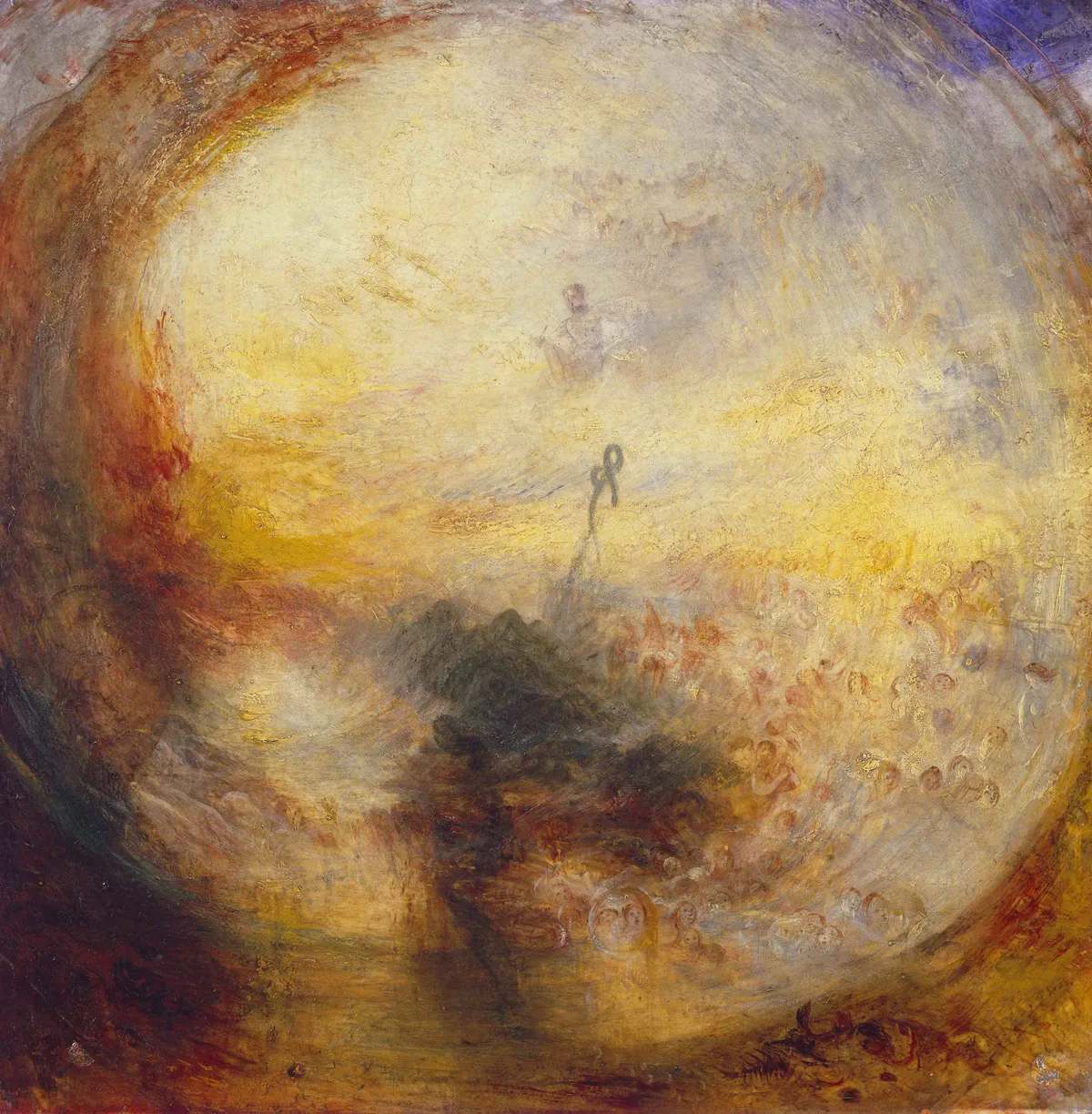
7. Light and Colour: The Morning after the Deluge by J.M.W. Turner (1843)
By the nineteenth century the Flood had become a subject for pure feeling, and no one pushed it further than J.M.W. Turner. In this late work the storm has passed and the world dissolves into a blazing whirl of gold and white. At the centre, a tiny figure of Moses sits writing the Book of Genesis, almost lost in the light, while ghostly forms rise on the swelling colour.
J.M.W. Turner, Light and Colour (The Morning after the Deluge), 1843. Tate, London
Turner gave the painting a long title tied to Goethe’s theory of colour, and he meant it as a meditation on hope after destruction. Many viewers in his own day found it baffling, little more than a smear of paint. Today it is admired as one of his most visionary canvases and hangs at Tate in London.
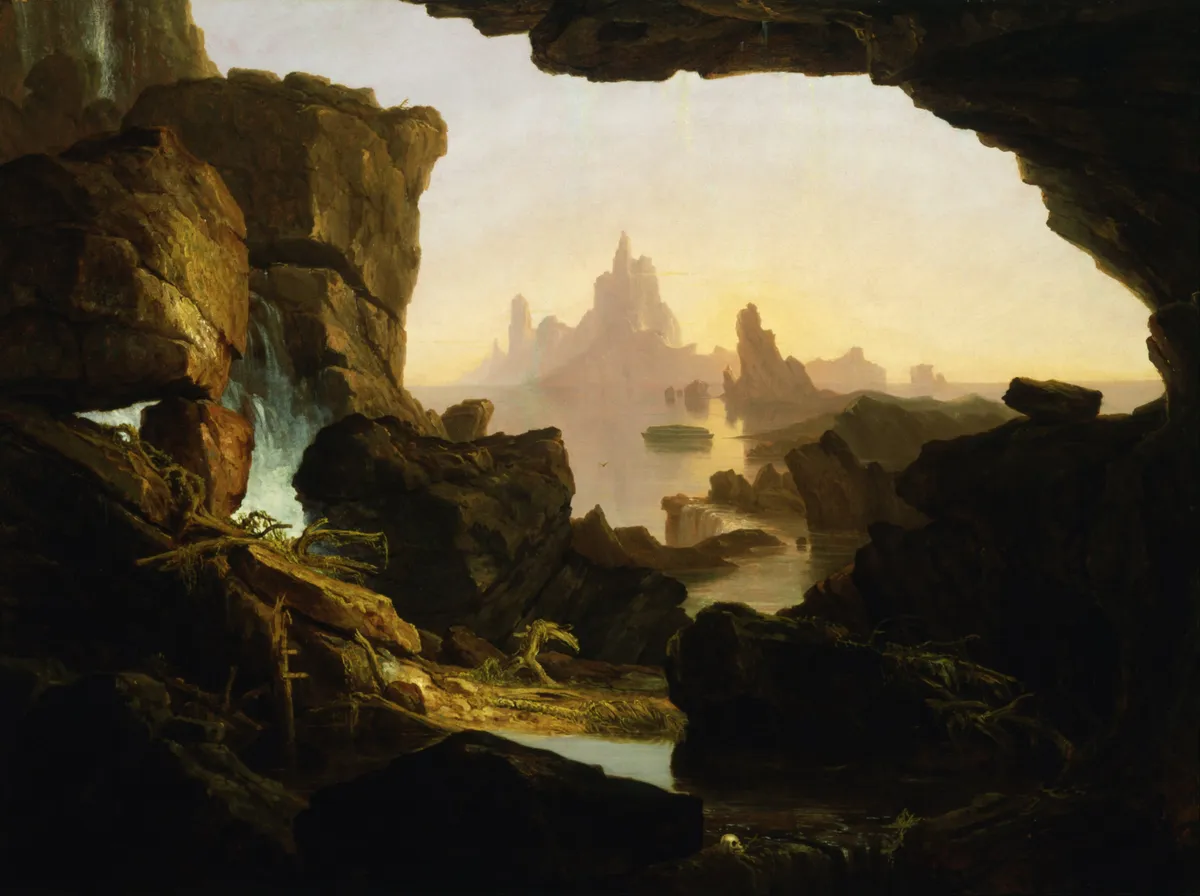
8. The Subsiding of the Waters of the Deluge by Thomas Cole (1829)
The American painter Thomas Cole, founder of the Hudson River School, viewed the Flood through the lens of wild landscape. We look out from the mouth of a dark cave over a desolate, half drowned world. Broken rocks and shattered trees fill the foreground, a skull lies among the debris, and far off, catching the first pale light, the ark rests safely on a distant peak.
Thomas Cole, The Subsiding of the Waters of the Deluge, 1829. Smithsonian American Art Museum
Cole loved to read moral lessons into nature, and here the receding water becomes an image of judgment giving way to renewal. The composition turns the eye from death in the shadows toward the small, bright sign of survival on the horizon. The painting belongs to the Smithsonian American Art Museum in Washington.
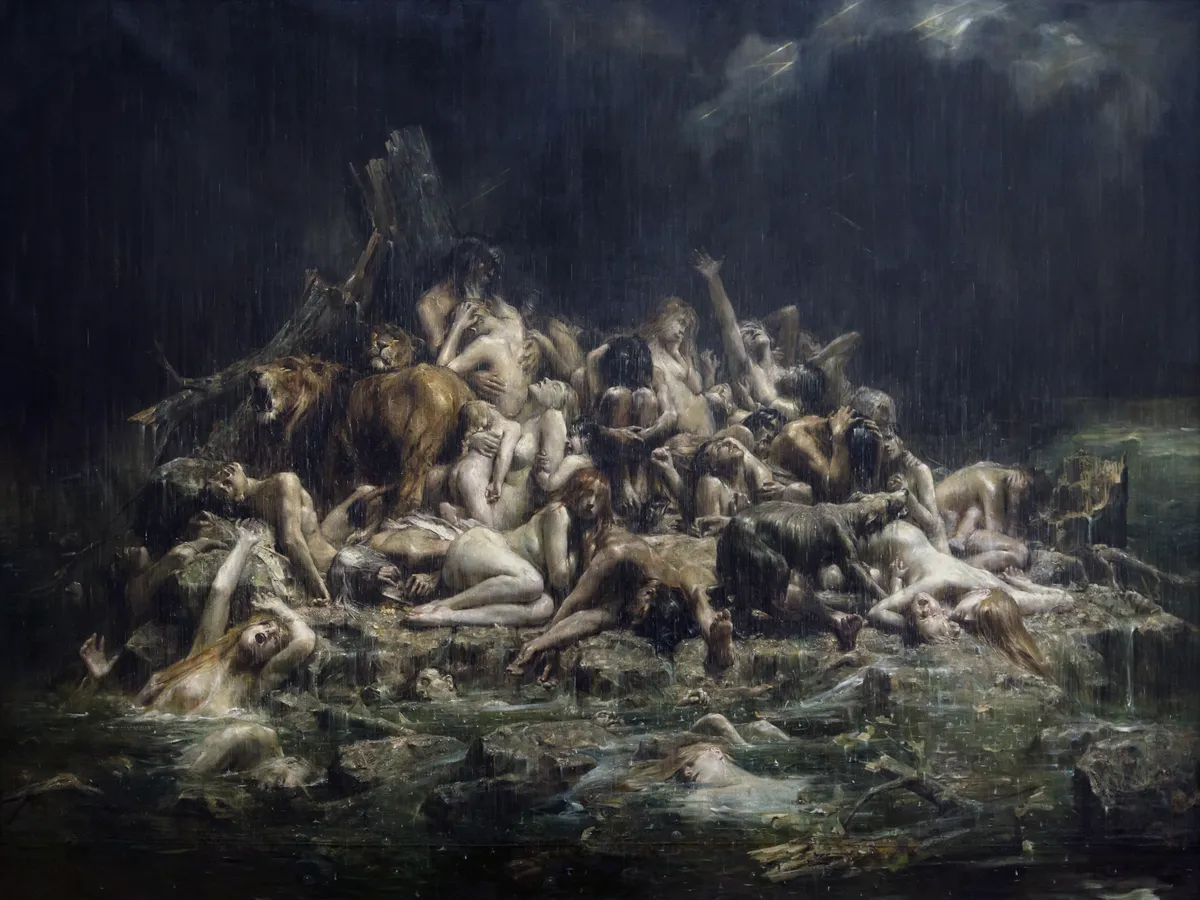
9. The Deluge by Leon Comerre (1911)
Few paintings convey the human terror of the Flood as fiercely as this one. The French academic painter Leon Comerre fills his canvas with a tangle of bodies clinging to the last bare rock as the black water rises around them. A lion crouches among the doomed, a mother lifts her child clear of the flood, and rain lashes down from a starless sky.
Leon Comerre, The Deluge, 1911. Musee d’arts de Nantes
Comerre shows no ark and no rescue, only the moment before the end for those left outside God’s mercy. It is a vision of judgment stripped of comfort, painted with the polished realism of the Paris Salon. The picture is one of the treasures of the Musee d’arts de Nantes.
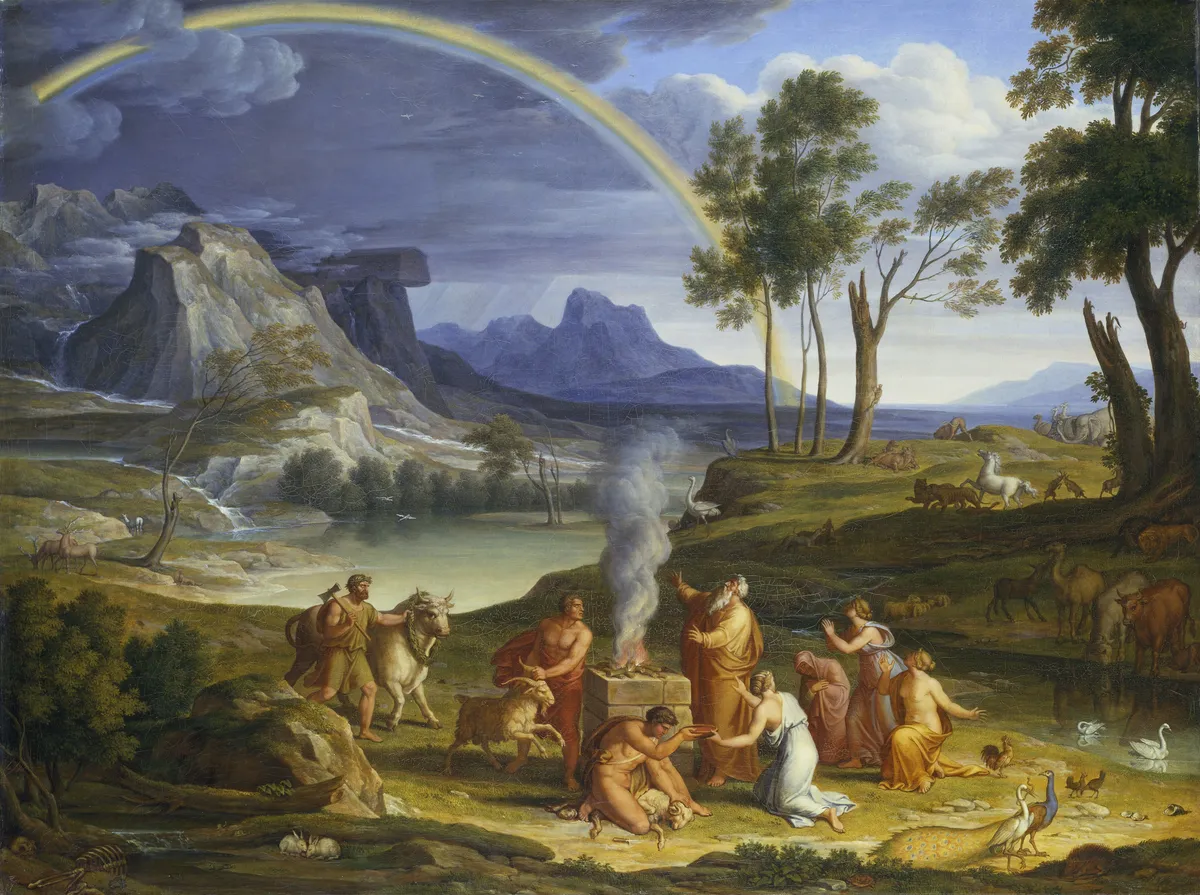
10. Noah’s Thank Offering by Joseph Anton Koch (c. 1803)
The series ends, as the Bible does, with hope. The Austrian painter Joseph Anton Koch sets his scene in a broad, sunlit Alpine valley after the waters have gone. Noah and his family kneel around a stone altar, smoke from their sacrifice curling upward, while the animals wander off in pairs across the green hills. Above them a wide rainbow arches across the clearing sky.
Joseph Anton Koch, Noah’s Thank Offering, c. 1803. Stadel Museum, Frankfurt
Koch was a master of the heroic landscape, and he uses the whole sweep of nature to frame the covenant between God and humanity. The rainbow is the promise that the waters will never return. Calm, ordered, and full of light, the painting is a fitting close to the story, and it hangs in the Stadel Museum in Frankfurt.
Across four centuries, painters have found in Noah’s Ark a story large enough to hold their whole imagination. Uccello saw a puzzle of perspective, Bassano a country evening, Michelangelo a tragedy of the human body, Turner a storm of pure light. Some lingered on the terror of the rising water, others on the gentle parade of animals or the bright covenant of the rainbow.
What unites them is the shape of the story itself, a movement from judgment to mercy. The ark carries a remnant of life through the worst the world can suffer, and the rainbow promises that the darkness will end. That is why these paintings still speak, far beyond the walls of any church or museum. They turn an ancient flood into an image of survival and grace that every viewer can recognise. For the next great chapter of the Old Testament story, see our gathering of Moses paintings.
✦ Free Noah’s Ark Coloring Pages
Love the story of the Flood? Noah’s Ark and the great Bible scenes are free printable coloring pages for kids and adults, ready to print and color at home.
The story of Noah’s Ark is told in chapters 6 to 9 of the Book of Genesis, where God commands Noah to build a wooden vessel so that his family and a pair of every animal can survive a worldwide flood.
The earliest images of Noah’s Ark appear in the Roman catacombs of the third century, where Noah is usually shown in a small box raising his hands as the dove returns with an olive branch.
The oldest famous Noah’s Ark painting is Paolo Uccello’s fresco in the Green Cloister of Santa Maria Novella in Florence, painted around 1447.
Edward Hicks’s Noah’s Ark of 1846, now in the Philadelphia Museum of Art, is one of the most widely reproduced versions and a celebrated example of American folk art.
Many Noah’s Ark paintings focus on the Flood, or Deluge, which became a favourite subject for Romantic painters such as J.M.W. Turner, Thomas Cole, and John Martin in the nineteenth century.
Questions and Answers
What is the most famous Noah’s Ark painting?
The most widely known single image is probably Edward Hicks’s Noah’s Ark of 1846, thanks to its warm, folk art charm and its endless reproduction on prints and book covers. Among Old Master works, Jacopo Bassano’s version in the Prado and Jan Brueghel the Elder’s panel at the Getty are the most celebrated. Michelangelo’s Deluge on the Sistine Chapel ceiling is the most famous treatment of the Flood itself. Fame here depends on whether you mean the gentle ark or the terrible storm around it.
What is the oldest Noah’s Ark painting?
Images of Noah go back to early Christian art in the Roman catacombs, but as a major painting the earliest landmark is Paolo Uccello’s fresco of around 1447 in Florence. The sixteenth century then produced several famous panels, including Simon de Myle’s signed work of 1570 and Jacopo Bassano’s canvas of the same decade. These Renaissance paintings set the patterns that later artists would follow. The subject has remained popular in every century since.
Where can you see original Noah’s Ark paintings?
They are spread across some of the world’s great museums. Bassano’s version is in the Prado in Madrid, Brueghel’s is at the Getty in Los Angeles, and Hicks’s is in the Philadelphia Museum of Art. Turner’s Deluge hangs at Tate in London, Cole’s at the Smithsonian American Art Museum, and Koch’s at the Stadel in Frankfurt. Michelangelo’s Deluge can be seen overhead in the Sistine Chapel, while Uccello’s fresco remains on the wall of Santa Maria Novella.
Why do some Noah’s Ark paintings show a unicorn?
The unicorn is a popular folk addition rather than a biblical fact, since Genesis names no specific species. An old legend holds that the unicorn was too proud or too playful to board in time and so was lost in the Flood, which folklore offered as a reason the creature is no longer seen. Artists and illustrators, especially in children’s versions, sometimes include a unicorn for charm or as a gentle moral about pride. None of the major historical paintings in this list depict one.
What is the difference between a Noah’s Ark painting and a Flood painting?
The two overlap, but the emphasis differs. A Noah’s Ark painting usually centres on the ark and its animals, whether boarding, sailing, or landing, as in the works by Hicks, Brueghel, and de Myle. A Flood, or Deluge, painting focuses on the disaster itself, the rising water and the people left outside the ark, as in the works by Michelangelo, Turner, and Comerre. Both draw on the same chapters of Genesis, and many artists move freely between them.
Can you buy Noah’s Ark paintings as canvas prints?
You can buy Noah’s Ark paintings at jesuschrist.pictures, in our shop, where the classic versions are offered as high quality canvas prints. Because the subject is so beloved, a faithful reproduction lets you bring a work like Hicks’s gentle ark or Bassano’s farmyard procession into a home, classroom, or church hall. Browse our collection of Christian art reproductions on canvas to find a piece for your home or parish.