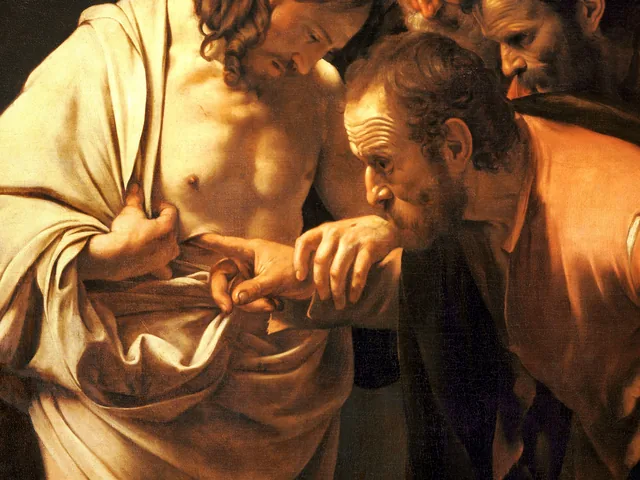
Famous Tintoretto Paintings from Venice’s Sacred World
Tintoretto paintings do not let you rest. Jacopo Comin, born in Venice in 1518 and known to his contemporaries as Tintoretto, the little dyer, after his father’s trade, produced a body of religious work of extraordinary energy and volume over a career spanning six decades. He is said to have painted with the drawing of Michelangelo and the colour of Titian as his guiding ambition, and while such formulas simplify a deeply original artist, they point toward something real. His sacred paintings are dramatic in a way that demands a response. The angels sweep, the light crashes, the figures strain. And underneath all that movement, the theological content is precise and serious.

The Venetian Master of Drama
Tintoretto grew up in Venice at a moment when the city’s painters were the envy of Europe. Giovanni Bellini had defined the Venetian altarpiece. Titian had elevated it. Tintoretto was the next generation, and he was impatient. He trained only briefly under Titian, who reportedly dismissed him from his workshop after a few weeks, and then taught himself from plaster casts of Michelangelo’s sculptures and from constant drawing. His style was formed in competition rather than apprenticeship, and it shows: from the beginning his work has the character of someone proving something.
The Adoration of the Magi at the Museum of Fine Arts in Boston demonstrates both his strengths and his distinctive approach. The composition does not settle into the ceremonial arrangement most painters preferred. Tintoretto breaks the scene open, giving the procession a turbulent momentum, animals and attendants pressing in from the edges, light shifting across surfaces with the drama of a stage production. The Magi approach not as solemn dignitaries but as men who have been travelling hard and have finally arrived.

Christ and the Adulteress, at the Statens Museum for Kunst in Copenhagen, shows a different facet of his narrative sensibility. The scribes and Pharisees press forward with their accusation, the woman stands at the centre in a moment of exposed vulnerability, and Christ responds not with argument but with presence. The spatial arrangement places the viewer uncomfortably close to the confrontation, Tintoretto’s characteristic way of making theology physically felt.

Service and Humility: Christ Among His Disciples
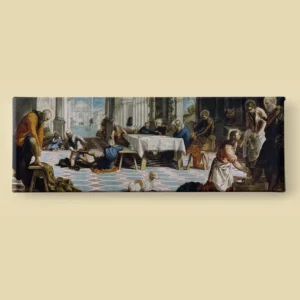
Among Tintoretto’s most original contributions to sacred painting is his treatment of the domestic episodes of Christ’s ministry, the moments of service and solidarity that other painters sometimes passed over in favour of more spectacular scenes. Christ Washing the Disciples’ Feet, at the Museo del Prado in Madrid, is a large canvas that places the act of washing at a slight remove from the centre of the composition. The apostles fill the left side of the picture, some removing sandals, some reclining, some watching. On the right, a loggia opens onto a harbour scene. Tintoretto makes the Washing feel like an event happening in a real world of ordinary human activity, which is precisely the point: humility as a lived practice, not an ideal.

Tintoretto returned to The Last Supper multiple times over his career, each version more dramatically conceived than the last. The San Trovaso version, now displayed in Venice, belongs to an earlier period in his development. Where his great late Last Supper at San Giorgio Maggiore dissolves the table into a blaze of light and angelic presences, the San Trovaso version is more contained, the apostles grouped around Christ with an intensity of attention that makes the moment of institution feel genuinely urgent. Both versions reject the symmetrical, frieze-like arrangement that had been conventional since Leonardo, placing Christ off-centre and letting the spatial drama carry the theological weight.


Contemplation and Penitence
Alongside his large public commissions, Tintoretto produced smaller devotional paintings of remarkable intimacy. The Penitent Magdalene at the Capitoline Museums in Rome shows Mary Magdalene in a landscape, her hair loose, books open beside her, turned in an attitude of prayer. This was a subject well suited to his temperament: the energy he normally spent on crowds and spatial complexity is here focused inward, the whole force of the image concentrated on a single figure and her interior state.

The Magdalene in the Wilderness at the Detroit Institute of Arts pushes this devotional intensity further. The saint is shown in a rocky landscape lit by a supernatural light, her gaze cast upward in an ecstasy that Tintoretto renders with physical conviction. These Magdalene paintings are among the most personal images he made, and they suggest a painter who, beneath the theatrical ambition of his public work, held a genuine and serious religious sensibility.

Saint Jerome, now in the Slovak National Gallery, belongs to the same vein of isolated holy figures. Jerome is shown in his traditional role as scholar and penitent, surrounded by the books of his great translation and by the lion who became his symbol. Tintoretto’s Jerome is not a serene academic but a man under pressure, the urgency of the Scriptures pressing on him from all sides.

Baptism, Suffering, and Resurrection
Ecce Homo at the Castelvecchio Museum in Verona places Pilate’s presentation of the scourged Christ before the crowd in a composition that divides the picture space with unusual boldness. Christ stands alone to one side, the crowd reacting on the other, and Tintoretto uses the architectural setting to frame the moment of rejection with the geometry of a stage set. The work belongs to a long tradition of Ecce Homo paintings, but Tintoretto’s version has a raw directness that belongs to him alone.

The Baptism of Christ, with versions at the Museo del Prado and the Royal Palace of Aranjuez, shows Tintoretto working at the intersection of heavenly and earthly space. The dove descends through a dramatic opening in the clouds while the crowd on the bank watches from below. The composition moves on a strong diagonal from the sky to the river, organizing the sacred event within a world of physical depth and atmospheric light.

The Risen Christ with Saint Andrew and donors at the Church of San Giorgio Maggiore in Venice is one of his most strikingly composed resurrection images. Christ appears in a blaze of light while Saint Andrew intercedes for the kneeling donors below. The arrangement captures what the resurrection meant to Tintoretto: not primarily a personal triumph for Christ, but a promise extended to ordinary human beings through the mediation of the saints. The donors’ presence is not an intrusion but the point.

Tintoretto died in Venice on May 31, 1594, at the age of seventy-five or seventy-six, having worked without pause almost until the end. He left behind the Scuola di San Rocco cycle, the great canvases of the Doges’ Palace, and hundreds of paintings in churches across the Veneto. His directness of approach and his refusal to make sacred subjects comfortable influenced Caravaggio‘s generation and, through them, the whole Baroque tradition. He also influenced El Greco profoundly, who may have passed through his workshop before leaving for Spain. Among the painters of the Italian Renaissance examined on this site, Tintoretto is the one whose work feels most insistently contemporary. The urgency never went away.
Summary of Tintoretto’s Major Paintings
| Painting | Artist | Date | Medium | Museum |
|---|---|---|---|---|
| Adoration of the Magi | Tintoretto | c. 1538-1540 | Oil on canvas | Museum of Fine Arts, Boston |
| Christ and the Adulteress | Tintoretto | c. 1545-1548 | Oil on canvas | Statens Museum for Kunst, Copenhagen |
| Christ Washing the Disciples’ Feet | Tintoretto | c. 1548-1549 | Oil on canvas | Museo del Prado, Madrid |
| Ecce Homo | Tintoretto | c. 1546-1547 | Oil on canvas | Castelvecchio Museum, Verona |
| Penitent Magdalene | Tintoretto | c. 1598 | Oil on canvas | Capitoline Museums, Rome |
| Saint Jerome | Tintoretto | c. 1571-1572 | Oil on canvas | Slovak National Gallery |
| The Baptism of Christ | Tintoretto | c. 1585 | Oil on canvas | Museo del Prado, Madrid |
| The Last Supper | Tintoretto | c. 1566 | Oil on canvas | Church of San Trovaso, Venice |
| The Magdalene in the Wilderness | Tintoretto | c. 1560 | Oil on canvas | Detroit Institute of Arts |
| The Risen Christ with Saint Andrew and donors | Tintoretto | c. 1555-1556 | Oil on canvas | Church of San Giorgio Maggiore, Venice |
Important Facts About Tintoretto
- Jacopo Comin was born in Venice in 1518, the son of a cloth-dyer, and received the nickname Tintoretto, meaning “little dyer,” from his father’s trade.
- He trained briefly under Titian before teaching himself from plaster casts of Michelangelo’s sculptures, and spent his entire career in Venice working almost exclusively for Venetian churches, confraternities, and the Doges’ Palace.
- Tintoretto belongs to the Late Renaissance and Venetian Mannerism, known above all for his dramatic foreshortening, his use of artificial light sources within compositions, and the extraordinary speed and energy of his brushwork.
- His most celebrated work is the Last Supper at the Church of San Giorgio Maggiore in Venice, painted between 1592 and 1594, which places the Eucharistic moment in a space dissolving into supernatural light.
- He died in Venice on May 31, 1594, and his influence extended directly to El Greco, who studied in or near his workshop, and through the drama of his compositions to the Baroque painters of the next generation.
Questions and Answers About Tintoretto’s Paintings
What is Tintoretto’s most famous painting?
The Last Supper at the Church of San Giorgio Maggiore in Venice, painted between 1592 and 1594, is generally considered his masterpiece. Unlike Leonardo’s famous version, Tintoretto places the table on a strong diagonal receding into the picture space, with the apostles scattered along it in animated conversation, while servants bustle in the foreground and angels swirl through the air above. The scene dissolves at the centre into a blaze of supernatural light that marks the institution of the Eucharist. The painting is still in its original location in Venice and can be visited today.
Where can I see Tintoretto’s religious paintings?
The largest concentration of Tintoretto’s work is in Venice, spread across the Doges’ Palace, the churches of San Rocco, San Giorgio Maggiore, Santa Maria dell’Orto, and the Scuola Grande di San Rocco, which holds a monumental cycle of Old and New Testament scenes he painted over a period of more than twenty years. Outside Venice, the Museo del Prado in Madrid holds several major works, including Christ Washing the Disciples’ Feet and the Baptism of Christ. The Uffizi in Florence, the Kunsthistorisches Museum in Vienna, and the Metropolitan Museum in New York also hold significant examples.
How does Tintoretto compare to Titian as a religious painter?
Titian’s religious paintings tend toward grandeur, formal balance, and a sensuous richness of colour that makes the sacred feel majestic and approachable. Tintoretto’s are more restless, more dramatically lit, and more spatially complex, favouring diagonals over horizontals and artificial light over natural. Titian makes you reverent; Tintoretto makes you alert. Both were defining painters of the Venetian school, but their temperaments were profoundly different. For Titian’s approach, see our article on Titian paintings.
What is the meaning of Christ Washing the Disciples’ Feet?
The scene comes from the Gospel of John (13:1-17), where Jesus washes the feet of his disciples before the Last Supper as a demonstration of servant leadership. The act was considered scandalous because foot-washing was servants’ work, and several disciples initially refused to allow it. By performing it himself, Jesus reversed the expected social order and set it as the model for his followers. Tintoretto’s treatment at the Prado emphasizes the ordinariness of the setting and the variety of the disciples’ reactions, making the theological statement feel like it is happening in real life rather than in a ceremonial space.
Did Tintoretto paint anything other than religious subjects?
Yes. Tintoretto also painted portraits, mythological scenes for the Doges’ Palace, and allegorical subjects. His portraits are among the most penetrating of the sixteenth century. The mythological paintings, including a celebrated series on the story of Susannah and the Elders and scenes from the Metamorphoses, show the same spatial and lighting innovations as his sacred works. But religious painting was the dominant medium of his public career, and the Scuola di San Rocco cycle, with its enormous canvases of Old and New Testament scenes, remains his most sustained achievement.
Where can I buy a canvas reproduction of a Tintoretto painting?
You can buy them at jesuschrist.pictures, in our shop: see all the canvas canvas prints, ready to hang, in several sizes.