The Lost Light in Geertgen tot Sint Jans Paintings
Few painters in the history of Western art remain as mysterious, and as immediately moving, as Geertgen tot Sint Jans. His name itself, which simply means “Little Gerard of the brothers of Saint John,” tells us that he was a lay brother of the Hospitaller Knights of Saint John in Haarlem, and that he died young, in his late twenties, before the close of the fifteenth century. The Geertgen tot Sint Jans paintings that have survived him are scarcely a dozen panels, but they hold an inner intensity that has fascinated viewers ever since.
This article gathers seven of his most important surviving religious panels, together with the only known contemporary portrait of the painter himself.

The Hospitaller Brother of Haarlem
Almost everything we know about Geertgen tot Sint Jans comes from a single brief notice in Carel van Mander’s Schilder-boeck of 1604. According to the Haarlem chronicler, the painter was born in Leiden around 1465, was trained by the Haarlem painter Albert van Ouwater, and entered the lay brotherhood of the Hospitaller commandery of Saint John in his native Holland. Van Mander adds that the brothers held him in such affection that they kept many of his works in their priory, and that he died at only twenty-eight years of age.
That priory and its art collection are now gone. The Reformation, the iconoclastic riots of 1566, and the destruction of the Saint John commandery scattered or destroyed almost everything Geertgen had painted. What survives is a small group of panels that have come down to us through the great German and Austrian collectors of the sixteenth and seventeenth centuries.
Nativity at Night
The most famous of all Geertgen’s surviving panels, the Nativity at Night is one of the earliest known oil paintings to attempt the difficult subject of a nocturnal scene lit only by supernatural light. The Christ child lies in the manger as the source of his own illumination, and the figures of the Virgin, the angels, and the ox and ass are bathed in his radiance. In the upper left corner, behind a hill, a second small light marks the angel announcing the birth to the shepherds.

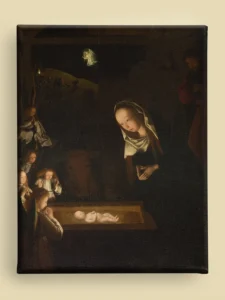
The picture is a meditation on the prologue of John’s Gospel, where the light shines in the darkness and the darkness has not overcome it. The painting is now at the National Gallery in London. For a wider survey of the subject, see our article on famous Nativity paintings.
The Glorification of the Virgin
This small panel of the Virgin in glory is one of Geertgen’s most personal compositions. Mary stands on the crescent moon with the Christ child in her arms, surrounded by concentric rings of angels playing instruments and singing. The composition is built like a medieval musical score, with hundreds of small figures arranged in perfect circles around the central image.

The painting is at the Museum Boijmans Van Beuningen in Rotterdam, one of the great Dutch primitive holdings of the Low Countries.
The Lamentation of Christ
One half of a great wing panel from the destroyed altarpiece of the Haarlem Knights of Saint John, this picture shows the body of Christ taken down from the cross and laid across the lap of the Virgin while John the Evangelist supports his shoulders and Mary Magdalene weeps at his feet. The figures are placed in a strange rocky landscape that closes around them like the inside of a tomb. Geertgen paints the scene with the same quietness as his Nativity at Night.

The painting is now at the Kunsthistorisches Museum in Vienna.
The Legend of the Relics of Saint John the Baptist
The companion panel to the Lamentation, this larger composition shows the medieval story of the discovery of the bones of John the Baptist by the Hospitaller knights of Saint John, the order to which Geertgen himself belonged. The brothers are shown gathering the relics in the foreground while in the background the story of the desecration of the saint’s body by the emperor Julian the Apostate unfolds in a continuous narrative.

The painting is also at the Kunsthistorisches Museum in Vienna. It is one of the very few medieval altarpieces in which the painter has been allowed to include a portrait of his own confraternity at work.
Saint John the Baptist in the Wilderness
The patron saint of Geertgen’s brotherhood sits alone on a rocky outcrop in a strangely soft landscape, his head in his hands, his lamb resting beside him. The figure is dressed in his usual camel skin tunic with a heavy purple robe falling around him. The expression is one of profound melancholy. This small panel is one of the most psychologically intense images of Saint John in the whole of early Netherlandish painting.


The painting is at the Gemäldegalerie in Berlin. For a wider survey, see our article on Saint John the Baptist paintings.
The Life of Saint Dominic
This rare panel shows scenes from the life of Saint Dominic, the founder of the Order of Preachers, including the miracle of the book that floated unburnt during the Albigensian disputes. The composition is built as a continuous landscape narrative, with several episodes of the saint’s life unfolding across the same painted space.

The painting is now in the collection of the Museum der bildenden Künste in Leipzig.
Virgin and Child
One of the most intimate of Geertgen’s surviving panels, this small Virgin and Child shows Mary holding her son against her shoulder while he plays with a small bell. The composition has the same close devotional intensity as his Nativity at Night. The figures are slightly elongated, the colour silvery, and the dark background pushes them gently forward.

The panel is now at the Gemäldegalerie in Berlin.
For more context on the early Netherlandish tradition, see our articles on Jan van Eyck, Rogier van der Weyden, and Dieric Bouts, the three older masters whose work shaped the visual world of Geertgen’s Holland. The wider tradition of Dutch Renaissance Jesus paintings holds Geertgen as its first great original voice.
Summary Table of Geertgen tot Sint Jans’s Religious Paintings
| Name | Artist | Date | Medium | Museum |
|---|---|---|---|---|
| Nativity at Night | Geertgen tot Sint Jans | c. 1490 | Oil on panel | National Gallery, London |
| The Glorification of the Virgin | Geertgen tot Sint Jans | c. 1490 to 1495 | Oil on panel | Museum Boijmans Van Beuningen, Rotterdam |
| The Lamentation of Christ | Geertgen tot Sint Jans | c. 1484 | Oil on panel | Kunsthistorisches Museum, Vienna |
| The Legend of the Relics of Saint John the Baptist | Geertgen tot Sint Jans | c. 1484 | Oil on panel | Kunsthistorisches Museum, Vienna |
| Saint John the Baptist in the Wilderness | Geertgen tot Sint Jans | c. 1490 | Oil on panel | Gemäldegalerie, Berlin |
| The Life of Saint Dominic | Geertgen tot Sint Jans | c. 1490 | Oil on panel | Museum der bildenden Künste, Leipzig |
| Virgin and Child | Geertgen tot Sint Jans | c. 1490 | Oil on panel | Gemäldegalerie, Berlin |
Conclusion
Geertgen tot Sint Jans is a painter we know almost entirely through what he painted, and what he painted is enough to make him one of the great lost masters of fifteenth century Christian art. The Nativity at Night, with its single luminous infant lighting a whole sleeping world, has been a touchstone for every later painter of religious darkness, from Correggio to Rembrandt to the German Expressionists. The Lamentation in Vienna has the strange melancholy of a young painter who already knew, perhaps, that he would not live to see his own old age.
Important Facts About Geertgen tot Sint Jans
- Geertgen tot Sint Jans was born around 1465 in Leiden, in the County of Holland, into a family whose name and circumstances are not recorded, and whose only documented biographer is Carel van Mander writing more than a century after his death.
- He trained according to van Mander in the Haarlem workshop of the painter Albert van Ouwater and entered as a lay brother the Hospitaller commandery of Saint John in Haarlem, from which he took the name by which we know him.
- Geertgen is one of the central figures of the early Netherlandish school of the late fifteenth century and is celebrated for the contemplative softness of his figures, the silvery atmosphere of his landscapes, and the originality of his Nativity at Night.
- His most famous religious work is the Nativity at Night, painted around 1490 and now displayed at the National Gallery in London, one of the earliest known oil paintings to render a fully nocturnal scene illuminated only by supernatural light.
- He died around 1495 at only twenty-eight years of age in Haarlem, and although the destruction of the Saint John commandery in the Reformation scattered most of his production, the surviving panels are universally recognised as among the finest of their generation in the Northern Low Countries.
Questions and Answers About Geertgen tot Sint Jans Paintings
What is Geertgen tot Sint Jans’s most famous painting?
By far the most celebrated is the Nativity at Night at the National Gallery in London, painted around 1490. It is one of the earliest oil paintings in Western art to attempt a fully nocturnal scene, and the radiant child in the manger has become one of the founding images of Christian art of light and darkness.
Where can I see Geertgen tot Sint Jans paintings today?
The National Gallery in London owns the Nativity at Night, the Museum Boijmans Van Beuningen in Rotterdam the Glorification of the Virgin, the Kunsthistorisches Museum in Vienna both the Lamentation and the Legend of the Relics, the Gemäldegalerie in Berlin the Saint John the Baptist and the Virgin and Child, and the Museum der bildenden Künste in Leipzig the Life of Saint Dominic.
What style is Geertgen tot Sint Jans associated with?
Geertgen belongs to the late phase of the early Netherlandish school, sometimes also called the Northern Renaissance of the Low Countries. His mature style is built on softened figures, silvery atmospheric landscapes, and an unusual sense of contemplative interiority that distinguishes him from his more linear contemporaries. He is one of the first Dutch painters to be recognised by name as an independent artistic personality.
Why did Geertgen die so young?
The exact cause of his death at twenty-eight years old is not known. Carel van Mander reports that he died in the Hospitaller commandery of Haarlem around 1495, but no medical detail is given. The early modern reader assumed plague or one of the many epidemics that swept fifteenth century Holland. The brevity of his life makes the small number of surviving panels all the more precious.
What does the name “Geertgen tot Sint Jans” mean?
The name is Middle Dutch and means literally “Little Gerard of Saint John’s,” with Geertgen being an affectionate diminutive of Geert or Gerard and tot Sint Jans referring to his lay brotherhood at the Hospitaller commandery of Saint John in Haarlem. It is the name by which his confraternity called him during his lifetime, and the only name under which his small corpus of works has come down to us.
How did Geertgen influence later Dutch painters?
His Nativity at Night, with its bold use of a single light source in a nocturnal scene, anticipates the great Caravaggesque experiments of the seventeenth century and the candle-lit interiors of Honthorst and the Utrecht painters. His soft, slightly elongated figures and silvery landscapes left a deep mark on his Haarlem successors, including Jan Mostaert and the early Lucas van Leyden.
Can you buy Geertgen tot Sint Jans paintings as canvas prints?
You can buy them at jesuschrist.pictures: browse all the Geertgen tot Sint Jans canvas prints in our shop, printed on museum-grade canvas and available in several sizes.


