Epiphany House Blessing 2027: How to Chalk Your Door
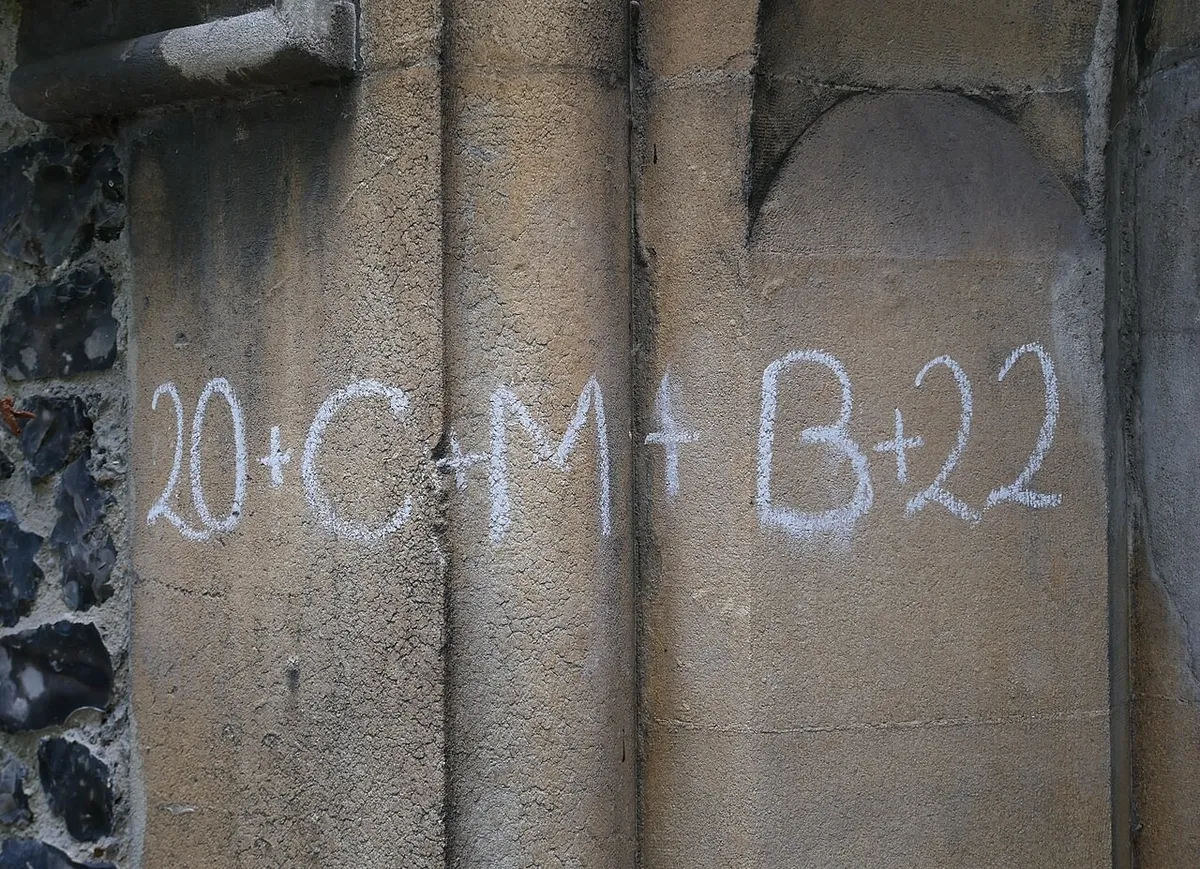
Early in January, in many Catholic homes, someone climbs on a chair with a piece of chalk and writes a short line above the front door:
20 + C + M + B + 27
This is the Epiphany house blessing, one of the oldest and simplest customs of the Christmas season. The family gathers at the door, reads the Gospel of the Wise Men, asks God’s blessing on the home and marks the new year over the threshold. It takes ten minutes, needs nothing more than a piece of chalk, and the inscription stays above the door for months, fading slowly, a quiet reminder of who is welcome in the house.
This page explains what the letters mean, where the custom comes from and how to do it in 2027, with the full text of the prayers. You will also find a free two-page printable to bring to the door: the instructions on one side, the blessing on the other.
✦ The Epiphany House Blessing as a Free Printable
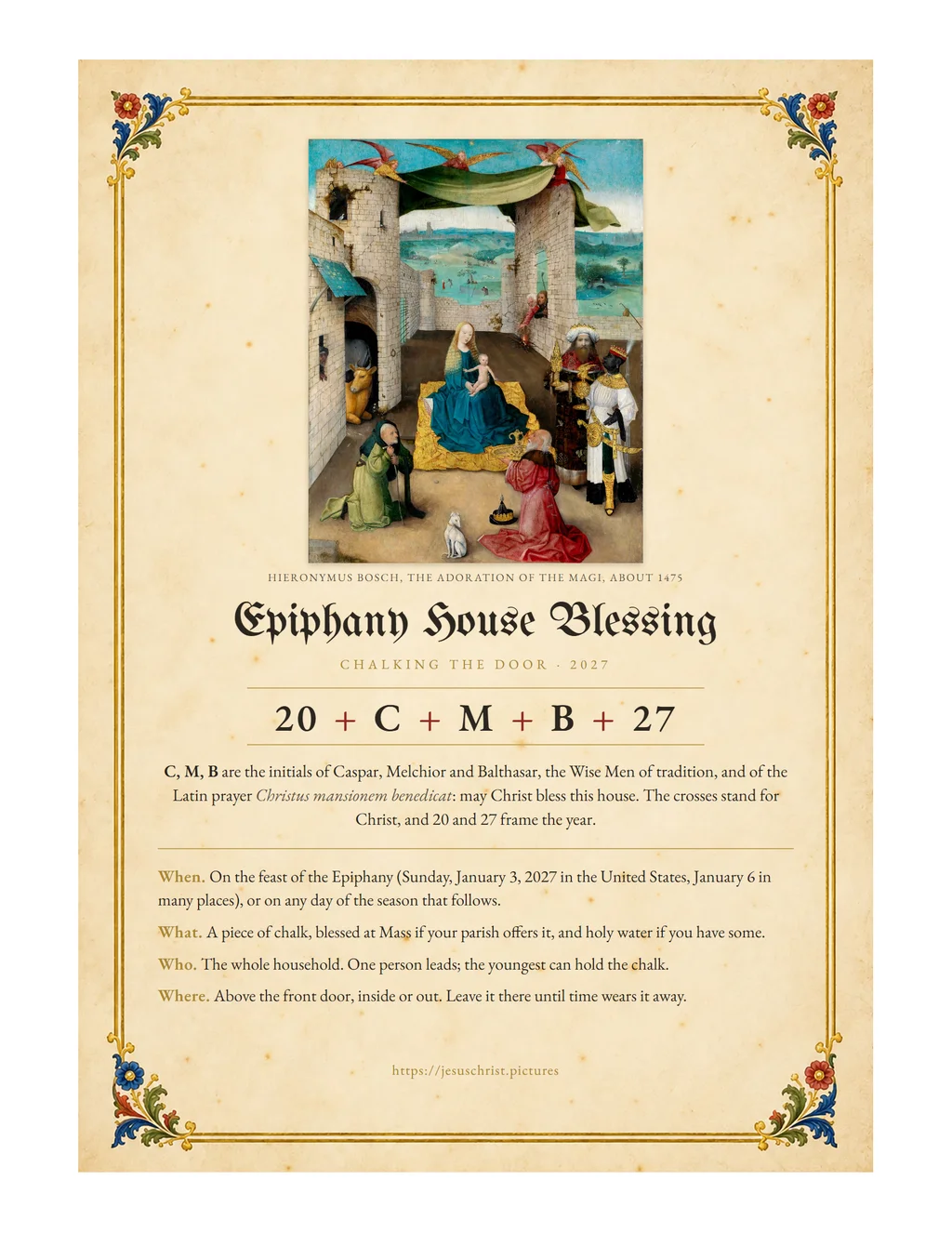
Two illuminated pages to bring to the door: on the first, the inscription for 2027, what it means and how to do it; on the second, the whole blessing, ready to pray together. It is free, and there is nothing to fill in.
Download for US LetterDownload for A4
PDF, two pages, ready to print.
What Does 20 + C + M + B + 27 Mean?
The inscription is read in three parts.
20 and 27 are the year, split in two: 2027. Each January the last two digits change, so a door chalked last winter reads 20 + C + M + B + 26.
C, M and B are the initials of Caspar, Melchior and Balthasar, the names tradition gives to the Wise Men. The same three letters are also read as the first words of a short Latin prayer, Christus mansionem benedicat: “May Christ bless this house.”
The crosses stand for Christ, in whose name the blessing is asked. In German-speaking countries the first and last signs are often drawn as stars, for the star that led the Magi to Bethlehem.
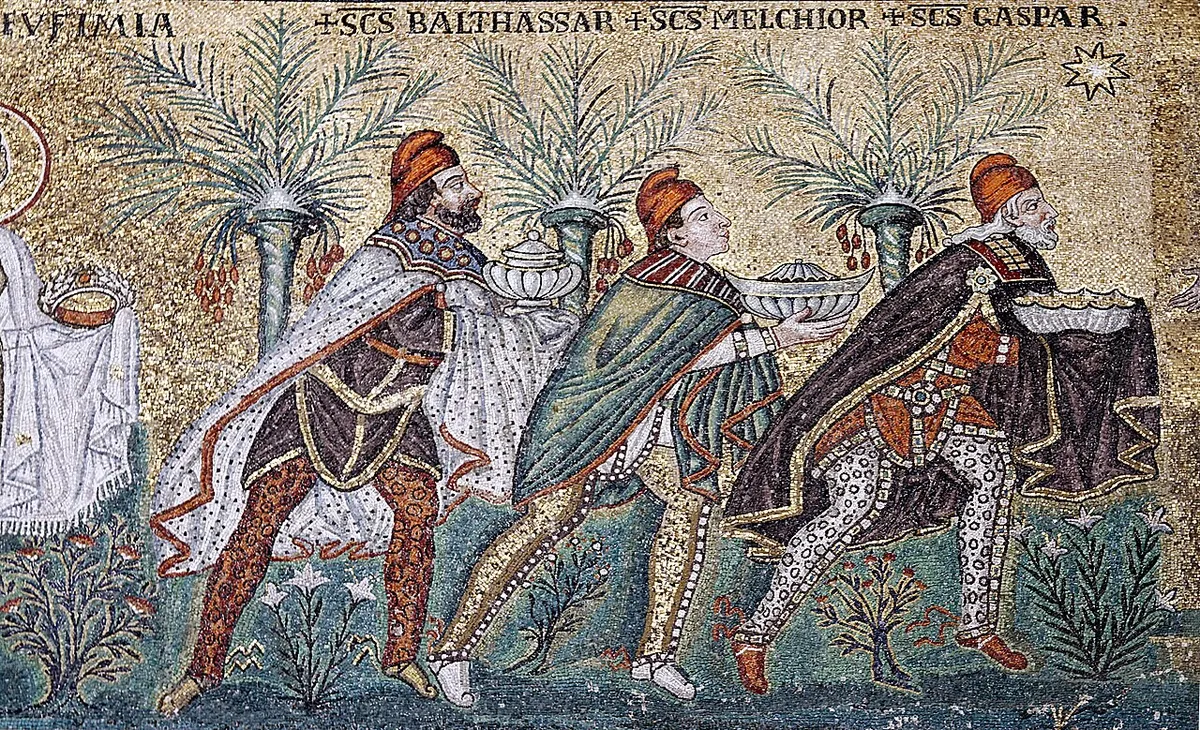
Saint Matthew does not name the Wise Men, nor even say how many they were. Their three gifts, gold, frankincense and myrrh, suggested three visitors, and by the sixth century they had names. In the basilica of Sant’Apollinare Nuovo in Ravenna, a mosaic made around 560 shows them in Persian dress and red caps, hurrying with their gifts toward the Virgin and Child, each with his name above his head: Balthassar, Melchior, Gaspar.
Where the Custom Comes From
The Gospel itself points to the door. When the Wise Men reached Bethlehem, Matthew writes, “they were come into the house, they saw the young child with Mary his mother” (Matthew 2:11). The feast of their visit became the natural day to ask Christ into every house.
The Roman Ritual, the Church’s old book of blessings, contains a blessing of homes for the feast of the Epiphany. The priest came in with the greeting Jesus taught his disciples, “Peace be to this house” (Luke 10:5), sang the antiphon of the Magi and the Magnificat while the rooms were sprinkled with holy water and incensed, and ended with a prayer that the home might be a place of health, purity, humility, goodness and thanksgiving. The same book has a blessing of chalk for the Epiphany, asking that those who write the names of the three Magi on the doors of their homes may receive health of body and protection of soul.
In much of Central Europe the custom never died out. In Germany and Austria, children dressed as the three kings, the Sternsinger or star singers, still go from door to door in the days after New Year with a star on a pole, sing, chalk the blessing over each door and collect money for children in need. In the English-speaking world it has spread widely again in recent years, among Catholics but also Anglicans, Lutherans and Methodists, and many parishes now bless chalk at the Epiphany Mass and give it to families to take home.
When to Bless Your Home in 2027
The custom belongs to the feast of the Epiphany. In the United States the feast is kept on the Sunday between January 2 and 8, which in 2027 is Sunday, January 3. In many other countries it stays on its traditional date, January 6, a Wednesday in 2027. If neither day works for your household, any day in the weeks that follow will do: what matters is that everyone is home and gathered at the door.
Leave the inscription until rain and time wear it away. Next January, the new year goes up in its place.
What You Need
- A piece of chalk. Blessed chalk is traditional, and many parishes hand it out after the Epiphany Mass. If yours does not, ask a priest to bless a few sticks, or simply use ordinary chalk: the family’s prayer at the door is the heart of the custom. White shows best on a dark door or stone; on a white frame, use a coloured chalk.
- Holy water, if you have some, to sprinkle the rooms.
- The words of the blessing: print the free PDF, one copy for the leader and one to share.
- A stepladder or a tall arm, and a child to hold the chalk until it is needed.
If you live in an apartment or rent your home, write the inscription on the inside of the front door frame, or on a card fixed above the door. Chalk washes off with a damp cloth.
How to Bless Your Home, Step by Step
- Gather at the front door, inside or out, with the chalk, the holy water and the printed blessing. One person leads; it is often a parent, but anyone in the household can.
- Greet the house. The leader says, “Peace be to this house,” and everyone answers, “And to all who live in it.”
- Read the Gospel of the Wise Men, Matthew 2:1-12, or the shorter passage printed on the card.
- Pray the antiphon of the Magi together. If you have holy water, walk through the rooms and sprinkle them, then come back to the door.
- Pray the Our Father, then the Epiphany prayer.
- Mark the door. The leader writes 20 + C + M + B + 27 above the door, and everyone asks Christ to bless the house and all who come and go through it.
- End with the blessing of the home, and make the sign of the cross.
If your parish priest offers to bless homes at Epiphany, invite him. The family blessing does not replace his; it prepares for it, or carries it on through the year.
The Prayers of the Epiphany House Blessing
These are the words printed on the free card. The prayers are our own translation from the Latin of the Roman Ritual; the Gospel is from the King James Version.
At the door
Leader: Peace be to this house.
All: And to all who live in it.
The Gospel (Matthew 2:1-2, 9-11)
Now when Jesus was born in Bethlehem of Judaea in the days of Herod the king, behold, there came wise men from the east to Jerusalem, saying, Where is he that is born King of the Jews? for we have seen his star in the east, and are come to worship him. … And, lo, the star, which they saw in the east, went before them, till it came and stood over where the young child was. When they saw the star, they rejoiced with exceeding great joy. And when they were come into the house, they saw the young child with Mary his mother, and fell down, and worshipped him: and when they had opened their treasures, they presented unto him gifts; gold, and frankincense and myrrh.
Antiphon of the Magi
All: From the East the Wise Men came to Bethlehem to worship the Lord. They opened their treasures and offered precious gifts: gold for the great King, incense for the true God, and myrrh for his burial. Alleluia.
The rooms may now be sprinkled with holy water. Then all pray the Our Father.
Let us pray
O God, who on this day revealed your only Son to the nations by the guiding of a star: grant in your mercy that we, who know you now by faith, may be led on until we see the beauty of your glory. Through Christ our Lord. Amen.
Marking the door
The leader writes above the door: 20 + C + M + B + 27
All: May Christ bless this house, and all who come and go through this door, in this year of grace 2027.
Blessing of the home
Bless, O Lord God almighty, this home: may there be in it health and purity, the strength that wins the victory, humility, goodness and gentleness, the fulfilling of the law, and thanksgiving to God the Father, the Son and the Holy Spirit. And may this blessing remain on this house and on all who live in it. Through Christ our Lord. Amen.
The last prayer in the Latin of the Roman Ritual, for those who like to pray it in the language of the Church:
Benedic, Domine Deus omnipotens, domum istam: ut sit in ea sanitas, castitas, victoriae virtus, humilitas, bonitas et mansuetudo, plenitudo legis, et gratiarum actio Deo Patri, et Filio, et Spiritui Sancto; et haec benedictio maneat super hanc domum, et super habitantes in ea. Per Christum Dominum nostrum. Amen.
The blessing ends where Isaiah’s prophecy of the kings begins: “Arise, shine; for thy light is come, and the glory of the LORD is risen upon thee” (Isaiah 60:1).
The Wise Men in Bosch’s Painting
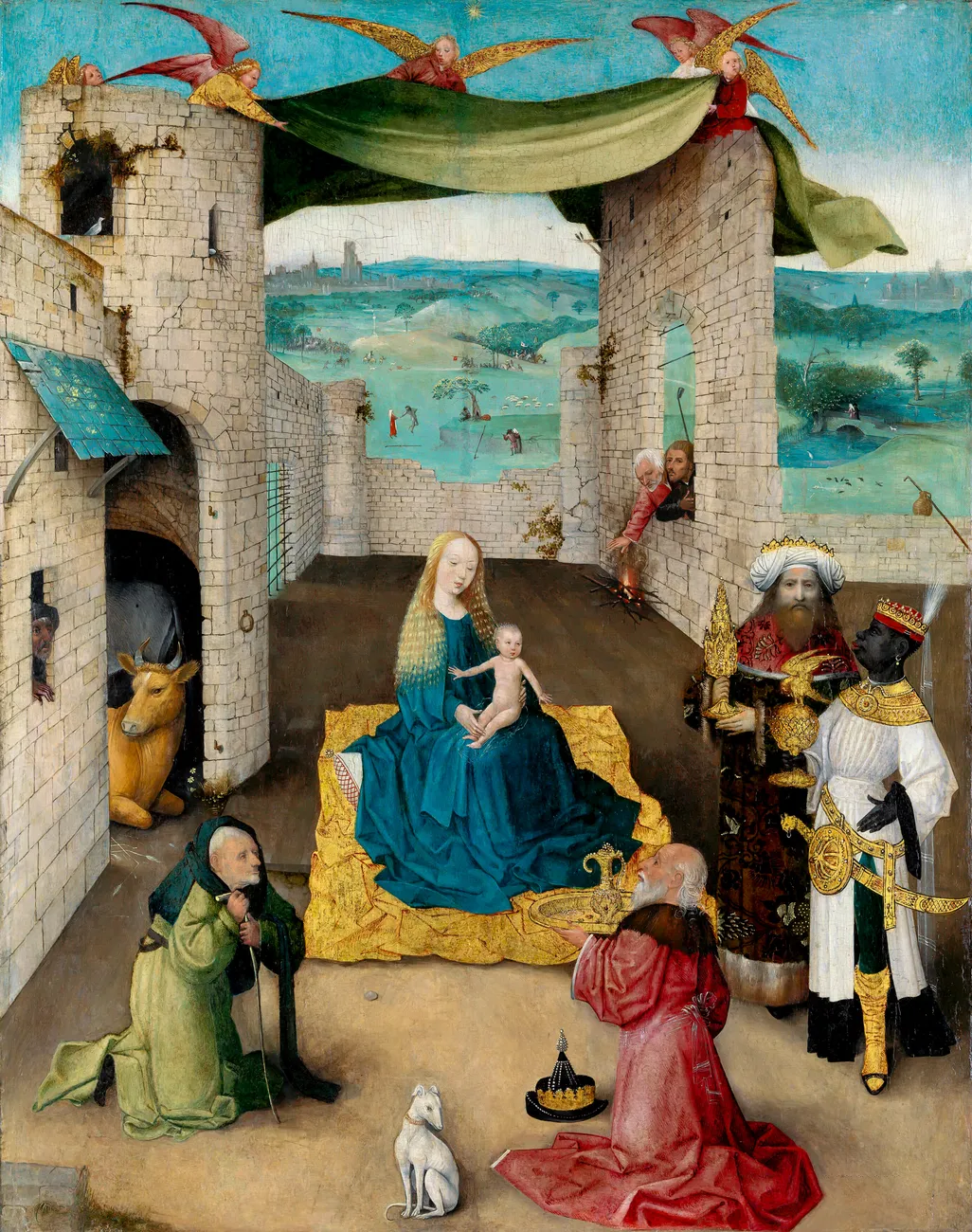
The painting at the top of this page is one of the earliest works of Hieronymus Bosch, painted around 1475 and now in the Metropolitan Museum of Art in New York. For a long time it was taken for a later copy; the Bosch Research and Conservation Project confirmed it as his own work in 2016, after studying the drawing beneath the paint.
Bosch sets the scene in a ruined courtyard that opens onto a wide Flemish landscape. Four angels in red hold a green canopy over the Virgin, who sits on a cloth of gold with the Child on her knee. The eldest king kneels before them with his gift, his crown on the ground. Behind him stand the two younger kings, one of them African, as painters of the North had begun to show him in the fifteenth century. A white greyhound sits in the foreground, and curious faces peer over the walls. It is the moment Matthew describes, the moment the blessing remembers: the Wise Men have come into the house.
For more of the ways painters have told this story, see our selection of Adoration of the Magi paintings.
Free Printable: The Epiphany House Blessing
To make the blessing easy at the door, we have made a free two-page printable in the style of an illuminated page. The first page has Bosch’s Adoration of the Magi, the inscription for 2027, what the letters mean and the four things to know: when, what, who and where. The second page has the whole blessing, with the parts for the leader and for everyone marked in red.
Download the printable: PDF, US Letter or PDF, A4. Free, no email needed. Print it on both sides of one sheet, or on two sheets kept together.
The Epiphany closes the Christmas season that begins with Advent. For the weeks before it, pray the O Antiphons from December 17, or the Saint Andrew Christmas Novena from the end of November; make the ornaments of the Jesse Tree; and give the children our Nativity coloring pages, which end with the Wise Men.
✦ Free Christian & Catholic Printables
Love this one? Find it, and our complete collection of illuminated prayer cards, novenas and Scripture printables, ready to print, free, in one place.
Browse all free printables →Frequently Asked Questions
What does 20 + C + M + B + 27 mean?
It is the Epiphany door inscription for the year 2027. The numbers 20 and 27 are the year, split in two. The letters C, M and B are the initials of Caspar, Melchior and Balthasar, the names tradition gives to the three Wise Men, and also of the Latin prayer Christus mansionem benedicat, May Christ bless this house. The crosses stand for Christ.
When do you do the Epiphany house blessing in 2027?
On the feast of the Epiphany. In the United States the feast is celebrated on Sunday, January 3, 2027; in many other countries it stays on January 6, which is a Wednesday in 2027. Any day in the weeks after the feast is also fine, as long as the household can gather at the door together.
Do you need blessed chalk for the Epiphany blessing?
Blessed chalk is traditional, and many parishes bless chalk at the Epiphany Mass and give it to families. If your parish does not, you can ask a priest to bless some, or use ordinary chalk: the heart of the custom is the family’s prayer at the door, not the chalk itself.
Can a family bless their own home on Epiphany?
Yes. In the old rite a priest blessed homes at Epiphany, and many priests still will if asked, but families have long prayed the Epiphany blessing themselves. One member of the household leads, the others answer, and together they ask God’s blessing on the home rather than blessing it in a priest’s name.
Where do you write the Epiphany chalk?
Above the front door, on the lintel or the top of the door frame, usually on the outside so that everyone who comes in passes under it. If you live in an apartment or rent your home, write it on the inside of the door frame, or on a card fixed above the door. Chalk washes off with a damp cloth.
How long do you leave the Epiphany chalk on the door?
There is no fixed rule. Most families leave the inscription until rain and time wear it away, and write the new year the following January. It is meant as a reminder through the year that Christ is welcome in the house.
Is there a printable Epiphany house blessing?
Yes. jesuschrist.pictures offers a free two-page printable for 2027, in US Letter and A4: the first page explains the inscription and how to chalk the door, with Bosch’s Adoration of the Magi; the second has the full blessing to pray as a family. The download links are at the top of this page.
Can you buy a painting of the Adoration of the Magi?
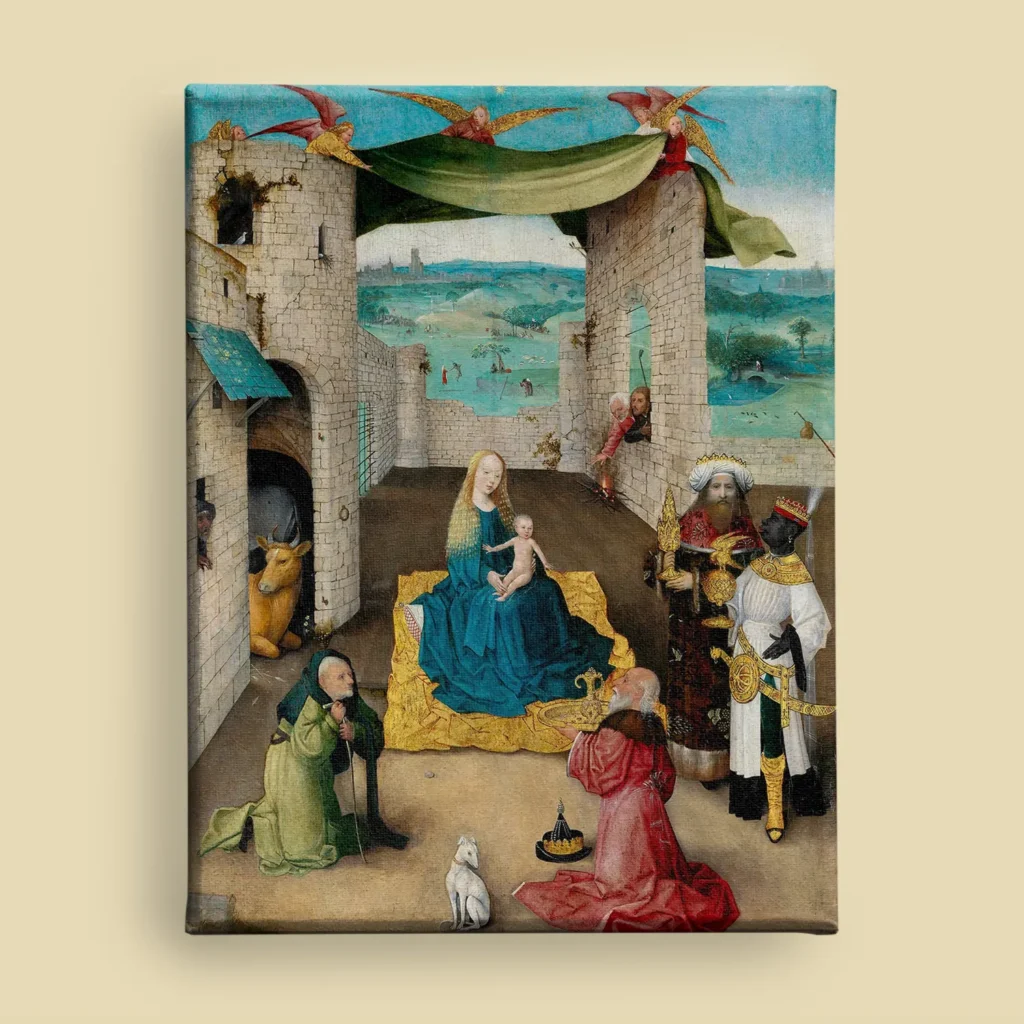
You can buy several paintings of the Adoration of the Magi at jesuschrist.pictures, in our shop, as canvas reproductions: Hieronymus Bosch’s Adoration of the Magi from the Metropolitan Museum, Gentile da Fabriano’s Adoration of the Magi, the round Adoration of the Magi by Fra Angelico and Filippo Lippi, and Rubens’ Adoration of the Magi. Hung near the front door, it keeps the blessing in sight all year.


