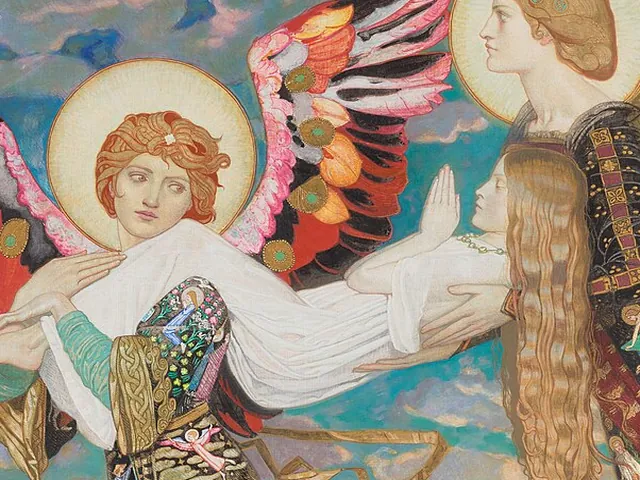
Saint Columbanus: The Irish Monk Who Rebuilt Europe
Saint Columbanus was about fifty years old, and the senior teacher of the most important monastery in Ireland, when he decided to leave and never come back. Over the next twenty-five years he founded monasteries across what is now France, Switzerland and Italy, wrote a monastic rule severe enough to frighten the Franks, told a pope his Easter calculation was wrong, refused to bless a king’s children to his face, was deported under armed guard, escaped, and crossed the Alps in his seventies to start again. He is the reason there was still a monastic network in western Europe when the Carolingians needed one. Robert Schuman, one of the architects of what became the European Union, called him the patron saint of those who seek to build a united Europe. And he is, by a separate and entirely serious decision, the patron saint of motorcyclists.
Bangor
He was born in Leinster around 543, and the sources say he was handsome enough to be a problem. A holy woman he consulted told him bluntly to leave the country if he wanted to keep his vocation. His mother threw herself across the doorway to stop him going. He stepped over her. He studied at Cleenish on Lough Erne under Sinell, then went north to Bangor in County Down, the monastery of Comgall, and stayed for something like thirty years. Bangor was one of the great schools of the Irish church, with a reputation for austerity that impressed even the Irish, and Columbanus became its principal teacher. Then, around 590, he asked permission to go into exile for Christ. The Irish called it peregrinatio pro Christo, the pilgrimage that has no destination and no return. Comgall refused for a long time, then let him go with twelve companions.
Luxeuil
They landed in Brittany and made their way east into Burgundy, where the Merovingian kings gave them a ruined Roman fort at Annegray in the Vosges. The community grew so fast that within a few years he had founded two more houses: Luxeuil, which became the greatest monastery in Gaul, and Fontaines.
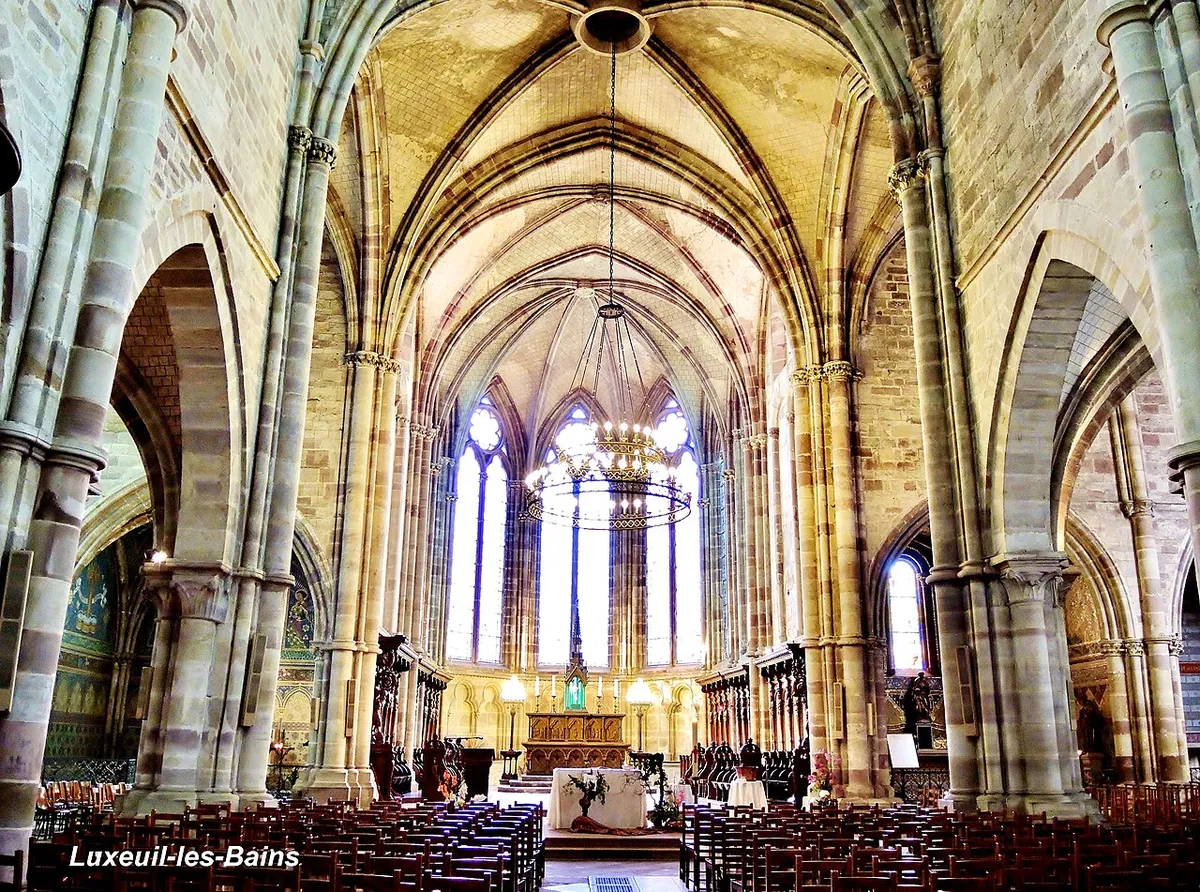
What made them grow is not obvious at first glance, because the Regula Columbani is the harshest monastic rule of the early Middle Ages. It prescribes corporal punishment counted in strokes for offences that the Rule of Saint Benedict handles with a warning. Six strokes for coughing at the start of a psalm. Fifty for failing to say amen. It also introduced to the continent something the Irish had developed and the Roman church had not: private, repeatable confession to a priest, with a tariff of penances. That practice spread out of Luxeuil across Europe, and it is the direct ancestor of confession as Catholics have known it ever since.
The man who could not stay quiet
Columbanus kept the Irish calculation of the date of Easter, which differed from the Roman one, and refused to change. When the Frankish bishops summoned him to a synod at Chalon in 603 to explain himself, he did not attend. He wrote them a letter instead, telling them to leave him alone, and suggesting that they might attend to their own conduct first. He wrote to Pope Gregory the Great to argue the Easter question, addressing him with respect and no deference at all. He wrote to Pope Boniface IV during the Three Chapters controversy in terms that no continental abbot would have used, urging him to summon a council and clear his name, and reminding him that the see of Peter is honoured for its faith rather than the reverse. The end in Burgundy came over a family matter. King Theuderic II had children by concubines, and his grandmother Brunhild, who governed through him, wanted them blessed and recognised. Columbanus refused, in the king’s presence, and said the sons of a brothel would not inherit. He was arrested, marched to Nantes under escort and put on a ship for Ireland. A storm drove the ship back onto the shore. The captain concluded that the passenger was more trouble than the crossing was worth and let him go.
Over the Alps
He went east instead, through Metz, up the Rhine, and into Alemannia around Lake Constance, where he and his companions broke up the pagan sanctuaries at Bregenz with enough vigour to make themselves unwelcome. It was here that he quarrelled with his oldest companion. Gall said he was too ill to continue into Italy. Columbanus, who did not accept excuses, forbade him to celebrate Mass again for as long as he, Columbanus, lived, and went on without him. He crossed the Alps at about seventy-one and was received by the Lombard king Agilulf, who gave him a ruined church at Bobbio in the Apennines above Piacenza. He rebuilt it in 614, carrying timber on his own shoulders according to the earliest life. He died there on 23 November 615, about a year later.
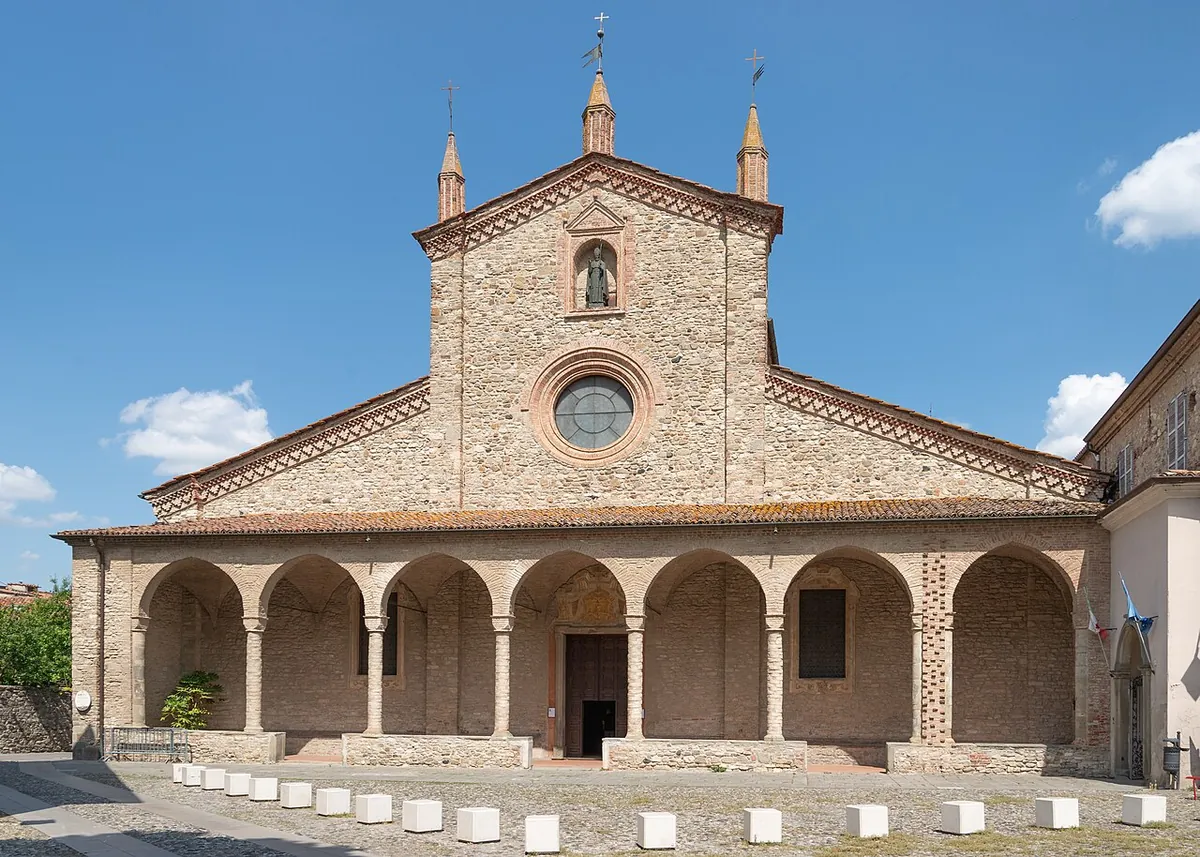
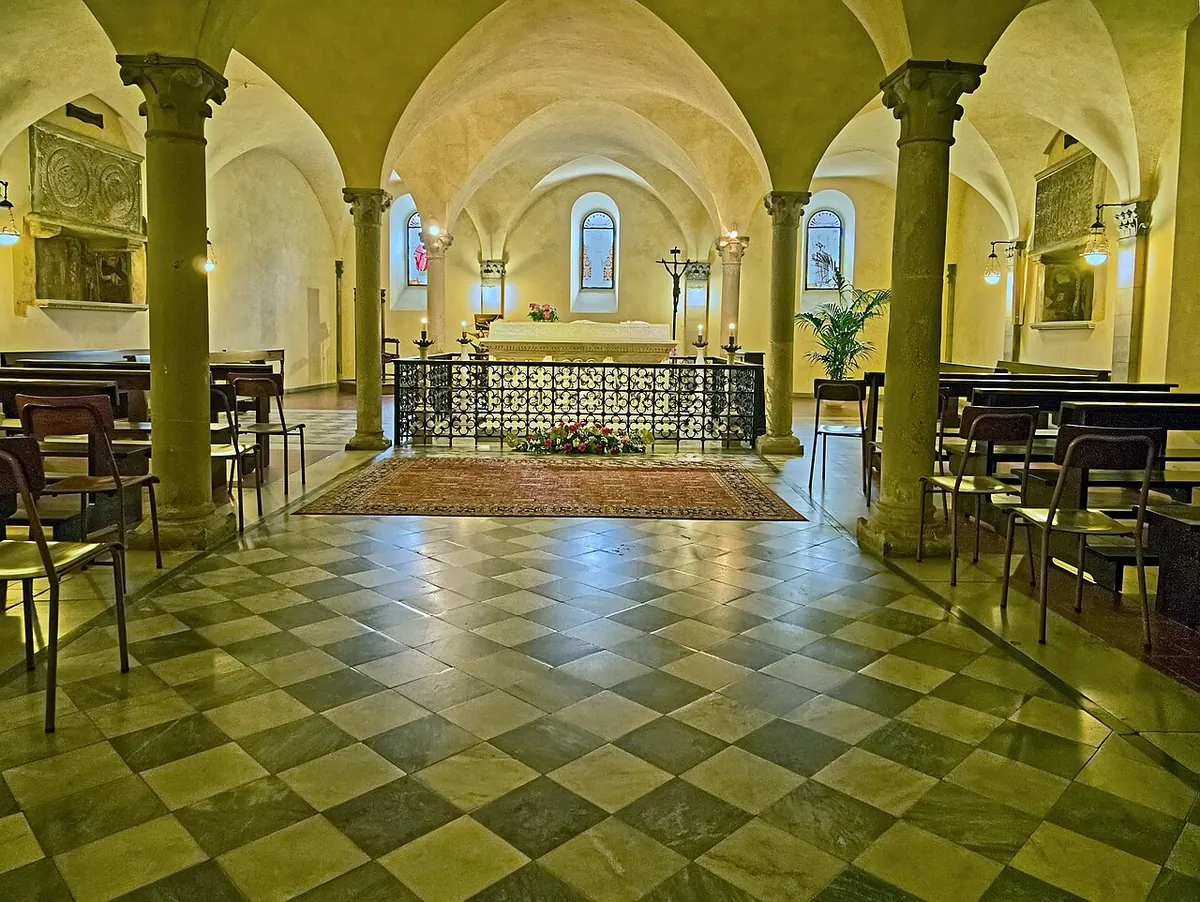
Bobbio’s library became one of the great collections of the early Middle Ages, famous for its palimpsests, manuscripts scraped and reused, under which scholars later found texts of Cicero and Ulfilas’s Gothic Bible that survive nowhere else. Most of it is now dispersed between the Ambrosiana in Milan and the Vatican. He lies in the crypt, in a sarcophagus behind an iron screen, and the carved slabs on the walls around him are older than anything else in the building.
The bear
Two animal stories cling to him, and both are worth knowing because they are the closest thing he has to an iconography. In the Vosges, living as a hermit in a cave, he found the cave already occupied by a bear. He told it to leave. It left. In another version he asks it to share, and it does. At Bobbio the story is put to work: the bear is harnessed to a plough in place of a dead ox and pulls it, tamed, which is why in the few images of Columbanus that exist at all there is often a bear beside him. The second is a wolf, or a set of wolves, that surrounded him in the forest while he stood still and prayed, and which passed him without touching him. Both belong to a standard type of Irish saint’s story in which the holy man reverses the fall of nature and creation obeys him, exactly as it obeys Gall and, in a rougher form, Columba.
Why motorcyclists
This is not a joke, and it is the second most searched thing about him. In the twentieth century Italian motorcyclists adopted Columbanus as their patron, and the patronage stuck to the point that Britannica names it in the title of his entry. The reasoning is straightforward once you see it: he is the saint who spent his life travelling enormous distances by the hardest available means, who crossed a continent on foot in his fifties and the Alps in his seventies, and who was still going when he died. There are Columbanus blessings of motorcycles in Italy on his feast day. Bobbio, which sits in genuinely good motorcycling country, has made rather a thing of it.
What Columbanus looks like
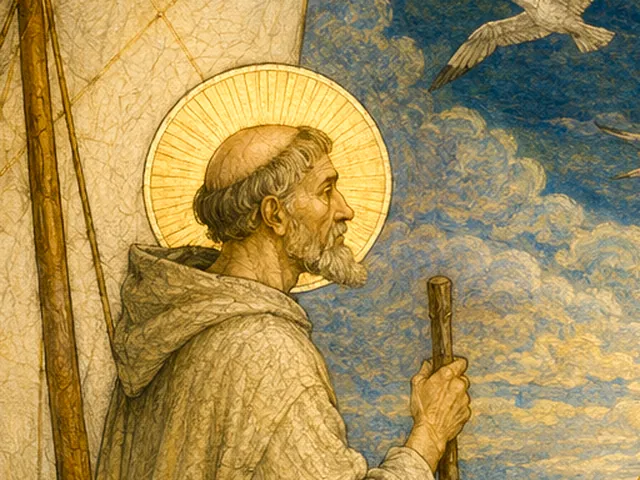
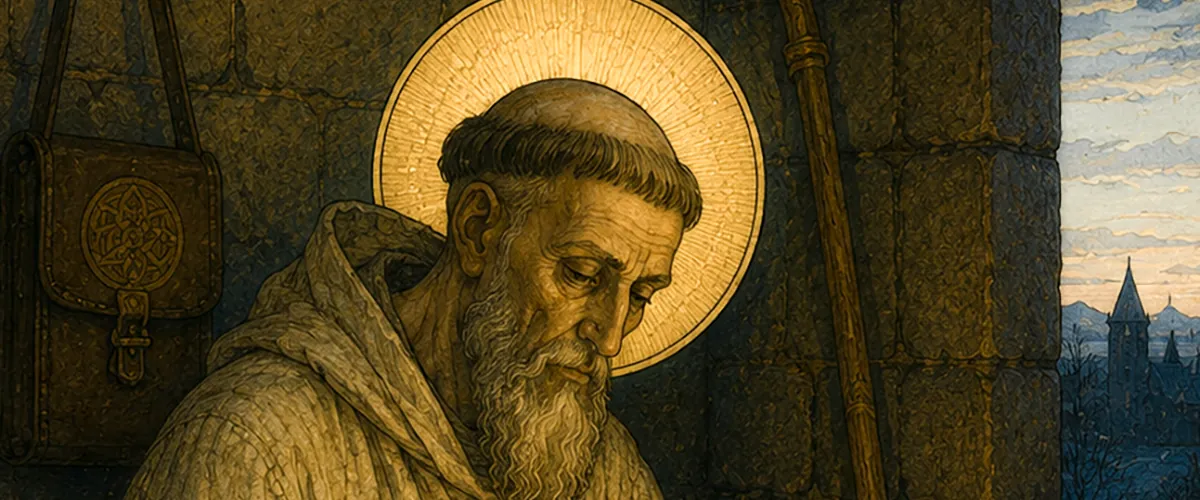
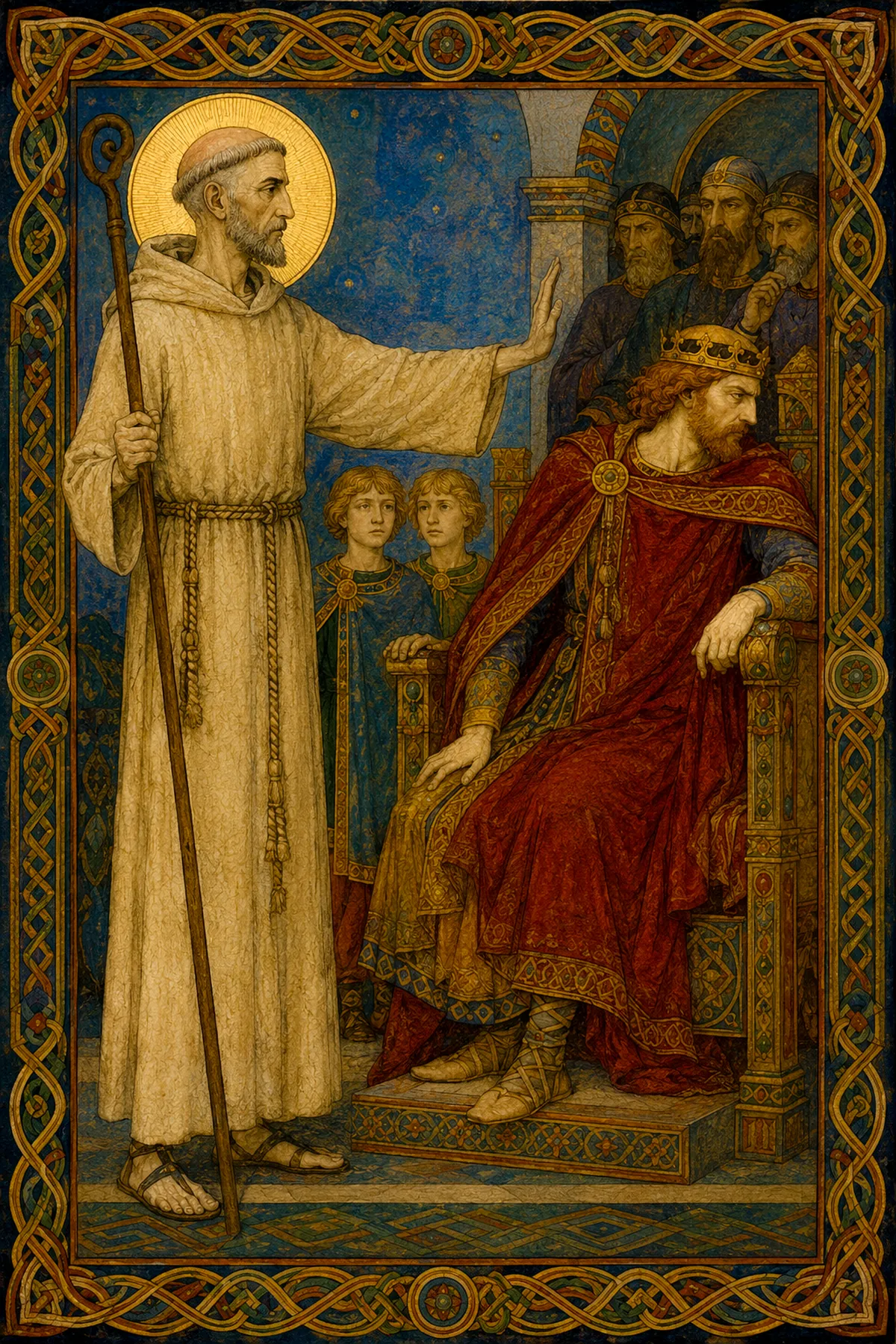
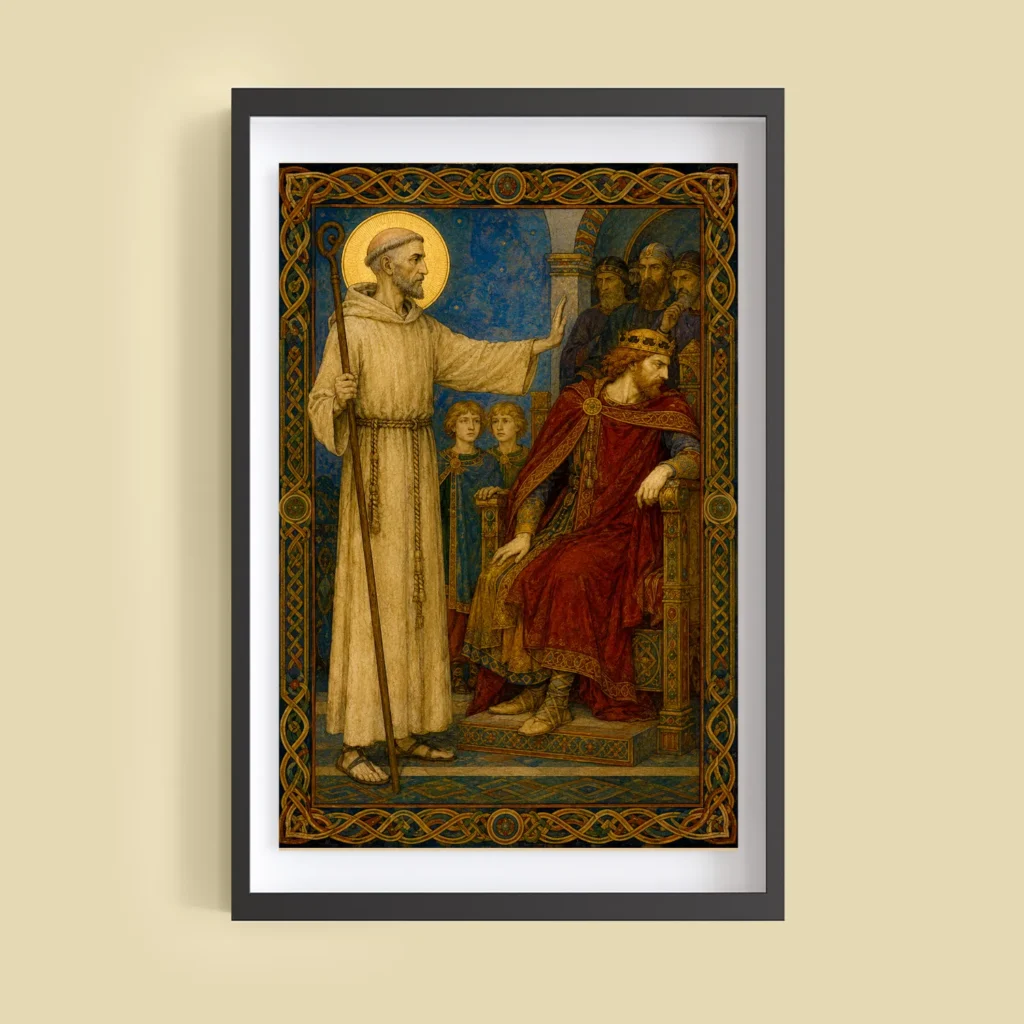
Nothing survives. This is the hardest case in the whole Irish calendar: a man who changed the shape of European monasticism, whose name is on churches from Brittany to Lombardy, and for whom the entire public domain holds one nineteenth century window at Bobbio and a handful of modern statues. The reason is the same as for the other early Irish saints, only sharper. His cult was strongest in places that were repeatedly rebuilt, Luxeuil and Bobbio both, and the centuries that would have painted him, the fifteenth to the seventeenth, were interested in saints with relics that drew pilgrims and orders with money to commission altarpieces. Columbanus founded no order that survived under his name. His rule was absorbed into the Benedictine one within a century of his death. So what is left is the places: a nave in the Vosges, an abbey in the Apennines, and a stone box in a crypt. The panel below was made for this article to give him a face, in the Celtic Revival manner of John Duncan and Harry Clarke. It shows the scene that decided the rest of his life: the abbot standing before the throne of Theuderic II, refusing to bless the king’s sons, with the boys watching from beside the chair and the court waiting behind. It is a new work rather than a historical one, and it is offered as such.
Saint Columbanus Places Featured in This Article
| Place | What it is | Date | Location |
|---|---|---|---|
| Abbey of San Colombano | Monastery founded by Columbanus | 614, rebuilt later | Bobbio, Piacenza, Italy |
| Crypt of Bobbio Abbey | His tomb and early medieval carved slabs | from the 7th century | Bobbio, Piacenza, Italy |
| Abbey church of Luxeuil | On the site of his greatest Frankish foundation | founded around 590 | Luxeuil-les-Bains, Haute-Saone, France |
Important facts about Saint Columbanus
- He left Ireland at about fifty and never returned, in the Irish practice of exile for Christ.
- He founded Annegray, Luxeuil, Fontaines and Bobbio, and his disciples founded dozens more across Gaul, Alemannia and Italy.
- He brought private confession to the continent. The Irish practice of repeatable confession with a tariff of penances spread out of Luxeuil across Europe.
- He argued with two popes in writing, Gregory the Great and Boniface IV, and with the Frankish bishops, and refused to change the Irish date of Easter.
- He crossed the Alps in his seventies and founded Bobbio at about seventy-one. He died there on 23 November 615.
- He is a patron of European unity and of motorcyclists, the second because he covered more ground than any other saint of his century.
Columbanus is one of a whole generation of Irish monks who left the island and reshaped Christian Europe from the outside, and one of the twelve gathered in 12 Irish Saints and the Art They Left Behind. For what the continent did with the visual tradition they helped preserve, see The Great Medieval Painters of Catholic Art. For a country whose saints were painted by the greatest artists of the Baroque, and the contrast could hardly be sharper, see our 15 Spanish Saints and the Painters Who Gave Them Their Faces.
Frequently asked questions about Saint Columbanus
What is Saint Columbanus famous for?
Columbanus is famous for leaving Ireland around 590 and founding a chain of monasteries across the continent, most importantly Luxeuil in the Vosges and Bobbio in the Apennines. He wrote the most severe monastic rule of the early Middle Ages, brought the Irish practice of private repeatable confession to Europe, and argued in writing with two popes and the entire Frankish episcopate about the date of Easter. He is often called the patron saint of European unity.
Are Saint Columba and Saint Columbanus the same person?
No, they are two different men of the same generation, and the similar names cause endless confusion. Columba, or Colum Cille, was born in 521 in Donegal and founded Iona off the Scottish coast in 563; he is one of the three patron saints of Ireland. Columbanus, sometimes called Columban, was born around 543 in Leinster, left Ireland around 590 and worked in France, Switzerland and Italy, where he died at Bobbio in 615. Columba went north to Scotland; Columbanus went south into Europe.
Why is Saint Columbanus the patron saint of motorcyclists?
Italian motorcyclists adopted him in the twentieth century, and the patronage is now well enough established that Britannica lists it. The logic is that Columbanus is the great traveller of the early medieval saints: he crossed most of a continent on foot in his fifties, walked the length of France after being deported, and crossed the Alps at about seventy-one to found his last monastery. Motorcycles are blessed on his feast day in Italy, and Bobbio, which sits in fine riding country in the Apennines, has embraced the connection.
What is Saint Columbanus the patron saint of?
He is invoked as a patron of Ireland, and specifically of the missionary Society of Saint Columban. He is widely called the patron saint of European unity, a title that comes from Robert Schuman, and he is the patron of motorcyclists. His feast day is 23 November, the day he died at Bobbio in 615.
Where is Saint Columbanus buried?
In the crypt of the abbey of San Colombano at Bobbio, in the Apennines above Piacenza in northern Italy, where he has lain since 615. The sarcophagus stands behind a wrought iron screen, surrounded by carved stone slabs that are older than the church around them. Bobbio remains a place of pilgrimage, and Irish groups still walk there.
Can you buy Saint Columbanus art?
You can buy Saint Columbanus art at jesuschrist.pictures, in our shop, as museum quality canvases and posters. Our catalogue covers the works reproduced on this page and the wider world of Christian painting they belong to, printed on demand and shipped worldwide. The shop is organised by subject and by period, and the saints have a section of their own.