The Most Powerful Religious Paintings by Peter Paul Rubens
Peter Paul Rubens is the great voice of the Flemish Baroque. The Peter Paul Rubens paintings that survive today, more than fourteen hundred securely attributed works, fill the great churches, palaces, and museums of Europe with the most muscular, theatrical, and exuberant religious art of the entire seventeenth century. He combined the rigour of Italian Renaissance composition with the dramatic light and twisting movement of the Baroque, and he ran the largest, most international workshop in Northern Europe for almost forty years.
This article gathers fifteen of his most important religious works, the panels and altarpieces that made him the supreme Catholic painter of the Counter-Reformation North.

From Siegen to the Antwerp Court of Archduke Albert
Peter Paul Rubens was born on 28 June 1577 in Siegen, in Westphalia, where his Flemish Protestant family had taken refuge from the Spanish religious troubles. After the death of his father in 1587, the family returned to Antwerp and reconverted to Catholicism. The young Rubens trained in three successive Antwerp studios, took his master’s papers in 1598, and travelled to Italy in 1600. He spent eight years there working for the Gonzaga court at Mantua, studying the Roman and Venetian masters, and travelling to Spain on diplomatic missions.
He returned permanently to Antwerp in 1608, where he became court painter to Archduke Albert and Archduchess Isabella, the Habsburg rulers of the Spanish Netherlands. From there he ran an enormous workshop that produced altarpieces, portraits, and mythological scenes for patrons across Catholic Europe, undertaking diplomatic missions for the Spanish crown in his spare time. He died in Antwerp on 30 May 1640.
The Descent from the Cross
Painted between 1612 and 1614 for the high altar of the Cathedral of Our Lady in Antwerp, this great triptych is the founding masterpiece of Flemish Baroque religious painting. The central panel shows the body of Christ being lowered from the cross by Joseph of Arimathea, Nicodemus, and the holy women, in a single great diagonal of muscular bodies and white linen shroud. The wings show the Visitation and the Presentation in the Temple.

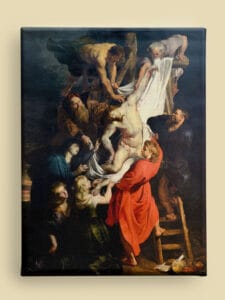
The altarpiece still hangs on the high altar of the Cathedral of Our Lady in Antwerp.
The Resurrection of Christ
Painted in 1612 for the Plantin family tomb in the same Antwerp Cathedral, this triptych shows Christ rising from the open sepulchre in a great vertical movement, with the holy women and the Roman soldiers below. The composition is one of Rubens’s most dramatic, with the risen body shown in extreme foreshortening as it lifts into the supernatural light above.


The triptych still hangs in its original chapel at the Cathedral of Our Lady in Antwerp. For a wider survey, see our article on famous Resurrection paintings.
Ecce Homo
Christ is presented to the Jerusalem crowd by Pilate after the scourging. Rubens paints the body of the saviour with the muscular precision of his Italian Baroque manner, the figure half-nude with the crown of thorns on his head and the bound hands raised in front. The composition is one of the most dramatic Northern interpretations of the subject.

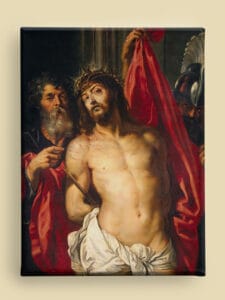
The painting is at the Hermitage Museum in Saint Petersburg.
Christ’s Entry into Jerusalem
Christ rides into the holy city on Palm Sunday while the crowd presses around him, some spreading their cloaks on the road, others waving palm branches. Rubens paints the scene with the dramatic Italian Renaissance composition he had absorbed in Rome, with the great horizontal movement of the crowd carrying the saviour forward into the city.

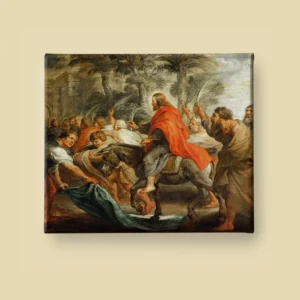
The painting is at the Musée des Beaux-Arts in Dijon.
The Last Supper
Painted around 1631 for the Confraternity of the Holy Sacrament in Mechelen, this great altarpiece shows the institution of the Eucharist with Christ at the centre of the long table, his hands raised over the bread and the chalice. Rubens paints the scene with the muscular Italianate composition of his late style, with the apostles arranged in dramatic poses around the central saviour.


The painting is at the Pinacoteca di Brera in Milan.
The Ascension
Christ ascends into heaven in a great vertical movement, surrounded by angels and seen from below in dramatic foreshortening. Rubens paints the scene with his characteristic muscular bodies and twisting Baroque composition, with the apostles below gazing upward in awe at the rising saviour.

The painting is in a private collection and is part of a long series of Ascension compositions that Rubens designed for both private and public altarpieces.
The Adoration of the Magi
Painted in 1609 for the Antwerp city hall and later expanded around 1628 to 1629, this great altarpiece shows the three Magi adoring the Christ child in the centre, with their attendants, camels, and pages filling the entire composition. The young king on the right is widely identified as a self-portrait of Rubens himself. The composition is one of the most ambitious of his early Antwerp years.

The painting is at the Museo del Prado in Madrid.
The Massacre of the Innocents
The biblical scene of King Herod’s massacre of the male infants of Bethlehem is one of Rubens’s most violent and dramatic religious paintings. He paints the scene with extreme muscular intensity, with the soldiers tearing the children from their mothers’ arms in a great horizontal sweep across the foreground of the picture. The composition is built on the dramatic Italianate principles of his Mantuan years.

The painting is at the Royal Museums of Fine Arts of Belgium in Brussels.
The Crowning of Saint Catherine
The fourth century virgin martyr Saint Catherine of Alexandria, the patron saint of philosophers, is crowned by angels in heaven after her martyrdom. Rubens paints the moment with the rich Italianate colour of his middle period, with the saint kneeling in the foreground while the cherubs descend with the diadem of her sanctity.

The painting is at the Toledo Museum of Art.
The Baptism of Christ
Painted around 1604 to 1605 during the painter’s Mantuan period, this large altarpiece shows John the Baptist pouring water over the head of Christ in the Jordan, while the dove of the Holy Spirit descends from above. Rubens paints the scene with the muscular Italian Renaissance composition he had absorbed in Rome and Mantua.

The painting is at the Royal Museum of Fine Arts in Antwerp.
The Miracle of Saint Ignatius of Loyola
Painted between 1617 and 1618 for the Jesuit church of Antwerp, the great Carolus Borromeuskerk, this huge altarpiece shows the founder of the Society of Jesus performing his miracles of healing and exorcism. The composition is one of Rubens’s most ambitious, with the saint at the centre in his Jesuit habit while the demons flee from the possessed in the foreground and the angels descend from above.
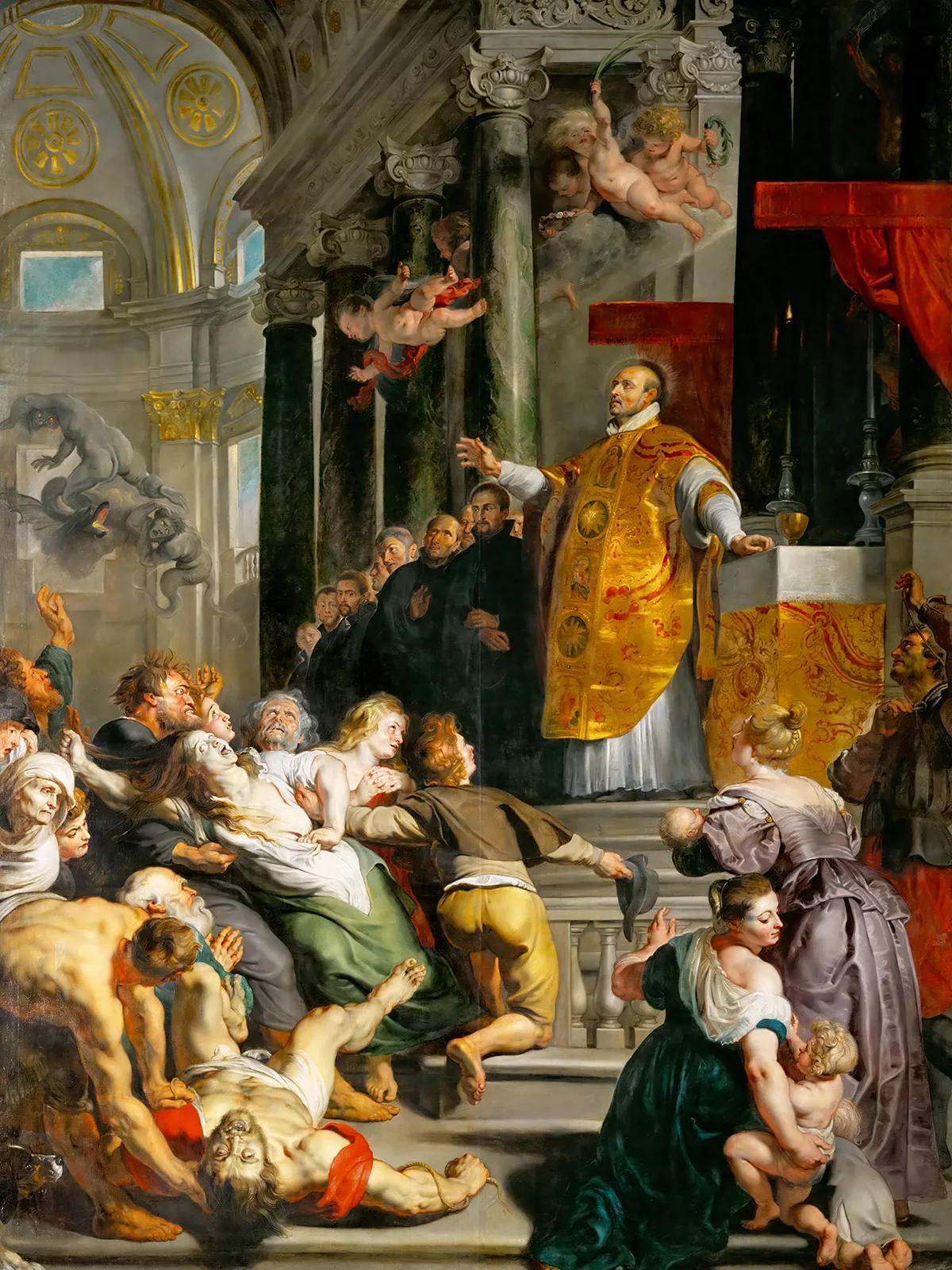
The painting is at the Kunsthistorisches Museum in Vienna.
The Miracles of Saint Francis Xavier (Modello)
The companion altarpiece to the Saint Ignatius, this Modello shows the Spanish Jesuit Saint Francis Xavier preaching to the peoples of Asia in his missionary travels. The composition is one of the most ambitious of Rubens’s early career, with the saint at the centre while the converts of every nation kneel around him and the pagan idols topple in the upper background.

The Modello is at the Kunsthistorisches Museum in Vienna.
Saint George and the Dragon
The Christian knight Saint George spears the dragon of evil while the rescued princess looks on from the rocks. Rubens paints the scene with the same muscular Italianate composition as his other martial subjects, with the horse and the dragon arranged in a dramatic vertical confrontation. The composition shows the influence of his Spanish patrons, who loved the chivalric subjects of the late medieval Catholic imagination.

The painting is at the Museo del Prado in Madrid.
The Gonzaga Family in Adoration of the Holy Trinity
Painted in 1604 to 1605 during his Mantuan years for Duke Vincenzo Gonzaga and the family chapel in the Palazzo Ducale, this large altarpiece shows the entire Gonzaga court in adoration before the Holy Trinity appearing in the upper sky. The painting was cut up after the family’s decline and only fragments survive, but it remains one of Rubens’s most ambitious Italian commissions.

The surviving fragments are at the Palazzo Ducale in Mantua.
Epitaph of Jan Michielsen and Maria Maes
A great memorial altarpiece showing Christ falling under the cross on the road to Calvary, painted around 1617 for the funerary chapel of the Antwerp couple Jan Michielsen and Maria Maes. The composition is built on the dramatic diagonal of the cross, with the saviour bent under its weight in the foreground while the soldiers and Cyrene assist him.

The painting is at the Royal Museum of Fine Arts in Antwerp.
For more context on Rubens’s Flemish world, see our articles on his great pupil Anthony van Dyck, on the older Flemish primitive tradition through Jan van Eyck and Rogier van der Weyden, and on the wider tradition of Baroque Jesus paintings.
Summary Table of Peter Paul Rubens’s Religious Paintings
| Name | Artist | Date | Medium | Museum |
|---|---|---|---|---|
| The Descent from the Cross | Peter Paul Rubens | 1612 to 1614 | Oil on panel | Cathedral of Our Lady, Antwerp |
| The Resurrection of Christ | Peter Paul Rubens | 1612 | Oil on panel | Cathedral of Our Lady, Antwerp |
| Ecce Homo | Peter Paul Rubens | c. 1612 | Oil on canvas | Hermitage Museum, Saint Petersburg |
| Christ’s Entry into Jerusalem | Peter Paul Rubens | c. 1632 | Oil on panel | Musée des Beaux-Arts, Dijon |
| The Last Supper | Peter Paul Rubens | c. 1631 to 1632 | Oil on panel | Pinacoteca di Brera, Milan |
| The Ascension | Peter Paul Rubens | c. 1620 | Oil on canvas | Private collection |
| The Adoration of the Magi | Peter Paul Rubens | 1609 and 1628 to 1629 | Oil on canvas | Museo del Prado, Madrid |
| The Massacre of the Innocents | Peter Paul Rubens | c. 1611 to 1612 | Oil on panel | Royal Museums of Fine Arts of Belgium, Brussels |
| The Crowning of Saint Catherine | Peter Paul Rubens | c. 1631 | Oil on canvas | Toledo Museum of Art |
| The Baptism of Christ | Peter Paul Rubens | 1604 to 1605 | Oil on canvas | Royal Museum of Fine Arts, Antwerp |
| The Miracle of Saint Ignatius of Loyola | Peter Paul Rubens | 1617 to 1618 | Oil on canvas | Kunsthistorisches Museum, Vienna |
| The Miracles of Saint Francis Xavier (Modello) | Peter Paul Rubens | 1617 to 1618 | Oil on canvas | Kunsthistorisches Museum, Vienna |
| Saint George and the Dragon | Peter Paul Rubens | c. 1605 to 1607 | Oil on canvas | Museo del Prado, Madrid |
| The Gonzaga Family in Adoration of the Holy Trinity | Peter Paul Rubens | 1604 to 1605 | Oil on canvas | Palazzo Ducale, Mantua |
| Epitaph of Jan Michielsen and Maria Maes | Peter Paul Rubens | c. 1617 | Oil on panel | Royal Museum of Fine Arts, Antwerp |
Conclusion
Rubens is the supreme voice of Flemish Baroque religious painting. His altarpieces fill the Catholic churches of the Spanish Netherlands and the Habsburg world with a muscular theatrical intensity that no other painter of the seventeenth century quite matched. He combined the linear discipline of his Antwerp training with the dramatic light and twisting movement that he had absorbed in Italy, and he produced for forty years a body of religious work that shaped the visual language of the Counter-Reformation Church across Catholic Europe.
Important Facts About Peter Paul Rubens
- Peter Paul Rubens was born on 28 June 1577 in Siegen, in Westphalia, where his Flemish Protestant family had taken refuge from the Spanish religious troubles, before returning to Antwerp and reconverting to Catholicism after his father’s death in 1587.
- He trained in three successive Antwerp studios, took his master’s papers in 1598, and travelled to Italy from 1600 to 1608, where he worked at the Gonzaga court of Mantua and studied the Roman and Venetian masters.
- Rubens is the supreme voice of the Flemish Baroque and is celebrated for the muscular theatrical intensity of his religious altarpieces, his great mythological cycles, his diplomatic missions for the Spanish crown, and the enormous international workshop that produced his work.
- His most famous religious work is the great Descent from the Cross triptych, painted between 1612 and 1614 for the high altar of the Cathedral of Our Lady in Antwerp, where it still hangs.
- He died on 30 May 1640 in Antwerp, having served as court painter to the Habsburg rulers of the Spanish Netherlands and as a diplomat for the Spanish crown, and his manner shaped European religious painting for the next century.
Questions and Answers About Peter Paul Rubens Paintings
What is Peter Paul Rubens’s most famous painting?
His best known religious work is the great Descent from the Cross triptych at the Cathedral of Our Lady in Antwerp, painted between 1612 and 1614. The Massacre of the Innocents at the Royal Museums of Fine Arts of Belgium and the Adoration of the Magi at the Prado are also among his most reproduced religious paintings.
Where can I see Peter Paul Rubens paintings today?
The Cathedral of Our Lady in Antwerp still holds the great Descent from the Cross and Resurrection triptychs. The Museo del Prado in Madrid owns the richest single Rubens collection in the world. The Kunsthistorisches Museum in Vienna, the Royal Museums of Fine Arts of Belgium in Brussels, the Alte Pinakothek in Munich, the Louvre in Paris, and the National Gallery in London all hold major works.
What style is Peter Paul Rubens associated with?
Rubens is the supreme master of the Flemish Baroque and one of the most influential European painters of the seventeenth century. His mature style fuses the linear discipline of his Antwerp training with the dramatic Italian Baroque composition, twisting muscular bodies, rich Venetian colour, and theatrical light that he absorbed during his eight years in Italy from 1600 to 1608.
How big was Rubens’s workshop?
By the 1620s and 1630s the Antwerp workshop of Rubens was the largest religious painting operation in Northern Europe. He employed dozens of assistants, including the young Anthony van Dyck, Jacob Jordaens, Frans Snyders, and many others, who specialised in figures, landscapes, animals, and still lifes. Most of his altarpieces were produced collaboratively under his close supervision, with Rubens himself painting the heads and the key passages.
Was Rubens also a diplomat?
Yes, he served the Spanish Habsburg crown as a diplomat on several important missions, including to Madrid in 1628 to 1629, where he met Velázquez, and to London in 1629 to 1630, where he negotiated the peace treaty between Spain and England. King Philip IV of Spain knighted him in 1624 and King Charles I of England in 1630. He was one of the very few major painters of his time to be received as an equal at European courts.
How does Rubens compare with Caravaggio?
The two painters were almost exact contemporaries and shared the dramatic Italian Baroque vocabulary of muscular bodies and theatrical light. But Caravaggio painted small dark scenes with a few life-size figures lit by a single intense source. Rubens painted vast altarpieces with dozens of twisting muscular bodies bathed in rich Venetian colour. Caravaggio is more austere; Rubens is more exuberant. Both transformed European religious painting at the very start of the seventeenth century.
Where can I buy a canvas reproduction of a Peter Paul Rubens painting?
You can buy them at jesuschrist.pictures. All the canvas canvas prints are gathered in our shop, printed on premium canvas and shipped worldwide.


