Magnificat Prayer: The Song of Mary in English, Latin and Seven Paintings
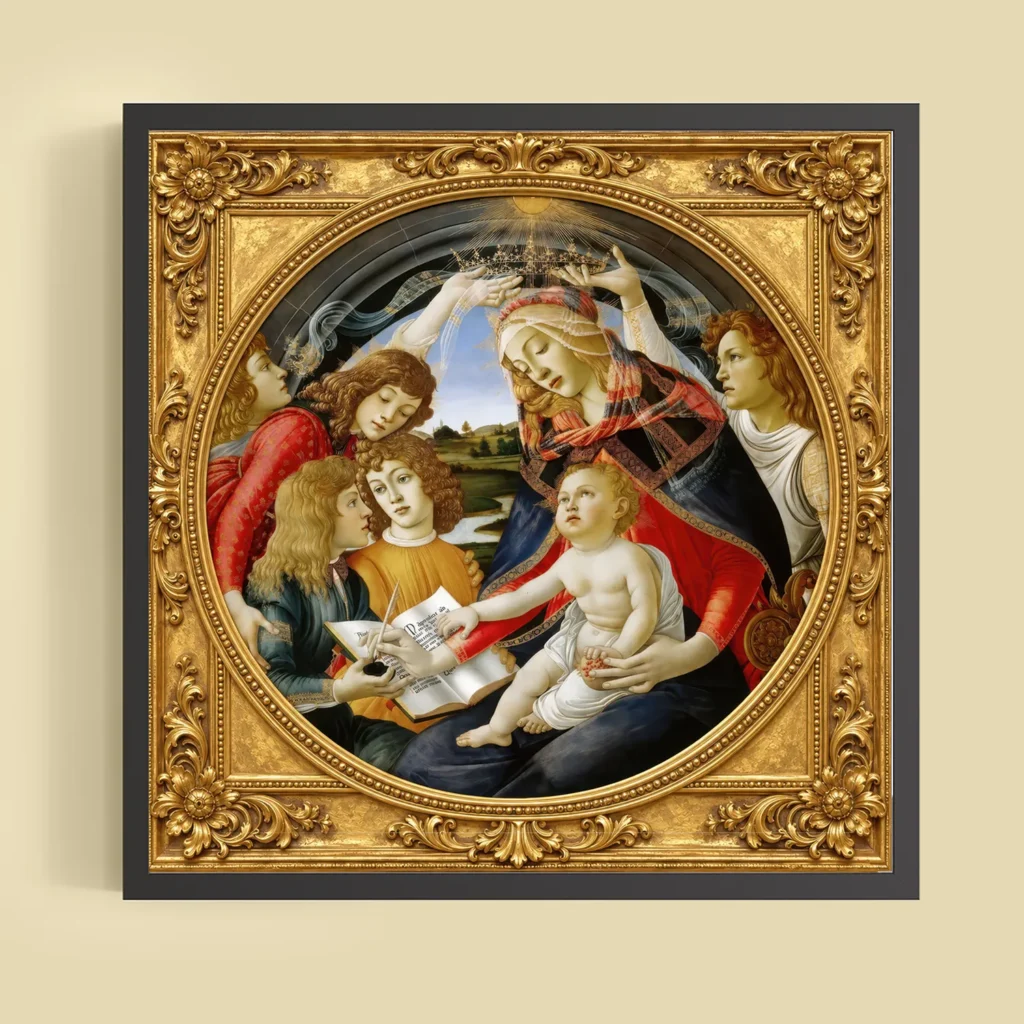
In a round painting in the Uffizi, the Virgin Mary is writing. Two kneeling angels hold the book and the inkwell for her, two others hold a golden crown above her head, and the words she writes are her own: Magnificat anima mea Dominum, my soul doth magnify the Lord. They are the longest words of Mary in the Gospels, and for some fifteen centuries the Church has sung them every evening, in monasteries, cathedrals and parishes, at the hour of Vespers.
This page gives the Magnificat prayer in its traditional English form, with the Gloria that ends it, the Latin text, its history, its meaning verse by verse, and a free printable prayer card. Each verse of the prayer is illustrated by a great painting, from Botticelli’s Madonna of the Magnificat to Tiepolo’s Abraham.
The Magnificat Prayer: Full Text
This is the traditional Catholic English text, from the Douay-Rheims Bible as revised by Bishop Challoner in the eighteenth century (Luke 1:46-55):
My soul doth magnify the Lord, and my spirit hath rejoiced in God my Saviour. Because he hath regarded the humility of his handmaid; for behold from henceforth all generations shall call me blessed. Because he that is mighty, hath done great things to me; and holy is his name. And his mercy is from generation unto generations, to them that fear him. He hath shewed might in his arm: he hath scattered the proud in the conceit of their heart. He hath put down the mighty from their seat, and hath exalted the humble. He hath filled the hungry with good things; and the rich he hath sent empty away. He hath received Israel his servant, being mindful of his mercy: as he spoke to our fathers, to Abraham and to his seed for ever.
When it is prayed, and always at Vespers, the canticle ends with the Gloria:
Glory be to the Father, and to the Son, and to the Holy Ghost. As it was in the beginning, is now, and ever shall be, world without end. Amen.
Most modern Catholic books use a newer translation that begins “My soul proclaims the greatness of the Lord”. The words change, the canticle does not. The older version above is the one generations of Catholics learned by heart, and the one used on our printable card.
The Magnificat in Latin
The Magnificat takes its name from its first word in Latin, as it is still sung at Vespers in monasteries and in the traditional liturgy:
Magnificat anima mea Dominum, et exsultavit spiritus meus in Deo salutari meo. Quia respexit humilitatem ancillae suae: ecce enim ex hoc beatam me dicent omnes generationes. Quia fecit mihi magna qui potens est: et sanctum nomen eius. Et misericordia eius a progenie in progenies timentibus eum. Fecit potentiam in brachio suo: dispersit superbos mente cordis sui. Deposuit potentes de sede, et exaltavit humiles. Esurientes implevit bonis: et divites dimisit inanes. Suscepit Israel puerum suum, recordatus misericordiae suae. Sicut locutus est ad patres nostros, Abraham et semini eius in saecula. Gloria Patri, et Filio, et Spiritui Sancto. Sicut erat in principio, et nunc, et semper, et in saecula saeculorum. Amen.
Where the Magnificat Comes From
The Magnificat is sung in the first chapter of the Gospel of Luke. After the Annunciation, Mary goes in haste to the hill country of Judah to visit her cousin Elizabeth, who is expecting a child in her old age. At Mary’s greeting the child leaps in Elizabeth’s womb, and Elizabeth cries out, “Blessed art thou among women, and blessed is the fruit of thy womb”, the words that became the second line of the Hail Mary. Mary answers with the Magnificat.
The song is woven from the Old Testament. It echoes almost line by line the prayer of Hannah, the mother of Samuel, who sang that the Lord “raiseth up the poor out of the dust” (1 Samuel 2:8), and it ends on the promise made to Abraham. Mary speaks as the daughter of a whole people: what God has done for her, he has done for Israel.
The Church took the canticle into its evening prayer very early. By the sixth century the Rule of Saint Benedict prescribed a canticle from the Gospel at Vespers, and the Magnificat has been sung there every evening ever since, by monks and nuns, by priests praying the Liturgy of the Hours, and in Anglican cathedrals at Evensong. It inspired some of the greatest music ever written, from Monteverdi’s Vespers to the Magnificat that Johann Sebastian Bach first performed in Leipzig at Christmas 1723. In Advent the canticle comes into its own: the famous O Antiphons of December 17 to 23 are the antiphons sung before and after the Magnificat at Vespers, and on December 22 the Magnificat itself is the Gospel of the Mass.
The Magnificat in Seven Paintings
Each verse of the prayer has been painted by a great master. Here are seven of them, in the order of the words.
1. “My Soul Doth Magnify the Lord”: The Madonna of the Magnificat by Sandro Botticelli (about 1483)
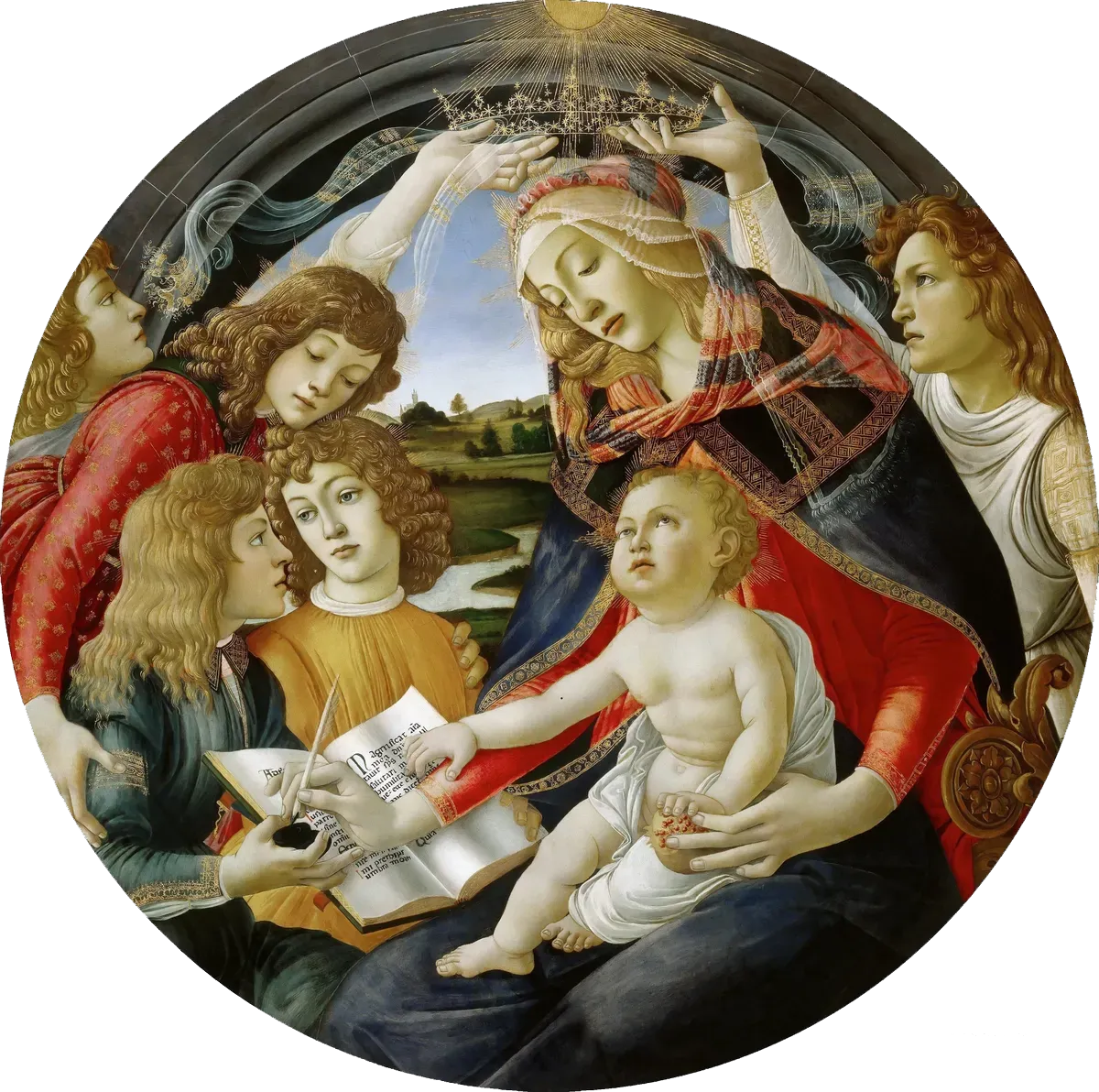
No painting is more closely tied to the canticle than this round panel by Sandro Botticelli, which gave the painting its name. Mary sits with the Christ Child on her lap and dips her pen in an inkwell held by a kneeling angel, writing her canticle in the open book the angels hold for her. Two angels above her hold a delicate golden crown, and through the open window behind them a quiet Tuscan valley runs down to a river. The Child rests his hand on her arm as she writes, and holds a pomegranate, the fruit of his future Passion. Botticelli painted it in Florence around 1483, and the curved space of the tondo, as if seen in a convex mirror, makes the whole scene lean toward the viewer.
2. “He Hath Regarded the Humility of His Handmaid”: The Annunciation by Fra Angelico (about 1425 to 1426)
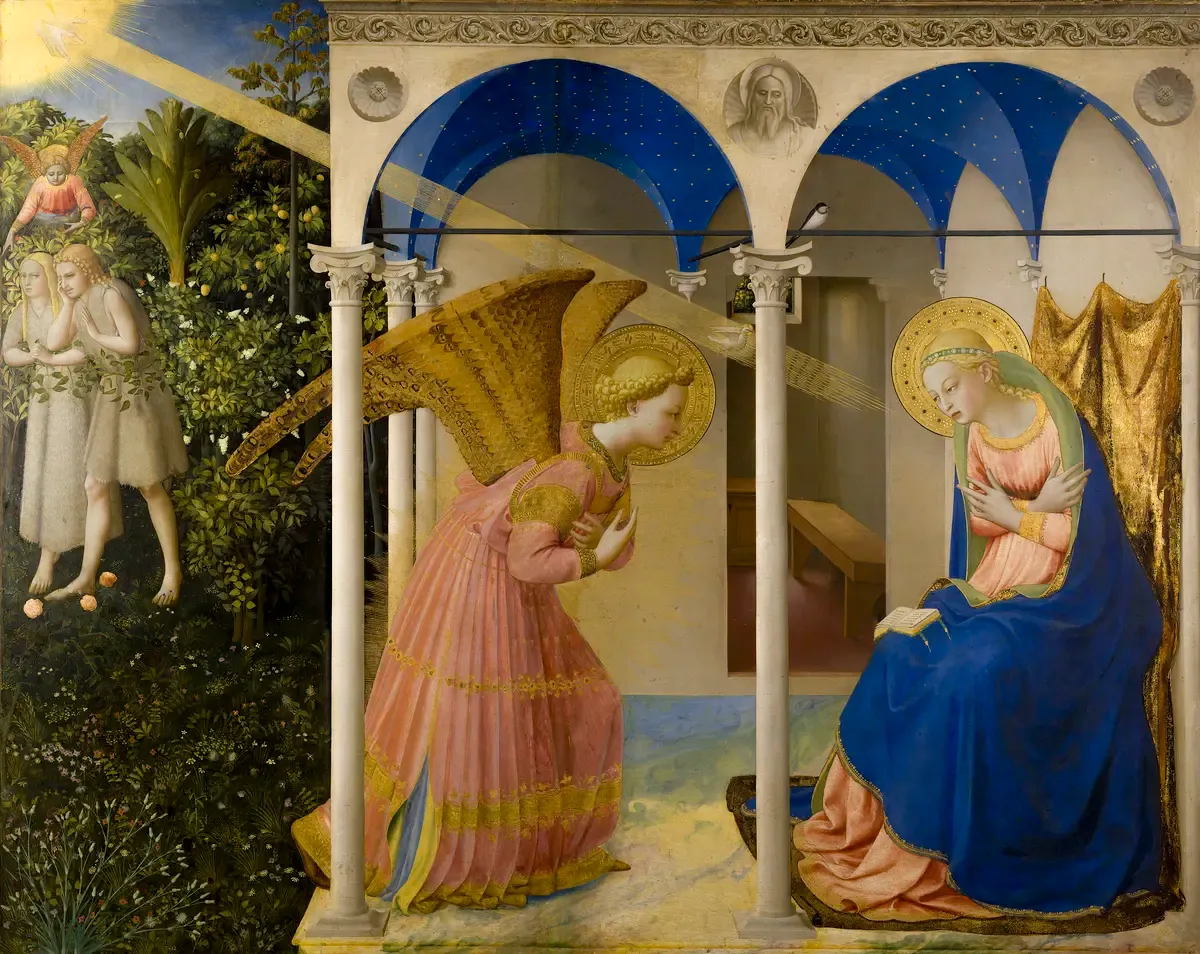
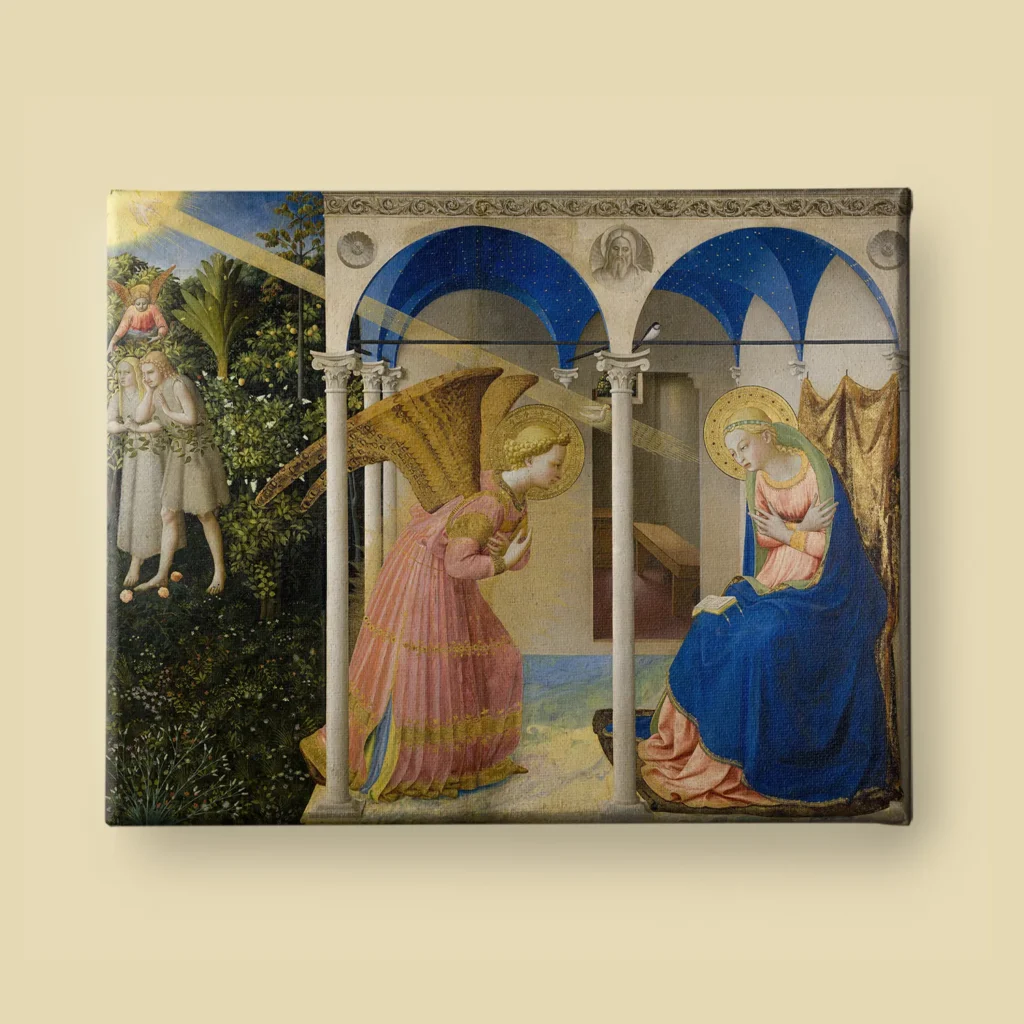
The humility the prayer speaks of is the moment of the Annunciation, when Mary answered the angel, “Behold the handmaid of the Lord” (Luke 1:38). Fra Angelico painted it as a scene of perfect stillness: under a loggia vaulted in blue and starred with gold, Gabriel bows in a rose robe, and Mary, her arms crossed on her breast, bows back. A ray of gold falls from the hand of God at the top left, carrying the dove of the Holy Spirit. In the garden on the left, Adam and Eve are driven out of Paradise: the humility of the second Eve answers the pride of the first. The panel, painted for the convent of San Domenico in Fiesole, is today in the Prado. Read the full story of Fra Angelico’s Annunciation.
3. “All Generations Shall Call Me Blessed”: The Visitation by Domenico Ghirlandaio (1491)
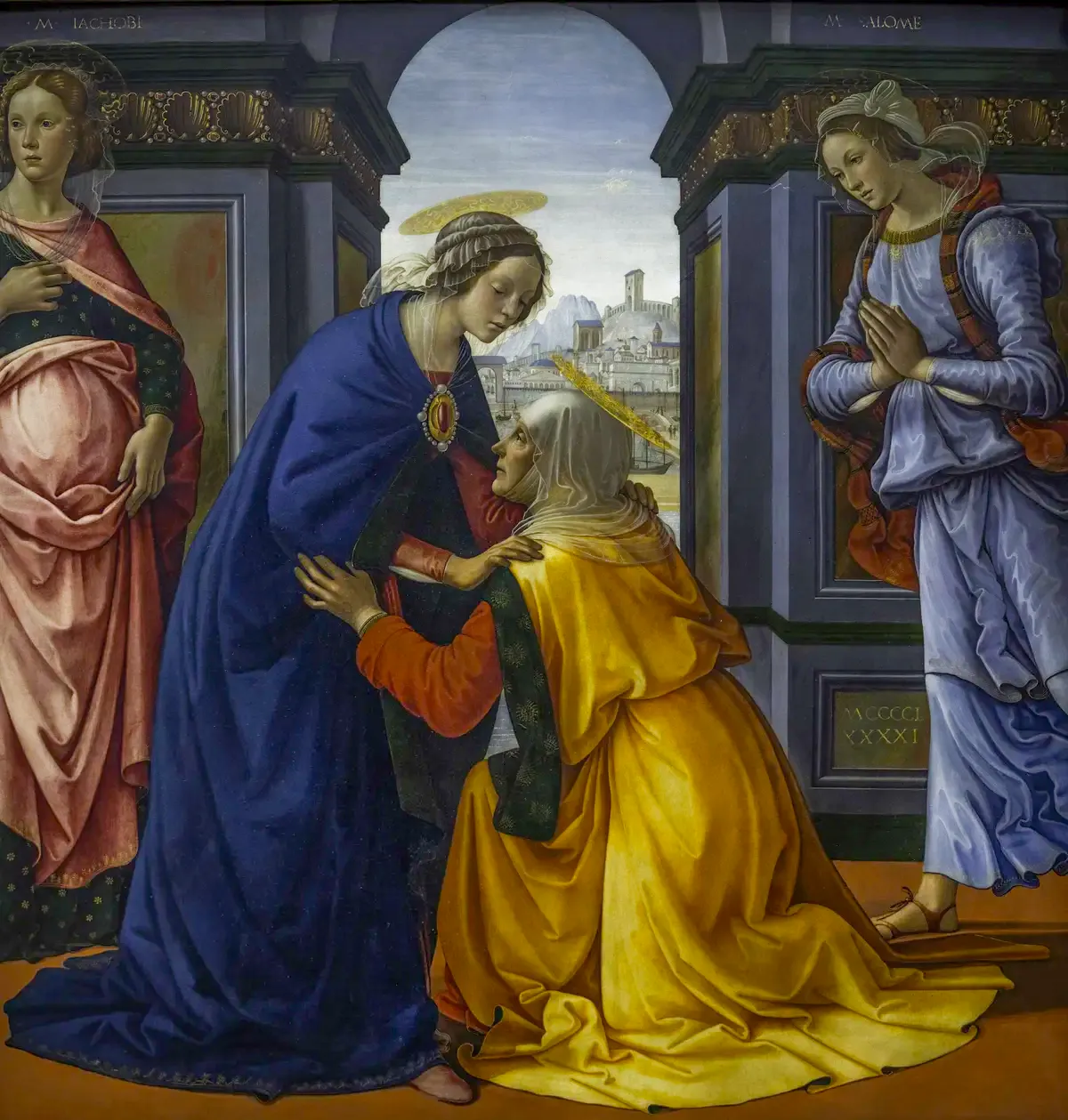
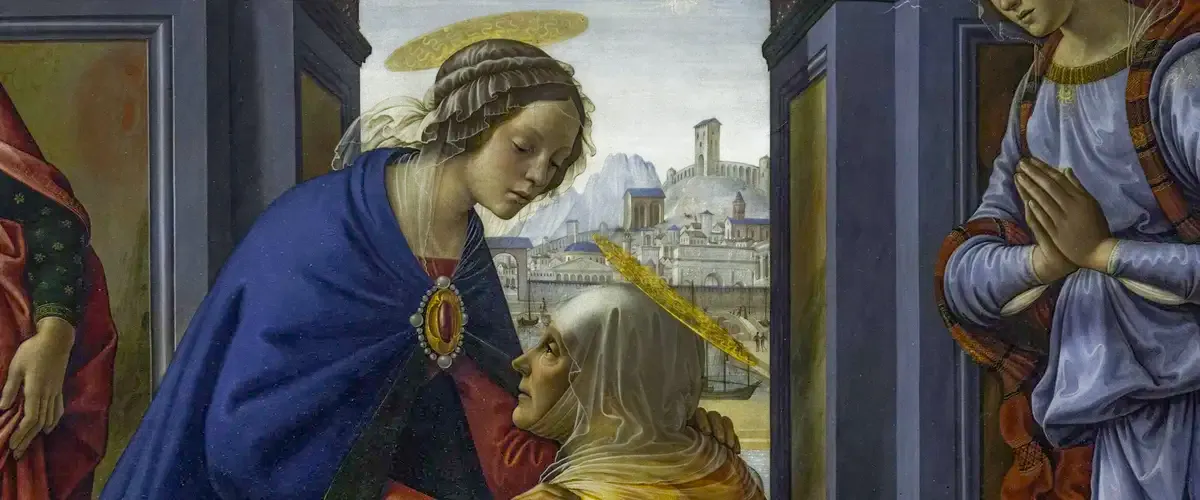
This is the moment the Magnificat was first sung. In Domenico Ghirlandaio‘s panel, the old Elizabeth, wrapped in a golden mantle, kneels before her young cousin, and Mary bends down to embrace her, one hand on her shoulder. Two women stand on either side, and behind them, through an arch, lies a sunlit town by the sea. Elizabeth is the first of the “all generations” who call Mary blessed: she does it on her knees. Ghirlandaio painted it in 1491 for the chapel of Lorenzo Tornabuoni in a Florentine church, and it hangs today in the Louvre.
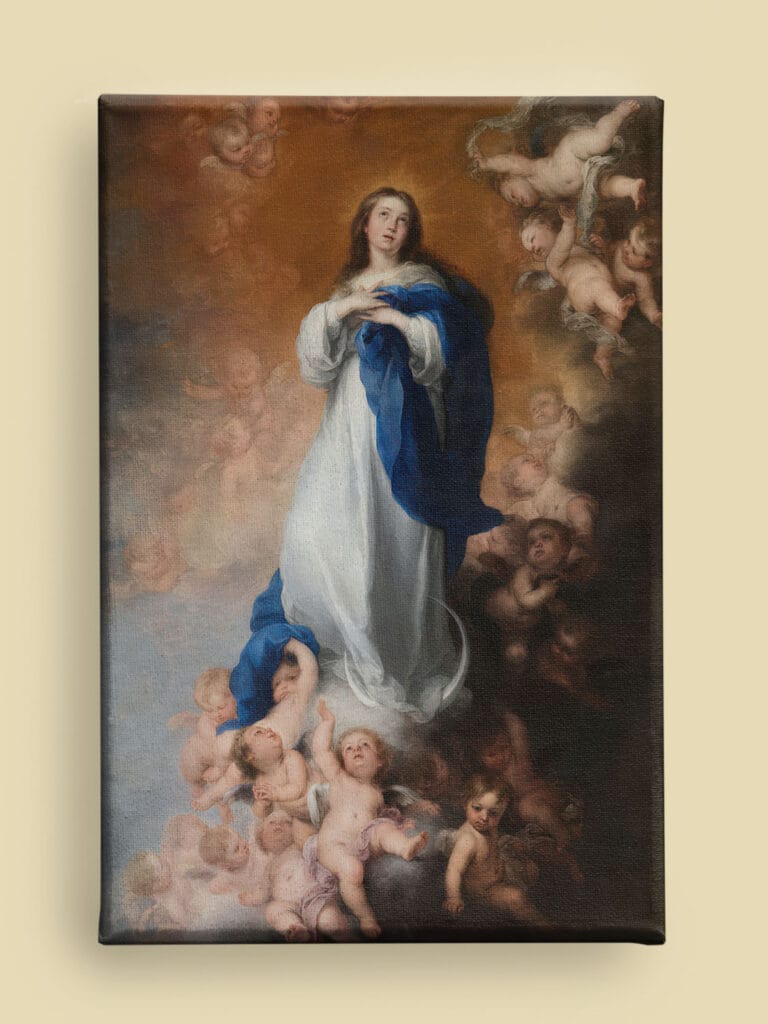
4. “He That Is Mighty Hath Done Great Things to Me”: The Immaculate Conception of los Venerables by Bartolome Esteban Murillo (1678)
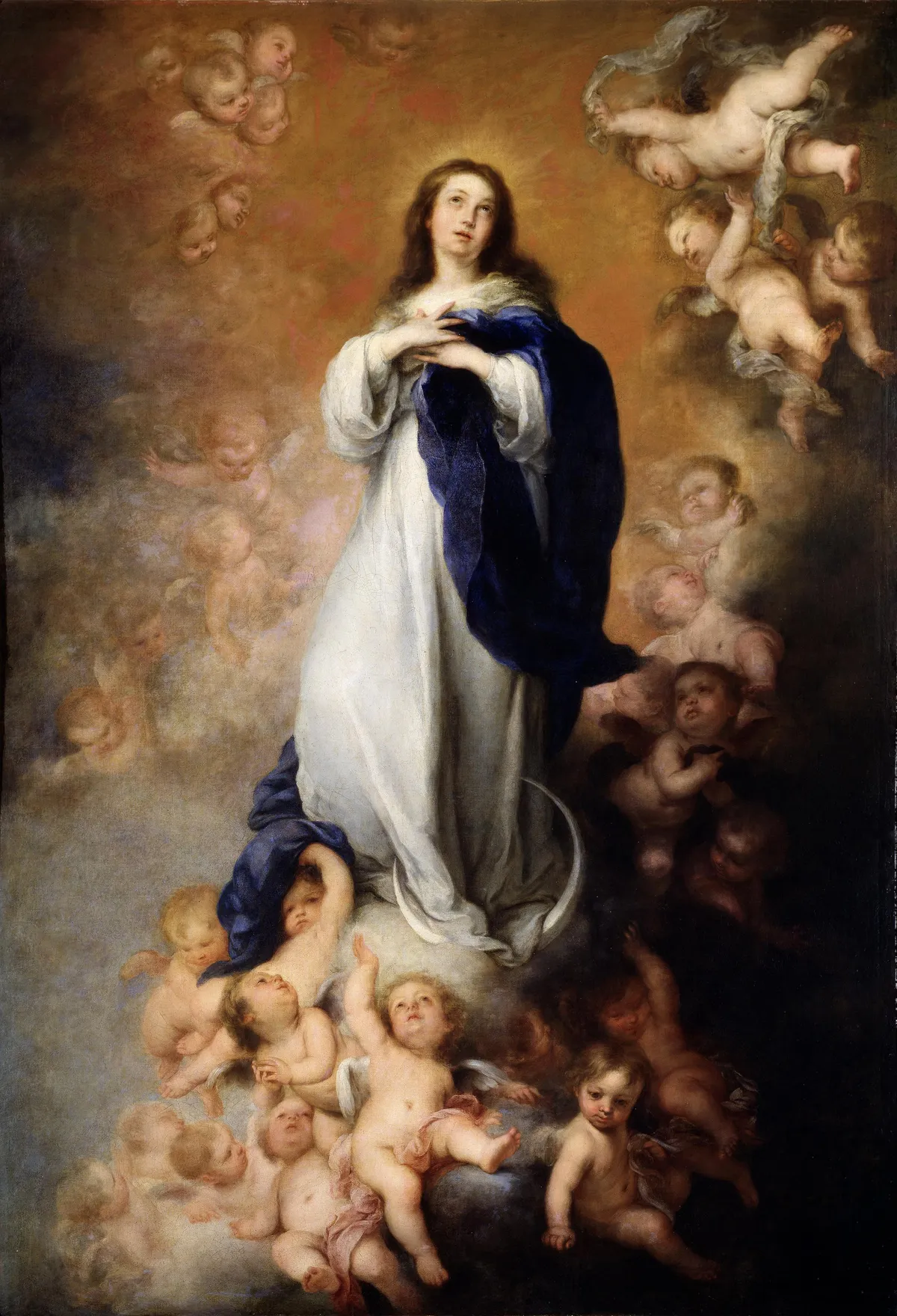
What are the great things God did for Mary? The Church has always answered: he preserved her from sin from the first moment of her life, the dogma of the Immaculate Conception. Murillo painted it more than twenty times, and this is the most famous version: Mary rises in white and blue on a golden cloud, her hands on her breast, her eyes raised, carried by a crowd of cherubs. It was painted in 1678 for a hospital for elderly priests in Seville, the Hospital de los Venerables. During the Napoleonic wars Marshal Soult carried it off to France, the Louvre bought it in 1852, and it came back to Spain only in 1941; it is now in the Prado. Read more about Murillo’s Immaculate Conception.
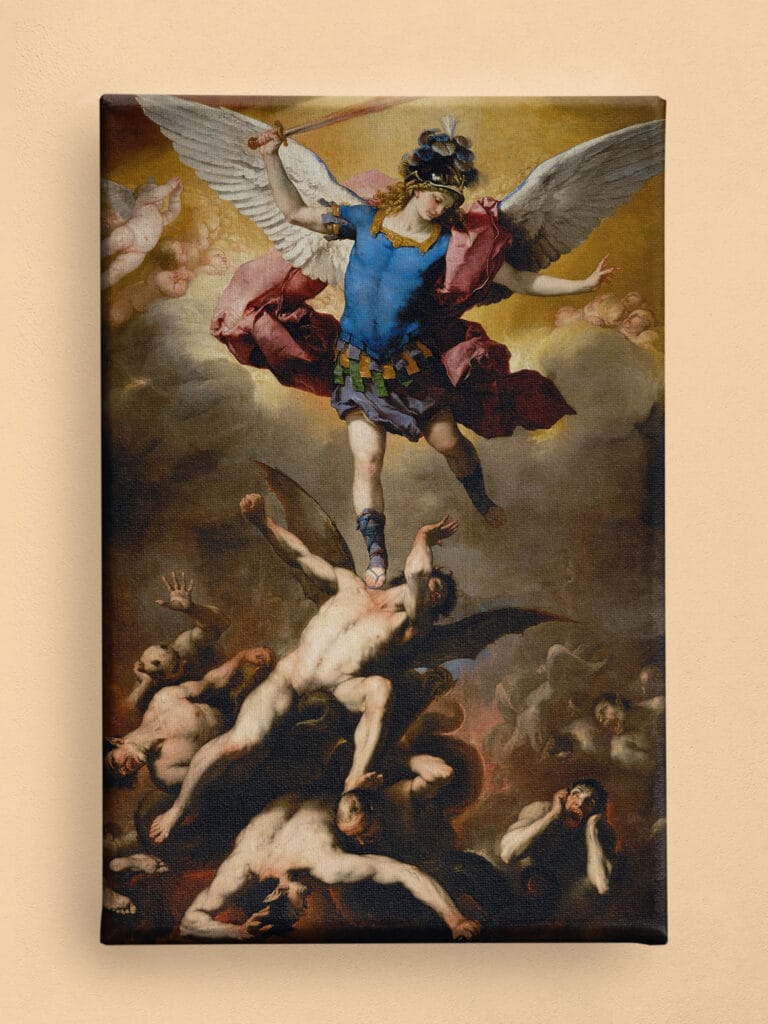
5. “He Hath Put Down the Mighty from Their Seat”: The Fall of the Rebel Angels by Luca Giordano (about 1666)
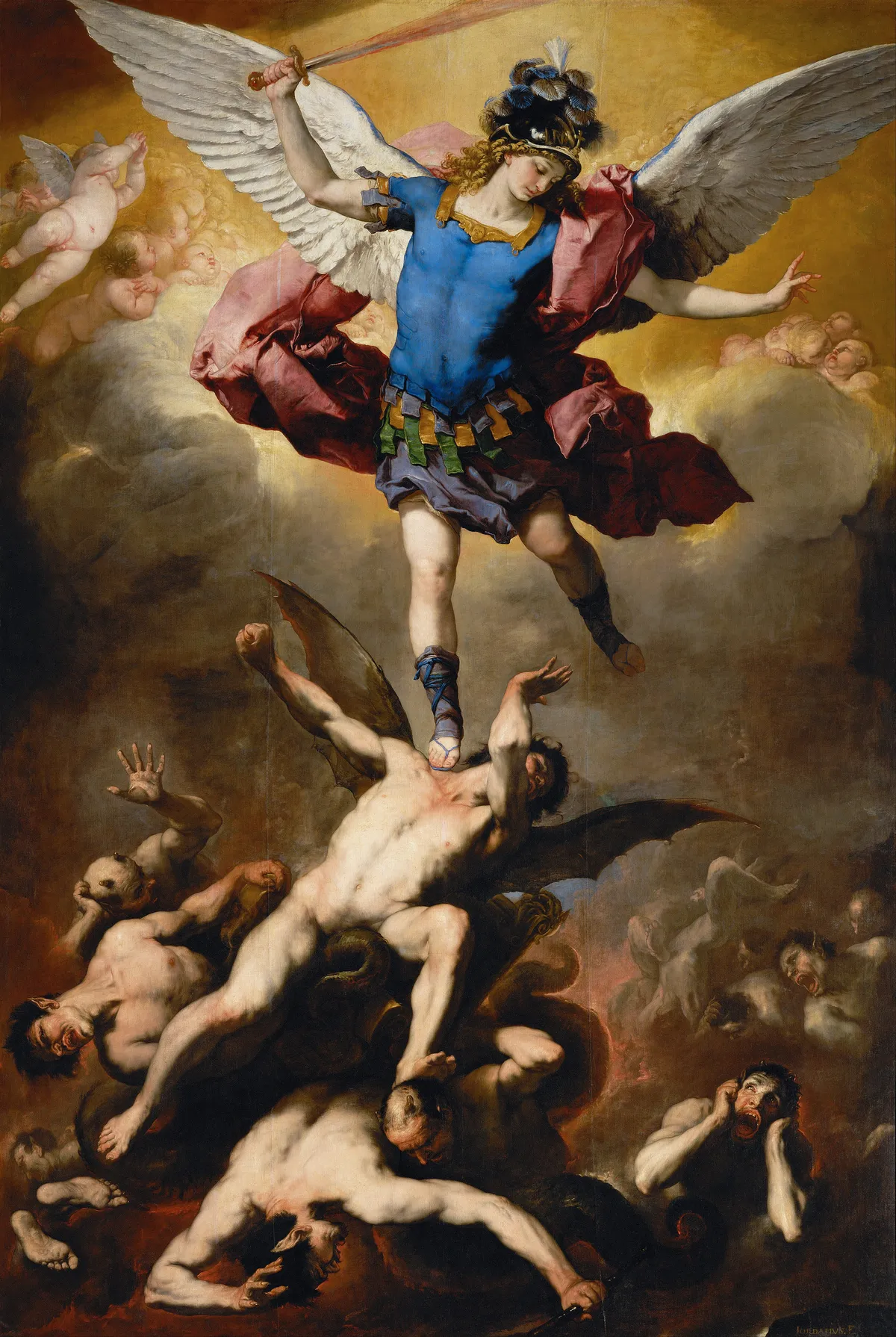
The Magnificat is a song of reversals, and the first and greatest of them is the fall of the angel who wanted to be like God. The Neapolitan painter Luca Giordano shows Saint Michael in blue armour and a red cloak, sword raised, standing on the shoulders of Lucifer as the rebel angels tumble headlong into the dark. The mighty is put down from his seat, and the one who throws him down is a servant whose very name, Michael, means “Who is like God?”. The canvas, painted around 1666, is in the Kunsthistorisches Museum in Vienna.
6. “He Hath Filled the Hungry with Good Things; and the Rich He Hath Sent Empty Away”: The Rich Man and Lazarus by Bonifacio de’ Pitati (about 1540)
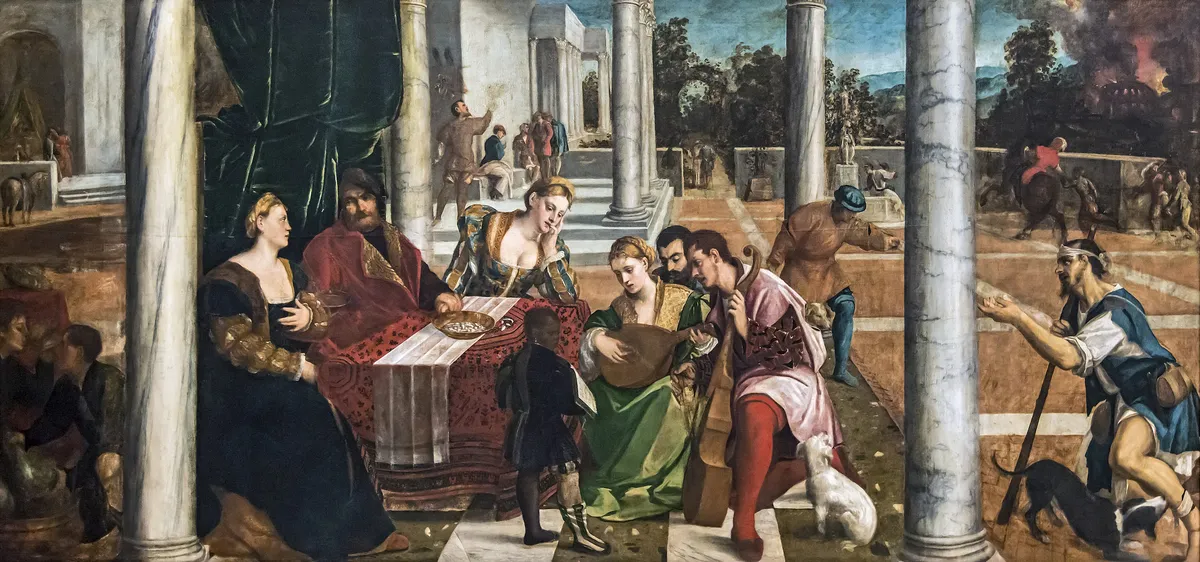
Jesus told the same reversal as a parable. A rich man “feasted sumptuously every day”, while a beggar named Lazarus, not the Lazarus raised from the dead but a poor man covered with sores, lay at his gate and longed for the crumbs from his table (Luke 16:19-31). When they died, the angels carried Lazarus to Abraham’s side, and the rich man found himself in torment. The Venetian Bonifacio de’ Pitati set the feast in a splendid loggia of his own city, with musicians, fine clothes and a table laden with dishes, and pushed Lazarus to the edge of the scene, near the dogs. The painting is in the Gallerie dell’Accademia in Venice.
7. “As He Spoke to Our Fathers, to Abraham and to His Seed for Ever”: The Three Angels Appearing to Abraham by Giandomenico Tiepolo (1773)
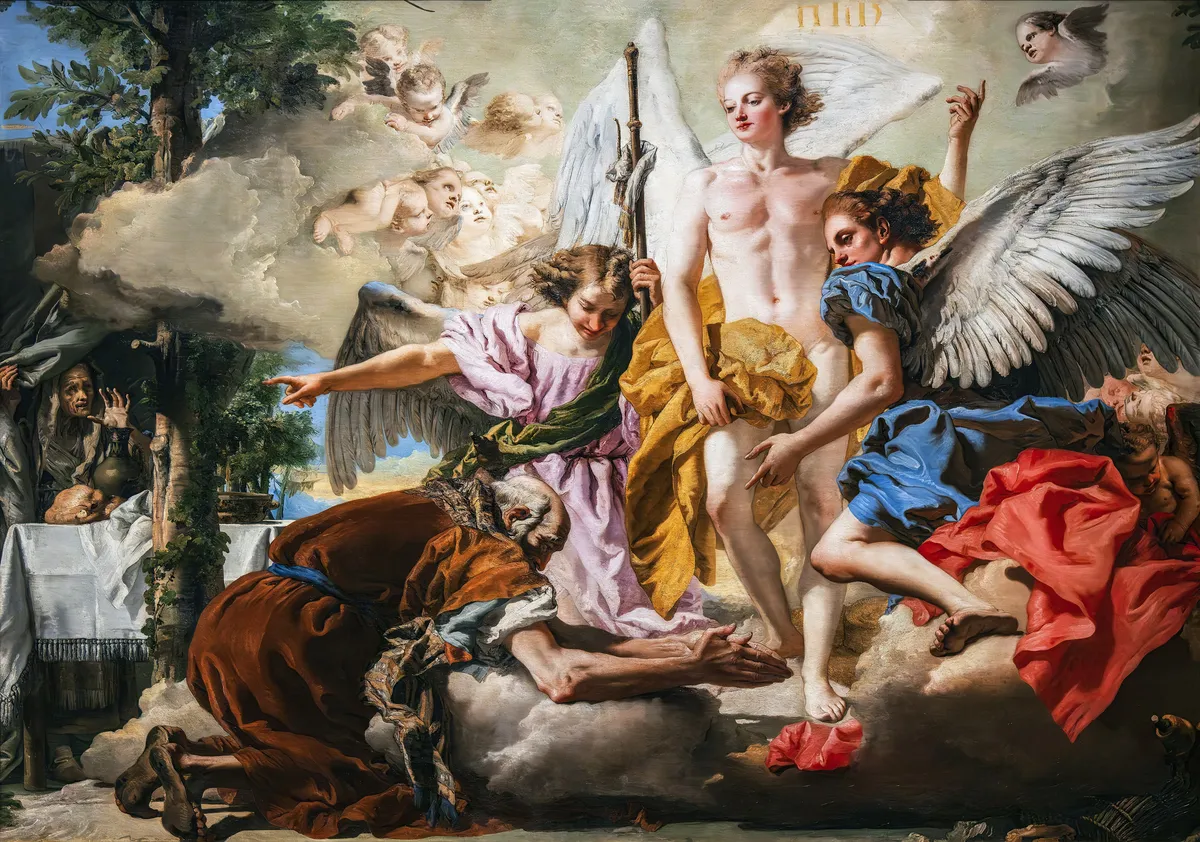
The Magnificat ends where the history of Israel began: with the promise to Abraham. In the book of Genesis, three mysterious visitors come to the old man’s tent by the oaks of Mamre and announce that his barren wife Sarah will bear a son (Genesis 18). Giandomenico Tiepolo, son of the great Giovanni Battista Tiepolo, painted Abraham prostrate on the ground before three winged angels descending on a cloud. The promise made in that tent, a son, a people, a blessing for all nations, is the one Mary sees fulfilled in the child she carries. The canvas, dated 1773, is in the Gallerie dell’Accademia in Venice.
What the Magnificat Means, Verse by Verse
My soul doth magnify the Lord, and my spirit hath rejoiced in God my Saviour. To magnify is to make great. Mary does not make God greater; she makes him seen as great. And she calls him “my Saviour”: the Immaculate Conception is a gift of salvation too.
Because he hath regarded the humility of his handmaid; for behold from henceforth all generations shall call me blessed. God looked at the lowliest. Every Hail Mary since then has fulfilled her prophecy.
Because he that is mighty, hath done great things to me; and holy is his name. The praise goes to God, not to herself: the great things are done to her.
And his mercy is from generation unto generations, to them that fear him. Mary’s own story becomes the story of every generation that trusts God.
He hath shewed might in his arm: he hath scattered the proud in the conceit of their heart. The proud are not defeated by force; they are scattered by their own imaginings.
He hath put down the mighty from their seat, and hath exalted the humble. The heart of the canticle: God reverses the order of the world.
He hath filled the hungry with good things; and the rich he hath sent empty away. The hungry of every kind, for bread, for justice, for God, are fed; those who think they need nothing receive nothing.
He hath received Israel his servant, being mindful of his mercy: as he spoke to our fathers, to Abraham and to his seed for ever. God keeps his word. What he promised Abraham two thousand years earlier, he fulfils in Mary’s child.
How to Pray the Magnificat
- In the evening: as the Church does at Vespers, say or sing it at the end of the day, with the Gloria.
- In Advent: pray it each evening from December 17, with the O Antiphons that belong to it.
- With the Rosary: it is the prayer of the second Joyful Mystery, the Visitation; many people say it after that decade.
- In thanksgiving: after a grace received, it is the Church’s own song of thanks, like the Hail Holy Queen is its song of trust.
With children, start with the first two lines, “My soul doth magnify the Lord, and my spirit hath rejoiced in God my Saviour”, and add the rest a verse at a time. The Visitation is an easy story to tell them first: two expectant mothers, one very young and one very old, and a baby who leaps for joy.
A Free Printable Magnificat Prayer Card
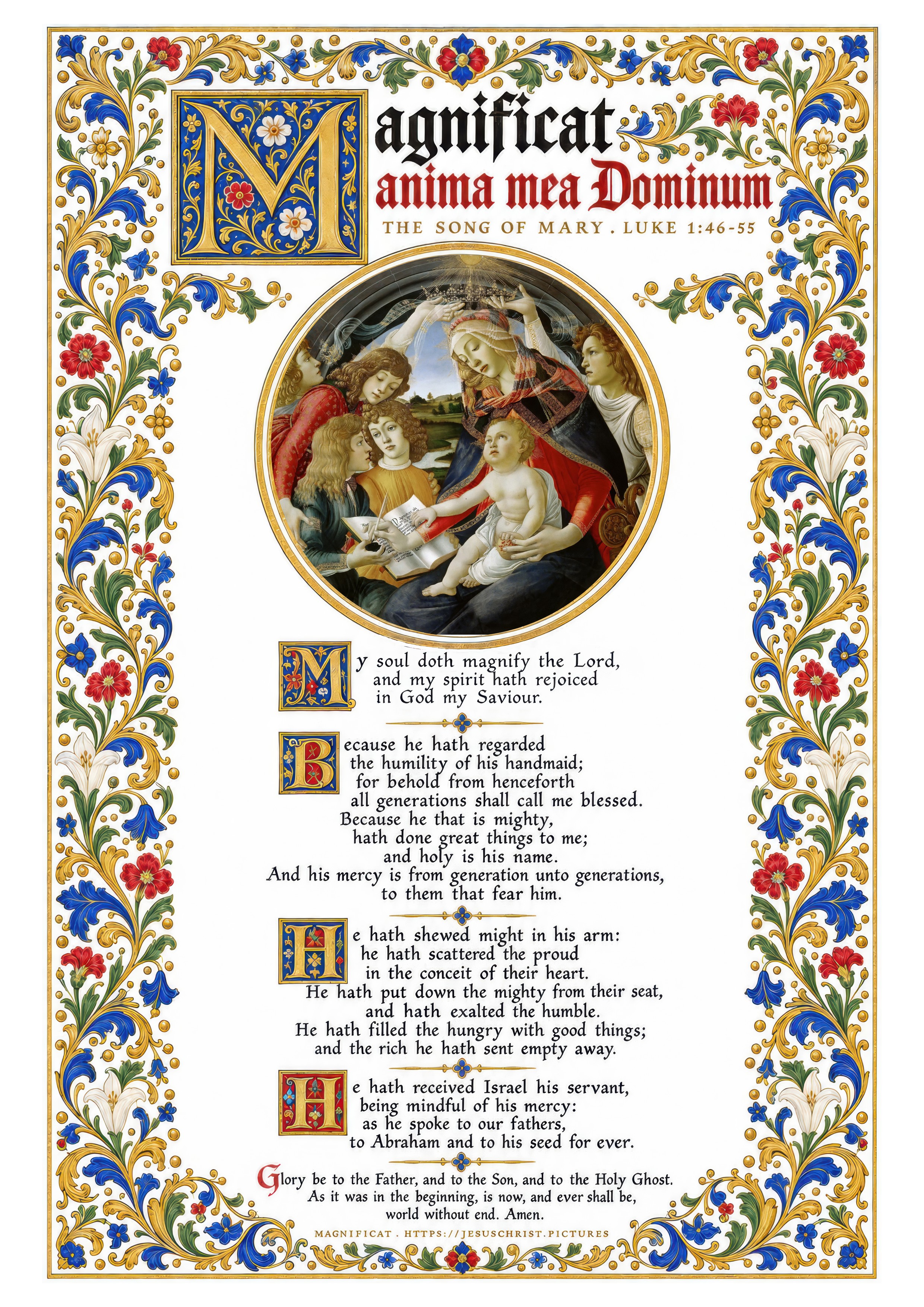
We have made the Magnificat into an illuminated prayer card, in the style of a Florentine book of hours: Botticelli’s Madonna of the Magnificat in a round gold medallion, a great initial M, the full traditional text and the Gloria.
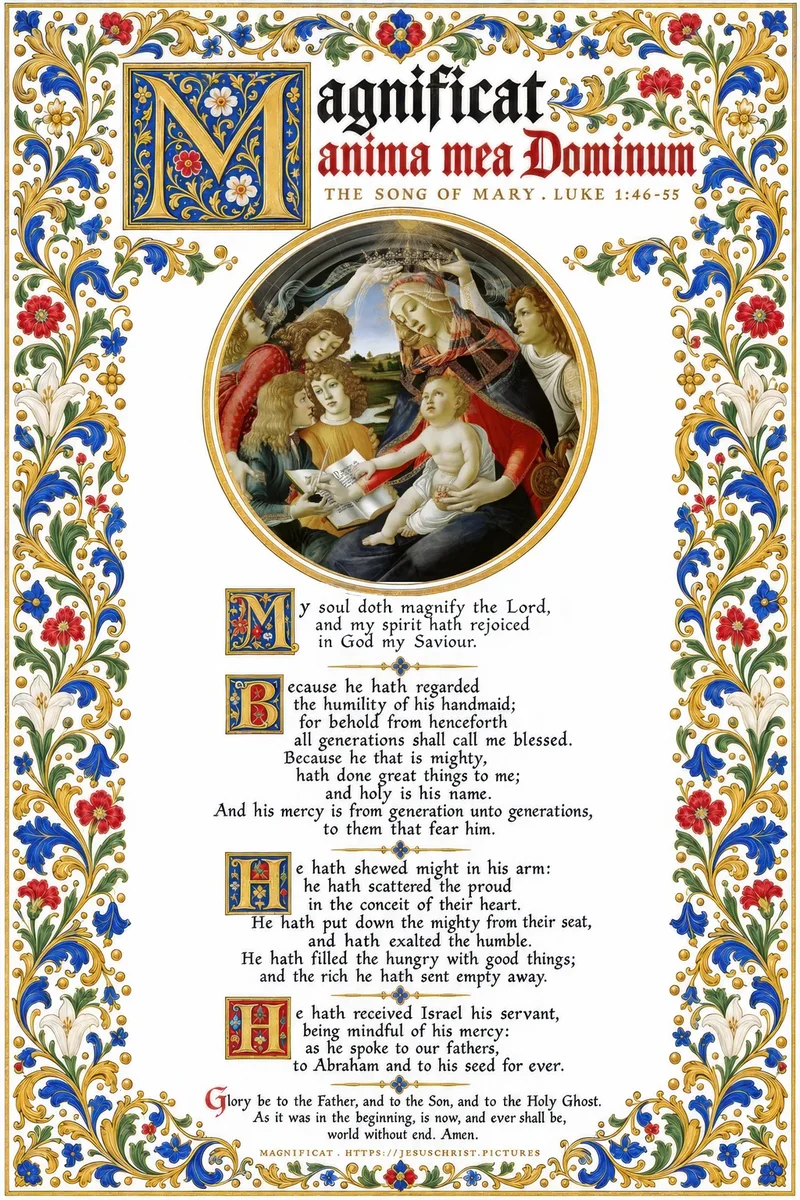
✦ Free Printable Prayer Card
Print it at home for Vespers, your missal or your prayer corner. It is free, and there is nothing to fill in.
Download for US LetterDownload for A4
Also as a high resolution image.
More prayer cards, novenas and Scripture printables are gathered in our free Christian printables.
Conclusion
The Magnificat is the song of a girl from a small town who had just said yes to God, and it has become the evening song of the whole Church. It is joyful and it is fierce: it praises the God who looks at the lowly, and it warns the proud, the mighty and the rich that the order of the world is not his. The painters heard both voices. Botticelli gave Mary a pen and a crown, Fra Angelico her bowed head, Ghirlandaio the embrace in which she first sang it, and Giordano, Bonifacio and Tiepolo the great reversals of her song. Each of them painted one verse of the same praise: my soul doth magnify the Lord.
For more images of the Mother of God, see our guide to Marian iconography, our selection of beautiful Virgin Mary paintings and the most famous Annunciation paintings.
The Paintings in This Article
| Verse of the prayer | Painting | Artist | Date | Medium | Location |
|---|---|---|---|---|---|
| My soul doth magnify the Lord | Madonna of the Magnificat | Sandro Botticelli | About 1483 | Tempera on panel | Uffizi Gallery, Florence |
| The humility of his handmaid | The Annunciation | Fra Angelico | About 1425 to 1426 | Tempera and gold on panel | Museo del Prado, Madrid |
| All generations shall call me blessed | The Visitation | Domenico Ghirlandaio | 1491 | Tempera on panel | Louvre, Paris |
| He hath done great things to me | The Immaculate Conception of los Venerables | Bartolome Esteban Murillo | 1678 | Oil on canvas | Museo del Prado, Madrid |
| He hath put down the mighty | The Fall of the Rebel Angels | Luca Giordano | About 1666 | Oil on canvas | Kunsthistorisches Museum, Vienna |
| The rich he hath sent empty away | The Rich Man and Lazarus | Bonifacio de’ Pitati | About 1540 | Oil on canvas | Gallerie dell’Accademia, Venice |
| To Abraham and to his seed for ever | The Three Angels Appearing to Abraham | Giandomenico Tiepolo | 1773 | Oil on canvas | Gallerie dell’Accademia, Venice |
Important Facts About the Magnificat
- It takes its name from its first word in Latin, Magnificat anima mea Dominum.
- It is in the Gospel of Luke (1:46-55), sung by Mary at the Visitation, and it is the longest passage spoken by Mary in the Gospels.
- It is also called the Song of Mary or the Canticle of Mary.
- It echoes the song of Hannah in the first book of Samuel (1 Samuel 2:1-10).
- It has been sung every evening at Vespers for some fifteen centuries, and the O Antiphons of Advent are its antiphons.
- The traditional Catholic English text is that of the Douay-Rheims Bible: “My soul doth magnify the Lord”.
Frequently Asked Questions
What are the words of the Magnificat prayer?
My soul doth magnify the Lord, and my spirit hath rejoiced in God my Saviour. Because he hath regarded the humility of his handmaid; for behold from henceforth all generations shall call me blessed. Because he that is mighty, hath done great things to me; and holy is his name. And his mercy is from generation unto generations, to them that fear him. He hath shewed might in his arm: he hath scattered the proud in the conceit of their heart. He hath put down the mighty from their seat, and hath exalted the humble. He hath filled the hungry with good things; and the rich he hath sent empty away. He hath received Israel his servant, being mindful of his mercy: as he spoke to our fathers, to Abraham and to his seed for ever.
What is the traditional version of the Magnificat prayer?
The traditional Catholic version in English is the Douay-Rheims text, which begins “My soul doth magnify the Lord, and my spirit hath rejoiced in God my Saviour”, followed by the Gloria Patri. Modern liturgical books use a newer translation beginning “My soul proclaims the greatness of the Lord”. In Latin the prayer begins “Magnificat anima mea Dominum”.
Did Mary really say the Magnificat?
The Gospel of Luke attributes the Magnificat to Mary, and so do almost all ancient manuscripts and the whole tradition of the Church. A few early Latin manuscripts give it to Elizabeth instead, but the Church has always read and prayed it as the song of Mary, sung at the Visitation.
When is the Magnificat sung?
The Magnificat is sung every evening at Vespers, the evening prayer of the Liturgy of the Hours, in the Catholic Church and at Evensong in the Anglican Church. In Advent it is sung with the O Antiphons from December 17 to 23, and on December 22 it is the Gospel of the Mass.
What is the Magnificat in Latin?
In Latin the Magnificat begins: Magnificat anima mea Dominum, et exsultavit spiritus meus in Deo salutari meo. The full Latin text, as it is sung at Vespers, is given on this page.
Can you buy a Magnificat painting or prayer card?
You can buy the paintings of the Magnificat at jesuschrist.pictures, in our shop: Botticelli’s Madonna of the Magnificat as a giclee poster, and Fra Angelico’s Annunciation, Murillo’s Immaculate Conception and Luca Giordano’s Fall of the Rebel Angels as canvas prints ready to hang. The Magnificat prayer card itself is free to print from this page, in US Letter and A4.