The Hail Mary is the most loved and most repeated prayer to the Mother of God, spoken millions of times a day around the world and woven into the beads of every Rosary. What many people never notice is that the Hail Mary prayer is also a painting in words. Almost every line of it is drawn from a scene that the greatest artists returned to again and again, the moment the angel Gabriel greeted a young woman in Nazareth. To pray it is to stand inside one of the central images of Christian art. Here is the prayer, its meaning, and the masterpieces that show it unfolding.
The Hail Mary Prayer (Full Text)
Hail Mary, full of grace, the Lord is with thee.
Blessed art thou amongst women, and blessed is the fruit of thy womb, Jesus.
Holy Mary, Mother of God, pray for us sinners, now and at the hour of our death. Amen.
The Annunciation, Fra Angelico, Museo di San Marco, Florence.
A Free Printable Hail Mary Prayer Card
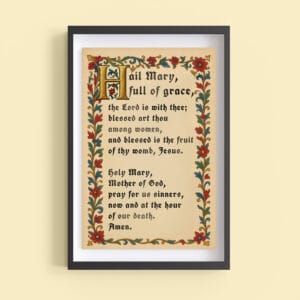
Long before it was set to music, the Hail Mary was written by hand and framed in gold, the way medieval scribes treated every prayer they loved. That is the spirit of this prayer card: the whole prayer set in a calligraphic hand, opened by a gilded initial and bordered by the bright flowers of a Gothic prayer book. It keeps the angel’s greeting and the plea of the faithful together on a single page, free to print and keep.
The Hail Mary prayer card, free to print.Free printable prayer card:
The Meaning of the Hail Mary: Where the Words Come From
The Hail Mary falls into two parts. The first half is taken almost word for word from the Gospel of Luke. It joins the greeting of the angel Gabriel at the Annunciation, “Hail, full of grace, the Lord is with thee,” to the words Elizabeth speaks when Mary visits her, “blessed art thou among women, and blessed is the fruit of thy womb.” The second half, which begins “Holy Mary, Mother of God,” is the Church’s own addition, a humble request for the Virgin’s prayers that took its final shape by the sixteenth century. So the prayer grows from scripture into petition, from the scene of the angel to the plea of the believer.
Hail, full of grace: the Annunciation
The opening words belong to the archangel Gabriel, and the Annunciation became one of the most painted subjects in all of Christian art. Fra Angelico, in the quiet corridors of San Marco in Florence, gave it perfect stillness, the angel bowing toward Mary beneath a row of slender arches, the whole scene hushed as if the world were holding its breath. Nothing moves, and everything is about to change.
The Annunciation, Simone Martini and Lippo Memmi, Uffizi Gallery, Florence.
Two centuries earlier, Simone Martini had made the angel’s greeting visible in gold. In his great Gothic panel in the Uffizi, the words “Ave gratia plena” are spelled out in raised letters running straight from Gabriel’s mouth toward the Virgin. Mary draws back, the lilies of her purity between them. It is the Hail Mary turned into pure image, the prayer you can almost read on the surface of the gold. The full sweep of the subject runs through our piece on the most famous Annunciation paintings.
Blessed art thou among women: the Visitation
The next words of the prayer are not the angel’s but Elizabeth’s. When Mary, newly carrying Christ, travels to visit her older cousin, Elizabeth greets her with the cry that became the heart of the Hail Mary, “blessed art thou among women, and blessed is the fruit of thy womb.” The meeting of the two women is the scene known as the Visitation.
The Visitation, Domenico Ghirlandaio, Louvre Museum, Paris.
Domenico Ghirlandaio painted it with Florentine grace, the two women clasping hands in a clear morning light while companions look on. The young Mary and the older Elizabeth lean toward one another, and the whole picture carries the warmth of the greeting that believers still repeat. Here the second line of the Hail Mary becomes a human embrace.
Holy Mary, Mother of God
With the words “Holy Mary, Mother of God,” the prayer turns from the Gospel scene to the Virgin herself, honored under the ancient title the Church gave her at the Council of Ephesus. Painters answered this title with their tenderest images, the Madonna enthroned, reading, or lost in thought over the child she carries.
Madonna of the Magnificat, Sandro Botticelli, Uffizi Gallery, Florence.
Botticelli’s Madonna of the Magnificat shows Mary writing the very words of her own song of praise, crowned by angels in a circle of gold. It is a fitting image for this part of the prayer, the Mother of God caught in the act of magnifying the Lord.
The Sistine Madonna, Raphael, Gemaldegalerie Alte Meister, Dresden.
Raphael’s Sistine Madonna gives the title its full majesty. Mary steps forward through parted curtains, carrying the Christ child toward us, her gaze grave and gentle at once. It is the Mother of God as the prayer names her, holy, and bearing the fruit of her womb into the world.
Pray for us sinners, now and at the hour of our death
The prayer ends not with praise but with a request. We ask Mary to pray for us, now and at the last, trusting that the mother who stood by the cross will stand by us too. This is why the Hail Mary is the prayer of the Rosary, repeated like a steady heartbeat, and why Mary is so often shown handing the rosary to the faithful.
Madonna of the Rosary, Caravaggio, Kunsthistorisches Museum, Vienna.
Caravaggio’s Madonna of the Rosary shows that intercession in dramatic light. Crowds reach up from the shadows toward the Virgin and Child, while Saint Dominic gives out the rosaries that carry their prayers. It is the last line of the Hail Mary made visible, the sinners asking, the Mother listening. That same quiet appeal lives in our own canvas of the Virgin Mary at prayer.
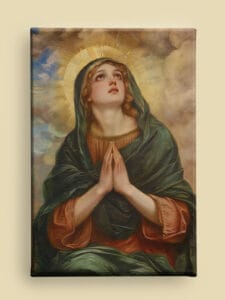
Virgin Mary Praying, our canvas in the Pre-Raphaelite style.
Generations of Catholics have prayed the Hail Mary in Latin, and it is this text that the great Ave Maria settings in music carry. Here is the full Latin version.
Ave Maria, gratia plena, Dominus tecum.
Benedicta tu in mulieribus, et benedictus fructus ventris tui, Iesus.
Sancta Maria, Mater Dei, ora pro nobis peccatoribus, nunc et in hora mortis nostrae. Amen.
The Ave Maria in Music
Because its words are so simple and so deep, the Hail Mary has drawn composers for five hundred years. Josquin des Prez set it in the Renaissance, and in the nineteenth century both Franz Schubert and Charles Gounod wrote settings of the Ave Maria that are still sung at weddings and funerals everywhere. Gounod built his melody directly over a prelude by Johann Sebastian Bach, so that the oldest prayer to Mary rides on one of the most beloved tunes in Western music. The prayer that began as an angel’s greeting has never stopped being sung.
The Hail Mary is a small prayer that holds a whole gallery inside it. Its first words are an angel’s, its next are a cousin’s welcome, its center is the oldest title of the Virgin, and its close is the quiet plea of every soul that has ever held a rosary. The painters only made visible what the words already carried. To pray the Hail Mary is to walk from the Annunciation to the hour of our death in the company of the Mother of God, and to keep that company close you can look through our collection of Christian wall art.
Important Facts About the Hail Mary
The Hail Mary is the most widely recited Marian prayer in the Catholic Church, also known as the Ave Maria from its Latin opening words.
Its first half is taken almost word for word from the Gospel of Luke, joining the greeting of the angel Gabriel to the words of Elizabeth at the Visitation.
The second half, beginning “Holy Mary, Mother of God,” was added gradually by the Church and reached its present form by the sixteenth century.
The prayer forms the heart of the Rosary, where it is repeated fifty-three times across the five decades.
The Ave Maria has inspired famous sacred music, including settings by Josquin des Prez, Franz Schubert and Charles Gounod.
Questions and Answers
Is the Hail Mary in the Bible?
The first half is. It comes straight from the first chapter of the Gospel of Luke, combining the angel Gabriel’s greeting at the Annunciation, “Hail, full of grace, the Lord is with thee,” with Elizabeth’s words at the Visitation, “blessed art thou among women, and blessed is the fruit of thy womb.” The second half, the appeal to Holy Mary, Mother of God, is a later prayer added by the Church. So the Hail Mary is partly scripture and partly the Church’s response to it.
Why do Catholics ask Mary to pray for them?
Catholics do not worship Mary, they ask her to pray for them, just as Christians ask one another for prayers. Because she is the mother of Christ and stood with him at the cross, she is honored as the first and closest of all believers. The last line of the Hail Mary, “pray for us sinners,” is exactly this request for her intercession. It asks her to bring our needs to her son.
What does “Hail Mary, full of grace” mean?
The phrase translates the angel’s greeting in Luke, where the Greek word used for Mary means something like “filled with grace” or “highly favored.” It means that God had filled Mary with his grace in order to prepare her to become the mother of his son. The Latin form, “gratia plena,” carries the same sense. It is a statement of how completely God had blessed her.
Why do so many Annunciation paintings seem to illustrate the Hail Mary?
Because the prayer’s opening words are the very words Gabriel speaks at the Annunciation. When an artist paints that scene, he is painting the first line of the Hail Mary. Some, like Simone Martini, even wrote the words “Ave gratia plena” directly into the picture. The Annunciation and the Hail Mary are two forms of the same moment, one in paint and one in prayer.
Is the Hail Mary the same as the Ave Maria?
Yes. Ave Maria is simply the Latin name for the Hail Mary, taken from its first two words. The famous musical settings by Schubert and Gounod use this Latin text, which is why they are known as Ave Marias. Whether sung in Latin or recited in English, it is the same prayer to the same Mother of God.
How many Hail Marys are in a Rosary?
A five-decade Rosary contains fifty-three Hail Marys: three after the opening Creed, and ten for each of the five decades. Praying all the sets of mysteries over a full twenty-decade Rosary brings the count above two hundred. The repetition is the point: the prayer becomes a steady rhythm beneath the mysteries of Christ’s life.
What is the Three Hail Marys devotion?
It is the old practice of praying three Hail Marys each morning and each evening, in honor of the Blessed Trinity, asking for Mary’s protection through the day and the night. Saints such as Alphonsus Liguori recommended it warmly, and it remains one of the simplest Marian devotions for daily life.
Where can I see the paintings in this article?
Fra Angelico’s Annunciation is in the Museo di San Marco in Florence, while Simone Martini’s and Botticelli’s Magnificat hang in the Uffizi nearby. Ghirlandaio’s Visitation is in the Louvre in Paris, Raphael’s Sistine Madonna is in the Gemaldegalerie in Dresden, and Caravaggio’s Madonna of the Rosary is in the Kunsthistorisches Museum in Vienna. Together they trace the whole prayer across the great museums of Europe.
Where can I buy a Hail Mary poster?
The medieval illuminated design shown on this page is available as a large poster, printed on high quality matte paper, from our own shop, jesuschrist.pictures: see the Hail Mary prayer poster. The shop also offers other prayers and psalms as posters, alongside canvas reproductions of the great Marian paintings.
Hans Baldung paintings carry the Dürer line into a stranger, more visionary world. Step inside the altarpieces of the German Renaissance master of Strasbourg.
Rembrandt paintings give Christian art its most psychologically honest seventeenth century voice. Step into the great biblical canvases of the Dutch Golden Age master.
The peace prayer of St Francis, make me an instrument of your peace, through Christian art. Its true origin, the saint behind it, and masterpieces by Giotto, Bellini, Zurbaran, Caravaggio and El Greco.