Essential Giovanni Bellini Paintings to Know
Giovanni Bellini paintings span nearly seven decades and define, more than any other body of work, what Venetian sacred art looks like. Born around 1430, Bellini worked until almost the end of his long life, he died around 1516, and in that time he moved from the crisp linear style of his early training to the warm, luminous colorism that would make Venice the painting capital of Europe. His Madonnas set the devotional standard for generations. His altarpieces redefined the relationship between figure, architecture, and landscape. Titian, Giorgione, and Sebastiano del Piombo all passed through his shadow, and all carried something of his light into their own work.

A Century of Sacred Painting
Giovanni Bellini was the son of the painter Jacopo Bellini and the brother-in-law of Andrea Mantegna, and in his early career the influence of both men is palpable. From Mantegna he took an interest in archaeological precision and sculptural clarity; from his father he inherited a devotion to devotional painting in the Venetian tradition. But Bellini’s greatness lay in what he added to both: a sensitivity to natural light and atmosphere, a warmth in color, and an emotional tenderness in his Madonnas that had no real precedent in northern Italian painting.
His long career also coincided with the arrival of Flemish panel paintings in Venice, works by Jan van Eyck and Rogier van der Weyden that showed Italian painters what oil paint could do when layered slowly and patiently. Bellini adopted oil as his principal medium probably in the 1470s, and the change transformed his work. The hard, linear quality of his early paintings gave way to a soft luminosity, shadows dissolving into golden light, that became the signature of the Venetian school.
The Agony in the Garden
Painted around 1458-1460 and now in the National Gallery in London, the Agony in the Garden shows Christ kneeling in prayer on the Mount of Olives while his three disciples sleep below. An angel appears bearing the cup of suffering. In the distance, Judas leads the soldiers across a winding road. What makes Bellini’s version distinctive, especially compared to the near-contemporary version by his brother-in-law Mantegna on the same theme, is the sky. Bellini gives Christ a dawn sky of extraordinary tenderness: pale gold at the horizon, deepening to blue above, the first light breaking over the hills of Jerusalem. The sleeping disciples, the approaching soldiers, the praying Christ, all are held in that moment between night and morning, sorrow and inevitable suffering.

The Madonna Compositions
No area of Bellini’s production was more prolific or more influential than his Madonna paintings. He produced dozens of them over his career, ranging from small private devotional panels to large altarpiece compositions, and in each he explored the same central theme, the mother’s love for a child she knows is not entirely hers, with unfailing inventiveness.
Contarini Madonna
The Contarini Madonna, painted around 1460 and now in the Gallerie dell’Accademia in Venice, belongs to Bellini’s early period, when Mantegna’s influence was still strong. The Virgin and Child are set against a plain dark background, their forms sharply defined, the light falling with almost sculptural clarity. Yet already there is something Bellini’s own: the quality of the Virgin’s gaze, turned slightly downward, inward, as if she is already contemplating what lies ahead.

Madonna of the Red Cherubim
Dated around 1485 and held at the Gallerie dell’Accademia, this Madonna takes its name from the band of red-winged cherubim that forms a parapet beneath the Virgin and Child. The format is characteristic of Bellini’s middle period: the figures placed close to the picture plane, a dark background opening into sky on either side, the Child blessing the viewer with one hand while reaching for his mother with the other. The red of the cherubim is warm and slightly startling against the cool blues of the drapery.

Alzano Madonna
The Alzano Madonna, now in the Accademia Carrara in Bergamo, dates from around 1487 and shows Bellini at the height of his middle period. The Virgin is placed before a parapet, behind her a sky of luminous blue. The Christ child sleeps across her lap, his small body relaxed in complete trust. There is a stillness to the image that is typical of Bellini’s best Madonnas: not a posed stillness but the particular quiet of a moment caught before it passes.

Madonna del Prato
Painted around 1505, the Madonna del Prato (Madonna of the Meadow) at the National Gallery in London represents Bellini’s mature style at its most poetic. The Virgin sits in a meadow, the sleeping Christ child lying across her knees, a landscape of Venetian plains and distant hills behind her. The sleeping child anticipates the Pieta; the mother’s downcast eyes acknowledge it. Around them, the world is quiet and green and fully alive. It is one of the most beautiful paintings Bellini ever made.

Madonna and Child Enthroned with Saints and Angels
This large devotional work at the Gallerie dell’Accademia in Venice places the Virgin and Child on a throne surrounded by saints and music-making angels, following the format of the sacra conversazione that Bellini helped establish as the dominant altarpiece type in Venice. The figures are arranged with a spacious calm, each absorbed in a private relationship with the divine presence at the center, and the whole composition breathes with the warm light that Bellini had made distinctly his own.

Monumental Altarpieces
San Zaccaria Altarpiece
Signed and dated 1505, the San Zaccaria Altarpiece remains in its original location in the church of San Zaccaria in Venice. It is Bellini’s masterpiece of monumental sacred composition: the Virgin and Child enthroned in an apse-like architectural space, flanked by Saints Peter, Catherine, Lucy, and Jerome. The painting is remarkable for the way it dissolves the boundary between the real architectural space of the church and the painted space of the altarpiece, the figures seem to exist in the same luminous air as the viewer. An angel sits at the base of the throne, playing a viola da gamba. The whole image radiates a warmth that has made it one of the most admired paintings in Venice for five centuries.

Saints Christopher, Jerome and Louis of Toulouse
This altarpiece, painted in 1513 for the church of San Giovanni Grisostomo in Venice, is one of Bellini’s very last works, produced when the artist was in his early eighties. Three saints stand in a landscape, their monumental figures filling the picture plane with a calm authority. Saint Christopher bears the Christ child on his shoulder; Saint Jerome reads from his book; Saint Louis of Toulouse stands in his bishop’s vestments. The landscape behind them is painted with the soft atmospheric light of Bellini’s late style, and the whole composition shows a painter who had lost none of his power.

Biblical Narratives
Presentation at the Temple
Now in the Pinacoteca Querini Stampalia in Venice, this early work presents the infant Jesus being brought to the Temple in Jerusalem, as prescribed by Jewish law. The figures are arranged in a shallow frieze against a dark background, their faces lit from below by the light of a candle held near the child. The composition shows Bellini’s debt to Mantegna in its sculptural clarity, but the warmth of the candlelight already hints at what would become his signature quality.

Saint Mark Preaching in Alexandria
This large narrative canvas in the Pinacoteca di Brera in Milan was begun by Giovanni’s older brother Gentile Bellini, who died in 1507 before completing it, and finished by Giovanni. The scene shows Saint Mark preaching in the piazza of Alexandria, Egypt, before a crowd of listeners dressed in exotic Eastern costume. The architectural backdrop, a mixture of Italian and Ottoman elements, gives the scene a theatrical grandeur. Giovanni’s contribution, concentrated in the figures and the sky, can be felt in the warmer, more atmospheric quality of the upper portions.

Transfiguration of Christ
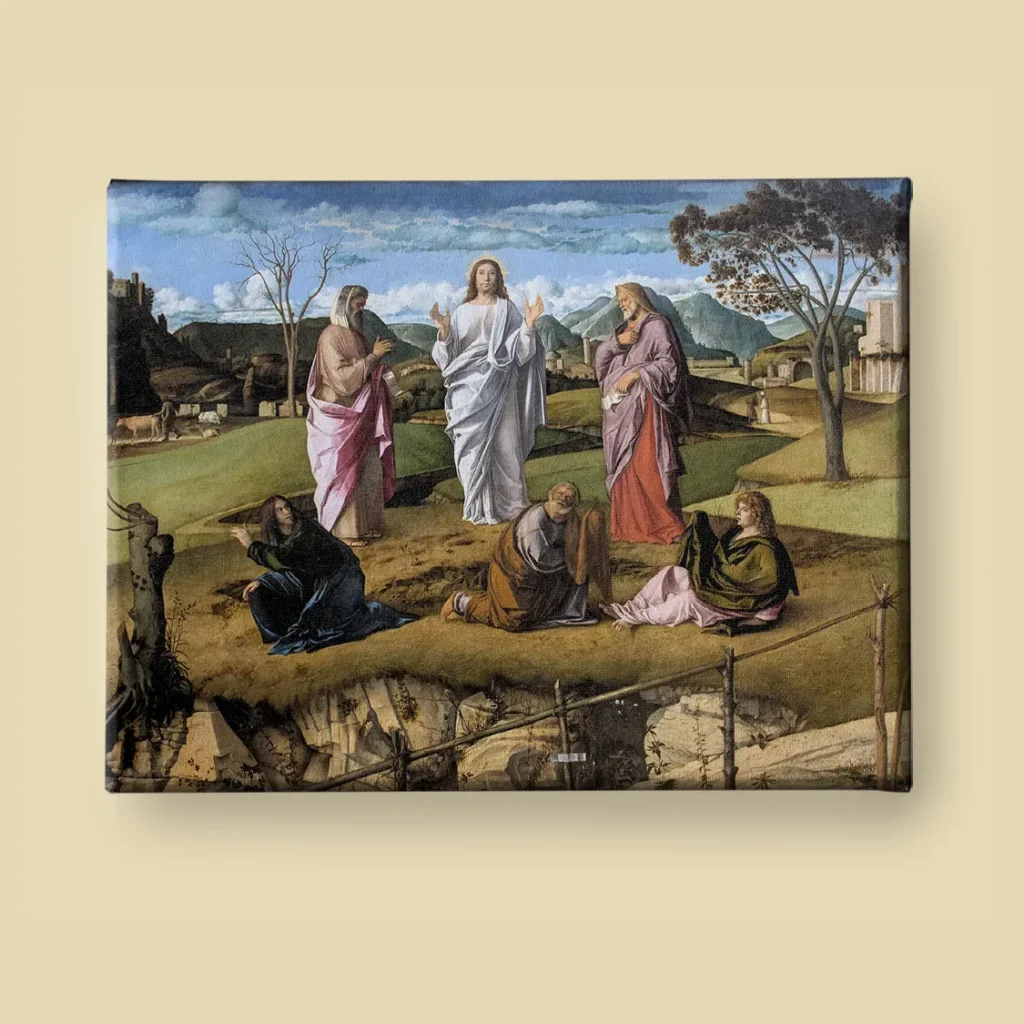
Painted around 1480 and now in the Museo Correr in Venice, the Transfiguration shows Christ on Mount Tabor, his body radiant with divine light, flanked by Moses and Elijah, while Peter, James, and John prostrate themselves below. Bellini handles the supernatural light with characteristic subtlety: Christ glows but does not overpower the landscape around him. The disciples below react with awe that is entirely human, shielding their eyes, falling to the ground, while behind the hilltop a Venetian landscape stretches quietly into the distance.

Saint Francis in the Desert
Perhaps the most celebrated of all Bellini’s paintings, the Saint Francis in the Desert at the Frick Collection in New York shows the saint in a rocky landscape, his arms spread, his face upturned in an expression of rapture. The stigmatization, the miraculous appearance of Christ’s wounds on Francis’s body, seems to be happening, though Bellini is characteristically indirect about the supernatural event itself. What dominates the picture is the landscape: a dawn sky of extraordinary beauty, the rocky terrain glowing with morning light, a donkey grazing peacefully in the middle distance, a heron standing in a stream. It is a painting about the presence of God in the natural world, about the holiness of light itself, and it stands as one of the supreme religious paintings of the Renaissance.

Summary of Giovanni Bellini’s Paintings
| Painting | Date | Location |
|---|---|---|
| Agony in the Garden | c. 1458-60 | National Gallery, London |
| Alzano Madonna | c. 1487 | Accademia Carrara, Bergamo |
| Contarini Madonna | c. 1460 | Gallerie dell’Accademia, Venice |
| Madonna and Child enthroned with Saints and Angels | c. 1490 | Gallerie dell’Accademia, Venice |
| Madonna del Prato | c. 1505 | National Gallery, London |
| Madonna of the Red Cherubim | c. 1485 | Gallerie dell’Accademia, Venice |
| Presentation at the Temple | c. 1460 | Pinacoteca Querini Stampalia, Venice |
| Saint Francis in the Desert | c. 1480 | The Frick Collection, New York |
| Saint Mark Preaching in Alexandria | c. 1504-07 | Pinacoteca di Brera, Milan |
| Saints Christopher, Jerome and Louis of Toulouse | 1513 | San Giovanni Grisostomo, Venice |
| San Zaccaria Altarpiece | 1505 | San Zaccaria, Venice |
| Transfiguration of Christ | c. 1480 | Museo Correr, Venice |
Important Facts about Giovanni Bellini
- Born: Around 1430 in Venice, son of the painter Jacopo Bellini and brother of Gentile Bellini.
- Training: Trained in his father Jacopo’s workshop in Venice; profoundly influenced by his brother-in-law Andrea Mantegna and by Flemish panel painting, particularly in his adoption of oil paint.
- Style: Pioneer of Venetian colorism and luminous atmospheric painting; his Madonnas set the devotional standard for the entire school, and his altarpieces established the sacra conversazione as Venice’s dominant sacred format.
- Major work: The San Zaccaria Altarpiece (1505), still in its original location in Venice, is widely considered the supreme example of the Venetian High Renaissance altarpiece.
- Death: Died around 1516 in Venice, aged approximately eighty-six. Titian and Giorgione were among the painters who formed in his workshop.
Frequently Asked Questions about Giovanni Bellini
Why is Giovanni Bellini so important to the history of painting?
Bellini is important for several reasons. He was the first great master of oil painting in Venice, having learned or adapted the technique from Flemish painting and made it the defining medium of the Venetian school. He transformed the altarpiece format, making it warmer, more atmospheric, more human. And he trained or influenced virtually every major Venetian painter of the next generation, including Titian, Giorgione, and Sebastiano del Piombo. Without Bellini, the Venetian school as we know it does not exist.
What is a sacra conversazione?
A sacra conversazione (sacred conversation) is an altarpiece format in which the Virgin and Child are shown enthroned and surrounded by saints who appear to share the same pictorial space, as if gathered together in silent communion. The term is a modern invention, Renaissance painters did not use it, but the format itself was the dominant altarpiece type in Venice from the mid-fifteenth century onward, and Bellini was one of its principal inventors and practitioners.
Did Giovanni Bellini paint portraits?
Yes, though portraits form a smaller part of his output than his religious work. His portraits, including the celebrated portrait of Doge Leonardo Loredan (National Gallery, London), are notable for their psychological directness and their mastery of oil glazing technique, which allowed him to render skin and fabric with extraordinary subtlety. He was among the first Italian painters to bring to portraiture the same luminous warmth he applied to his sacred subjects.
What is the relationship between Giovanni Bellini and Titian?
Titian trained in Bellini’s workshop as a young man, probably around 1500-1510. He absorbed Bellini’s colorism and his atmospheric handling of landscape, and when Bellini died in 1516 Titian succeeded him as the leading painter in Venice. Vasari records that Bellini, even in old age, was still producing beautiful work, and that he was reluctant to see Titian overtake him. The two men represent two generations of the same Venetian tradition, and Titian’s genius is unthinkable without Bellini’s foundation.
Where can I see Giovanni Bellini’s paintings today?
The largest concentrations of his work are in Venice, the Gallerie dell’Accademia and several Venetian churches, including San Zaccaria where the great altarpiece remains in situ. Major works are also in the National Gallery in London (Agony in the Garden, Madonna del Prato), the Frick Collection in New York (Saint Francis in the Desert), and the Pinacoteca di Brera in Milan (Saint Mark Preaching in Alexandria).
Where can I buy Giovanni Bellini paintings reproductions?
You can buy them at jesuschrist.pictures, in our shop: see all the Giovanni Bellini canvas prints, ready to hang, in several sizes.


