10 Doubting Thomas Paintings, From Duccio to Carl Bloch
Doubting Thomas paintings capture one of the most human moments in the Gospels. When the risen Christ first appeared to his disciples, the apostle Thomas was not with them, and he refused to believe. “Unless I see the mark of the nails in his hands,” he said, “and put my finger where the nails were, and my hand into his side, I will not believe.” Eight days later Christ returned and offered him exactly that. Thomas touched the wounds, cried out “My Lord and my God,” and heard the famous reply: “Blessed are those who have not seen and yet have believed.” For painters the scene is a gift. It sets a living, wounded body at the centre, a hand reaching toward an open wound, and a ring of faces caught between fear and wonder. It is a drama of doubt turning into faith in a single instant, and it gave artists a reason to paint flesh, light, and raw emotion at close range. The subject was a special favourite of the followers of Caravaggio, whose own version below made it unforgettable. The ten works here run from a small gold panel of the early fourteenth century to a Danish etching of 1882, and together they show how many ways one doubt can be pictured. It belongs to the great cluster of scenes after the empty tomb, gathered in our guide to famous Resurrection paintings.
1. The Incredulity of Thomas by Duccio (1308 to 1311)
The oldest work here is a small, radiant panel from the greatest altarpiece of medieval Siena. Duccio di Buoninsegna painted it as one scene on the back of his vast Maesta, against a ground of pure gold. Christ stands in the centre and lifts his arm to bare the wound in his side, while Thomas reaches up to touch it and the other apostles press close on either side.
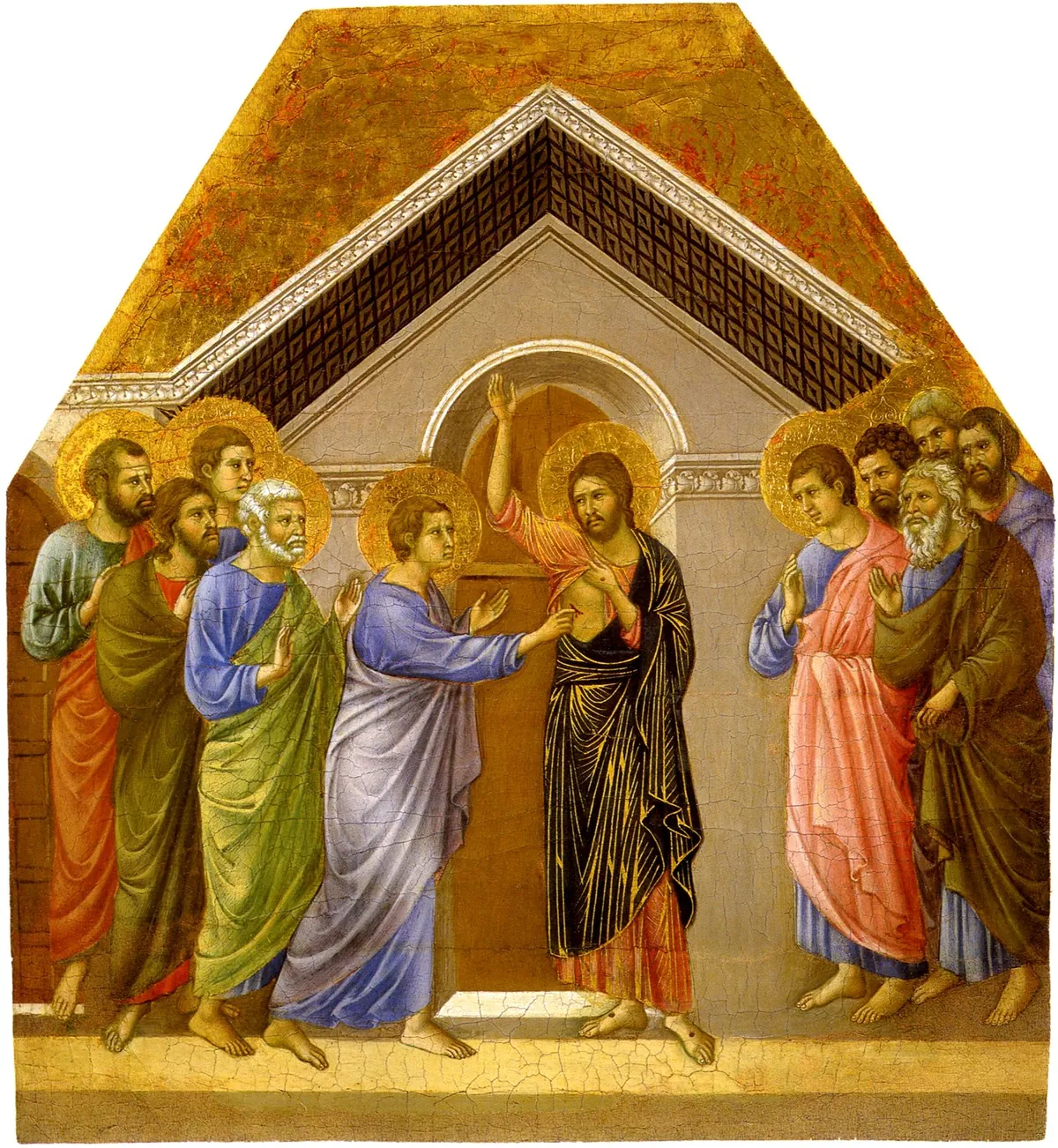
Everything is calm, ordered, and graceful, told in the elegant line and glowing colour of the Sienese school. There is no violence in it, only a quiet certainty, the sacred story set out like a jewel. The panel is now in the Museo dell’Opera del Duomo in Siena.
2. Christ and the Doubting Thomas by Luca Signorelli (c. 1477 to 1482)
The Tuscan master Luca Signorelli painted his version as a fresco, part of a cycle in the sacristy of the great pilgrimage church at Loreto. Christ, in a swirling white robe, raises one arm high to open his side, while Thomas steps forward and reaches toward the wound. The two figures stand beneath a painted architectural canopy, monumental and sculptural.
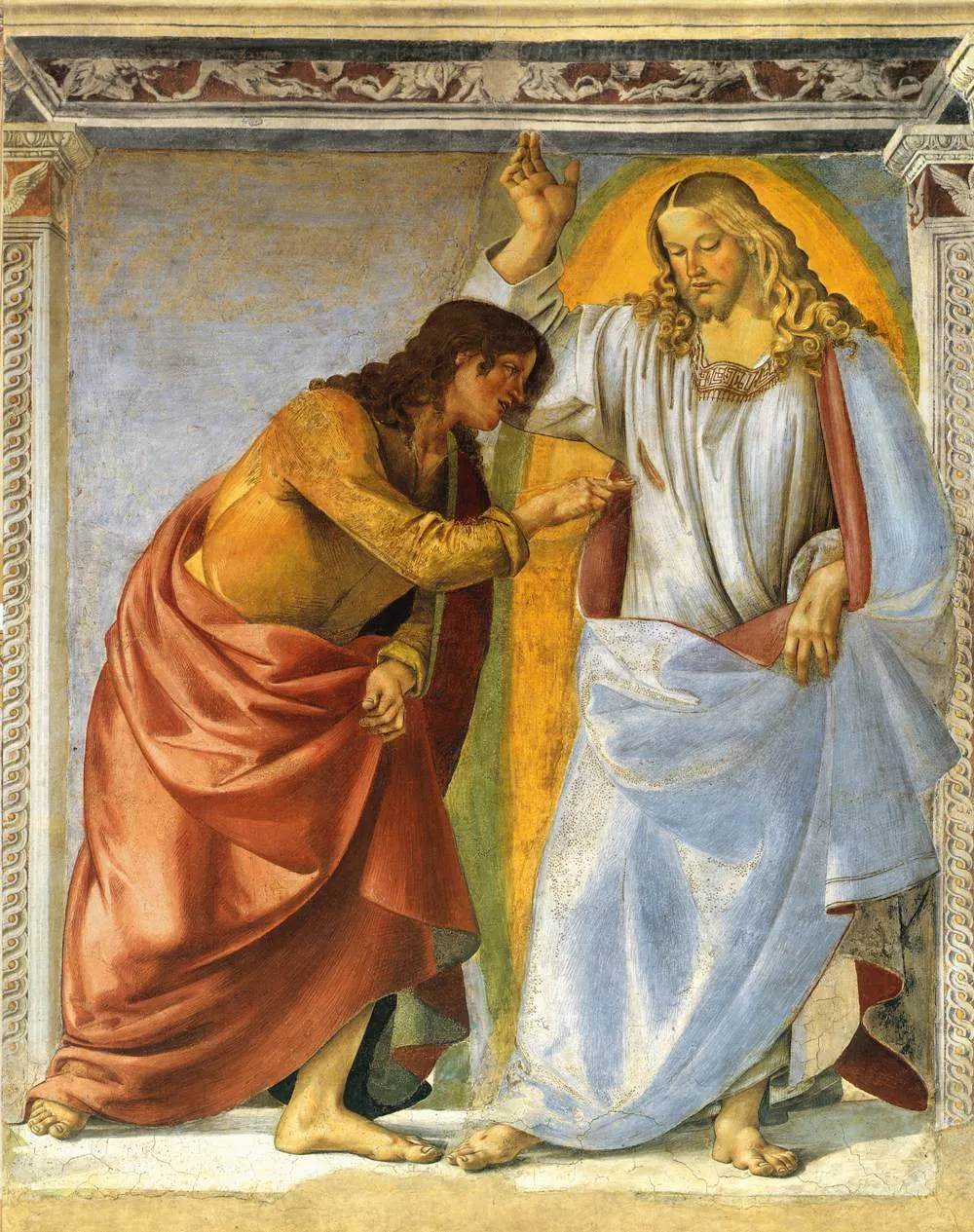
Signorelli was famous for his powerful sense of the human body, later a direct inspiration to Michelangelo, and here he gives the scene the weight of carved stone. The fresco is one of a series on the life of Christ and the apostles in the Basilica della Santa Casa at Loreto.
3. The Incredulity of Saint Thomas by Cima da Conegliano (1504)
The Venetian painter Cima da Conegliano set the scene in a serene, sunlit hall crowned by a coffered dome, with two arched openings onto a green Venetian landscape. Christ stands at the centre showing the wound, Thomas kneels to touch it, and the apostles gather in a calm, dignified semicircle around them.
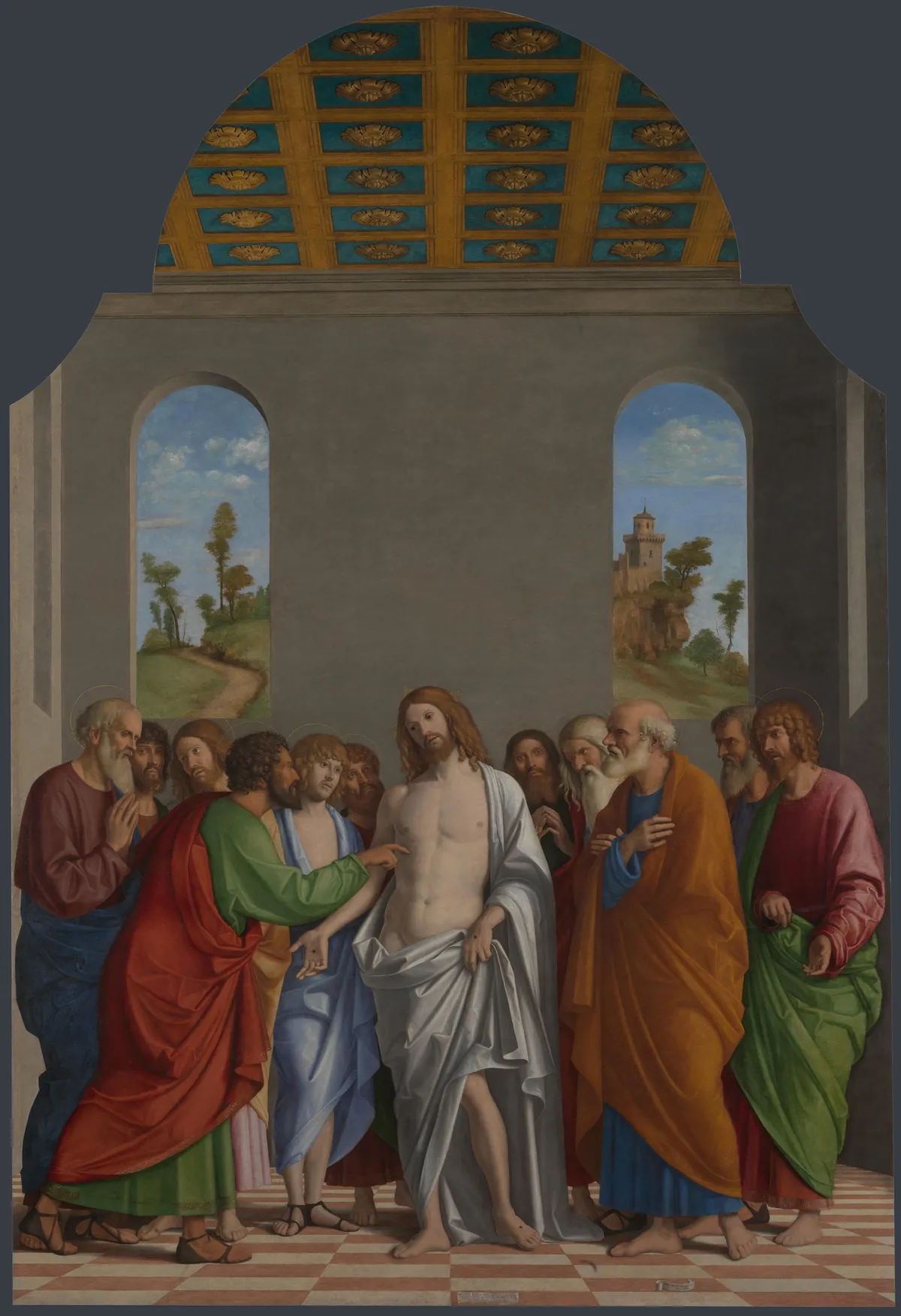
Cima was a master of clear light and quiet devotion, and his version turns the drama into a moment of grave, gentle order. The picture was painted for a Venetian confraternity and is now one of the treasures of the National Gallery in London.
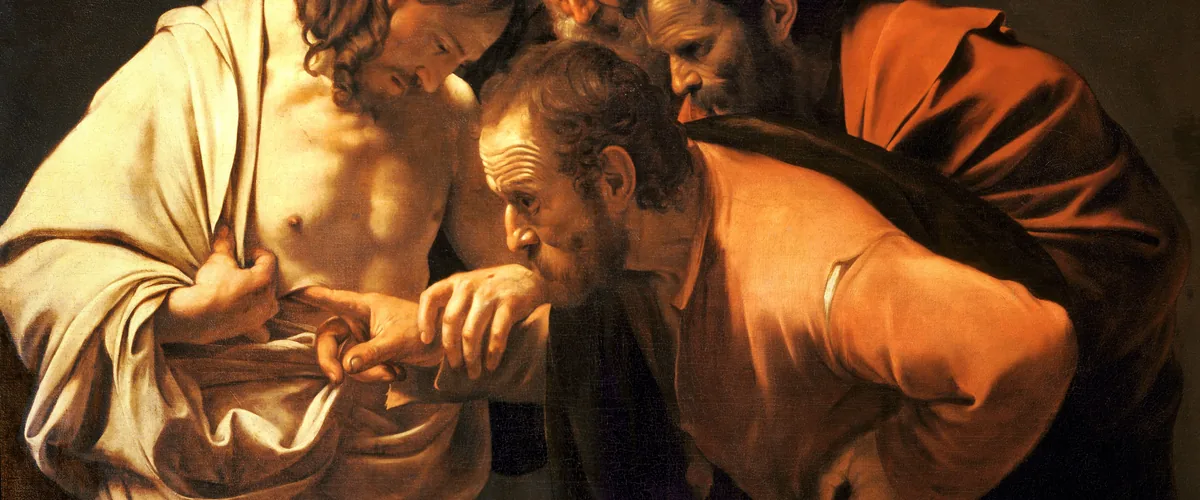
4. The Incredulity of Saint Thomas by Caravaggio (c. 1601 to 1602)
This is the version that changed everything. Caravaggio strips away the gold, the architecture, and the crowd, and pushes four figures right up against the surface in a plain dark space. Christ takes Thomas by the wrist and guides his finger physically into the wound, the skin puckering around it, while Thomas and two other apostles lean in with furrowed, sunburnt brows.
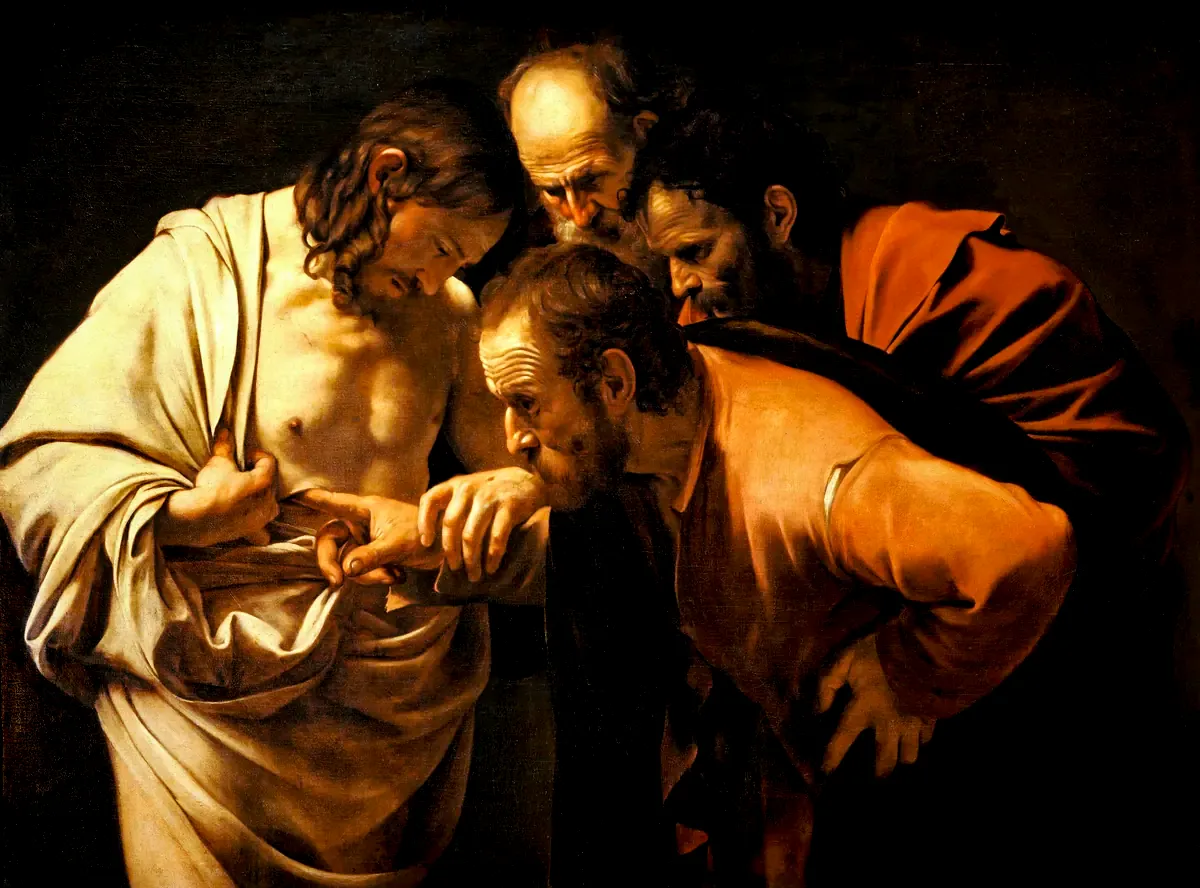
Nothing in earlier art is this blunt or this close. Caravaggio makes doubt a matter of dirty fingernails and torn clothes, faith proven by touch. The picture was copied and imitated across Europe and remains the most famous image of the subject, comparable to his Supper at Emmaus, another scene of the risen Christ recognised at close range. It hangs in the Sanssouci Picture Gallery in Potsdam.
5. The Incredulity of Thomas by Peter Paul Rubens (c. 1613 to 1615)
Peter Paul Rubens painted his version as the centre of a triptych, an epitaph for the Antwerp burgomaster Nicolaas Rockox and his wife. In the central panel the risen Christ shows the wound to Thomas and the crowding apostles, while on the two side wings the kneeling donors, painted from life, are shown at prayer, joining the sacred scene across the centuries.
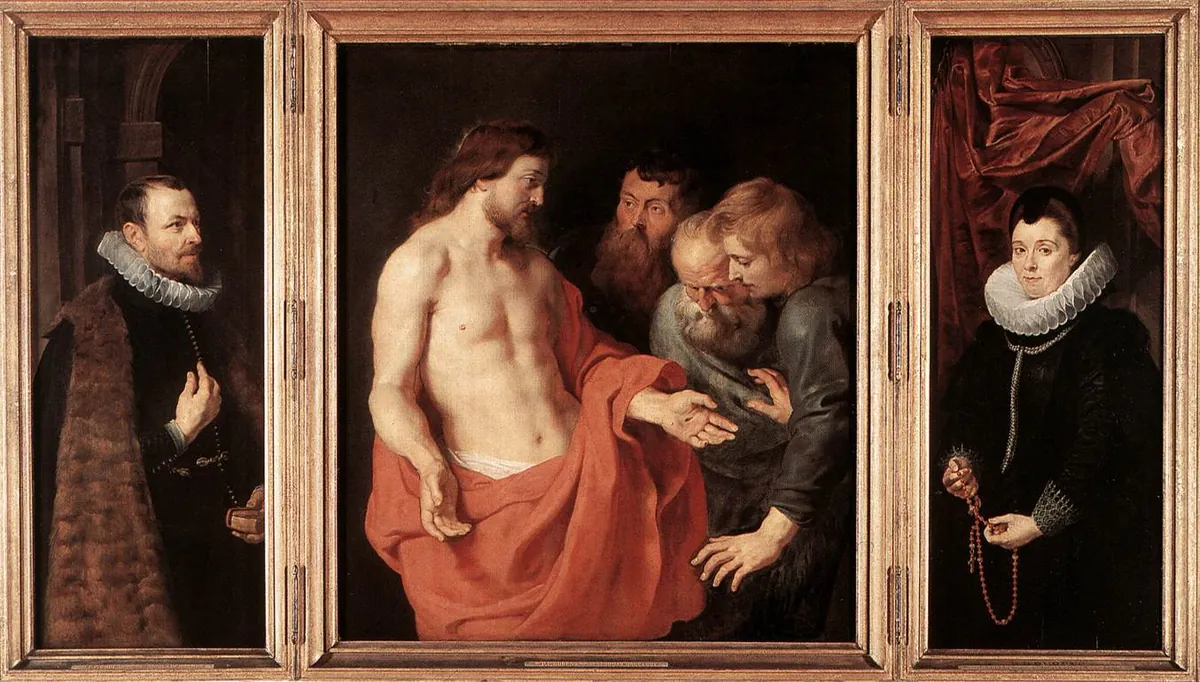
Rubens gives the figures his full Baroque energy and warmth, the flesh solid and alive. The work was designed for the couple’s tomb, a private plea for salvation dressed as a public masterpiece. The triptych is a highlight of the Koninklijk Museum voor Schone Kunsten in Antwerp.
6. The Incredulity of Saint Thomas by Bernardo Strozzi (c. 1620s)
The Genoese painter Bernardo Strozzi bathes the scene in warm, golden light. His Christ stands luminous and calm, drawing back the white cloth to reveal the wound, while the apostles crowd around in rich, glowing colour, their faces full of wonder. One leans in close, another looks out toward us, drawing the viewer into the circle.
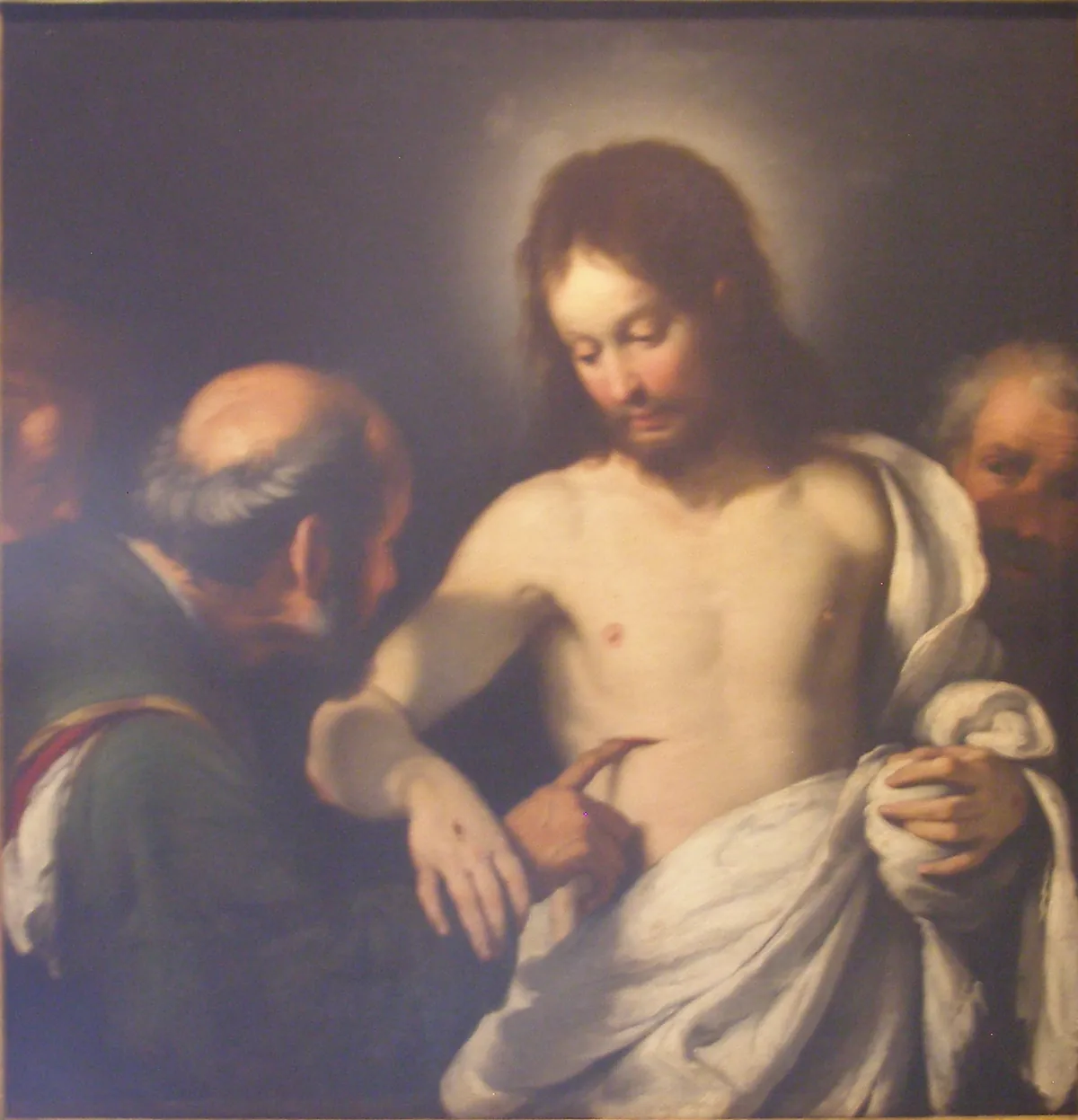
Strozzi combined the drama of Caravaggio with the soft colour of the Venetians, and here the effect is both tender and grand. The painting belongs to the Palazzo Rosso in Genoa, part of the city’s great collection of Baroque art.
7. The Incredulity of Saint Thomas by Hendrick ter Brugghen (c. 1622)
The Dutch painter Hendrick ter Brugghen had studied in Rome, and he brought Caravaggio’s raw realism home to Utrecht. His apostles are ordinary, weathered men, packed tightly together in a shallow space, their heads almost touching as they strain to see. Thomas leans in and probes the wound with one blunt finger while Christ calmly guides his hand.
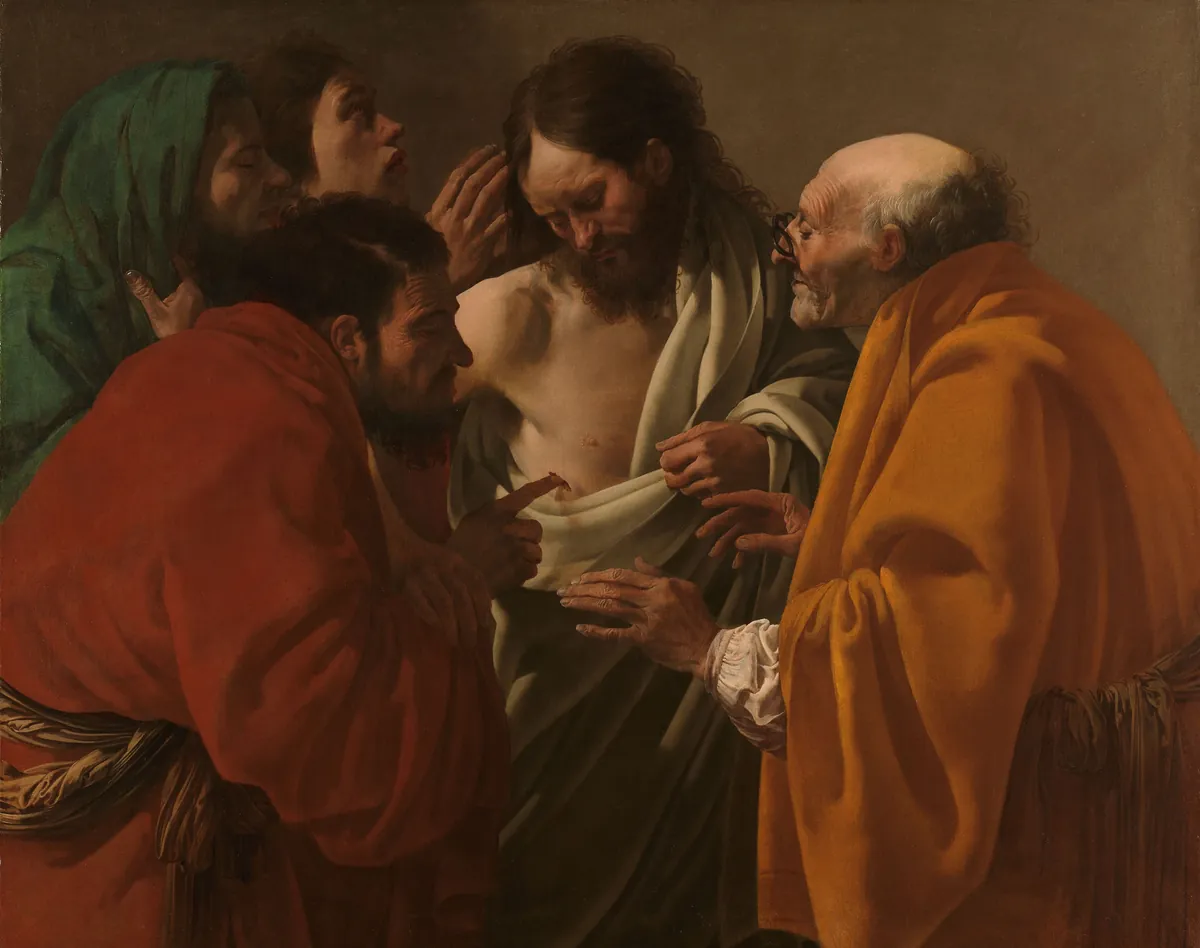
Ter Brugghen was one of the leading Utrecht Caravaggists, and his version is admired for its honesty and its close, human warmth. The faces are unidealised and completely convincing. The painting is in the Rijksmuseum in Amsterdam.
8. The Incredulity of Saint Thomas by Rembrandt (1634)
Rembrandt tells the story through light. In his small, intense panel a brilliant glow breaks from the risen Christ and throws the surrounding apostles into a jumble of shadow and astonishment. One man shields his eyes, another recoils, and Thomas draws back his hand as if suddenly afraid of what he has done.
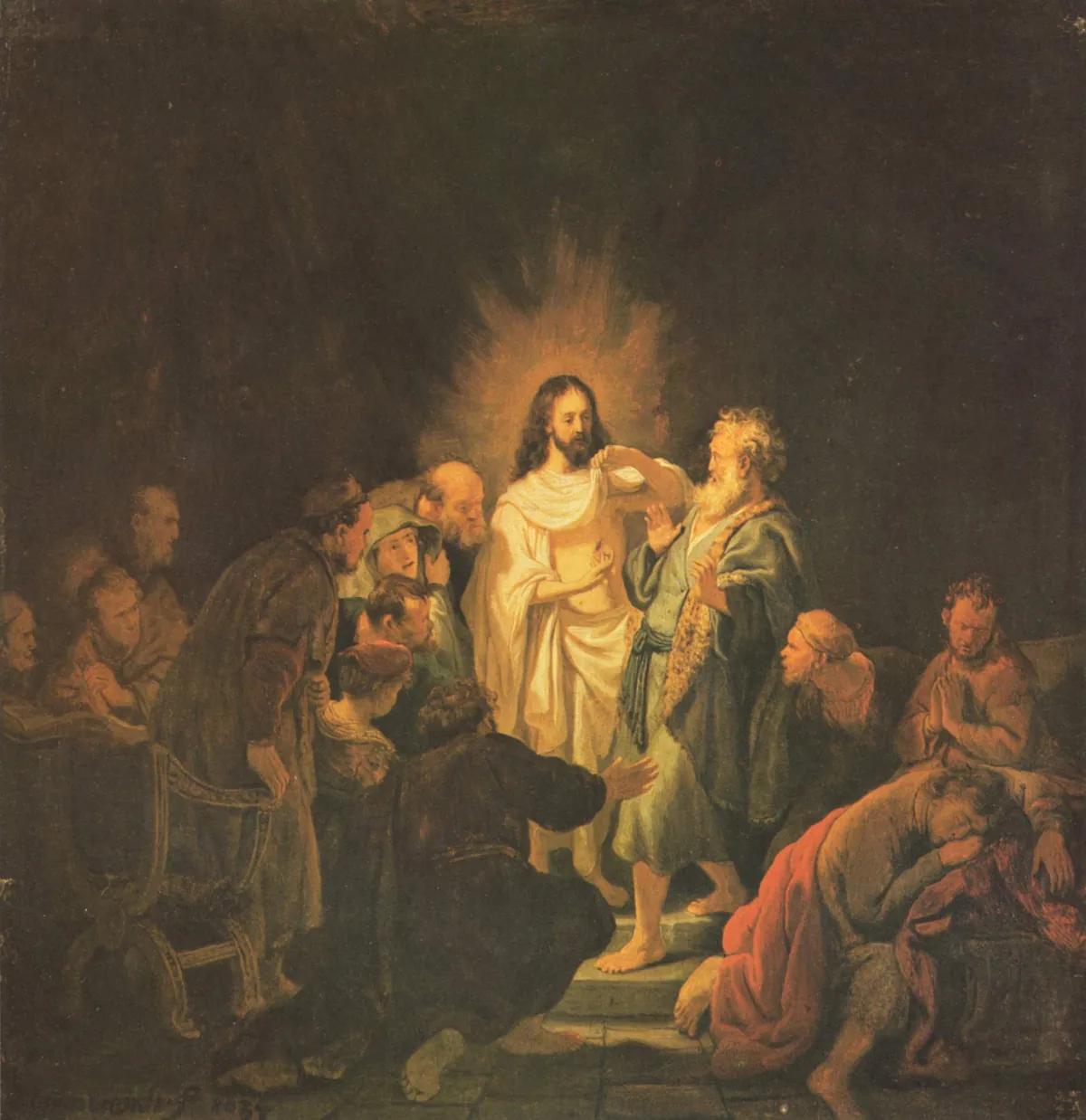
Rembrandt is less interested in the physical touch than in the shock of the supernatural, the moment when doubt collapses into awe. The darkness and the sudden light do the work that other painters gave to gesture. The painting belongs to the Pushkin Museum in Moscow.
9. The Incredulity of Saint Thomas by Matthias Stom (c. 1640s)
The Dutch painter Matthias Stom, who spent his career in Italy, turned the scene into a night piece lit by a single hidden flame. The warm light rakes across the figures from below, catching the pale body of Christ, the bald head of a leaning apostle, and the raised, gesturing hands, while everything else sinks into deep brown shadow.
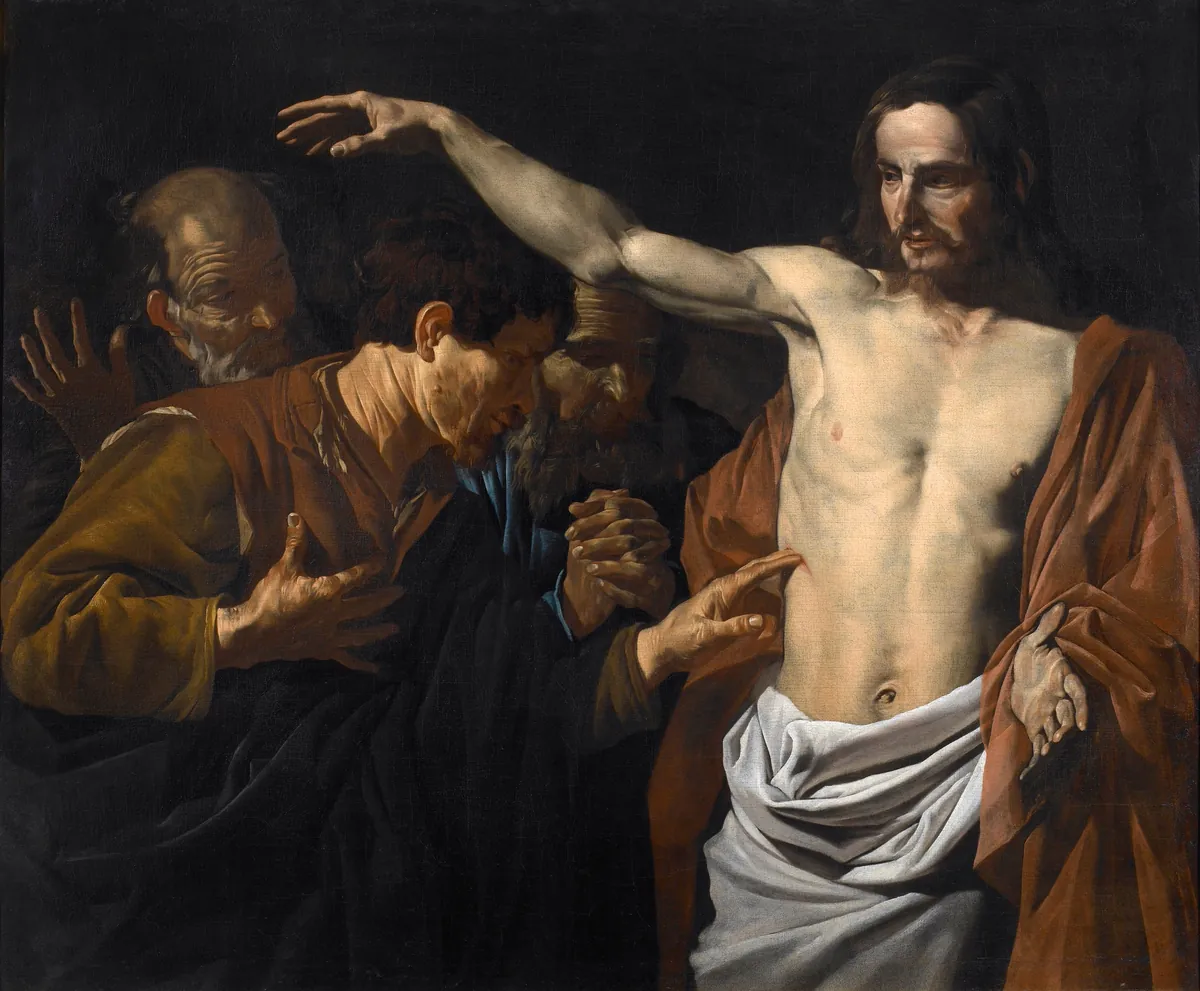
Stom loved these candlelit effects, learned from the followers of Caravaggio, and here they lend the miracle a hushed, secret intensity, as if witnessed by lamplight. The painting is in the Pinacoteca Tosio Martinengo in Brescia.
10. Doubting Thomas by Carl Bloch (1882)
The series ends with the most famous religious artist of nineteenth century Denmark, Carl Bloch, whose scenes from the life of Christ are still loved and reproduced around the world. In this etching the risen Christ stands upright and serene in a flowing robe, while Thomas kneels low before him and reaches up to touch the wound in his side, overcome.
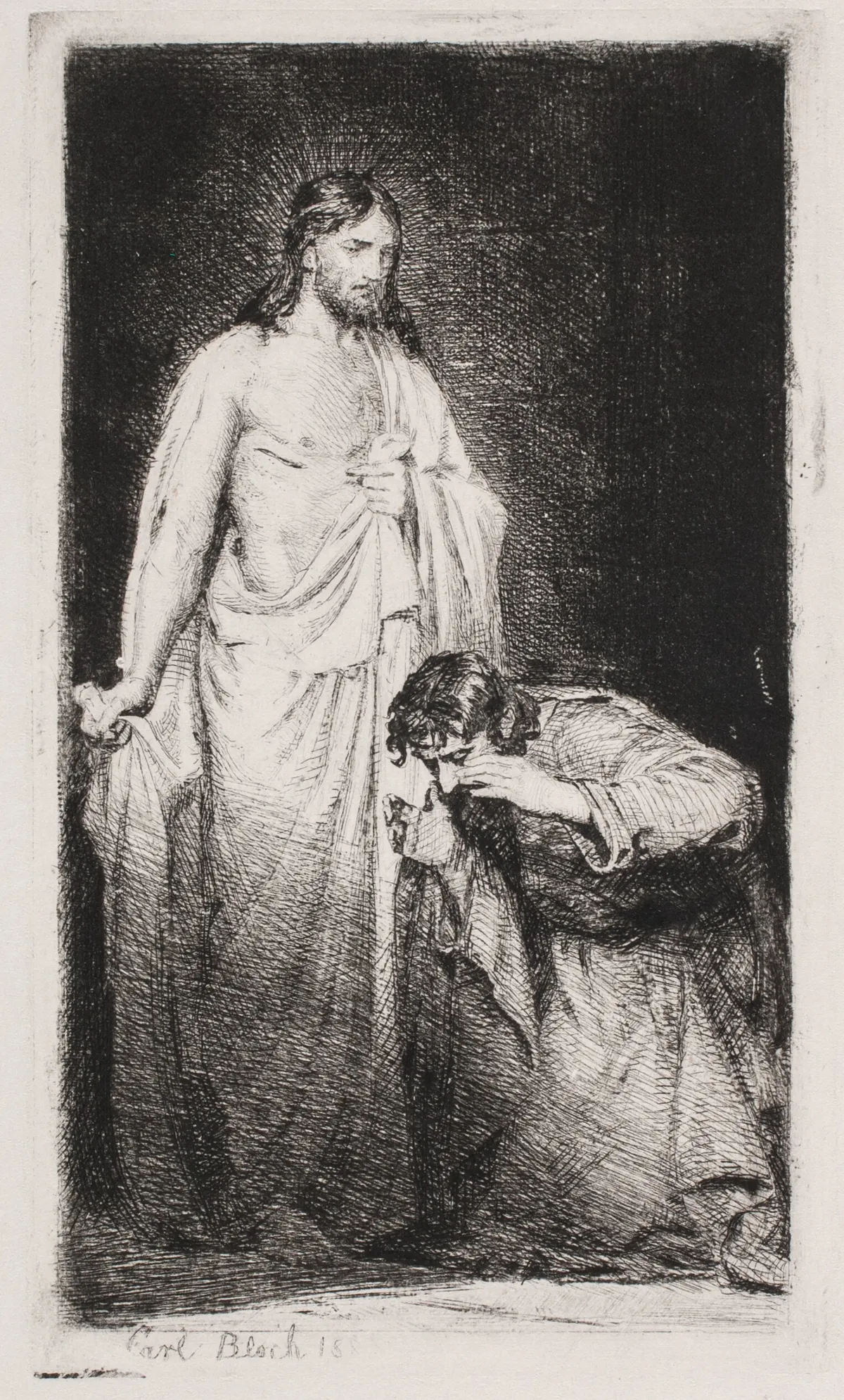
Bloch strips the scene to its two essential figures, the calm Saviour and the kneeling doubter, and lets the contrast between standing and kneeling carry the whole meaning. Worked in fine black and white lines, it is a quiet, heartfelt close to the story, faith found at last at the Saviour’s feet.
Summary of the Paintings
| Work | Artist | Date | Medium | Location |
|---|---|---|---|---|
| The Incredulity of Thomas (Maesta) | Duccio di Buoninsegna | 1308 to 1311 | Tempera on panel | Museo dell’Opera del Duomo, Siena |
| Christ and the Doubting Thomas | Luca Signorelli | c. 1477 to 1482 | Fresco | Basilica della Santa Casa, Loreto |
| The Incredulity of Saint Thomas | Cima da Conegliano | 1502 to 1504 | Oil on panel | National Gallery, London |
| The Incredulity of Saint Thomas | Caravaggio | c. 1601 to 1602 | Oil on canvas | Sanssouci, Potsdam |
| The Incredulity of Thomas (Rockox Epitaph) | Peter Paul Rubens | c. 1613 to 1615 | Oil on panel | KMSKA, Antwerp |
| The Incredulity of Saint Thomas | Bernardo Strozzi | c. 1620s | Oil on canvas | Palazzo Rosso, Genoa |
| The Incredulity of Saint Thomas | Hendrick ter Brugghen | c. 1622 | Oil on canvas | Rijksmuseum, Amsterdam |
| The Incredulity of Saint Thomas | Rembrandt | 1634 | Oil on panel | Pushkin Museum, Moscow |
| The Incredulity of Saint Thomas | Matthias Stom | c. 1640s | Oil on canvas | Pinacoteca Tosio Martinengo, Brescia |
| Doubting Thomas | Carl Bloch | 1882 | Etching | Statens Museum for Kunst, Copenhagen |
✦ Free Doubting Thomas Coloring Page
Caravaggio’s Incredulity of Saint Thomas is now a free coloring page, beside the real painting with a short story for children. It closes our twenty Easter coloring pages, from Palm Sunday to the days after Easter, gathered in a free printable booklet.
Conclusion
Across nearly six hundred years, the doubt of Thomas has drawn some of the greatest painters in Europe. Duccio set it in gold, Cima in serene Venetian light, Caravaggio in blunt and dirty realism, Rembrandt in a burst of glory out of the dark. Some pressed the finger right into the wound, others held back at the edge of touch, but all of them stopped at the same charged instant, the moment a man decided to believe. That is why the scene still speaks so directly. Thomas is the doubter in all of us, and his story ends not in rebuke but in mercy, with the risen Christ meeting him exactly where his faith failed. For more of the encounters that followed the empty tomb, see our articles on Noli Me Tangere paintings and the Supper at Emmaus in art, and for the wounds that Thomas touched, our gathering of famous Crucifixion paintings. It is also the Gospel of Divine Mercy Sunday, the Sunday after Easter, prepared by the nine days of our Divine Mercy Novena.
Important Facts About Doubting Thomas in Art
- The story is told only in the Gospel of John, chapter 20, verses 24 to 29, when the risen Christ invites Thomas to touch the wounds in his hands and side.
- Thomas responds with the words “My Lord and my God,” and Christ replies, “Blessed are those who have not seen and yet have believed.”
- The scene is often called by its Latin and Italian name, the Incredulity of Saint Thomas, the incredulity meaning disbelief.
- Caravaggio’s version of about 1601, now at Sanssouci in Potsdam, is the most famous, and it was widely copied by the artists known as the Caravaggisti.
- The phrase “a doubting Thomas” has passed into everyday language to describe anyone who refuses to believe something without direct proof.
Questions and Answers
Who painted the most famous Doubting Thomas painting?
The most famous version is The Incredulity of Saint Thomas by Caravaggio, painted around 1601 and now in the Sanssouci Picture Gallery in Potsdam. It is celebrated for showing Christ physically guiding Thomas’s finger into the wound, in stark light against a dark background. Many other great artists painted the subject too, including Duccio, Cima da Conegliano, Rubens, Rembrandt, and the Danish painter Carl Bloch.
What is the story of Doubting Thomas?
After the Resurrection, Christ appeared to his disciples, but the apostle Thomas was absent and refused to believe their account, saying he would not accept it unless he could touch the wounds himself. Eight days later Christ appeared again and invited Thomas to place his finger in the wounds. Thomas answered, “My Lord and my God,” and Christ told him, “Blessed are those who have not seen and yet have believed.” The story is found in the Gospel of John, chapter 20.
Where is Caravaggio’s Incredulity of Saint Thomas?
Caravaggio’s Incredulity of Saint Thomas hangs in the Sanssouci Picture Gallery in Potsdam, near Berlin, part of the Prussian royal collection. It was painted around 1601 to 1602, probably for the Roman nobleman Vincenzo Giustiniani. Other famous versions of the subject are spread across Europe, in Siena, London, Antwerp, Genoa, Amsterdam, Moscow, Brescia, and Copenhagen.
What does “Doubting Thomas” mean?
A “doubting Thomas” is a person who refuses to believe something until they have seen clear proof of it with their own eyes. The phrase comes directly from the apostle Thomas, who would not accept that Christ had risen until he could touch the wounds. Over time it has become a common expression for any determined skeptic, used far beyond its religious origin.
Why did artists love painting the Incredulity of Saint Thomas?
The scene gave painters an unusually physical and emotional subject: a wounded body, a reaching hand, and a circle of faces caught between fear and belief. It let them show flesh, light, and raw feeling at close range, which is why it became a favourite of Caravaggio and his followers. It also carried a deep meaning, the triumph of faith over doubt, that spoke to every believer.
Can you buy Doubting Thomas paintings as canvas prints?
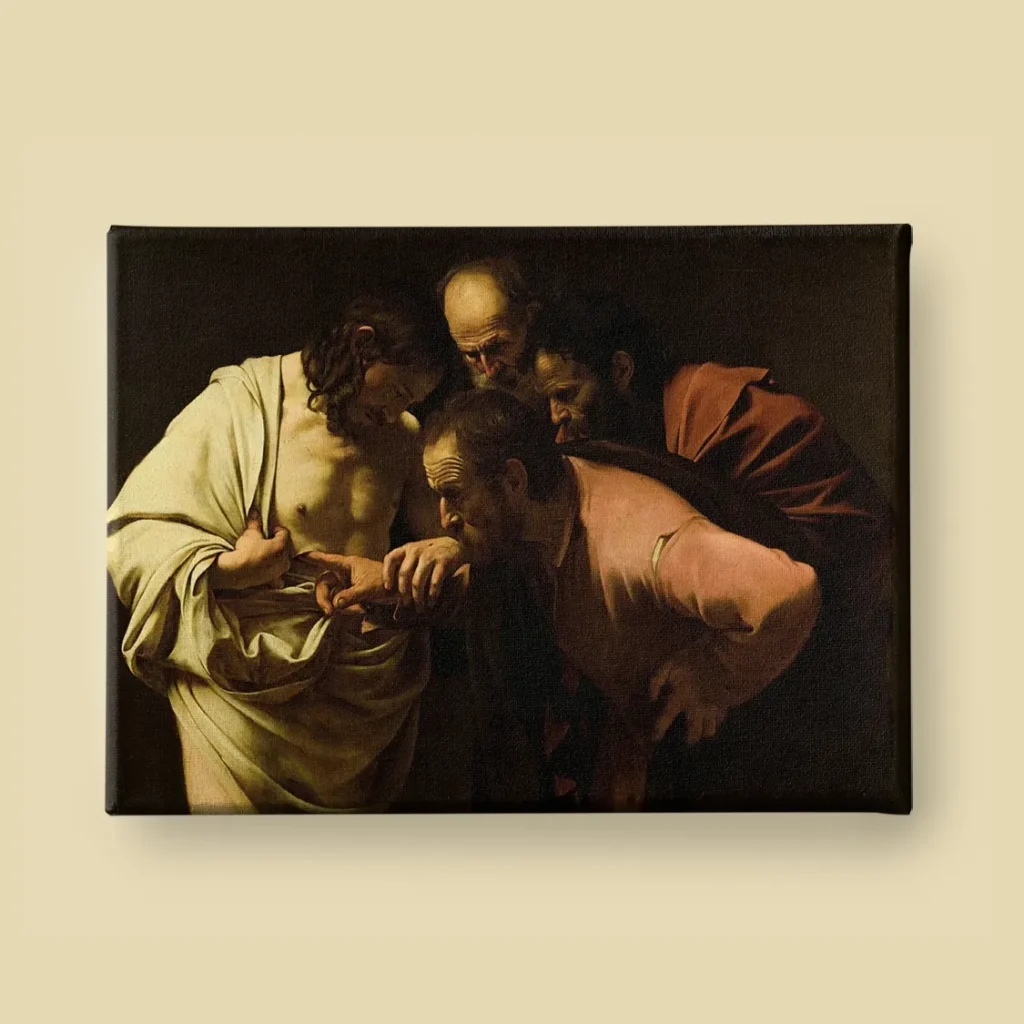
You can buy Doubting Thomas paintings at jesuschrist.pictures, in our shop, where these classic works are offered as high quality canvas prints, including a faithful reproduction of Caravaggio’s Incredulity of Saint Thomas. A masterpiece like Caravaggio’s brings extraordinary drama and depth to a wall, whether in a home, a study, or a church. Browse our collection of Christian art reproductions on canvas to find a piece that speaks to you.