Rubens’ Descent from the Cross: Grief in Motion
The Descent from the Cross is one of the greatest works of the Flemish Baroque, painted by Peter Paul Rubens between 1612 and 1614. It is the central panel of a large triptych and shows the dead Christ being lowered from the cross onto a white shroud. The painting still hangs where it was made, in the Cathedral of Our Lady in Antwerp. Its medium is oil on panel.
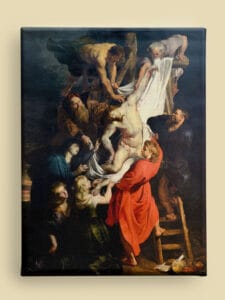
The whole picture is built on a single great diagonal. Christ’s pale, heavy body slides down the bright cloth from the upper right to the lower left, and every figure bends to take its weight. Against the dark background the white shroud and the luminous body draw the eye at once.
Rubens painted the scene not as wild drama but as a moment of careful, tender effort. Nine figures work together to bring the body down gently, and their restrained grief gives the painting its quiet power. Readers who want to see more of the artist can also read our article on Peter Paul Rubens’ paintings.
The History of The Descent from the Cross
The Descent from the Cross was commissioned by the guild of arquebusiers of Antwerp for their altar in the cathedral. Their patron was Saint Christopher, whose name means the Christ-bearer, and Rubens built the whole triptych around the idea of carrying Christ. The painted wings, the Visitation and the Presentation in the Temple, each show Christ being carried or held.

Rubens had recently returned from years in Italy, where he had studied Caravaggio, Michelangelo, and the great Venetians. In this painting their lessons come together, the strong light and shadow, the monumental bodies, and the rich color, all turned to a deeply felt religious scene. It made him the leading painter of northern Europe.
The Body on the Shroud
At the center hangs the body of Christ, just lifted from the cross. The skin is pale and bloodless, the head fallen, the arm hanging loose. Above, two men on ladders, Joseph of Arimathea and Nicodemus, ease the body down, one of them holding a corner of the shroud in his teeth so as not to let it slip.

The brilliant white of the shroud is the heart of the design. It catches the light, sets off the body against the darkness, and traces the long diagonal that holds the whole composition together. Rubens makes the cloth itself a part of the drama.
The Grief of the Living
Around the body the living press close. Saint John the Evangelist, in a flowing red robe, takes the weight of Christ on his shoulder. Below him the Virgin Mary, in blue, reaches up toward her son with a face full of restrained sorrow, while Mary Magdalene, her fair hair loose, gently supports one of his feet.

There is no shouting or wild gesture here. The grief is deep but contained, expressed through reaching hands and bowed heads. This quiet seriousness sets the Descent apart from the more violent energy of its companion piece, the Elevation of the Cross.
A Triptych on Bearing Christ
The central panel is only part of a larger whole. When the triptych is open, the side wings show the Visitation, in which the unborn Christ is carried by his mother, and the Presentation in the Temple, in which the infant Christ is held by the old man Simeon. The closed wings show Saint Christopher carrying the Christ child across a river.
Seen together, the panels turn on a single theme, the carrying of Christ, in the womb, in the arms, on the shoulders, and finally down from the cross. It is one of the most thoughtful programs Rubens ever designed.
The Calm Heart of the Baroque
The Descent from the Cross shows the Baroque at its most controlled. Rubens had all the drama of light, color, and movement at his command, yet here he used them with restraint, to serve the gravity of the moment rather than to overwhelm it.
That balance is why the painting has stayed so admired for four centuries. It is grand and tender at once, a public altarpiece that still feels like an intimate act of love and grief.
Conclusion
In The Descent from the Cross Rubens turned the lowering of a body into a single, unforgettable diagonal of effort and care. The white shroud, the pale Christ, and the reaching hands draw together into a scene of quiet, overwhelming sorrow.
Still in its place in Antwerp Cathedral, the painting remains one of the central works of the Baroque. It shows Rubens at the height of his powers, joining Italian grandeur to a northern depth of feeling.
Artwork Information
| Artwork | Artist | Date | Medium | Current Location |
|---|---|---|---|---|
| The Descent from the Cross | Peter Paul Rubens | 1612 to 1614 | Oil on panel | Cathedral of Our Lady, Antwerp |
Five Facts About The Descent from the Cross
- The Descent from the Cross is the central panel of a triptych by Peter Paul Rubens, painted from 1612 to 1614.
- It is a masterpiece of the Flemish Baroque and still hangs in its original place.
- It is in the Cathedral of Our Lady in Antwerp, Belgium.
- Christ’s pale body is lowered on a white shroud along a strong diagonal, held by nine figures.
- The triptych’s wings show the Visitation and the Presentation, all on the theme of carrying Christ.
FAQ
What does Rubens’ Descent from the Cross show?
It shows the dead Christ being lowered from the cross onto a white shroud, helped by nine figures including Saint John in red, the Virgin Mary in blue, and Mary Magdalene. It is a scene of careful, tender grief.
Where is the Descent from the Cross located?
It is in the Cathedral of Our Lady in Antwerp, Belgium, still on the altar for which it was painted.
When did Rubens paint the Descent from the Cross?
He painted it between 1612 and 1614, soon after returning from his years of study in Italy.
Is the Descent from the Cross a triptych?
Yes. It is the central panel of a triptych whose wings show the Visitation and the Presentation in the Temple, all turning on the theme of carrying Christ.
Who are the figures around Christ?
They include Joseph of Arimathea and Nicodemus on the ladders, Saint John the Evangelist in red, the Virgin Mary in blue, and Mary Magdalene, who supports Christ’s foot.
What is the medium of the Descent from the Cross?
It is oil on panel, a very large altarpiece more than four meters tall.
Why is the Descent from the Cross considered a masterpiece?
It joins Italian grandeur with northern feeling in a single, perfectly balanced design. The diagonal of the body, the brilliant shroud, and the restrained grief make it one of the defining works of the Baroque.
Can you buy a reproduction of Rubens’ Descent from the Cross?
You can buy a reproduction of Rubens’ Descent from the Cross at jesuschrist.pictures. The canvas reproduction is in our shop, printed on premium canvas and shipped worldwide.