The Emotional Strength of Spanish Renaissance Jesus Paintings
The Sacred Beauty of the Spanish Renaissance
The Spanish Renaissance brought a powerful spiritual depth to Christian art, marked by emotional intensity, dramatic realism, and a distinctly Catholic vision of salvation. Between the late 15th and early 17th centuries, Spanish painters embraced sacred subjects (especially the figure of Jesus) with a sense of devotion that was both deeply personal and profoundly theological.
Inspired by Italian Renaissance techniques yet rooted in Spanish mysticism and the religious climate of the Counter-Reformation, these artists redefined the way Christ was portrayed. Their works did not merely illustrate biblical narratives, they invited contemplation, evoked compassion, and drew the faithful closer to the divine.
Spanish Renaissance Jesus Paintings
Masterpieces of Faith
Throughout this period, painters such as El Greco, Velázquez, Zurbarán, Murillo, and Ribera produced some of the most enduring images of Christ in Western art. Their Jesus is both divine and profoundly human, often depicted in moments of silence, suffering, or glory. The compositions are bold, the lighting theatrical, and the emotional resonance unmistakable.
These works were created not just for altarpieces and cathedrals, but also for private devotion, each canvas a theological meditation in color and form. Whether portraying the Passion, the Resurrection, or the quiet presence of Jesus among saints or family, Spanish Renaissance artists captured the mystery of the Incarnation with unmatched intensity.
To better understand how these works relate to other European movements, see our related guides to the Italian Renaissance and Northern Renaissance.
A Distinctive Spiritual Legacy
The Spanish Renaissance left a lasting imprint on Christian iconography, particularly in its portrayals of Jesus Christ. While Italy emphasized balance and classical harmony, Spanish painters focused on emotional depth, realism, and the mystery of divine suffering. Their art became a profound response to the religious fervor of post-Reformation Spain, where visual storytelling was central to Catholic devotion and education.
These works often employed dramatic lighting (chiaroscuro), naturalistic anatomy, and psychologically charged compositions to bring viewers into intimate contact with the Passion, the Nativity, or Christ’s solitude. The goal was not just to depict, but to move, convert, and comfort.
Influenced by Italian techniques but shaped by local mysticism and intense religious culture, Spanish artists helped forge a style that was at once contemplative and emotionally immediate. Their depictions of Jesus continue to stand apart for their theological seriousness and spiritual gravity, an essential bridge between the Renaissance and the Baroque.
To explore similar transitions in other countries, see our article on Italian Renaissance Jesus paintings or the evolving styles of the Dutch Renaissance.
El Greco’s Mystical Christ
El Greco (Doménikos Theotokópoulos), a Cretan-born artist who found his spiritual and artistic home in Spain, occupies a unique space in the Spanish Renaissance. His work cannot be confined to a single school : it bridges Byzantine tradition, Venetian color, Mannerist form, and Spanish religious intensity.
In El Greco’s hands, Jesus becomes more than a biblical figure; He becomes a vision. Figures are elongated, often bathed in an ethereal light, their gestures heightened, their faces radiant with sorrow or transcendence. The focus is not on anatomy or proportion, but on spiritual essence, on inner drama over outer perfection.
His depictions of Christ are among the most emotionally charged and visually innovative of the Renaissance. Whether standing before His tormentors in The Disrobing of Christ or isolated in the solitude of The Agony in the Garden, El Greco’s Jesus speaks directly to the soul.

This blend of expressive form, luminous palette, and mystical atmosphere profoundly influenced the trajectory of Spanish religious painting. For a look at the contrasting iconography of earlier traditions, see Byzantine Jesus paintings and Gothic Jesus paintings.
Diego Velázquez’s Humanized Christ
Diego Velázquez, one of Spain’s most revered painters, brought a striking sense of realism and subtlety to religious art during the late Spanish Renaissance. Though best known for his court portraits, Velázquez’s sacred works reflect his deep engagement with the emotional and theological dimensions of Christ’s life.
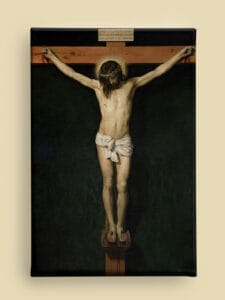
Velázquez departed from overly idealized depictions of Jesus, instead portraying Him with profound psychological depth. His use of chiaroscuro added visual gravity to scenes such as the Crucifixion or Christ in the House of Martha and Mary, where divine presence meets the quiet weight of human existence. Through muted color palettes and restrained compositions, Velázquez expressed both suffering and serenity, drawing viewers into silent reflection rather than spectacle.
His ability to convey spiritual truths through realism placed him at the forefront of religious painting in Spain. His works became templates for later generations seeking to balance devotion with naturalism.

Murillo’s Gentle Vision of the Divine
Bartolomé Esteban Murillo brought warmth and tenderness to Spanish sacred art, especially in his portrayals of Jesus. His works reflect the growing devotion to the humanity of Christ in the 17th century, and his style (soft, luminous, and compassionate) made his paintings beloved in churches and private chapels alike.
Murillo excelled in capturing the emotional bond between Jesus and His followers. In works like The Holy Family with a Little Bird or Christ on the Cross, he emphasized love, mercy, and spiritual intimacy. His delicate brushwork and glowing color harmonies created a serene, accessible vision of the divine, inviting viewers to approach Jesus with childlike trust.
What sets Murillo apart is his ability to portray Jesus not only as the Redeemer but as a gentle, approachable companion. His style, influenced by both Italian grace and Spanish realism, became emblematic of devotional art in post-Tridentine Spain.


Francisco de Zurbarán: Silence, Light, and Devotion
Francisco de Zurbarán is often described as the visual poet of Spanish mysticism. His paintings of Jesus are deeply contemplative, combining unflinching realism with a monastic stillness that mirrors the quiet intensity of Spanish devotional life in the Counter-Reformation period.
Zurbarán’s mastery of chiaroscuro lends his compositions a meditative gravity. Figures often emerge from dark, minimalist backgrounds, allowing the viewer to focus fully on Christ’s suffering, solitude, or redemptive presence. In works like Christ on the Cross and The Agony in the Garden, Jesus is rendered with almost sculptural clarity, his body fragile yet luminous, his face a study in both physical pain and divine endurance.
This stripped-down realism echoes earlier sacred traditions but adds an emotional depth aligned with Baroque sensibilities. It reflects a shift in Spanish spirituality, where visual simplicity was used to guide the soul toward contemplation. Zurbarán’s work sits at the intersection of artistic refinement and spiritual austerity.

For a look at how similar themes were expressed with more narrative and decorative complexity, explore the emotion-driven realism of Gothic Jesus art.
Luis de Morales: Sacred Intimacy in the Spanish Renaissance
Luis de Morales, known as El Divino, stands as a central figure in the devotional art of the Spanish Renaissance. Active during the mid-16th century, Morales developed a unique visual language marked by tenderness, introspection, and spiritual refinement. His paintings often focus on the emotional connection between Christ and the faithful, crafted for personal devotion rather than grand altarpieces.
One of his most emblematic works, Christ Embracing the Cross (c. 1566), held in the Museo del Prado, portrays Jesus holding the cross with solemn serenity. There is no surrounding crowd, no background narrative : only Christ, the symbol of His sacrifice, and the quiet space that invites personal contemplation.
Morales emphasized Christ’s suffering not with violence but with mournful stillness. His soft modeling, cool palette, and subtle expressions draw the viewer into an intimate meditation on redemption and divine love. The painting’s Renaissance clarity is paired with profound spirituality, bridging human vulnerability and sacred purpose.
Through works like this, Morales crafted a powerful visual theology of compassion. His contributions remain essential to understanding how Spanish Renaissance artists sought to visualize Christ not only as Redeemer but as the very embodiment of mercy.

His legacy bridges the transition from Renaissance spirituality to Baroque emotion, paralleling developments found in Baroque Jesus paintings and offering a stark contrast to the serenity of Neoclassical interpretations.
Conclusion: The Sacred Legacy of Spanish Renaissance Jesus Paintings
Spanish Renaissance Jesus paintings remain some of the most profound expressions of Christian art in the Western canon. These works are more than visual achievements; they are spiritual meditations rendered in color and form. Through the emotional realism of Murillo, the mystical vision of El Greco, the quiet devotion of Zurbarán, the human depth of Velázquez, and the dramatic power of Ribera, a rich theological tapestry emerges, one that continues to speak to viewers across time.
What unites these artists is not a shared style, but a shared mission: to portray Jesus Christ not only as an object of worship, but as a living presence who suffers, teaches, heals, and redeems. Their paintings invite contemplation, not just admiration. Whether displayed in grand cathedrals or carefully preserved in museums, these masterpieces bear witness to the enduring power of faith translated through art.
Spanish Renaissance Jesus Paintings Featured in This Article
| Painting | Artist | Date | Size | Location |
|---|---|---|---|---|
| The Disrobing of Christ (El Expolio) | El Greco | 1577 | 285 × 173 cm | Toledo Cathedral, Spain |
| Christ on the Cross | Francisco de Zurbarán | 1627 | 291 × 165 cm | Art Institute of Chicago |
| Christ Crucified | Diego Velázquez | 1632 | 248 × 169 cm | Museo del Prado, Madrid |
| The Immaculate Conception | Bartolomé Esteban Murillo | 1678 | 274 × 190 cm | Museo del Prado, Madrid |
| Christ Embracing the Cross | Luis de Morales | c. 1566 | 105 × 83 cm | Museo del Prado, Madrid |
Frequently Asked Questions
What distinguishes Spanish Renaissance Jesus paintings from those of other regions?
Spanish Renaissance Jesus paintings are noted for their emotional depth, dramatic lighting, and intense spirituality. Unlike the idealized beauty of Italian works, Spanish art often emphasizes Christ’s suffering and humanity, reflecting the devotional culture of the Spanish Counter-Reformation.
Who are the most important artists of the Spanish Renaissance?
Key figures include El Greco, Diego Velázquez, Bartolomé Esteban Murillo, Francisco de Zurbarán, and Jusepe de Ribera. Each brought a distinct vision to the life of Christ, shaped by regional influences and personal spirituality.
What themes are most common in Spanish Renaissance Jesus paintings?
Recurring themes include the Passion of Christ, the Crucifixion, the Last Supper, and intimate moments of prayer or family life. These works often focus on sacrifice, redemption, and the emotional connection between Jesus and the viewer.
How did the Spanish Inquisition affect religious art?
The Inquisition emphasized orthodoxy and religious piety, encouraging artists to create images that would inspire devotion and emotional response. This led to a preference for realistic, spiritually intense portrayals of Jesus.
Where can I see Spanish Renaissance Jesus paintings today?
Many major works are housed in the Museo del Prado in Madrid, the Cathedral of Toledo, the Art Institute of Chicago, and major European institutions such as the National Gallery in London and the Louvre in Paris.
What techniques define Spanish Renaissance painting?
Artists employed chiaroscuro (dramatic light and shadow), tenebrism (extreme contrasts), and naturalistic textures. These techniques heightened emotional effect and spiritual resonance.
Where can I buy Spanish Renaissance Jesus paintings prints?
You can buy Spanish Renaissance Jesus paintings prints at jesuschrist.pictures: see the canvas reproduction in our shop, printed on museum-grade canvas and available in several sizes.