The Seven Last Words of Jesus, and the Painting That Shows What He Saw
Jesus spoke seven times from the cross. No single Gospel records all seven: Matthew and Mark keep one cry, Luke three sayings, John three more. Gathered together in the order of the Passion, they have been known for centuries as the seven last words of Jesus, and Christians have prayed them every Good Friday for generations, in sermons, in the three-hour devotion of the Tre Ore, and in the music Joseph Haydn wrote for a Good Friday service in Cádiz in 1787.
Painters heard them too. Each word has its own moment and its own witnesses, and the great Crucifixions often show exactly one of them: the good thief turning his head, John taking Mary in his arms, a soldier raising a sponge, a head that falls. Here are the seven last words of Jesus in order, with their Bible verses, what they mean, and the painting that shows each one best, starting with a picture painted from the cross itself.

Andrea Mantegna set the scene in his small Crucifixion for the altarpiece of San Zeno in Verona, now in the Louvre: the rocky hill of Golgotha, the two thieves, the soldiers casting lots for the tunic, the Virgin fainting among the holy women. Everything the Gospels say about those three hours is there. What he could not paint is what was said.
The First Word: “Father, Forgive Them, for They Know Not What They Do”
The first word comes in Luke 23:34, as the soldiers nail him to the cross, before the insults have even begun: “Father, forgive them; for they know not what they do.” Jesus does not forgive the soldiers alone. He prays for everyone around the cross, the priests who condemned him, the crowd that chose Barabbas, the passers-by who wag their heads. It is the first thing he says, and it sets the tone of everything that follows.
Around 1890, the French painter James Tissot had an idea that few, if any, had tried in fifteen centuries of Crucifixions. Instead of painting Jesus on the cross, he painted what Jesus could see from it.
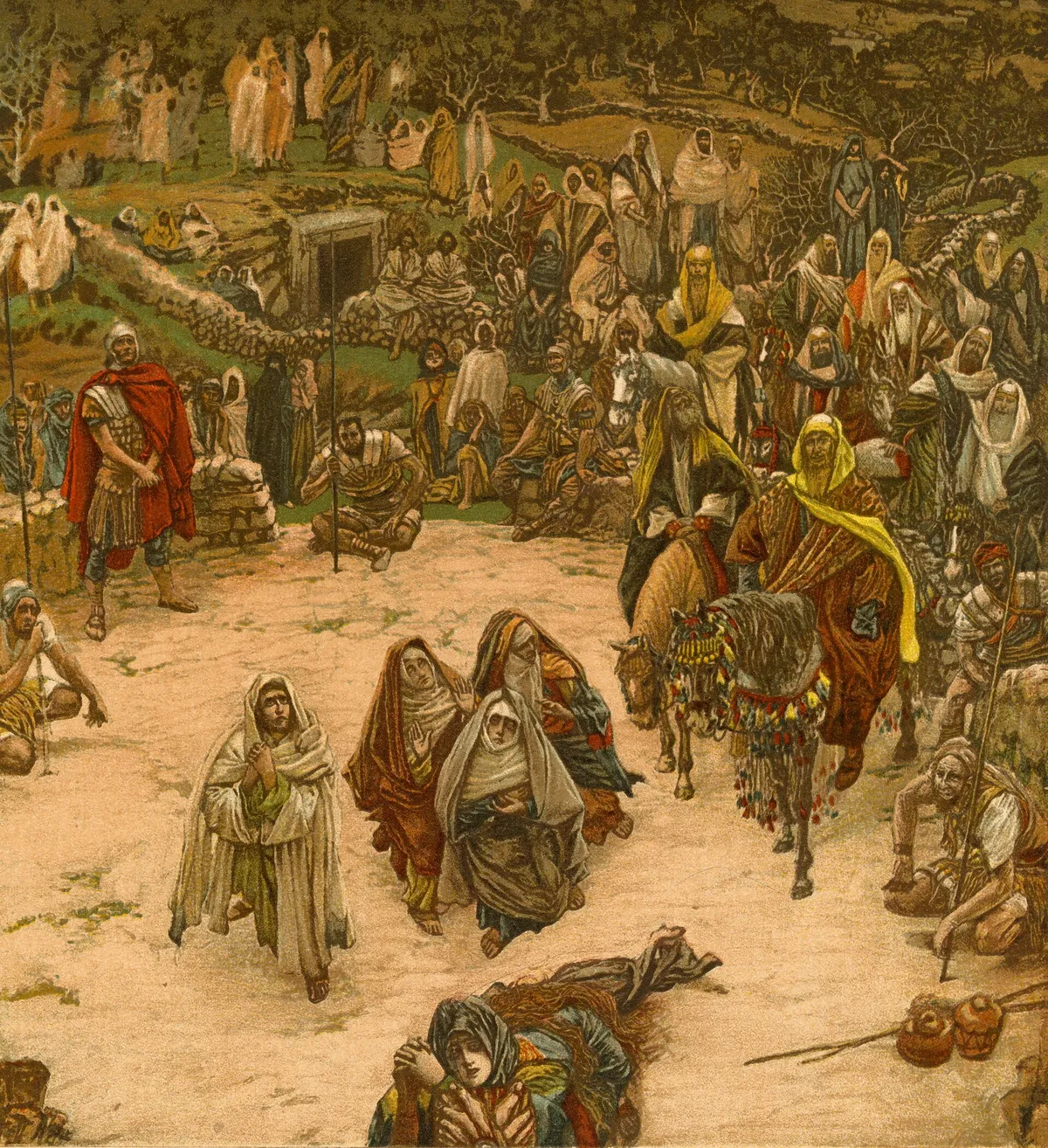
What Our Saviour Saw from the Cross is one of the 350 gouaches of Tissot’s Life of Christ, painted after his journeys to the Holy Land and now in the Brooklyn Museum. We look down from the height of the cross. Mary Magdalene kneels at its foot, her hair loose over her shoulders; behind her stand John, the Virgin and the other women. A Roman centurion waits on the left, the priests watch from their horses on the right, and beyond them a whole crowd sits on the hillside as if at a spectacle. In the slope at the back is the dark doorway of a tomb cut in the rock.
The picture turns the first word into a question for the viewer. These are the people he forgave, and we are standing among them. Few images of the Passion are as unsettling, or as close to the spirit of the prayer.
The Second Word: “Today You Will Be with Me in Paradise”
Two criminals were crucified with Jesus. Matthew and Mark say both of them mocked him, but Luke tells what happened next. One kept jeering: “If thou be Christ, save thyself and us.” The other rebuked him: “We receive the due reward of our deeds: but this man hath done nothing amiss.” Then he turned to Jesus: “Lord, remember me when thou comest into thy kingdom.” And Jesus answered, in the second word (Luke 23:43): “Verily I say unto thee, To day shalt thou be with me in paradise.”
Tradition gave the good thief a name, Dismas, and the Church honours him as a saint. He is the only person in the Gospels to whom Jesus promises paradise in so many words, and he received the promise for one sentence, at the very end.
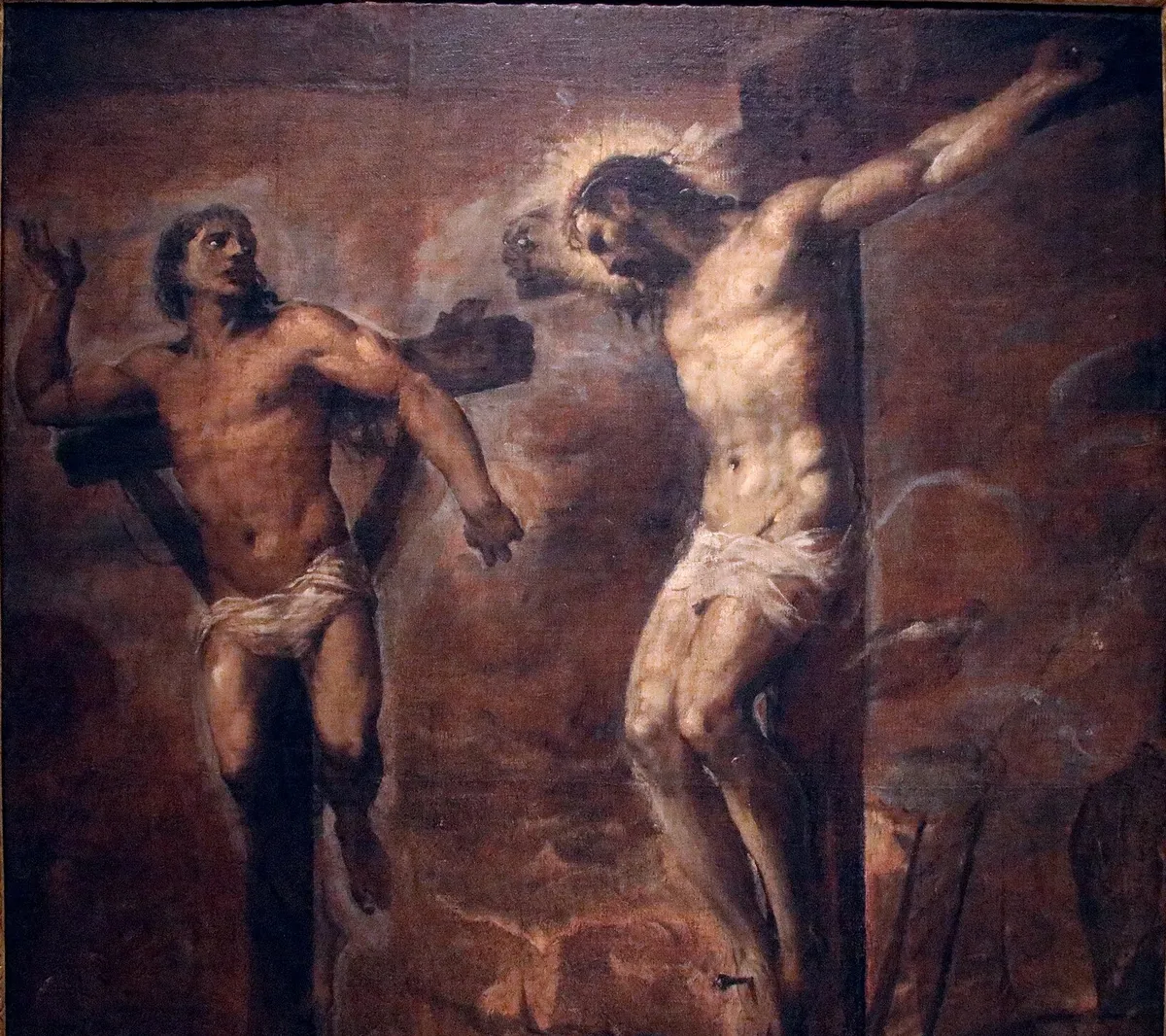
Most painters show the three crosses side by side, the thieves twisted in pain. Titian, in a late canvas painted with his workshop around 1563 and now in the Pinacoteca Nazionale of Bologna, leaves out the bad thief altogether and brings the two crosses close together. The good thief, young and strong, turns his whole body toward Christ and raises his hand; Christ bows his head toward him. It is a conversation, the only one in the Crucifixion, painted in the loose, smoky brushwork of Titian’s old age.
The Third Word: “Woman, Behold Your Son”
John alone records the third word (John 19:26-27). Standing by the cross are the mother of Jesus, her sister, Mary the wife of Cleophas, and Mary Magdalene. “When Jesus therefore saw his mother, and the disciple standing by, whom he loved, he saith unto his mother, Woman, behold thy son! Then saith he to the disciple, Behold thy mother! And from that hour that disciple took her unto his own home.”
It is a son providing for his widowed mother, the last practical thing he does. The Church has always read more in it: John stands for every disciple, and from the cross Jesus gives his mother to all of them. Catholic devotion to Mary as mother of the Church takes its root here.

No painter made this word more visible than Matthias Grünewald in the Isenheim Altarpiece, painted between 1512 and 1516 for the hospital of the Antonite monks and now in the Unterlinden Museum in Colmar. On the left, the Virgin, in a white mantle like a shroud, falls backward, and John, in red, catches her in his arms. He has already taken her. Mary Magdalene kneels at the foot of the cross wringing her hands, while John the Baptist, who was dead by then, stands on the right and points at Christ with an enormous finger, a little lamb at his feet.
The Fourth Word: “My God, My God, Why Have You Forsaken Me?”
At noon, darkness fell over the whole land until three in the afternoon. “And about the ninth hour Jesus cried with a loud voice, saying, Eli, Eli, lama sabachthani? that is to say, My God, my God, why hast thou forsaken me?” (Matthew 27:46; Mark 15:34). It is the only word that Matthew and Mark record, and the only one they keep in Jesus’ own Aramaic. Some of the bystanders misheard it and thought he was calling on Elijah.
This is the hardest of the seven words, and the most discussed. It is the opening line of Psalm 22, a psalm that begins in abandonment and ends in praise: “All the ends of the world shall remember and turn unto the Lord.” By naming its first verse, Jesus prays the whole psalm. But the cry is not play-acting. The Son of God takes on the full experience of being forsaken, the silence of God that so many feel in suffering, and he takes even that to the Father in a prayer.
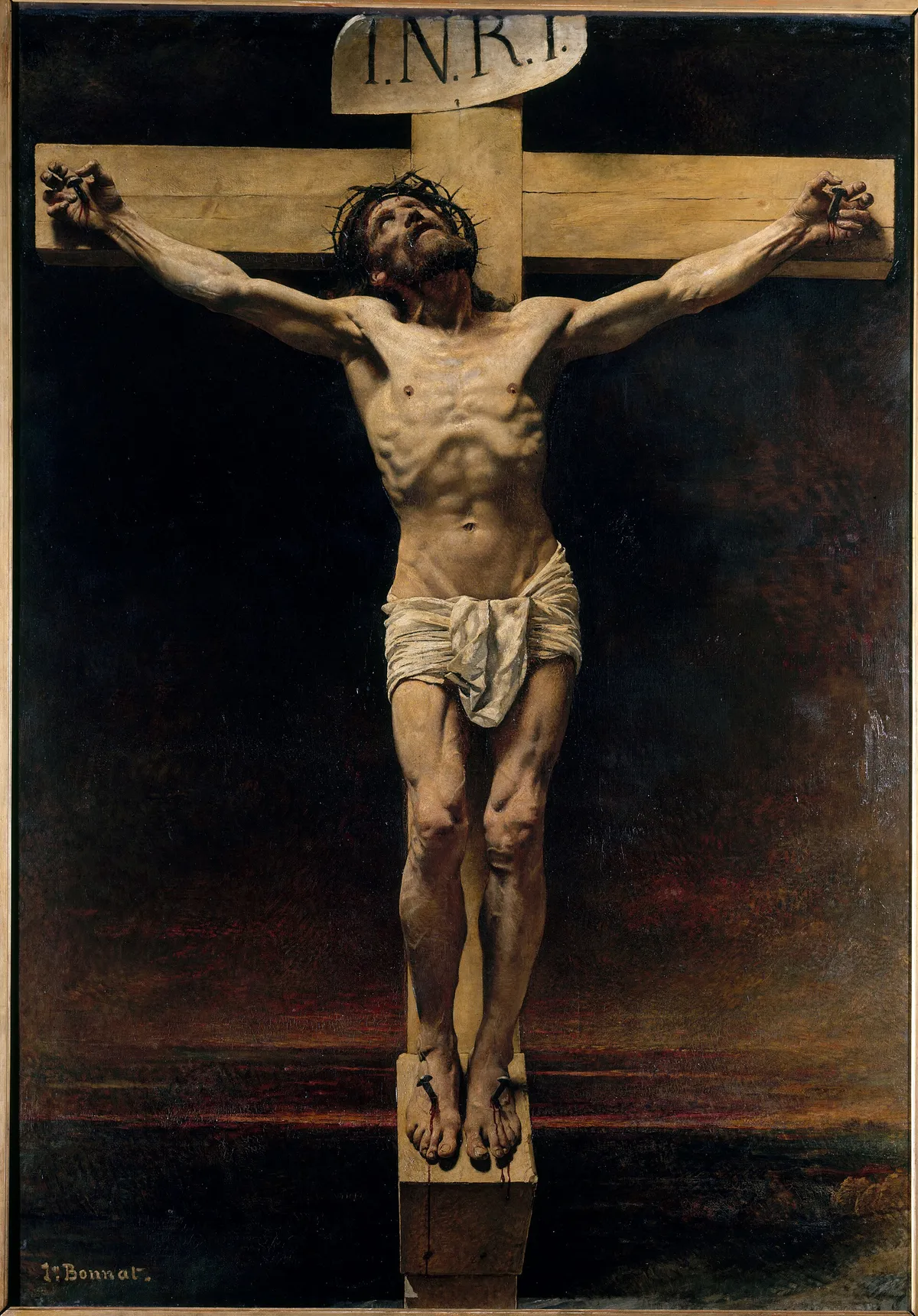
Léon Bonnat painted the cry. His Christ on the Cross, painted in 1874 for the assize court of the Palais de Justice in Paris, is now in the Petit Palais. There are no mourners, no landscape, no thieves: only a life-size body, which Bonnat is said to have studied from a corpse fixed to a cross in his studio, against a black sky. The head is thrown back, the mouth open. It is a portrait of the ninth hour, and it is hard to look at for long.
The Fifth Word: “I Thirst”
“After this, Jesus knowing that all things were now accomplished, that the scripture might be fulfilled, saith, I thirst” (John 19:28). A vessel of vinegar, the sour wine soldiers drank, stood nearby. “They filled a spunge with vinegar, and put it upon hyssop, and put it to his mouth.”
It is the only word in which Jesus speaks of his own body. After hours of blood loss, thirst is one of the worst torments of crucifixion, and the word shows how fully he was human. John also notes that it fulfils Scripture: “in my thirst they gave me vinegar to drink” (Psalm 69:21). And there is a third meaning, the one Saint Teresa of Calcutta had written beside the crucifix in every chapel of her sisters: the thirst of God for souls, the same thirst as when he asked the Samaritan woman at the well for a drink.
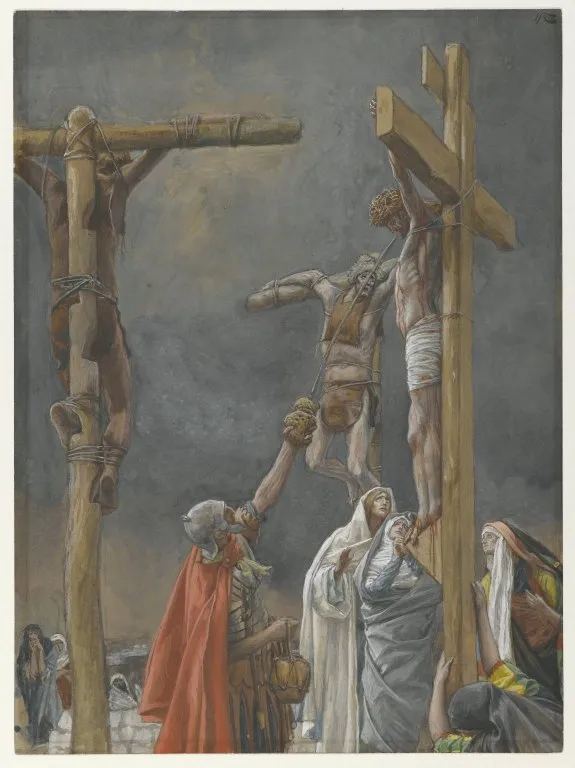
Tissot returns here, this time from the ground. In “I Thirst”: The Vinegar Given to Jesus, also in Brooklyn, a soldier reaches up with the sponge on its reed, and the holy women, below, can only watch. The hyssop John mentions is the plant used to sprinkle the blood of the Passover lamb on the doorposts in Egypt, a detail no early reader of John’s Gospel would have missed.
The Sixth Word: “It Is Finished”
“When Jesus therefore had received the vinegar, he said, It is finished: and he bowed his head, and gave up the ghost” (John 19:30). The Greek is a single word, tetelestai, in Latin Consummatum est. It is not a sigh of exhaustion. The same verb is found in business papyri of the time for a debt settled in full, and it is the word of someone who has completed a task: the mission the Father gave him, the Scriptures he came to fulfil, the sacrifice of the new Passover.
John adds a detail no other Evangelist gives: Jesus bowed his head before he died, as if he chose the moment.

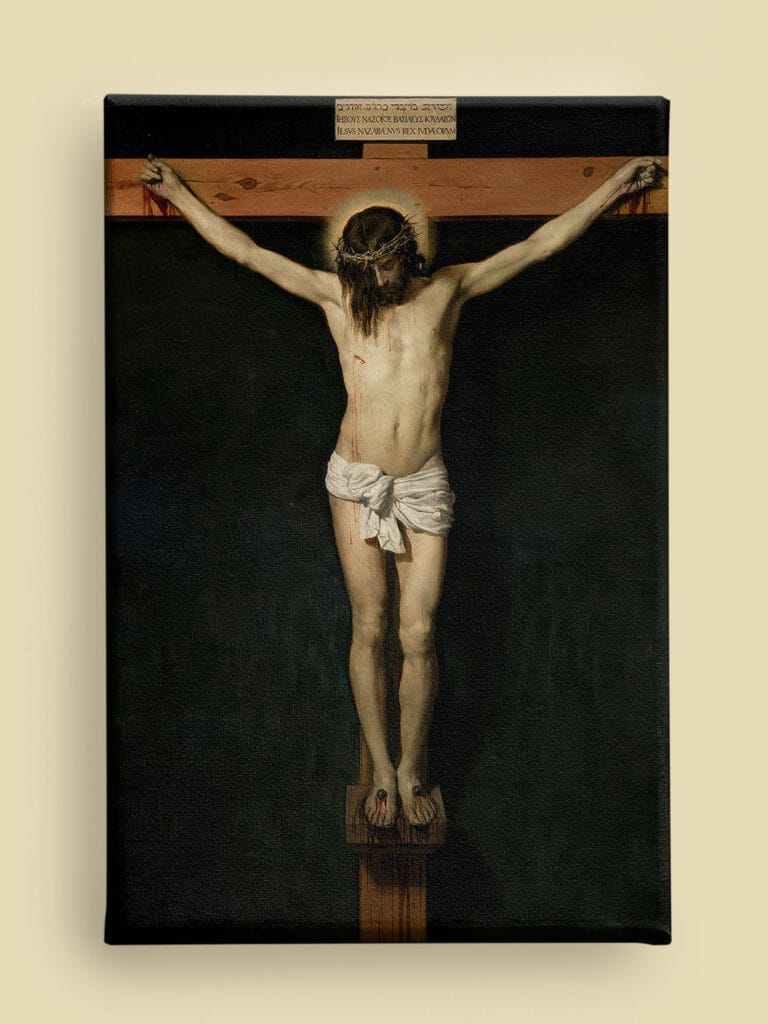
That bowed head is the whole subject of Diego Velázquez‘s Christ Crucified, painted around 1632 for the convent of San Plácido in Madrid and now in the Prado. Christ is alone, on a plain cross against a dark background, his feet nailed side by side on a small support. The head has fallen to one side, and a curtain of hair hides half the face. Velázquez paints the instant after the sixth word: everything is accomplished, and the silence that follows is the painting. The Spanish poet Miguel de Unamuno wrote a book-length poem about it.
The Seventh Word: “Father, into Your Hands I Commend My Spirit”
Luke gives the last word, spoken with a loud voice at the very end (Luke 23:46): “Father, into thy hands I commend my spirit: and having said thus, he gave up the ghost.” It is a verse of Psalm 31, a prayer of trust that pious Jews said at nightfall, and Jesus adds one word to it: “Father.”
The first word and the last are both addressed to the Father, and they frame the whole Passion. Between the cry of abandonment and this act of trust, nothing has changed on the outside. The darkness is still there, the pain, the jeering crowd. What has changed is that the Son puts himself, freely, into the hands he cried out to. The Church still prays this verse every night at Compline.
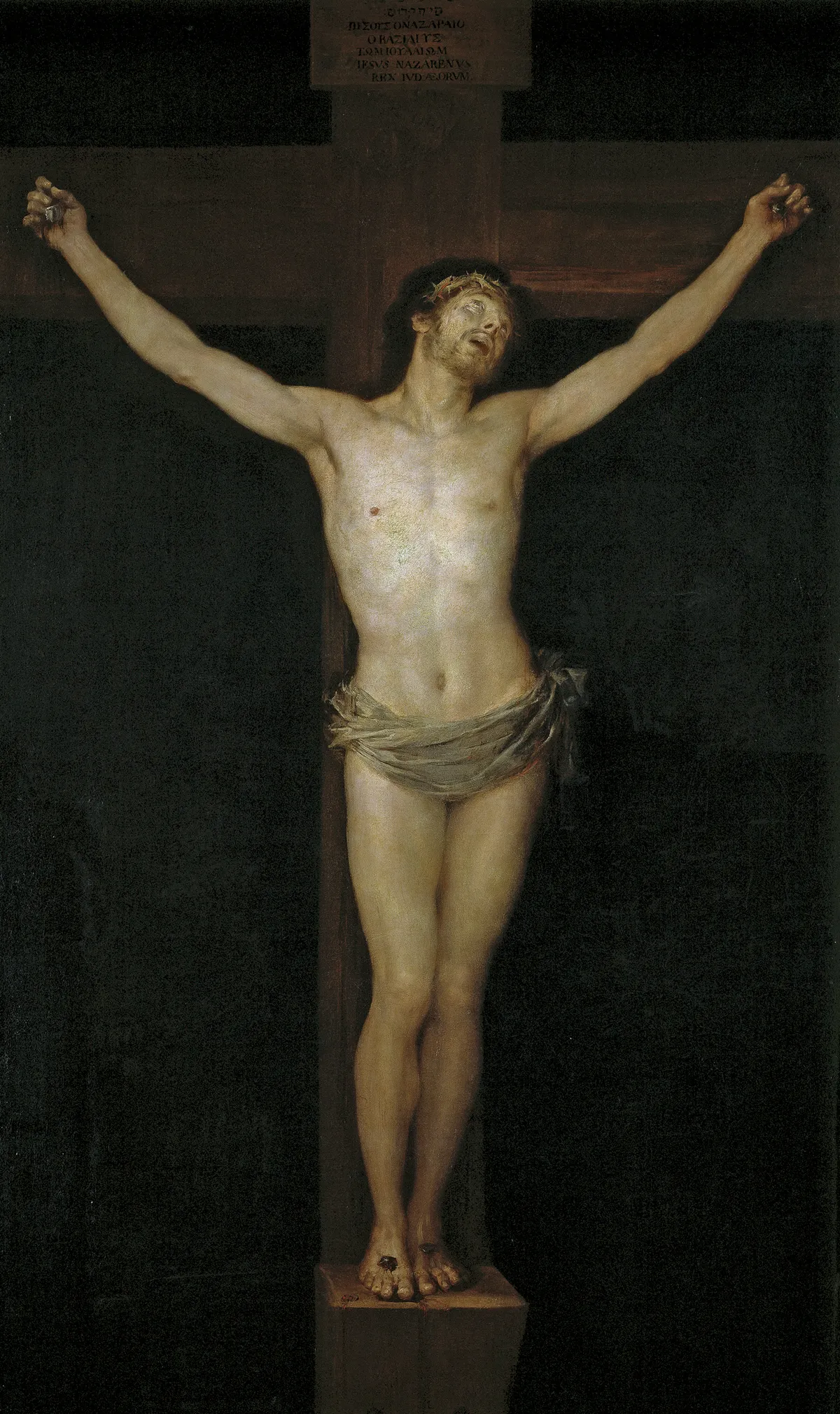
Francisco de Goya was 34 when he painted Christ on the Cross in 1780, to win his place at the Royal Academy of San Fernando; it is now in the Prado. It is a young man’s homage to Velázquez, with the same dark background, the same four nails and the same small support under the feet. But Goya changes the moment. His Christ is still alive, pale and almost weightless, his eyes raised to heaven and his lips parted. He is about to speak the seventh word.
Seven Last Words of Jesus Paintings Featured in This Article
| Word | Painting | Artist | Date | Museum |
|---|---|---|---|---|
| Introduction | The Crucifixion | Andrea Mantegna | 1457 to 1459 | Musée du Louvre, Paris |
| 1. Father, forgive them | What Our Saviour Saw from the Cross | James Tissot | 1886 to 1894 | Brooklyn Museum, New York |
| 2. Today you will be with me in paradise | Christ and the Good Thief | Titian and workshop | About 1563 | Pinacoteca Nazionale, Bologna |
| 3. Woman, behold your son | Isenheim Altarpiece, the Crucifixion | Matthias Grünewald | 1512 to 1516 | Unterlinden Museum, Colmar |
| 4. My God, my God, why have you forsaken me? | Christ on the Cross | Léon Bonnat | 1874 | Petit Palais, Paris |
| 5. I thirst | “I Thirst”: The Vinegar Given to Jesus | James Tissot | 1886 to 1894 | Brooklyn Museum, New York |
| 6. It is finished | Christ Crucified | Diego Velázquez | About 1632 | Museo del Prado, Madrid |
| 7. Father, into your hands | Christ on the Cross | Francisco de Goya | 1780 | Museo del Prado, Madrid |
Praying the Seven Last Words on Good Friday
The custom of meditating on the seven words during the three hours of the agony, from noon to three in the afternoon, goes back to a Jesuit in Lima, Alonso Messia Bedoya, at the end of the seventeenth century. The Tre Ore spread through Spain, Italy and the Americas, and many parishes still keep it on Good Friday: a short reading, a homily and a long silence for each word. Haydn’s Seven Last Words of Our Saviour on the Cross was written for exactly such a service in Cádiz, where the bishop read each word aloud and preached on it before the music.
A painting can serve the same purpose. Take one word, look at its picture for a few minutes in silence, then read the verse again. Our guide to the Stations of the Cross follows the road that led to Calvary, our prayer before a crucifix is a short way to stay at the foot of the cross, and you will find many more images of the Passion among our famous Crucifixion paintings.
Conclusion: Seven Words, One Prayer
Read in order, the seven last words of Jesus are not seven separate sayings. They begin and end with “Father”. In between, Jesus forgives his enemies, promises paradise to a thief, gives his mother to his friend, cries out in the dark, admits that he is thirsty, declares his work complete, and gives himself back to God. It is the whole Gospel in three hours.
The painters each kept one moment. Tissot looked down at the crowd, Titian listened to the thief, Grünewald watched John catch Mary, Bonnat heard the cry, Velázquez painted the bowed head and Goya the eyes raised to heaven. Together they show what no single Gospel tells on its own.
Important Facts About the Seven Last Words of Jesus
- No Gospel records all seven words: Luke has three, John three, and Matthew and Mark share one.
- The traditional order is: Father, forgive them (Luke 23:34); Today you will be with me in paradise (Luke 23:43); Woman, behold your son (John 19:26-27); My God, my God, why have you forsaken me? (Matthew 27:46, Mark 15:34); I thirst (John 19:28); It is finished (John 19:30); Father, into your hands I commend my spirit (Luke 23:46).
- The fourth word is the first verse of Psalm 22, and the seventh is a verse of Psalm 31.
- The fourth word is the only one the Gospels keep in Jesus’ own Aramaic: “Eli, Eli, lama sabachthani”.
- The Good Friday devotion of the Three Hours (Tre Ore) on the seven words began with the Jesuit Alonso Messia Bedoya in Lima in the late seventeenth century.
- Joseph Haydn composed The Seven Last Words of Our Saviour on the Cross in 1787 for a Good Friday service in Cádiz.
- James Tissot’s What Our Saviour Saw from the Cross, in the Brooklyn Museum, shows the Crucifixion from the viewpoint of Christ on the cross.
Frequently Asked Questions
What are the seven last words of Jesus in order?
In the traditional order, the seven last words of Jesus are: 1. Father, forgive them, for they know not what they do (Luke 23:34). 2. Today you will be with me in paradise (Luke 23:43). 3. Woman, behold your son; behold your mother (John 19:26-27). 4. My God, my God, why have you forsaken me? (Matthew 27:46; Mark 15:34). 5. I thirst (John 19:28). 6. It is finished (John 19:30). 7. Father, into your hands I commend my spirit (Luke 23:46).
Where are the seven last words of Jesus found in the Bible?
They are spread across the four Gospels. Luke records three: the prayer of forgiveness, the promise to the good thief and the final prayer to the Father. John records three: the words to Mary and John, I thirst, and It is finished. Matthew and Mark record only the cry My God, my God, why have you forsaken me? The traditional order is a harmony of the four accounts.
Why did Jesus say “I thirst”?
Because he was truly thirsty: after the scourging, the way of the cross and hours of blood loss, thirst is one of the worst torments of crucifixion, and the word shows how fully he shared our human nature. John adds that he said it so that Scripture might be fulfilled, recalling Psalm 69:21, “in my thirst they gave me vinegar to drink”. Christian tradition also hears in it the thirst of God for souls, the theme Saint Teresa of Calcutta placed beside the crucifix in every chapel of her sisters.
Why did Jesus say “My God, my God, why have you forsaken me?”
The cry is the first verse of Psalm 22, a psalm that begins in abandonment and ends in trust and praise. By quoting it, Jesus prays the whole psalm. Christians understand that he truly took on the experience of being forsaken that people feel in suffering and death, without ever ceasing to be the Son, and that he turned even that cry into a prayer addressed to God.
What did Jesus mean by “It is finished”?
The Greek word, tetelestai, means accomplished or completed, and the same verb appears in business papyri of the time for a debt paid in full. Jesus was not saying that his life was over but that his work was done: the mission received from the Father, the fulfilment of the Scriptures and the sacrifice for sin. John adds that he then bowed his head and gave up his spirit.
What is the Seven Last Words service on Good Friday?
It is the devotion of the Three Hours, or Tre Ore, held from noon to three in the afternoon, the hours Jesus hung on the cross. Each of the seven words is read, followed by a reflection, a hymn or music and a time of silence. It was begun by the Jesuit Alonso Messia Bedoya in Lima in the late seventeenth century, and Haydn’s Seven Last Words was written for such a service in Cádiz.
Can you buy paintings of the Crucifixion?
You can buy Crucifixion paintings at jesuschrist.pictures, in our shop, as canvas reproductions, including Christ Crucified by Diego Velázquez, the Crucifixion with the Virgin, Saint John and Mary Magdalene by Jean-Baptiste de Champaigne, and the Crucifixions of Fra Angelico, Giotto and El Greco. Each is printed on canvas, ready to hang, for a prayer corner or a wall at home.