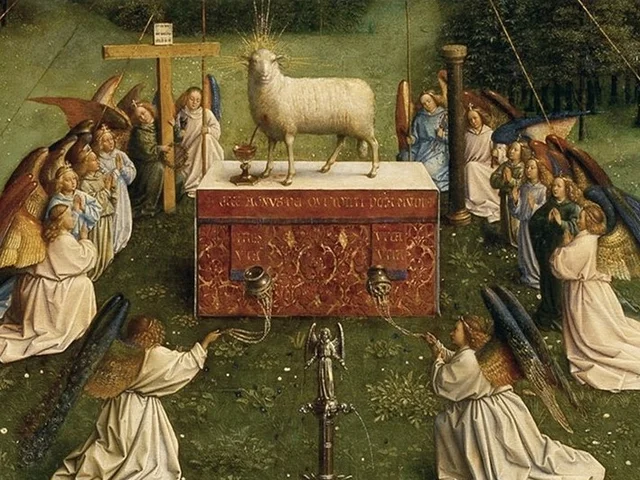
10 Last Judgment Paintings Before Michelangelo
Last Judgment paintings did not begin with Michelangelo. When he started work on the altar wall of the Sistine Chapel in 1536, the end of the world had already been painted for more than two centuries, on church walls in Padua and Pisa, on gold panels in Florence and Cologne, on folding altarpieces in Bruges and Beaune. The subject comes from the Gospel of Matthew: the Son of Man returns in glory, all the nations are gathered before him, and he separates them as a shepherd separates the sheep from the goats. Painters turned those few verses into the largest picture of all, heaven, earth and hell in a single image.
The ten works below were all painted before Michelangelo’s Last Judgment, and most of them were famous in his lifetime. They are arranged in order of date, from Giotto around 1306 to Luca Signorelli in 1504. Read together, they show how a fixed medieval scheme, Christ enthroned above, the dead rising below, the saved on one side and the damned on the other, slowly loosened into something more human and more frightening, until Michelangelo was ready to break it apart.
1. The Last Judgment by Giotto (c. 1306)
Giotto painted his Last Judgment on the entrance wall of the Scrovegni Chapel in Padua, so that every visitor sees it on the way out. Christ sits in a rainbow mandorla at the centre, the twelve apostles enthroned on either side of him, while ranks of angels fill the sky above. Below, a great cross held by two angels divides the scene: on Christ’s right the blessed stand in calm rows, on his left a river of fire pours out from his throne and carries the damned down into hell.

Giotto’s hell is still medieval in spirit, a crowded pit ruled by a huge blue Satan who devours sinners and passes them out again, with Judas hanging from a tree among the torments. But the blessed already have the weight and gravity of real people. Just under the cross Giotto painted the patron, Enrico Scrovegni, kneeling to offer a model of the chapel to the Virgin, a reminder that the whole building was a prayer for his family’s salvation. The fresco can still be seen in place at the Scrovegni Chapel.
2. The Last Judgment by Buonamico Buffalmacco (1336 to 1341)
In the 1330s the Florentine painter Buonamico Buffalmacco covered a long wall of the Camposanto, the monumental cemetery beside Pisa Cathedral, with a cycle on the last things: the Triumph of Death, the Last Judgment and Hell. In his Judgment, Christ and the Virgin sit side by side in twin mandorlas, an unusual arrangement that gives Mary almost equal place beside her Son as advocate for humanity. Beneath them the apostles sit in a long row and armed angels herd the risen dead to the right or the left.
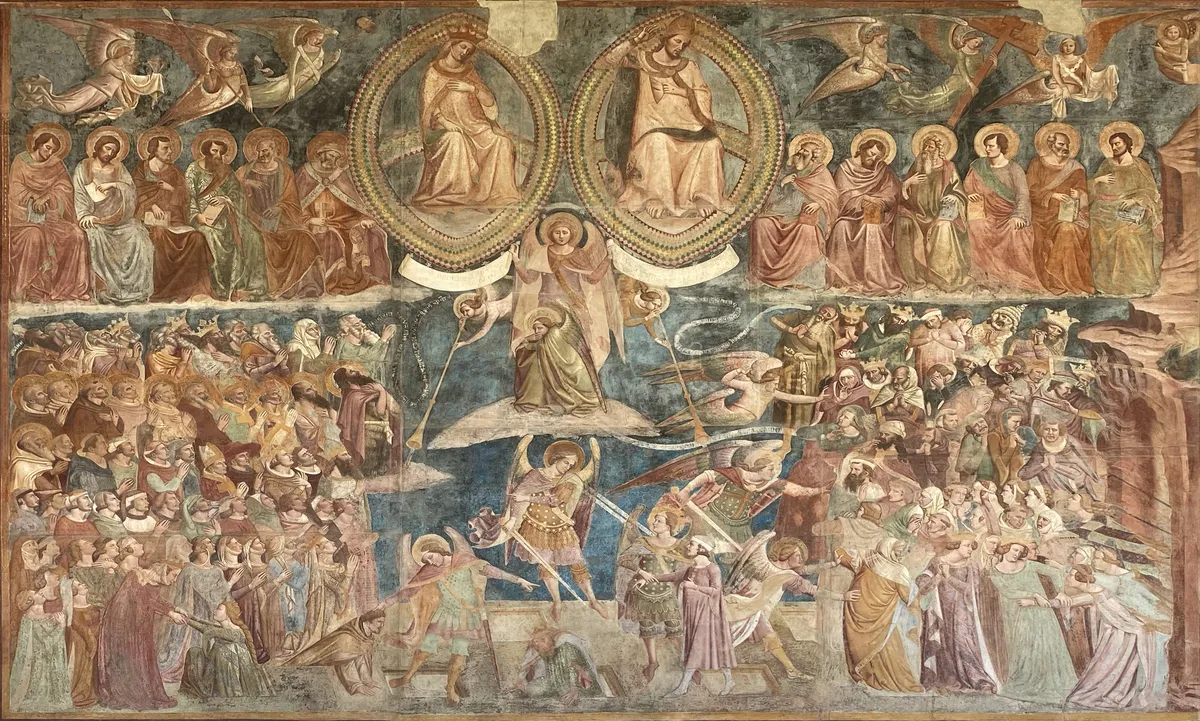
The frescoes nearly disappeared in July 1944, when Allied shelling set fire to the roof of the Camposanto and molten lead ran down the walls. Restorers peeled the damaged paintings off the masonry, uncovering the artist’s preparatory drawings beneath, and spent decades saving them. The Last Judgment and the Hell went back on their wall in 2018. They can be seen in the Camposanto Monumentale on the Piazza dei Miracoli.
3. The Inferno by Giovanni da Modena (c. 1410)
No painter in this list gave more room to hell than Giovanni da Modena. In 1408 the Bolognese merchant Bartolomeo Bolognini left instructions in his will for the decoration of his family chapel in the Basilica of San Petronio, and asked that the hell be painted as horrible as possible. Giovanni obeyed. The upper part of the wall shows Christ and the court of heaven, but the eye is pulled down at once to the enormous, hairy Lucifer who fills the lower half.
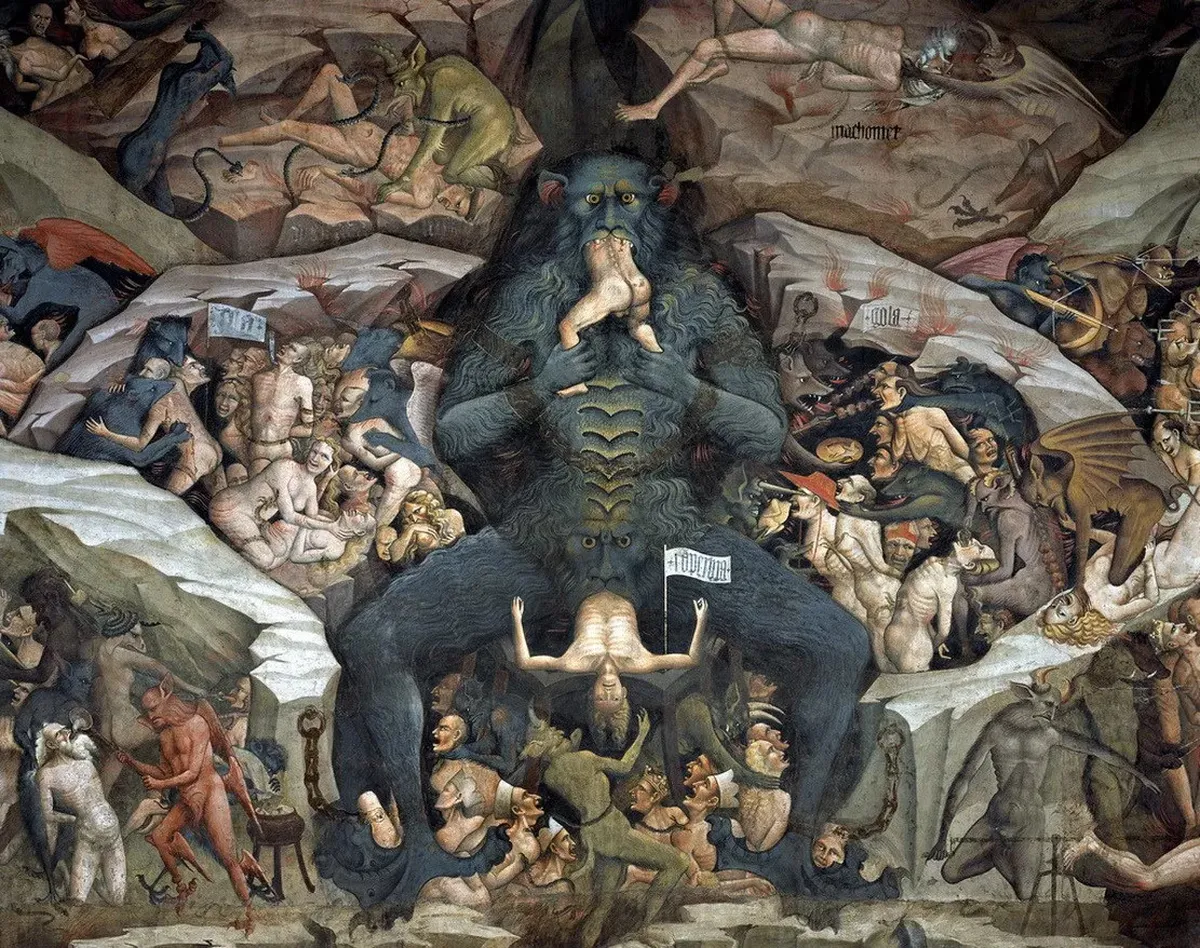
Lucifer swallows one sinner whole and expels another through a second face on his belly, while around him demons punish each vice in its own compartment, following the structure of Dante’s Inferno, which every educated Bolognese knew by heart. The colours are dark and earthy, the bodies pale and twisted, and the whole wall reads as a sermon on what awaits the unrepentant. The chapel is in the left aisle of the Basilica of San Petronio in Bologna.
4. The Last Judgment by Fra Angelico (c. 1425 to 1431)
Fra Angelico, the Dominican friar whose painting seemed to his contemporaries a form of prayer, made the most serene of all Last Judgments. Painted on a panel with a three-lobed top for the Camaldolese monastery of Santa Maria degli Angeli in Florence, it is organised around a long road of open tombs running into the distance, empty now that the dead have risen. Christ sits above in a ring of cherubim, the Virgin and Saint John on either side.

On the left the blessed embrace their guardian angels and dance in a circle through a flowering garden toward the golden light of the heavenly city. On the right, the damned are driven into a hell divided into cells, where Satan chews on sinners. The contrast between the two halves is complete: the friar spends all his tenderness on paradise and treats hell almost as a diagram. The panel is now in the Museo di San Marco, in the convent where Fra Angelico lived, through the national museums of Tuscany.
5. The Last Judgment by Stefan Lochner (c. 1435)
North of the Alps, the leading painter of Cologne, Stefan Lochner, painted the Judgment against a sky of burnished gold. Christ in a red mantle sits on a rainbow with his wounds displayed, the Virgin and Saint John the Baptist kneeling on either side to plead for mankind. On the left, angels lead the blessed into a tall Gothic gate that looks like a cathedral portal; on the right, swarms of grotesque devils, some of them with faces on their bellies, drag the damned toward the flames.
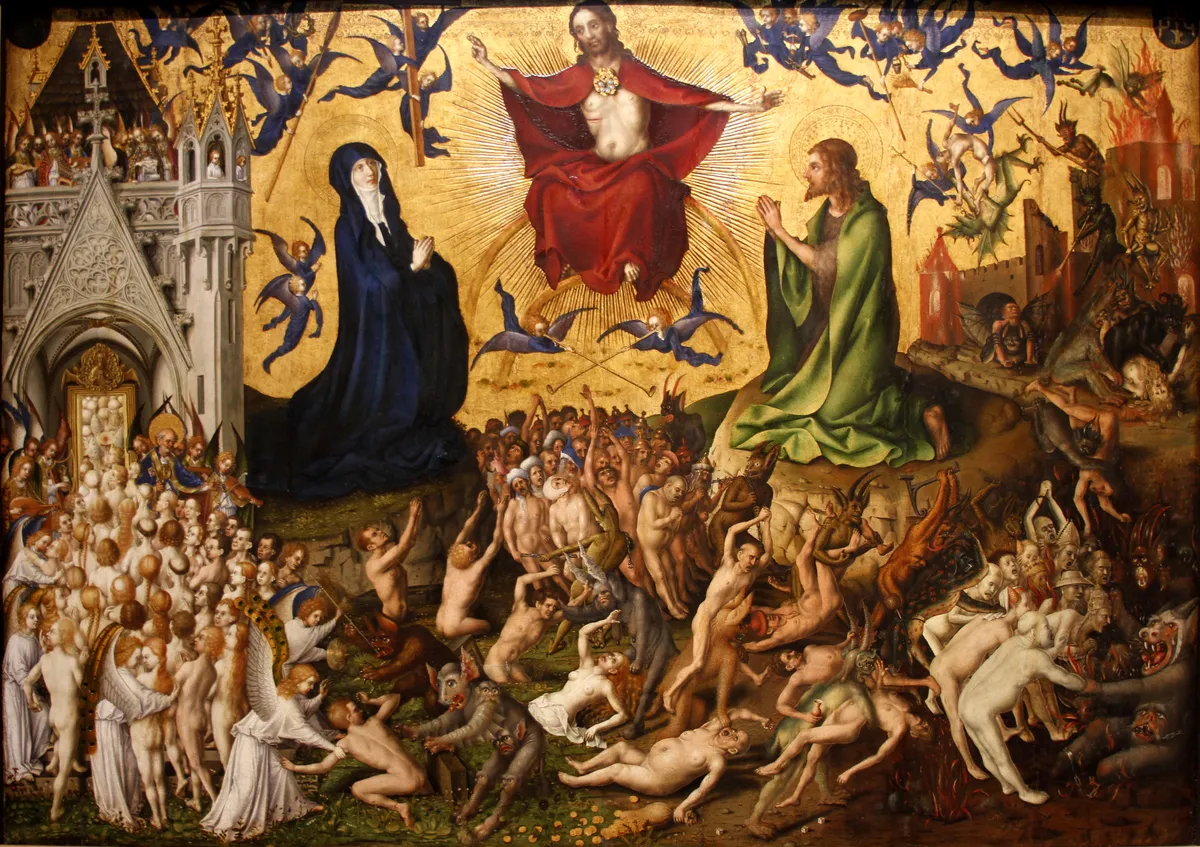
Lochner shows no favour to the powerful: crowned heads and churchmen in their robes are among those dragged away, a warning aimed at the very people who could afford such an altarpiece. The panel was the centre of an altarpiece for the parish church of Saint Laurence in Cologne. Its wings, painted with the martyrdoms of the apostles and with standing saints, were cut apart and are now divided between Frankfurt and Munich. The central panel is in the Wallraf-Richartz-Museum in Cologne.
6. The Crucifixion and The Last Judgment by Jan van Eyck and workshop (c. 1440 to 1441)
These two tall, narrow panels were painted in the workshop of Jan van Eyck, probably with the master’s own hand in much of it, a few years after the Ghent Altarpiece. The left panel shows the Crucifixion, the right the Last Judgment, so that the sacrifice of Christ and its final consequence are seen side by side. At the top of the Judgment, Christ sits with the apostles and saints in a vision of heaven of almost unbelievable detail.

The lower half is one of the most startling images in Flemish painting. Saint Michael stands on the back of a giant skeleton, the figure of Death, whose bat-like wings stretch across the whole width of the panel. Between its legs the damned tumble head first into a black pit where they are devoured by monsters, rendered with the same patient oil technique Van Eyck used for jewels and brocade. The diptych is in the Metropolitan Museum of Art in New York.
7. The Beaune Altarpiece by Rogier van der Weyden (c. 1445 to 1450)
Nicolas Rolin, chancellor of the Duke of Burgundy and the donor kneeling in Van Eyck’s Madonna of Chancellor Rolin, founded a hospital for the poor at Beaune in 1443 and commissioned Rogier van der Weyden to paint its great altarpiece. Opened on feast days, the polyptych spreads the Last Judgment across nine panels. Christ sits on a rainbow above a golden sky, and directly beneath him the Archangel Michael, in a white robe, weighs the souls of the risen dead in a pair of scales.

The altarpiece hung at the end of the hospital ward, where the sick could see it from their beds. Rogier gives the scene the emotional intensity of his Descent from the Cross: the damned on the right do not need demons to push them, they hurl themselves toward hell in despair. Saint Michael is the calm still point at the centre, a figure explored further in our article on Archangel Michael. The altarpiece is still shown in the Hotel-Dieu of the Hospices de Beaune.
8. The Last Judgment by Hans Memling (1467 to 1471)
Twenty years later, Hans Memling, who had probably trained in Rogier’s workshop, took up the same composition in Bruges for Angelo Tani, the agent of the Medici bank. Memling follows the Beaune model closely: Christ on a rainbow above a golden sphere, the apostles on either side and Saint Michael at the centre, this time in shining armour, weighing a soul in his scales. The left wing shows Saint Peter welcoming the blessed up a crystal staircase into heaven, the right the damned falling into hell.

The triptych has the strangest history in this list. In 1473 the ship carrying it to Florence was captured in the North Sea by the privateer Paul Beneke of Danzig, and the painting was given to the city’s church of Saint Mary instead. Florence protested, even to the Pope, but the altarpiece never reached Italy. After further journeys to Paris and Berlin, and a wartime removal to Russia, it returned to the city now called Gdansk. It is in the National Museum in Gdansk.
9. The Last Judgment Triptych by Hieronymus Bosch (c. 1482 or later)
Hieronymus Bosch painted the darkest Last Judgment of all. The left wing shows Eden, the creation of Eve and the fall of the rebel angels, the first sins from which all the others follow. In the centre panel Christ sits small and far away in a blue sky, while the earth beneath him has already become hell: a burning landscape where demons, half animal and half machine, torment humans in every imaginable way, each punishment matched to a sin.
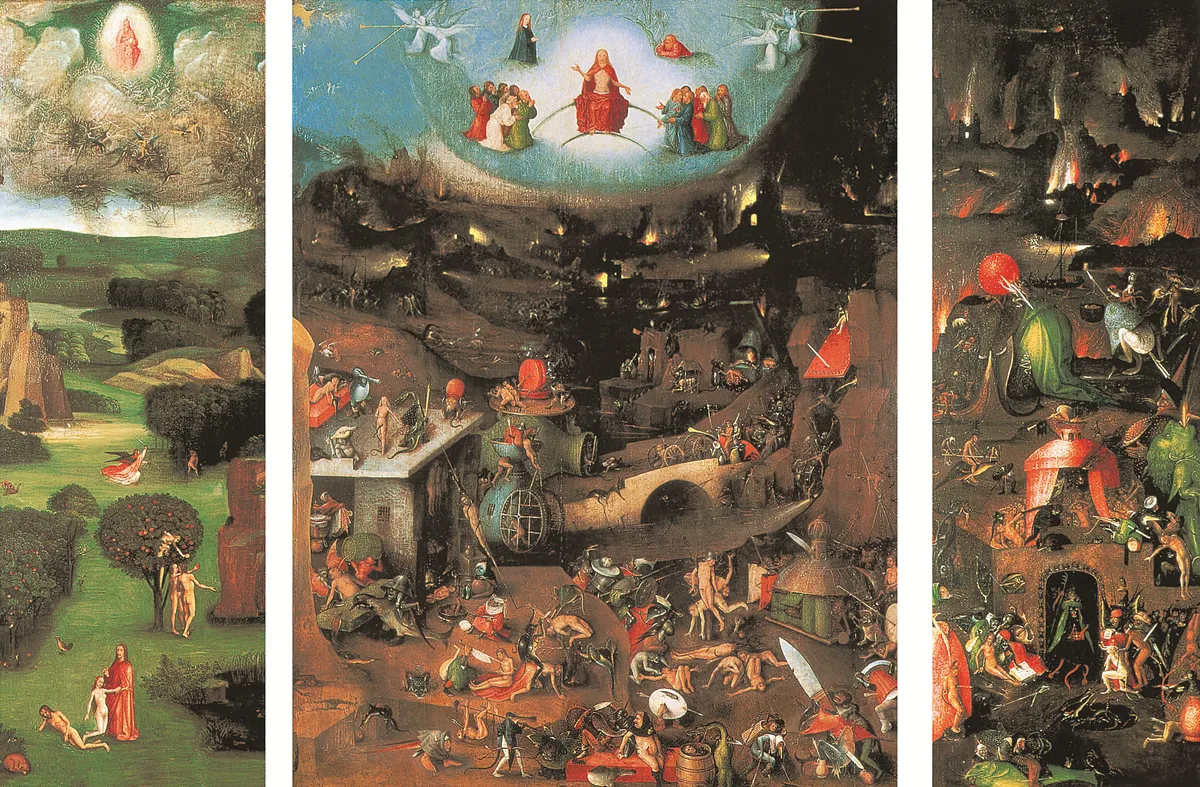
In earlier versions the blessed and the damned are roughly equal in number. In Bosch almost no one is saved; the few souls rising toward Christ are lost in a vast panorama of punishment that continues into the right wing, the realm of Satan. It is the same world of nightmare as his Temptation of Saint Anthony, turned on the whole of humanity. The date is debated, but the triptych is one of Bosch’s major works. It belongs to the paintings gallery of the Academy of Fine Arts Vienna.
10. The Last Judgment Frescoes by Luca Signorelli (1499 to 1504)
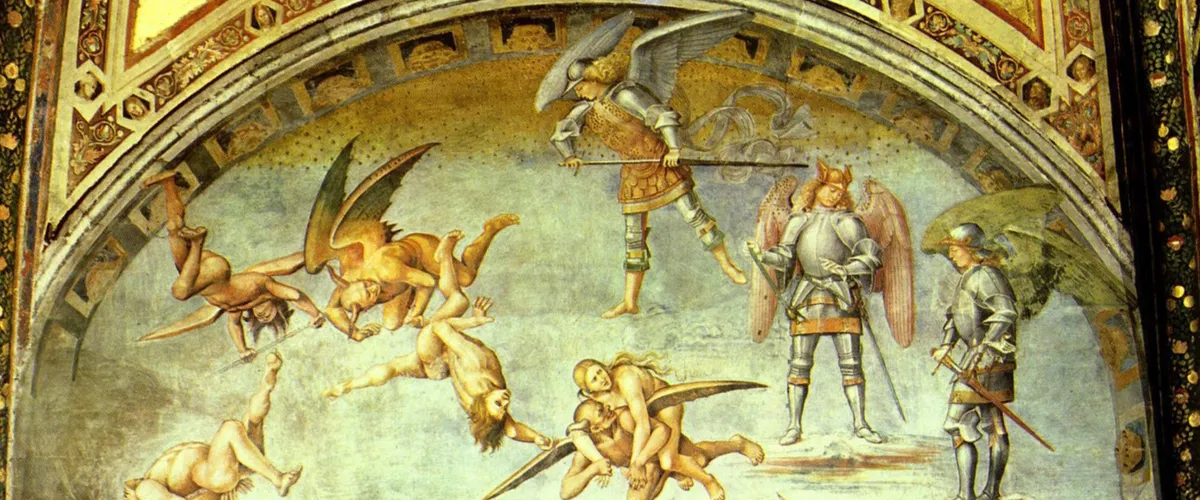
The last great Judgment before Michelangelo was painted in the San Brizio Chapel of Orvieto Cathedral. Fra Angelico had begun the vault in 1447 and left it unfinished; half a century later Luca Signorelli was hired to complete it, and he covered the walls with the end of the world in several scenes: the rule of the Antichrist, the resurrection of the flesh, the damned, and the elect called to paradise.
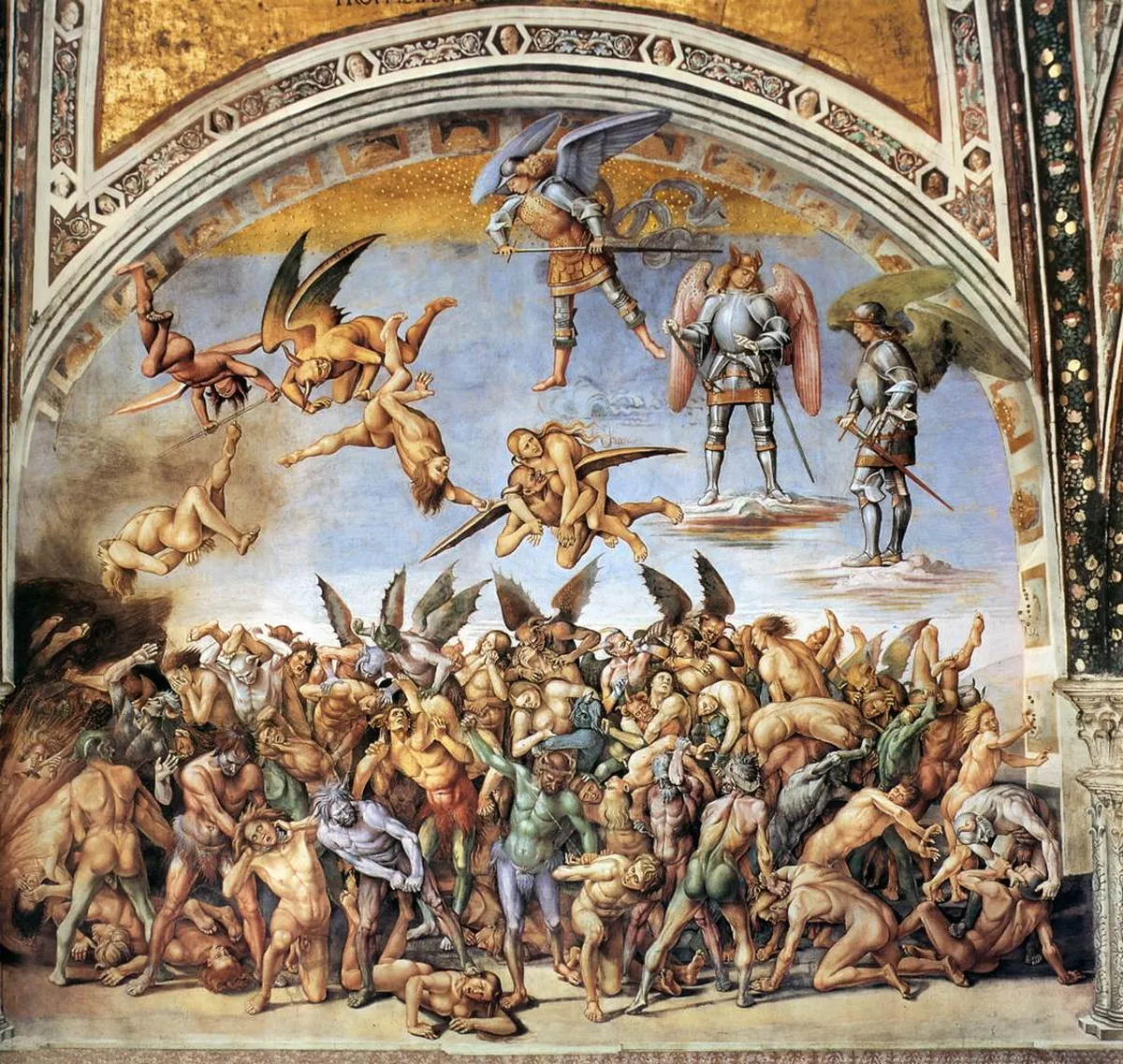
In The Damned, Signorelli does away with the tidy rows of earlier painters. Hell is a heap of nude, muscular bodies twisted in every direction, seized and bound by demons whose skin turns green and violet, while three armoured archangels watch coldly from the sky. Signorelli studied anatomy with an intensity no one before him had shown, and it is no surprise that Vasari reports Michelangelo’s admiration for the chapel. Thirty years later, the bodies of the Sistine wall would owe something to these. The frescoes can be seen in Orvieto Cathedral.
Summary of the Paintings
| Painting | Artist | Date | Medium | Where to see it |
|---|---|---|---|---|
| The Last Judgment | Giotto | c. 1306 | Fresco | Scrovegni Chapel, Padua |
| The Last Judgment | Buonamico Buffalmacco | 1336 to 1341 | Fresco | Camposanto Monumentale, Pisa |
| The Inferno (Last Judgment) | Giovanni da Modena | c. 1410 | Fresco | Basilica of San Petronio, Bologna |
| The Last Judgment | Fra Angelico | c. 1425 to 1431 | Tempera on panel | Museo di San Marco, Florence |
| The Last Judgment | Stefan Lochner | c. 1435 | Oil and gold on panel | Wallraf-Richartz-Museum, Cologne |
| The Crucifixion and The Last Judgment | Jan van Eyck and workshop | c. 1440 to 1441 | Oil on canvas, transferred from panel | Metropolitan Museum of Art, New York |
| The Last Judgment (Beaune Altarpiece) | Rogier van der Weyden | c. 1445 to 1450 | Oil on panel | Hotel-Dieu, Hospices de Beaune |
| The Last Judgment | Hans Memling | 1467 to 1471 | Oil on panel | National Museum, Gdansk |
| The Last Judgment triptych | Hieronymus Bosch | c. 1482 or later | Oil on panel | Academy of Fine Arts, Vienna |
| The Damned and the Last Judgment cycle | Luca Signorelli | 1499 to 1504 | Fresco | Orvieto Cathedral |
Conclusion
Seen in order, these ten works tell a story of their own. Giotto, Buffalmacco and Fra Angelico built the Judgment like a cathedral facade, in bands and compartments where every soul has its place. The Flemish painters brought it down to earth with oil paint and the weight of real bodies, and placed Saint Michael and his scales at its heart. Giovanni da Modena and Bosch let hell swallow the picture, and Signorelli, finally, gave the damned the anatomy of living men.
When Michelangelo came to the Sistine altar wall in 1536, he inherited all of this, and swept most of it away: no architecture, no scales, no neat rows, only bodies rising and falling around a Christ who raises his arm. To see how he did it, read our article on Michelangelo’s Last Judgment, or bring the fresco home as a Last Judgment canvas print. For the same end of time told in thread rather than paint, see the medieval Apocalypse Tapestry of Angers.
Important Facts About Last Judgment Paintings
- The main biblical source is Matthew 25:31 to 46, where Christ separates the nations as a shepherd separates the sheep from the goats; painters also drew on the Book of Revelation.
- Last Judgments were usually painted on the west wall of a church, the wall people face as they leave, so that the image would follow them back into the world.
- By tradition the blessed are placed on Christ’s right hand, the viewer’s left, and the damned on his left hand, the viewer’s right.
- The Virgin Mary and Saint John the Baptist kneeling beside Christ form a group called the Deesis, from the Greek word for prayer or supplication.
- Saint Michael weighing souls in a pair of scales, a scene not found in the Gospels, became the centre of the Flemish versions by Rogier van der Weyden and Hans Memling.
Questions and Answers
What does a Last Judgment painting symbolize?
A Last Judgment painting shows the end of time as the Gospel of Matthew describes it, when Christ returns in glory and separates the saved from the damned like a shepherd dividing sheep from goats. It is a picture of justice and of mercy at once. The blessed rise on Christ’s right hand toward heaven, the damned fall on his left into hell, and the Virgin Mary and Saint John the Baptist usually kneel beside him to plead for humanity. Placed on the west wall of a church or above an altar, the image reminded every believer that their own life would one day be weighed.
Who painted the Last Judgment before Michelangelo?
Many painters did, across more than two centuries. Giotto painted one on the entrance wall of the Scrovegni Chapel in Padua around 1306, Buffalmacco covered a wall of the Camposanto in Pisa with another in the 1330s, and Fra Angelico painted a famous panel version in Florence around 1425 to 1431. In the north, Stefan Lochner, Jan van Eyck, Rogier van der Weyden, Hans Memling and Hieronymus Bosch all treated the subject in the fifteenth century. The last great version before Michelangelo is Luca Signorelli’s fresco cycle in Orvieto Cathedral, finished in 1504.
How big is the Last Judgment painting?
If you mean Michelangelo’s fresco in the Sistine Chapel, it measures about 13.7 by 12 metres and covers the whole altar wall. The earlier versions vary enormously. Giotto’s and Buffalmacco’s frescoes fill entire walls, Rogier van der Weyden’s polyptych in Beaune is more than five metres wide when open, while Jan van Eyck’s panel in New York is only about 57 centimetres tall and was made to be studied up close.
How is Michelangelo’s Last Judgment different from earlier ones?
The painters before him arranged the Judgment in neat horizontal bands: Christ enthroned at the top, the apostles seated in rows, the saved and the damned divided by a clear line, often with Saint Michael weighing souls in the centre. Michelangelo kept the theme but broke the order. He removed the architecture, the scales and most of the attributes, and set hundreds of muscular nude bodies whirling around a beardless, athletic Christ. What had been a diagram of the afterlife became a single tide of human bodies in motion.
Where can you see Last Judgment paintings today?
The frescoes are still where they were painted: the Scrovegni Chapel in Padua, the Camposanto in Pisa, the Basilica of San Petronio in Bologna and the San Brizio Chapel of Orvieto Cathedral. The panels are in museums: Fra Angelico’s in the Museo di San Marco in Florence, Lochner’s in the Wallraf-Richartz Museum in Cologne, Van Eyck’s in the Metropolitan Museum of Art in New York, Memling’s in the National Museum in Gdansk and Bosch’s in the Academy of Fine Arts in Vienna. Rogier van der Weyden’s altarpiece is shown in the Hotel-Dieu at Beaune, the hospital it was made for.
Can you buy a Last Judgment painting as a canvas print?
You can buy a Last Judgment painting at jesuschrist.pictures, in our shop, where Michelangelo’s Last Judgment is available as a canvas print in several sizes. The shop also offers other sacred masterworks by painters in this list, such as Fra Angelico, Giotto, Hans Memling and Hieronymus Bosch, printed on gallery-quality canvas and ready to hang in a home, a classroom or a parish hall.