Caravaggio’s Entombment of Christ: Descent into Darkness
The Entombment of Christ, also called the Deposition, is one of the most admired religious paintings of the Baroque, made by Caravaggio between 1603 and 1604. It shows the dead Christ being lowered onto the stone of the tomb, his body held by two men while three women grieve above. The painting is now in the Vatican Pinacoteca. Its medium is oil on canvas.
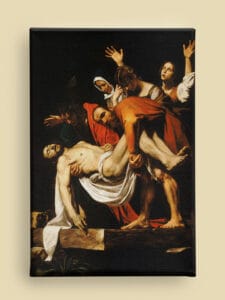
The composition falls like a slow, heavy movement downward. Christ’s pale body sinks toward the corner of a great stone slab, which juts out of the picture toward the viewer. There is no landscape and no sky, only a few figures lit against a deep black ground.
Caravaggio gives the scene the weight of a real burial. The bodies are solid and ordinary, the grief is plain, and the body of Christ has the dead weight of true flesh. Readers who want to see more of the artist can also read our article on Caravaggio’s paintings.
The History of The Entombment of Christ
Caravaggio painted The Entombment of Christ for the chapel of the Vittrice family in the church of Santa Maria in Vallicella, the Chiesa Nuova, in Rome. It was commissioned by Girolamo Vittrice around 1602 and finished by 1604, during the years of Caravaggio’s greatest fame.

The painting stayed in the church for two centuries before being taken to Paris under Napoleon and later returned to the Vatican, where the original now hangs. A copy stands in the chapel in its place. Even in its own day the work was famous, and later masters, including Rubens, made careful copies of it.
The Body of Christ
At the center lies the body of Christ, pale and lifeless, slipping from the arms of those who hold him. His head falls back, his side still shows the wound, and one arm hangs down to brush the cold stone. Caravaggio paints him with the full, dead weight of a real corpse, heavy and hard to carry.

The white shroud beneath him catches the light and sets the body apart in the darkness. There is nothing idealized here. This is the human Christ, truly dead, and the painting asks the viewer to feel the reality of that death.
The Bearers and the Stone
Two men carry the body. The younger, in red, supports the shoulders, his fingers brushing the open wound, while the older, bearded man bends low to take the weight of the legs. Their effort is real, their faces grave, and they lower Christ toward the great stone at the front of the picture.

That stone is the key to the whole design. Its sharp corner pushes out past the edge of the scene, into the space of the viewer. For the worshippers in the chapel, the stone became the altar itself, so that the body of Christ seemed to be laid down on the very stone where the Mass was said.
The Grief of the Women
Above the men stand three women. The aged Virgin Mary reaches out over her son, Mary Magdalene bows her head in quiet sorrow, and a third woman flings both arms up toward heaven in a cry of grief.

Caravaggio sets three different kinds of mourning side by side, the still grief of a mother, the bowed sorrow of love, and the wild despair of open arms. Together they carry the emotion of the scene upward, while the body sinks down, and the whole painting is held between the two.
The Painting Other Masters Copied
The Entombment of Christ was praised from the start as one of Caravaggio’s finest works. Its clear, powerful design and its deep, simple feeling made it a model for other painters, and copies and variations spread across Europe.
Its lasting power comes from its honesty. Caravaggio strips the burial of all decoration and shows it as a real, human event, lit by a hard light, weighed down by a real body. Few paintings make the death of Christ feel so present.
Conclusion
In The Entombment of Christ Caravaggio turned the burial of Christ into a single, heavy movement downward, from the raised arms of grief to the body sinking onto the stone. The plain figures, the dark ground, and the jutting slab draw the viewer into the moment.
Still admired four centuries later, it remains one of the great images of the Passion. It shows Caravaggio’s gift for making the sacred real, and for placing the worshipper face to face with the body of Christ.
Artwork Information
| Artwork | Artist | Date | Medium | Current Location |
|---|---|---|---|---|
| The Entombment of Christ | Caravaggio | 1603 to 1604 | Oil on canvas | Vatican Pinacoteca |
Five Facts About The Entombment of Christ
- The Entombment of Christ was painted by Caravaggio around 1603 to 1604.
- It shows the dead Christ being lowered onto the stone of the tomb, watched by three grieving women.
- The corner of the stone slab juts out toward the viewer, drawing us into the scene.
- It was made for the Vittrice chapel in the Chiesa Nuova in Rome, and the original is now in the Vatican Pinacoteca.
- It was so admired that later masters, including Rubens, made copies of it.
FAQ
What does Caravaggio’s Entombment of Christ depict?
It shows the burial of Christ, his dead body being lowered onto the stone of the tomb by Nicodemus and John, while the Virgin Mary, Mary Magdalene, and a third woman grieve above.
What is the meaning of the painting?
It presents the death of Christ as a real, human event, and links it to the Mass. The stone on which the body is laid stands for the altar, so that worshippers saw Christ placed on the very stone where the sacrament was celebrated.
Who are the figures in the Entombment?
They are Nicodemus and John the Evangelist, who carry the body, and three women, the Virgin Mary, Mary Magdalene, and Mary of Cleophas, who lifts her arms toward heaven.
Where is Caravaggio’s Entombment of Christ?
The original is in the Vatican Pinacoteca. A copy stands in the Chiesa Nuova in Rome, where it was first placed.
Why is it also called the Deposition?
The painting shows the moment between the lowering of Christ from the cross, the deposition, and his burial, the entombment, so both names are used for it.
When did Caravaggio paint it?
He painted it between 1603 and 1604, at the height of his career in Rome.
Why is it considered one of his masterpieces?
It joins a clear, powerful design to deep, simple feeling, and makes the death of Christ feel utterly real. It was widely copied, including by Rubens, and has been admired ever since.
Can you buy a reproduction of Caravaggio’s Entombment of Christ?
You can buy a reproduction of Caravaggio’s Entombment of Christ at jesuschrist.pictures: see the canvas reproduction in our shop, printed on museum-grade canvas and available in several sizes.


