Holman Hunt’s Light of the World, a Knock of Grace
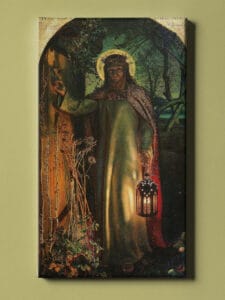
The Light of the World is one of the most famous religious paintings of the nineteenth century, made by the English Pre-Raphaelite artist William Holman Hunt between 1851 and 1854. It shows Christ standing at night before an overgrown door, a lantern in one hand, the other raised to knock. The original hangs in the chapel of Keble College, Oxford. Its medium is oil on canvas.
The painting illustrates a verse from the Book of Revelation, in which Christ says, Behold, I stand at the door, and knock. Hunt turns those words into a vivid night scene, painted with the sharp detail and glowing color that mark the Pre-Raphaelite style. Every leaf, jewel, and weed is rendered with care.
The most quietly powerful detail is the door itself. It is weathered, tangled with ivy and weeds, and it has no handle on the outside. Hunt explained that the door is the human soul, which can only be opened from within. Christ knocks, and waits, but he will not force his way in. Readers who want to explore this world can also read our article on Pre-Raphaelite Jesus paintings.
The History of The Light of the World
Holman Hunt painted The Light of the World as a young man, working partly outdoors at night to capture the true effect of moonlight and lamplight. He was a founder of the Pre-Raphaelite Brotherhood and a deeply religious man, and he meant the picture to be a sermon in paint.

The painting became enormously popular. Hunt later made a small replica, now in Manchester, and a large version which he painted when he was almost seventy, now in Saint Paul’s Cathedral in London. That late version was sent on tour around the British Empire, where huge crowds came to see it, making it one of the most widely viewed paintings of its age.
The Face of Christ
Christ stands robed in white, a richly embroidered cloak over his shoulders. On his head he wears two crowns at once, a golden crown of a king and, woven through it, the crown of thorns. A soft halo of light surrounds his head, and his expression is calm, patient, and grave.

The double crown holds the whole meaning of the figure. This is Christ as both the suffering savior and the king of glory, the one who was crowned with thorns and now reigns. Hunt paints him not in agony but in quiet majesty, waiting at the door.
The Lantern and the Light
In his left hand Christ carries an ornate lantern, its warm light spilling onto the dark ground. The title of the painting comes from another of Christ’s sayings, I am the light of the world, and the lantern makes that claim visible.

The lantern has been read in many ways, as conscience, as truth, as the light of salvation. Its glow is the only warmth in a cold, blue night, and it falls on the weeds before the door, as if inviting the soul within to wake and open.
The Door That Will Not Open
The door before Christ has clearly not been opened for a very long time. Ivy climbs across it, weeds grow thick at its foot, and rusted nails dot its boards. Christ raises his hand to knock, but he stands outside, unable to enter on his own.

The absence of a handle is Hunt’s master stroke. The door, he said, can be opened only from the inside, because it stands for the closed human heart. The painting becomes a gentle question put to every viewer, whether they will hear the knock and open the door.
An Image That Travelled the World
The Light of the World became one of the most reproduced religious images ever made. Engravings and prints of it hung in countless homes, churches, and schools across the English-speaking world, and the late version drew crowds of millions on its imperial tour.
Its appeal lies in its directness. Behind the rich Pre-Raphaelite detail is a single, simple idea that anyone can grasp, a patient Christ knocking at a closed door, asking to be let in. Few paintings have carried a message so far.
Conclusion
In The Light of the World Holman Hunt turned a single verse of scripture into an unforgettable image. The lantern, the two crowns, and above all the handleless door make a quiet, searching appeal to the viewer’s own heart.
More than a century and a half later, the painting still glows in its Oxford chapel and still asks its question. Christ knocks, the light shines, and the door waits to be opened from within.
Artwork Information
| Artwork | Artist | Date | Medium | Current Location |
|---|---|---|---|---|
| The Light of the World | William Holman Hunt | 1851 to 1854 | Oil on canvas | Keble College, Oxford |
Five Facts About The Light of the World
- The Light of the World was painted by William Holman Hunt between 1851 and 1854.
- It shows Christ knocking at an overgrown door, a lantern in hand, based on the Book of Revelation.
- The door has no handle on the outside, because it stands for the human heart, which must open from within.
- The original hangs in the chapel of Keble College, Oxford, and a large later version is in Saint Paul’s Cathedral.
- It is one of the most reproduced and widely seen religious paintings in the world.
FAQ
What does The Light of the World depict?
It shows Christ standing at night before a closed, overgrown door, holding a lantern and raising his hand to knock. It illustrates the verse from Revelation, Behold, I stand at the door, and knock.
Why does the door have no handle?
Holman Hunt left out the handle on purpose. The door stands for the human soul, which can only be opened from the inside. Christ knocks and waits, but he will not force his way in.
What is the meaning of the painting?
It is an image of Christ patiently seeking to enter a person’s life. The lantern is his light, the overgrown door is the neglected heart, and the whole scene asks the viewer to open the door from within.
Where is the original Light of the World?
The original is in the side chapel of Keble College, Oxford.
Are there other versions of the painting?
Yes. Hunt made a small replica now in Manchester, and a large later version, painted when he was nearly seventy, which hangs in Saint Paul’s Cathedral in London.
When did Holman Hunt paint The Light of the World?
He painted the original between 1851 and 1854, working partly outdoors at night to capture the moonlight.
What does the lantern symbolize?
The lantern stands for the light Christ brings, his truth, conscience, and salvation. It takes its meaning from his words, I am the light of the world.
Where can I buy a print of Holman Hunt’s Light of the World?
You can buy a print of Holman Hunt’s Light of the World at jesuschrist.pictures, in our shop: the canvas reproduction comes in several sizes, ready to hang.


