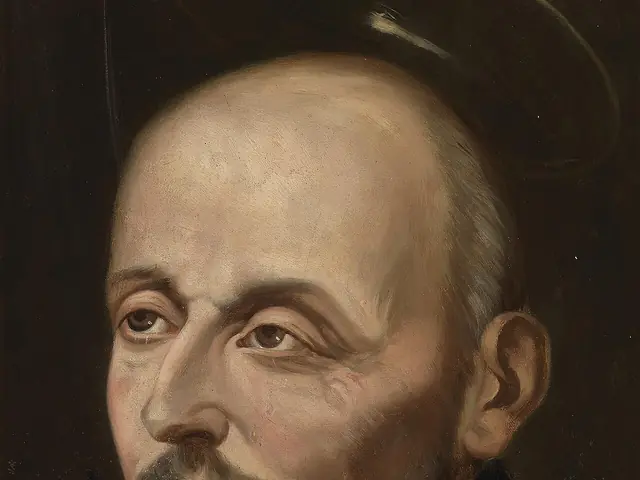
Agostino Carracci: Sacred Paintings from the Carracci Circle
Agostino Carracci (1557–1602) occupies a singular place among the three Carracci cousins: he was the most intellectually versatile, equally accomplished as painter, engraver, and art theorist. Born in Bologna a year after Annibale and trained alongside him and their cousin Ludovico, Agostino became the theoretical voice of the Accademia degli Incamminati, the man who codified its principles and gave them literary form. As an engraver, his prints after Tintoretto, Veronese, and Raphael circulated the achievements of the Venetian and Roman Renaissance across Europe, making him one of the most important transmitters of image culture in the late sixteenth century.

As a painter, Agostino worked in a style close to Annibale’s but with a particular refinement and a tendency toward poetic, lyrical subjects. He collaborated with Annibale on the Farnese Gallery ceiling in Rome, a project he eventually abandoned, and his independent paintings are fewer but often exceptionally beautiful. His sacred works show a deep engagement with Correggesque softness and Venetian color, and his devotional paintings have a meditative quality that distinguishes them from the more dramatically forceful works of Ludovico.
Annunciation

Agostino’s Annunciation in the Louvre demonstrates his ability to combine the learned figure style of the Carracci academy with genuine devotional warmth. The angel arrives with graceful certainty; Mary receives the message with a mixture of surprise and acceptance rendered through a single, eloquent gesture. The composition is classical in structure but intimate in feeling, and the soft light that fills the space reflects Agostino’s deep familiarity with Correggesque and Venetian painting, an intimacy gained not only through direct study but through his work as an engraver reproducing those masters’ compositions.
Assumption of the Virgin

The Assumption of the Virgin in the Pinacoteca Nazionale di Bologna shows Agostino working at the scale of large altarpiece painting with authority and clarity. The Virgin rises on a cloud of angels while the apostles below gesture upward in wonder. Agostino’s version is more restrained than Ludovico‘s treatment of the same subject, the composition is more tightly controlled, the emotional temperature cooler, the references to Raphael more explicit. It is a work that declares its learning without sacrificing beauty.
Saint Francis Consoled by the Musical Angel

This devotional painting in the National Gallery of Art depicts the beloved Franciscan legend in which an angel appears to the stigmatized Francis and consoles him with music so beautiful that he begs the angel to stop, fearing he could not bear more joy. Agostino renders the scene with exceptional poetic sensitivity: the angel bows over the instrument with concentrated grace while Francis tilts his head in rapturous listening. The soft, golden light that unites the two figures and the dreamy, meditative quality of the brushwork make this one of Agostino’s most appealing paintings, and one that influenced subsequent treatments of the subject in Bolognese art.
St. Jerome, after Tintoretto

This painted copy after Tintoretto, now in the Vanderbilt Museum of Art, reflects a central aspect of Agostino’s artistic practice: the sustained, systematic study of the great Venetian masters. As an engraver, Agostino translated Tintoretto’s compositions into print with extraordinary fidelity; as a painter, he made copies that served both as personal studies and as demonstrations of his analytical understanding of another master’s technique. This St. Jerome captures Tintoretto’s dynamic handling of light and the raw energy of the penitent saint beating his breast in the wilderness.
The Ecstasy of Saint Catherine of Siena

The Ecstasy of Saint Catherine of Siena in the Galleria Borghese in Rome shows Catherine supported by angels as she receives the mystical union that left her periodically unable to stand. Agostino renders the saint’s transport with a combination of physical collapse and spiritual radiance that captures the paradox of mystical experience: the body overwhelmed, the soul exalted. The angels who support her are painted with Agostino’s characteristic refinement, their faces combining beauty with attentiveness. The Galleria Borghese setting connects this work to the great Counter-Reformation collecting tradition of Rome.
The Holy Family

The Holy Family in the National Gallery of Art in Washington is a tender and intimate work that shows Agostino’s gifts as a painter of small-scale devotional subjects. The Christ Child, the Virgin, and Joseph are arranged with the naturalness and quiet affection that the Carracci academy promoted as an alternative to Mannerist artifice. The figures relate to one another with real human warmth, and the composition, clear, simple, and devotionally direct, reflects the principles of the Accademia degli Incamminati translated into a private, personal register.
The Last Communion of St. Jerome

The Last Communion of St. Jerome in the Pinacoteca Nazionale di Bologna is widely regarded as Agostino’s masterpiece. The aged, emaciated Jerome is borne to receive his final communion by two young monks who support his almost weightless body with reverent care. A priest administers the host; angels hover above. Agostino creates a scene of extraordinary emotional gravity by focusing attention on the contrast between Jerome’s frailty and the solemnity of the sacramental moment. The painting became enormously influential: Domenichino‘s famous version of the same subject in the Vatican, painted two decades later, is a direct response to Agostino’s composition.
The Last Supper

This Last Supper, now in the Museo del Prado in Madrid, places the sacred meal in a clearly organized architectural space with the figures arranged around the table in attitudes of response to Christ’s announcement that one of them will betray him. Agostino’s version is more measured than the dramatic, spatially complex Last Suppers of Tintoretto, emphasizing the psychological variety of the apostles’ reactions rather than theatrical spectacle. The classicizing dignity of the composition reflects Agostino’s training and his deep study of Raphael.
The Madonna Protecting Two Members of a Confraternity

This small devotional painting in the National Gallery of Art belongs to the tradition of the Madonna della Misericordia, the Virgin of Mercy who extends her cloak over the faithful. Two kneeling members of a religious confraternity shelter beneath the Virgin’s protective mantle, their faces turned upward in prayer. Agostino handles the subject with a delicacy and economy that makes the tenderness of the gesture feel immediate and personal. The gold-ground format and the small scale suggest a work made for private devotion, possibly commissioned by the confraternity itself as a votive offering.
Summary Table
| Name | Date | Medium | Location |
|---|---|---|---|
| Annunciation | c. 1593 | Oil on canvas | Louvre, Paris |
| Assumption of the Virgin | c. 1587 | Oil on canvas | Pinacoteca Nazionale di Bologna |
| Saint Francis Consoled by the Musical Angel | c. 1598–1600 | Oil on copper | National Gallery of Art, Washington |
| St. Jerome, after Tintoretto | c. 1585–1595 | Oil on canvas | Vanderbilt Museum of Art |
| The Ecstasy of Saint Catherine of Siena | c. 1590–1600 | Oil on canvas | Galleria Borghese, Rome |
| The Holy Family | c. 1589 | Oil on canvas | National Gallery of Art, Washington |
| The Last Communion of St. Jerome | 1592 | Oil on canvas | Pinacoteca Nazionale di Bologna |
| The Last Supper | c. 1598 | Oil on canvas | Museo del Prado, Madrid |
| The Madonna Protecting Two Members of a Confraternity | c. 1590 | Oil on copper | National Gallery of Art, Washington |
Important Facts About Agostino Carracci
- Agostino Carracci (1557–1602) was the middle cousin of the Carracci family and the most intellectually gifted, serving as the theorist and teacher of the Accademia degli Incamminati in Bologna.
- As an engraver, he produced a vast body of prints after Tintoretto, Veronese, Titian, and Raphael that made the achievements of the Italian Renaissance available across Europe.
- He worked alongside Annibale on the Farnese Gallery ceiling in Rome but abandoned the project after disagreements, moving to Parma where he died in 1602.
- His Last Communion of St. Jerome is regarded as his masterpiece and directly inspired Domenichino’s famous version of the same subject painted for Saint Peter’s in Rome.
- Among the three Carracci cousins, Agostino was the one most concerned with the theoretical justification of their reform, writing poetry and delivering lectures that articulated the academy’s principles.
Frequently Asked Questions
Who was Agostino Carracci?
Agostino Carracci (1557–1602) was a Bolognese painter, engraver, and art theorist, the eldest of the working Carracci cousins alongside Annibale. He co-founded the Accademia degli Incamminati and served as its intellectual voice, while his prints after the great Venetian and Roman masters made those works widely known across Europe.
What is Agostino Carracci best known for?
He is best known for his masterpiece The Last Communion of St. Jerome, for his engraving activity reproducing works by Tintoretto, Veronese, and Raphael, and for his theoretical contribution to the Carracci reform of Italian painting that ended Mannerism and prepared the way for the Baroque.
How does Agostino Carracci differ from Annibale?
Agostino was more intellectually oriented and more invested in theory and engraving than Annibale. His painted style is close to Annibale’s but tends toward greater refinement and a more meditative, lyrical quality; he was less prolific as a painter and less concerned with grand decorative cycles.
Why did Agostino leave the Farnese Gallery project?
Agostino began work with Annibale on the Farnese Gallery ceiling in Rome but reportedly clashed with his brother over working methods and artistic credit. He left Rome and moved to Parma in 1600, where he worked for Ranuccio I Farnese until his death in 1602.
Where can I see Agostino Carracci’s paintings?
His major works are in the Pinacoteca Nazionale di Bologna (Last Communion of St. Jerome, Assumption of the Virgin), the Louvre in Paris (Annunciation), the National Gallery of Art in Washington (Saint Francis, Holy Family, Madonna protecting a Confraternity), and the Galleria Borghese in Rome (Ecstasy of Saint Catherine).
Where can I buy an Agostino Carracci painting reproduction?
The shop at jesuschrist.pictures offers museum-quality canvas reproductions of the great Christian paintings, and the collection keeps growing; it is the best place to look for an Agostino Carracci painting reproduction.