Sainte-Chapelle Stained Glass: The Bible in 1,113 Scenes
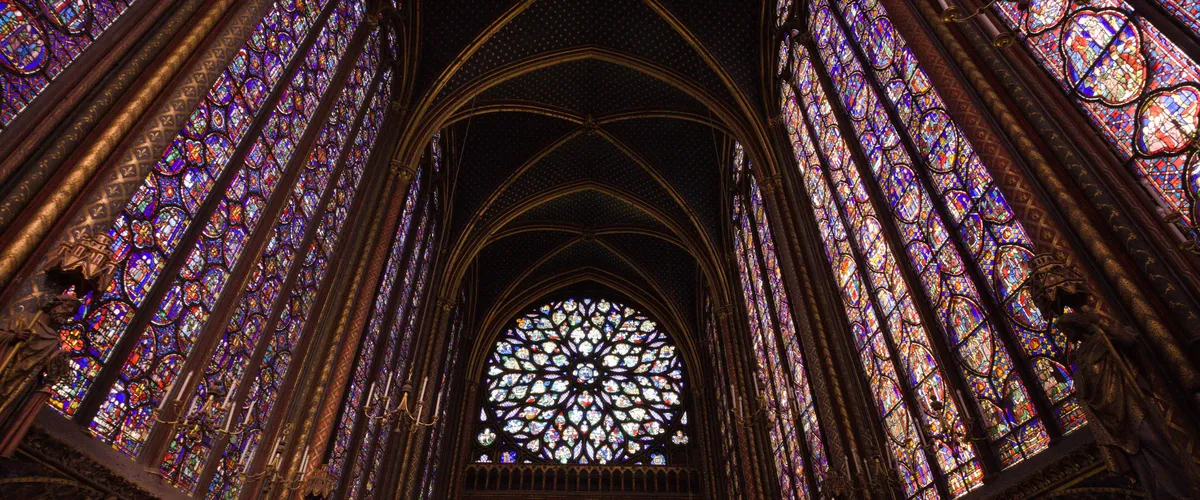
The Sainte-Chapelle stained glass is the closest thing the Middle Ages left us to a Bible you can walk into. In the upper chapel of this small royal church on the Île de la Cité in Paris, fifteen windows rise to about fifteen metres and tell, in 1,113 painted scenes, the story of the world from the Creation to the arrival of the Crown of Thorns in Paris. A sixteenth window, the great rose in the west wall, ends the story with the Apocalypse.
Most visitors climb the narrow spiral stair, step into the colour and stay ten minutes. The windows reward a slower look. They were designed to be read, panel after panel, by a king and his household, and once you know the order they follow, the chapel turns from a dazzling blur into a book.
This guide walks through the windows in the order the glaziers intended, picks out the scenes worth finding, and explains how much of the glass you see is truly medieval. The same Gothic world appears in paint and ink in our guides to medieval Christian paintings and medieval manuscript art.
A Reliquary Made of Light
The chapel exists because of a single relic. In 1239 King Louis IX of France, the future Saint Louis, bought from Baldwin II, the Latin emperor of Constantinople, the relic venerated as Christ’s Crown of Thorns. Baldwin had pawned it to Venetian lenders to pay for the defence of his city, and Louis paid 135,000 livres to release it, an enormous sum for the time. When the relic reached France in August 1239, the king walked the last stage of the road barefoot, dressed as a penitent, carrying it himself.
Other relics of the Passion followed in 1241, among them a fragment of the True Cross. To house them, Louis built a two-storey chapel against his palace: a lower chapel for the household and a high, glass-walled upper chapel for the royal family and the relics. It was consecrated on 26 April 1248. The building and its glass together cost about 40,000 livres, less than a third of the price of the Crown. The chapel was conceived as a reliquary turned inside out: instead of gold and gems around a relic, walls of coloured light around a king at prayer.
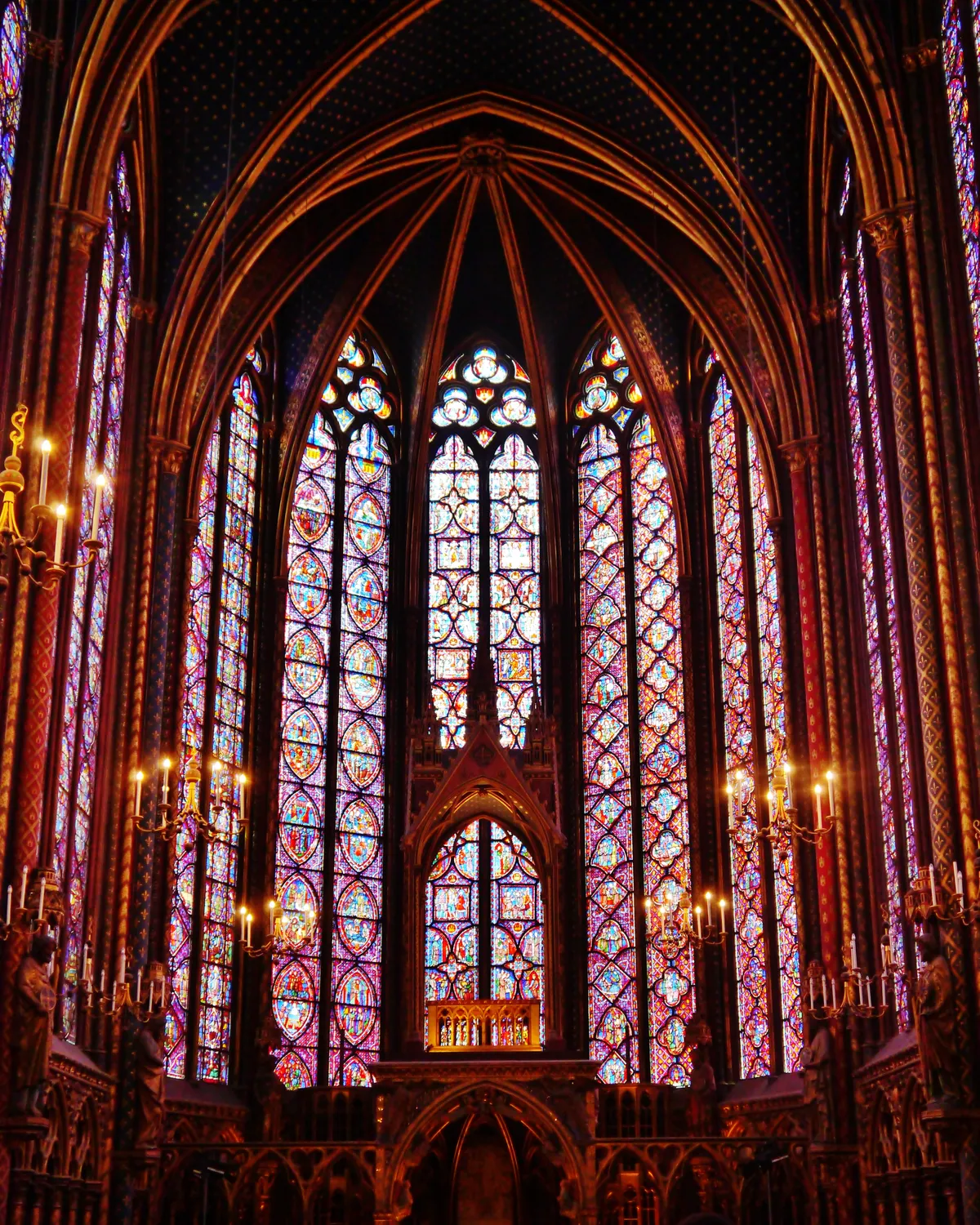
The architecture is built to make the stone disappear. The piers between the windows are bundles of slender columns, iron chains hidden behind the glazing bars hold the walls together, and more than six hundred square metres of glass fill the space between them. Deep blues and reds dominate, and the light inside changes from hour to hour.
How to Read the Sainte-Chapelle Windows
The reading starts on the north side, in the first window next to the entrance, with Genesis. It then moves clockwise: along the north wall of the nave, around the apse behind the altar, and back along the south wall, ending beside the entrance with the story of the relics. Inside each window, read from left to right and from the bottom up, one row at a time. The four great windows on each side of the nave are about 15.35 metres high and 4.70 metres wide; the seven windows of the apse are narrower.
One theme runs through them all: kingship. Scene after scene shows a ruler being crowned, leading his people, defending them in battle or tearing down idols. The chapel belonged to a king who kept, as his most precious possession, the crown of the King of Kings, and the windows set him in the long line of the kings of Israel.
The names of the glaziers are lost. Art historians have recognised at least three workshops at work at the same time: a main workshop, a master named after the Ezekiel window, and a Master of Judith and Esther whose delicate faces recall the illuminated manuscripts made in Paris in the same years. Together they glazed the chapel in a remarkably short time, probably less than four years.
1. The Genesis Window: the World Made in Glass
The first window on the north side opens with the Creation. God, a tall figure in a long robe, separates light from darkness, sets the sun, moon and stars in the sky, and calls plants and trees out of the earth. Then come Adam and Eve, the Fall, Cain and Abel, Noah’s Ark, and the long family stories of Abraham, Isaac, Jacob and Joseph, which spill over into the top of the next window.
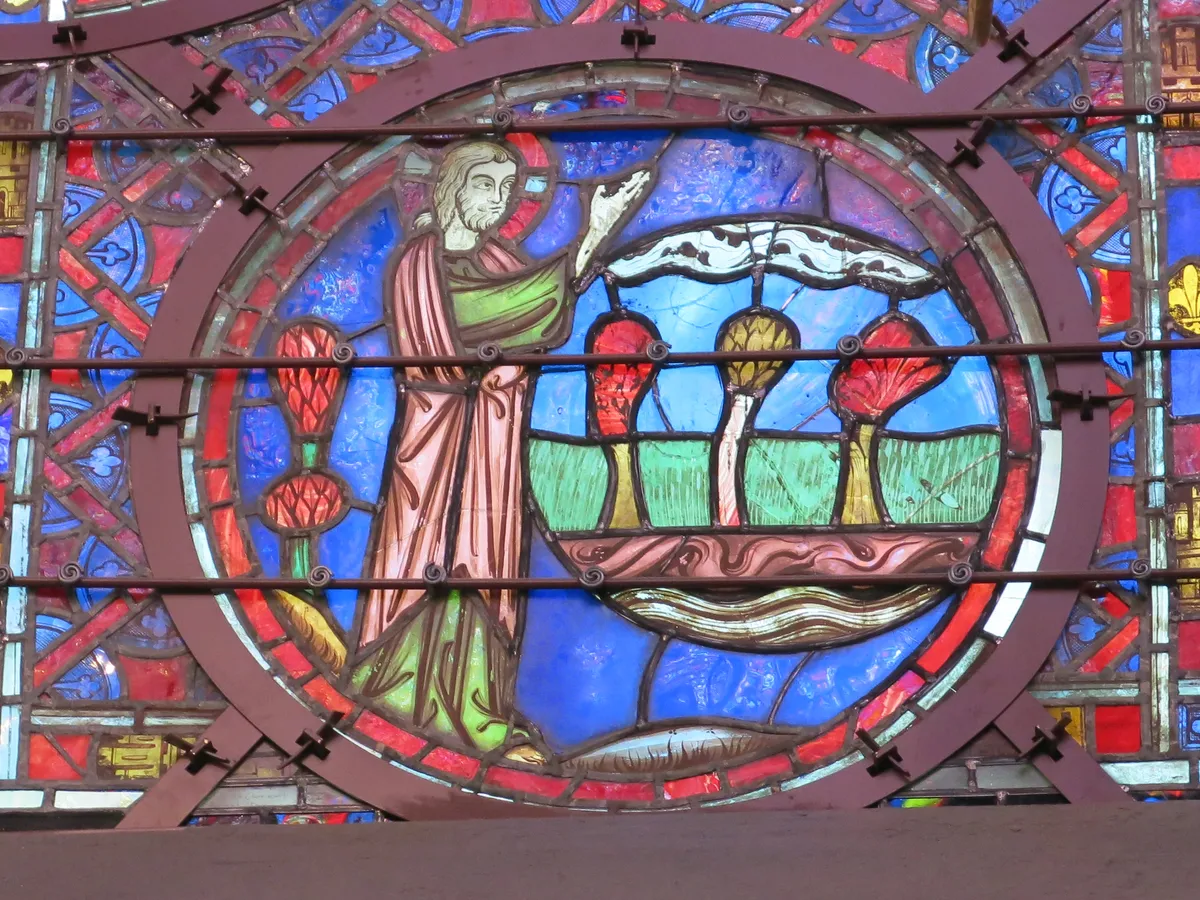
This is also the window that suffered most. An organ was set against it in the fifteenth century, and later building work on the palace damaged it further, so that when the restorers of the nineteenth century took it down, only a handful of its panels were still medieval. What you see is largely a careful reconstruction in the thirteenth-century style. The same stories, painted on panel and canvas, fill our selections of Adam and Eve paintings and Noah’s Ark paintings.
2. Exodus, Numbers and Joshua: Moses and the Promised Land
The Exodus window is one of the best preserved in the chapel, and most of its scenes are still medieval glass. It follows Moses from the basket in the reeds to the burning bush, the plagues of Egypt, the crossing of the Red Sea and the giving of the Law. The glaziers present him as leader and lawgiver, the model of a ruler chosen by God: in seven scenes God appears or speaks to him directly.
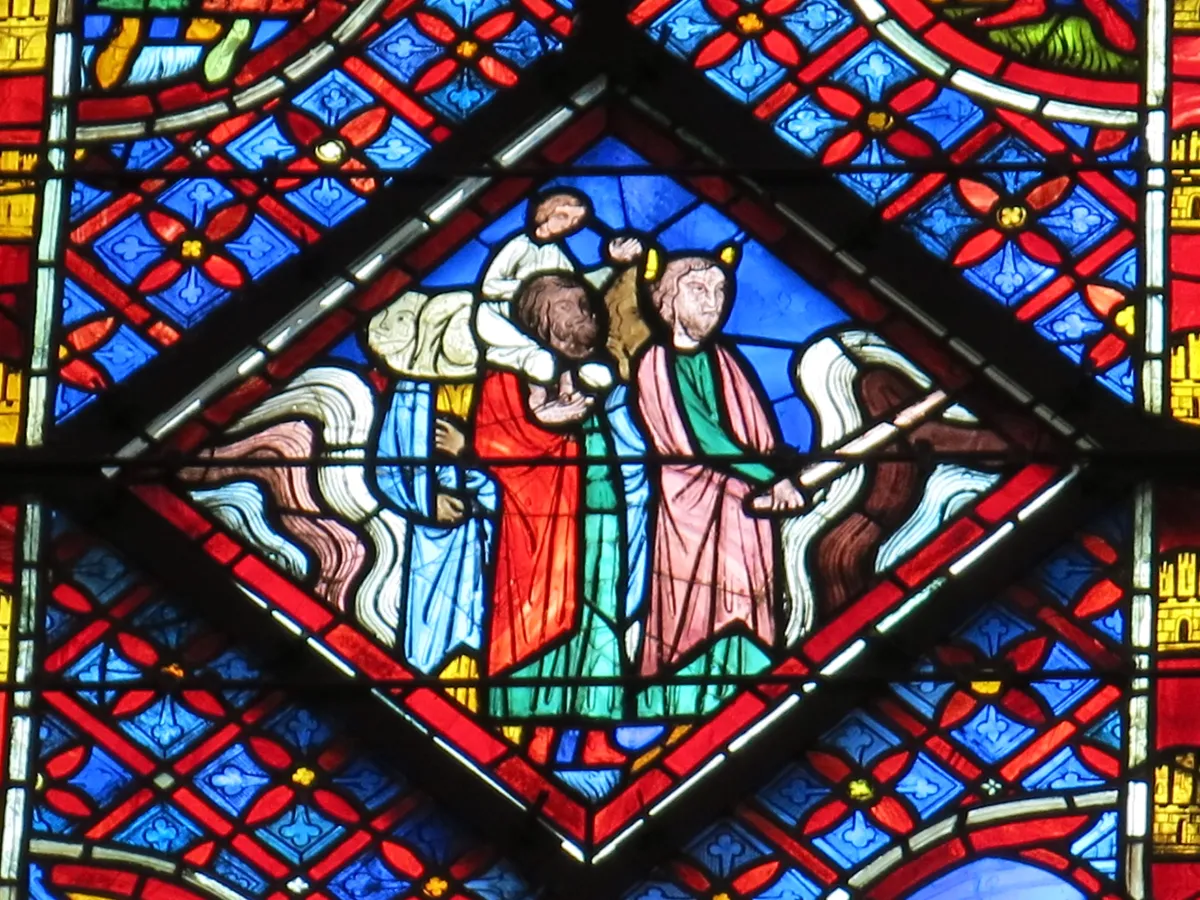
The next window, the Book of Numbers, rises above the niche on the north side of the nave that was reserved for the king. Twenty of its scenes show princes of the tribes of Israel being crowned, and Moses is easy to spot by the two horns on his head, the medieval way of showing the rays of light that shone from his face after he spoke with God. The fourth window turns to Deuteronomy and Joshua: the struggle against idols, the crossing of the Jordan and the fall of Jericho, with the story of Ruth in the tracery at the top. Our Moses paintings follow the whole story of Exodus in painting.
3. The Judges Window: Gideon and Samson
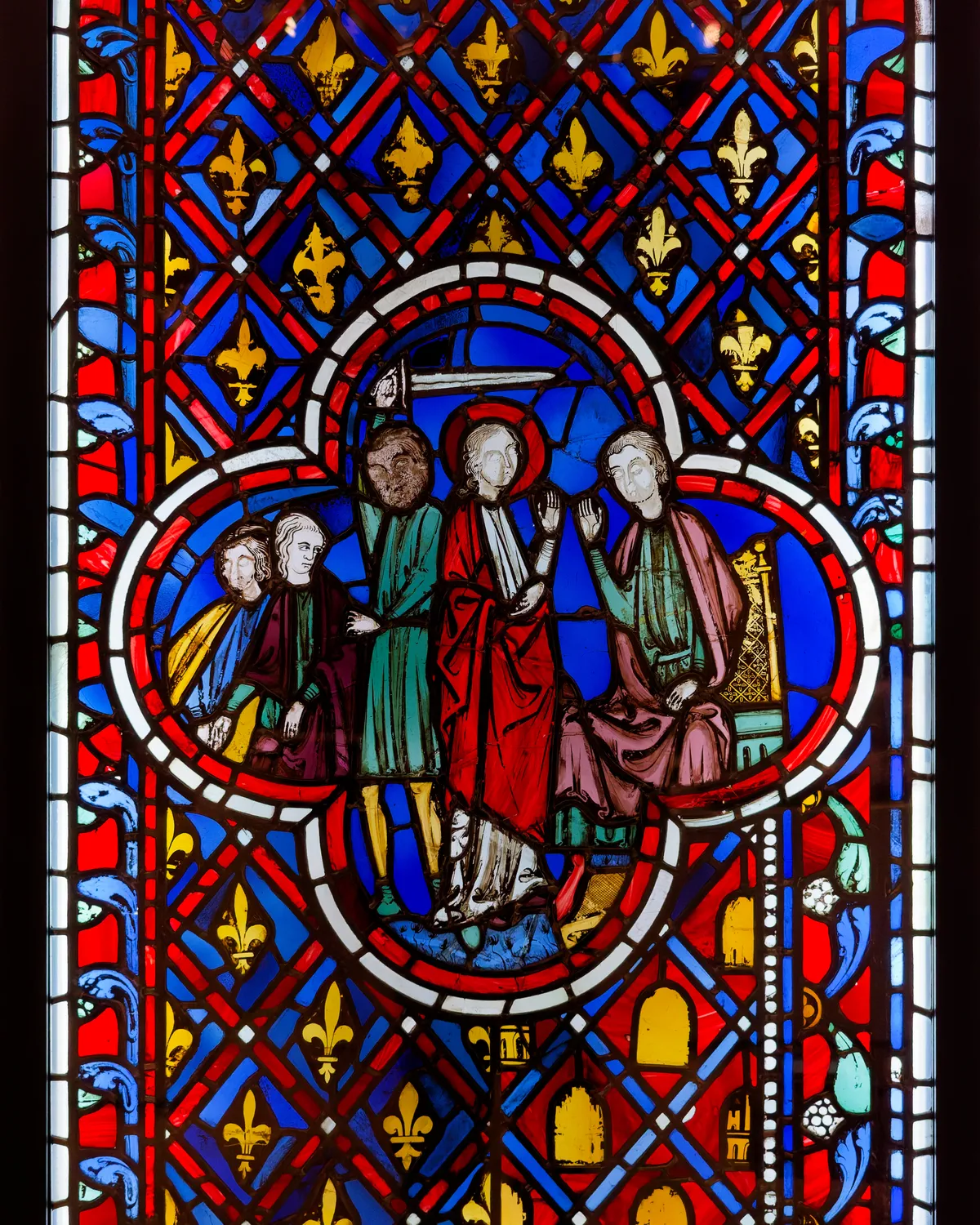
With the fifth window the story enters the apse. The Book of Judges tells of the leaders who defended Israel before it had kings: Gideon and his victory over the Midianites, Jephthah, and Samson, the strongman whose adventures read like the labours of Hercules. It is one of the most damaged windows in the chapel: fewer than half of its 64 figured panels are original.
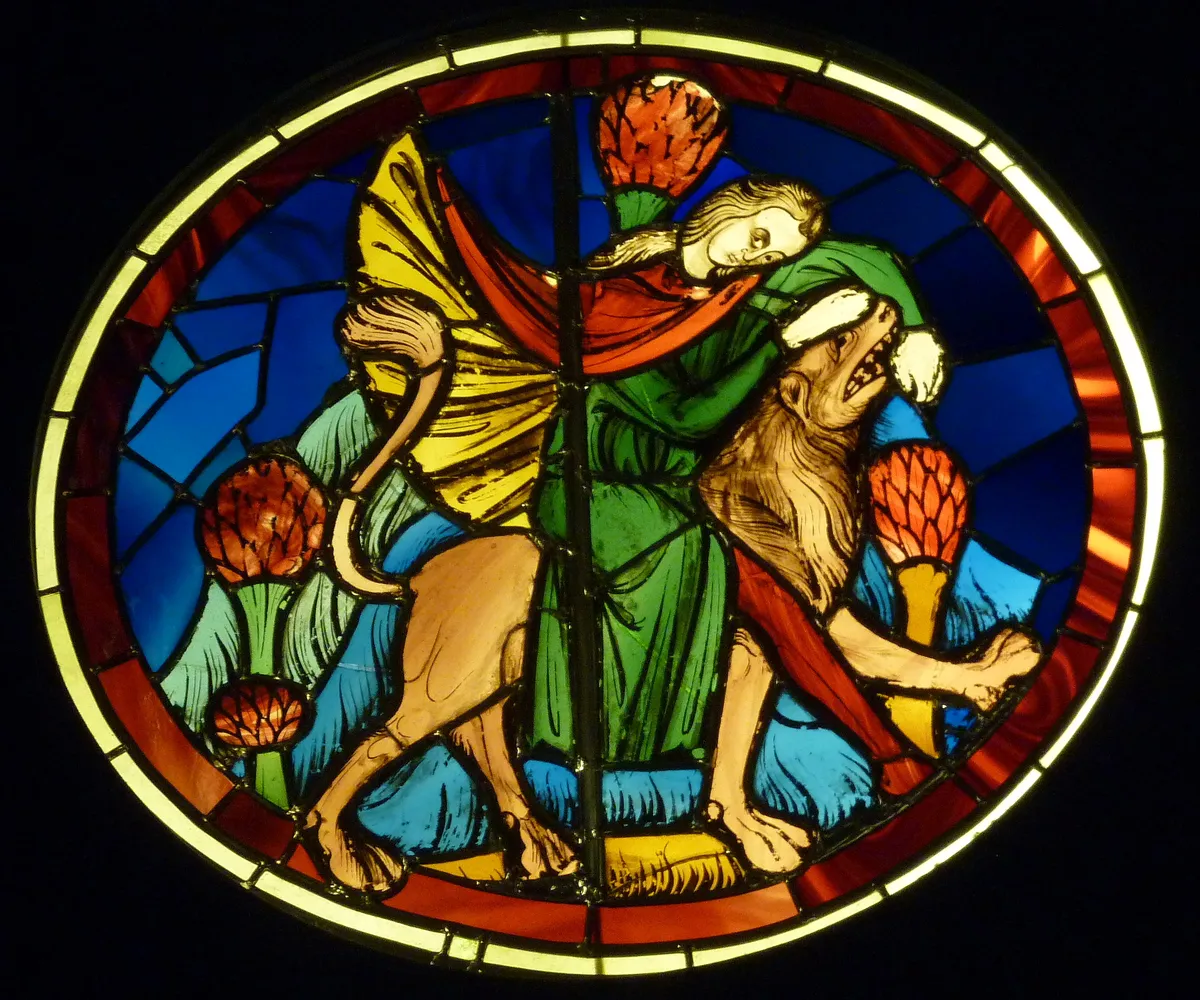
Some of the missing pieces were not destroyed but moved. The roundel of Samson tearing the lion apart, above, left the chapel in the nineteenth century and is now in the Musée de Cluny, the national museum of the Middle Ages in Paris, where it can be seen at eye level. Samson’s later fall is told in our article on the story of Samson and Delilah.
4. The Apse: Isaiah and the Tree of Jesse
The apse, the rounded east end where the clergy and the king followed the liturgy, changes the subject from history to prophecy. The window of Isaiah has two independent halves: on the left the life and visions of the prophet, on the right a complete Tree of Jesse, the family tree of Christ growing from the sleeping Jesse, after Isaiah’s words about the shoot that springs from the stem of Jesse. It is the hinge of the whole programme, the point where the Old Testament turns towards the coming of Christ.
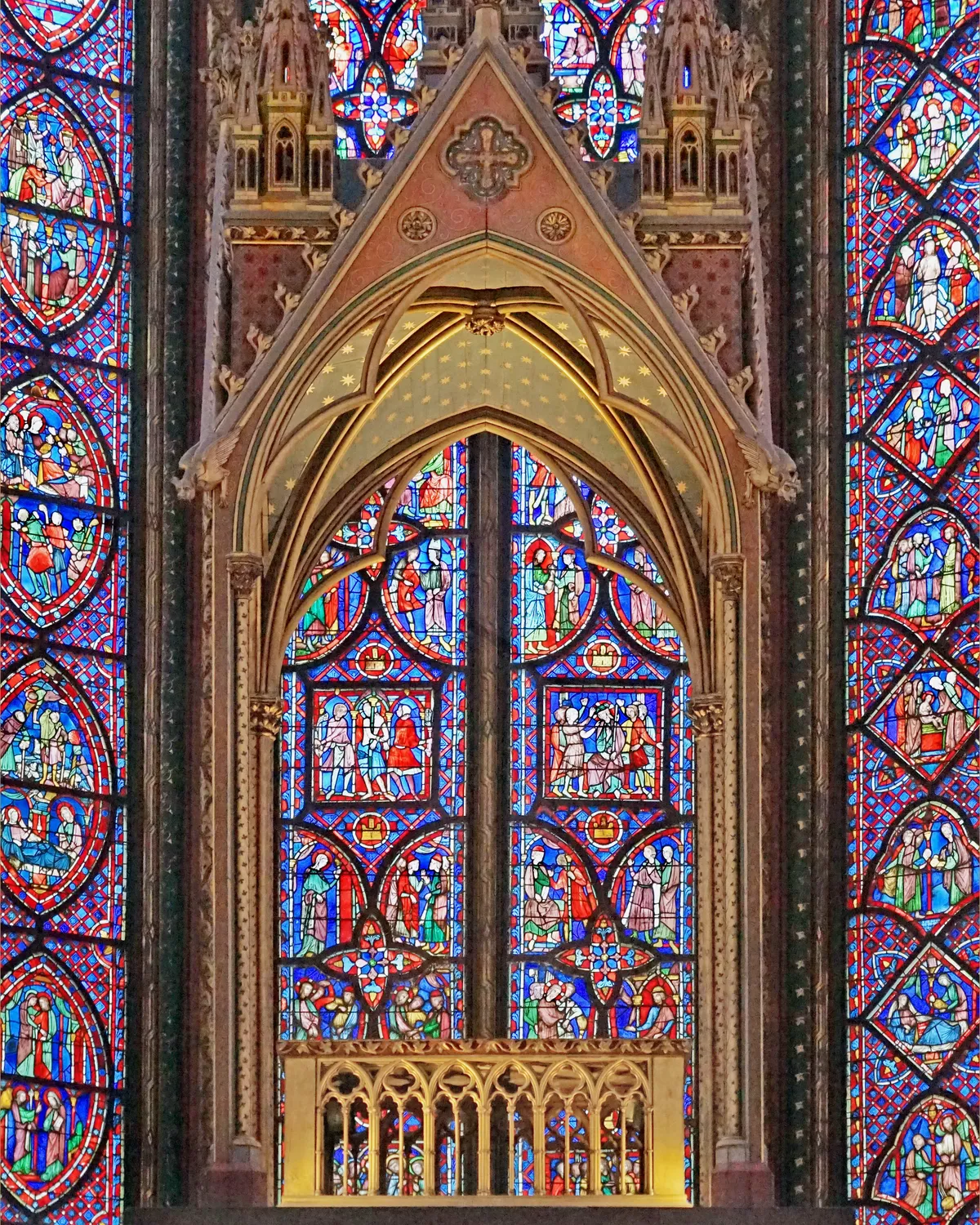
In front of the central windows stands the tribune of the relics, a canopied platform installed in the 1260s, where the Crown of Thorns and the other relics were kept in a great chest of silver and gilded copper. Each Good Friday, Louis brought them out and showed them to the faithful. The chest was melted down during the Revolution; the tribune, restored in the nineteenth century, still frames the glass behind it. The same Tree of Jesse inspired our free Jesse Tree for Advent, and it can hang in your home as a Tree of Jesse fine art poster.
5. The Passion Window, Behind the Crown
The axial window, directly behind the tribune, tells the Passion of Christ. Its place is the key to the whole chapel. Anyone looking up at the relics on their platform saw, rising behind them in glass, the very scenes they recalled: the Flagellation, the Crowning with Thorns and the Crucifixion. The object and its story were seen together, one in front of the other.
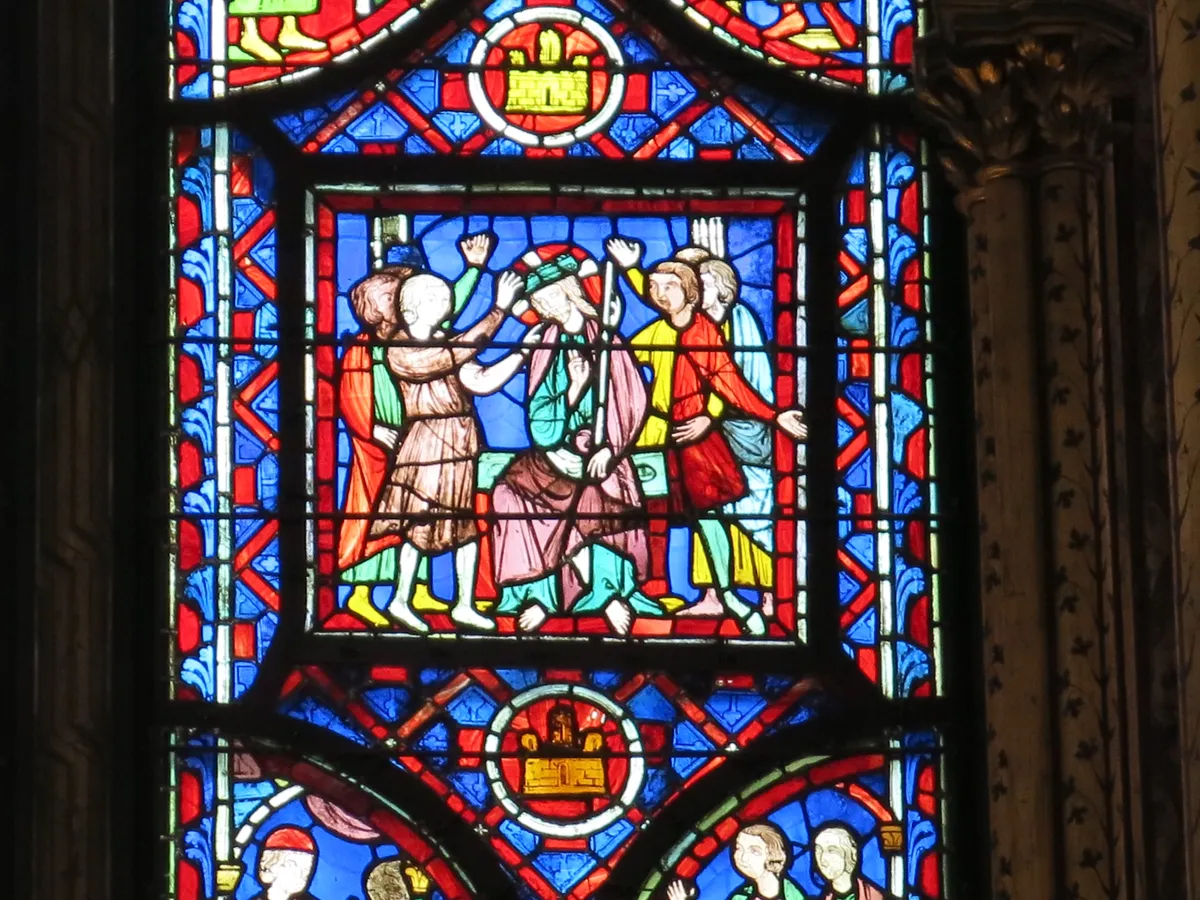
The Passion window is well preserved, with most of its scenes still medieval, and its story does not stop at the tomb. It continues through the Resurrection to Pentecost, the coming of the Holy Spirit, which gives the Passion its meaning. Painters would retell these scenes for centuries; our famous Crucifixion paintings follow one of them through Western art, and the Life of Christ in 20 paintings sets them in the whole Gospel story.
6. The Two Saints John, Daniel and Ezekiel
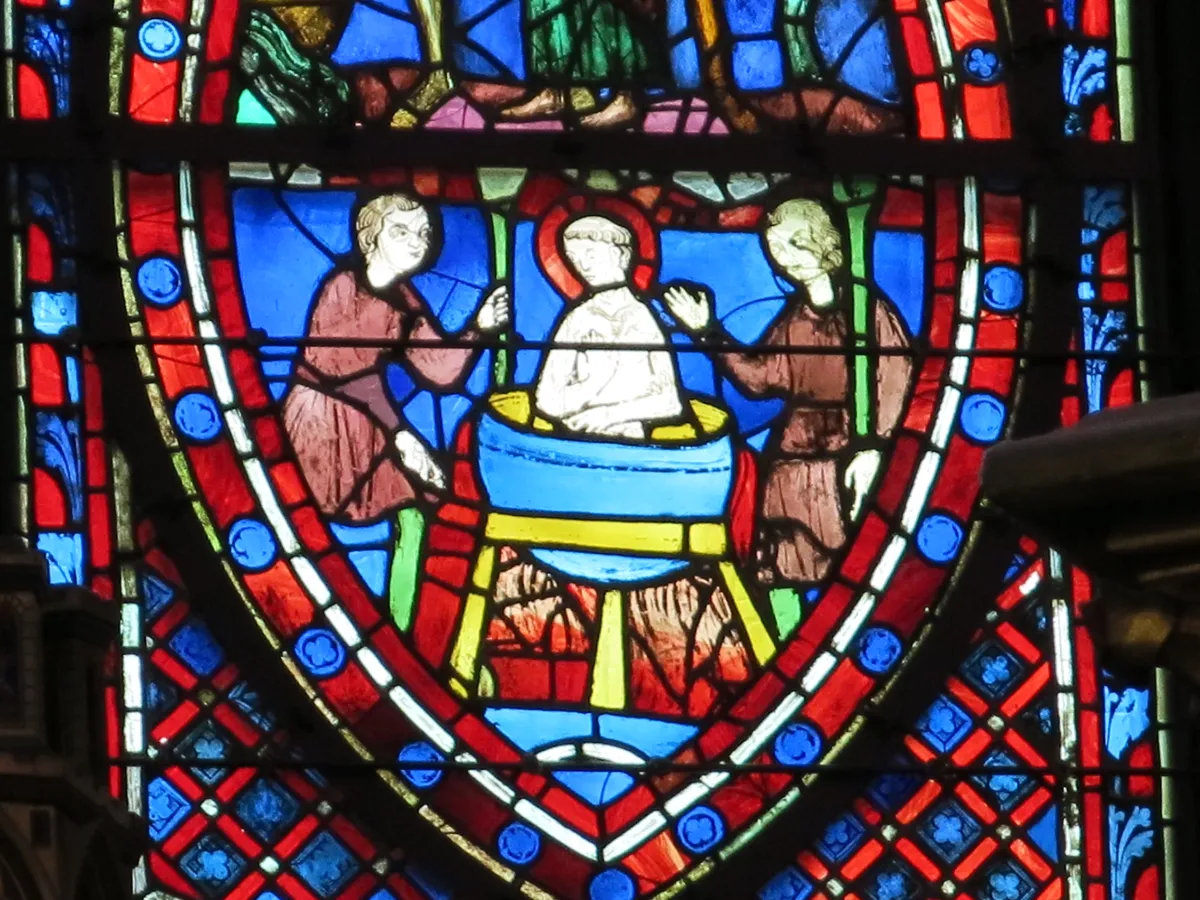
On either side of the Passion stand its witnesses. To the left, one window pairs the Childhood of Christ with the life of Saint John the Evangelist, the author of the Apocalypse, shown here plunged into a cauldron of boiling oil from which, according to legend, he came out unharmed. To the right, another pairs Saint John the Baptist, the last of the prophets, who pointed to Christ as the Lamb of God, with the Book of Daniel and its den of lions.
Further round come the visions of Ezekiel, where the four living creatures that later became the symbols of the Evangelists appear, then Jeremiah and the Book of Tobit. Tobit carries a personal note: Saint Louis was attached to the story of young Tobias, guided on his journey by the Archangel Raphael, and is said to have prayed as Tobias did in the days before his own wedding. You can meet the same angel in our article on the Archangel Raphael, and the Baptist in our Saint John the Baptist paintings.
7. Judith, Job and Esther: the Queens’ Side
Back in the nave, the south wall belongs largely to women. The window of Judith and Job opens with forty panels on the widow of Bethulia who saved her people by beheading the Assyrian general Holofernes. Some of its scenes carry captions in French rather than Latin, which may be the earliest French ever written on a stained glass window, a small sign of the language of the court entering the art of the Church.
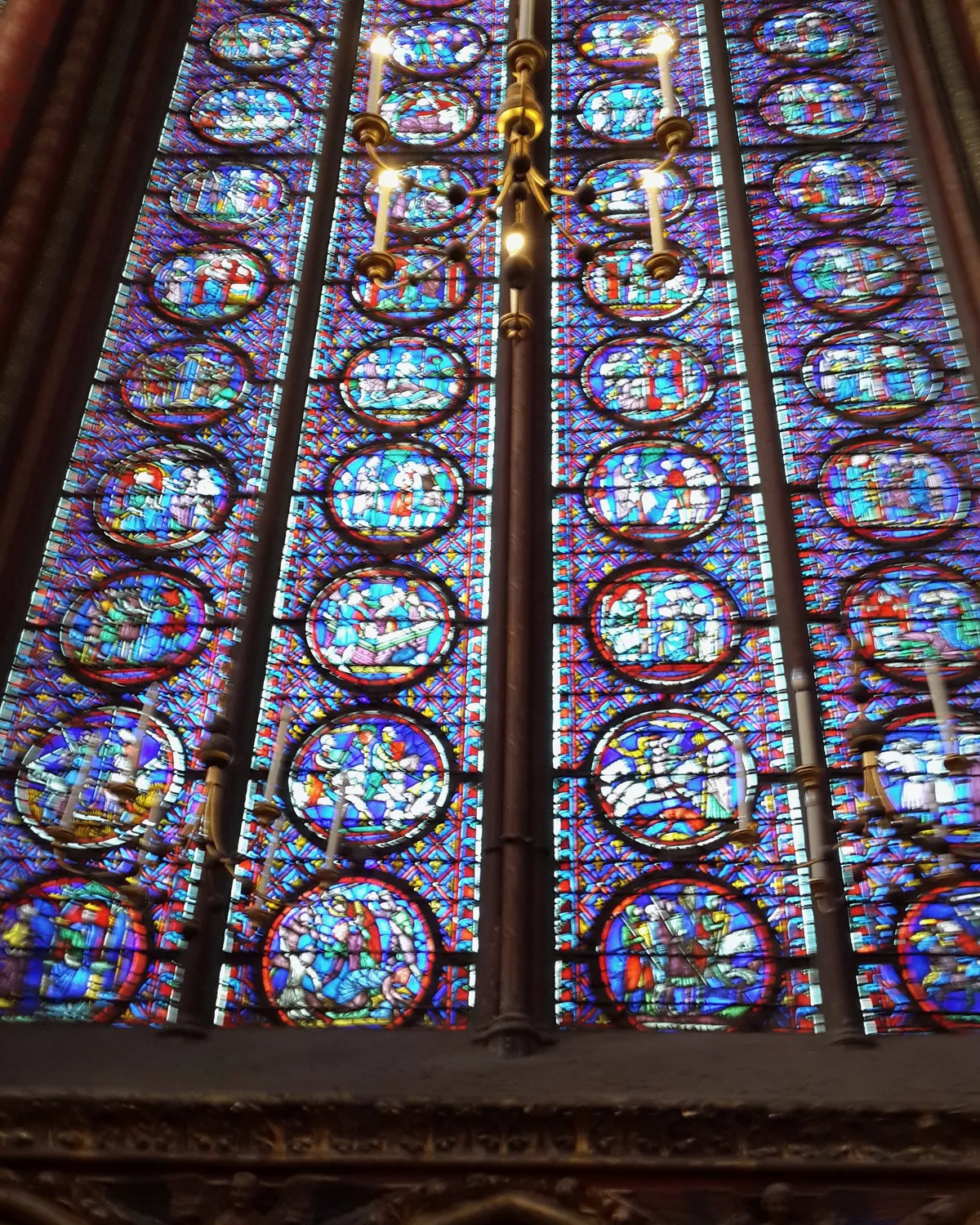
The next window tells the Book of Esther in 120 panels: the Jewish queen of Persia who saved her people from a massacre. It rises above the niche of Blanche of Castile, the king’s mother, who had governed France during his childhood, and like six other windows it is strewn with the golden castles of Castile beside the fleurs-de-lis of France. Esther’s story reads as a tribute to a queen who protected her people. Then comes the Kings window, with Samuel, Saul, David and Solomon, the anointed rulers of Israel. Judith’s story in painting is told in our article on Judith and Holofernes.
8. The Relics Window: a King in His Own Bible
The last of the fifteen windows, next to the entrance on the south side, brings the Bible up to the thirteenth century. Its lower rows tell the legend of Saint Helena, the mother of Emperor Constantine, who searched for the cross of Christ in Jerusalem; when three crosses were found, the true one was recognised by the healing it worked. Above, the story moves to Constantinople and then to France, ending with Louis IX receiving the relics and carrying them into Paris.
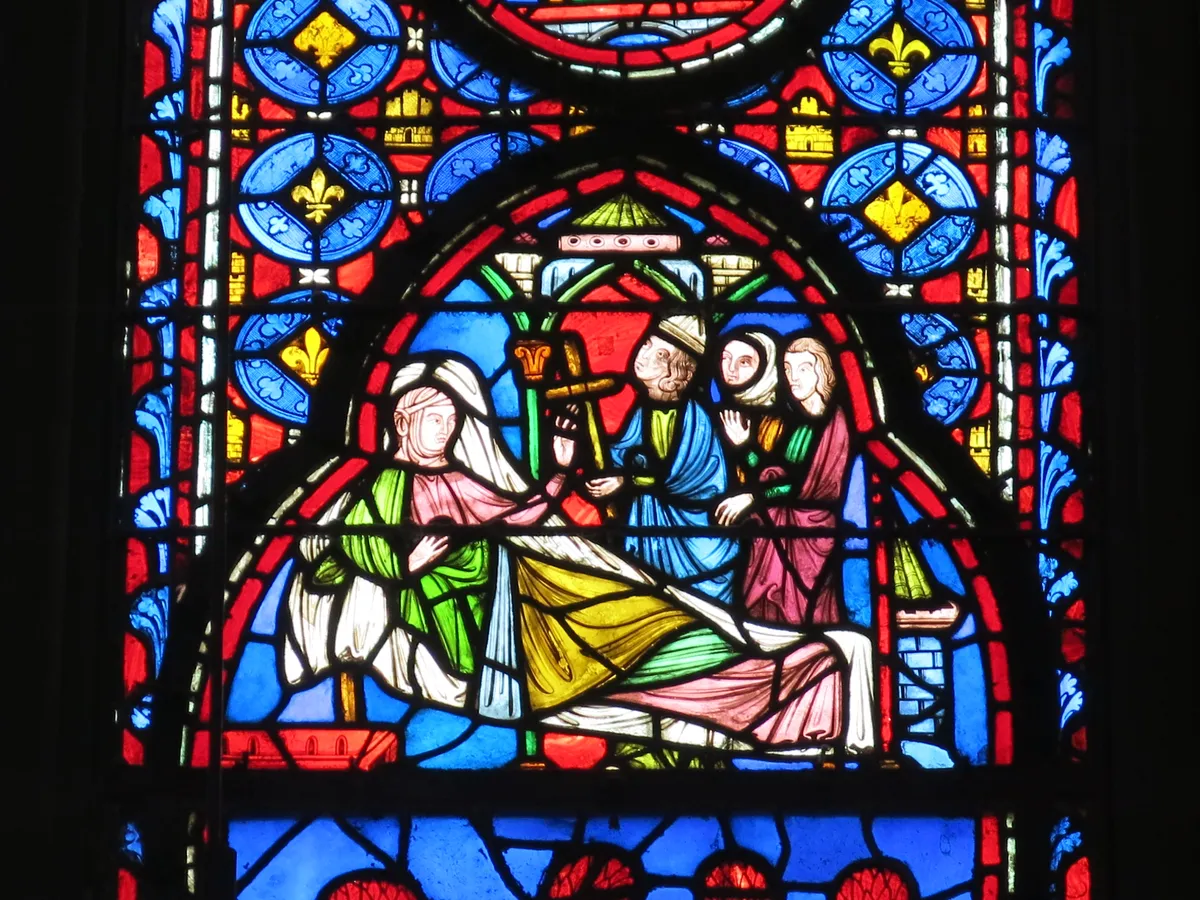
To show a living king in a sacred window was almost unheard of in the thirteenth century. The message was plain: the history that began with Adam and passed through Moses, David and Esther now continued in Paris, with Louis as the guardian of Christ’s own crown. Honesty requires a caveat. This is one of the least preserved windows in the chapel, and the nineteenth-century restorers had to reinvent much of it, the Helena scenes in particular. The episodes of Saint Louis were rebuilt with the help of about nineteen surviving medieval panels.
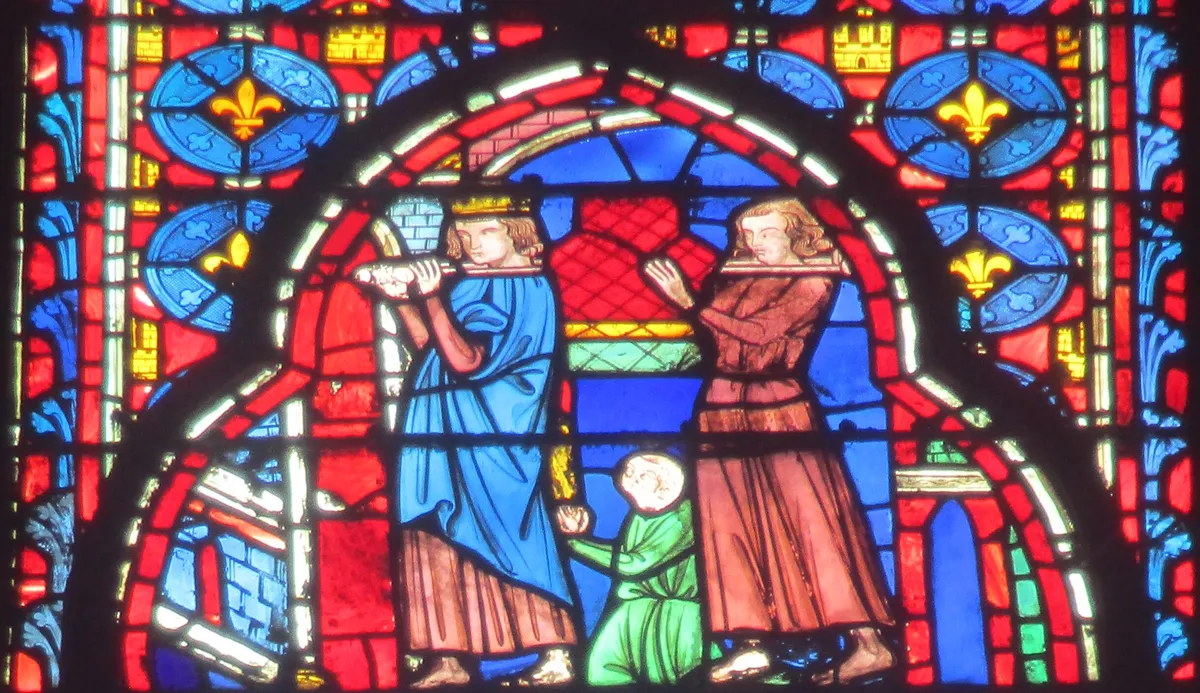
The Crown itself survived the Revolution and is kept today in Notre-Dame de Paris. It was rescued from the fire of April 2019 and returned to the cathedral in December 2024.
9. The Apocalypse Rose
Turn around before you leave. The great rose window in the west wall, about nine metres across, closes the story with the end of time: the Book of Revelation, from the vision of Saint John to the Last Judgment and the heavenly Jerusalem. The first rose of the 1240s probably showed the Apocalypse already, but the one you see was made between 1485 and 1498 for King Charles VIII, whose royal initial appears in the glass.
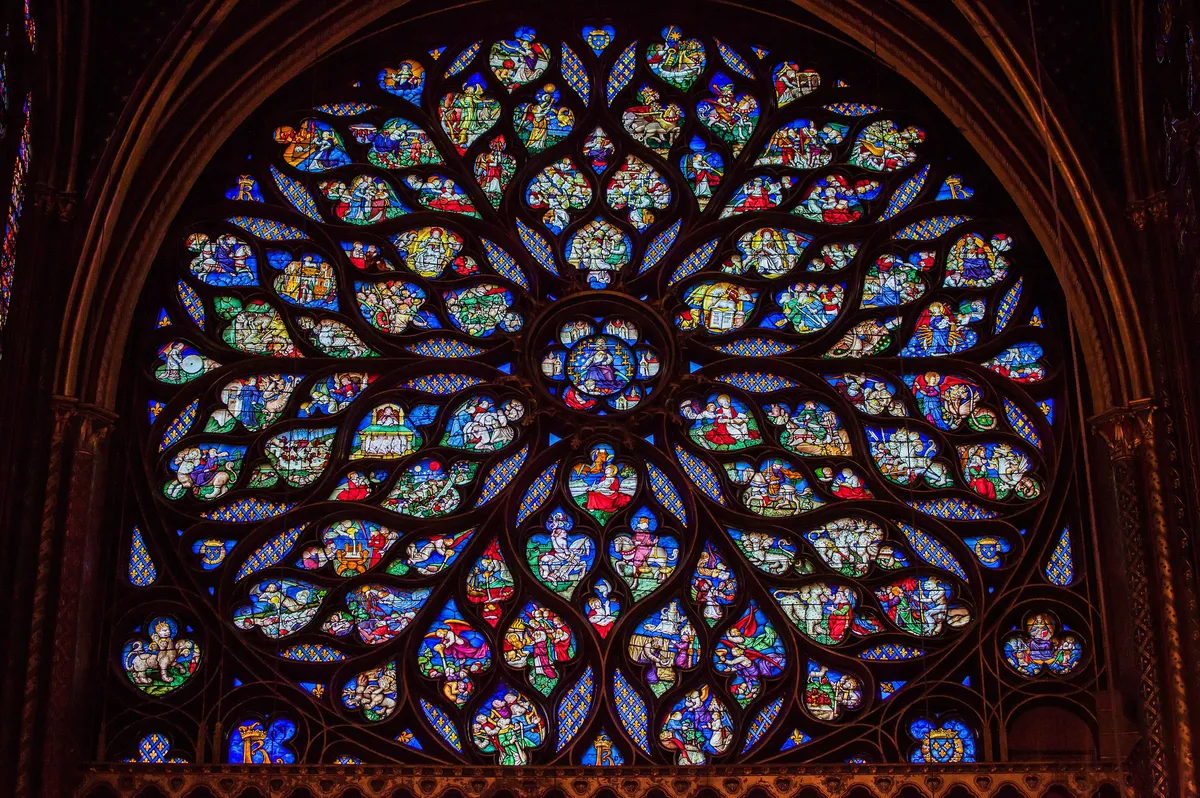
Two centuries separate it from the rest of the glass, and it shows. The flamboyant tracery curls like flames, the panels are larger and lighter, and the glaziers made full use of silver stain, a fourteenth-century discovery that tints glass yellow when fired, so that a single piece can carry two colours without another line of lead. The rose was glazed in the same years that Albrecht Dürer was cutting his Apocalypse woodcuts in Nuremberg, published in 1498, and a few years after Hans Memling painted the vision of Saint John on his altarpiece in Bruges. The Apocalypse had been a favourite subject of French court art for more than a century, as the Apocalypse Tapestry of Angers shows, and its scenes of judgment invite a comparison with Michelangelo’s Last Judgment. The rose faces west and is at its best in the late afternoon.
10. How Much of the Glass Is Original?
About two thirds of the glass in the fifteen great windows is thirteenth-century, a remarkable survival. The chapel came close to losing far more. After the Revolution it served as a flour store and then, from 1803 to 1837, as an archive for the law courts next door. The lower part of the windows, about two metres, was taken out to give the clerks more light, and the panels were sold. Many were bought by English collectors, which is why scenes from the Sainte-Chapelle can be found today in the Victoria and Albert Museum in London, in the parish church of Twycross in Leicestershire, and in museums in Rouen and Paris.
The great restoration came in the middle of the nineteenth century, between about 1846 and 1855, with the antiquarian Ferdinand de Guilhermy in charge of the iconography, the painter Louis Steinheil drawing the designs and the glazier Antoine Lusson making the glass. Missing scenes were redrawn in the manner of the originals, and the medieval pieces they removed went to the Musée de Cluny. The windows were taken down for safety in both world wars. The most recent campaign, from 2008, cleaned every panel and added a discreet outer layer of protective glass; its last stage, the rose, was completed for the eight hundredth anniversary of the birth of Saint Louis, born in 1214.
The Fifteen Windows and the Rose, in Reading Order
| Order | Window | Main stories | What to look for |
|---|---|---|---|
| 1 | Genesis | Creation to Joseph | God creating the stars, plants and trees |
| 2 | Exodus | Moses, the plagues, the Law | Moses striking the Red Sea |
| 3 | Numbers | The tribes of Israel | Horned Moses above the king’s niche |
| 4 | Deuteronomy and Joshua | Jordan, Jericho | Ruth in the tracery |
| 5 | Judges | Gideon, Jephthah, Samson | Samson and the lion (now at Cluny) |
| 6 | Isaiah and the Tree of Jesse | Prophecy of the Messiah | The ancestors of Christ on one tree |
| 7 | Saint John the Evangelist and the Childhood of Christ | Infancy, life of John | John in the boiling oil |
| 8 | The Passion (axial window) | Passion to Pentecost | The Crowning with Thorns behind the tribune |
| 9 | Saint John the Baptist and Daniel | The Forerunner, the prophet | Daniel in the lions’ den |
| 10 | Ezekiel | The prophet’s visions | The four living creatures |
| 11 | Jeremiah and Tobit | Exile and return | Tobias and the Archangel Raphael |
| 12 | Judith and Job | Judith and Holofernes, Job’s trials | Captions in French |
| 13 | Esther | The queen who saved her people | The castles of Castile |
| 14 | Kings | Samuel, Saul, David, Solomon | Coronation scenes |
| 15 | Relics of the Passion | Saint Helena, Constantinople, Saint Louis | The king carrying the relics |
| Rose | The Apocalypse (1485 to 1498) | The Book of Revelation | The initial of Charles VIII |
Seeing the Windows for Yourself
Choose a bright day: stained glass needs sunlight behind it, and on a grey morning the chapel loses much of its fire. The apse faces east and glows in the morning, the south wall around midday, the rose in the late afternoon. The lowest rows are the easiest to read, so start there in each window and work upward; a small pair of binoculars brings the upper scenes within reach. Then go and see the glass that left: the Musée de Cluny, a short walk away on the left bank of the Seine, keeps panels from the chapel, the Samson roundel among them.
Conclusion: a Bible Made for a King
The Sainte-Chapelle was built to hold a crown, and its windows were made to explain it. They lead the eye from the Creation through the kings and queens of Israel to the Passion, set the relic of the Crown of Thorns in front of the scenes it recalls, and end with a living king carrying it home. Read in order, the 1,113 scenes become one argument: the history of salvation, passing through Paris.
The same stories were told again in paint, a generation later in Italy, by Giotto and his followers, and for centuries after. Our selection of the most famous Christian paintings is a good place to continue the journey.
Important Facts About the Sainte-Chapelle Stained Glass
- The Sainte-Chapelle was built by Louis IX to house the Crown of Thorns, bought in 1239 for 135,000 livres, and was consecrated on 26 April 1248.
- The upper chapel has fifteen windows of the 1240s, eight in the nave and seven in the apse, with 1,113 figured scenes, plus a rose window of 1485 to 1498.
- About two thirds of the thirteenth-century glass is original; the rest was restored between about 1846 and 1855.
- The windows are read from the north side next to the entrance, clockwise, and inside each window from left to right and from the bottom up.
- The axial Passion window stands directly behind the tribune where the relics were displayed.
- The last window shows the arrival of the relics in Paris, with Saint Louis himself, a rare contemporary subject for the thirteenth century.
- Panels removed from the chapel are now in the Musée de Cluny in Paris and the Victoria and Albert Museum in London, among other places.
- The Crown of Thorns is kept today in Notre-Dame de Paris.
Frequently Asked Questions
Is the stained glass in Sainte-Chapelle original?
Mostly, yes. About two thirds of the glass in the fifteen great windows dates from the 1240s, which makes the Sainte-Chapelle one of the largest surviving collections of thirteenth-century stained glass in the world. The rest was restored between about 1846 and 1855, when missing scenes were redrawn in the medieval style. The Genesis and Relics windows are the most restored; the Exodus and Passion windows are among the best preserved. The west rose is original glass from the late fifteenth century.
How many stained glass windows are in Sainte-Chapelle?
The upper chapel has fifteen great windows, eight in the nave and seven in the apse, plus the west rose window, sixteen in all. Together they contain 1,113 figured scenes from the Bible, from Genesis to the Passion, and the story of the relics, while the rose shows the Apocalypse. The lower chapel has its own windows, but those date from the nineteenth century.
What is so special about Sainte-Chapelle?
It is a royal chapel built as a reliquary for the Crown of Thorns, and its walls are almost entirely made of glass. More than six hundred square metres of thirteenth-century stained glass tell the Bible in 1,113 scenes, in an order meant to be read like a book, and the whole chapel was built and glazed in only a few years in the 1240s.
Which is older, Sainte-Chapelle or Notre-Dame?
Notre-Dame was begun first: its first stone was laid in 1163, about eighty years before work started on the Sainte-Chapelle. But the cathedral took nearly two centuries to complete, while the Sainte-Chapelle was finished and consecrated in 1248, so the chapel’s glass was in place while Notre-Dame was still being built.
Is Sainte-Chapelle the same as Notre-Dame?
No. They are two different buildings on the same island, the Île de la Cité, a few minutes’ walk apart. Notre-Dame is the cathedral of Paris. The Sainte-Chapelle is a royal chapel inside the old palace of the kings, today surrounded by the law courts. The Crown of Thorns, made for the Sainte-Chapelle, is now kept in Notre-Dame.
Can you buy medieval Christian art like the Sainte-Chapelle windows?
You can buy medieval Christian art in the spirit of the Sainte-Chapelle at jesuschrist.pictures, in our shop, as canvas reproductions and fine art posters: Giotto’s Crucifixion, Gentile da Fabriano’s Gothic Adoration of the Magi, Jesus with the Crown of Thorns, and posters of the Tree of Jesse and the Agnus Dei in the style of medieval manuscripts. They bring the deep reds, blues and gold of Gothic art into a home, a prayer corner or a parish hall.