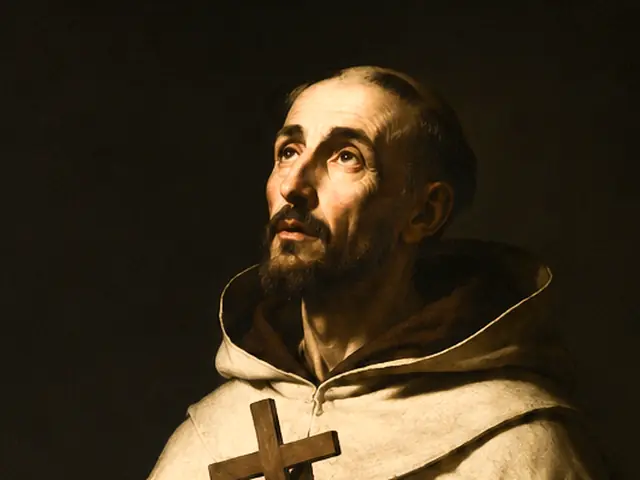
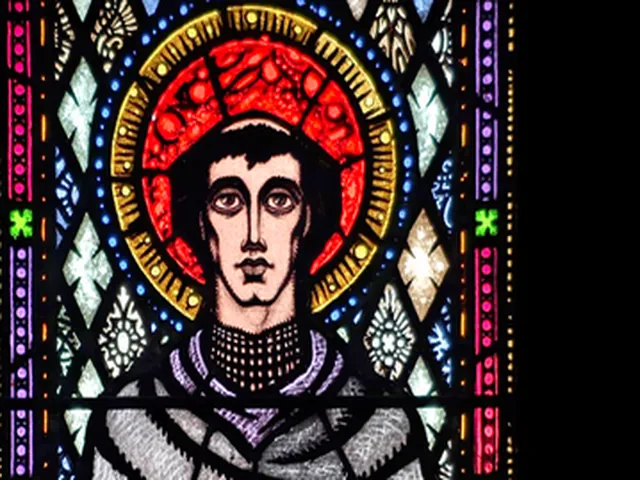
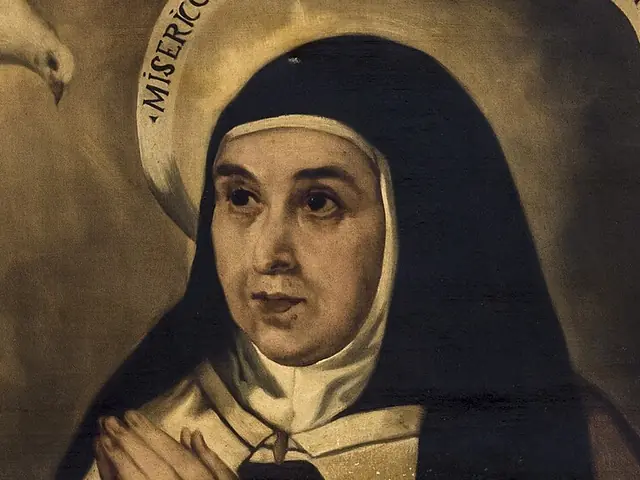
15 Spanish Saints and the Painters Who Gave Them Their Faces
Spain has given the Church more canonised saints than almost any other nation, and it did something rarer still: it produced, in the same century, the painters who could look them in the face. Teresa of Avila was born in 1515 and Ignatius of Loyola in 1491. El Greco arrived in Toledo in 1577, Zurbaran was born in 1598, Velazquez in 1599, Murillo in 1617. The mystics and the men who painted them breathed the same air. That is why the Spanish saints do not look like symbols. They look like people who were in the room. This guide gathers fifteen of them, from a first century apostle buried at Compostela to a priest who died in 1975, and pairs each with the painting that fixed his or her face in the Western imagination.
Why Spain Produced So Many Saints, and So Many Painters to Match
Three things came together. First, geography: for eight centuries the Iberian peninsula was a frontier between Christianity and Islam, and frontiers make martyrs, monks and militant reformers. Second, empire: after 1492 Spanish missionaries sailed to Asia and the Americas, and a missionary vocation is a saint making machine. Third, and this is the part that concerns an art site, the Counter Reformation gave Spanish painters a job. The Council of Trent, closing in 1563, told the Church to teach through images. Spain took the instruction more literally than anyone. Convents, cathedrals and confraternities commissioned saints by the hundred, and they wanted them convincing. Zurbaran painted monks you could touch. Ribera painted skin, age and pain with an honesty that still unsettles. Murillo painted tenderness. You can follow the whole arc through our Spanish Renaissance paintings and the darker, more theatrical Spanish Baroque that followed it.
1. Saint James the Greater, Santiago (feast 25 July)
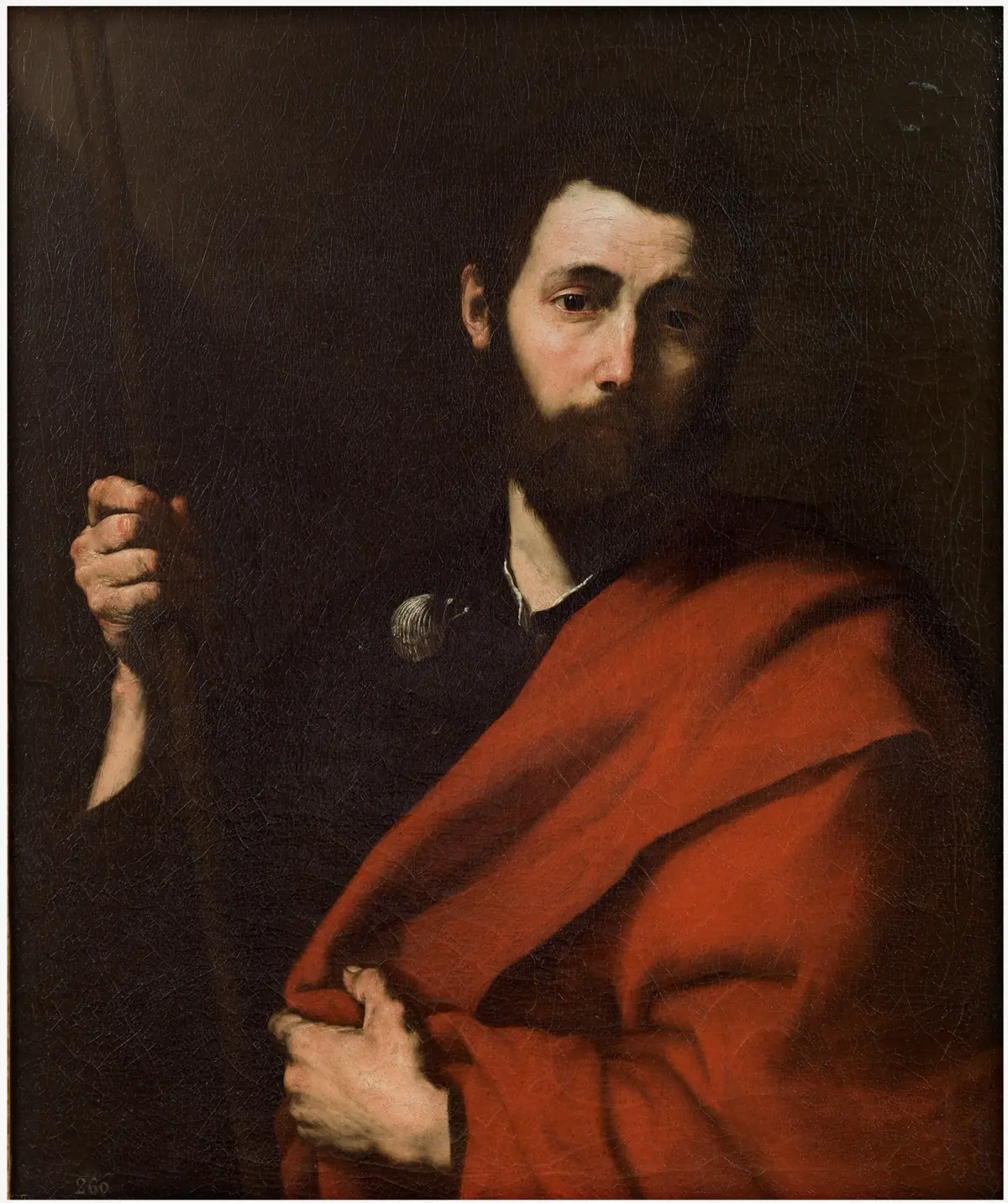
The apostle James, brother of John, was beheaded in Jerusalem around the year 44. Spanish tradition holds that his body was carried by sea to Galicia, and that his tomb was rediscovered in the ninth century at what became Santiago de Compostela. Whatever a historian makes of the journey, the consequence is beyond dispute: the third great pilgrimage of Christendom, after Jerusalem and Rome, and a shrine that still receives hundreds of thousands of walkers a year. Jusepe de Ribera paints him not as a warrior but as a weathered old pilgrim, staff in hand, the face carved by light. He is the patron saint of Spain, and the reason the country’s national day of the apostle falls on 25 July.
2. Saint Vincent of Saragossa (feast 22 January)
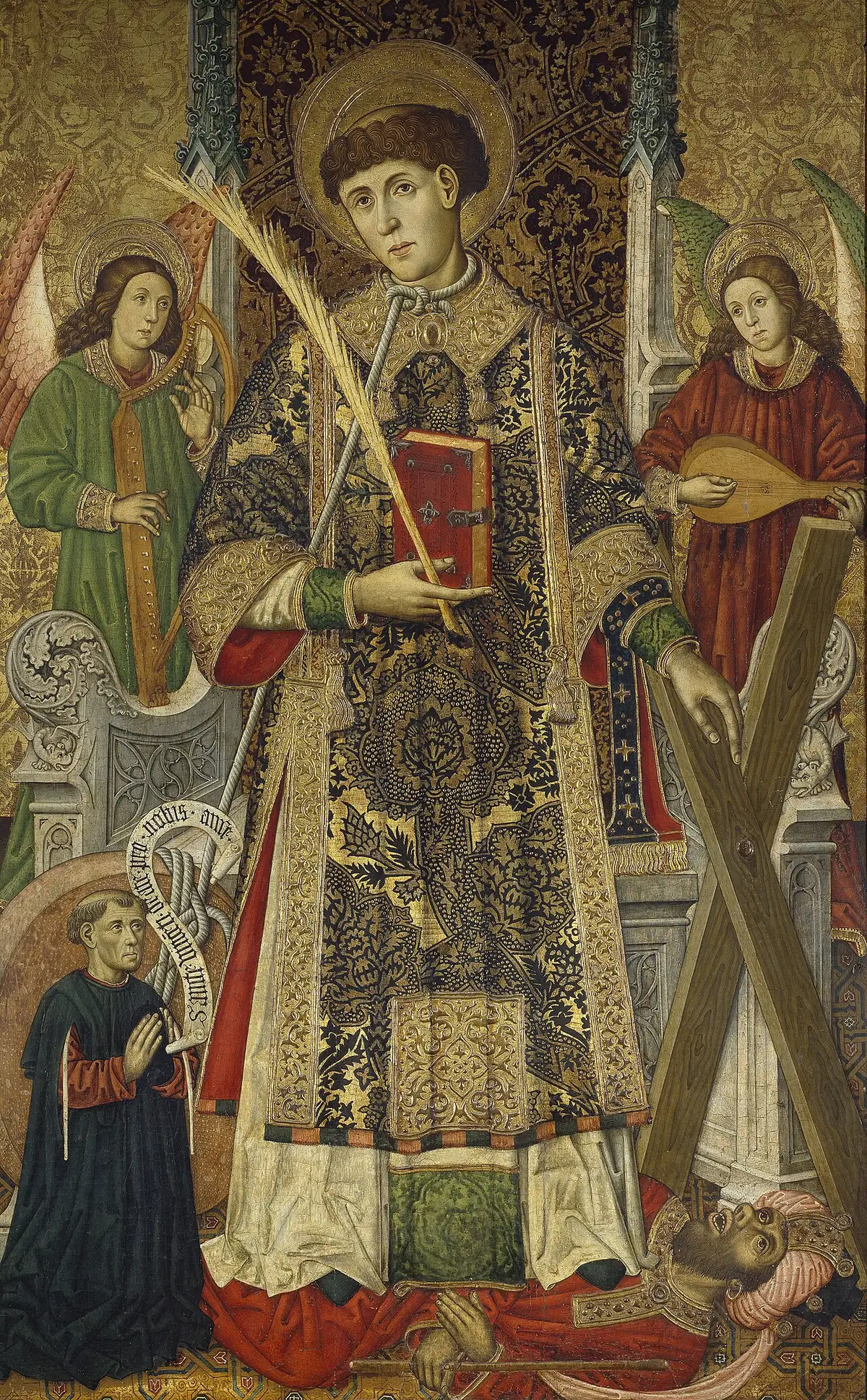
The oldest saint on this list in terms of Spanish devotion. Vincent was a deacon of Saragossa, tortured and killed at Valencia in 304 during the persecution of Diocletian. Augustine of Hippo preached on him within a century of his death, which tells you how quickly the cult spread. Tomas Giner’s panel is the odd one out here, and deliberately so: painted between 1462 and 1466, before the Golden Age, on a tooled gold ground, it belongs to the Hispano Flemish world of Aragon. The young deacon holds the palm of martyrdom and the book of the Gospels he was ordered to burn and refused.
3. Saint Eulalia of Merida (feast 10 December)
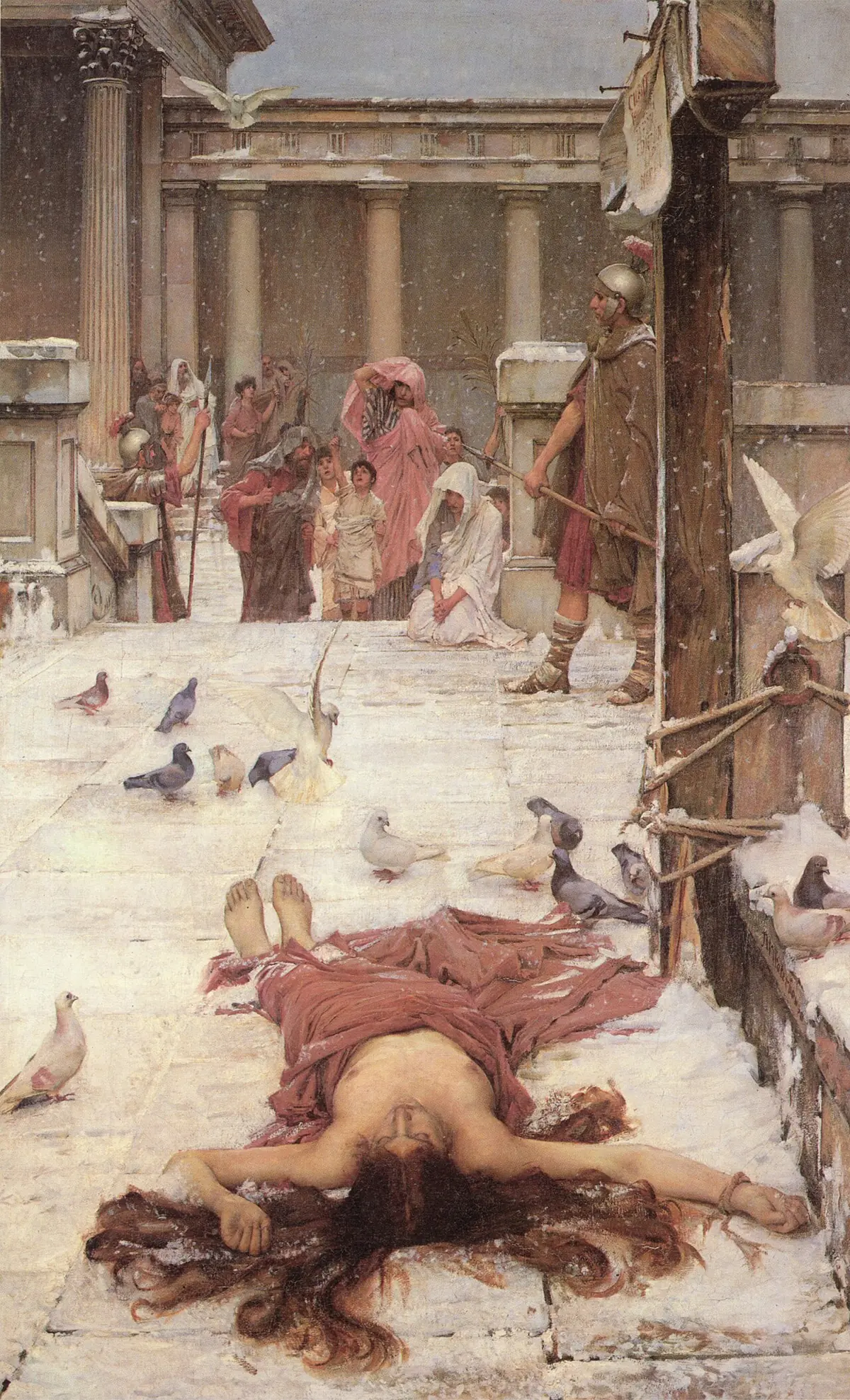
Eulalia was, by the tradition, thirteen years old when she walked into the forum at Merida and denounced the Roman magistrate to his face. She was tortured and killed around 304. The poet Prudentius, writing about a century later, added the detail that has fixed her in art ever since: snow fell and covered her body. The painting is by an Englishman. Female saints in art rarely get a canvas this bold. John William Waterhouse shows her from above, small, splayed on the paving, doves rising, the snow already settling. It is a strange and modern picture for 1885, and it is one of the most affecting images of a Spanish saint anywhere.
4. Saint Lawrence (feast 10 August)
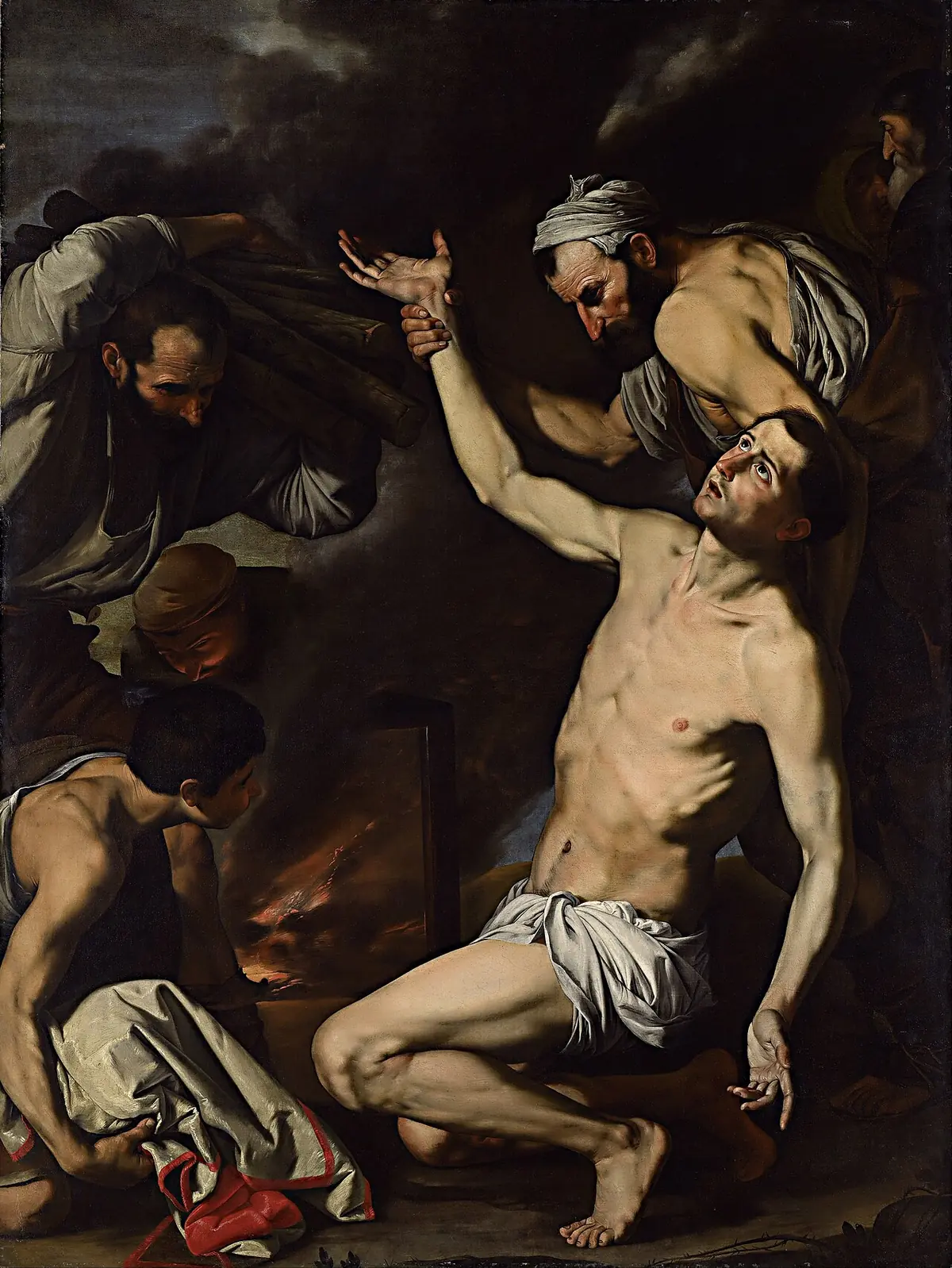
Lawrence is claimed by Rome, where he served as a deacon and died in 258, but Spanish tradition places his birth at Huesca in Aragon, and Spain has never let go of him. Ordered to hand over the treasures of the Church, he is said to have presented the poor. He was roasted on a gridiron for the insolence. Ribera, again, and at his most physical. This is not a martyrdom softened by glory. It is a body being dragged. Philip II built the Escorial on a gridiron plan in Lawrence’s honour, which gives you the measure of his standing in Spain.
5. Saint Isidore of Seville (feast 4 April)
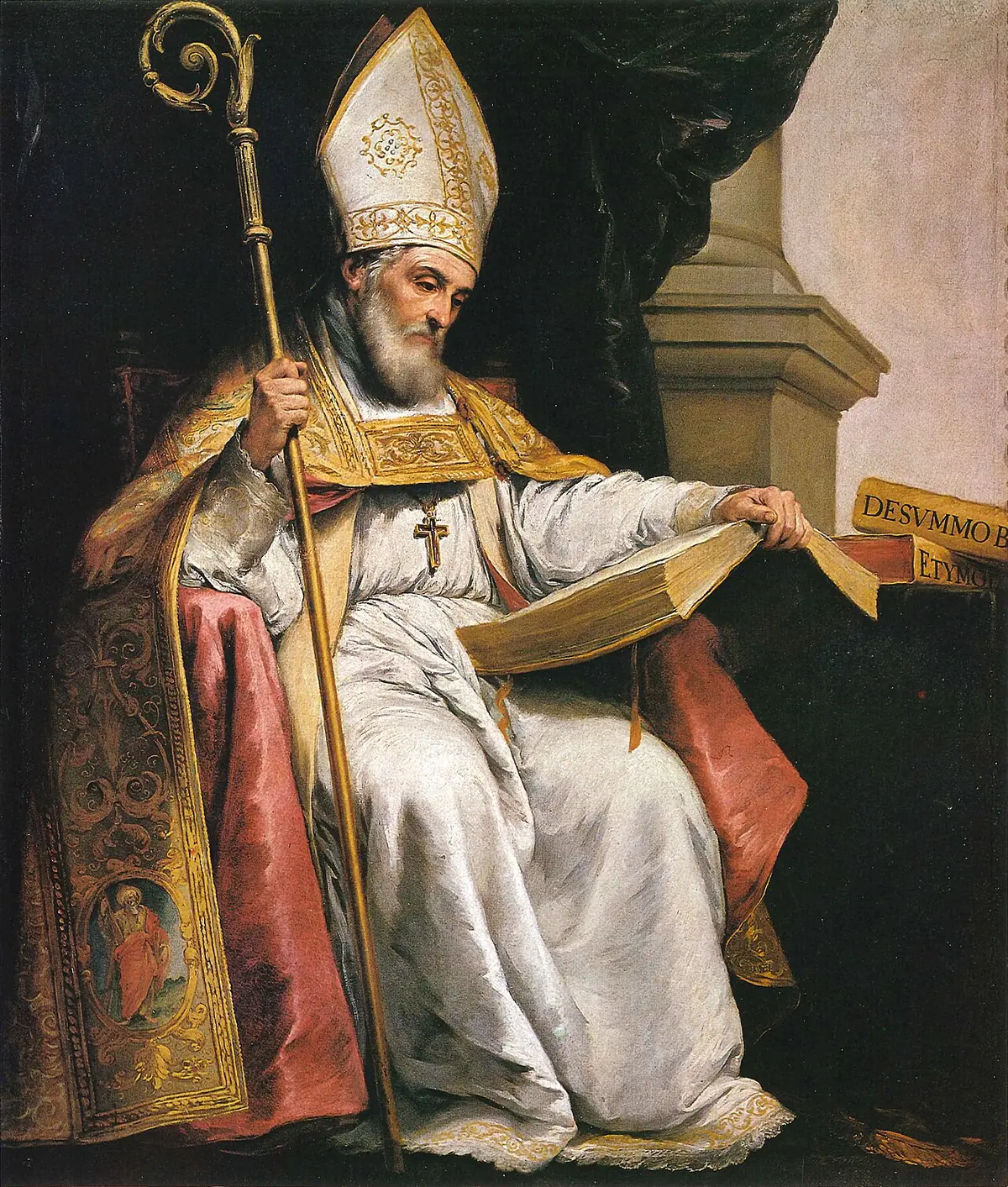
Bishop of Seville from about 600 to 636, and the man often called the last scholar of the ancient world. His Etymologiae was an attempt to compile everything then known, and it remained a standard reference for something like a thousand years. He presided at the councils that shaped the Visigothic Church, and he was declared a Doctor of the Church in 1722. Murillo paints him seated, mitred, a book open on his knee. Note what the painter does not do: no miracle, no vision, no drama. A scholar at his desk was thought worth a cathedral altarpiece.
6. Saint Isidore the Laborer, San Isidro (feast 15 May)
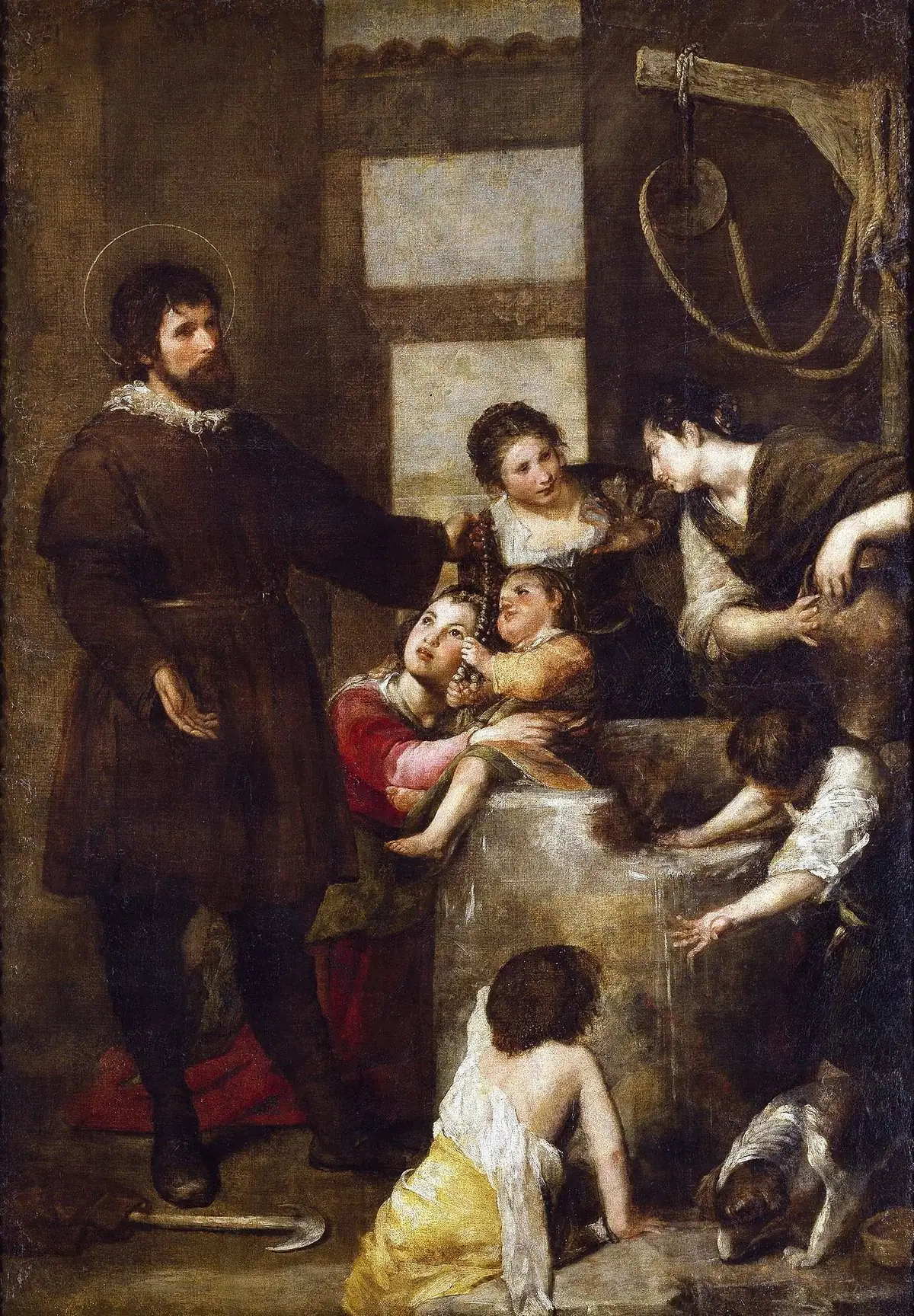
A different Isidore entirely, and a reminder that Spanish sanctity was not only for bishops. Isidore was a farm labourer near Madrid who died around 1130. The stories about him are domestic: angels ploughing his field while he prayed, food multiplied for the poor, and the miracle of the well, where his son fell in and the water rose to carry the boy back up. That is the moment Alonso Cano paints. Isidore is the patron saint of Madrid and of farmers, and his May feast is still one of the great festivals of the capital.
7. Saint Dominic de Guzman (feast 8 August)
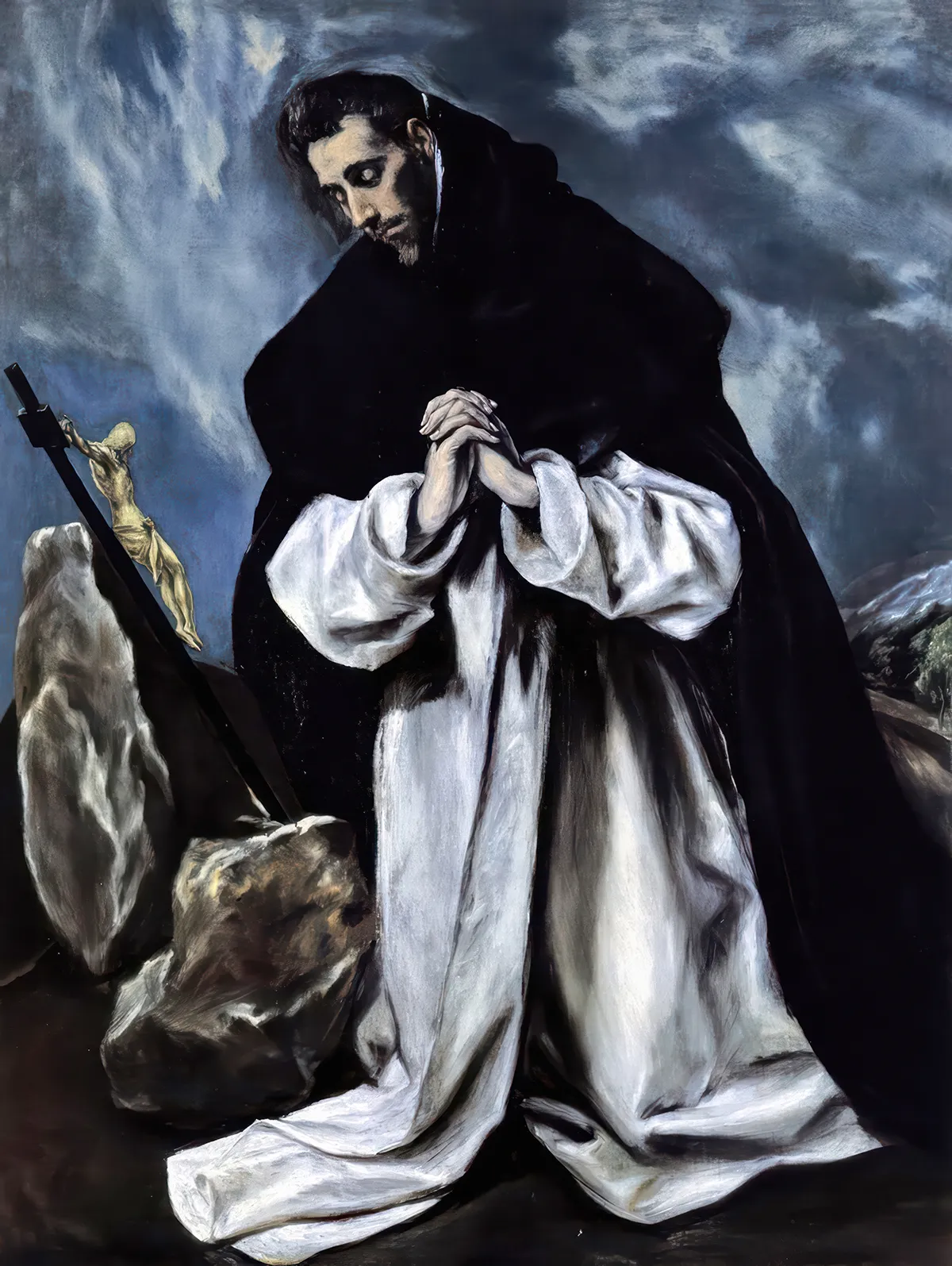
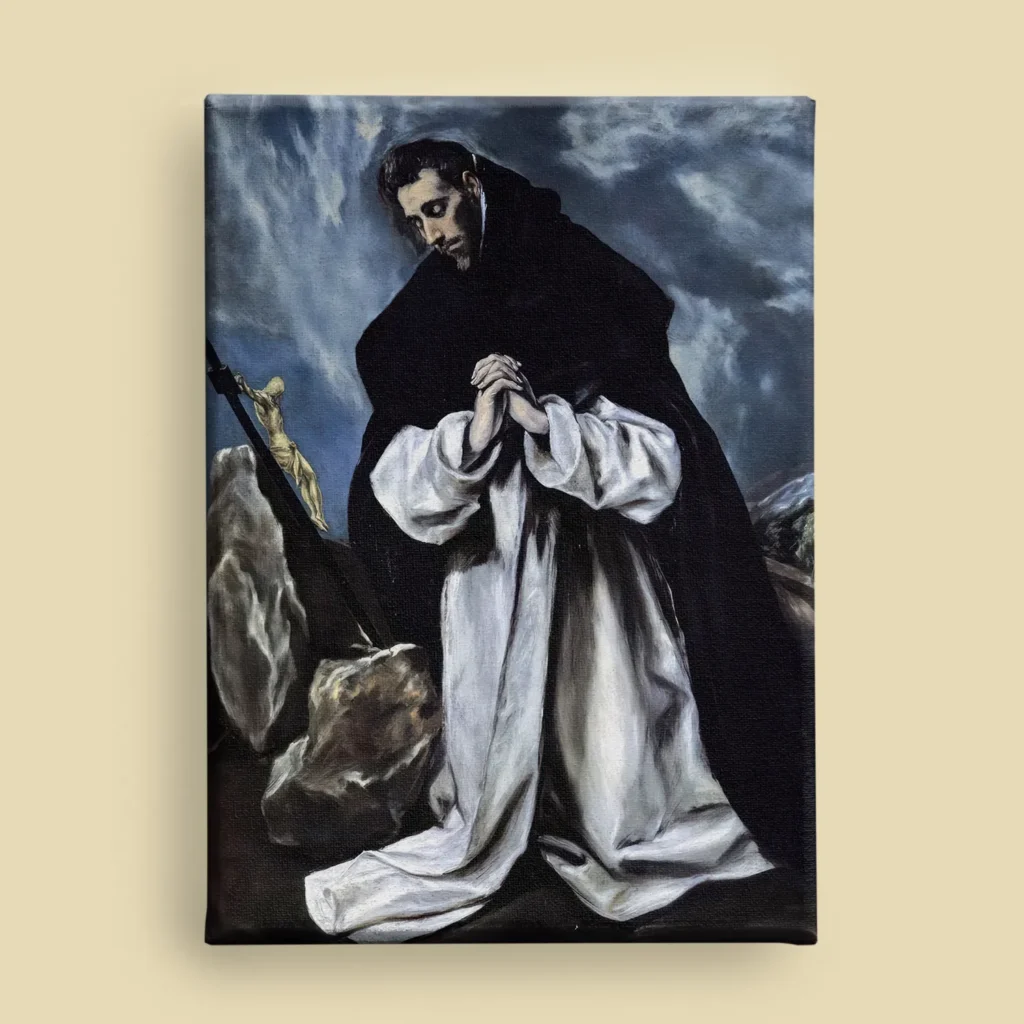
Born at Caleruega in Castile around 1170, Dominic founded the Order of Preachers, the Dominicans, in 1216. His insight was simple and consequential: heresy would not be answered by wealthy prelates arriving on horseback, but by educated men who preached in poverty. We tell that story at greater length in Saint Dominic and the birth of the Order of Preachers. El Greco gives him none of the usual attributes, no dog, no star, no lily. Just a man kneeling on rock under a bruised sky with a small crucifix, the black cappa swallowing the light and the white habit catching it.
8. Saint Vincent Ferrer (feast 5 April)
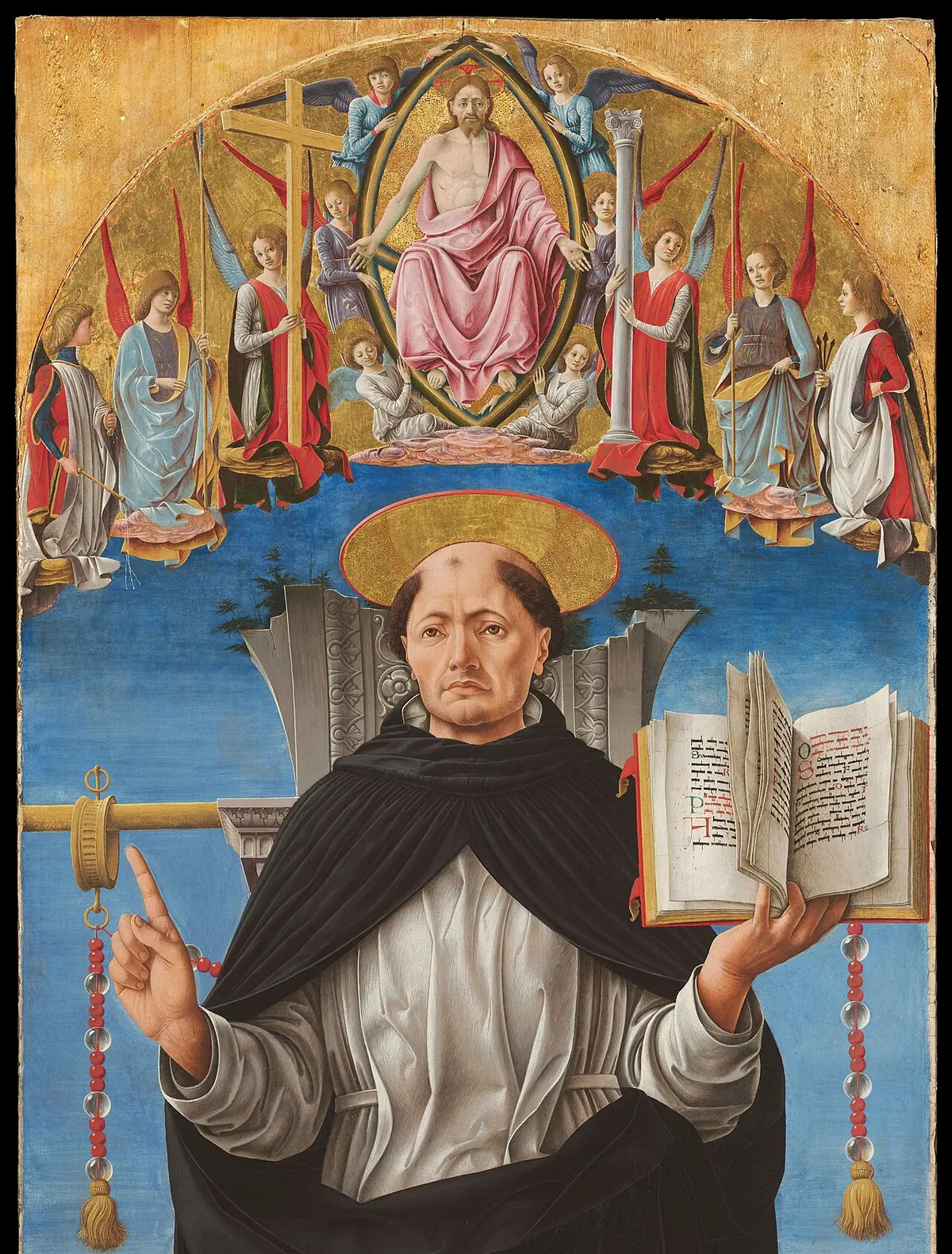
A Valencian Dominican, born 1350, who preached across Western Europe during the Great Schism to crowds counted in the thousands. His subject was the Last Judgement, and he is usually shown with a finger raised toward heaven and the word Timete Deum nearby. Francesco del Cossa painted him in Ferrara, for the Griffoni Polyptych, within decades of his canonisation. It is a useful corrective to the idea that Spanish saints were a Spanish concern: Vincent Ferrer was a European celebrity, and an Italian painter got the commission.
9. Saint Ignatius of Loyola (feast 31 July)
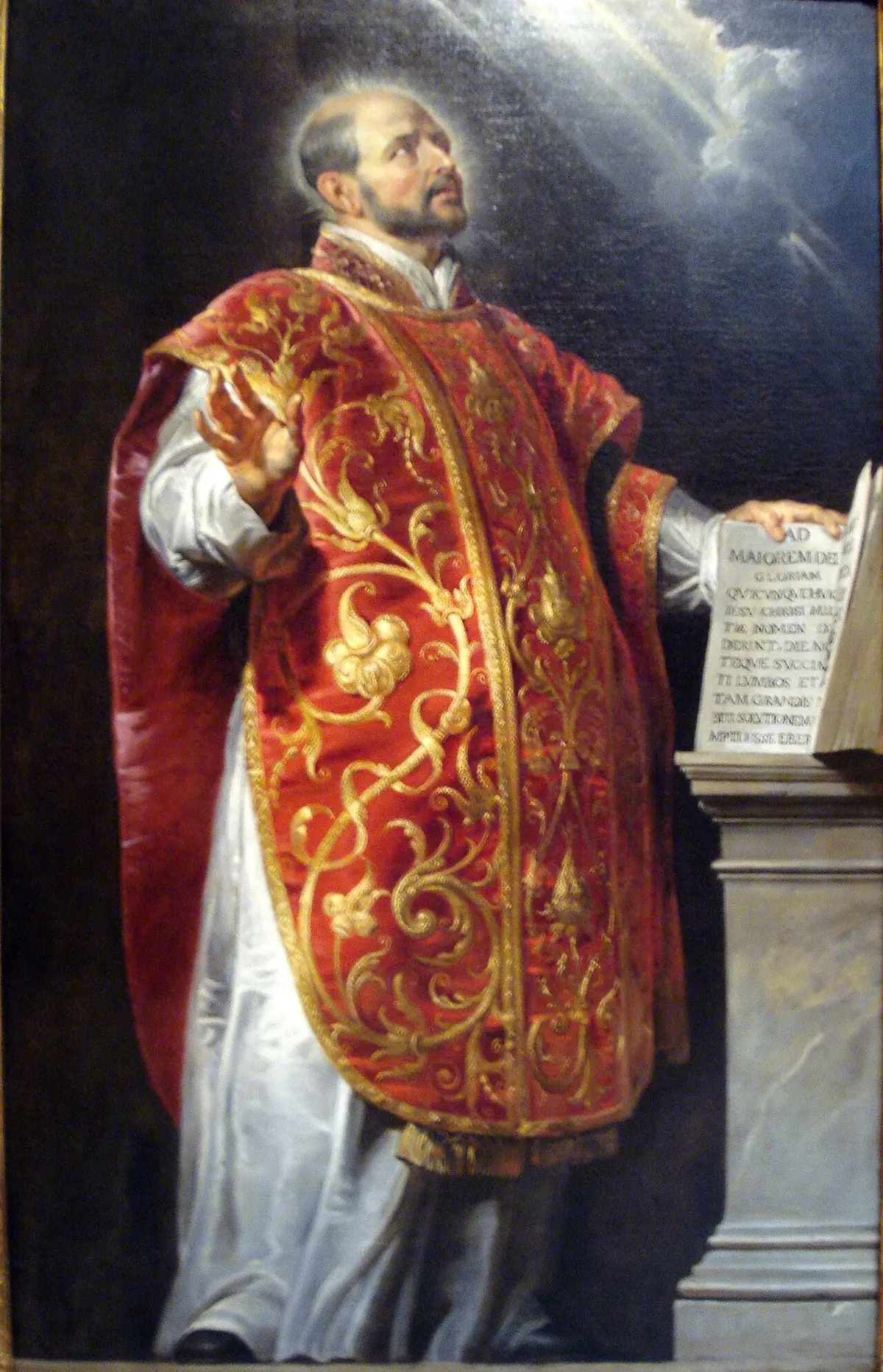
A Basque soldier whose leg was shattered by a cannonball at Pamplona in 1521. Convalescing, with nothing to read but a life of Christ and a book of saints, he changed direction entirely. He founded the Society of Jesus in 1540 and wrote the Spiritual Exercises, a manual of structured prayer still in use five centuries later. Rubens paints him as what he became, a founder and a priest, book in hand, the soldier entirely gone from the face.
The full story is told in Ignatius of Loyola: The Cannonball That Made a Saint.
10. Saint Francis Xavier (feast 3 December)
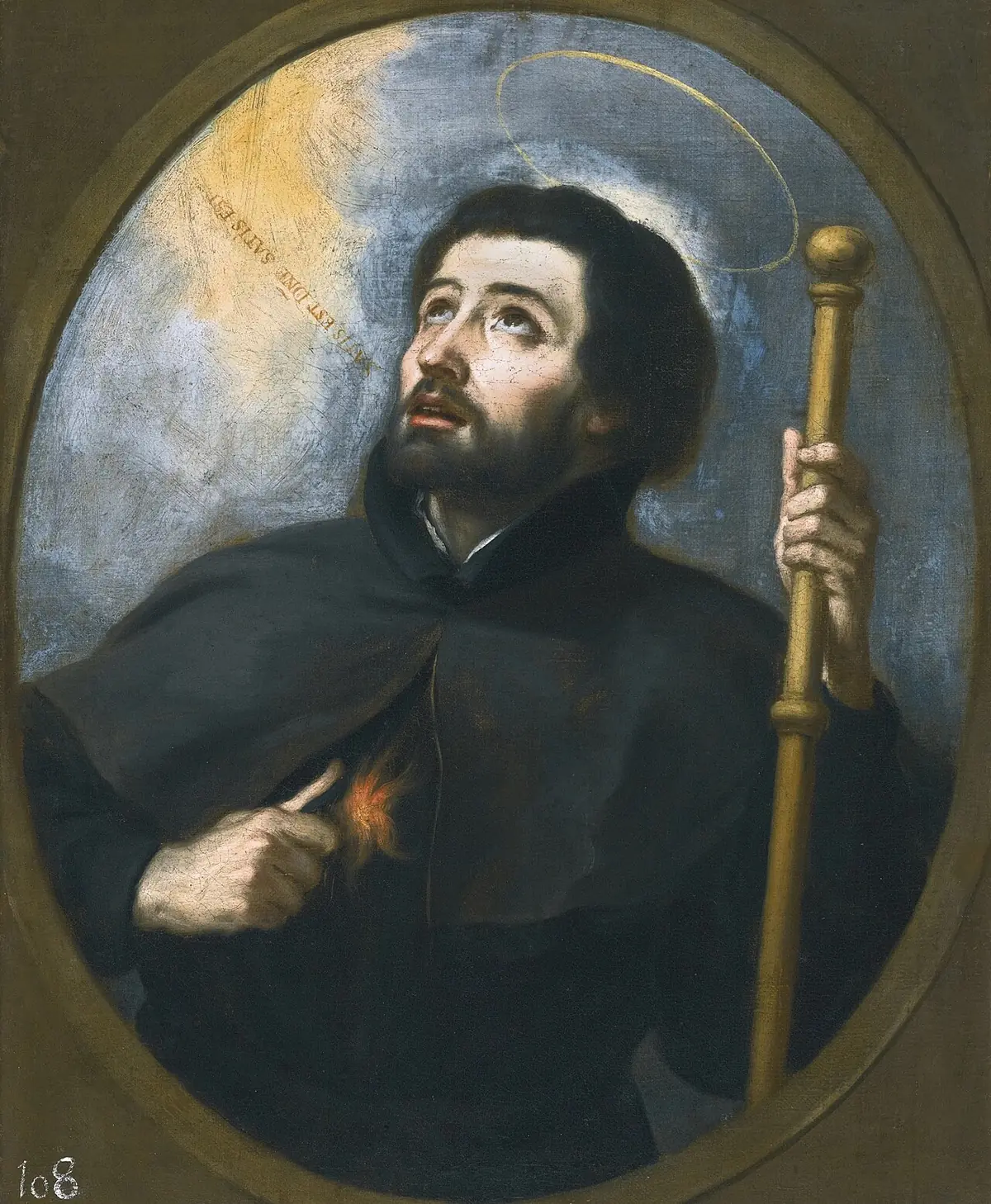
Ignatius’ room mate in Paris, and the most travelled saint of the sixteenth century. From 1541 he worked in Goa, southern India, the Moluccas and Japan, and he died in 1552 on the island of Shangchuan, waiting for permission to enter China. He is the patron of missions, and with Teresa he shares the honour of being canonised on the same day in 1622. Murillo shows him in cassock and surplice with a crucifix, eyes up. His feast on 3 December closes the Novena of Grace and marks one of the busiest days of the Spanish devotional year.
The full story is told in Francis Xavier: The Missionary Whose Body Refused to Decay.
11. Saint Teresa of Avila (feast 15 October)
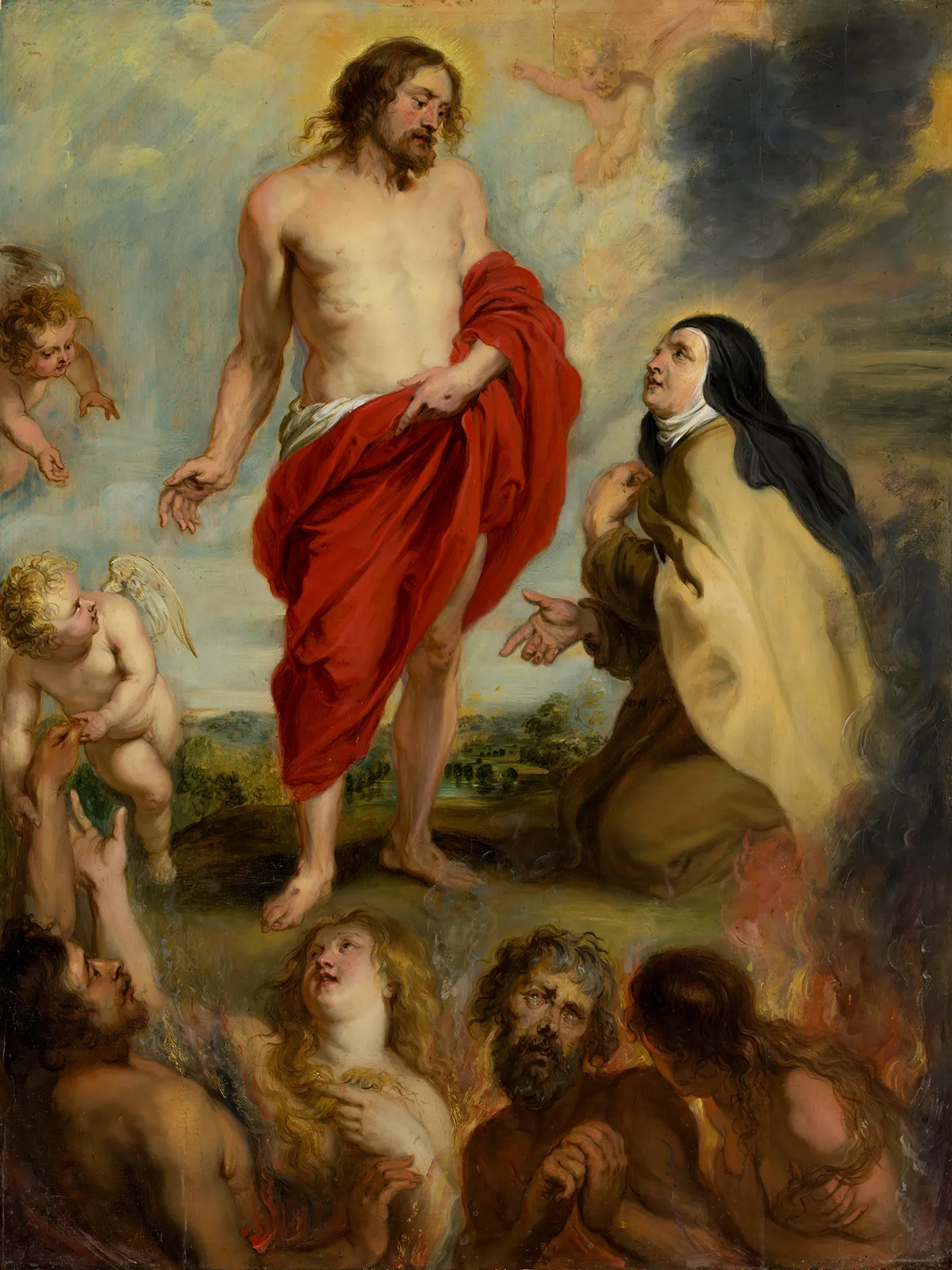
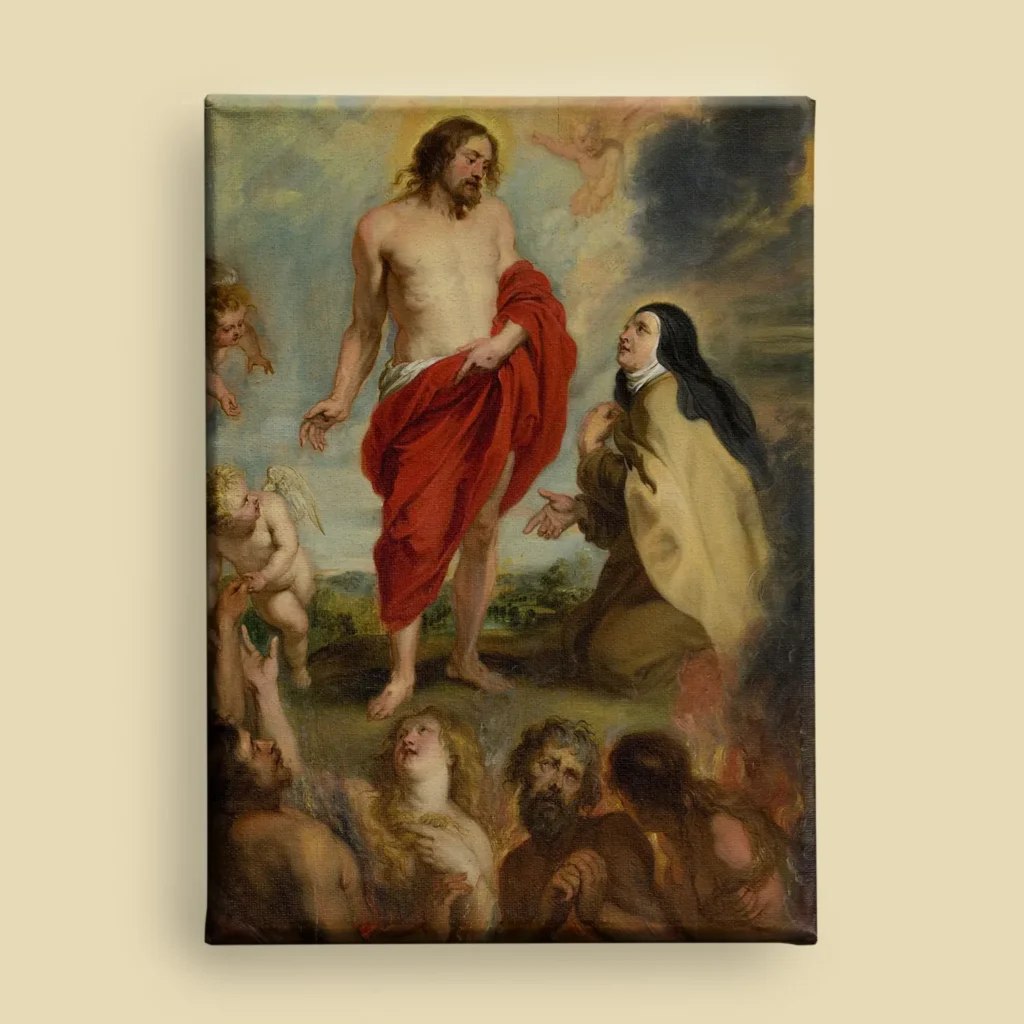
The most consequential woman in Spanish religious history. Born at Avila in 1515, she entered the Carmelites at twenty, spent nearly twenty years in a comfortable and unremarkable religious life, then reformed her order from the ground up, founding seventeen houses of Discalced Carmelites against considerable opposition. She wrote The Interior Castle and an autobiography that is still read as literature. In 1970 she became the first woman declared a Doctor of the Church. Rubens paints her interceding, not in ecstasy: Teresa kneels before Christ and pleads for the souls below. It is a better likeness of her temperament than the famous Bernini sculpture, because Teresa was, above everything, practical. We will give her a page of her own shortly.
The full story is told in Teresa of Avila: The Mystic Who Was Also a Builder.
12. Saint John of the Cross (feast 14 December)
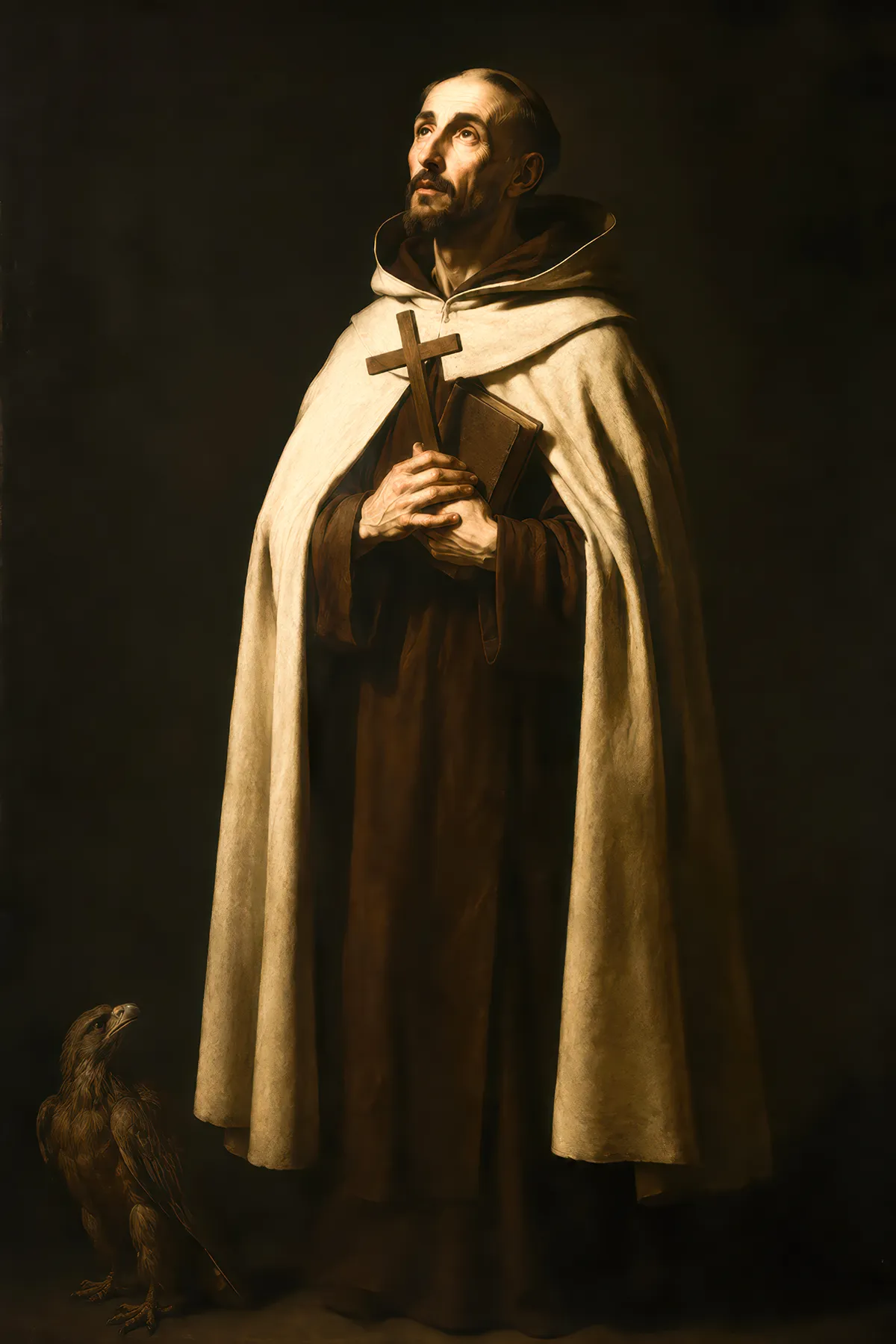
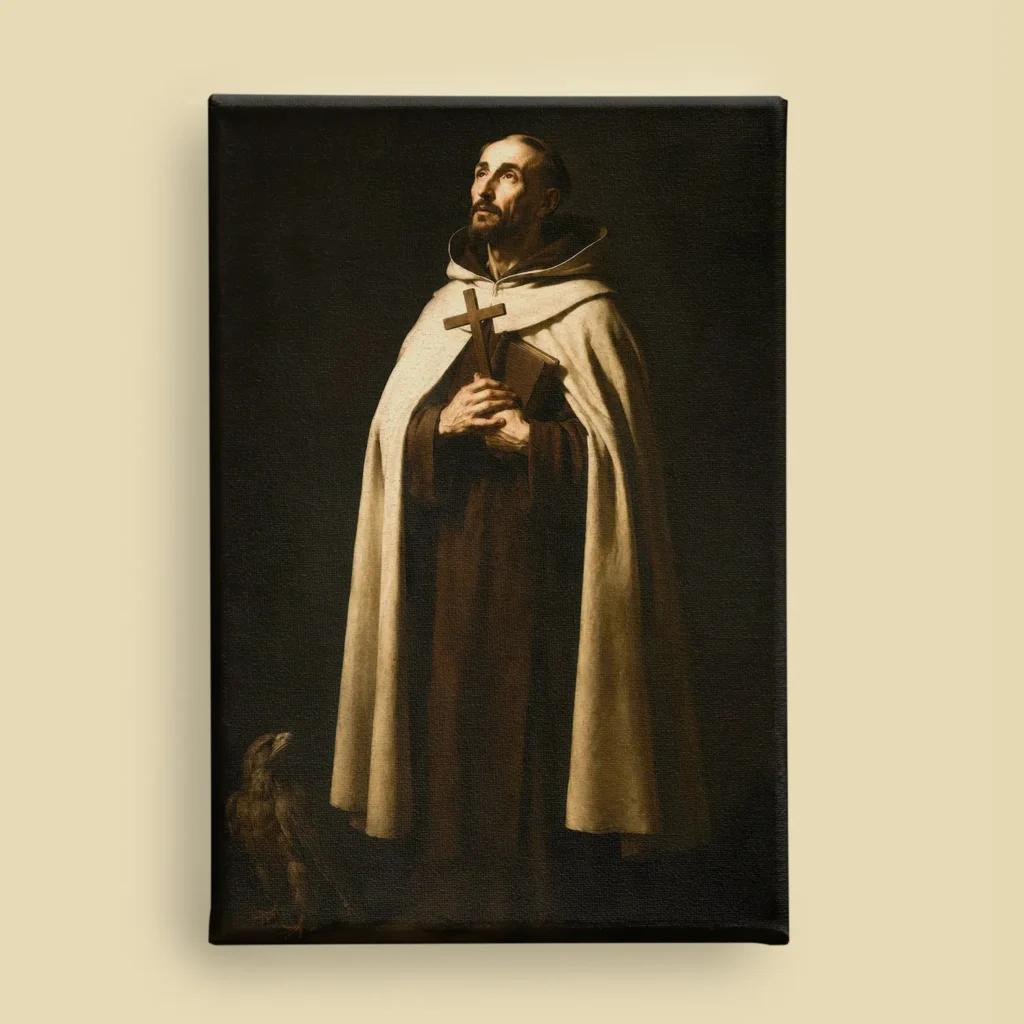
Teresa’s partner in the reform, and the finest poet in the Spanish language to be canonised. Born near Avila in 1542, he joined her Discalced reform, was imprisoned for nine months by his own brother friars in Toledo, and wrote some of his greatest verse in that cell. The Dark Night of the Soul gave the language a phrase it has never given back. No public domain painting of him survives in a form worth reproducing, so the portrait here was made for this site in the Golden Age manner. His most famous afterlife in art came in 1951, when Salvador Dali built a painting around a small drawing of the crucifixion that John made with his own hand: see Christ of Saint John of the Cross.
The full story is told in John of the Cross: The Poet Who Wrote His Masterpiece in a Prison Cell.
13. Saint Thomas of Villanova (feast 22 September)
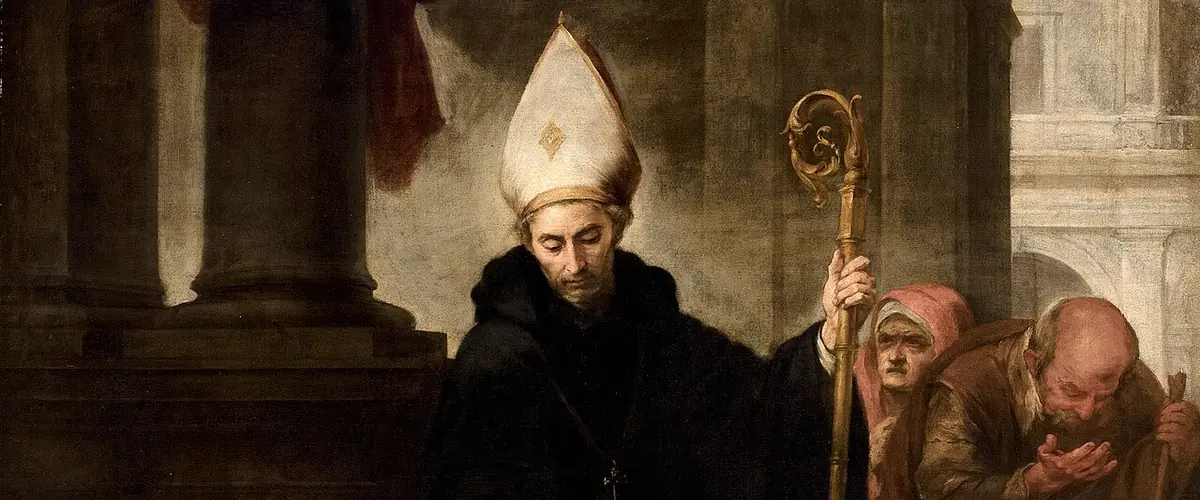
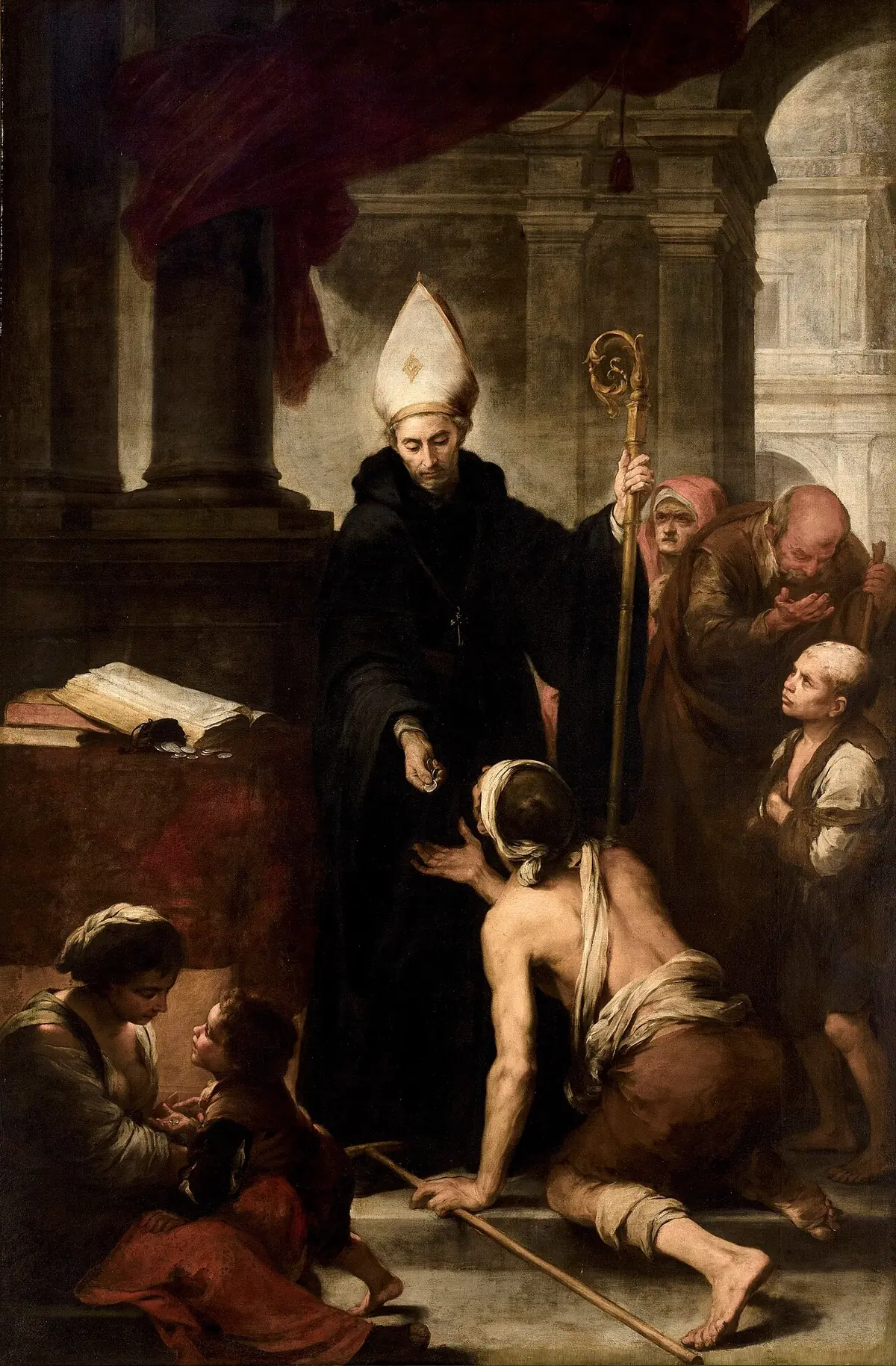
Augustinian friar and archbishop of Valencia from 1544, known for giving away almost everything that passed through his hands. He refused the archbishopric of Granada, accepted Valencia reluctantly, and reportedly kept the same habit for years while funding orphanages and dowries. The Murillo is the painter’s own favourite. He is said to have called it “my picture”. The composition is a lesson in how to make charity legible: the bishop’s hand and the beggar’s hand meet dead centre, and everything else in the canvas leans toward that point.
14. Saint John of God (feast 8 March)
Born in Portugal in 1495 but Spanish by adoption and by cult, John was a soldier, a shepherd and a bookseller before a sermon by John of Avila sent him into what looked like madness. Committed to a hospital in Granada, he was appalled at how patients were treated, recovered, and spent the rest of his life running a better one. The Brothers Hospitallers grew from it, and he is patron of hospitals, nurses and the sick. Murillo painted him too, but Claudio Coello’s version is the one worth looking at here: the saint bent under the weight of a sick man, an angel holding the lantern.
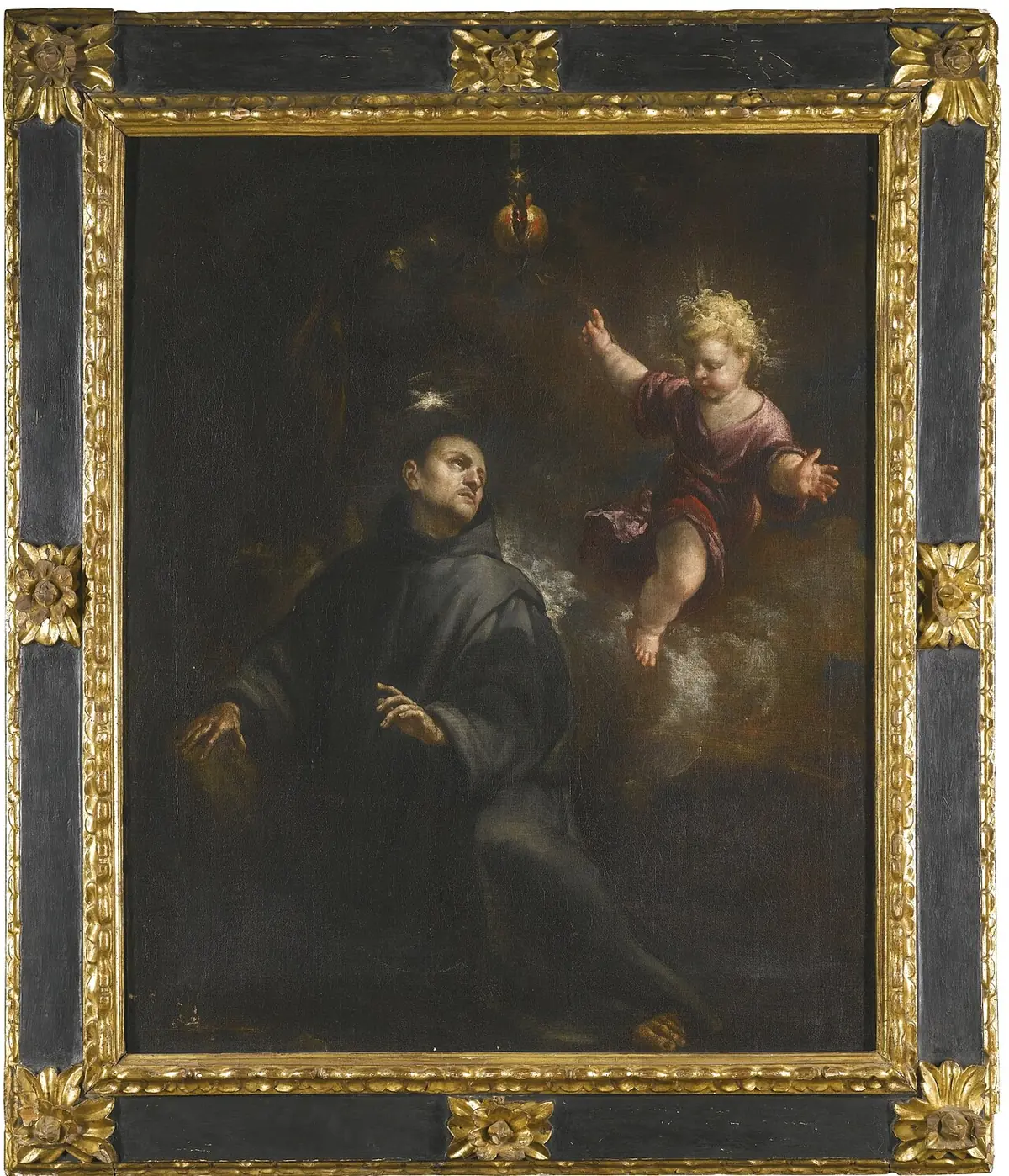
15. Saint Josemaria Escriva (feast 26 June)
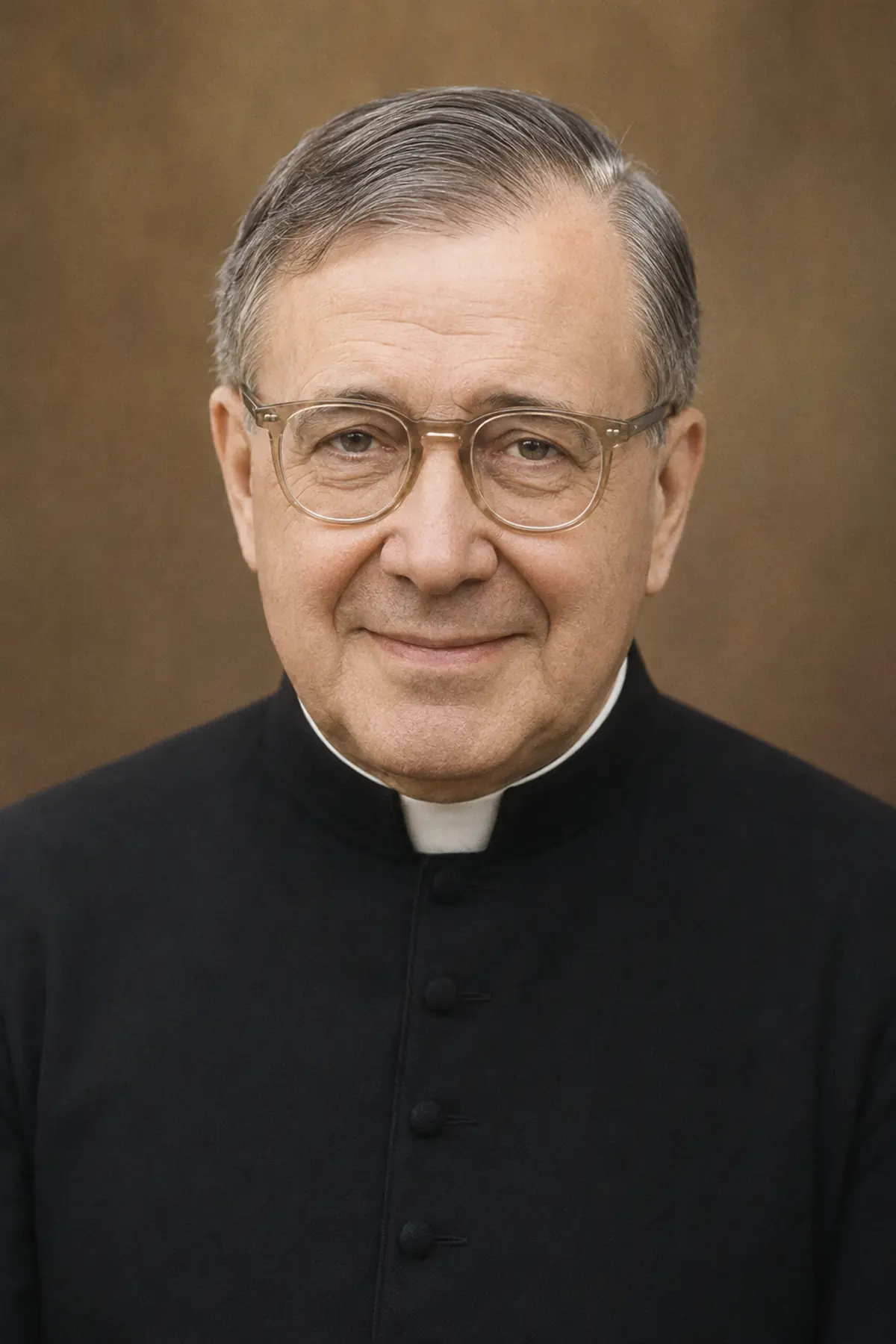
The modern entry, and included because no honest list of Spanish saints can stop in 1700. Born at Barbastro in Aragon in 1902, ordained in 1925, he founded Opus Dei in 1928 on a single idea: that ordinary work, done well, is itself a path to holiness. He died in Rome in 1975 and was canonised in 2002, one of the fastest canonisations of the modern era. He remains a debated figure, which is what happens when a saint is recent enough for people to have known him. There is no old master portrait, for the obvious reason. The image here was made for this site.
Spanish Women Saints
Two of the fifteen are women, and they sit at opposite ends of the story. Eulalia of Merida is the archetype of the early Spanish martyr: young, anonymous until the moment of refusal, remembered through a poem. Teresa of Avila is the opposite in every way, a mature administrator with a paper trail, who argued with bishops and left seventeen convents and four books behind her. Beyond this list, Spain also gives us Maria de la Cabeza, wife of Isidore the Laborer and canonised in her own right, and Teresa of Los Andes, the first Chilean saint but a daughter of the Spanish Carmel. For a broader survey across countries and centuries, see our gallery of female saints in art.
The Spanish Saints we talked in this article
| Saint | Feast day | Known as | Painting | Artist |
|---|---|---|---|---|
| James the Greater | 25 July | Patron saint of Spain | Santiago el Mayor | Jusepe de Ribera |
| Vincent of Saragossa | 22 January | Deacon, protomartyr of Spain | Saint Vincent | Tomas Giner |
| Eulalia of Merida | 10 December | Child martyr | Saint Eulalia | John William Waterhouse |
| Lawrence | 10 August | Deacon of the gridiron | The Martyrdom of Saint Lawrence | Jusepe de Ribera |
| Isidore of Seville | 4 April | Doctor of the Church | Saint Isidore of Seville | Murillo |
| Isidore the Laborer | 15 May | Patron of Madrid and farmers | The Miracle of the Well | Alonso Cano |
| Dominic de Guzman | 8 August | Founder of the Dominicans | Saint Dominic in Prayer | El Greco |
| Vincent Ferrer | 5 April | Preacher of the Judgement | Saint Vincent Ferrer | Francesco del Cossa |
| Ignatius of Loyola | 31 July | Founder of the Jesuits | Saint Ignatius of Loyola | Peter Paul Rubens |
| Francis Xavier | 3 December | Patron of missions | Saint Francis Xavier | Murillo |
| Teresa of Avila | 15 October | Doctor of the Church | Interceding for Souls in Purgatory | Peter Paul Rubens |
| John of the Cross | 14 December | Doctor of the Church, poet | Devotional portrait | jesuschrist.pictures |
| Thomas of Villanova | 22 September | Archbishop of Valencia | Giving Alms | Murillo |
| John of God | 8 March | Patron of hospitals and nurses | Saint John of God with an Angel | Claudio Coello |
| Josemaria Escriva | 26 June | Founder of Opus Dei | Devotional portrait | jesuschrist.pictures |
Important Facts About the Spanish Saints
- The patron saint of Spain is Saint James the Greater, Santiago, whose shrine at Compostela anchors the Camino. Spain also has a patroness, the Immaculate Conception, declared in 1760 and painted more often by Murillo than by anyone.
- Teresa of Avila and Francis Xavier were canonised on the same day, 12 March 1622, together with Ignatius of Loyola, Philip Neri and Isidore the Laborer. Four of those five are Spanish.
- Spain has produced four Doctors of the Church: Isidore of Seville, Teresa of Avila, John of the Cross and John of Avila.
- Ignatius, Francis Xavier and Dominic were all founders, and all three orders they created or shaped are still among the largest in the Church.
- Not every saint painted by a Spanish master is Spanish, and not every Spanish saint was painted by one. Zurbaran’s Saint Serapion was English. Vincent Ferrer, a Valencian, got his best portrait from an Italian.
Frequently Asked Questions
Who are the five saints of Spain?
There is no official five, but the five most commonly named are James the Greater as patron of the country, Teresa of Avila, Ignatius of Loyola, John of the Cross and Francis Xavier. Four of those five belong to the sixteenth century, which is why that century is called the Spanish Golden Age in religion as well as in painting.
Who is the patron saint of Spain?
Saint James the Greater, Santiago, whose feast falls on 25 July. His shrine at Santiago de Compostela in Galicia has drawn pilgrims since the ninth century. Spain also honours the Immaculate Conception as its patroness.
Who are some famous Hispanic saints?
Hispanic and Spanish are not the same thing. Spanish saints were born in Spain. Hispanic saints of the Americas include Juan Diego of Mexico, Rose of Lima, the first canonised saint of the Americas, Martin de Porres of Peru and Blessed Miguel Pro. Several were born in Spain and died in the New World, which is where the two categories overlap.
What are some famous Spanish women saints?
Teresa of Avila is the most important, a Carmelite reformer, writer and the first woman named a Doctor of the Church. Eulalia of Merida is the great early martyr. Others include Maria de la Cabeza, Joaquina Vedruna and Maria Micaela.
Why did Spain produce so many saints?
Eight centuries of religious frontier, a global missionary empire after 1492, and a Counter Reformation Church that funded religious art and religious orders on an enormous scale. The same conditions that produced Teresa and Ignatius also produced El Greco, Zurbaran, Ribera, Velazquez and Murillo, which is why the Spanish saints are so unusually well painted.
Can you buy Spanish saint paintings as canvas prints?
You can buy Spanish saint paintings at jesuschrist.pictures, in our shop, as museum quality canvas reproductions and posters. The Spanish school is one of the strongest parts of the collection: The Holy Trinity by El Greco, The Penitent Magdalene by El Greco, The Immaculate Conception by Murillo, Christ Crucified by Velazquez and Christ of Saint John of the Cross by Dali are all available on canvas.