The Sacred Light in Spanish Baroque Jesus Art
Introduction: The Spiritual Brilliance of Spanish Baroque Jesus Paintings
From the late 16th to the early 18th century, Spain emerged as a spiritual and artistic powerhouse, with the Baroque period ushering in one of the most expressive chapters in the history of Catholic art. In this deeply devotional context, Spanish painters turned their attention to the life of Jesus Christ, rendering Him not only with profound theological insight but with unprecedented emotional realism.
Spanish Baroque Jesus paintings are marked by an intense interplay of light and shadow, expressive gestures, and dramatic compositions that aimed to draw the viewer into a deeper spiritual reflection. These were not just works of beauty, they were visual instruments of prayer, often created to support the goals of the Catholic Counter-Reformation. Whether displayed in a grand cathedral or a quiet chapel, these paintings were designed to move hearts, stir conscience, and teach the mysteries of Christ’s life and Passion through visual storytelling.
Through the brush of Velázquez, Zurbarán, Ribera, and Murillo, Christ appears not only as Redeemer but as a deeply human figure, suffering, compassionate, and present in the daily experience of faith. The Spanish Baroque did not aim for quiet contemplation alone, but for active emotional engagement, forging an intimate bond between art and belief.
For a fuller view of how the representation of Christ evolved across cultures and centuries, explore our articles on Gothic Jesus paintings, Renaissance Jesus paintings, and Italian Baroque Jesus paintings.
Characteristics of Spanish Baroque Jesus Paintings
Spanish Baroque Jesus paintings are deeply rooted in devotion, marked by their dramatic visuals and emotional power. Emerging in a time when the Catholic Church sought to reinforce faith through art, these works were created to stir the soul and guide the viewer into meditation on Christ’s Passion, sacrifice, and divinity.
Religious Symbolism and Iconography
Spanish Baroque artists infused their compositions with potent religious symbols that made theological truths visually accessible. Light served as a metaphor for divine presence, while the cross, the lamb, and expressive hand gestures highlighted Christ’s sacrifice, innocence, and priestly mission.
Some of the most common symbols found in these paintings include:
| Symbol | Meaning |
|---|---|
| The Cross | Christ’s redemptive sacrifice and the core of Christian salvation. |
| Light and Shadow | Divine revelation, contrasting the sacred with the worldly. |
| The Lamb | Symbol of Jesus as the innocent, sacrificial Lamb of God. |
| Open Hands | Gesture of offering, prayer, and surrender to the Father’s will. |
Artistic Techniques and Styles
The Spanish Baroque style was defined by strong visual contrasts and dynamic compositions. Artists made use of tenebrism (deep, theatrical shadows offset by sudden bursts of light) to dramatize the sacred moments in Jesus’s life. Rich colors, expressive brushwork, and movement all served to evoke intense emotional response.
Key techniques that characterize this style include:
| Technique | Description |
|---|---|
| Tenebrism | Sharp contrasts between light and dark to focus the viewer’s gaze and heighten spiritual intensity. |
| Dramatic Composition | Use of diagonal lines and asymmetry to create energy and tension within the scene. |
| Rich Color Palette | Use of deep reds, luminous whites, and golden tones to convey sacredness and depth. |
| Expressive Brushwork | Visible brush strokes that enhance emotional realism and human vulnerability. |
Through these methods, Spanish Baroque artists delivered Jesus’s story not as distant doctrine but as an intimate and deeply human drama. For those interested in how this style evolved, compare it with Renaissance Jesus paintings or Italian Baroque Jesus paintings.
Notable Spanish Baroque Painters
The Spanish Baroque was home to some of the most spiritually compelling portrayals of Jesus in Catholic art. Painters such as Diego Velázquez, Francisco de Zurbarán, Jusepe de Ribera, and Bartolomé Esteban Murillo were central to this golden age of religious painting. Each artist brought a distinct spiritual and artistic vision to their depictions of Christ.
Key Artists and Their Contributions
| Artist | Notable Work | Contribution |
|---|---|---|
| Diego Velázquez | Christ Crucified | Known for his realism and restraint, Velázquez brought a sense of quiet divinity and human emotion into sacred themes. |
| Francisco de Zurbarán | The Crucifixion | Master of contemplative compositions with dramatic lighting, highlighting spiritual solitude and purity. |
| Jusepe de Ribera | Christ in the Tomb | Emphasized physical suffering and divine sorrow using powerful chiaroscuro and anatomical detail. |
| Bartolomé Esteban Murillo | Christ on the Cross | Focused on compassion and gentleness, ideal for devotional images full of grace and spiritual intimacy. |
Each of these artists offered a different emotional tone (from the harsh realism of Ribera to the radiant tenderness of Murillo) creating a body of work that continues to move the faithful and inspire Catholic aesthetics to this day.
Most Famous Spanish Baroque Jesus Paintings
Highlights of Masterpieces
Some Spanish Baroque paintings of Jesus are more than just iconic : they are deeply woven into the artistic and religious fabric of Catholic Spain. These works continue to inspire awe through their spiritual intensity and technical brilliance. Let’s explore a few of the most celebrated examples:
Francisco de Zurbarán – Christ on the Cross (1627)
This masterpiece is one of Zurbarán’s most solemn and revered paintings. Jesus is depicted alone on the cross, against a stark dark background, drawing the viewer into intimate contemplation of his sacrifice. The focus on silence, stillness, and pain exemplifies the spiritual seriousness of the Spanish Baroque.

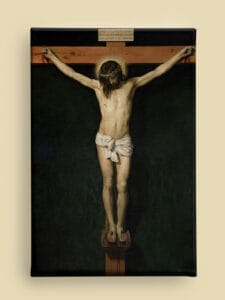
Diego Velázquez – Christ Crucified (1632)
Velázquez’s depiction of Jesus nailed to the cross is arguably the most famous Spanish image of the Crucifixion. The restrained composition, naturalistic anatomy, and gentle lighting evoke dignity and peace in the midst of suffering. It has become a central devotional work in the Museo del Prado.

El Greco – The Disrobing of Christ (El Expolio) (1577)
Though stylistically unique, this work stands as a bridge between late Renaissance and early Baroque. El Greco’s elongated forms, intense reds, and emotional charge make this painting one of the most important representations of Jesus in Spanish religious art. It hangs in the sacristy of Toledo Cathedral.

Bartolomé Esteban Murillo – Christ on the Cross (c. 1675)
Murillo’s version emphasizes the compassionate aspect of Christ’s suffering. His soft brushwork and glowing light convey a sense of hope and redemption. This painting captures Murillo’s gentle devotional approach, often considered a counterbalance to the dramatic austerity of Zurbarán.

Jusepe de Ribera – Christ in the Tomb (c. 1620)
A haunting image of the dead Christ laid to rest, Ribera’s painting confronts the viewer with the raw realism of death. The emotional power and dramatic chiaroscuro underline both human fragility and divine sacrifice.
These paintings are foundational to understanding how Spanish artists communicated the passion, divinity, and humanity of Jesus Christ during the Baroque period. Their legacy continues through exhibitions, academic study, and ongoing devotional use.

Preservation and Exhibition
The survival of Spanish Baroque Jesus paintings owes much to centuries of care, restoration, and institutional commitment. From delicate touch-ups to full-scale conservation efforts, each painting represents a labor of love, ensuring its message of faith continues to inspire across generations.
Restoration Efforts
Due to the age and fragility of many Baroque works, restoration is essential to prevent irreversible damage. Environmental factors, war, and neglect have threatened these masterpieces. Fortunately, skilled restorers today employ both traditional techniques and cutting-edge technology to revive and preserve them.
Key methods used in restoration include:
| Technique | Purpose |
|---|---|
| Surface Cleaning | Removes grime and oxidized varnish layers that dull original color and detail. |
| Paint Stabilization | Secures flaking pigments and reinforces canvas to prevent further loss. |
| Varnish Replacement | Applies new protective layers while preserving color depth and contrast. |
| Infrared Scanning | Reveals underdrawings and original outlines hidden beneath later additions. |
Thanks to these conservation efforts, viewers today can witness these paintings much as they were intended to be seen: full of color, detail, and sacred resonance.
Public Display and Impact
Once restored, these Spanish Baroque paintings often become highlights of exhibitions in churches, national galleries, and religious museums across Europe and the Americas. They are also central to pilgrimages and educational programs, offering spiritual insight and cultural heritage to visitors of all ages.
Common exhibition venues include:
| Venue | Contribution |
|---|---|
| El Prado Museum, Madrid | Houses iconic works by Velázquez, Ribera, and Murillo. |
| National Gallery, London | Features major Spanish Baroque canvases in its permanent collection. |
| Toledo Cathedral | Home to El Greco’s masterwork The Disrobing of Christ. |
| Private and Monastic Collections | Still preserve devotional paintings in sacred settings. |
Through restoration and public access, these paintings continue to nourish faith and artistic appreciation alike, strengthening their legacy in both sacred and secular spaces. For related perspectives, see our features on Italian Baroque Jesus paintings and Spanish Renaissance Jesus paintings.
Appreciating Spanish Baroque Jesus Paintings
Spanish Baroque Jesus paintings are more than artistic achievements, they are spiritual testaments. Their power lies in their ability to convey the mystery of Christ through visual beauty, emotional depth, and theological clarity. Whether viewed in a chapel or museum, these images invite reverence and reflection.
Cultural and Artistic Value
These works serve as cultural artifacts as much as religious ones. They reflect the aesthetics, theological priorities, and artistic innovations of 17th-century Spain, a nation profoundly shaped by Catholic devotion and Counter-Reformation ideology.
| Aspect | Significance |
|---|---|
| Artistic Language | Deep emotional resonance, chiaroscuro, and lifelike expression. |
| Spiritual Impact | Encourages contemplation, humility, and reverence. |
| Historical Mirror | Captures the tension between faith, monarchy, and reform movements. |
| Cultural Identity | Symbol of Spanish religious and artistic heritage. |
Their ability to speak across centuries affirms their place in the canon of Christian sacred art.
Connection to Faith and History
These paintings are rooted in the Spanish Baroque’s mission to make faith visible. Commissioned for churches, convents, and royal chapels, they acted as visual catechism for both learned theologians and illiterate parishioners. Their depictions of Christ (suffering, risen, and merciful) brought theological truths into daily devotional life.
Moreover, they reflect the Church’s strategic response to Protestant iconoclasm: emphasizing orthodoxy through visual grandeur. In doing so, they preserved Catholic heritage and inspired generations of believers. Even today, their images continue to move viewers toward spiritual meditation and artistic wonder.
To understand their full context, consider also Renaissance Jesus paintings and Flemish Baroque Jesus paintings, which laid much of the foundation for the Spanish Baroque’s sacred intensity.
Conclusion
Spanish Baroque Jesus paintings stand as some of the most powerful religious artworks in Catholic history. These masterpieces combined bold artistic innovation with deep spiritual reflection, capturing the essence of Christ’s life, suffering, and divine mission. Through chiaroscuro, emotional intensity, and symbolic depth, artists such as Velázquez, Zurbarán, El Greco, Murillo, and Ribera redefined how Jesus was portrayed, not as a distant figure, but as an intimately present savior.
These paintings were more than artistic achievements. They served as instruments of faith during the Counter-Reformation, reinforcing Catholic devotion and teaching theological truths through visual storytelling. Whether displayed in churches or preserved in great museums, they continue to inspire believers and art lovers alike.
Their influence extends beyond Spain, shaping Christian art across Europe and laying the groundwork for future religious expressions in the Baroque tradition. For anyone exploring sacred art, the Spanish Baroque era offers a profound testament to how beauty and faith can intertwine in timeless harmony.
Spanish Baroque Jesus Paintings Featured in This Article
| Painting | Artist | Date | Size | Location |
|---|---|---|---|---|
| Christ on the Cross | Francisco de Zurbarán | 1627 | 290 × 168 cm | Museo del Prado, Madrid |
| Christ Crucified | Diego Velázquez | 1632 | 248 × 169 cm | Museo del Prado, Madrid |
| The Disrobing of Christ (El Expolio) | El Greco | 1577 | 285 × 173 cm | Toledo Cathedral, Spain |
| Christ on the Cross | Bartolomé Esteban Murillo | c. 1675 | 209 × 123 cm | Museo del Prado, Madrid |
| Christ in the Tomb | Jusepe de Ribera | c. 1620 | 127 × 99 cm | Museo del Prado, Madrid |
Frequently Asked Questions
What defines Spanish Baroque Jesus paintings?
Spanish Baroque Jesus paintings are known for their emotional depth, intense use of light and shadow (chiaroscuro), and rich symbolism. These works focus on the humanity and divinity of Christ, often highlighting themes of suffering, redemption, and compassion.
Which artists are most associated with Spanish Baroque Jesus art?
Key artists include Francisco de Zurbarán, Diego Velázquez, El Greco, Bartolomé Esteban Murillo, and Jusepe de Ribera. Each brought a unique vision to their portrayals of Christ, combining spiritual devotion with technical mastery.
What are the most famous Spanish Baroque paintings of Jesus?
Some of the most celebrated works include:
- Christ on the Cross by Francisco de Zurbarán (1627)
- Christ Crucified by Diego Velázquez (1632)
- The Disrobing of Christ (El Expolio) by El Greco (1577)
- Christ on the Cross by Bartolomé Esteban Murillo (c. 1675)
- Christ in the Tomb by Jusepe de Ribera (c. 1620)
Where can I see these paintings today?
Most are displayed in major Spanish institutions, especially the Museo del Prado in Madrid. Others, like El Greco’s El Expolio, can be seen in Toledo Cathedral.
What makes these paintings different from Italian or Flemish Baroque art?
While Italian Baroque focuses on theatrical grandeur and Flemish Baroque often emphasizes richness and movement, Spanish Baroque art is known for its contemplative tone, religious solemnity, and spiritual intimacy. The emphasis on suffering and sacrifice is especially distinct.
Why are Spanish Baroque Jesus paintings important today?
These works continue to inspire devotion and scholarship. They bridge theology and aesthetics, reflecting the religious and cultural shifts of the Counter-Reformation and offering insight into 17th-century Spanish spirituality.
Where can I buy Spanish Baroque Jesus paintings on canvas?
You can buy Spanish Baroque Jesus paintings on canvas at jesuschrist.pictures. The canvas reproduction is in our shop, printed on premium canvas and shipped worldwide.