Pompeo Batoni Paintings and the Sacred Heart of Jesus
Pompeo Batoni paintings occupy a singular position in the history of Catholic art. Born in Lucca in 1708 and trained in Rome, he became the most celebrated painter of his era in the Eternal City and left behind a religious legacy of enormous importance. He is remembered today principally for two things: his brilliant portraits of aristocratic visitors on the Grand Tour, which defined the genre for a generation, and his Sacred Heart of Jesus at Il Gesu in Rome, a painting that helped establish the sacred iconography of the devotion that now reaches across every continent of the Catholic world. His iconic Sacred Heart is available as a Sacred Heart of Jesus canvas in our shop. He was a Neoclassical artist working in a Baroque tradition, and his religious paintings combine the elegance and clarity of Neoclassicism with the devotional intensity of his Roman formation.

Rome, the Grand Tour, and the Religious Vocation
Batoni settled in Rome around 1727 and spent essentially his entire career there. He studied the ancient sculpture of the Roman collections and the Renaissance masters in the Vatican and the great Roman churches with the systematic dedication of a painter who intended to master everything that had been achieved before him. By the 1740s he was recognized as the finest painter in Rome, sought out by English, Irish, Scottish, and Continental aristocrats who wanted their portraits painted by the best in the business. But he never allowed his portrait work to crowd out his religious painting. The altarpieces he produced for Roman and Italian churches show a painter of genuine spiritual seriousness, whose faith informed every aspect of his work.
Batoni’s style is rooted in the Raphael and the antique, the twin poles of the Roman classical tradition that had shaped Italian painting since the High Renaissance. His figures have the serene authority of classical sculpture, his colors are clear and luminous, his compositions ordered with a rationality that belongs to the Neoclassical moment. He was older than Giovanni Battista Tiepolo died, and he outlived the entire generation of Baroque decorators to become the leading representative of a new, more restrained visual language.
The Sacred Heart of Jesus
The Sacred Heart of Jesus (1767), painted for the Church of the Gesu in Rome, is the work by which Batoni’s name is most widely known in the Catholic world. Pope Clement XIII had approved the feast of the Sacred Heart for certain dioceses in 1765, and this painting was among the first significant artistic responses to that devotional renewal. Batoni shows Christ pointing to his heart, which glows with a visible, physical radiance, while his gaze addresses the viewer with direct and intimate compassion. The composition is simple, even austere by the standards of Baroque altarpiece painting, but the emotional directness of that gaze and that gesture carries enormous devotional power.

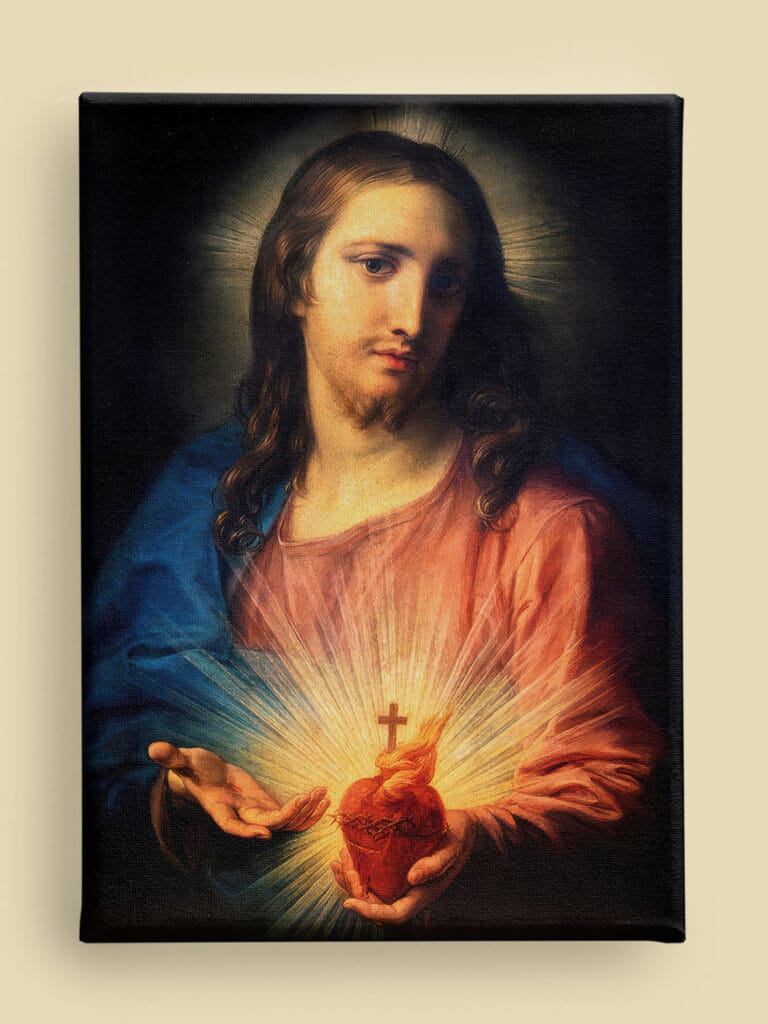
The painting established a visual formula for the Sacred Heart that spread throughout Catholic devotional culture and remains the standard iconography today. Reproductions of Batoni’s composition, or variants of it, appear in churches, homes, schools, and hospitals across the world. This is an unusually direct form of artistic legacy: a single painting that has shaped the visual imagination of Catholic piety for more than two and a half centuries.
The Holy Family and the Madonnas
The Holy Family with Saints Elizabeth and John the Baptist, in the Hermitage Museum in Saint Petersburg, is one of Batoni’s most complete sacred compositions. Mary holds the Christ child, who reaches toward the young John the Baptist, while Elizabeth and Joseph look on. The scene has the Neoclassical clarity that marks all of Batoni’s best work: figures arranged in a stable pyramidal composition, color cool and luminous, the relationships between the figures communicated through gesture and gaze rather than through narrative drama.

The Madonna and Child in Glory, in the Toledo Museum of Art in Toledo, Ohio, shows the Virgin and Child raised above the earthly plane, set against a heavenly light that Batoni renders with the kind of luminous clarity that is his most characteristic technical achievement. The Rest on the Flight into Egypt, in the Dundee Art Galleries and Museums, is a more intimate work on a very different scale: Mary rests with the Christ child on the journey to Egypt, the setting suggesting a real landscape rather than a symbolic space. Both works show the range of scale and register within which Batoni could operate with complete ease.


The Martyrdoms
The Martyrdom of Saint Lucy, in the Real Academia de Bellas Artes de San Fernando in Madrid, shows the young Sicilian martyr at the moment of her death. Lucy was a virgin martyr of the early church, and her cult had deep roots in Catholic devotion. Batoni handles the scene with controlled emotion: the figure of Lucy is beautiful and composed, her suffering acknowledged without being dwelt upon. The color is typically lucid, the composition elegant in its arrangement of the figures around the central saint.

The Ecstasy of Saint Catherine of Siena, in the Museo Nazionale di Palazzo Mansi in Lucca, shows the Dominican mystic in the moment of her mystical rapture, a state Catherine herself described in her Dialogue and that her biographers documented extensively. Batoni brings the same quality of interior illumination to this painting that he brought to the Sacred Heart: the figure is lit from within as much as from without, the spiritual experience rendered as something physically perceptible. Catherine was one of the great doctors of the Church and a patron of Italy, and Batoni’s image captures both her ecstatic mysticism and her doctrinal authority.

Christ, the Apostles, and the Annunciation
Christ in Glory with Saints Celsus, Julian, Marcionilla and Basilissa, in the J. Paul Getty Museum in Los Angeles, is an ambitious multi-figure composition showing Christ enthroned in heavenly glory while a group of Roman martyrs, local saints of Brescia, gather below. The painting demonstrates Batoni’s ability to organize a complex sacred hierarchy across a large canvas with the compositional authority that was his most consistent virtue. The saints are individualized and specific, yet the overall arrangement achieves the clarity that Batoni consistently aimed for.

The Saint Andrew, in the Art Institute of Chicago, is a concentrated single-figure work of the kind that Batoni handled with particular economy and force. The Apostle holds his characteristic X-shaped cross and looks upward with the directness that Batoni brought to all his sacred figures. The Crucifixion, in the Museum of Fine Arts in Boston, brings Batoni to the central subject of Christian sacred art: Christ on the cross, painted with the Neoclassical restraint that marks his mature style. No theatrical excess, no labored drama, only the figure on the cross and the light around it.


The Virgin of the Annunciation, in the Louvre, is among his most refined single-figure compositions. Mary is shown at the moment of Gabriel’s greeting, her posture and expression conveying the humility and assent that Catholic theology read into her “fiat mihi secundum verbum tuum”, let it be done to me according to your word. The figure has the Neoclassical elegance and the spiritual depth that characterize Batoni’s finest sacred work, and the Louvre painting stands as one of his most complete achievements in the devotional mode.

Paintings by Pompeo Batoni
| Name | Date | Medium | Location |
|---|---|---|---|
| Christ in Glory with Saints Celsus, Julian, Marcionilla and Basilissa | 1747-1748 | Oil on canvas | J. Paul Getty Museum, Los Angeles |
| Holy Family with Saints Elizabeth and John the Baptist | c. 1760 | Oil on canvas | Hermitage Museum, Saint Petersburg |
| Madonna and Child in Glory | c. 1742 | Oil on canvas | Toledo Museum of Art, Ohio |
| Martyrdom of Saint Lucy | c. 1750 | Oil on canvas | Real Academia de Bellas Artes de San Fernando, Madrid |
| Sacred Heart of Jesus | 1767 | Oil on canvas | Church of the Gesu, Rome |
| Saint Andrew | c. 1740-1745 | Oil on canvas | Art Institute of Chicago |
| The Crucifixion | c. 1760-1765 | Oil on canvas | Museum of Fine Arts, Boston |
| The Ecstasy of Saint Catherine of Siena | c. 1743 | Oil on canvas | Museo Nazionale di Palazzo Mansi, Lucca |
| The Rest on the Flight into Egypt | c. 1760 | Oil on canvas | Dundee Art Galleries and Museums, Dundee |
| The Virgin of the Annunciation | c. 1742-1745 | Oil on canvas | Louvre Museum, Paris |
Important Facts About Pompeo Batoni
- Pompeo Batoni was born on January 25, 1708, in Lucca, the son of a goldsmith, and moved to Rome around 1727 to complete his artistic training under Sebastiano Conca and by studying the ancient collections and the works of Raphael.
- He trained in Rome under Sebastiano Conca and by intensive study of classical sculpture and Renaissance painting, establishing a style grounded in the Raphael tradition and the antique.
- Batoni is the supreme Italian Neoclassical painter of the eighteenth century, celebrated equally for his portraits of Grand Tour aristocrats and for his sacred altarpieces, which combine Neoclassical clarity with deep devotional feeling.
- His most celebrated religious work is the Sacred Heart of Jesus (1767) at the Church of the Gesu in Rome, one of the earliest significant artistic treatments of the devotion and the painting that established the iconographic formula still used throughout the Catholic world.
- He died in Rome on February 4, 1787, and is buried in the Church of San Celso e Giuliano in Rome; his legacy rests both on his transformation of portrait painting and on his contribution to the Catholic devotion to the Sacred Heart of Jesus.
Questions & Answers
What is Pompeo Batoni’s most famous painting?
The Sacred Heart of Jesus (1767) at the Church of the Gesu in Rome is by far his most widely known and influential work. The painting established a visual formula for the devotion to the Sacred Heart that has been reproduced in Catholic homes and churches around the world for two and a half centuries. Among his secular works, his portraits of British Grand Tour visitors, showing aristocrats posed with ancient sculpture and Roman ruins, are the works most frequently discussed in art historical literature.
Where can I see Pompeo Batoni’s paintings today?
The Sacred Heart of Jesus remains in the Church of the Gesu in Rome, where it was painted. The J. Paul Getty Museum in Los Angeles holds the large altarpiece of Christ in Glory with Saints. The Hermitage in Saint Petersburg, the Louvre in Paris, the Art Institute of Chicago, the Museum of Fine Arts in Boston, and the Toledo Museum of Art all have significant works. His portraits are scattered across British country houses and museums worldwide. The Uffizi in Florence and the Pinacoteca Nazionale in Bologna also hold important paintings.
Was Pompeo Batoni a Baroque or Neoclassical painter?
He bridges the two styles. He was born into the Baroque era and trained within it, and his earliest works show the dramatic compositional energy and chiaroscuro of the Baroque tradition. But as Neoclassicism developed in Rome from the 1750s onward, driven by the archaeological discoveries at Pompeii and Herculaneum and the theoretical writings of Winckelmann, Batoni’s style moved toward greater clarity, elegance, and restraint. His mature religious paintings from the 1760s and 1770s are fully Neoclassical in their lucid color and ordered composition, while retaining something of the Baroque devotional intensity in their spiritual feeling.
Why is Batoni’s Sacred Heart so important in Catholic history?
The devotion to the Sacred Heart of Jesus had deep roots in Catholic mysticism, particularly in the visions of Saint Margaret Mary Alacoque in France in the 1670s, but it did not receive full official papal approval until the nineteenth century. Batoni’s painting (1767) was one of the earliest significant artistic treatments of the devotion following Pope Clement XIII’s 1765 approval for certain dioceses. His image of Christ pointing to his glowing heart while gazing directly at the viewer became the visual template that spread through Catholic devotional culture worldwide, making it one of the most consequential single images in the history of Catholic iconography.
What made Pompeo Batoni so popular with Grand Tour visitors?
Grand Tour visitors, chiefly British, Irish, and Scottish aristocrats making the educational journey through Italy that was considered essential for any man of culture, came to Rome expecting to encounter the greatest art and the greatest artists. Batoni was simply the best portrait painter available, and his ability to combine an elegant, flattering likeness with carefully posed references to ancient sculpture and Roman landmarks gave his sitters exactly what they wanted: proof of their cultural sophistication and their encounter with antiquity. He painted over 200 such portraits between the 1750s and the 1780s, and his studio on the Via delle Quattro Fontane was one of the essential stops on any serious Grand Tour itinerary.
How is Pompeo Batoni related to other Italian painters on this blog?
Batoni was the last great figure of Italian sacred painting before the nineteenth century, and he represents the end of the long tradition that stretched from Giotto through the Renaissance and Baroque to the eighteenth century. He was a contemporary and acquaintance of Giovanni Battista Tiepolo, who represented a parallel achievement in the Venetian tradition. Both painters brought the Italian Baroque to its culmination in very different registers: Tiepolo in the soaring decorative fresco, Batoni in the composed easel painting and altarpiece. Together they represent the last moment of Italian painting as the dominant force in European art.
Can you buy Pompeo Batoni paintings as canvas prints?
You can buy them at jesuschrist.pictures. All the Pompeo Batoni canvas prints are gathered in our shop, printed on premium canvas and shipped worldwide.