Our Lady of Perpetual Help: the Icon’s Hidden Meanings
Our Lady of Perpetual Help is a Byzantine icon of the Virgin and Child, painted in tempera on a wood panel of about 54 by 41.5 centimeters, and venerated in the church of Saint Alphonsus Liguori in Rome, where the Redemptorists have kept it since 1866. Copies of it hang in more churches and homes than almost any other Marian image on earth.
Millions know the picture; far fewer know that nothing in it is decorative. The two miniature angels, the Greek letters, the Child’s clasped hands, the mysterious sandal hanging from his foot: every element is a sentence in a theology of fear and comfort. This article walks through the icon detail by detail, then tells the improbable story of its journeys, and ends with the prayer and a free printable prayer card.
A Byzantine Icon of the Passion
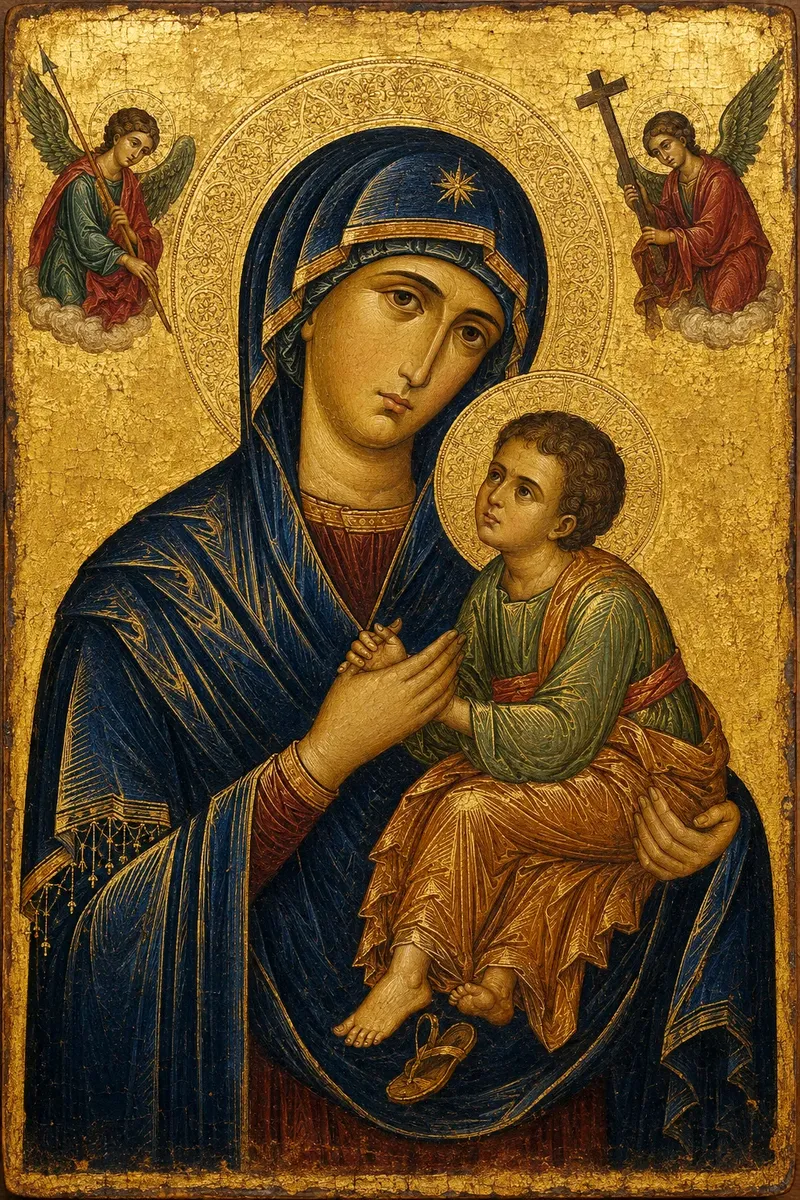
The image belongs to a type the Eastern Church calls the Virgin of the Passion: a Mother of God holding her Child while angels display, not lilies or crowns, but the instruments of his future death. Art historians attribute the panel to the Cretan school, the great icon workshops of Venetian Crete, and date it somewhere between the thirteenth and the fifteenth century. The West absorbed this Byzantine manner early, through masters such as Cimabue, whose gold-ground Madonnas belong to the same family; you can read about him in our article on Cimabue’s paintings.
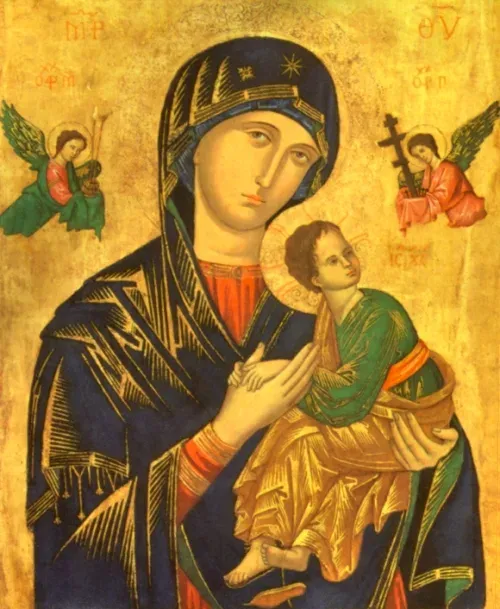
The Greek initials scattered across the gold identify each figure with bureaucratic precision: MP-ΘY for Mother of God beside Mary’s head, IC-XC for Jesus Christ beside the Child, and over the two small angels, the abbreviations of the archangels Michael and Gabriel. Everything else in the panel is silence and gold, the icon painter’s shorthand for heaven, an art whose language we explore in our guides to Catholic icons and Marian iconography.
The Two Archangels and the Instruments of the Passion
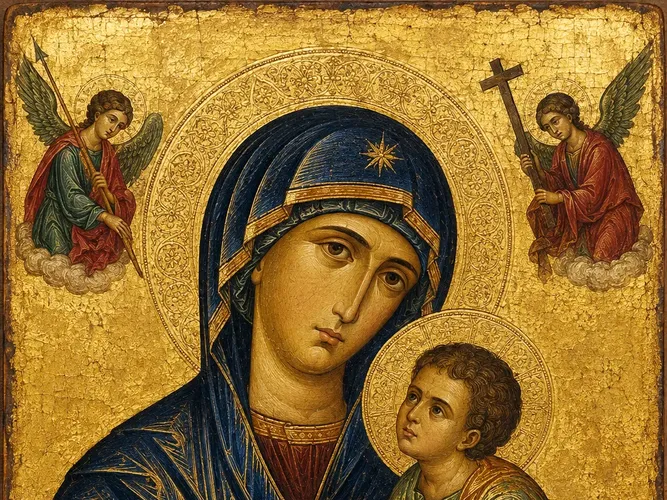
Look first at the upper corners. On the left, the archangel Michael carries the lance that will pierce Christ’s side and the pole with the sponge of vinegar. On the right, Gabriel, the very angel who once announced the Child’s birth, now presents his cross and nails. Both hold the instruments with veiled hands, the way a priest handles sacred vessels, as if the tools of the Passion were already relics.
This is the icon’s central invention: the Christ Child is not being shown toys or symbols of kingship. He is being shown, in a vision, how he will die.
The Frightened Child and His Mother’s Hands
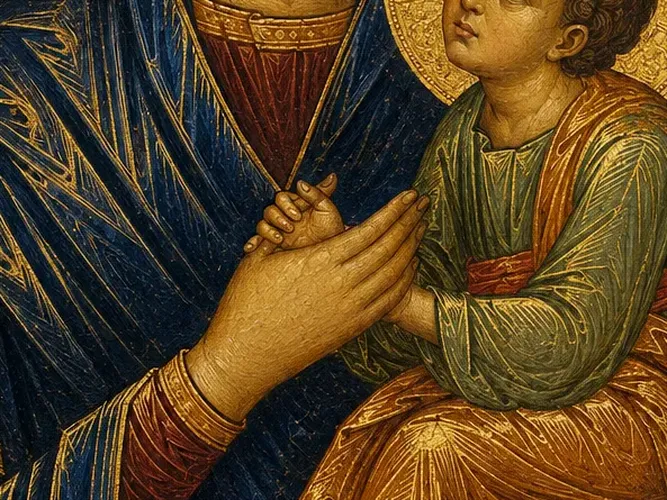
The Child has just seen the vision. He has run to his Mother so fast that he has nearly lost a sandal, and he buries both his small hands in her free hand, looking not at us but away, toward the cross Gabriel carries. Mary holds him, but notice what her hand does not do: it does not close over his. Her right hand remains open, flat, turned toward the viewer, at once comforting her Son and presenting him to us, the same gesture the Byzantine tradition uses for “she who shows the way”.
And her eyes. The Child looks at the angels; Mary looks at no one but you. Her gaze is the icon’s engine: grave, direct, unhurried, the look of a mother who has absorbed her child’s fear and turned to face whoever else is afraid. The small mouth, in the icon painters’ code, is silence; the large eyes are for seeing everything.
The Falling Sandal
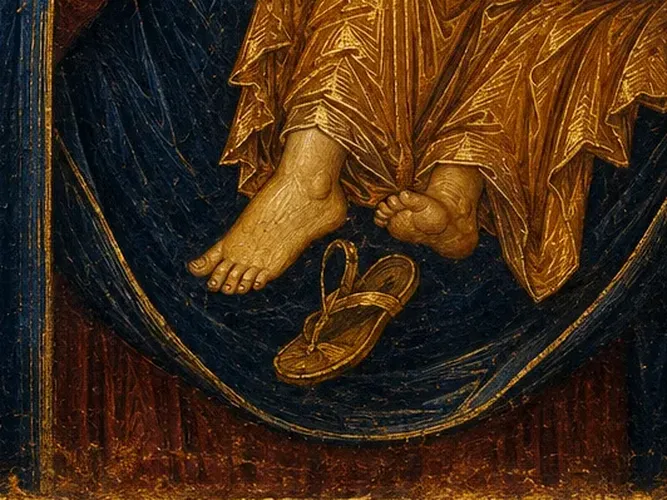
At the bottom of the icon dangles its most beloved detail, a small sandal slipping from the Child’s right foot, held by a single strap. Devotional tradition has read it many ways: the haste of a frightened boy who ran to his Mother; the humanity of Christ, hanging, like the sandal, by a thread as he contemplates the Passion; or the soul that clings to God by one strap of grace. The icon itself does not choose an interpretation. It simply leaves the sandal falling forever, halfway between heaven and us, and lets every generation of the faithful see its own fear, and its own rescue, in that small suspended shoe.
Stolen, Lost, and Found Again
The icon’s history is as dramatic as its imagery. Tradition says a merchant stole the wonder-working image from a church in Crete at the end of the fifteenth century and carried it to Rome, surviving a storm at sea on the way. On his deathbed he confessed, and after the Virgin appeared to a child of the household, the icon was enthroned in 1499 in the church of San Matteo on the Via Merulana, where it was venerated for exactly three hundred years.
In 1798 Napoleonic troops demolished San Matteo. The icon vanished. The Augustinian friars who fled the ruined church kept the panel in obscurity, at one point hanging it in a house chapel where an old brother would point it out to an altar boy named Michael Marchi. Decades later, Marchi had become a Redemptorist, and his congregation had built the church of Saint Alphonsus on the Via Merulana, on the very ground of the old San Matteo. When a Jesuit preacher publicly wondered where the lost Madonna of San Matteo had gone, Marchi remembered.
In 1866 Pope Pius IX ordered the icon returned to the Via Merulana and entrusted it to the Redemptorists with a command that became their motto: “Make her known throughout the world.” The icon was solemnly crowned in 1867, healings were reported at its very first procession, and the Redemptorist missions did the rest: today the image is venerated on every continent, and the Eternal City’s quietest icon became, by copies, one of the most reproduced sacred images in history.
Feast Day and the Wednesday Novena
The feast of Our Lady of Perpetual Help is kept on June 27. Her devotion has its own weekly rhythm as well: the Perpetual Novena, prayed publicly every Wednesday in Redemptorist churches since 1927. Its most famous home is the National Shrine of Our Mother of Perpetual Help in Baclaran, Manila, where the Wednesday devotions draw crowds of up to a hundred thousand, among the largest regular Marian gatherings in the world.
Prayer to Our Lady of Perpetual Help
This is the traditional prayer of the devotion, the one on our printable prayer card and poster.
O Mother of Perpetual Help, behold at your feet a poor sinner who has recourse to you and confides in you.
O Mother of Mercy, have pity on me. I hear you called by all the refuge and hope of sinners: be, then, my refuge and my hope.
Help me, for the love of Jesus Christ; stretch forth your hand to me, a poor fallen creature who commends myself to you.
I know that as my Mother you desire my salvation more than I do myself. Obtain for me, then, the graces I need, and above all the grace never to be separated from your Son.
(Mention your intention.)
O Mother of Perpetual Help, never let me lose my God. Amen.
Like the Hail Mary, it is short enough to become a daily habit, prayed before any copy of the icon.
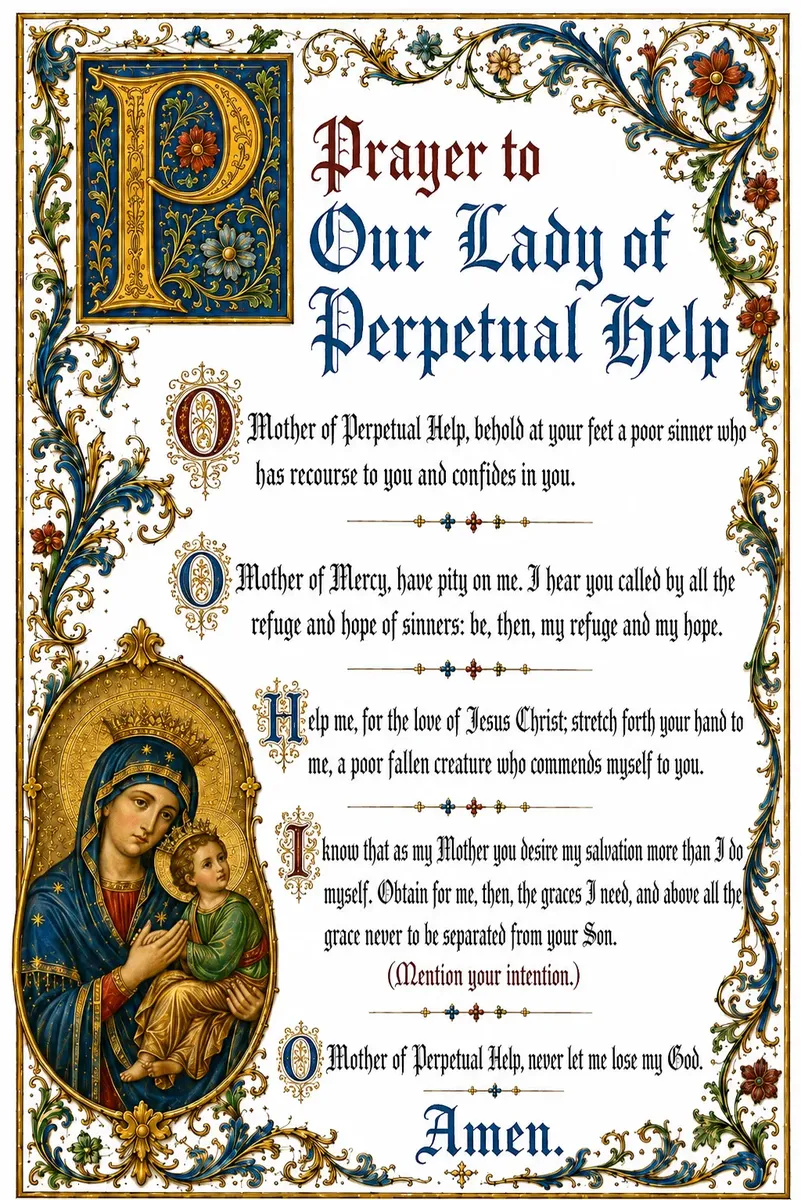
Free printable prayer card:
These files are free for personal use, for your parish, or for catechism class.
✦ Free Christian & Catholic Printables
Love this one? Find it, and our complete collection of illuminated prayer cards and Scripture printables, ready to print, free, in one place.
Browse all free printables →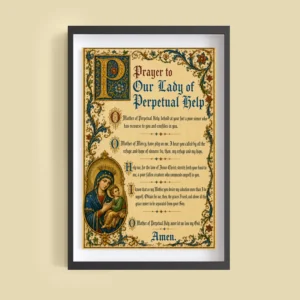
Conclusion
Our Lady of Perpetual Help endures because it does something almost no other famous image of Mary does: it admits that faith and fear live in the same heart. The Child of the icon is God, and he is frightened; his Mother comforts him, and looks at us. Whoever has ever run to someone with their fear understands this picture without a word of explanation, which may be why the Redemptorists’ mission to make her known succeeded so completely. The Hail Holy Queen prayer says the same thing in words, crying to Mary from a valley of tears as a child runs to its mother.
To go further among the great dark-toned icons of the tradition, read the story of the Black Madonna of Częstochowa, or survey the whole language of sacred images in our guide to Catholic icons and their meaning.
Artwork Information
| Artwork | Our Lady of Perpetual Help (Our Lady of Perpetual Succour) |
| Artist | Unknown; attributed to the Cretan school |
| Date | 13th to 15th century (dating debated) |
| Medium | Tempera on wood panel (icon, Virgin of the Passion type) |
| Dimensions | About 54 x 41.5 cm |
| Location | Church of Saint Alphonsus Liguori, Rome (Redemptorists) |
Five Facts About Our Lady of Perpetual Help
- The icon is a Virgin of the Passion of the Cretan school, painted in tempera on wood between the 13th and 15th centuries, and measures about 54 by 41.5 centimeters.
- The archangels Michael and Gabriel hold the lance, sponge, cross and nails of the Passion with veiled hands, showing the Child a vision of his own death.
- The falling sandal on the Child’s right foot, loosened as he ran to his Mother, is the icon’s most beloved detail.
- Stolen from Crete, venerated for 300 years in San Matteo in Rome, and lost after 1798, the icon was rediscovered and entrusted to the Redemptorists by Pius IX in 1866 with the words “Make her known throughout the world”.
- Her feast is June 27, and the Wednesday Perpetual Novena at Baclaran in Manila draws some of the largest weekly Marian crowds in the world.
Frequently Asked Questions
What does the icon of Our Lady of Perpetual Help mean?
The icon shows the Child Jesus running to his Mother after the archangels Michael and Gabriel show him, in a vision, the instruments of his future Passion: the cross, the nails, the lance and the sponge. He grips her hand, losing a sandal in his haste, while Mary comforts him and turns her eyes to us, offering the same refuge to everyone who looks at her. The image is a complete theology of fear consoled by a mother’s help.
Where is the original icon of Our Lady of Perpetual Help?
The original icon hangs above the high altar of the church of Saint Alphonsus Liguori (Sant’Alfonso all’Esquilino) on the Via Merulana in Rome, a short walk from the basilica of Saint Mary Major. The Redemptorist congregation has been its custodian since Pope Pius IX entrusted it to them in 1866.
What is the history of the image of Our Lady of Perpetual Help?
Painted by an unknown master of the Cretan school between the 13th and 15th centuries, the icon was, according to tradition, stolen from Crete by a merchant and brought to Rome, where it was enthroned in the church of San Matteo in 1499. When Napoleonic troops destroyed San Matteo in 1798 the icon disappeared for decades, until the memory of an old altar boy, by then a Redemptorist, led to its rediscovery. Pius IX had it returned in 1866 to the new church built on the same street, and it was crowned in 1867.
What do you pray to Our Lady of Perpetual Help for?
As her title says, for perpetual help: constant assistance in every need, great or small. The faithful bring her illness, family troubles, financial distress, fear and conversion, either through the traditional prayer on this page or through the Wednesday Perpetual Novena prayed in Redemptorist churches worldwide since 1927. Mothers in particular have always recognised themselves in the icon.
Is it okay for Catholics to have icons?
Yes. Catholic teaching, defined at the Second Council of Nicaea in 787, distinguishes worship, which belongs to God alone, from veneration, which may be given to images of Christ, Mary and the saints because the honour passes to the person represented. An icon in the home is a window for prayer, not an idol, and the Church has blessed and crowned images like Our Lady of Perpetual Help for centuries.
Where can I buy an Our Lady of Perpetual Help picture?
You can buy an Our Lady of Perpetual Help picture at jesuschrist.pictures: our Our Lady of Perpetual Help poster reproduces the miraculous icon on thick matte paper, and the traditional prayer is available as an illuminated prayer poster. Both ship ready to frame, and the printable prayer card above is free.