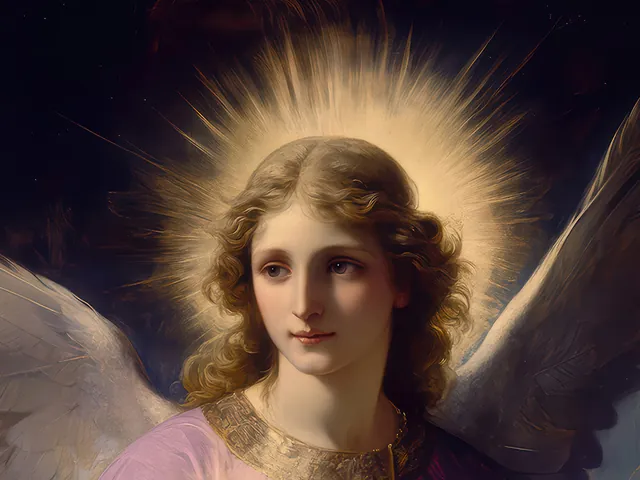
Beautiful Religious Paintings by William-Adolphe Bouguereau
William-Adolphe Bouguereau is the most polished religious painter of the French Belle Époque. The William-Adolphe Bouguereau paintings that survive today combine the calm classical drawing of the late academic tradition with a porcelain perfection of surface that no other painter of his generation quite matched. He was the most successful Salon painter of the second half of the nineteenth century, the most exhibited Catholic religious artist of his time, and one of the central voices of the French academic establishment from the 1860s until his death in 1905.
This article gathers eleven of his most important religious works, the panels and canvases that fill the great French and American collections with his late academic Marian devotion.

From La Rochelle to the Salon
William-Adolphe Bouguereau was born on 30 November 1825 in La Rochelle, on the Atlantic coast of France, the son of a wine and olive oil merchant. He studied first with the local painter Louis Sage and then in 1846 entered the École des Beaux-Arts in Paris under François-Édouard Picot, the teacher of Alexandre Cabanel. In 1850 he won the Prix de Rome and spent four years at the Villa Medici studying Raphael and the Italian Renaissance masters.
From his return to Paris in 1854 he became the dominant figure of the French academic Salon, exhibiting almost every year for more than five decades and accumulating an enormous body of religious, mythological, and genre paintings. He was a member of the Institut, professor at the École des Beaux-Arts, and the most decorated French painter of his generation. He died on 19 August 1905 in his native La Rochelle.
The Virgin with Angels
One of Bouguereau’s most reproduced religious paintings, this great altarpiece of 1881 shows the Virgin and Christ child enthroned with a host of small angels gathered around them. The composition is built on a single dramatic vertical, with the Virgin in deep blue at the centre and the angels descending in concentric ranks of pink and gold. The picture became one of the most widely reproduced Marian devotional images of the Belle Époque.

The painting is at the Forest Lawn Museum in Glendale, California.
Virgin with Angels (variant)
A second version of the same composition, this variant shows subtle differences in the pose of the central Virgin and the surrounding angels. Bouguereau produced several versions of his most successful religious compositions for different patrons.

The painting is also at the Forest Lawn Museum in Glendale.
The Virgin Comforter
This great altarpiece of 1877 shows the Virgin Mary on a marble throne, holding a kneeling young woman in mourning while the dead body of her child lies across the Virgin’s lap. The painting was conceived as a meditation on the medieval iconographic type of the Consolatrix afflictorum, the Virgin who consoles the afflicted, and was painted by Bouguereau after the death of his own son.

The painting is at the Musée des Beaux-Arts in Strasbourg, on long-term loan from the Musée d’Orsay.
Pietà
Painted in 1876, this large canvas shows the Virgin holding the dead body of Christ in her lap while a host of angels weeps around her. The composition is one of Bouguereau’s most concentrated religious paintings, with the dead Christ as the bright centre of the picture and the figures of the angels providing the chorus of grief.

The painting is at the Dallas Museum of Art.
Flagellation of Our Lord Jesus Christ
Painted in 1880 for the Cathedral of Saint-Louis in La Rochelle, the painter’s native city, this great altarpiece shows the scourging of Christ at the column by the Roman soldiers. The composition is built on the dramatic Italian Baroque vertical of the body of Christ at the centre, with the executioners arranged in muscular Renaissance poses around him.

The painting still hangs in the Cathédrale Saint-Louis of La Rochelle.
The Three Marys at the Tomb
This great canvas of 1890 shows the three Marys arriving at the empty tomb of Christ on Easter morning, where an angel appears to them with the news of the Resurrection. Bouguereau paints the moment with the calm classical balance of his mature manner, with the three women caught in three different moments of recognition.

The painting is at the Royal Museum of Fine Arts in Antwerp.
The Madonna of the Lilies
One of Bouguereau’s most intimate Marian devotional panels, this picture of 1899 shows the Virgin holding the Christ child while she stands in front of a great bouquet of white lilies, the symbol of her purity. Bouguereau paints the figures with the polished porcelain modelling of his late academic manner.

The painting is in a private collection.
The Madonna of the Roses
The companion in spirit to the Madonna of the Lilies, this small panel shows the Virgin holding the Christ child in front of a great bouquet of pink and white roses, the medieval Marian symbol of her sweet devotion.

The painting is in a private collection.
The Virgin of the Lamb
This great Marian altarpiece shows the Virgin standing with the Christ child while a small lamb plays at their feet, the medieval symbol of Christ as the Lamb of God. Bouguereau paints the composition with the calm classical balance of his late Salon manner.

The painting is in a private collection.
Virgin and Child
A small devotional panel of the Virgin and Christ child, this picture shows the figures in a calm domestic pose against a soft golden background. Bouguereau paints the two faces with the porcelain perfection that defined all his Marian devotional images of the 1890s.

The painting is at the Gemäldegalerie in Berlin.
Dream of Spring
This great allegorical canvas shows the Virgin and Christ child surrounded by a host of small angels representing the flowering of paradise. Although not strictly a religious painting in the iconographic sense, Bouguereau gives the composition the soft devotional sweetness that he reserved for his Marian altarpieces.

The painting is in a private collection.
For more context on Bouguereau’s French academic world, see our articles on his great rival and friend Alexandre Cabanel, on the great Salon illustrator Gustave Doré, on the Italian Academic master Antonio Ciseri, and on the wider tradition of Realist Jesus paintings.
Summary Table of William-Adolphe Bouguereau’s Religious Paintings
| Name | Artist | Date | Medium | Museum |
|---|---|---|---|---|
| The Virgin with Angels | William-Adolphe Bouguereau | 1881 | Oil on canvas | Forest Lawn Museum, Glendale |
| Virgin with Angels (variant) | William-Adolphe Bouguereau | 1900 | Oil on canvas | Forest Lawn Museum, Glendale |
| The Virgin Comforter | William-Adolphe Bouguereau | 1877 | Oil on canvas | Musée des Beaux-Arts, Strasbourg |
| Pietà | William-Adolphe Bouguereau | 1876 | Oil on canvas | Dallas Museum of Art |
| Flagellation of Our Lord Jesus Christ | William-Adolphe Bouguereau | 1880 | Oil on canvas | Cathédrale Saint-Louis, La Rochelle |
| The Three Marys at the Tomb | William-Adolphe Bouguereau | 1890 | Oil on canvas | Royal Museum of Fine Arts, Antwerp |
| The Madonna of the Lilies | William-Adolphe Bouguereau | 1899 | Oil on canvas | Private collection |
| The Madonna of the Roses | William-Adolphe Bouguereau | 1903 | Oil on canvas | Private collection |
| The Virgin of the Lamb | William-Adolphe Bouguereau | 1903 | Oil on canvas | Private collection |
| Virgin and Child | William-Adolphe Bouguereau | c. 1890 | Oil on canvas | Gemäldegalerie, Berlin |
| Dream of Spring | William-Adolphe Bouguereau | c. 1901 | Oil on canvas | Private collection |
Conclusion
Bouguereau is the most polished religious painter of the French Belle Époque. His Madonnas, his angels, and his Christ Child became the standard visual language of French Catholic devotional culture in the second half of the nineteenth century, reproduced in prints, holy cards, and parish altarpieces across the Catholic world for more than a century after his death. The modernist generation of the early twentieth century rejected him as the embodiment of everything they wanted to overturn, but the late twentieth and early twenty-first centuries have brought a quiet rehabilitation, and his religious paintings have once again become the subject of serious art historical study.
Important Facts About William-Adolphe Bouguereau
- William-Adolphe Bouguereau was born on 30 November 1825 in La Rochelle, on the Atlantic coast of France, the son of Théodore Bouguereau, a wine and olive oil merchant.
- He studied first with the local painter Louis Sage and then in 1846 entered the École des Beaux-Arts in Paris under François-Édouard Picot, before winning the Prix de Rome in 1850 and spending four years at the Villa Medici.
- Bouguereau is the most successful French Salon painter of the second half of the nineteenth century and the most exhibited Catholic religious artist of his time, exhibiting almost every year of the Paris Salon for more than fifty years.
- His most famous religious work is the great Virgin with Angels of 1881 at the Forest Lawn Museum in Glendale, California, one of the most widely reproduced Marian devotional images of the entire Belle Époque.
- He died on 19 August 1905 in his native La Rochelle, having been a member of the Institut, professor at the École des Beaux-Arts, and the most decorated French painter of his generation.
Questions and Answers About William-Adolphe Bouguereau Paintings
What is William-Adolphe Bouguereau’s most famous painting?
The single most reproduced religious painting is the great Virgin with Angels of 1881, now at the Forest Lawn Museum in Glendale, California. The Pietà at the Dallas Museum of Art and the Virgin Comforter at Strasbourg are also widely known. Among his mythological paintings, the Birth of Venus of 1879 at the Musée d’Orsay is his most famous work.
Where can I see William-Adolphe Bouguereau paintings today?
The Musée d’Orsay in Paris and the Petit Palais hold significant works. The Forest Lawn Museum in Glendale, California, the Dallas Museum of Art, the Sterling and Francine Clark Art Institute in Williamstown, and the Metropolitan Museum of Art in New York all hold important religious paintings. The Cathédrale Saint-Louis of La Rochelle still preserves the great Flagellation in its original chapel.
What style is William-Adolphe Bouguereau associated with?
Bouguereau is the central figure of late French Academic painting and one of the most polished representatives of the so-called peinture lisse, the smooth painting of the late nineteenth century French Salon. His mature style is built on classical drawing, polished porcelain surface finish, idealised figural beauty, and a deeply Catholic religious imagination that placed him in direct opposition to the rising modernist movements of his late career.
Why did Bouguereau fall out of fashion?
The modernist generation of the early twentieth century, from Cézanne and Matisse to the Surrealists, identified Bouguereau as the embodiment of everything they wanted to overturn: the polished academic surface, the idealised classical figure, the Catholic religious subject matter, and the official Salon machine. For most of the twentieth century his paintings were dismissed as kitsch. The late twentieth and early twenty-first centuries have brought a serious rehabilitation, and his religious works are once again the subject of serious art historical study.
Did Bouguereau paint many religious subjects?
Yes, religious subjects formed a substantial part of his output throughout his career. His many Madonnas, his angels, his Virgin Comforter, his Pietà, and his great altarpieces for French parish churches placed him at the centre of the late nineteenth century French Catholic devotional revival. His religious works were widely reproduced in prints and holy cards and shaped the visual culture of French Catholic piety for more than a century.
How does Bouguereau compare with Cabanel?
The two painters were the two leading representatives of French academic painting in the second half of the nineteenth century, and they often shared juries, prizes, and commissions. Cabanel was slightly older and more dramatic, with a particular love for Romantic biblical subjects. Bouguereau was younger and more polished, with a particular love for tender Madonnas and angel scenes. Together they define the two main poles of late French Academic religious painting.
Where can I buy William-Adolphe Bouguereau paintings reproductions?
The shop at jesuschrist.pictures offers museum-quality canvas reproductions of the great Christian paintings, and the collection keeps growing; it is the best place to look for William-Adolphe Bouguereau paintings reproductions.