Archangel Zadkiel: The Angel of Mercy and the Knife of Abraham
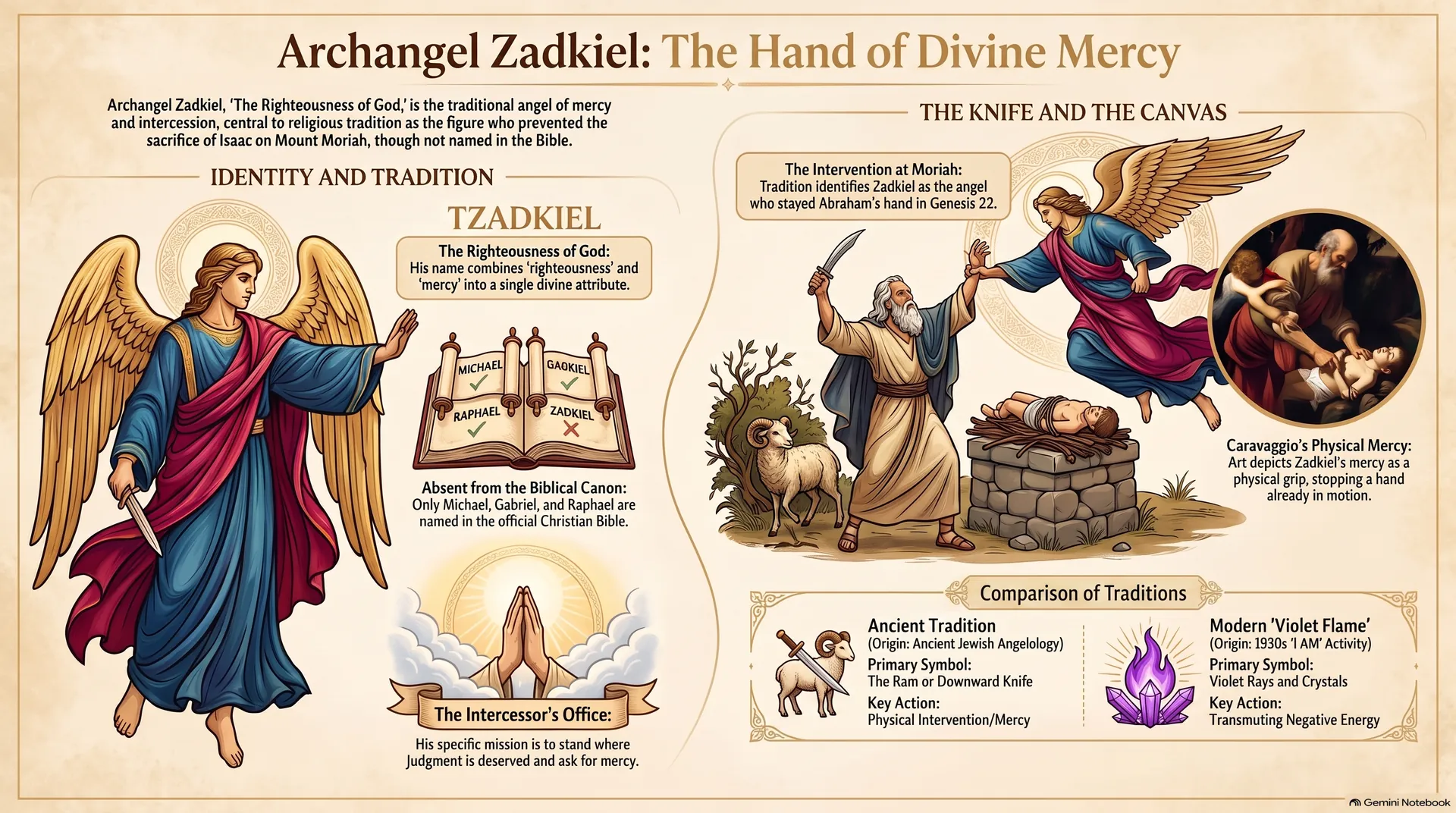
Archangel Zadkiel is the angel of mercy. His name, in Hebrew Tzadkiel, means the Righteousness of God, and Jewish and Christian angelology has given him one office above all others: to stand where judgement is deserved and ask for something else. He is also called Hasdiel, from a root meaning loving kindness, which says the same thing twice.
He is not named in the Bible. What tradition does say about him is more striking than most of what the internet now says: that the angel who stopped Abraham on Mount Moriah, whose hand closed on the old man’s wrist a second before the knife came down, was Zadkiel. Scripture does not give that angel a name. The tradition supplies one, and it chose the angel of mercy. This article follows that thread, looks hard at the painting that shows the moment best, and then separates what belongs to the Jewish and Christian tradition from what was invented in California in the twentieth century.
The Name: Righteousness of God
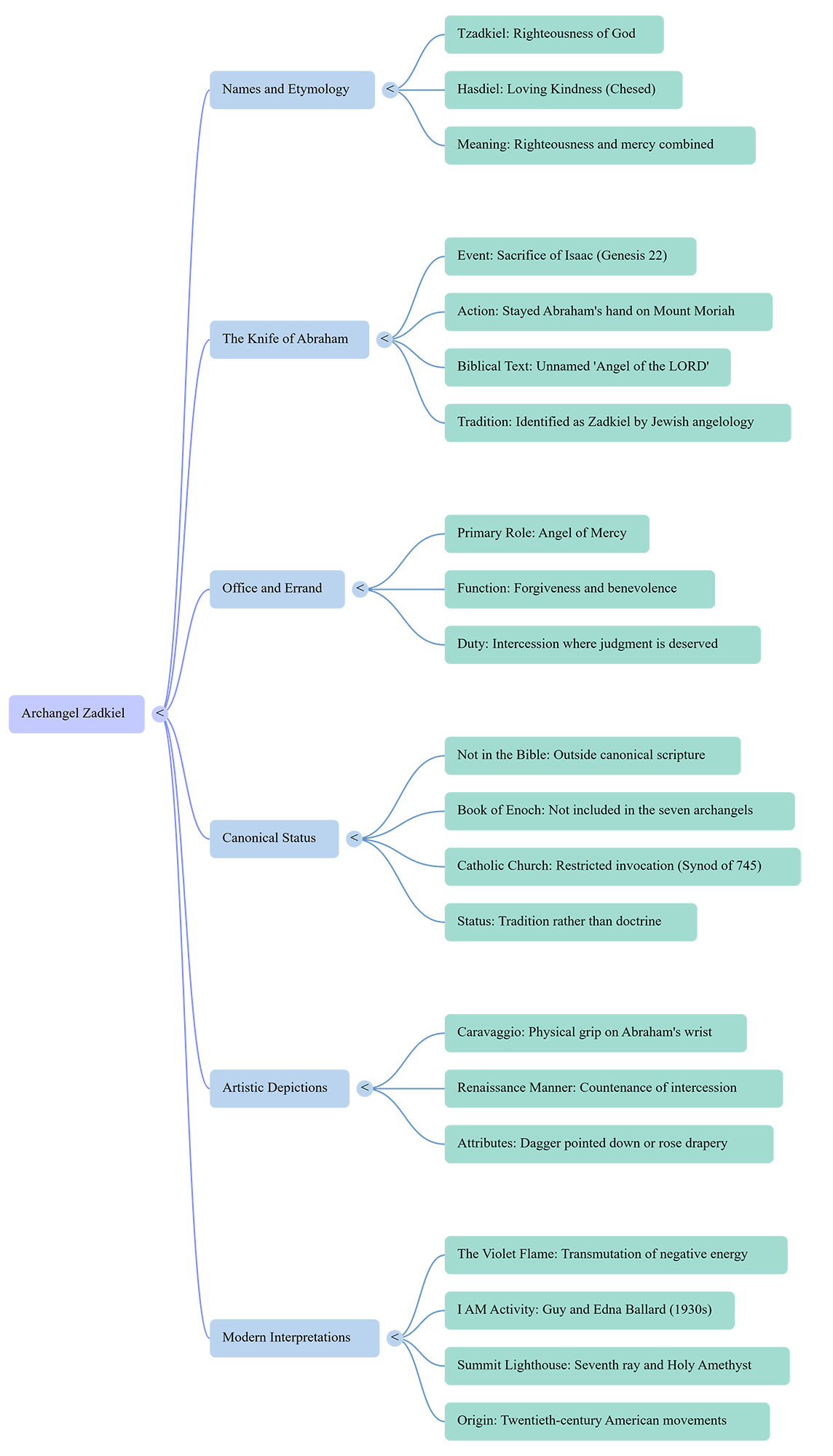
Tzedek is the Hebrew word for righteousness, for what is right and straight and owed. Attach El, the divine name, and you have Tzadkiel: the righteousness of God, or God is my righteousness. The other name given him, Hasdiel, comes from chesed, a word usually translated as loving kindness or steadfast love, the covenant loyalty God shows whether or not it is deserved.
Put the two names side by side and you have the whole idea. Zadkiel is not the angel who suspends justice. He is the angel in whom righteousness and mercy turn out to be the same attribute seen from different angles. In the Kabbalistic ordering of the divine attributes, Chesed stands opposite Gevurah, severity, and Zadkiel is attached to the side of Chesed. That is a later, mystical systematisation, but it is at least a Jewish one, and it is where the association of Zadkiel with mercy actually comes from.
The Knife of Abraham
Genesis 22 is the hardest chapter in the book. God tells Abraham to take his son, his only son, whom he loves, and offer him as a burnt offering on a mountain in the land of Moriah. Abraham says nothing. He rises early, splits the wood, saddles the donkey, walks three days, builds the altar, binds the boy, and takes the knife.
Then: the angel of the LORD called to him out of heaven and said, Abraham, Abraham. And he said, Here am I. And he said, Lay not thine hand upon the lad.
Scripture does not name that angel. It says the angel of the LORD, which in Genesis is often a way of speaking of God’s own presence rather than of a distinct creature. Later Jewish angelology, working through the names it had gathered, identified the voice on Moriah with Zadkiel, on the reasonable ground that an angel who arrives to stop a killing is doing the work of mercy. It is a tradition, not a text. It should be held that way, and it is worth holding, because it is a genuine and old reading of what the moment means.
What Caravaggio Saw
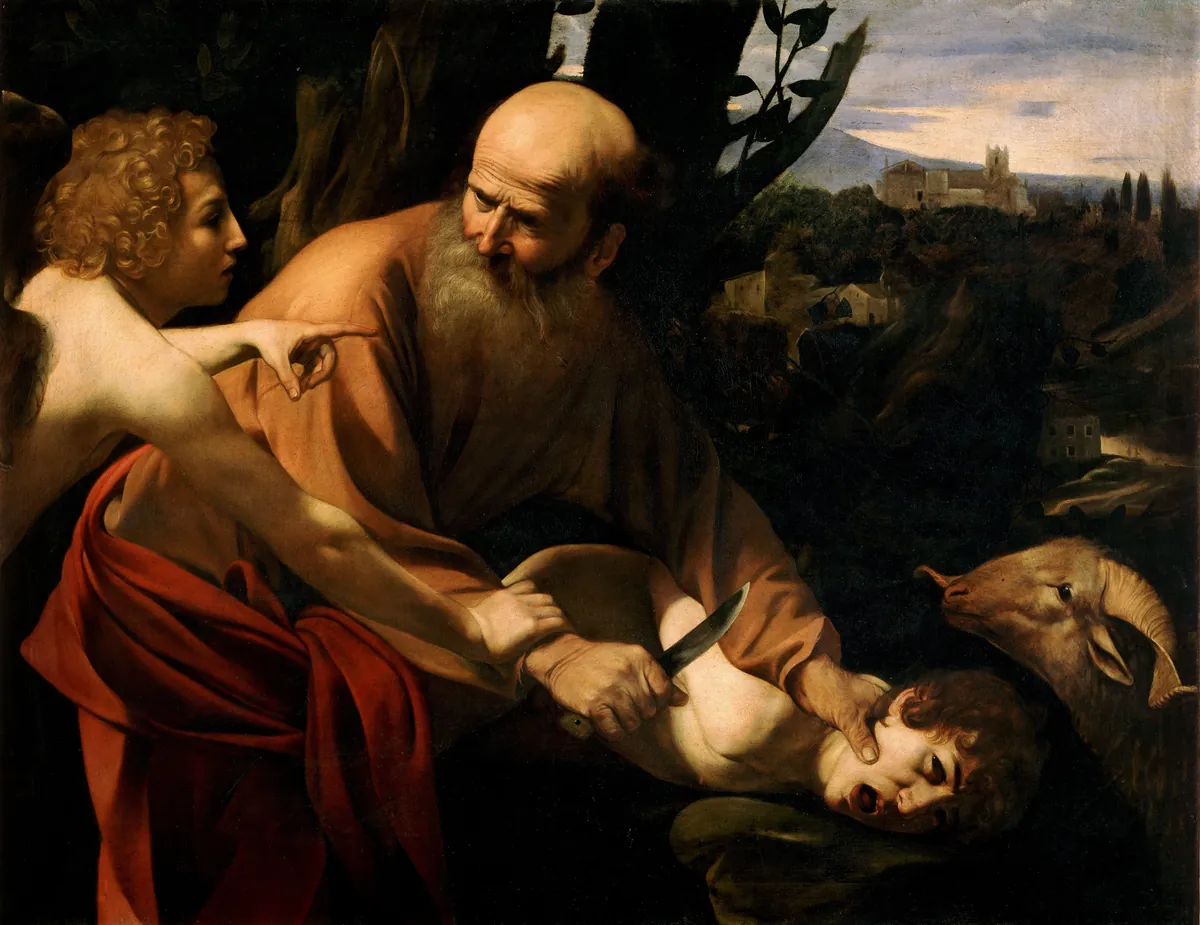
Around 1603 Caravaggio painted the scene for Cardinal Maffeo Barberini, the future Urban VIII. The panel hangs in the Uffizi, and it is the most useful image in Christian art for understanding what the tradition means by mercy.
Look at what the angel does. He does not appear in glory. He does not hover, or gesture from a cloud, or unroll a scroll. He has come in close, shoulder to shoulder with Abraham, and he has taken hold of the man’s wrist. The grip is a real grip: fingers dug into the forearm, the whole weight of a young body braced against an old one. With his other hand he points, off to the side, at the ram caught in the thicket.
Isaac is screaming. Caravaggio gives him a boy’s open mouth and a cheek pressed into the stone, and the knife is a hand’s width from his throat. The mercy in this painting is not a feeling. It is an interruption, applied physically, at the last possible instant.
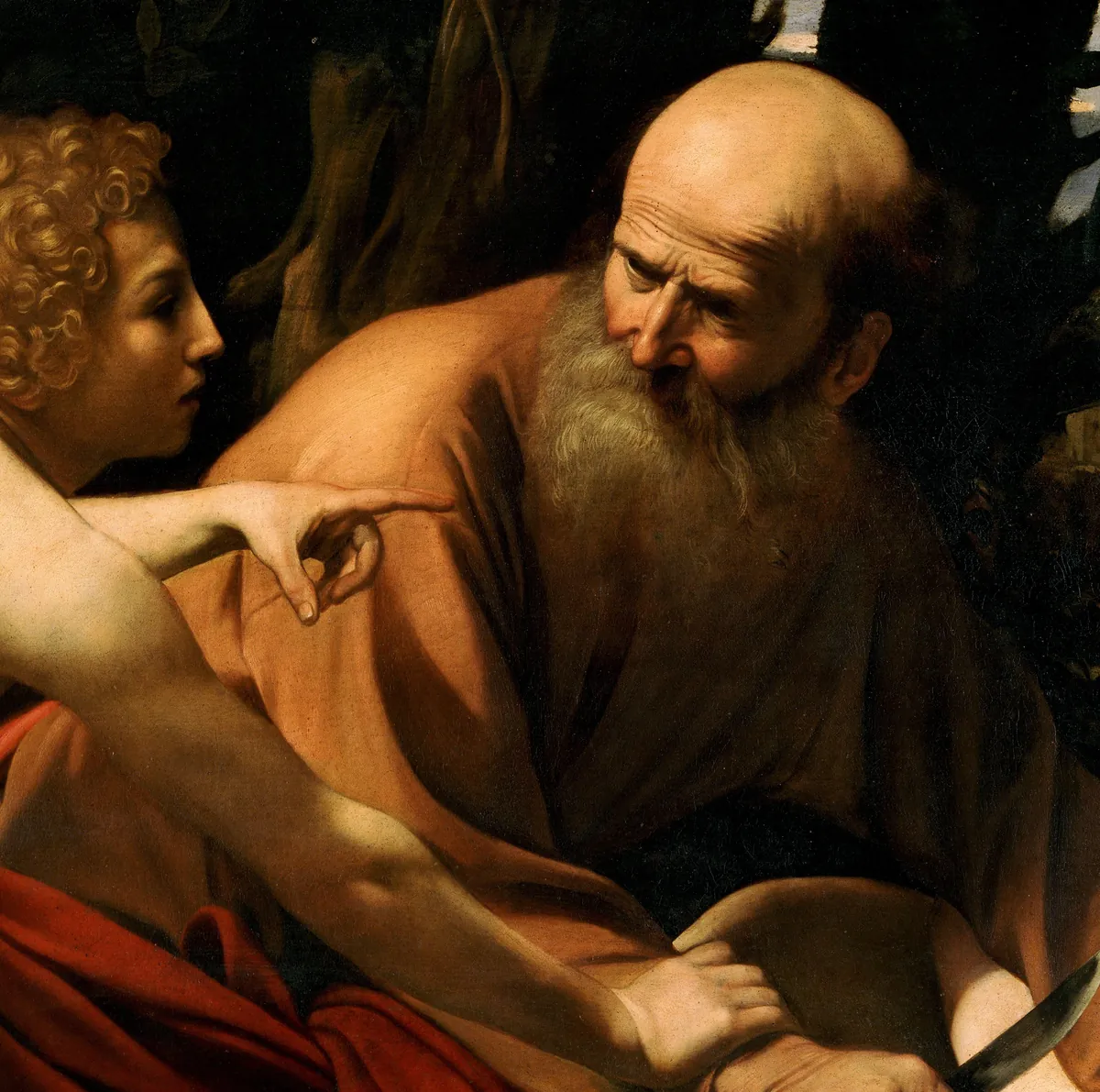
That is the theological point the tradition was reaching for when it put Zadkiel’s name on the scene. Mercy is not the absence of justice, and it is not sentiment. It is something that arrives and takes hold. Caravaggio, who understood violence better than most painters who ever lived, painted it as the only thing strong enough to stop a hand already moving.
Mercy as an Office
The archangels in the tradition are not characters with hobbies. Each is an errand, and the errand is written into the name. Michael is who is like God, and he fights. Gabriel is the strength of God, and he announces. Raphael is God heals, and he travels with the sick. Zadkiel is the righteousness of God, and his errand is to intercede.
Seen that way, the placing of him at Moriah is not arbitrary. Of the named angels, he is the one whose office fits an intervention that spares. The tradition did not invent a story; it read an unnamed angel and asked which of the names it already had would belong there. For the fuller picture of how these names and offices were assembled, see our guide to the archangels and their mission.
Is Zadkiel in the Bible?
No, and it is worth being exact. Three angels are named in the canonical scriptures: Michael, Gabriel and Raphael, the last of these in the Book of Tobit, which Catholics and Orthodox receive and Protestants do not. Every other angelic name in circulation, Zadkiel included, comes from outside the canon: from Jewish angelological literature, from the Book of Enoch, from later mystical writing.
Zadkiel is not even in the list of seven given in the Book of Enoch, which names Uriel, Raphael, Raguel, Michael, Saraqael, Gabriel and Remiel. He belongs to a different and largely Jewish stream of tradition, and he entered Christian angelology sideways rather than through any council or canon. The Roman Church, which in 745 restricted the invocation of angels to the biblical names, has never had a feast or an approved cult of Zadkiel.
None of that makes the tradition worthless. It makes it tradition rather than doctrine, which is the correct label for it.
The Violet Flame, and Where It Actually Comes From
Search for Zadkiel today and the first thing offered is the violet flame: a visualisation in which a purple light is called down to transmute negative energy, karma and past mistakes, with Zadkiel and a consort called Holy Amethyst presiding over the seventh ray.
This is not ancient, and it is not Jewish or Christian. It comes from the I AM Activity founded by Guy and Edna Ballard in the 1930s, and from the Summit Lighthouse, founded by Mark and Elizabeth Clare Prophet in 1958, which developed the ray system and the twin flames in full. The vocabulary is theosophical: rays, ascended masters, karma, transmutation. It is a twentieth century American religious movement with its own scriptures and its own founders.
That is worth stating plainly, not to sneer at anyone, but because a reader looking for the Christian Zadkiel deserves to know which parts of what they are reading are two thousand years old and which parts are ninety. The angel of mercy in Genesis and the presiding intelligence of the seventh ray are not the same figure with the same history. They only share a name.
Zadkiel in Art
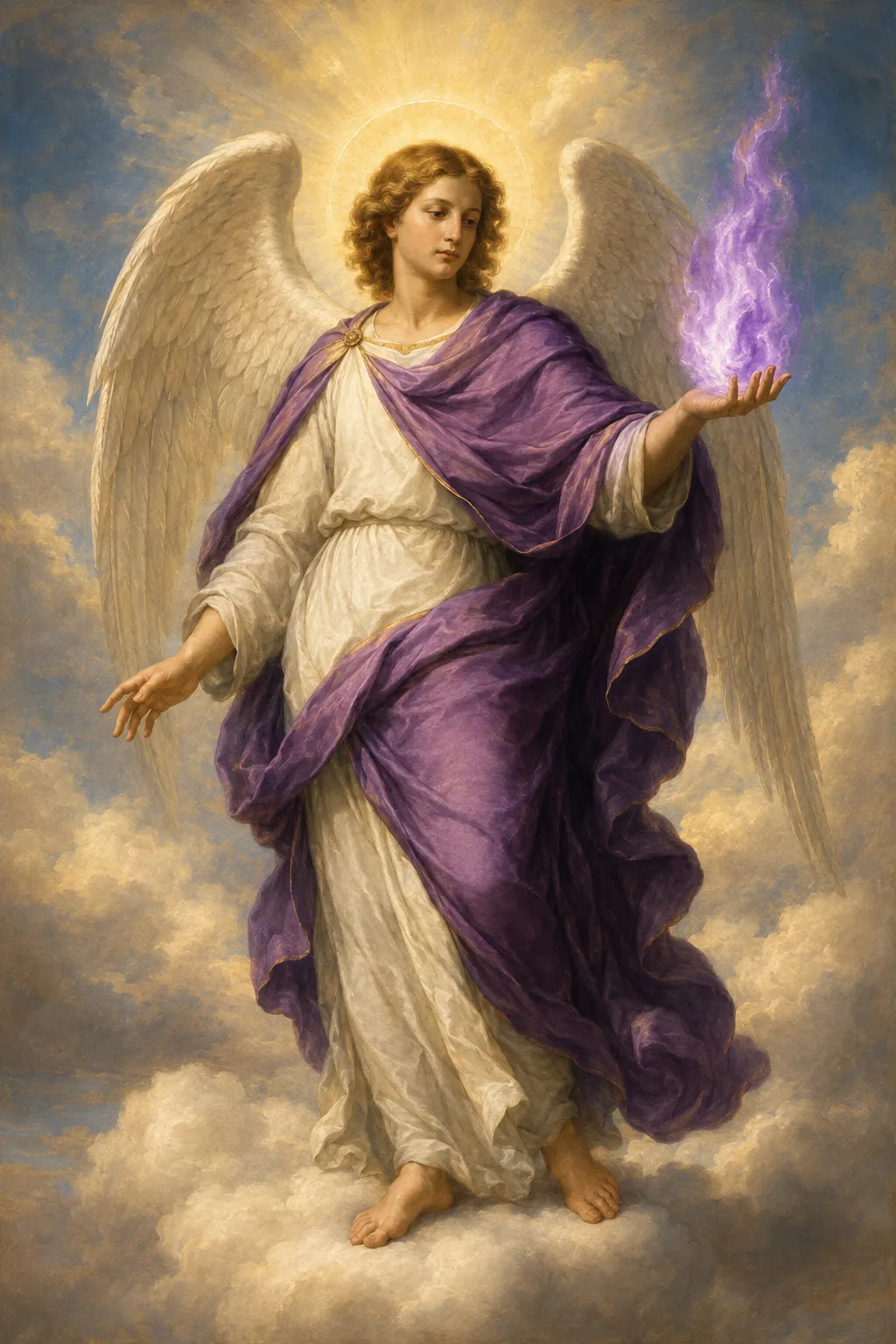
There is very little. Because the Western Church would not invoke the name, no painter was ever commissioned to produce a Zadkiel, and no iconographic type formed. Where he appears in modern devotional imagery the attributes are borrowed, usually a dagger or a knife held point down, sometimes reversed or lowered, in reference to Moriah, and often violet or rose drapery imported from the twentieth century colour schemes.
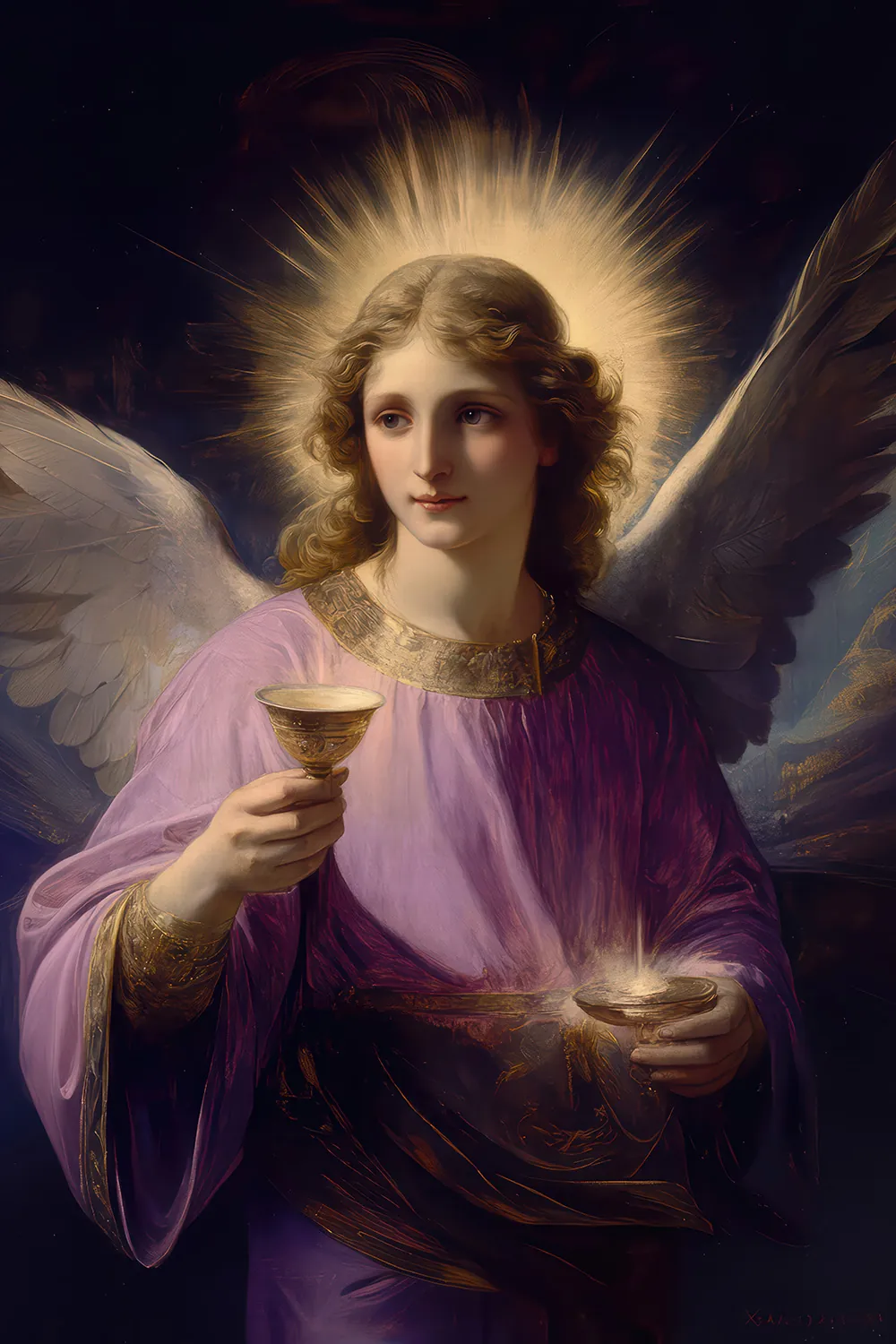
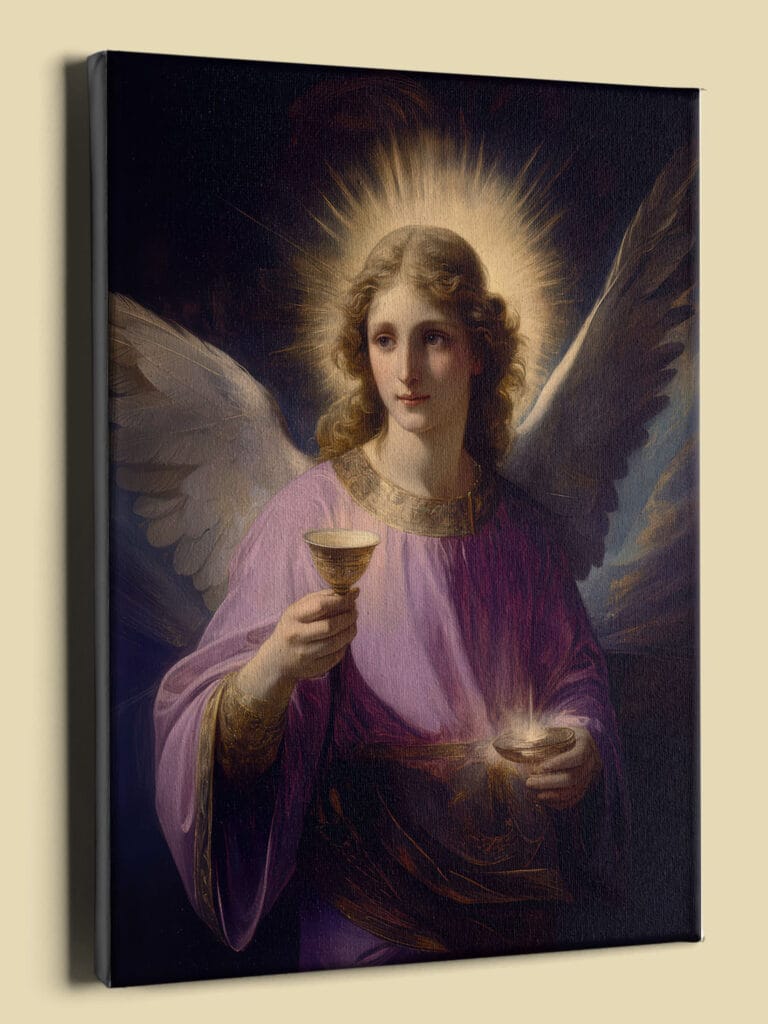
Our own painting takes the older road. It shows him in the Renaissance manner, in rose rather than violet, without the knife, the face lit from within rather than by a coloured ray. If the office is intercession, the useful image is not a weapon at all but a countenance you would want turned toward you when your case is being heard.
Works Featured in This Article
| Work | Artist | Date | Location |
|---|---|---|---|
| The Sacrifice of Isaac | Caravaggio | c. 1603 | Galleria degli Uffizi, Florence |
| Archangel Zadkiel, the Angel of Mercy | Contemporary, jesuschrist.pictures | 2025 | Original artwork |
The Hand on the Wrist
Strip away the rays and the crystals and what remains of Zadkiel is a single, serious idea, and the Bible supplies the picture for it even though it withholds the name. On a mountain in Moriah a man who had obeyed everything was about to lose everything, and something arrived and took his arm.
Whether you call that something the angel of the LORD, as Genesis does, or Zadkiel, as the tradition does, the meaning does not change. Mercy is not softness and it is not a mood. It is an intervention, and in Caravaggio’s painting you can see exactly how much force it takes.
Important Facts About Archangel Zadkiel
- Name: Zadkiel, Hebrew Tzadkiel, the Righteousness of God. Also called Hasdiel, from chesed, loving kindness.
- Office: mercy, forgiveness, benevolence and intercession.
- In scripture: not named. Only Michael, Gabriel and Raphael are named in the canonical Bible.
- Chief tradition: identified with the angel who stayed Abraham’s hand at the binding of Isaac, Genesis 22. Genesis itself says only the angel of the LORD.
- Source of the tradition: Jewish angelological literature and later Kabbalistic writing, where he is attached to Chesed, the attribute of loving kindness.
- Not in the Enochic seven: the Book of Enoch names Uriel, Raphael, Raguel, Michael, Saraqael, Gabriel and Remiel.
- Status in the Roman Church: no feast, no approved cult. The synod of 745 restricted invocation to the biblical names.
- The violet flame: not ancient. It comes from the I AM Activity of the 1930s and the Summit Lighthouse, founded 1958.
Frequently Asked Questions
What is Archangel Zadkiel the angel of?
Zadkiel is the angel of mercy, forgiveness and benevolence. His name means the Righteousness of God, and the tradition treats him as the angel who intercedes where judgement would otherwise fall. In Jewish mystical writing he is attached to Chesed, the divine attribute of loving kindness, which is why mercy rather than severity is his office.
Is Archangel Zadkiel in the Bible?
No. Zadkiel is not named anywhere in the canonical Bible. Only three angels are named in scripture: Michael, Gabriel and Raphael. Zadkiel comes from Jewish angelological tradition outside the canon. He is not even among the seven archangels listed in the Book of Enoch, which names Uriel, Raphael, Raguel, Michael, Saraqael, Gabriel and Remiel.
Is Zadkiel the angel who stopped Abraham?
Tradition says so, scripture does not. Genesis 22 says that the angel of the LORD called to Abraham from heaven and told him not to lay a hand on the boy, without giving that angel a name. Later Jewish angelology identified the voice with Zadkiel, because an angel who arrives to prevent a death is performing the work of mercy. It is a traditional identification and should be described as one.
Is Zadkiel a fallen angel?
No. Zadkiel appears in no list of fallen angels or Watchers. The confusion usually comes from the Book of Enoch, where a number of angels with similar sounding names are counted among the Watchers who fell, and from modern fiction and games that borrow angelic names freely. In the Jewish and Christian tradition Zadkiel is consistently an angel of mercy.
What are the powers of Zadkiel?
The tradition does not describe powers in the way modern angelology does. It describes an office: to intercede, to ask mercy, to stay the hand of a judgement already in motion. If the identification with Genesis 22 is followed, the one act attributed to him is the most consequential intervention in the Hebrew Bible, and it consists of stopping something rather than causing it.
What is the violet flame of Archangel Zadkiel?
The violet flame is a modern devotional practice, not an ancient one. It belongs to the I AM Activity founded in the 1930s and to the Summit Lighthouse founded in 1958, where Zadkiel presides over the seventh ray with a consort called Holy Amethyst. The system of rays, ascended masters and transmutation is theosophical in origin. It has no basis in the Bible, in Jewish angelology or in the Christian Fathers.
How do you pray to Archangel Zadkiel?
There is no approved Catholic prayer to Zadkiel, and the Roman Church does not invoke angels by names outside scripture. A Christian who wants to pray for mercy, for forgiveness of a serious fault, or for someone under judgement, is on firm ground praying directly to God, whose mercy is the point of the Moriah story, or asking the intercession of Saint Michael the Archangel, whose prayer is ancient and approved.
Where can I buy Archangel Zadkiel wall art?
You can buy Archangel Zadkiel wall art at jesuschrist.pictures: our original Archangel Zadkiel canvas shows the angel of mercy painted in the Renaissance manner, in rose rather than the modern violet. It is printed to gallery standard and ships ready to hang. Zadkiel is almost never painted, which is why we made one.


