Sebastiano del Piombo Paintings: When Venice Meets Rome
Sebastiano del Piombo paintings occupy a unique position in the history of the Italian Renaissance because they stand at the meeting point of two great traditions. Born Sebastiano Luciani in Venice around 1485, he trained under Giovanni Bellini and then under Giorgione, absorbing the Venetian mastery of color, tone, and atmospheric light. He moved to Rome in 1511, where he became a close friend and collaborator of Michelangelo, who supplied him with drawings that Sebastiano then translated into paint. The result was an art that combined the grand Florentine and Roman ambitions of Michelangelo’s figure style with the Venetian command of color and surface that no Roman painter of the period could match. His large altarpieces and devotional works are among the most powerful religious paintings of the sixteenth century.

From Venice to Rome: The Synthesis That Shaped His Art
Sebastiano arrived in Rome in the retinue of the banker Agostino Chigi, who wanted a Venetian painter for the decorations of his Villa Farnesina. In Rome, Sebastiano immediately recognized in Michelangelo an ally against the dominant influence of Raphael, who was then at the height of his powers and the center of Roman artistic life. Michelangelo, always eager to prove his superiority to Raphael, began supplying Sebastiano with compositional drawings, seeing in the Venetian’s color sense an instrument that could challenge Raphael on ground where Raphael was vulnerable, the Florentines had never mastered color as the Venetians had. The collaboration produced some of the most imposing paintings of the period. After Raphael’s death in 1520, Sebastiano became the leading painter in Rome, and his position was cemented in 1531 when Pope Clement VII gave him the lucrative sinecure of the Piombo, the papal seal, from which his later name derives.
The Adoration of the Shepherds
The Adoration of the Shepherds at the Fitzwilliam Museum in Cambridge shows Sebastiano combining the nocturnal quality of Giorgione‘s approach to the Nativity with the monumental figure style he absorbed from his Roman years. The shepherds approach the infant Christ in a landscape lit partly by the divine radiance of the Child and partly by the natural light of the night sky, and the combination of these light sources gives the scene its characteristic atmosphere. The figures have the physical weight and solidity of Roman monumental painting, while the tonality of the whole is unmistakably Venetian.

Judith (or Salome)
This half-length figure in the National Gallery in London, identified variously as Judith with the head of Holofernes or as Salome with the head of John the Baptist, shows Sebastiano working in the format of the Venetian half-length beauty, a type established by Giorgione and developed by Titian. The female figure is shown with a tray or charger, bearing a severed head, and her expression, absorbed, not triumphant, gives the image its characteristic ambiguity. The handling of the figure, the rich fabric, and the deep background tone reflect Sebastiano’s Venetian formation, while the compositional clarity and force of the figure show his Roman development.

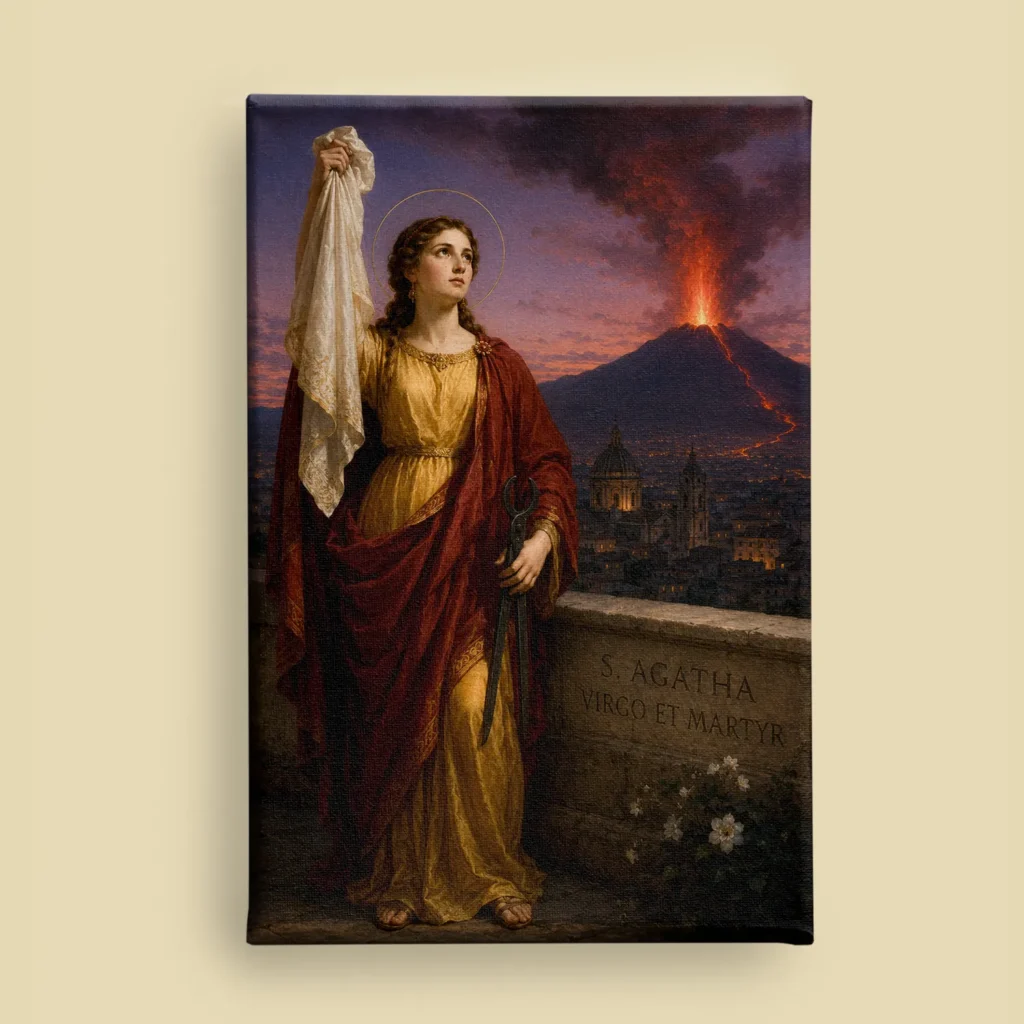
Martyrdom of Saint Agatha
The Martyrdom of Saint Agatha at the Galleria Palatina in Florence, painted around 1520, is one of the most powerful images of female martyrdom in Renaissance painting. Agatha, the third-century Sicilian martyr, is shown at the moment of her torture, her expression not of anguish but of composed spiritual transcendence. The executioners who torment her are rendered with the monumental physical presence that reflects Sebastiano’s absorption of Michelangelo’s approach to the figure, while the quality of light and color is entirely Venetian. The painting shows at full power what the combination of the two traditions could achieve.

Pieta
The Pieta at the Museo del Prado in Madrid, painted around 1516-17, was produced with a compositional drawing by Michelangelo and is one of the most important products of their collaboration. The dead Christ is held by the Virgin in a twilight landscape, and the combination of the massive, heavily muscled figure of Christ, designed by Michelangelo, with the rich color and atmospheric depth of the landscape, contributed by Sebastiano, creates an image of unusual grandeur and emotional depth. Michelangelo is reported to have said that this painting proved that a Venetian painter who also had good drawing could surpass anyone.

Saint Louis of Toulouse
The panel of Saint Louis of Toulouse at the Gallerie dell’Accademia in Venice shows the young Franciscan bishop who renounced a kingdom to enter religious life. Louis of Anjou, who gave up the throne of Naples to become a Franciscan friar and was subsequently made Bishop of Toulouse, is shown in his episcopal vestments with the crown of the kingdom he refused placed at his feet or nearby. The painting belongs to Sebastiano’s Venetian period, before his move to Rome, and shows the influence of Bellini and Giorgione in its warm tonality and the naturalistic treatment of the figure.

San Giovanni Crisostomo Altarpiece
The altarpiece painted for the church of San Giovanni Grisostomo in Venice, completed around 1510-11, is Sebastiano’s last major Venetian work before his departure for Rome. Saint John Chrysostom, the great theologian and bishop of Constantinople whose name the church bears, is shown seated in a landscape setting flanked by other saints, including Mary Magdalene. The composition is indebted to Giovanni Bellini’s sacra conversazione tradition, but the figures have a new monumentality and the landscape a new atmospheric depth that reflect Giorgione’s influence and anticipate the direction Sebastiano would take in Rome.

St Bartholomew and St Sebastian
This panel at the Gallerie dell’Accademia in Venice shows two martyred saints in the paired format that was common in Venetian altarpiece production. Bartholomew, the apostle martyred by flaying, and Sebastian, the Roman soldier martyred by arrows, are shown with their respective attributes in a composition that reflects Sebastiano’s thorough formation in the Venetian tradition. The figures have the individual presence and the warm tonality that characterize his Venetian period.

The Holy Family with St. Catherine, St. Sebastian and a Donor
This large devotional canvas in the Louvre shows the Holy Family surrounded by saints and accompanied by a kneeling donor, the patron who commissioned the work. The format is that of the sacra conversazione, and Sebastiano handles it with the compositional command and the quality of color he had developed over his career. The figures of St. Catherine and St. Sebastian are shown with the physical presence of his Roman monumental manner, while the warmth and richness of the whole reflect the Venetian formation that never left him.

The Lamentation
The Lamentation at the Hermitage Museum in St. Petersburg shows the mourning over the dead body of Christ, the Virgin, Mary Magdalene, and Saint John gathered around the figure of Christ after the deposition from the cross. The composition again reflects Michelangelo’s influence in the weight and solidity of the figures, while the emotional intensity and the quality of the light belong to Sebastiano’s own synthesis. It is a work of genuine grandeur, the tragedy rendered with a restraint that makes the grief more rather than less affecting.

The Madonna and Child with Saints and a Donor
The Madonna and Child with Saints and a Donor at the National Gallery in London is a devotional work that shows Sebastiano combining the formal conventions of the sacra conversazione with the psychological intimacy of the best Venetian Madonna paintings. The Virgin holds the Christ child with natural warmth, the saints attend with individual presence, and the kneeling donor is given the realistic portraiture that Sebastiano excelled at. The painting demonstrates the full range of his ability to work within traditional sacred formats while giving them a personal quality that is entirely his own.

Summary of Sebastiano del Piombo’s Paintings
| Painting | Date | Location |
|---|---|---|
| Adoration of the Shepherds | c. 1510 | Fitzwilliam Museum, Cambridge |
| Judith (or Salome) | c. 1510 | National Gallery, London |
| Martyrdom of Saint Agatha | c. 1520 | Galleria Palatina, Florence |
| Pieta | c. 1516-17 | Museo del Prado, Madrid |
| Saint Louis of Toulouse | c. 1508 | Gallerie dell’Accademia, Venice |
| San Giovanni Crisostomo Altarpiece | c. 1510-11 | San Giovanni Grisostomo, Venice |
| St Bartholomew and St Sebastian | c. 1508 | Gallerie dell’Accademia, Venice |
| The Holy Family with St. Catherine, St. Sebastian and a Donor | c. 1530 | Louvre, Paris |
| The Lamentation | c. 1516 | Hermitage Museum, St. Petersburg |
| The Madonna and Child with Saints and a Donor | c. 1530 | National Gallery, London |
Important Facts about Sebastiano del Piombo
- Born: Around 1485 in Venice as Sebastiano Luciani; trained under Giovanni Bellini and then under Giorgione, becoming one of the most accomplished painters of the Venetian school before moving to Rome.
- Michelangelo collaboration: In Rome he formed a close friendship with Michelangelo, who supplied him with compositional drawings for major works; their collaboration, intended partly as a challenge to Raphael‘s dominance, produced some of the most powerful paintings of the period.
- Synthesis: His art uniquely combines the Venetian mastery of color and atmospheric light with the Roman-Florentine grandeur of Michelangelo’s figure style; no other painter of his generation achieved a comparable synthesis of the two great traditions.
- Office: In 1531 Pope Clement VII appointed him Keeper of the Papal Seal (piombo), a lucrative sinecure that gave him the name by which he is known; the appointment reduced his artistic output significantly in his later years.
- Death: Died in 1547 in Rome, where he had spent most of his adult career; he is buried in the Pantheon.
Frequently Asked Questions about Sebastiano del Piombo
Why did Michelangelo collaborate with Sebastiano del Piombo?
Michelangelo’s collaboration with Sebastiano was motivated partly by friendship and partly by rivalry with Raphael. Michelangelo believed that Raphael’s dominance of Roman painting was partly a matter of his superior color sense, something the Florentines had never cultivated as intensely as the Venetians. By supplying Sebastiano, who had the finest Venetian color training of any painter then in Rome, with his own compositional drawings, Michelangelo could create paintings that combined the grandeur of his own figure design with a quality of color that could challenge Raphael on his weakest ground. The collaboration was competitive in origin but productive in result.
What is the Piombo and why does Sebastiano’s name include it?
The Piombo, literally “lead”, was the papal seal, the instrument used to seal official papal documents with a lead bulla. The office of Keeper of the Seal was a lucrative sinecure, requiring little actual work, and was used by popes as a form of patronage to reward favored artists, scholars, and officials. Pope Clement VII gave the office to Sebastiano in 1531, and from that point on the painter was known as Sebastiano del Piombo, Sebastiano of the Seal. The appointment was both an honor and, in practice, something of an artistic handicap: it gave Sebastiano financial security that reduced his motivation to paint.
How does Sebastiano relate to Giorgione’s influence?
Sebastiano was among the small group of Venetian painters who worked under or alongside Giorgione in the first decade of the sixteenth century and absorbed the revolutionary approach to painting that Giorgione was developing, the subordination of precise drawing to the overall tonal unity of the composition, the atmospheric treatment of landscape, the mysterious psychological states of the figures. The San Giovanni Crisostomo Altarpiece shows Giorgione’s influence most clearly in the mood and the treatment of landscape, but the Venetian quality of Sebastiano’s work throughout his career, even after decades in Rome, is ultimately rooted in what he learned from Giorgione in his youth.
What happened to Sebastiano’s productivity after receiving the Piombo?
The appointment as Keeper of the Seal in 1531 gave Sebastiano a secure income independent of painting, and his output slowed dramatically after this point. Michelangelo complained about his friend’s idleness, and the contrast between the prolific first twenty years of his Roman career and the relative sterility of the last sixteen is striking. The works he did produce in his late period show no decline in quality, but they are fewer and more slowly executed. It is one of the clearer examples in Renaissance art of how economic security and artistic productivity do not always go together.
Where can the major works of Sebastiano del Piombo be seen?
The Prado in Madrid holds the Pieta, one of the key products of his collaboration with Michelangelo. The National Gallery in London has the Judith and the Madonna and Child with Saints and a Donor. The Galleria Palatina in Florence holds the Martyrdom of Saint Agatha. The Louvre in Paris has the Holy Family with Saints and a Donor. In Venice, the church of San Giovanni Grisostomo retains the altarpiece he painted for it around 1510. The Hermitage in St. Petersburg holds the Lamentation. The Fitzwilliam Museum in Cambridge has the Adoration of the Shepherds.
Where can I buy a Sebastiano del Piombo painting reproduction?
The shop at jesuschrist.pictures offers museum-quality canvas reproductions of the great Christian paintings, and the collection keeps growing; it is the best place to look for a Sebastiano del Piombo painting reproduction.