The St Benedict Medal: Symbols and Meaning
The Saint Benedict Medal is one of the oldest and most powerful sacramentals in the Catholic Church. Covered in mysterious letters, it has been worn, hung over doorways, buried in the foundations of houses, and pressed into the hands of the dying for centuries, all as a sign of protection against evil. To anyone who does not know the code, the medal looks like a puzzle. Once the letters are explained, it reads like a short, fierce prayer cast in metal.
This guide decodes the Saint Benedict Medal completely, the meaning of every letter and symbol on both the front and the back, then tells the story of the saint behind it, explains how the medal is blessed and used, and answers why it is considered so powerful. For more on the holy men and women of the Church, see our collection of articles on the inspirational saints.
What Is the Saint Benedict Medal?
The Saint Benedict Medal is a sacramental, a holy object blessed by the Church to draw the faithful toward grace and to guard them against evil. It is not a charm or a lucky token. Its strength lies entirely in the prayers it carries and the faith of the person who wears it.
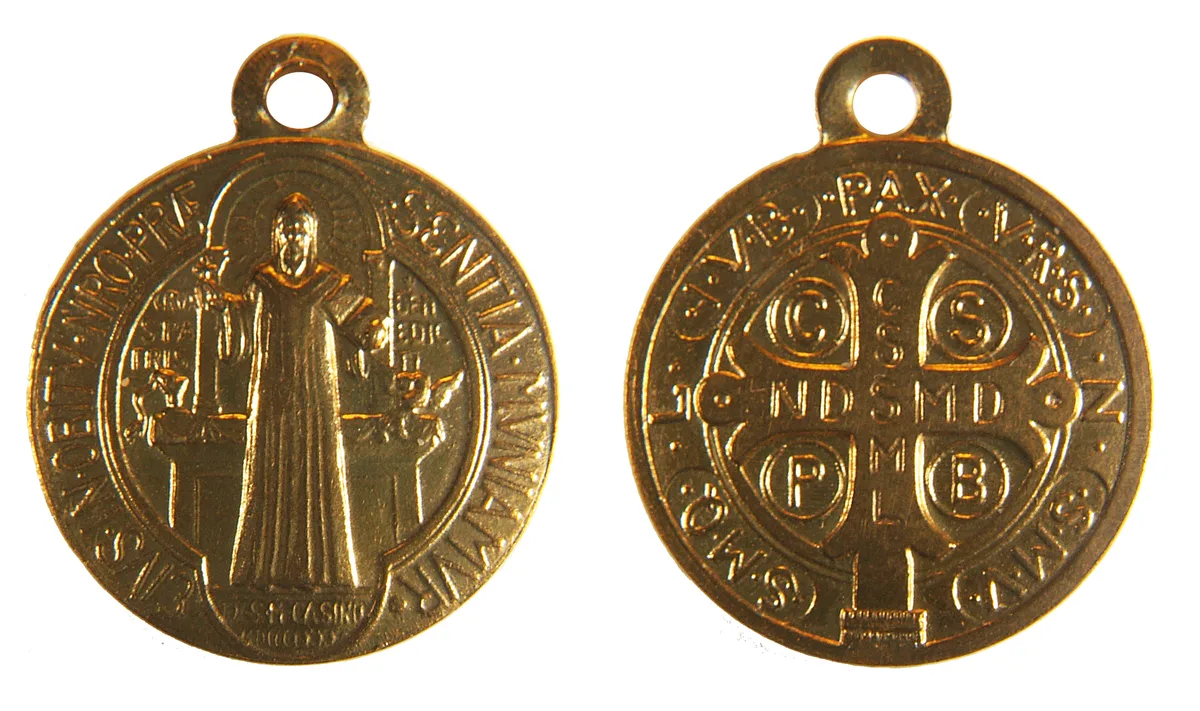
The design we know today is called the Jubilee Medal, struck in 1880 at the Archabbey of Monte Cassino to mark the fourteen hundredth anniversary of Saint Benedict’s birth. Older forms of the medal go back centuries before that. Catholics wear it on a chain, clip it to a rosary, hang it in the home or the car, and place it where protection is wanted. It is often called the most exorcised medal in the Church, because the blessing once reserved for it included a prayer against the power of the devil.
The Front of the Medal
The front of the medal shows Saint Benedict himself, standing and holding a cross in one hand and his Rule for monasteries in the other. Beside him are two of the most famous symbols from his life: a cup with a serpent rising out of it, recalling the poisoned drink that shattered when he blessed it, and a raven carrying away a poisoned loaf of bread meant to kill him.
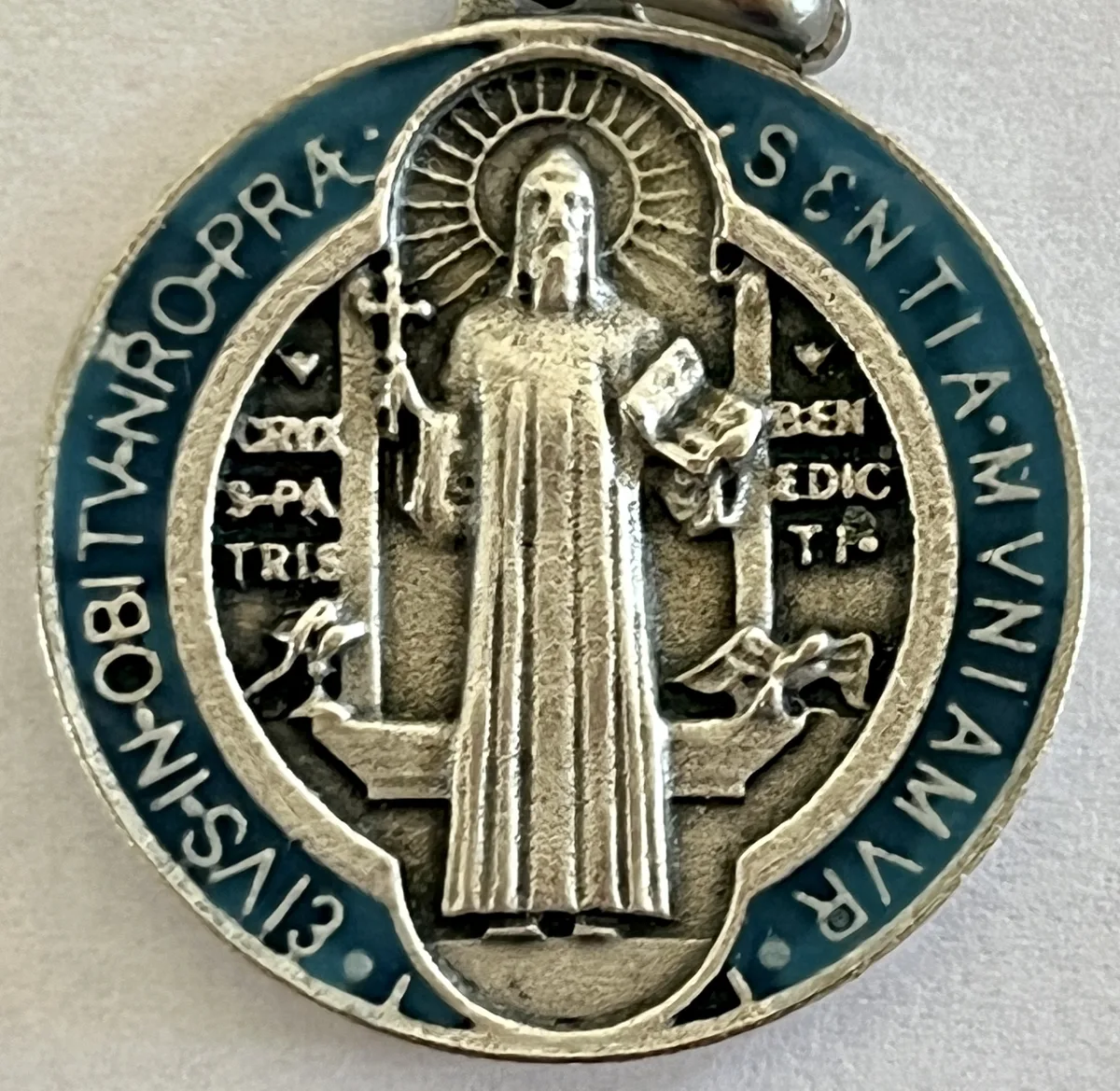
Around the rim runs the Latin inscription Eius in obitu nostro praesentia muniamur, “May we be strengthened by his presence in the hour of our death”. Below the saint’s feet are the words Crux Sancti Patris Benedicti, “The Cross of our Holy Father Benedict”. From the very first glance, the medal points to two things Benedict trusted, the cross of Christ and a holy death.
The Back of the Medal: The Letters Explained
The back of the medal is where the famous code appears. A large cross fills the centre, and letters are scattered across it and around the edge. Each group is the first letter of a word in a Latin prayer.
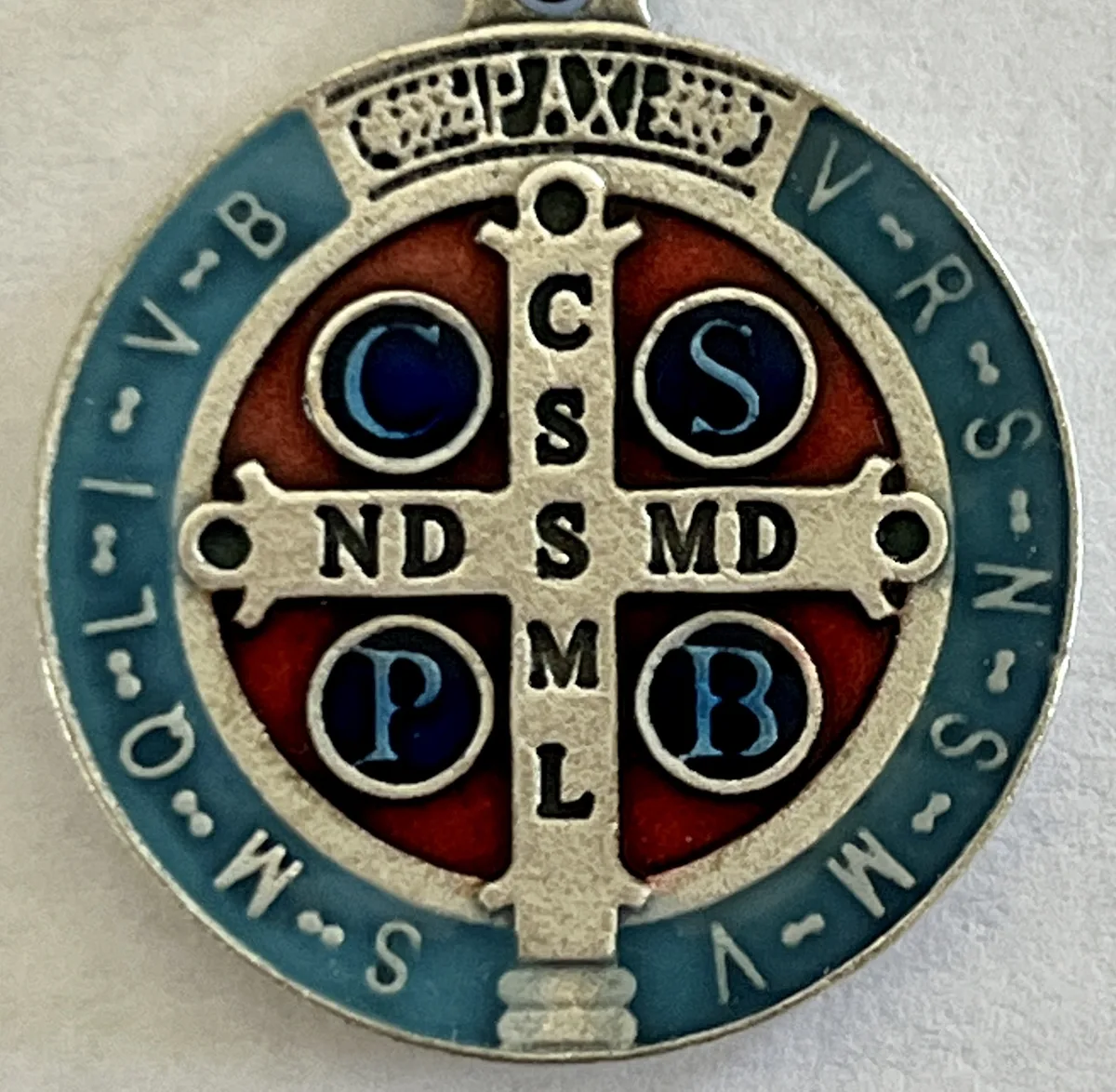
On the arms of the cross, reading down and across, are the letters C S S M L and N D S M D. They stand for Crux Sacra Sit Mihi Lux, Non Draco Sit Mihi Dux, “May the Holy Cross be my light; may the dragon never be my guide”. In the four corners made by the cross are the letters C S P B, again Crux Sancti Patris Benedicti, “The Cross of our Holy Father Benedict”.
Around the outer rim are the letters V R S N S M V and S M Q L I V B. They spell out a prayer of rejection: Vade Retro Satana, Nunquam Suade Mihi Vana; Sunt Mala Quae Libas, Ipse Venena Bibas, “Begone, Satan! Never tempt me with your vanities. What you offer me is evil. Drink the poison yourself”. At the very top sits the word PAX, “Peace”, the ancient motto of the Benedictine order. Read as a whole, the back of the medal is a small exorcism, a refusal of evil and a plea for the light of the cross.
Who Was Saint Benedict?
Saint Benedict of Nursia, who lived from about 480 to 547, is honoured as the father of Western monasticism. As a young man he left the corruption of Rome to live as a hermit in a cave at Subiaco, and his holiness drew so many followers that he founded a series of monasteries, crowned by the great abbey of Monte Cassino.
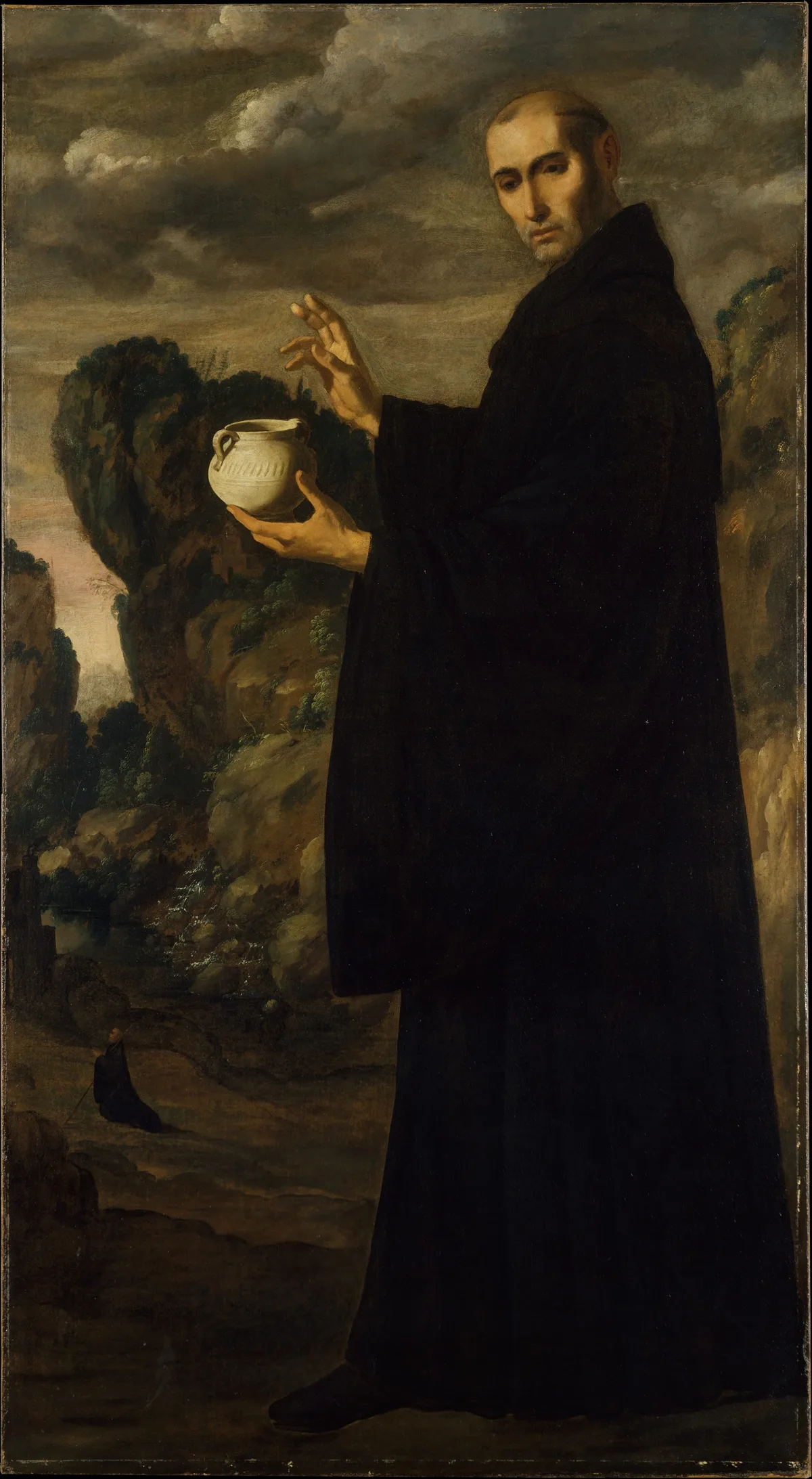
Francisco de Zurbaran painted him as the monks of his own day imagined him, grave and recollected in the black Benedictine habit. To discover more of this great Spanish painter of saints and monks, read our article on Francisco de Zurbaran’s paintings. Benedict’s lasting gift was his Rule, a wise and humane guide to community life summed up in the motto ora et labora, pray and work. The stories of the poisoned cup and the poisoned bread, both pictured on the medal, come from the life written by Pope Saint Gregory the Great, and they explain why Benedict has always been invoked against poison and evil.
How the Saint Benedict Medal Is Used and Blessed
The medal carries no power on its own. It should be blessed by a priest, and the Church provides a special blessing for it. Any Catholic priest may give this blessing, and it only needs to be done once, when the medal is first received.
After that, the faithful use the medal in many ways. They wear it around the neck, attach it to a rosary or a key ring, hang it over the doors of a house, fix it in a car, or set it into the foundations of a building. Parents place it in a child’s room and travellers carry it on the road. In every case the medal is meant to be a steady reminder of the cross of Christ and a request for protection through the prayers of Saint Benedict.
Why Is the Saint Benedict Medal So Powerful?
People often ask why this small medal is considered so powerful. The answer is not magic. The medal is powerful in the way any sacramental is powerful, because it expresses and stirs up faith, and because the Church prays through it for the help of God.
What the wearer carries is really a prayer, the prayer written in those letters: that the cross would be their light and that evil would have no hold on them. Worn in that spirit, the Saint Benedict Medal becomes a daily act of trust in Christ crucified. Its long history of devotion, and the comfort it has given to the sick and the frightened, are reason enough for its enduring place in Catholic life.
The Saint Benedict Medal in Art
| Work | Artist or origin | Date | Location |
|---|---|---|---|
| The Saint Benedict Medal (Jubilee Medal) | Archabbey of Monte Cassino | 1880 | Worn and venerated worldwide |
| Saint Benedict | Francisco de Zurbaran | c. 1640 | Metropolitan Museum of Art, New York |
Conclusion
The Saint Benedict Medal turns a whole spiritual battle into a single small object. Its front holds up the saint, the cross, and the hope of a holy death. Its back hides a prayer that drives evil away and asks for the light of the cross. For fifteen hundred years Benedict’s followers have trusted that prayer, and the medal carries it still, into homes, hospitals, and pockets around the world.
Worn with faith and blessed by the Church, it is not a superstition but a sign, a way of keeping the cross of Christ close and of remembering, every day, the words at the heart of it: may the holy cross be my light. For more on the saints who shaped the faith, explore our articles on the inspirational saints and our wider guide to famous Christian paintings.
Key Facts About the Saint Benedict Medal
- It is a Catholic sacramental, not a charm, blessed by the Church as a sign of protection against evil.
- The design in common use today is the Jubilee Medal, struck at Monte Cassino in 1880.
- The front shows Saint Benedict with the cross and his Rule, beside the poisoned cup and the raven from his life.
- The letters on the back stand for Latin prayers, including “May the Holy Cross be my light” and “Begone, Satan”.
- It should be blessed by a priest once, after which it can be worn, hung at home, or carried for protection.
Frequently Asked Questions
What do the symbols on the Saint Benedict Medal mean?
The front shows Saint Benedict holding a cross and his Rule, with a poisoned cup and a raven from his life. The back is covered with the initials of Latin prayers: CSSML NDSMD on the cross means “May the Holy Cross be my light; may the dragon never be my guide”, CSPB in the corners means “The Cross of our Holy Father Benedict”, and the rim spells “Begone, Satan”, with PAX, “Peace”, at the top.
What is the Saint Benedict Medal used for?
It is used as a sign of protection and a reminder of faith. Catholics wear it, attach it to a rosary, hang it over doorways or in cars, place it in the foundations of buildings, and give it to the sick and the dying. In every case it is meant to ask, through the prayers of Saint Benedict, for protection against evil and for the grace of Christ.
What is the history of the Saint Benedict Medal?
Medals honouring Saint Benedict go back many centuries, but the form used today, the Jubilee Medal, was struck at the Archabbey of Monte Cassino in 1880 for the fourteen hundredth anniversary of the saint’s birth. Its symbols draw on the life of Benedict written by Pope Saint Gregory the Great in the sixth century.
How is the Saint Benedict Medal blessed?
The medal should be blessed by a priest, who uses a special blessing provided by the Church. Any Catholic priest may give this blessing, and it only needs to be done once, when the medal is first obtained. After it is blessed, the medal can be worn or placed wherever protection is desired.
Why is Saint Benedict so powerful against evil?
Saint Benedict was invoked against evil and poison from early on, because of the stories of the poisoned cup and bread that could not harm him. His medal is considered powerful not through magic but as a sacramental, because it expresses faith in the cross of Christ and carries the prayers of the Church against the devil.
Can you buy Saint Benedict art and prints?
You can buy Catholic art at jesuschrist.pictures, in our shop, where saints and sacred subjects are offered as canvas reproductions and posters. The metal medal itself is sold by Catholic goods stores, but if you would like Saint Benedict or the cross as wall art for a home or chapel, our shop is the place to look.