Moses paintings span the entire history of Christian art, because no Old Testament figure gave painters more to work with. The man who was drawn from the Nile, spoke with God in a burning bush, parted the sea, and carried the Law down from Sinai is a whole life of drama in one person. From Florentine frescoes to Dutch portraits and grand Salon canvases, artists have followed Moses from the bulrushes to the edge of the Promised Land, and the ten works gathered here trace that journey almost step by step.
The story comes from the books of Exodus, Numbers, and Deuteronomy. Moses leads the Hebrews out of slavery in Egypt, through the divided waters of the Red Sea, and across forty years of wilderness toward a land he himself is never allowed to enter. Along the way he becomes the great mediator between God and his people, the lawgiver whose face shines from speaking with the divine. For more sacred stories told in paint, see our guide to famous biblical masterpieces.
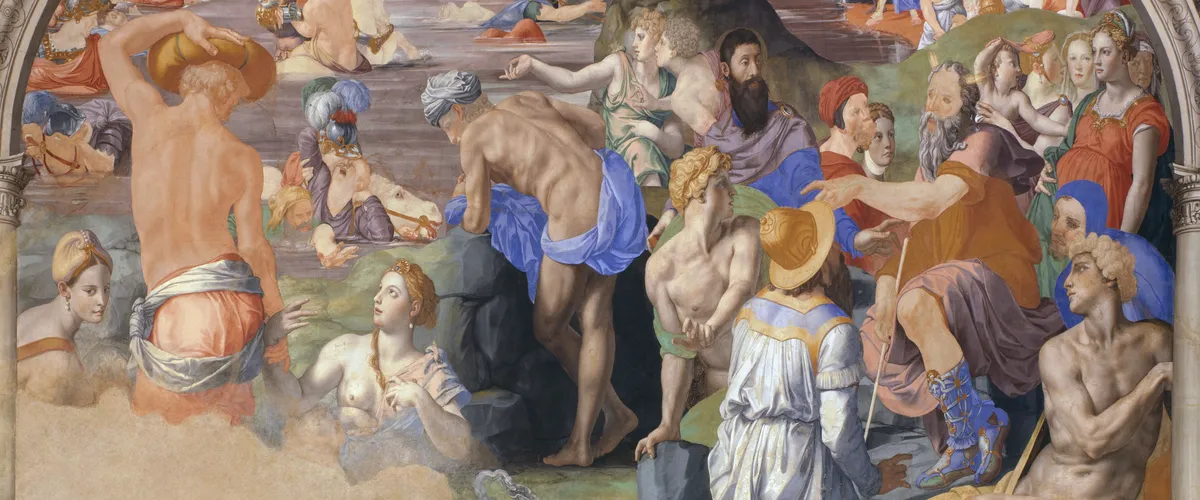
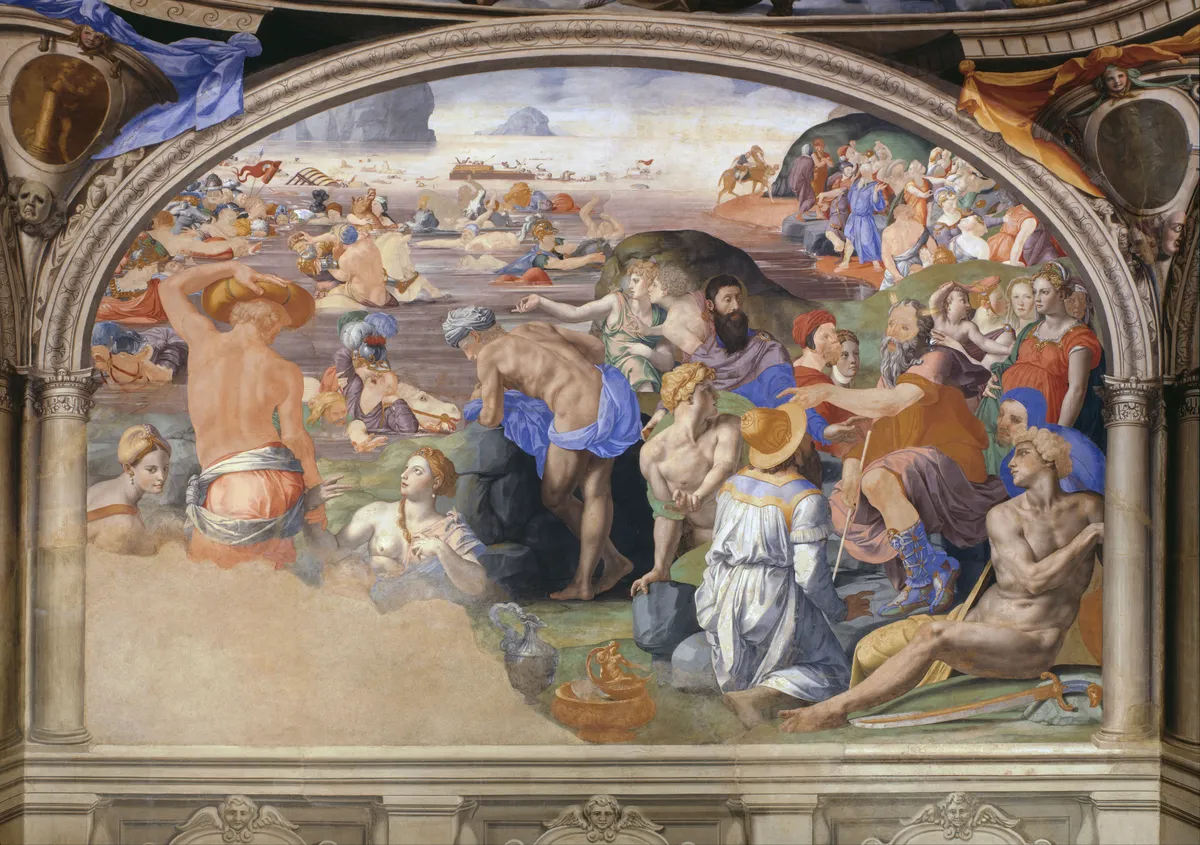
The Crossing of the Red Sea (detail), Bronzino, c. 1542. Chapel of Eleonora, Palazzo Vecchio, Florence
Why Does Moses Have Horns?
Before the journey begins, one strange detail needs explaining, because you will meet it again and again. In many older works Moses has two small horns on his head. This comes from a translation, not the Bible itself. When Saint Jerome rendered Exodus into Latin, the Hebrew describing Moses’s face as radiant, sending out rays of light, was read instead as horned. For centuries painters and sculptors followed Jerome, and the most famous result is Michelangelo’s marble Moses in Rome. To see more of that artist’s vast biblical imagination, read our articles on Michelangelo’s paintings and the Sistine Chapel ceiling. Later artists returned to rays of light, but the horned Moses never quite disappeared.
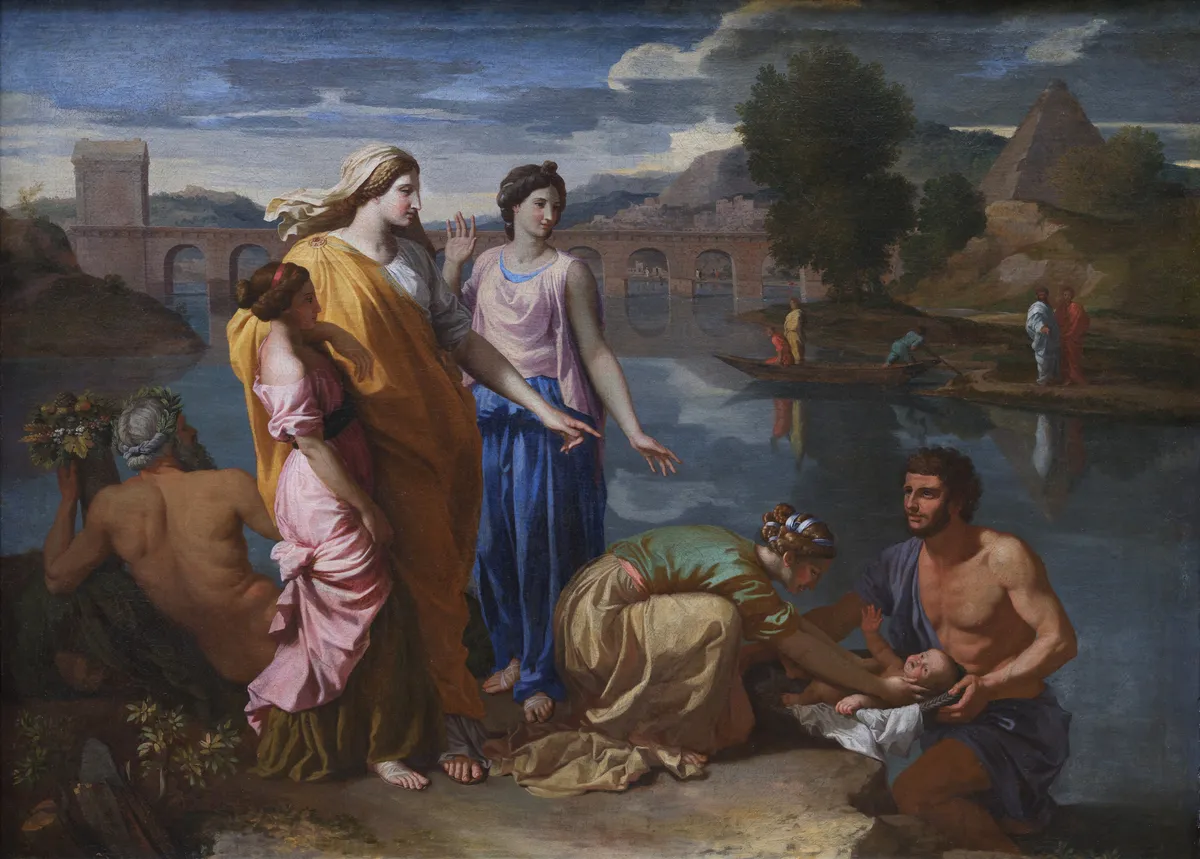
1. The Finding of Moses by Nicolas Poussin (1638)
The story opens on the bank of the Nile. To save her son from Pharaoh’s order to drown every Hebrew boy, Moses’s mother hides him in a basket among the reeds, where Pharaoh’s daughter finds him. Nicolas Poussin sets the scene like a calm classical stage, the princess and her maidens in clear blues, pinks, and golds, the infant lifted gently from the water while a distant city and a river god frame the moment.
Nicolas Poussin, The Finding of Moses, 1638. Musee du Louvre, Paris
Poussin painted the subject several times, and this 1638 version in the Louvre is among his most admired. The mood is serene rather than dramatic, an ordered world where a great destiny begins quietly. To explore the painter who shaped French classicism, read our article on Nicolas Poussin’s paintings.
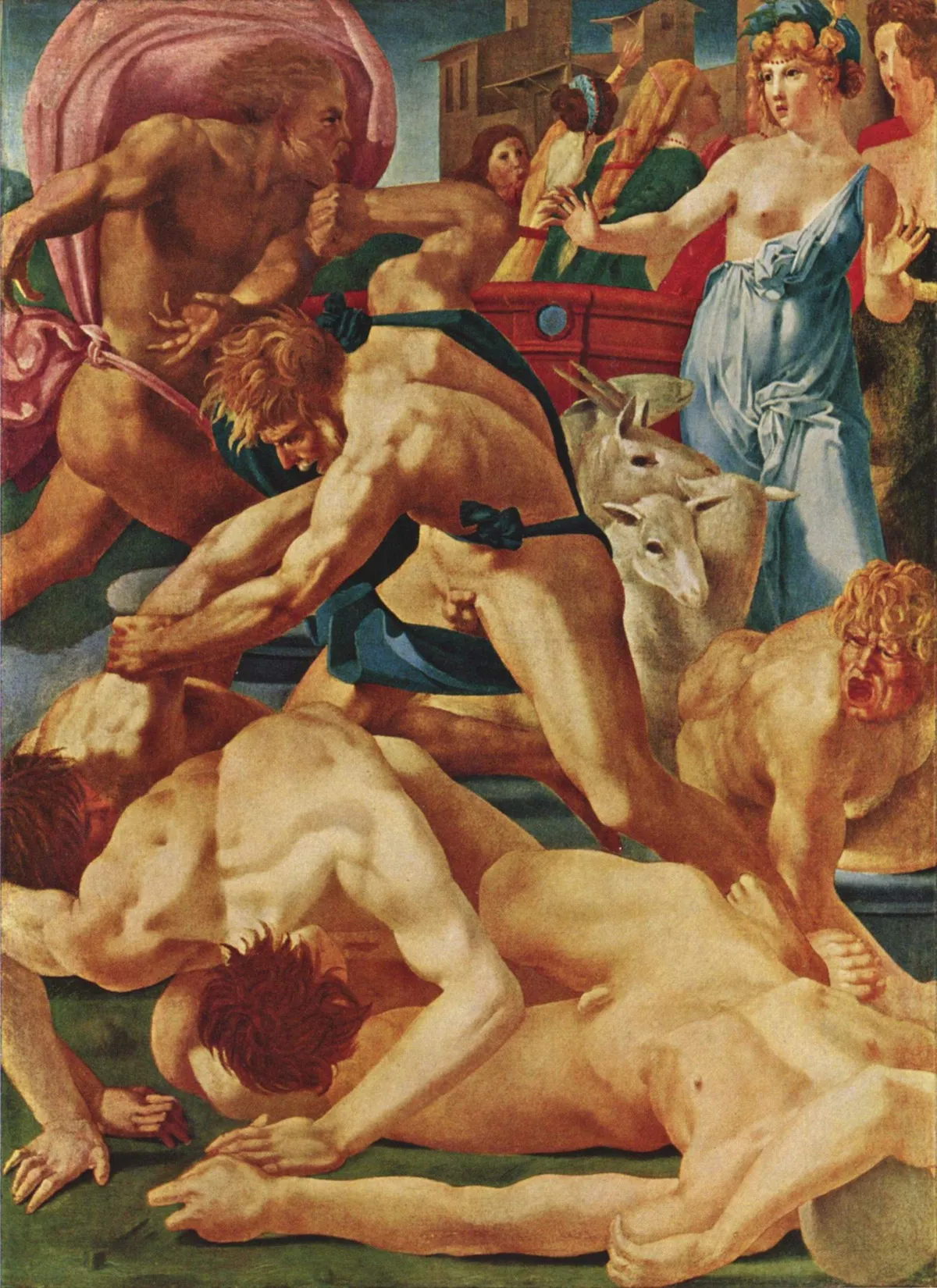
2. Moses Defending the Daughters of Jethro by Rosso Fiorentino (c. 1523)
Grown and exiled from Egypt, Moses comes to the land of Midian and finds shepherds driving away the seven daughters of the priest Jethro from a well. He fights the shepherds off. Rosso Fiorentino turns this brief episode into an explosion of muscular nude bodies, limbs tangled and twisting across the surface in a way that startled his contemporaries and still does.
Rosso Fiorentino, Moses Defending the Daughters of Jethro, c. 1523. Uffizi, Florence
This is one of the boldest works of Florentine Mannerism, painted with a strange, almost violent energy. Rosso has no dedicated page on our site yet, but you can find the same restless spirit in our article on his fellow Florentine Pontormo. The picture hangs in the Uffizi in Florence.
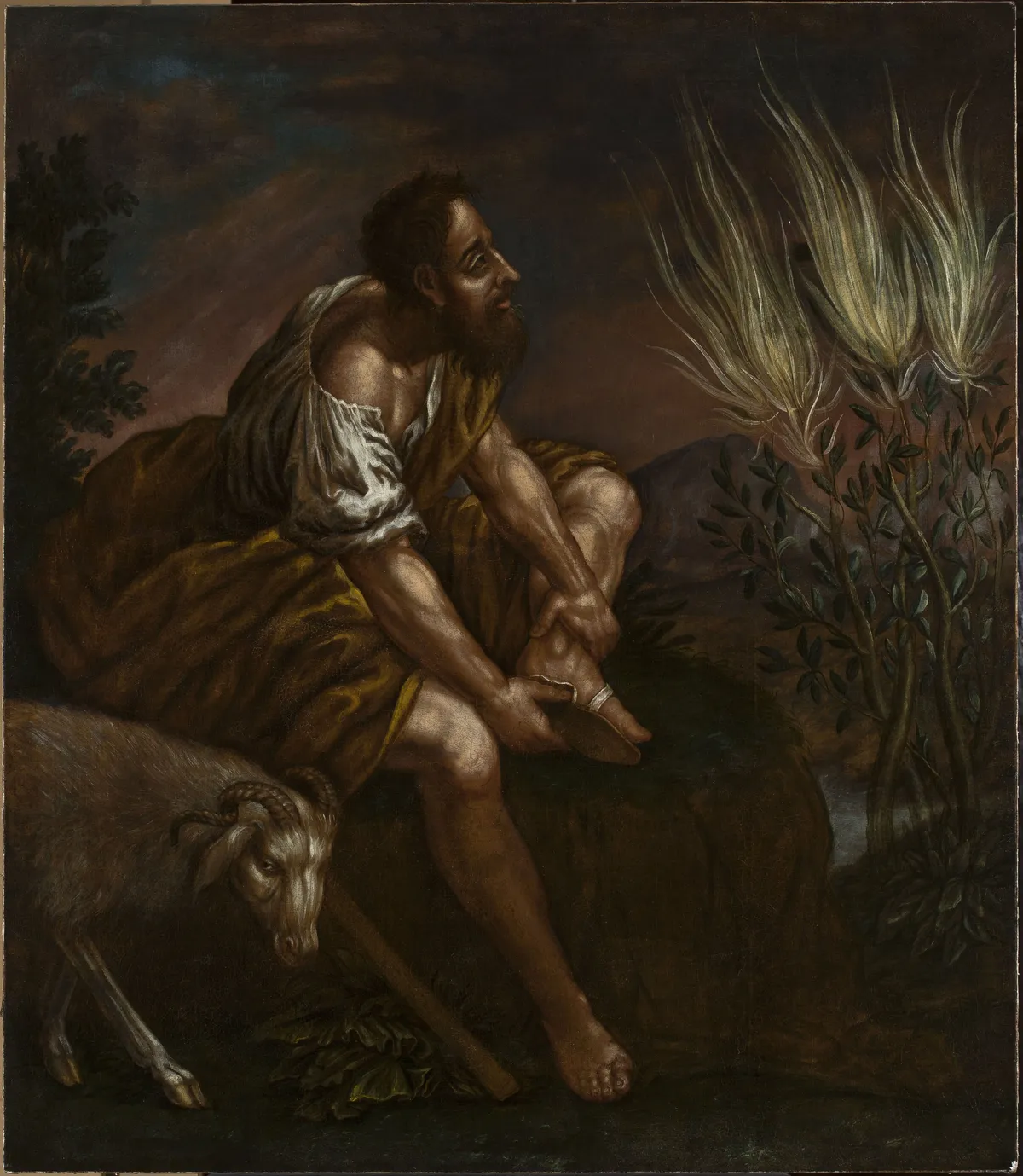
3. Moses before the Burning Bush by Domenico Fetti (c. 1614)
Keeping Jethro’s flock on Mount Horeb, Moses sees a bush that burns without being consumed, and from it God calls him to lead Israel out of Egypt. Domenico Fetti paints the moment of holy fear, Moses pulling back and shielding his eyes, one sandal already loosened because he stands on holy ground.
Domenico Fetti, Moses before the Burning Bush, c. 1614. National Museum, Warsaw
Fetti was a master of small, intense religious scenes, and here the landscape itself seems to lean toward the flame. The encounter at the bush is the hinge of the whole story, the call that turns a shepherd into a prophet. This version belongs to the National Museum in Warsaw.
4. The Crossing of the Red Sea by Bronzino (c. 1542)
The great escape from Egypt reaches its climax at the sea. Moses stretches out his hand, the waters part for Israel, then close again over Pharaoh’s pursuing army. Bronzino frescoed this scene on the wall of the private chapel of Eleonora of Toledo in the Palazzo Vecchio, filling it with cool, sculptural figures gathered safe on the far shore as the drowned soldiers float behind them.
Bronzino, The Crossing of the Red Sea, c. 1542. Chapel of Eleonora, Palazzo Vecchio, Florence
The elegant, polished bodies are pure Florentine court style, beautiful and a little chilly. It is a deliverance painted as a courtly tableau rather than a storm. For more of this refined Mannerist, see our article on Bronzino’s paintings. The fresco remains in the Chapel of Eleonora in the Palazzo Vecchio, Florence.
5. Moses Drawing Water from the Rock by Tintoretto (1577)
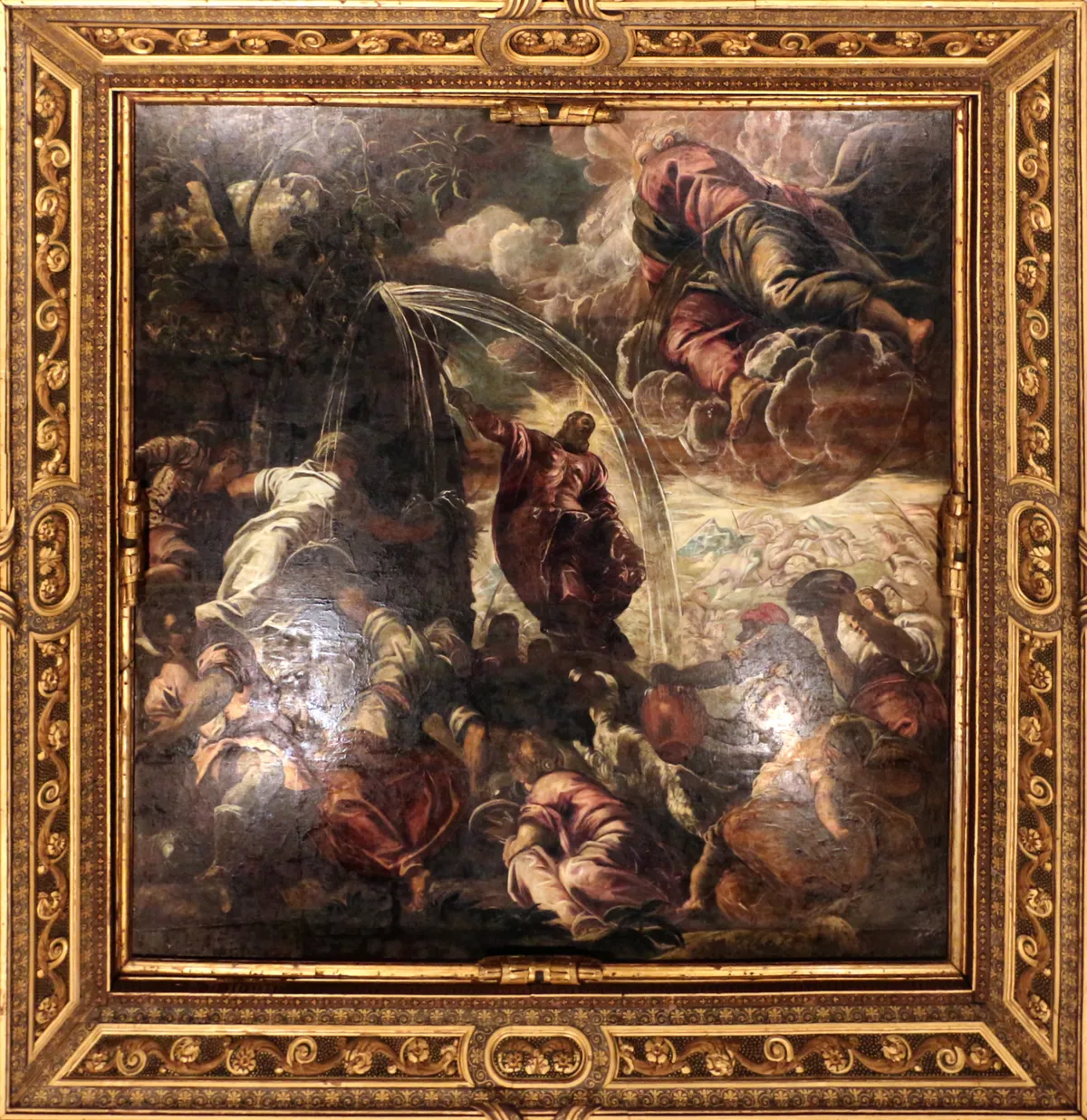
In the desert the people are dying of thirst, so God tells Moses to strike a rock, and water pours out. Tintoretto painted this miracle for the ceiling of the upper hall of the Scuola Grande di San Rocco in Venice, and he gives it all his rushing energy, the water bursting down in a bright cascade while the crowd surges forward with cups and jars.
Tintoretto, Moses Drawing Water from the Rock, 1577. Scuola Grande di San Rocco, Venice
Seen from below, the composition tilts and swirls with figures, light breaking through dark cloud. It is one panel in Tintoretto’s enormous cycle for San Rocco, a lifetime project of biblical scenes. To discover this restless Venetian genius, read our article on Tintoretto’s paintings.
6. The Adoration of the Golden Calf by Nicolas Poussin (c. 1634)
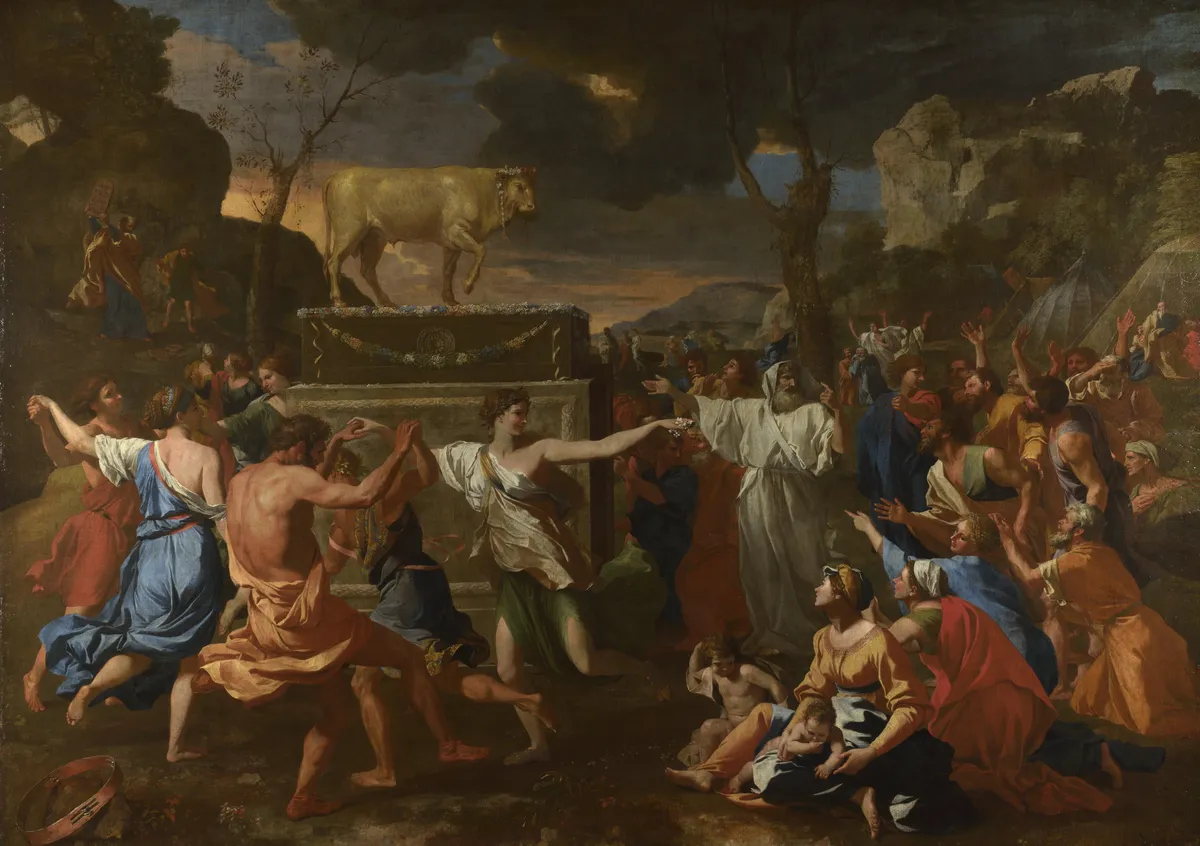
While Moses is on the mountain receiving the Law, the people lose patience and make a golden calf to worship. Poussin shows them caught mid dance, a ring of figures spinning around the idol with raised arms, while at the far left Moses appears in the distance and hurls down the tablets in fury.
Nicolas Poussin, The Adoration of the Golden Calf, c. 1634. National Gallery, London
Poussin based the swaying dancers on antique models, turning idolatry into a piece of choreographed motion that is both beautiful and damning. It is a study of a crowd losing its way. The painting is one of the treasures of the National Gallery in London.
7. Moses with the Tablets of the Law by Rembrandt (1659)
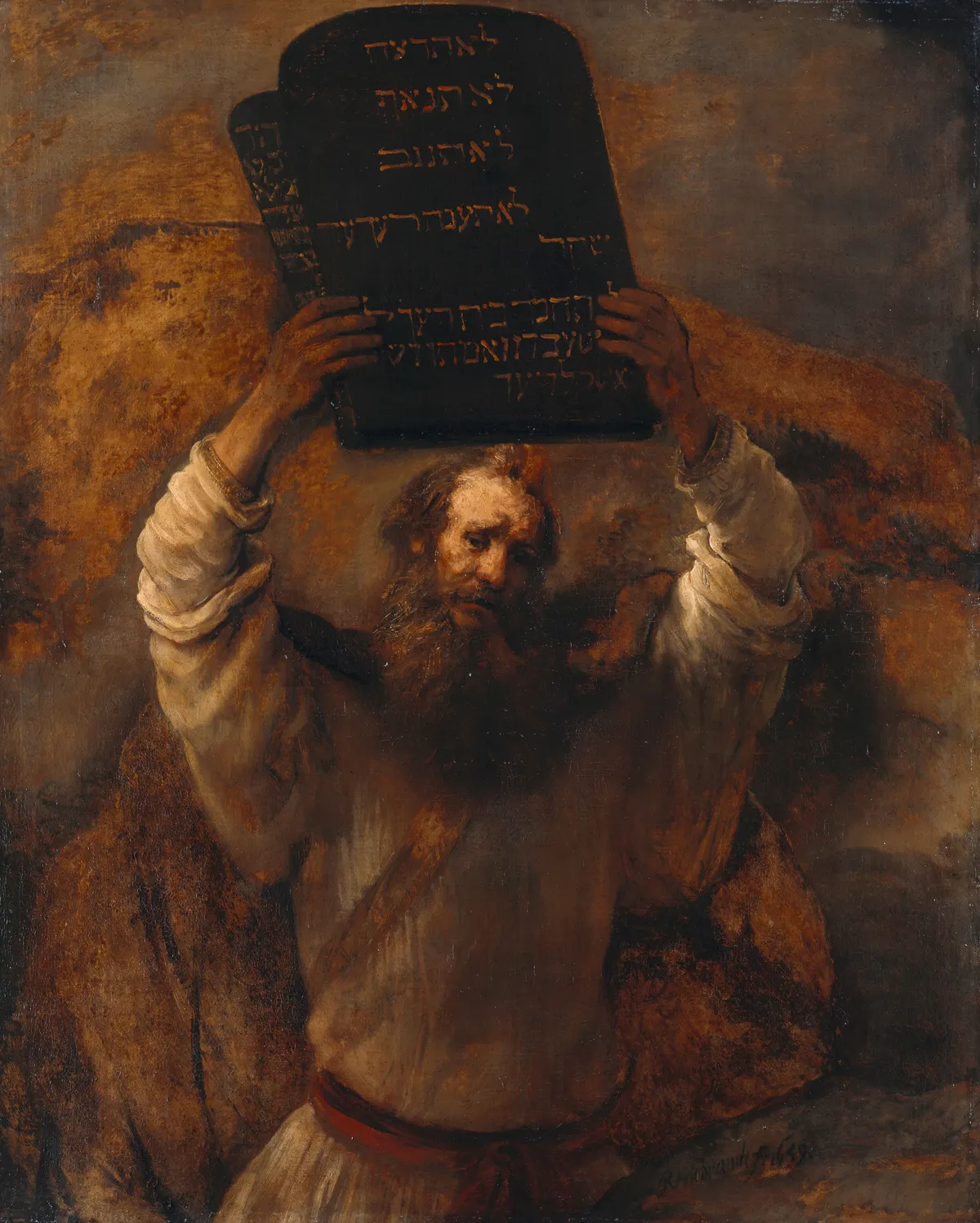
This is the single most powerful image of Moses ever painted. Rembrandt strips away the crowd and the landscape and gives us only the prophet, lifting the two great stone tablets, their Hebrew letters glowing out of the gloom. His face is worn, anxious, deeply human.
Rembrandt, Moses with the Tablets of the Law, 1659. Gemaeldegalerie, Berlin
Scholars still debate the moment. Is Moses raising the Law in triumph, or lifting the tablets to smash them at the sight of the golden calf below? Rembrandt leaves it open, and that uncertainty is the painting’s genius. The Hebrew text is the actual wording of the commandments. The canvas hangs in the Gemaeldegalerie in Berlin. For more of the master’s sacred work, read our article on Rembrandt’s paintings.
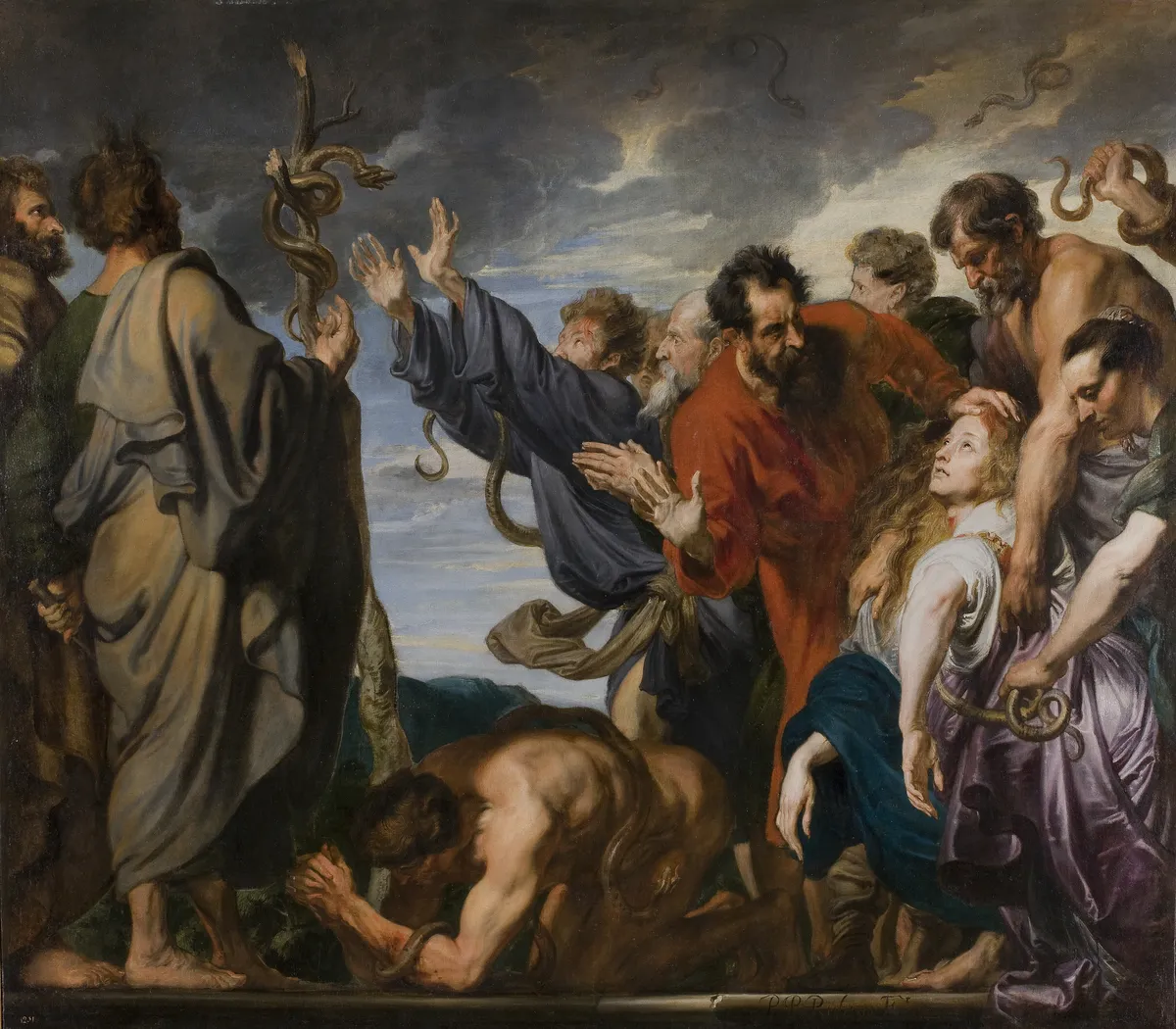
8. The Brazen Serpent by Anthony van Dyck (c. 1620)
Later in the wilderness, a plague of serpents punishes the grumbling people, and God tells Moses to raise a bronze serpent on a pole, so that all who look at it are healed. Anthony van Dyck paints the desperate crowd twisting toward the bright figure of Moses, who points firmly up at the saving image.
Anthony van Dyck, The Brazen Serpent, c. 1620. Museo del Prado, Madrid
Painted early in his career under the spell of Rubens, the picture is full of straining bodies and dramatic Baroque light. Christian tradition reads the lifted serpent as a foreshadowing of the cross. The work belongs to the Museo del Prado in Madrid. To follow this Flemish master beyond his royal portraits, see our article on Anthony van Dyck’s paintings.
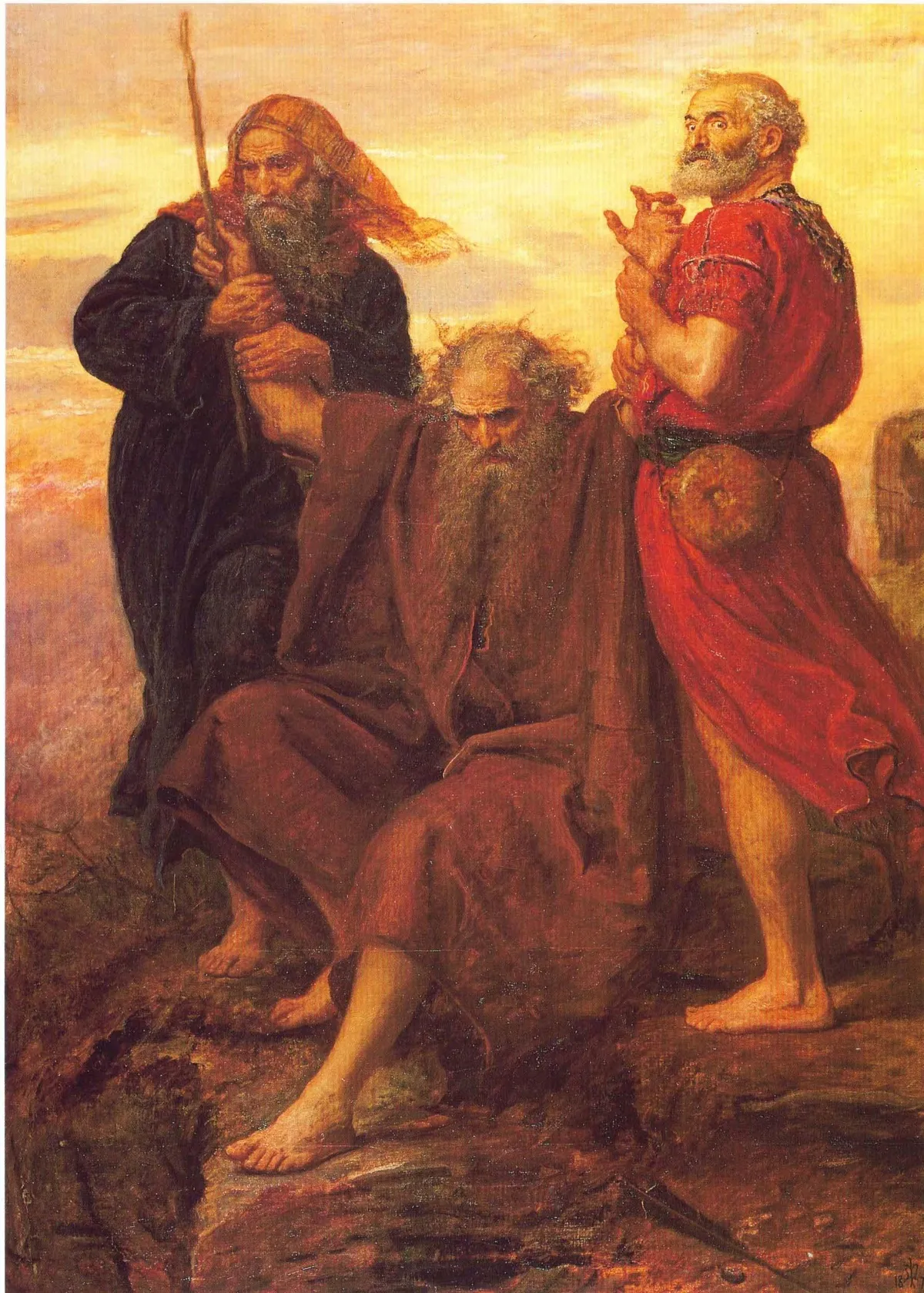
9. Victory O Lord! by John Everett Millais (1871)
During the battle against the Amalekites, Israel prevails only while Moses holds up his hands, so as he tires Aaron and Hur sit him on a stone and hold his arms aloft until sunset. John Everett Millais seizes on this very human image, the exhausted old prophet propped up between two helpers on a bare hilltop.
John Everett Millais, Victory O Lord!, 1871. Manchester Art Gallery
The Pre-Raphaelite painter strips the scene to three weary figures against the sky, turning a story of war into one of stubborn, supported faith. For more of this movement’s sacred art, read our article on Pre-Raphaelite Jesus paintings. The picture is held by Manchester Art Gallery.
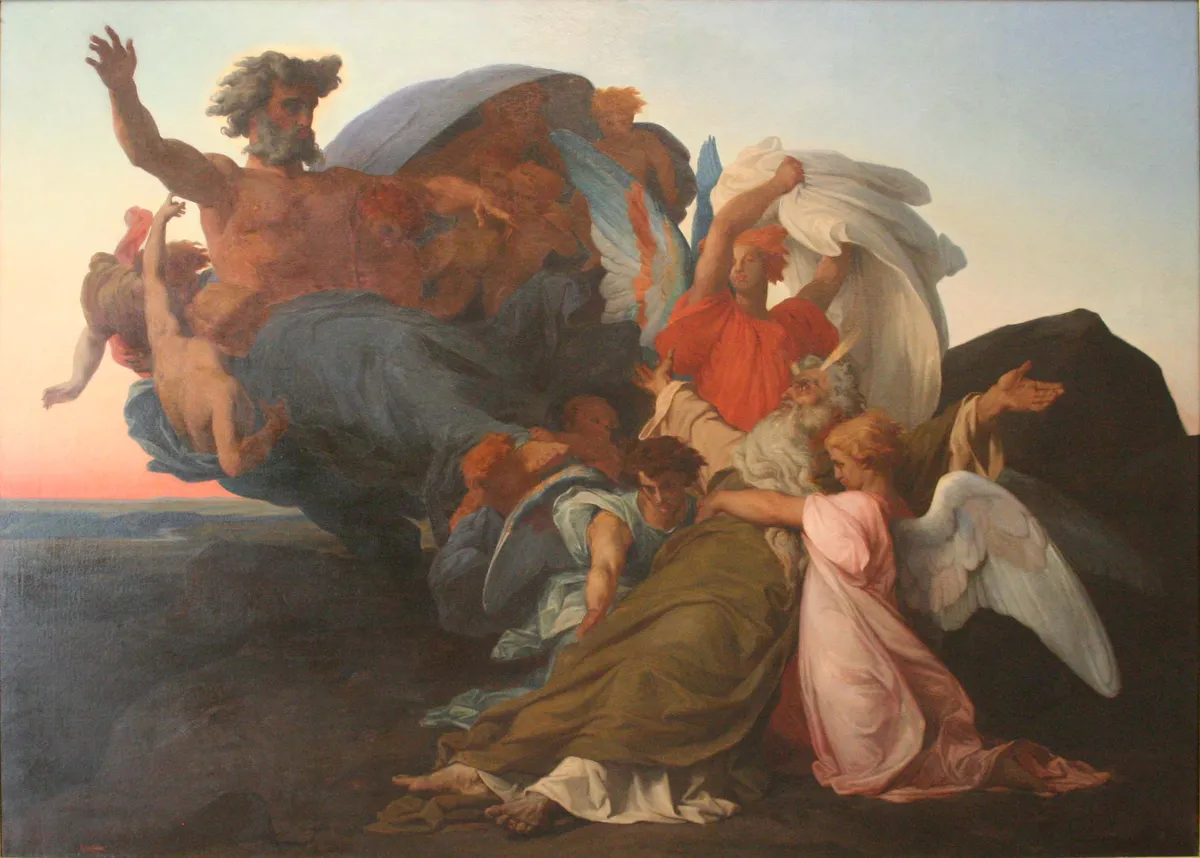
10. The Death of Moses by Alexandre Cabanel (1851)
The story ends on Mount Nebo. Moses is allowed to see the Promised Land but not to enter it, and there he dies within sight of the goal of forty years. Alexandre Cabanel paints the moment as a great heavenly vision, the prophet borne up among clouds and angelic figures while God appears in glory above.
Alexandre Cabanel, The Death of Moses, 1851. Dahesh Museum of Art, New York
This vast early work won Cabanel acclaim and helped launch his Salon career. It closes the cycle on a note of sorrow and promise, a life of struggle gathered up into light. The painting is in the Dahesh Museum of Art in New York. For more of this painter, see our article on Alexandre Cabanel’s paintings and his haunting Fallen Angel.
Moses was not the only Old Testament hero the masters loved to paint; the young shepherd who felled a giant fills our guide to David and Goliath paintings.
Conclusion
Laid end to end, these ten paintings tell the life of Moses almost as a continuous film, from the basket in the reeds to the last breath on Mount Nebo. Poussin gives the story its calm beginning, Bronzino its courtly miracle, Tintoretto its rushing water, Rembrandt its lonely human weight, Cabanel its luminous close. Each artist found in the same prophet something different, a lawgiver, a leader, a tired old man held up by his friends.
What binds them is the shape of Moses himself, the mediator who stands between God and a stubborn people and carries them forward whether they deserve it or not. That is why painters never tired of him, and why his story still moves viewers far beyond any church wall. For another Old Testament tale that drew the same great hands, see our article on Adam and Eve paintings, or our gathering of Noah’s Ark paintings.
✦ Free Moses and Bible Coloring Pages
From the baby in the bulrushes to the parting of the Red Sea, the story of Moses and the great Bible scenes are free printable coloring pages for kids and adults, ready to print and color at home.
The story of Moses is told across the books of Exodus, Numbers, and Deuteronomy, which gave painters dozens of distinct scenes to choose from, far more than most biblical figures.
Moses is often shown with horns because of a Latin mistranslation by Saint Jerome, who read the Hebrew for a radiant, shining face as a horned one.
The Finding of Moses, the Crossing of the Red Sea, and Moses receiving or breaking the tablets of the Law are the most frequently painted episodes of his life.
Rembrandt’s Moses with the Tablets of the Law of 1659, now in Berlin, is widely considered the single greatest painting of the prophet.
Moses is one of the rare Old Testament figures placed at the very heart of Christian art, since the lifted bronze serpent and the Law he carries were both read as foreshadowings of Christ.
Questions and Answers
Why is Moses shown with horns in old paintings?
The horns come from a translation error, not from scripture. The Hebrew text of Exodus says that Moses’s face was radiant after he spoke with God, sending out rays of light. When Saint Jerome translated the Bible into Latin in the fourth century, he rendered the word as horned instead of shining. For more than a thousand years artists followed his version, the most famous example being Michelangelo’s marble Moses in Rome. From the Renaissance onward many painters quietly returned to beams of light, but the horned Moses survived for centuries.
What is the most famous painting of Moses?
Among single figures, Rembrandt’s Moses with the Tablets of the Law of 1659 in Berlin is the most celebrated, admired for its raw humanity and its glowing Hebrew letters. For dramatic narrative scenes, Nicolas Poussin’s Finding of Moses and Adoration of the Golden Calf are the most reproduced of the Old Masters. Michelangelo’s horned Moses is the most famous of all, though it is a sculpture rather than a painting. Fame here depends on whether you mean the quiet portrait or the crowded miracle.
What scenes from the life of Moses do painters depict most?
A handful of episodes appear again and again. The Finding of Moses opens the story on the Nile, the Burning Bush marks his call, and the Crossing of the Red Sea is the great escape from Egypt. In the wilderness painters love the water from the rock, the golden calf, and the bronze serpent, while Sinai gives them Moses receiving or smashing the tablets of the Law. The cycle usually closes with his death on Mount Nebo, in sight of a land he never enters.
Why did Rembrandt paint Hebrew letters on the tablets?
Rembrandt lived near the Jewish community of Amsterdam and took real care with Hebrew, so the letters on his tablets are the genuine wording of the commandments rather than decoration. Reading them helps explain the painting, since the visible text is the second tablet, which deals with duties between people. That detail feeds the long debate over the picture, whether Moses is lifting the Law to show it to Israel or raising it to dash it to pieces over the golden calf.
Can you buy Moses paintings as canvas prints?
You can buy Moses paintings at jesuschrist.pictures, in our shop, where the classic versions are offered as high quality canvas prints. Because the Exodus story is so beloved, a faithful reproduction lets you bring a work like Rembrandt’s powerful Moses or Poussin’s serene Finding of Moses into a home, classroom, or church hall. Browse our collection of Christian art reproductions on canvas to find a piece for your home or parish.