Famous Pontormo Paintings That Break Renaissance Rules
Pontormo paintings are among the most emotionally intense sacred works produced in the sixteenth century. Born Jacopo Carucci in 1494 in the Tuscan village of Pontormo, from which he took his name, he trained in Florence under several masters before emerging as one of the founders of Florentine Mannerism. Where his pupil Bronzino would take Mannerism toward cool, aristocratic detachment, Pontormo’s version is charged with psychological urgency: his figures twist and reach in acid-bright colors, their faces registering grief and ecstasy with an expressiveness that has no precedent in earlier Italian painting. He was, by all accounts, a reclusive and anxious man, and that inner life permeates every painting he made.

The Florentine Visionary
Pontormo trained under Leonardo da Vinci, Piero di Cosimo, and Andrea del Sarto before developing an entirely personal style that took Florentine painting in a new direction. His early work still shows the influence of del Sarto, but by the 1520s he had arrived at the distinctive palette, acid lemon yellows, coral pinks, cold blues, and the complex, writhing figure compositions that define his mature manner.
Giorgio Vasari, who knew him personally, described him as solitary, melancholic, and obsessively dedicated to his work. His diary from the last years of his life, recording his daily meals, his health, his dreams, his progress on the lost frescoes for San Lorenzo, is one of the most extraordinary documents in the history of art: the self-portrait of a man consumed by his vocation. He died in 1557 before completing those frescoes, and the loss is incalculable.
The Deposition from the Cross
The Deposition from the Cross, painted between 1525 and 1528 for the Capponi Chapel in the church of Santa Felicita in Florence, is Pontormo’s masterpiece and one of the strangest, most moving paintings of the entire sixteenth century. Christ’s body has just been removed from the cross and is being supported by a group of figures whose identity is deliberately ambiguous, the Virgin, Mary Magdalene, and others, but the usual iconographic clarity of the Deposition scene is abandoned. The figures hover and twist in a space that has no ground and no horizon, their coral, pink, and acid-green draperies creating a chromatic intensity that has no equivalent in contemporary painting. They do not stand on the earth; they float in grief. The painting was meant to be seen in the intimate space of the private chapel, and its effect on the viewer who sits beneath it is overwhelming.

The Visitation of Carmignano
The Visitation, now in the rectory of Saints Michael and Francis in Carmignano (near Prato), was painted around 1528–1529 and is the other great masterpiece of Pontormo’s maturity. The subject is the meeting of Mary and Elizabeth after the Annunciation, when Elizabeth recognizes that Mary carries the Son of God and exclaims, “Blessed are you among women.” Pontormo renders the moment as a confrontation of two vast, pyramidal figures who seem to fill the entire picture plane, their robes, orange, green, rose, pale yellow, creating a visual intensity that is almost overwhelming. Two secondary figures at the left and right observe the scene with expressions of absorbed wonder. The Visitation is one of the supreme images of religious feeling in Renaissance painting.

The Supper at Emmaus
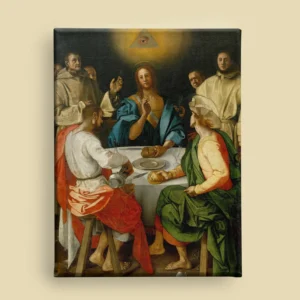
Painted in 1525 for the guest quarters of the Certosa di Galluzzo monastery (where Pontormo took refuge during the plague), the Supper at Emmaus is now in the Uffizi Gallery. The scene shows the moment from the Gospel of Luke when the risen Christ reveals himself to two disciples at the table in Emmaus, breaking the bread. Pontormo sets the scene with concentrated intensity: Christ at the center, his face luminous, the two disciples frozen in the moment of recognition. Above the scene, an eye within a triangle, the all-seeing eye of the Trinity, observes from a roundel at the top of the picture. The work was painted under the influence of Northern European prints, particularly Dürer, and the combination of Flemish compositional influence with Pontormo’s acid Florentine color is remarkable.

The Pucci Altarpiece
The Pucci Altarpiece, painted in 1518 for the church of San Michele Visdomini in Florence, was Pontormo’s first major independent altarpiece commission, painted when he was only twenty-four years old. The sacra conversazione format, Virgin and Child with saints, is handled in a way that already announces the Mannerist departure from High Renaissance balance: the figures are compressed into an agitated, almost pyramidal arrangement, their gestures urgent, their expressions charged with feeling. It is an early work, and the influence of del Sarto is still present, but the specific emotional temperature of Pontormo’s mature style is already unmistakable.

The Birth of John the Baptist
Part of a series of decorative works painted around 1515–1516 for a bedroom in the Villa Medici at Poggio a Caiano, The Birth of John the Baptist in the Uffizi Gallery presents the domestic scene of Elizabeth’s lying-in with remarkable freshness and intimacy. Women attend to the newborn child, visitors arrive with gifts, the room is full of the warm bustle of a birth. The scene has a naturalism that recalls del Sarto, but the arrangement of figures in the shallow foreground space already shows Pontormo’s instinct for compositional compression.

Madonna Compositions
Madonna and Child with Saint Anna and Four Saints
This altarpiece, now in the Louvre (INV 232), shows the Virgin and Child with Saint Anna and four saints in a complex arrangement typical of Pontormo’s mature compositional thinking. The figures inhabit a space of deliberate ambiguity, their relationship to each other more psychological than spatial. The palette is already moving toward the acid intensity of the Capponi Chapel Deposition, and the faces carry the expressions of interior absorption that characterize Pontormo’s most personal work.

Madonna and Child with Saint John the Baptist
This devotional panel in the Uffizi Gallery places the Virgin and Child with the young Saint John in an intimate format that Pontormo handles with characteristic psychological density. The figures are close, their gazes intersecting and withdrawing, the space between them charged with the awareness of what the child’s future holds. The color, particularly the warm rose of the Virgin’s robe, has a soft intensity that distinguishes this work from Bronzino’s cooler palette.

The Virgin and Child with St Joseph and St John the Baptist
Now in the Hermitage Museum in Saint Petersburg, this larger sacred grouping adds Joseph to the familiar Madonna, Child, and Baptist configuration. The arrangement is generous but still Pontormesque in its psychological intensity: each figure inhabits a private relationship to the others, their gazes and gestures creating a web of sacred meaning. The soft landscape behind the figures gives the composition a warmth unusual in Pontormo’s often groundless sacred spaces.

Saint Anthony Abbot
This panel in the Uffizi Gallery shows the desert saint, the Egyptian hermit who became the patron of monks and the model of Christian solitude, in Pontormo’s characteristically individualized manner. The face of the saint is old and searching, his expression one of sustained interior attention. The figure is given a presence that transcends the formal requirements of the saint’s portrait: this is a man who has lived deeply, in the desert of both geography and spirit.

Portrait of Maria Salviati
Pontormo was one of the finest portraitists of sixteenth-century Florence, and his portraits of the Medici circle are among the most psychologically penetrating of the Renaissance. The Portrait of Maria Salviati in the Uffizi, widow of the condottiere Giovanni delle Bande Nere and mother of Cosimo I de’ Medici, shows a woman of contained grief and extraordinary presence. Her dark dress and severe manner suggest mourning; her face reveals a woman of formidable intelligence and will. It is among the most compelling female portraits of the period.

Summary of Pontormo’s Paintings
| Painting | Date | Location |
|---|---|---|
| Madonna and Child with Saint Anna and Four Saints | c. 1527–29 | Louvre Museum, Paris |
| Madonna and Child with Saint John the Baptist | c. 1527–29 | Uffizi Gallery, Florence |
| Portrait of Maria Salviati | c. 1543–45 | Uffizi Gallery, Florence |
| Pucci Altarpiece | 1518 | San Michele Visdomini, Florence |
| Saint Anthony Abbot | c. 1518–19 | Uffizi Gallery, Florence |
| Supper at Emmaus | 1525 | Uffizi Gallery, Florence |
| The Birth of John the Baptist | c. 1515–16 | Uffizi Gallery, Florence |
| The Deposition from the Cross | 1525–28 | Santa Felicita, Capponi Chapel, Florence |
| The Virgin and Child with St Joseph and St John the Baptist | c. 1521–27 | Hermitage Museum, Saint Petersburg |
| Visitation of Carmignano | c. 1528–29 | Rectory of Saints Michael and Francis, Carmignano |
Important Facts about Pontormo
- Born: 24 May 1494 in Pontormo (a hamlet near Empoli, Tuscany); trained in Florence under Mariotto Albertinelli, Piero di Cosimo, Leonardo da Vinci, and Andrea del Sarto.
- Training: His formation in the workshops of del Sarto gave him a thorough foundation in High Renaissance technique; he then broke decisively from that tradition to develop his own Mannerist style.
- Style: Pioneer of Florentine Mannerism, characterized by acid colors (lemon yellow, coral pink, cold blue), complex twisting figures, ambiguous spatial settings, and intense psychological expressiveness.
- Major work: The Deposition from the Cross in the Capponi Chapel at Santa Felicita in Florence (1525–1528) is his acknowledged masterpiece and one of the supreme works of sixteenth-century Italian painting.
- Death: Died 2 January 1557 in Florence, before completing the ambitious fresco decoration of the choir of San Lorenzo, a lost work mourned by art historians as one of the great might-have-beens of Italian painting.
Frequently Asked Questions about Pontormo
What makes the Deposition from the Cross so unusual?
Several things distinguish the painting from earlier Deposition scenes. First, the spatial setting: Pontormo eliminates the cross, the ground, and most conventional spatial markers, leaving the figures floating in an undefined field of color. Second, the palette: the acid pinks, yellows, and greens are unlike anything in earlier Florentine painting and create an emotional intensity that is almost physical. Third, the composition: rather than a clear narrative of body being lowered from cross to tomb, the painting presents a moment of pure grief, the figures supporting and sustaining each other rather than performing a specific action. The result is devotional rather than narrative, a painting for contemplation rather than instruction.
Why are Pontormo’s colors so strange?
Pontormo’s colors depart from the warm, naturalistic palette of the High Renaissance in favor of combinations that are deliberately artificial and emotionally charged. The acid yellows, pinks, and cold blues he favored have no equivalent in nature and are not attempts to represent natural light. They are expressive choices, designed to create a specific psychological and devotional effect. This use of color as emotional language, rather than as a descriptive tool, is one of the defining characteristics of Mannerism, and Pontormo is its most radical Florentine practitioner.
What is the relationship between Pontormo and Bronzino?
Bronzino trained in Pontormo’s workshop and was his pupil and close companion for many years. The two men were the dominant figures of Florentine Mannerism, but they represent contrasting temperaments: Pontormo nervous, visionary, psychologically intense; Bronzino cool, polished, aristocratic. Both took the Mannerist distortion of High Renaissance form in very different directions. Pontormo is said to have loved Bronzino as a son, and the relationship between the anxious master and his calm, successful pupil is one of the most touching in the history of art.
Was Pontormo influenced by Northern European art?
Yes, significantly. During his stay at the Certosa di Galluzzo monastery in the 1520s, Pontormo had access to prints after Dürer and other Northern European artists, and their influence is visible in the Passion scenes he painted there. The Supper at Emmaus, with its dramatic use of light and its iconic frontality, shows a particularly strong debt to Northern printmaking. Pontormo was one of the few Florentine painters of his generation to take Northern European art seriously as a source of formal ideas rather than merely as a curiosity.
Where are the San Lorenzo frescoes?
They no longer exist. Pontormo spent the last decade of his life, from approximately 1546 to 1556, painting frescoes in the choir of the church of San Lorenzo in Florence for Cosimo I de’ Medici. He worked in near-total isolation, allowing no one to see the work in progress. He died before completing them. The frescoes were later judged inadequate and destroyed in the eighteenth century. We know them only through descriptions, principally Vasari’s, which was generally negative, and through Pontormo’s own notes. Their loss is one of the greatest in the history of Italian painting.
Where can I buy a canvas reproduction of a Pontormo painting?
You can buy them at jesuschrist.pictures. All the canvas canvas prints are gathered in our shop, printed on premium canvas and shipped worldwide.


