Pre-Raphaelite Jesus Paintings and Their Spiritual Idealism
Introduction
Emerging in mid-19th century England, the Pre-Raphaelite Brotherhood reshaped religious art with a visionary blend of realism, symbolism, and deep emotional resonance. While earlier artistic movements had often idealized or stylized the figure of Christ, the Pre-Raphaelites sought to portray Jesus with a profound sense of humanity, grounded in historical authenticity and spiritual truth. Their approach gave new life to sacred themes, inviting viewers to engage with the life of Christ not only through faith, but through beauty and narrative depth.
Pre-Raphaelite Jesus paintings are immediately recognizable for their luminous colors, intricate natural details, and rich iconography. Artists like William Holman Hunt, John Everett Millais, and Dante Gabriel Rossetti approached biblical stories with a devotional intensity, weaving personal belief and artistic discipline into every brushstroke. They were deeply concerned with moral messages, often drawing on Scripture and Christian symbolism to convey redemption, compassion, sacrifice, and divine love in compelling ways.
This article explores some of the most significant representations of Jesus within the Pre-Raphaelite movement. From the meditative symbolism of The Light of the World to the dramatic realism of Christ in the House of His Parents, these works continue to resonate with Catholic art lovers and spiritual seekers alike. For those interested in the evolution of sacred imagery, Pre-Raphaelite depictions of Christ offer a moving bridge between tradition and modernity, and lead on to the modern art of Christ that came after.
The Pre-Raphaelite Movement
In 1848, a group of young English artists and thinkers came together to form what they called the Pre-Raphaelite Brotherhood. Disenchanted with the rigid academic conventions of their time, they sought to revive the purity, sincerity, and spiritual depth they saw in early Renaissance art, particularly that which predated Raphael, whom they viewed as a turning point toward artificiality in painting.
Led by Dante Gabriel Rossetti, William Holman Hunt, and John Everett Millais, the Pre-Raphaelites were committed to creating works grounded in truth, nature, and faith. They embraced meticulous craftsmanship, vibrant color, and symbolic richness to convey deep emotional and moral truths. Rather than follow the polished formalism of prevailing artistic norms, they turned to biblical stories, medieval legends, and the natural world, aiming to stir both the heart and the soul of the viewer.
Through their devotion to beauty and meaning, the Pre-Raphaelites reshaped religious art in Britain and left a lasting impact that can still be felt in sacred visual culture today.
| Year | Event |
|---|---|
| 1848 | Pre-Raphaelite Brotherhood is born |
| 1850s | Start gaining steam and attention |
| 1880s | Movement slows, but its legacy sticks around |
Influence on Religious Art
The Pre-Raphaelites made a profound impact on religious art, particularly through their vivid and emotionally charged depictions of Jesus Christ and biblical narratives. Drawing on early Christian symbolism and medieval iconography, they reimagined sacred subjects with renewed intensity and spiritual depth.
Their paintings of Jesus are characterized by luminous color, richly detailed settings, and a deep sensitivity to symbolic meaning. Blending realism with theological insight, they created works that invited contemplation and emotional engagement. These images were not meant to be glanced at casually, they were designed to draw the viewer in, stirring devotion through the beauty of detail and the truth of expression.
In contrast to the stylized abstraction of Byzantine and medieval Jesus paintings, the Pre-Raphaelite approach emphasized the humanity of Christ within sacred mystery, making their works both visually compelling and spiritually resonant.
Table: Comparison of Styles in Religious Art
| Art Style | Characteristics | Examples |
|---|---|---|
| Byzantine | Flat, symbolic imagery; gold backgrounds | Byzantine Jesus paintings |
| Medieval | Stylized figures; less focus on realism | Medieval Jesus paintings |
| Pre-Raphaelite | Bright colors; emotional punch; realism | Pre-Raphaelite Jesus paintings |
The way these artists wove stories and emotions into their work helped them speak directly to the art lovers in the pews. Their take on religious imagery didn’t just shake things up, it left a lasting impression that’s echoed through other art styles. Folks who dig into their canvas worlds often find themselves wandering into other exciting art periods, like the Italian Renaissance and beyond, eager to spot the influences and connections.
Characteristics of Pre-Raphaelite Jesus Paintings
Pre-Raphaelite Jesus paintings are immediately recognizable for their vivid emotional expression, symbolic richness, and extraordinary attention to detail. Rooted in the ideals of the Pre-Raphaelite Brotherhood, these works reflect a deep desire to unite beauty, faith, and truth through artistic integrity. Among their defining qualities, two stand out in particular: a profound use of symbolism and an almost devotional commitment to realism.
Symbolism and Imagery
Symbolism lies at the heart of Pre-Raphaelite religious art. Artists in this movement often employed natural elements (such as flora, light, and animals) not merely for aesthetic value but as theological signposts. These symbols were carefully chosen to reflect core Christian themes like purity, sacrifice, redemption, and divine presence.
For instance, a lily placed subtly in a scene may reference the purity of Christ or the Virgin Mary. Rays of light suggest divine revelation or grace, while darker shadows may hint at trials or impending sacrifice. The careful placement of each element guides the viewer not just through the story, but toward a deeper meditation on its spiritual meaning.
Below are some commonly used symbols and their interpretations in Pre-Raphaelite Jesus paintings:
| Symbol | Meaning |
|---|---|
| Water | Baptism, spiritual cleansing, renewal |
| Thorns | Suffering, sacrifice, the Passion of Christ |
| Lilies | Purity, the Virgin Mary, resurrection |
| Doves | The Holy Spirit, peace, divine presence |
These elements work in harmony to draw the viewer into a layered visual theology : an invitation to see beyond the image and into the mystery it represents.
Attention to Detail and Realism
At the core of Pre-Raphaelite artistry lies a remarkable dedication to detail. These painters pursued realism not as mere visual accuracy, but as a means to honor truth, both spiritual and physical. Every element of their work, from the folds of a garment to the smallest leaf in the background, was rendered with painstaking care and symbolic intention.
Expressions are lifelike, gestures are deeply human, and surroundings are never ornamental filler. The natural world in particular takes on sacred importance. Richly painted flora and fauna serve not only to enhance realism but also to reflect the harmony between creation and the divine. In this way, the Pre-Raphaelites elevated their religious subjects by anchoring them in a world that feels both holy and real.
To achieve this depth, the artists employed a number of distinctive techniques:
| Technique | Description |
|---|---|
| Naturalistic colors | Use of accurate, lifelike tones to reflect the true appearance of nature |
| Intricate patterns | Detailed depiction of fabrics, textures, and surfaces to enrich visual complexity |
| Real-life models | Painting from life to imbue scenes with authenticity and human emotion |
By combining this realism with layered symbolism, Pre-Raphaelite Jesus paintings invite the viewer not only to admire their beauty but to reflect more deeply on the mystery of Christ. Their timeless themes continue to resonate today. To better understand their roots, consider exploring medieval Jesus paintings and the enduring influence of the Byzantine tradition.
Notable Pre-Raphaelite Jesus Paintings
The Pre-Raphaelites approached the figure of Jesus with emotional depth, theological nuance, and visual richness. Below are five of the most significant representations of Christ by members of the Brotherhood and their circle. These works blend intense symbolism, realism, and narrative beauty, hallmarks of the movement’s vision of sacred art.
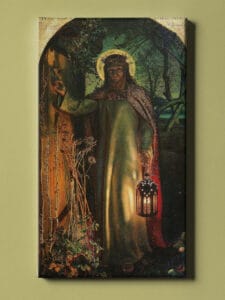
1. The Light of the World – William Holman Hunt (1851-1854)
Perhaps the most iconic Pre-Raphaelite painting of Jesus, The Light of the World portrays Christ standing before a closed door, lantern in hand, symbolizing His patient call to the human soul. Inspired by Revelation 3:20 (“Behold, I stand at the door and knock…”), the door’s lack of handle symbolizes that it must be opened from within. Hunt painted this in meticulous detail during a spiritual crisis, and the result is a luminous depiction of divine invitation and gentle persistence.
The original version hangs at Keble College, Oxford, while a larger replica commissioned in 1904 resides in St Paul’s Cathedral, London. This painting has become one of the most reproduced religious images in the English-speaking world.

2. Christ in the House of His Parents – John Everett Millais (1849-1850)
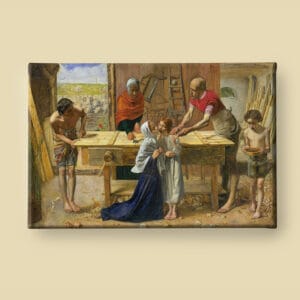
This early masterpiece shocked Victorian audiences with its hyper-realistic depiction of a young Jesus working in Joseph’s carpenter shop. Millais filled the scene with rich symbolism: a wounded hand foreshadows the Crucifixion, while a dove rests quietly nearby, representing the Holy Spirit. The cluttered interior and visibly tired family members added a domestic intimacy rarely seen in sacred art at the time.
Charles Dickens famously criticized the painting for portraying the Holy Family as too “ordinary,” but today, it is recognized as a groundbreaking blend of spiritual reverence and Pre-Raphaelite realism. It is housed at the Tate Britain in London.

3. The Shadow of Death – William Holman Hunt (1873)
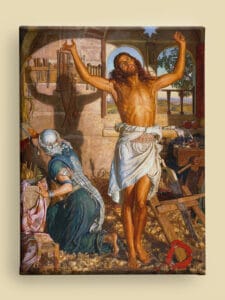
In The Shadow of Death, Holman Hunt returns to the figure of Christ in a deeply symbolic and dramatic composition. Jesus is shown stretching after labor in the carpenter’s shop, and His shadow casts a cruciform image on the wall behind Him. Mary, kneeling and opening a chest of gifts, looks up and sees the premonition. The tension between domestic setting and prophetic imagery captures both the humanity and divinity of Christ.
Executed with stunning detail and a glowing palette, the painting demonstrates Hunt’s belief in the moral power of sacred narrative. It is currently held at the Manchester Art Gallery.

4. The Passover in the Holy Family – Dante Gabriel Rossetti (1855-1856)
Rossetti’s rare religious painting, The Passover in the Holy Family, was painted during a short phase when he sought to engage more deeply with biblical subjects. The work shows a young Jesus participating in Jewish Passover rituals with Mary and Joseph. The painting emphasizes the Jewish roots of Christianity, with careful attention to ritual objects and symbolism.
Unlike Hunt and Millais, Rossetti focused less on strict realism and more on symbolic intensity and emotional resonance. The painting is part of a private collection and rarely exhibited publicly.

5. The Finding of the Saviour in the Temple – William Holman Hunt (1854-1860)
Based on the account in Luke 2:41–50, this work shows Mary and Joseph discovering the young Jesus teaching in the Temple. Hunt visited Jerusalem to study the architecture and dress of the region firsthand. The result is a complex, crowded composition filled with rich detail and authentic elements. Christ is portrayed as a brilliant, self-possessed boy surrounded by aged scholars.
The painting reflects the Pre-Raphaelite ideals of moral seriousness, historical authenticity, and visual intensity. It is currently housed in the Birmingham Museum and Art Gallery.

Together, these paintings reveal how the Pre-Raphaelites reshaped the portrayal of Jesus, bridging emotional immediacy with spiritual grandeur. Compared to the idealized balance of Renaissance or the dramatic contrast of Baroque art, Pre-Raphaelite works favor introspection, devotion, and poetic beauty.
William Dyce’s tender Good Shepherd belongs to this same Pre-Raphaelite spirit; see our full guide to Good Shepherd paintings.
Conclusion
Pre-Raphaelite Jesus paintings represent a luminous chapter in the history of sacred art. One defined by heartfelt emotion, rich symbolism, and meticulous craftsmanship. These artists rejected the rigidity of academic norms and instead infused religious themes with vibrant detail and deep spiritual meaning. Whether through Hunt’s quiet allegories, Millais’ realistic domestic scenes, or Rossetti’s symbolic intimacy, the figure of Christ emerged not just as divine, but deeply human and emotionally resonant.
The Pre-Raphaelite movement gave us a new lens through which to contemplate the life of Jesus. One that invited reflection through beauty, moral seriousness, and visual poetry. These works continue to inspire both art lovers and the faithful today, offering fresh insight into timeless truths.
To appreciate how these deeply emotional portrayals relate to other sacred styles, explore our articles on Gothic Jesus paintings or compare them with the structured balance of Renaissance religious art. Each movement offers its own path to contemplating the face of Christ.
Pre-Raphaelite Jesus Paintings Mentioned in this Article
| Painting Title | Artist | Date | Medium | Museum (with link) |
|---|---|---|---|---|
| The Light of the World | William Holman Hunt | 1851–1854 | Oil on canvas | Keble College, Oxford |
| Christ in the House of His Parents | John Everett Millais | 1849–1850 | Oil on canvas | Tate Britain |
| The Shadow of Death | William Holman Hunt | 1873 | Oil on canvas | Manchester Art Gallery |
| The Passover in the Holy Family | Dante Gabriel Rossetti | 1855–1856 | Oil on panel | Private Collection |
| The Finding of the Saviour in the Temple | William Holman Hunt | 1854–1860 | Oil on canvas | Birmingham Museum and Art Gallery |
Frequently Asked Questions
What defines Pre-Raphaelite Jesus paintings?
These works are known for their emotional intensity, symbolic depth, vivid color, and extreme attention to detail. They often mix spiritual themes with everyday realism.
Who were the main artists painting Jesus in the Pre-Raphaelite style?
Key figures include William Holman Hunt, John Everett Millais, Dante Gabriel Rossetti, and other members or associates of the Pre-Raphaelite Brotherhood.
How did Pre-Raphaelite art differ from earlier religious styles?
Unlike the stylized symbolism of Byzantine or Medieval art, or the grandeur of Baroque works, Pre-Raphaelite paintings focused on realism, human emotion, and nature-infused symbolism.
Why is “The Light of the World” so important?
William Holman Hunt’s “The Light of the World” became one of the most beloved religious images in the English-speaking world, symbolizing Christ’s quiet appeal to the human soul.
Where can I see Pre-Raphaelite Jesus paintings today?
You can view major works in the Tate Britain, Manchester Art Gallery, Birmingham Museum, and Keble College, Oxford.
Where can I buy Pre-Raphaelite Jesus paintings prints?
You can buy Pre-Raphaelite Jesus paintings prints at jesuschrist.pictures, in our shop: the canvas reproduction comes in several sizes, ready to hang.


