Biblical Masterpieces: 10 Famous Paintings of Sacred Stories

1. The Creation Story
Genesis opens with perhaps the most foundational narrative in Judeo-Christian tradition: the creation of the world. In this account, God creates the universe in six days, crafting light and darkness, separating the waters, forming land and vegetation, placing celestial bodies, creating animals, and finally shaping humanity in the divine image.
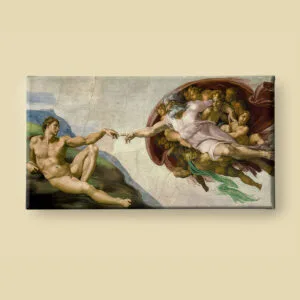
The seventh day, when God rests, establishes the concept of Sabbath, a day of rest that continues to influence cultural practices worldwide. This narrative has inspired numerous artistic interpretations, with Michelangelo’s Sistine Chapel ceiling representing perhaps the most iconic visualization of these early Genesis moments.
The Creation narrative introduces several profound theological concepts: divine intentionality in creation, humanity’s special relationship with the divine, and the inherent goodness of the created world. These themes have resonated through centuries of artistic and philosophical exploration.
2. Adam and Eve in the Garden of Eden
The Garden of Eden story presents humanity’s idyllic beginnings and subsequent fall from grace. Adam and Eve live in perfect harmony with God and nature until they succumb to temptation, eating fruit from the forbidden Tree of Knowledge of Good and Evil.
This act of disobedience results in their expulsion from Eden and introduces mortality, labor, and suffering into human experience. The narrative grapples with fundamental questions about human nature, free will, temptation, and the origins of human suffering.
Artists throughout history have been drawn to this story’s dramatic potential and psychological complexity. Masaccio’s “Expulsion from the Garden of Eden” powerfully captures the emotional devastation of this moment, while Albrecht Dürer’s engravings explore the psychological tension between desire and divine command.
The Eden narrative established enduring cultural motifs about temptation, innocence, and the human condition that continue to surface in contemporary literature, film, and art.
3. Noah’s Ark and the Great Flood
The Flood narrative presents a divine response to humanity’s corruption. God, witnessing widespread wickedness, decides to cleanse the earth through a devastating flood while preserving righteous Noah, his family, and pairs of all animals aboard an ark.
This account raises profound questions about divine judgment, mercy, redemption, and environmental stewardship. The rainbow that appears after the flood becomes a symbol of God’s covenant never again to destroy the earth by water.
Edward Hicks’ Noah’s Ark (c. 1846) embodies his Quaker spirituality and folk art sensibility, depicting the biblical narrative with a serene, almost childlike simplicity that underscores themes of faith, divine promise, and humanity’s connection to the natural world.Artists like J.M.W. Turner have captured the flood’s apocalyptic drama, while others have focused on the ark itself or the hopeful moment of emerging onto dry land. The story’s visual elements—the massive ark, paired animals, the rainbow—offer rich material for artistic interpretation.
The Flood story resonates across cultures, with similar deluge myths appearing in Mesopotamian, Greek, and other traditions, suggesting its archetypal significance in human understanding of catastrophe and renewal.

4. Abraham and Isaac – The Binding of Isaac
Few biblical narratives have provoked as much theological reflection and artistic response as Abraham’s near-sacrifice of his son Isaac. When God commands Abraham to offer his beloved son as a burnt offering, Abraham proceeds in faithful obedience until a divine messenger intervenes at the critical moment.
This story, known as the Binding of Isaac or Akedah, explores the tension between faith and ethical intuition, raising profound questions about divine commands, human responsibility, and the nature of sacrifice.
Artists like Rembrandt and Caravaggio (the master of italian Baroque) have captured the psychological drama of this moment : Abraham’s anguish, Isaac’s vulnerability, and the divine intervention that prevents the sacrifice. The visual tension in these works mirrors the theological tension inherent in the narrative itself. This story has been interpreted variously as a test of Abraham’s faith, a divine rejection of human sacrifice, and a prefiguration of Christ’s sacrifice in Christian theology. Its ethical complexities continue to engage philosophers, theologians, and artists alike.
5. Moses and the Exodus
The Exodus narrative recounts the Israelites’ liberation from Egyptian slavery under Moses’ leadership. This extended account includes several iconic episodes: Moses’ encounter with the burning bush, the ten plagues visited upon Egypt, the parting of the Red Sea, and the receiving of the Ten Commandments at Mount Sinai.
This story established foundational concepts of liberation theology and has inspired numerous modern freedom movements. The Passover celebration commemorating the Exodus remains a central observance in Jewish tradition.
Artists have gravitated toward the narrative’s dramatic moments, particularly the parting of the Red Sea and Moses receiving the tablets of law. Poussin’s “Crossing of the Red Sea” captures the drama of divine intervention, while Rembrandt’s works explore Moses’ encounters with the divine.
The Exodus story articulates themes of divine justice, liberation from oppression, covenant relationship, and the formation of community identity that continue to resonate in religious and political discourse.

6. David and Goliath
The confrontation between the young shepherd David and the Philistine champion Goliath represents one of the Bible’s most compelling underdog narratives. Armed with only a sling and five stones, David defeats the heavily armored giant, prefiguring his rise to become Israel’s greatest king. This single duel between shepherd and giant fills our companion guide to David and Goliath paintings.
This account has become a cultural archetype for situations where the seemingly weak overcome powerful opponents through courage, skill, and divine favor.
The dramatic encounter has inspired artists across centuries. Michelangelo’s sculpture of David captures the moment before the battle, emphasizing the youth’s determination and readiness. Caravaggio’s painting depicting David holding Goliath’s severed head explores the aftermath, with some interpretations suggesting the artist used his own face for Goliath.
The David and Goliath narrative continues to influence contemporary discussions about power dynamics, courage in the face of overwhelming odds, and the unexpected sources of strength.

7. Jonah and the Whale
The book of Jonah relates the story of a prophet who attempts to flee from divine commission, only to be swallowed by a great fish (often depicted as a whale), within which he spends three days before being deposited back on land. Jonah subsequently fulfills his mission to prophesy to Nineveh, whose inhabitants repent and avoid divine judgment.
This narrative explores themes of divine calling, human resistance, repentance, and God’s universal concern for all peoples.
Artists have been particularly drawn to the dramatic moment of Jonah being swallowed or expelled by the great fish. Works by Rubens and Pieter Lastman capture these supernatural encounters, emphasizing the prophet’s helplessness before divine intervention.
In Christian tradition, Jonah’s three days in the fish became interpreted as prefiguring Christ’s death and resurrection, adding layers of typological significance to this already rich narrative.

8. The Nativity
The Gospel accounts of Jesus’ birth have formed the foundation for Christmas celebrations and inspired countless artistic depictions. Elements including the angelic announcement, the journey to Bethlehem, the humble stable birth, visiting shepherds, and the later arrival of wise men have been woven together in cultural imagination.
The Nativity narrative juxtaposes the divine and the mundane, suggesting that sacred presence emerges in seemingly ordinary circumstances.
Artists like Giotto, Botticelli, and Rembrandt have explored various aspects of the Nativity, often emphasizing the contrast between the child’s humble circumstances and his cosmic significance. The use of light in these compositions often symbolizes divine presence breaking into human experience.
Beyond formal religious art, the Nativity continues to inspire contemporary artistic expressions and remains central to Christmas celebrations worldwide, with crèche displays forming an important devotional and decorative tradition.

9. The Last Supper
Jesus’ final meal with his disciples before his crucifixion established what would become the central sacrament for many Christian traditions. During this Passover meal, Jesus instituted the Eucharist by identifying bread with his body and wine with his blood, and predicted his imminent betrayal.
This narrative connects the Christian story with Jewish Passover traditions while establishing new symbolic meanings that would shape Christian worship for centuries.
Leonardo da Vinci’s masterpiece, painted for the refectory of Santa Maria delle Grazie in Milan, represents perhaps the most influential artistic interpretation of this scene. Leonardo captures the moment of Jesus’ announcement that one disciple will betray him, depicting the various emotional reactions among the group.
Other artists like Tintoretto brought different perspectives to this scene, emphasizing various theological aspects of the meal. The Last Supper remains a central subject in religious art and continues to be referenced in contemporary visual culture. For a closer look at how the masters staged this scene, see our guide to last supper paintings.


10. The Crucifixion and Resurrection
The accounts of Jesus’ crucifixion and subsequent resurrection form the theological cornerstone of Christian faith. These narratives describe Jesus’ trial, suffering, death by crucifixion, burial, and resurrection on the third day, followed by appearances to his followers.
These events have been interpreted as representing divine sacrifice for human redemption and triumph over death, establishing foundational concepts in Christian theology.
Few subjects have received more artistic attention throughout Western art history. Artists from Giotto and Grünewald to Dalí and Chagall have offered interpretations of these events, emphasizing different theological and emotional aspects. Grünewald’s own version, the Isenheim Altarpiece, sets the Lamb of God at the foot of the cross, bleeding into a chalice. The crucifixion has been depicted both as a moment of agonizing suffering and as a triumphant sacrifice, reflecting various theological understandings.
Resurrection scenes often emphasize themes of light, transformation, and victory, with artists like Piero della Francesca creating iconic images of the risen Christ that balance human and divine elements.

The first of Christ’s miracles inspired its own tradition of masterpieces; explore our guide to Wedding at Cana paintings.
Conclusion
These ten biblical narratives represent just a fraction of the Bible’s rich storytelling tradition, yet they have exerted enormous influence on Western art, literature, and cultural imagination. Their continued presence in artistic expression, from Renaissance masterpieces to contemporary film and literature, testifies to their enduring psychological and spiritual resonance.
Whether approached as sacred scripture or cultural heritage, these stories continue to offer powerful reflections on human experience, ethical choice, divine presence, and the search for meaning. Through their artistic interpretations, we gain insight not only into biblical tradition but also into the evolving ways humans have understood their relationship to the transcendent across centuries.
The visual legacy these stories have inspired constitutes one of the great treasures of world art, a testament to the generative power of narrative to shape human understanding and creative expression.
That legacy did not begin on panel. Through the early Middle Ages the same stories were carried on parchment, and the insular manuscripts made in Ireland and on Iona, the Book of Kells above all, are the missing link between the Byzantine East and the Gothic West. They hold the oldest surviving Western image of the Virgin and Child, three centuries before Giotto. The monks who made them are the subject of our page on the Irish saints and the art they left behind, and the pages themselves, from the Book of Durrow to the flower borders of Ghent and Bruges, are gathered in our survey of medieval manuscript art.
The infographic below provides a visual overview of key biblical narratives and their representation in major works of Christian art.
✦ Free Christian & Catholic Printables
Illuminated prayer cards and Scripture verses, the Memorare, Psalm 23, Psalm 91 and more, already free to print with no email needed. Join and I will send you the complete set in every format, US Letter, A4 and pocket size, and each new card by email first, thirty days before it reaches the public library.
No spam, unsubscribe anytime. Or browse the whole library →
Biblical Paintings Featured in This Article
| Painting | Artist | Date | Size | Location |
|---|---|---|---|---|
| The Sacrifice of Isaac | Bartolomeo Cavarozzi | c. 1598 | 117 × 172 cm | Galleria Nazionale d’Arte Antica, Rome |
| The Creation of Adam | Michelangelo | c. 1512 | 280 × 570 cm (fresco) | Sistine Chapel, Vatican |
| The Expulsion from the Garden of Eden | Masaccio | c. 1425 | 208 × 88 cm (fresco) | Brancacci Chapel, Florence |
| Noah’s Ark | Edward Hicks | c. 1846 | 66 × 89.5 cm | Philadelphia Museum of Art |
| The Sacrifice of Isaac | Caravaggio | 1603 | 104 × 135 cm | Uffizi Gallery, Florence |
| The Crossing of the Red Sea | Nicolas Poussin | 1634 | 155.6 × 215.3 cm | National Gallery of Victoria, Melbourne |
| David with the Head of Goliath | Caravaggio | 1610 | 125 × 101 cm | Galleria Borghese, Rome |
| Jonah and the Whale | Pieter Lastman | 1621 | 59.7 × 90.3 cm | Museum of Fine Arts, Budapest |
| Nativity | Giotto | c. 1305 | 200 × 185 cm (fresco) | Scrovegni Chapel, Padua |
| The Last Supper | Leonardo da Vinci | 1498 | 460 × 880 cm (fresco) | Santa Maria delle Grazie, Milan |
| The Isenheim Altarpiece | Matthias Grünewald | 1512–1516 | 376 × 668 cm (open) | Unterlinden Museum, Colmar |