Our Lady of Częstochowa: the Scarred Black Madonna’s Story
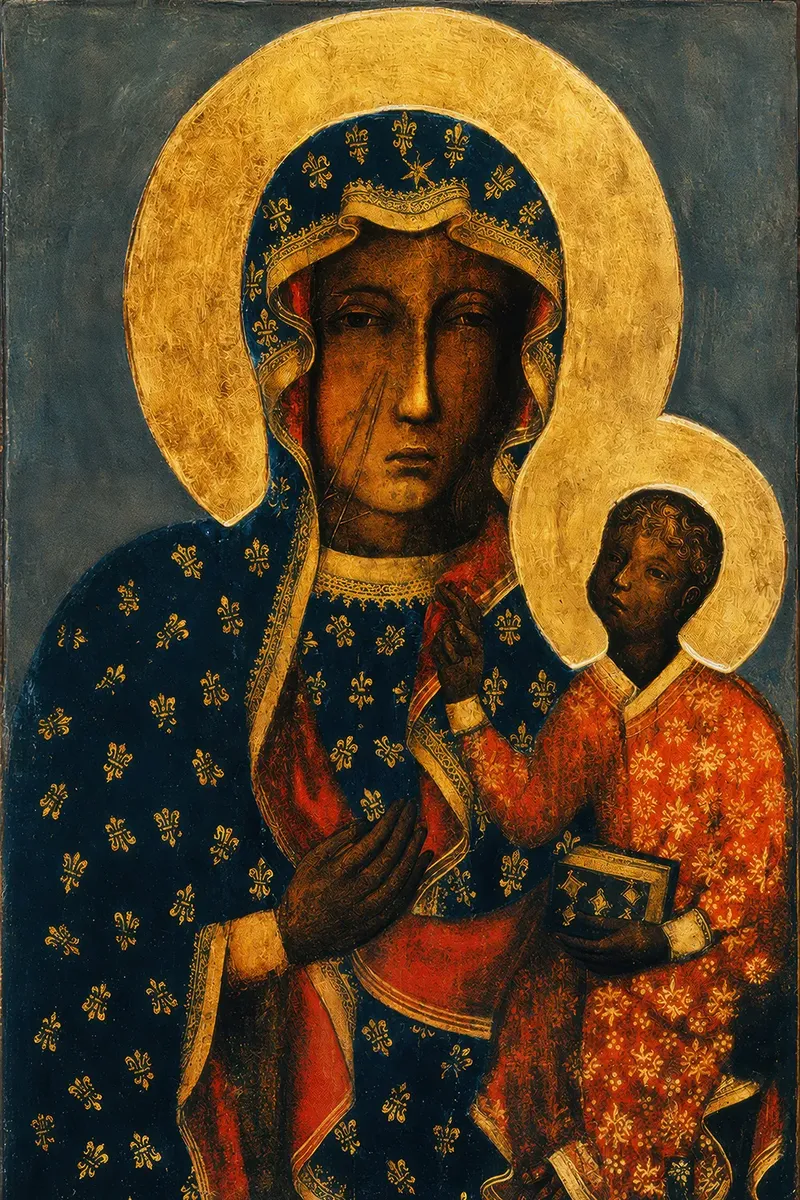
Our Lady of Częstochowa, known across the world as the Black Madonna of Jasna Góra, is a medieval icon of the Virgin Mary painted in tempera on a wood panel and venerated at the Jasna Góra Monastery in Częstochowa, Poland. She is one of the most recognisable images of Mary ever made, and one of the strangest at first sight: a dark-faced Queen of Heaven whose right cheek carries two deep, deliberate scars.
Those scars are not damage that restorers failed to repair. They are kept, repainted, almost cherished, and they are the key to the whole story. This article tells it from the beginning: the legend of Saint Luke, the attack of 1430, the siege that changed the history of Poland, and the prayer that pilgrims still whisper in front of the icon today.
The Legend of Saint Luke
Tradition says the icon was painted by Saint Luke the Evangelist himself, on a tabletop of cedar wood from the house of the Holy Family in Nazareth. The legend continues that Saint Helena found the image in Jerusalem in the fourth century and carried it to Constantinople, where it protected the imperial city for centuries before travelling west through princely hands.
Historians tell a more cautious story. The icon is a Hodegetria, “she who shows the way”, a Byzantine type in which Mary holds the Child on her left arm and points to him with her right hand: he, not she, is the way. Scholars generally place the panel’s origin in the Byzantine world, with datings that range from the sixth to the fourteenth century, and the painting we see today owes most of its surface to a thorough medieval restoration, as we will see. What is documented is the icon’s arrival at Jasna Góra, the “Bright Hill” of Częstochowa, where Prince Władysław of Opole entrusted it to the Pauline monks he had installed there in 1382. Within a generation the image was already famous for graces and miracles, and the hilltop monastery had become the spiritual heart of Poland.
The Western world knew this Byzantine manner of painting the Virgin through masters such as Cimabue, whose dark-toned, gold-ground Madonnas belong to the same family; you can read about him in our article on Cimabue’s paintings.
1430: the Attack That Scarred Her Face
On Easter of 1430 a band of raiders, often described in the sources as Hussite sympathisers, stormed Jasna Góra and stripped the chapel of its treasures. The icon itself was thrown down and robbed of its votive ornaments. According to the earliest accounts, one of the attackers slashed the Virgin’s face with his sword, and the panel was broken.
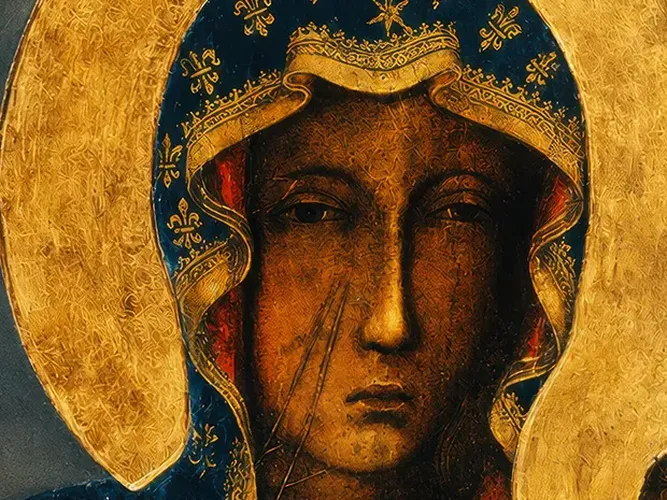
King Władysław II Jagiełło took the wounded image under his protection and had it restored at his court in Kraków. The medieval restorers found that the new tempera would not hold on the ancient painting surface, so they laid a fresh ground and repainted the icon entirely, following the old composition faithfully. And then they did something remarkable: they cut the scars back into the new, unblemished face. Two parallel lines on the right cheek, crossed by a third, with further marks on the neck. The wounds had already become part of who she was. For six centuries, every copy of Our Lady of Częstochowa has carried them, the way a crucifix carries its nails.
That choice is unique in the history of sacred art. Where every other restoration hides damage, this one canonised it. Pilgrims who kneel before the icon see a Mother who has been hurt and remains beautiful, and that, more than any legend, explains the Black Madonna’s hold on the heart.
Reading the Icon: the Child, the Book, the Lilies
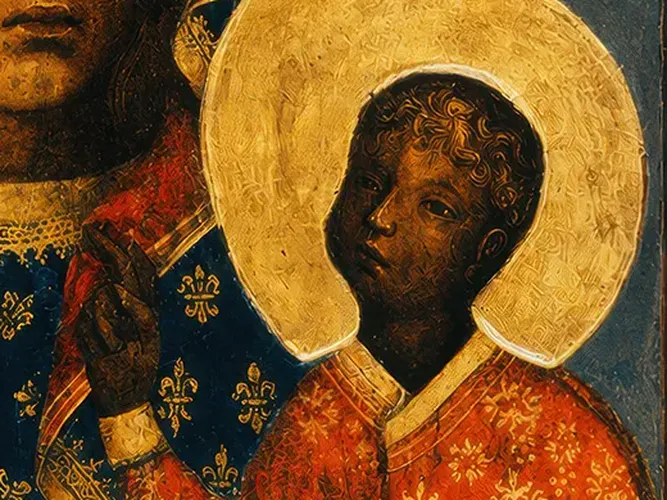
The Child Jesus sits on his Mother’s left arm, wrapped in a scarlet robe woven with gold, and holds the book of the Gospels in his left hand while his right rises in blessing. Unlike most infant Christs, he looks not at us but slightly away, a small, grave king. Mary’s maphorion, the deep blue veil that covers her head and shoulders, is strewn with golden fleurs-de-lis, the lilies of the royal house of Anjou, a mark of the icon’s medieval links to the Hungarian and Polish crowns. Above both faces shine engraved gold nimbi, and the whole image stands against a ground the colour of old steel.
The faces are dark, a deep honey-brown that gave the icon its popular name. The darkness was never meant as a portrait of skin colour: centuries of candle smoke, incense, darkened varnish and the pigments of the medieval repainting each played their part. Over time, though, the dark face became the icon’s glory rather than an accident, echoing the bride of the Song of Songs: “I am black but beautiful.” She belongs to a whole family of dark images of Mary across Europe, the Black Madonnas, alongside the sacred images explored in our guides to Catholic icons and their meaning and Marian iconography.
The Siege of 1655 and the Queen of Poland
In the winter of 1655, during the Swedish invasion that Poles still call the Deluge, a Swedish force arrived to take Jasna Góra. Inside the walls were about seventy monks and a small garrison of volunteers. The siege lasted forty days, and the monastery did not fall. In a war in which nearly everything else had been lost, the survival of the sanctuary of the icon electrified the country, and the tide of the war turned.
The following year, in 1656, King John II Casimir made a solemn vow in the cathedral of Lwów and proclaimed the Mother of God Queen of the Crown of Poland. In 1717 the icon was crowned with papal crowns, one of the first images outside Rome to receive that honour. From then on the history of the icon and the history of the nation are one braid: partitions, uprisings, occupations, and always the Bright Hill at the centre. Saint John Paul II, who grew up praying before her, returned to Jasna Góra again and again as pope, and left his blood-stained sash from the 1981 assassination attempt as a votive offering to her.
Her feast day, August 26, draws hundreds of thousands of pilgrims, many of whom walk for nine days from Warsaw in the great August pilgrimage, a river of people that has flowed every summer since 1711.
An Icon That Could Not Be Silenced
The strangest chapter of the story is recent. In 1957, for the thousandth anniversary of Poland’s baptism, the Polish Church sent a consecrated copy of the icon travelling from parish to parish across the country. The communist authorities watched the crowds grow with alarm, and in 1966 they seized the pilgrim image and confined it to Jasna Góra. The peregrination continued anyway: for six years Polish parishes venerated an empty frame, sometimes with a candle and a book of Gospels where the icon should have been. The authorities had managed to arrest a painting, and the painting won. The image returned to the road in 1972, and the empty frame remains one of the great silent protests of the twentieth century.
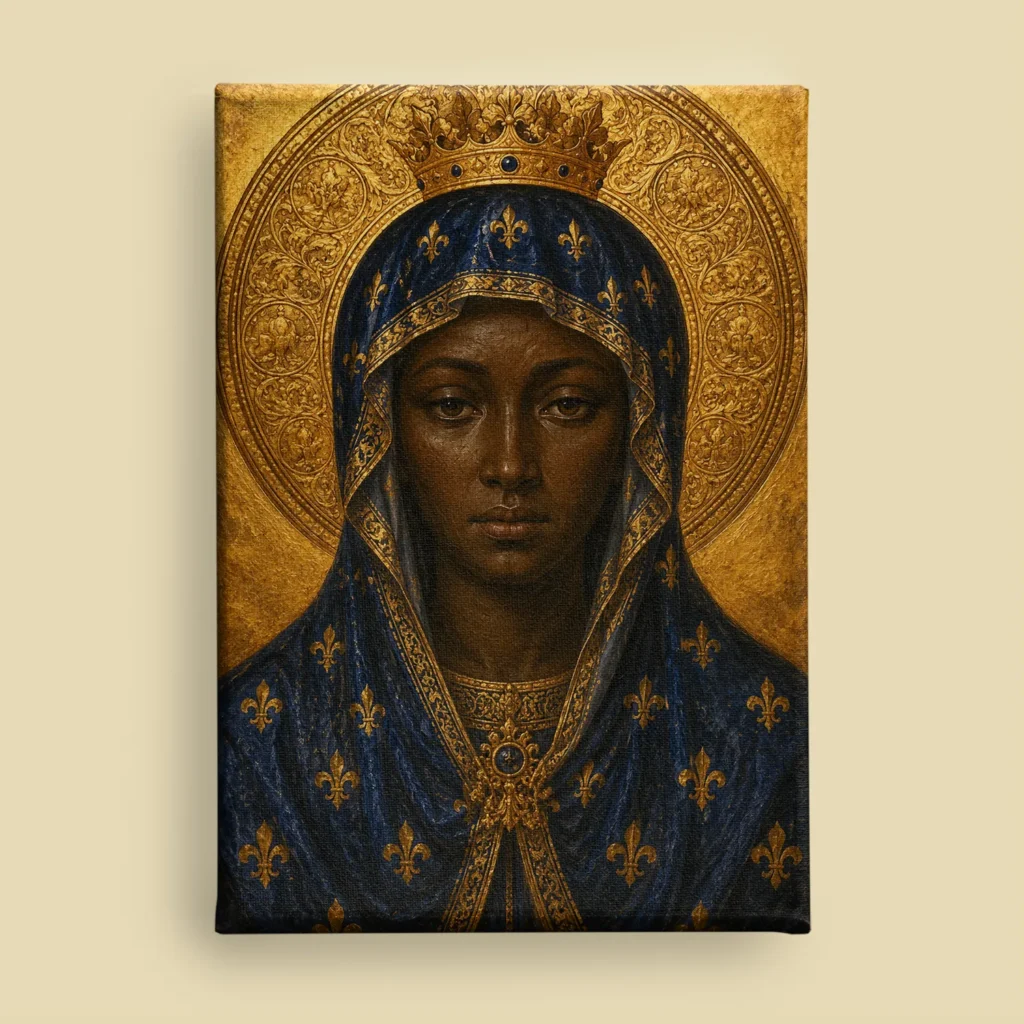
She has crossed the ocean too. The National Shrine of Our Lady of Częstochowa in Doylestown, Pennsylvania, the “American Częstochowa”, carries the devotion of Polish emigrants and their descendants, and copies of the scarred icon hang in churches on every continent. Contemporary painters continue to return to her, and our own original Black Madonna canvas below belongs to that living tradition, a crowned dark Virgin painted in homage to the iconography she made universal.
Prayer to Our Lady of Częstochowa
This prayer takes up the icon’s own language, the wounded face that shines, and turns it toward whoever prays it.
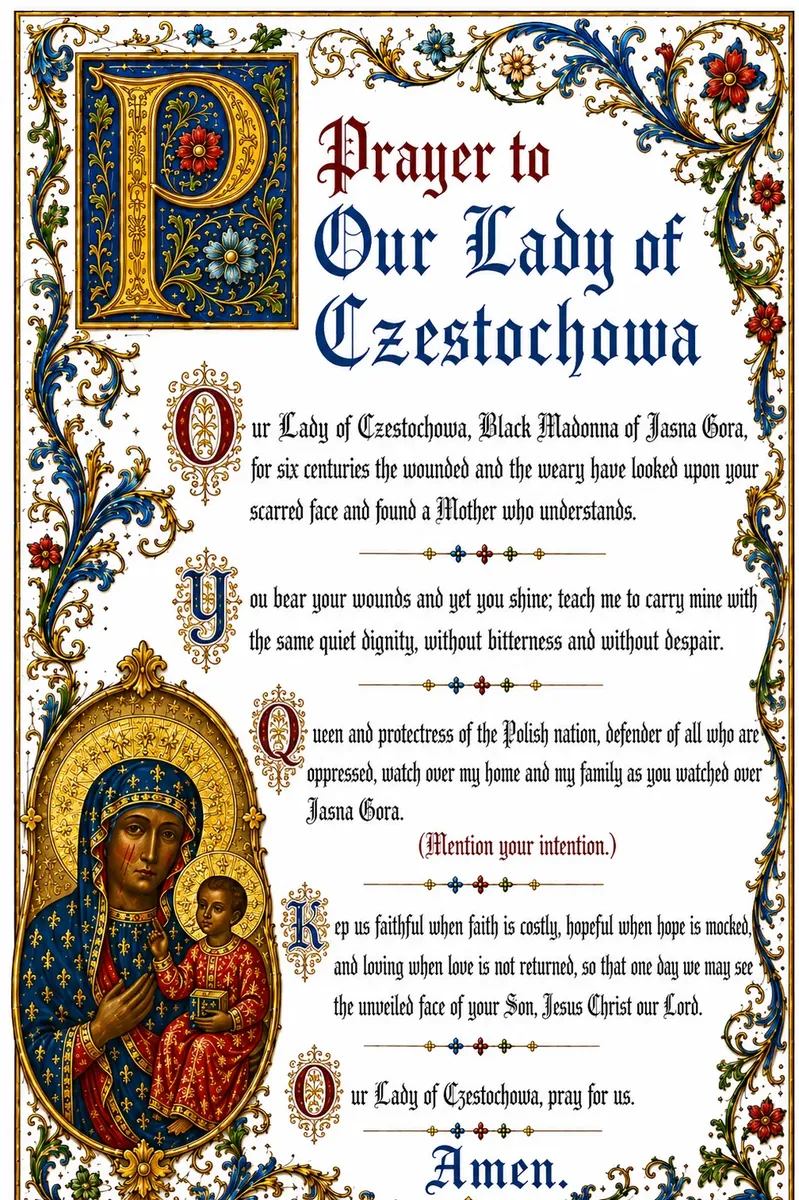
Our Lady of Częstochowa, Black Madonna of Jasna Góra,
for six centuries the wounded and the weary have looked upon your scarred face and found a Mother who understands.
You bear your wounds and yet you shine; teach me to carry mine with the same quiet dignity, without bitterness and without despair.
Queen and protectress of the Polish nation, defender of all who are oppressed, watch over my home and my family as you watched over Jasna Góra.
(Mention your intention.)
Keep us faithful when faith is costly, hopeful when hope is mocked, and loving when love is not returned, so that one day we may see the unveiled face of your Son, Jesus Christ our Lord.
Our Lady of Częstochowa, pray for us. Amen.
Like the Hail Mary, it is short enough to be learned by heart and prayed before any copy of the icon.
Free printable prayer card:
These files are free for personal use, for your parish, or for catechism class.
✦ Free Christian & Catholic Printables
Love this one? Find it, and our complete collection of illuminated prayer cards and Scripture printables, ready to print, free, in one place.
Browse all free printables →
Conclusion
Our Lady of Częstochowa is not the most delicate Madonna in the history of art, nor the most naturalistic. She is something rarer: an image that a whole people has treated as a person for six hundred years. Sword blows, sieges, partitions and police seizures have only deepened the devotion, and the two lines on her cheek say more about grace under wounds than most treatises on suffering.
If this story moved you, continue with our guide to the meaning and mysteries of the Black Madonna, or step back and see how painters across the centuries have imagined the Mother of God in our list of beautiful Virgin Mary paintings.
Artwork Information
| Artwork | Our Lady of Częstochowa (Black Madonna of Częstochowa) |
| Artist | Unknown; attributed by legend to Saint Luke the Evangelist |
| Date | Medieval, of debated origin; repainted after 1430 |
| Medium | Tempera on wood panel (icon) |
| Dimensions | About 122 x 82 cm |
| Location | Jasna Góra Monastery, Częstochowa, Poland |
Five Facts About Our Lady of Częstochowa
- The icon is a Byzantine Hodegetria, “she who shows the way”: Mary’s right hand points to the Child, who holds the book of the Gospels.
- The two scars on her right cheek date from the attack of 1430 and were deliberately preserved by the royal restorers in Kraków, and by every copyist since.
- After the monastery of Jasna Góra withstood the Swedish siege of 1655, King John II Casimir proclaimed Mary Queen of the Crown of Poland in 1656.
- The icon was crowned with papal crowns in 1717, and Saint John Paul II left his blood-stained sash from the 1981 assassination attempt as a votive offering to her.
- When communist authorities seized the travelling copy of the icon in 1966, Polish parishes venerated an empty frame for six years until the image was freed.
Frequently Asked Questions
What is the story behind Our Lady of Częstochowa?
Legend says the icon was painted by Saint Luke on a tabletop from the house of the Holy Family and reached Poland through Constantinople. Historically, the Byzantine-style icon was entrusted to the Pauline monks of Jasna Góra in 1382, was attacked and scarred in 1430, survived the Swedish siege of 1655, and became the national image of Poland, crowned with papal crowns in 1717.
Why does Our Lady of Częstochowa have slash marks on her face?
During the raid on Jasna Góra in 1430, an attacker slashed the icon’s face with his sword. When the image was restored at the royal court in Kraków, the restorers had to repaint it entirely, and they deliberately cut the two scars back into the new surface of her right cheek. The wounds were kept as part of the icon’s identity, and every faithful copy reproduces them.
What is the miracle of Our Lady of Częstochowa?
The most famous is the defence of Jasna Góra in 1655, when about seventy monks and a small garrison held the monastery against a Swedish force during a forty day siege, a turning point that Poles attributed to the Virgin’s protection. Centuries of individual graces and healings are recorded in the monastery’s books, and the icon’s survival of the 1430 attack is itself counted among her wonders.
What does Częstochowa mean?
Częstochowa is simply the name of the Polish city, derived from the old personal name Częstoch. The monastery hill is called Jasna Góra, which means “Bright Hill” or “Luminous Mount”, and the icon takes both names: Our Lady of Częstochowa, the Madonna of Jasna Góra.
What is the feast day of Our Lady of Częstochowa?
Her feast is celebrated on August 26. It is preceded by the great walking pilgrimages of August, the most famous of which leaves Warsaw and walks about nine days to reach Jasna Góra, a tradition that has continued without interruption since 1711.
Where is the Black Madonna of Częstochowa located?
The original icon hangs above the altar of the Chapel of Our Lady at the Jasna Góra Monastery in Częstochowa, in southern Poland, where it is unveiled and veiled daily with a solemn ceremony. A national shrine dedicated to her, the “American Częstochowa”, also stands in Doylestown, Pennsylvania.
Where can I buy an Our Lady of Częstochowa print?
You can buy an Our Lady of Częstochowa print at jesuschrist.pictures: our Black Madonna icon poster reproduces the scarred icon on thick matte paper, and our original Black Madonna canvas continues the tradition with a contemporary crowned Virgin. Both ship ready to frame or hang, and the same illuminated prayer is available as a poster and as the free printable card above.