Beautiful Konrad Witz Paintings from Late Gothic Europe
Konrad Witz is one of the great forgotten masters of late medieval German art. The Konrad Witz paintings that survive today, fewer than two dozen securely attributed panels, made him the most original painter of the upper Rhine in the second quarter of the fifteenth century. He absorbed the new Flemish realism of Jan van Eyck and the Master of Flémalle and built on it a personal manner of sculptural figures, dense observed detail, and luminous Alpine landscapes that has no real parallel anywhere else in his time.
This article gathers eight of his most important religious works, the panels that fill the museums of Basel, Geneva, Berlin, and Strasbourg with his quiet upper Rhine devotion.

From Rottweil to the Painters’ Guild of Basel
Konrad Witz was probably born around 1400 in Rottweil, a small free city in the Black Forest, the son of a goldsmith of the same name. He is first documented in Basel in 1434, where he was registered as a master in the painters’ guild and probably had been resident for some years before. He worked in Basel for the rest of his short life, with at least one major commission for the cathedral of Geneva in 1444, and he died in 1446, leaving an unfinished altarpiece and a small but extraordinary corpus.
His career covers only twelve documented years, but it spans the moment when the new Flemish oil technique was beginning to reach the German-speaking world. Witz was one of the first Northern artists to fully internalise the lessons of the early Netherlandish school and to apply them to a personal vision of the upper Rhine landscape and Catholic devotion.
The Miraculous Draught of Fishes
Painted in 1444 for the high altarpiece of Saint Peter’s Cathedral in Geneva, this is the single most famous of all Witz’s surviving panels and one of the most original religious paintings of the entire fifteenth century. The composition shows Christ standing on the shore of a vast lake while the apostles pull in their miraculous catch of fish. The lake is recognisably Lake Geneva, with the Alps rising in the distance, the small town of Geneva on the right, and every reflection and ripple of the water rendered with extreme observed precision. It is the first identifiable topographical landscape in the history of European painting.

The panel is at the Museum of Art and History in Geneva.
The Annunciation
This panel of the Annunciation shows the Virgin in a Flemish bourgeois interior at the moment when the angel Gabriel appears to her with the divine message. The composition is built on the calm linear refinement of the early Flemish school, but Witz adds a particular sculptural solidity to the figures that distinguishes him from his Netherlandish contemporaries.

The painting is at the Germanisches Nationalmuseum in Nuremberg. For a wider survey, see our article on famous Annunciation paintings.
Christ on the Cross
One of Witz’s most concentrated devotional panels, this Crucifixion shows Christ alone on the cross against a darkened sky, with the towers of a small German city visible in the distance behind. The body of Christ is rendered with the same sculptural precision as Witz’s Esther figure, and the composition is built on the absolute vertical of the cross dominating a horizontal landscape.

The painting is at the Gemäldegalerie in Berlin, in the rooms of German painting of the thirteenth to sixteenth century.
Lamentation
The body of Christ lies across the lap of the Virgin while John the Evangelist supports his shoulders and Mary Magdalene weeps at his feet. Witz paints the moment with the same sculptural solidity as his other religious panels, and the figures are arranged in a tight triangular composition that gives the picture the gravity of a relief sculpture in carved wood.

The painting is at the Frick Collection in New York.
The Heilsspiegelaltar (Augustus and the Sibyl of Tibur)
Painted around 1435 for the church of Saint Leonard in Basel, the Heilsspiegelaltar, or Mirror of Salvation Altarpiece, was Witz’s most ambitious cycle. The surviving panels show Old Testament scenes that the medieval typological tradition read as prefigurations of the New Testament. The panel reproduced here shows the Emperor Augustus and the Sibyl of Tibur receiving a vision of the future birth of Christ from heaven, the medieval legend that explained the simultaneity of the Roman Empire and the Incarnation.

The panel is at the Musée des Beaux-Arts in Dijon.
Esther before Ahasuerus
Another panel of the Heilsspiegelaltar, this scene shows Queen Esther kneeling before the Persian king Ahasuerus to plead for the lives of the Jewish people, the Old Testament prefiguration of the Virgin Mary interceding before Christ at the Last Judgement. Witz paints the moment with the same sculptural intensity as his other panels, with the figures arranged in a tight Gothic architectural space.

The panel is at the Kunstmuseum Basel, the city of Witz’s adult career.
Saint Christopher
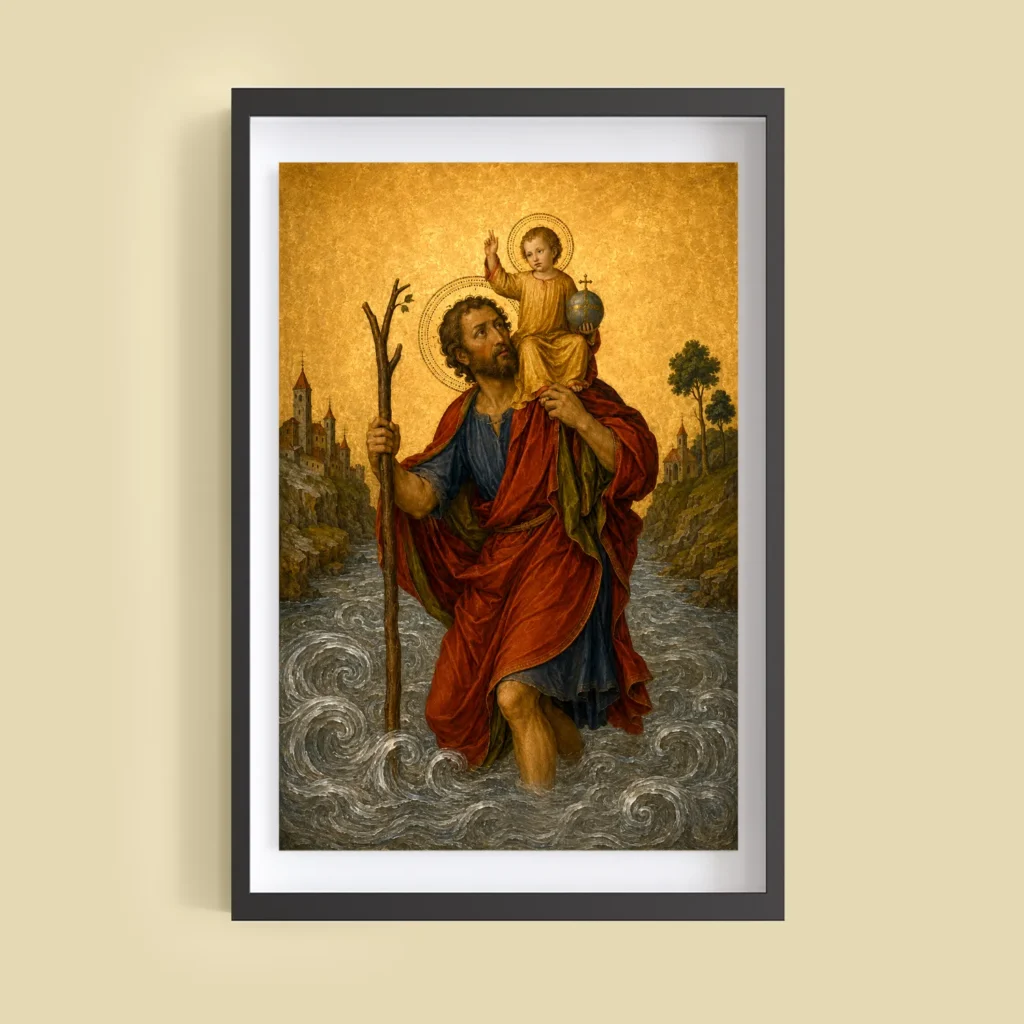
The legendary giant Saint Christopher wades through the river with the Christ child on his shoulder. Witz paints the figure with extreme sculptural solidity, like a polychrome wood statue brought to life. The Christ child looks back at the saint with grave attention while the water swirls around his legs.

The panel is at the Gemäldegalerie in Berlin.
Saints Catherine and Mary Magdalene
The two saints stand side by side, Catherine with the wheel of her martyrdom and the open book of her learning, Mary Magdalene with her ointment jar. Witz paints them with the same sculptural solidity as his other figures, against a deep dark interior space. The composition is one of his most concentrated images of paired saintly women.

The painting is at the Musée de l’Œuvre Notre-Dame in Strasbourg.
For more context on Witz’s upper Rhine world, see our articles on Stefan Lochner, on Hans Multscher, on Martin Schongauer, and on the great Flemish predecessor Jan van Eyck, whose oil technique Witz absorbed in the 1430s.
Summary Table of Konrad Witz’s Religious Paintings
| Name | Artist | Date | Medium | Museum |
|---|---|---|---|---|
| The Miraculous Draught of Fishes | Konrad Witz | 1444 | Oil on panel | Museum of Art and History, Geneva |
| The Annunciation | Konrad Witz | c. 1440 | Oil on panel | Germanisches Nationalmuseum, Nuremberg |
| Christ on the Cross | Konrad Witz | c. 1440 | Oil on panel | Gemäldegalerie, Berlin |
| Lamentation | Konrad Witz | c. 1440 | Oil on panel | Frick Collection, New York |
| Heilsspiegelaltar, Augustus and the Sibyl of Tibur | Konrad Witz | c. 1435 | Oil on panel | Musée des Beaux-Arts, Dijon |
| Esther before Ahasuerus | Konrad Witz | c. 1435 | Oil on panel | Kunstmuseum Basel |
| Saint Christopher | Konrad Witz | c. 1435 | Oil on panel | Gemäldegalerie, Berlin |
| Saints Catherine and Mary Magdalene | Konrad Witz | c. 1440 | Oil on panel | Musée de l’Œuvre Notre-Dame, Strasbourg |
Conclusion
Witz’s religious painting is one of the most concentrated bodies of upper Rhine art of the early fifteenth century. He died young, in his middle forties, and the body of work he left behind is small. But the Miraculous Draught of Fishes alone, with its identifiable view of Lake Geneva and the Alps, makes him one of the most original painters of his generation. He stood at the moment when the new Flemish oil technique was meeting the late Gothic German sculpture tradition, and his panels carry the weight of both.
Important Facts About Konrad Witz
- Konrad Witz was probably born around 1400 in Rottweil, in the Black Forest of southwestern Germany, the son of a goldsmith of the same name and a member of a family of craftsmen of the upper Rhine.
- He is first documented in 1434 in Basel, where he was registered as a master in the painters’ guild and probably had been resident for some years, and he received the freedom of the city in 1435.
- Witz is one of the central figures of late Gothic German painting and is celebrated for his sculptural solidity, his patient observed detail, and his pioneering use of the new Flemish oil technique on the upper Rhine.
- His most famous religious work is The Miraculous Draught of Fishes, painted in 1444 for the high altarpiece of Saint Peter’s Cathedral in Geneva and considered the first identifiable topographical landscape in the history of European painting.
- He died in 1446 in Basel, leaving a small but extraordinary corpus and an unfinished altarpiece, and his innovations shaped the next generation of upper Rhine painters, including the young Martin Schongauer.
Questions and Answers About Konrad Witz Paintings
What is Konrad Witz’s most famous painting?
By far the most studied is The Miraculous Draught of Fishes at the Museum of Art and History in Geneva. Painted in 1444 for the high altarpiece of Saint Peter’s Cathedral, the panel includes an identifiable view of Lake Geneva and the Alps and is considered the first topographical landscape in the history of European painting.
Where can I see Konrad Witz paintings today?
The Kunstmuseum Basel holds the largest single collection of his work, including several panels of the Heilsspiegelaltar. The Museum of Art and History in Geneva owns the Miraculous Draught of Fishes. The Gemäldegalerie in Berlin, the Frick Collection in New York, the Germanisches Nationalmuseum in Nuremberg, and the Musée des Beaux-Arts in Dijon all hold significant works.
What style is Konrad Witz associated with?
Witz belongs to the late Gothic upper Rhine school of the early fifteenth century. His mature style combines the sculptural solidity of late medieval German wood carving with the new Flemish oil technique and the patient observed detail of the early Netherlandish primitives. He is among the first German painters to fully absorb the lessons of Jan van Eyck and Robert Campin.
Why is the Miraculous Draught of Fishes so important?
The panel is the first identifiable topographical landscape in the history of European painting. The body of water that Witz painted is recognisably Lake Geneva, with the small town of Geneva visible on the right and the Mont Salève and the snow-capped Alps in the background. Earlier religious paintings had used generic landscapes, but Witz here gives the gospel scene a specific Swiss setting, anchoring the miraculous in observed geography.
Who trained Konrad Witz?
The documents are silent on his training, but the closeness of his style to the early Netherlandish school points to a direct knowledge of the work of Jan van Eyck and Robert Campin in the early 1430s. He may have travelled to Flanders or to Burgundy as a young journeyman, although the topic remains debated.
How does Witz compare with Van Eyck?
The two painters share the new oil technique, the patient observed detail, and the careful linear refinement of the early Northern Renaissance. But Witz brings to his panels a sculptural solidity that distinguishes him from Van Eyck’s silvery atmospheric refinement. His figures feel carved rather than painted, his landscapes are wider and more dramatic, and his palette is warmer and more earthy.
Where can I buy a Konrad Witz painting reproduction?
The shop at jesuschrist.pictures offers museum-quality canvas reproductions of the great Christian paintings, and the collection keeps growing; it is the best place to look for a Konrad Witz painting reproduction.