The Prodigal Son in Art: 12 Paintings From the Departure to the Fatted Calf
Around 1635, Rembrandt painted himself in a tavern. He wears a plumed hat and a sword, he laughs over his shoulder at us, and he raises a glass of beer as tall as a candlestick. On his knee sits his young wife Saskia. On the wall behind them hangs a tally board, the slate on which an innkeeper chalked what a customer owed. The couple are playing a part: the prodigal son, spending his inheritance on wine and women. Some thirty years later, ruined, widowed and close to death, Rembrandt painted the same story again, and this time the son was kneeling.
The prodigal son painting is one of the great subjects of Western art because the parable itself has everything a painter needs: a departure, a feast, a fall into misery, a long road home and an embrace. Jesus told it in the Gospel of Saint Luke (15:11-32), and its last words are among the most consoling in Scripture: “this my son was dead, and is alive again; he was lost, and is found.”
This guide follows the parable from beginning to end in twelve works, from a Flemish tavern of 1536 to a riverside party in Victorian England. For each one you will find the verse it illustrates, what the artist chose to show, and the museum where you can see it. A summary table and answers to the most common questions close the article.
The Parable in Brief
A man has two sons. The younger asks for his share of the inheritance (“Father, give me the portion of goods that falleth to me”), leaves for a far country and “wasted his substance with riotous living” (Luke 15:12-13). When a famine comes he is reduced to feeding pigs, the worst work a Jewish listener could imagine, and he would gladly have eaten “the husks that the swine did eat”. Then “he came to himself” and decided to go home and ask to be treated as a hired servant. “But when he was yet a great way off, his father saw him, and had compassion, and ran, and fell on his neck, and kissed him” (Luke 15:20). The father calls for the best robe, a ring and shoes, and has the fatted calf killed for a feast. The elder son, coming in from the fields, refuses to join the celebration, and the father goes out to plead with him too.
Painters have treated each stage as a picture of its own. The departure and the tavern let them paint luxury and folly; the swine, misery and repentance; the return, mercy; and the feast, the joy of heaven and the jealousy of the brother who stayed home.
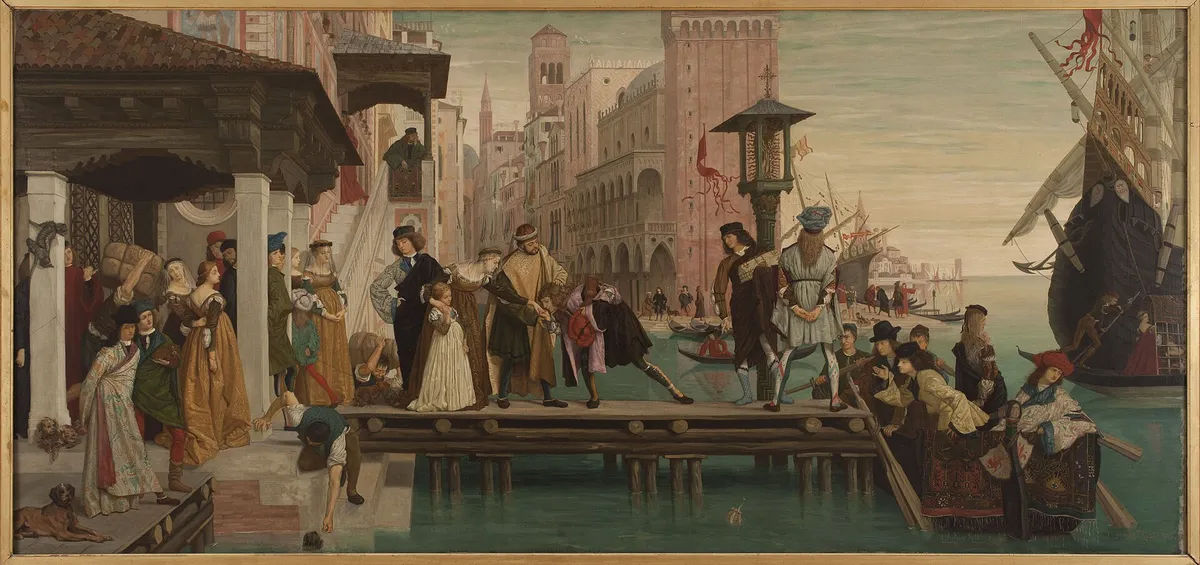
1. The Departure of the Prodigal Son in Venice by James Tissot (1863)
Few painters show the beginning of the story, when the young man still has everything. The French painter James Tissot did it twice, twenty years apart. In 1863, at the start of his career, he set the departure in a Venice of the Renaissance, in the manner of fifteenth-century Venetian painters such as Vittore Carpaccio. On a marble quay the son takes leave of his family before a waiting boat, people in rich gowns watch from the steps, and the lagoon opens behind them. Nothing in the scene announces a tragedy. That is precisely the point: the son leaves in broad daylight, in fine clothes, with the full approval of the world. The painting belongs to the Petit Palais in Paris. We will meet Tissot again at the end of the story.
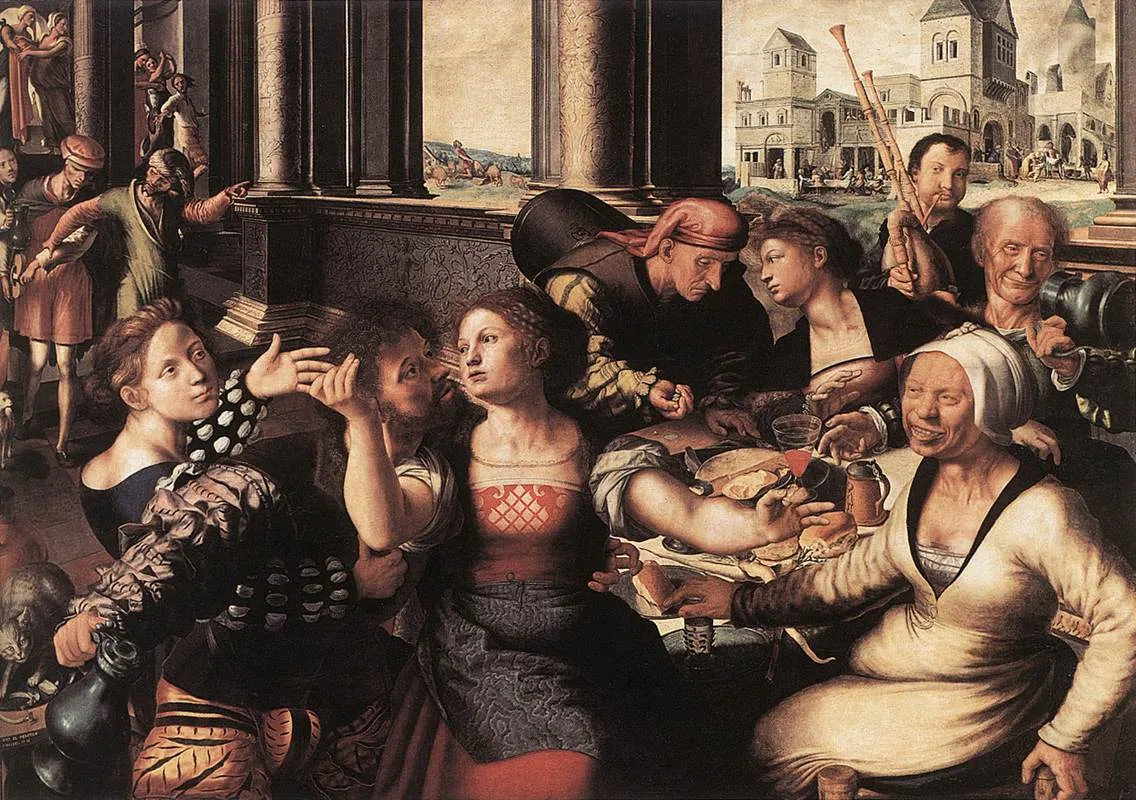
2. The Prodigal Son by Jan Sanders van Hemessen (1536)
Luke says only that the son wasted his money “with riotous living”, and the elder brother later adds that he “devoured thy living with harlots” (Luke 15:30). The Antwerp painter Jan Sanders van Hemessen took the hint and painted the biggest brothel scene of the Flemish Renaissance. In the foreground, a crowded table: the young man is caught between a pretty courtesan in a red bodice and her companions, a bagpiper plays, a servant pours wine, and an old procuress in a white headdress grins at the whole scene. Behind the columns, tiny scenes tell what follows: on the left the son is chased out with a stick, in the window he guards pigs in a bare field, and on the right he comes home to his father’s house.
The panel, now in the Royal Museums of Fine Arts of Belgium in Brussels, was a moral warning for rich merchants: the ruin of a young man is told in one glance, from pleasure to pigs.
3. The Prodigal Son in the Tavern by Rembrandt (about 1635)
This is the painting described at the top of this article, and the answer to a question many people ask: yes, Rembrandt is in a prodigal son painting. The young painter, newly married and newly rich in Amsterdam, gave his own face to the son and Saskia’s face to the woman on his knee. The tally board on the wall and the peacock pie on the table belong to the iconography of the prodigal in the tavern, a popular subject in Dutch painting. Historians still debate whether the picture is a joke at his own expense, a boast, or a sincere confession of a man who knew he loved luxury. The canvas, in the Gemaldegalerie Alte Meister in Dresden, seems to have been cut down at some point, and other figures may once have stood at the edge of the scene.
Whatever Rembrandt meant, the painting gives his life story a strange shape. The laughing prodigal of 1635 would lose Saskia in 1642, go bankrupt in 1656 and paint the son’s return at the very end of his life. The whole arc is told on our page of Rembrandt paintings.

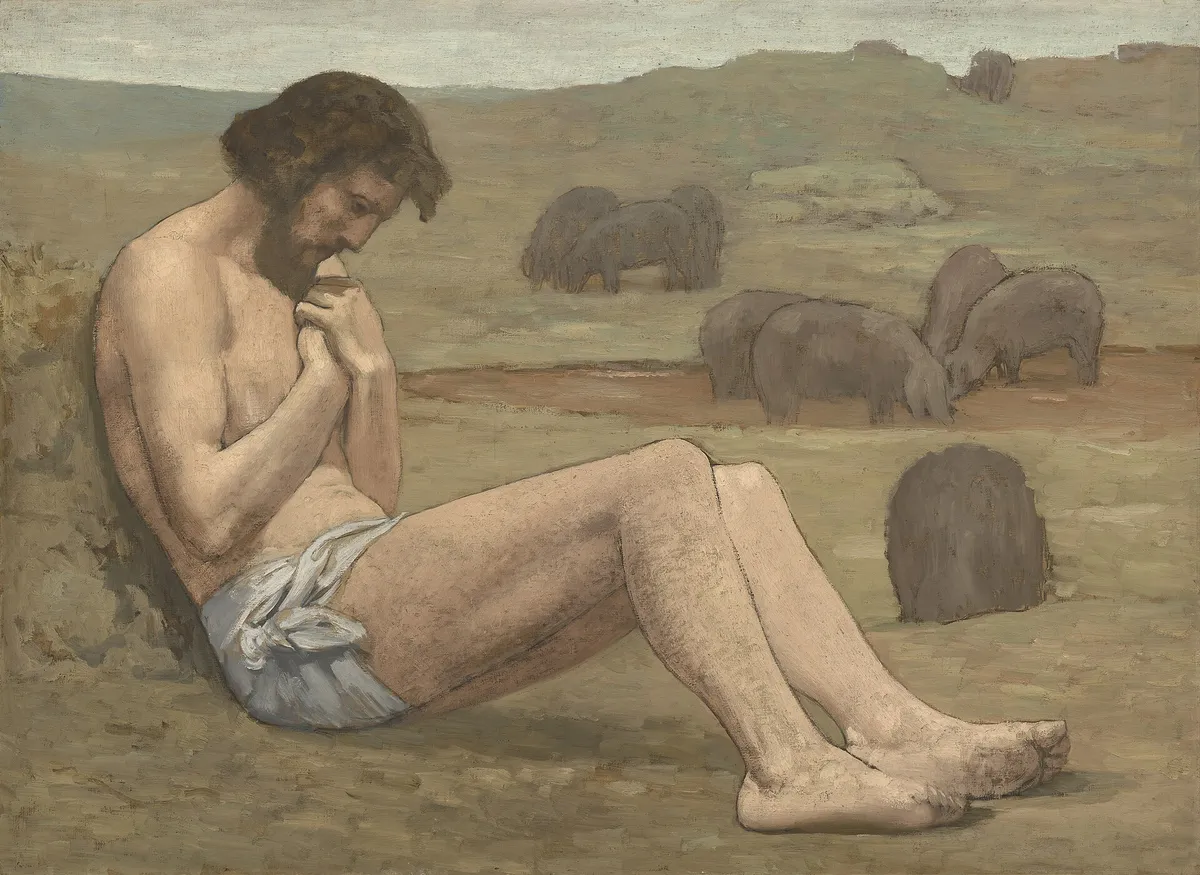
4. The Wayfarer by Hieronymus Bosch (about 1500)
Bosch’s octagonal panel in the Museum Boijmans Van Beuningen in Rotterdam was long called The Prodigal Son, and many still read it that way, although today the museum calls it The Pedlar and the identification is debated. A thin, grey man with a basket on his back walks away from a shabby inn. Look closely: a couple embrace in the doorway, a man relieves himself against the wall, a woman watches from the window, and pigs feed at a trough by the house. The traveller wears one shoe and one slipper, his leg is bandaged, and a snarling dog follows him. Yet he looks back over his shoulder, as if tempted, while the gate in front of him stands half open on the road.
The panel originally formed the outer wings of a triptych whose inner panels included the Ship of Fools, now in the Louvre. Whether he is the prodigal or every sinner on the road of life, Bosch’s wanderer is caught at the moment of choice: back to the inn, or on through the gate. More of his strange visions are gathered in the strange religious paintings of Hieronymus Bosch.
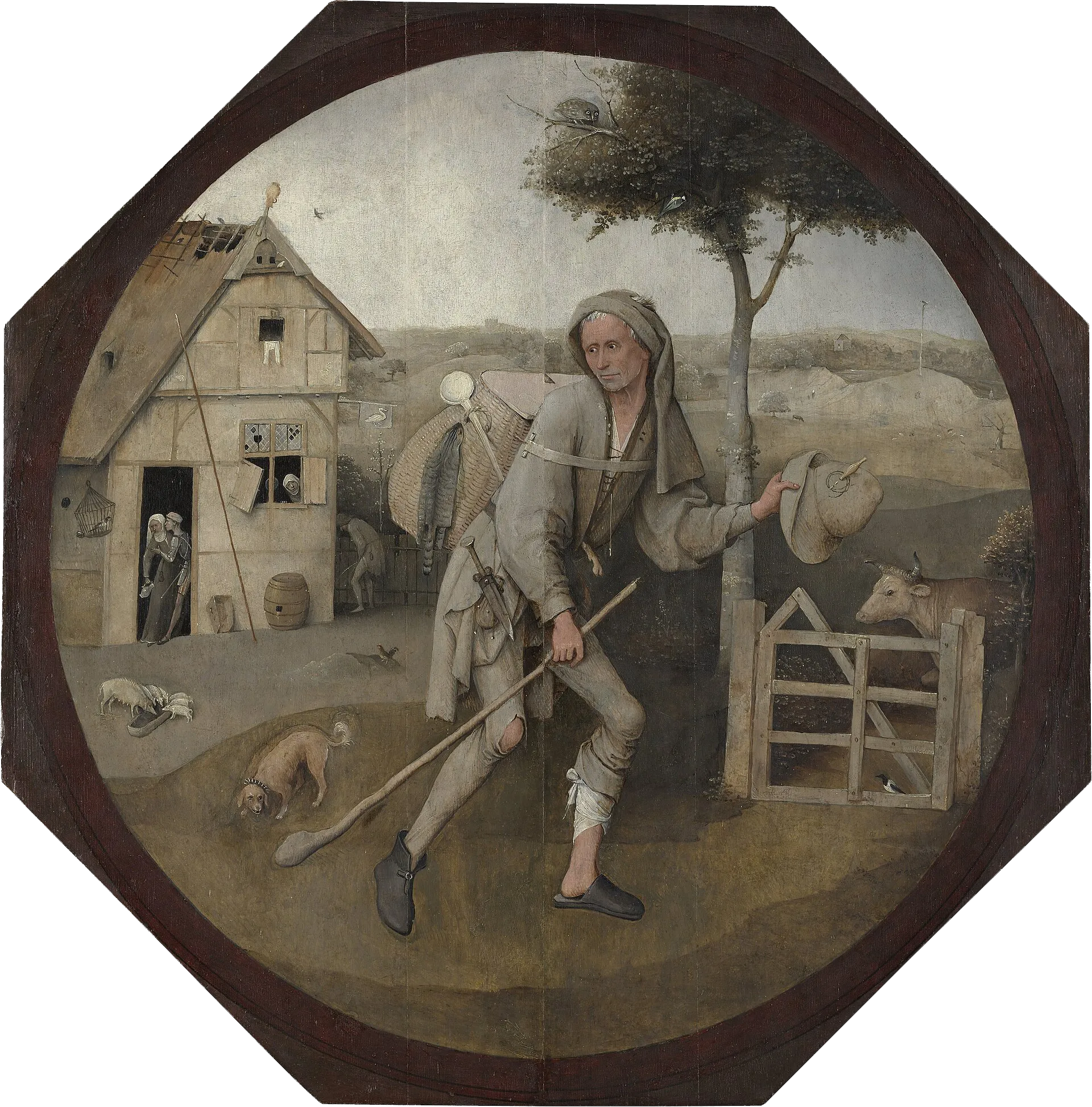
5. The Prodigal Son amid the Swine by Albrecht Durer (about 1496)
This is the only print in the selection, and it may be the most influential image of the parable ever made. Around 1496 the young Albrecht Durer engraved the son at his lowest point. He kneels in the mud of a farmyard among pigs crowding a trough, his hands joined, his face lifted to heaven: the instant when “he came to himself” (Luke 15:17). Instead of an exotic far country, Durer drew a real Franconian farm, with its sagging roofs and muddy yard, so detailed that the eye wanders through it. The engraving was sold across Europe and copied for a century; Vasari praised it in Italy. Impressions are kept in several museums, among them the National Gallery of Art in Washington.
Some scholars have seen Durer’s own features in the son’s long face and hair. True or not, it is the first great image of repentance as a private, inner event, and it prepares the inner drama of Rembrandt’s late work. The painter’s other works are on our page of Albrecht Durer paintings.
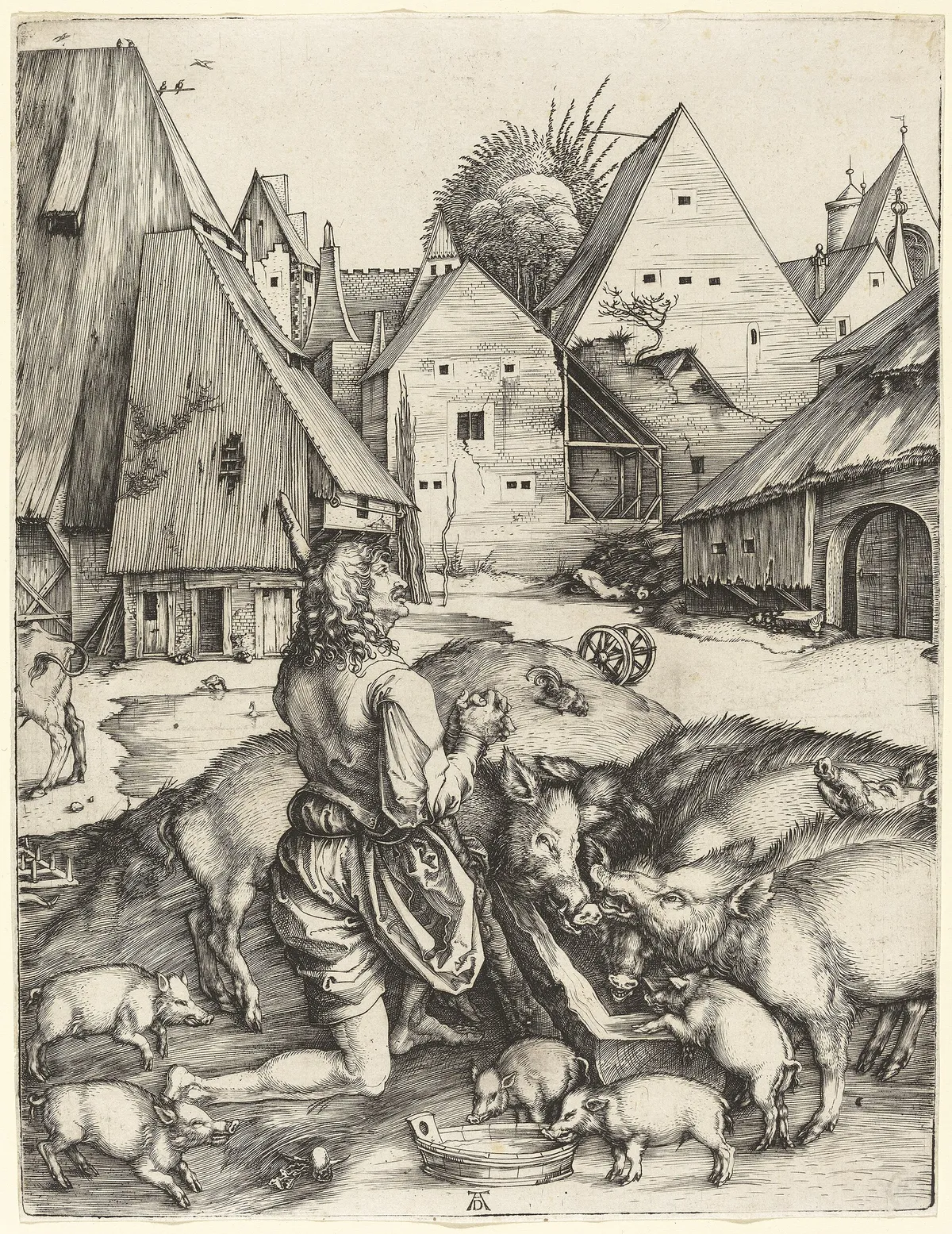
6. The Prodigal Son by Peter Paul Rubens (about 1618)
Rubens turned the same moment into a Flemish farm scene at dusk. Inside a dark barn, horses and cows stand in their stalls, tools lie on the straw, and in the right corner the prodigal, in rags, kneels beside the pigs and holds out his hand to a farm woman who is pouring their feed. Through the open door, the evening sun sets over the fields. Rubens painted animals and still life with real love, and the barn is so warm and so rich that the son’s poverty stands out all the more: everyone here has food, except him.
The painting is one of the treasures of the Royal Museum of Fine Arts Antwerp (KMSKA), in the city where Rubens lived. His more dramatic altarpieces are presented on our page of Peter Paul Rubens paintings.
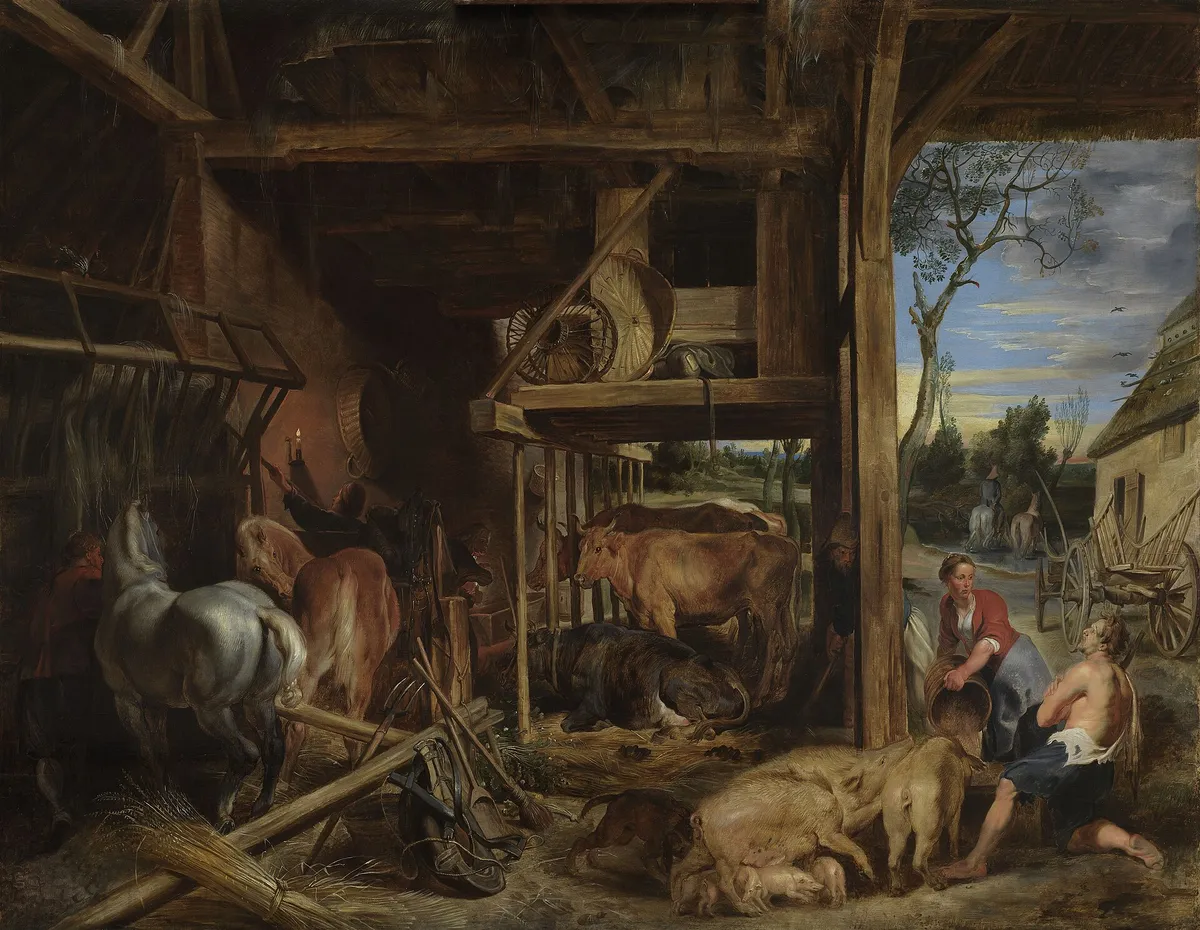
7. The Prodigal Son by Pierre Puvis de Chavannes (about 1879)
After the crowd and the clutter of the Flemish masters, Puvis de Chavannes empties the picture. The French muralist, admired by Gauguin and the Symbolists, shows a gaunt young man sitting on the bare ground, his hands clasped, his legs stretched out on the ground, his eyes lowered. Behind him a few black pigs graze in a colourless landscape under a pale sky. There is no farm, no tavern, no story around him, only hunger and silence. It is the most modern image of the parable before the twentieth century: the far country has become a state of mind.
Puvis painted the subject in 1879; one version belongs to the Bührle collection in Zurich, and the smaller one reproduced here is in the National Gallery of Art in Washington.
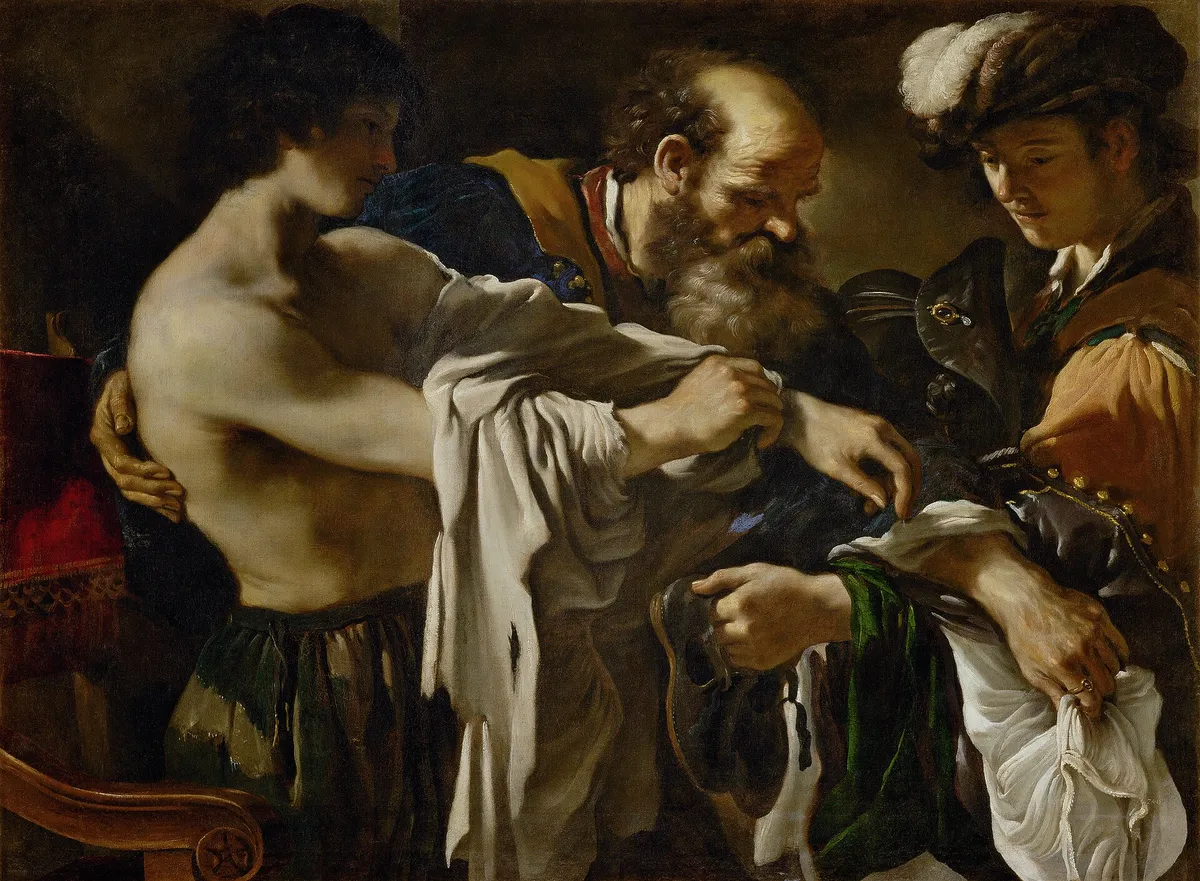
8. The Return of the Prodigal Son by Guercino (about 1619)
Most painters show the embrace. The young Guercino, around 1619, chose the next moment, when the father has already forgiven and the household gets to work: “Bring forth the best robe, and put it on him; and put a ring on his hand, and shoes on his feet” (Luke 15:22). The son, still half naked, pulls off his old shirt; the father, between him and a servant, reaches for the clean white linen; the servant holds out the new clothes. The three figures fill the canvas in a tight, almost physical knot, lit from the side in the manner of Caravaggio. The picture says something simple and profound: forgiveness is not only a feeling, it is a change of clothes, a dignity given back.
The painting hangs in the Kunsthistorisches Museum in Vienna. He returned to the parable several times in his career. See our page of Guercino paintings for his other works.
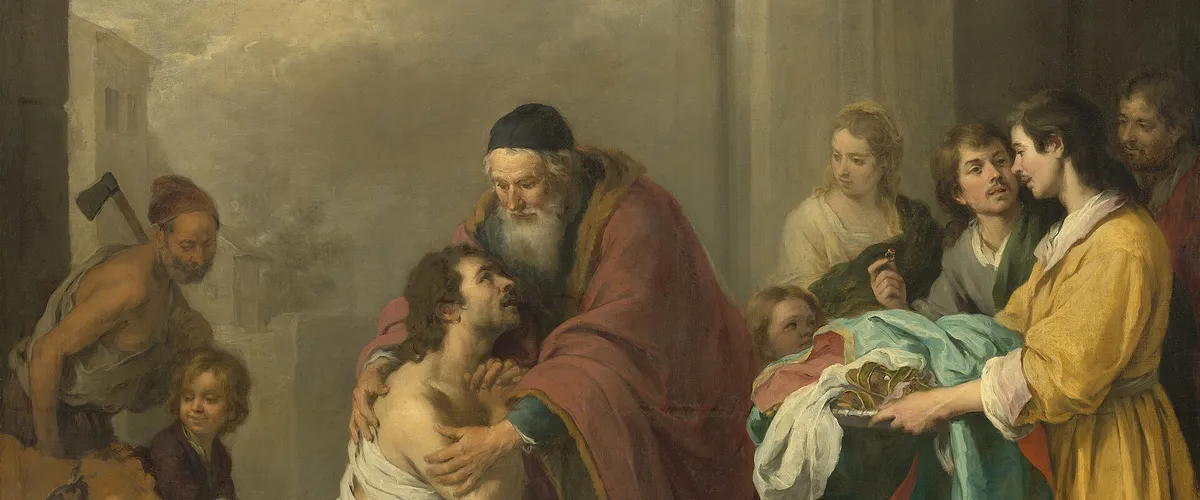
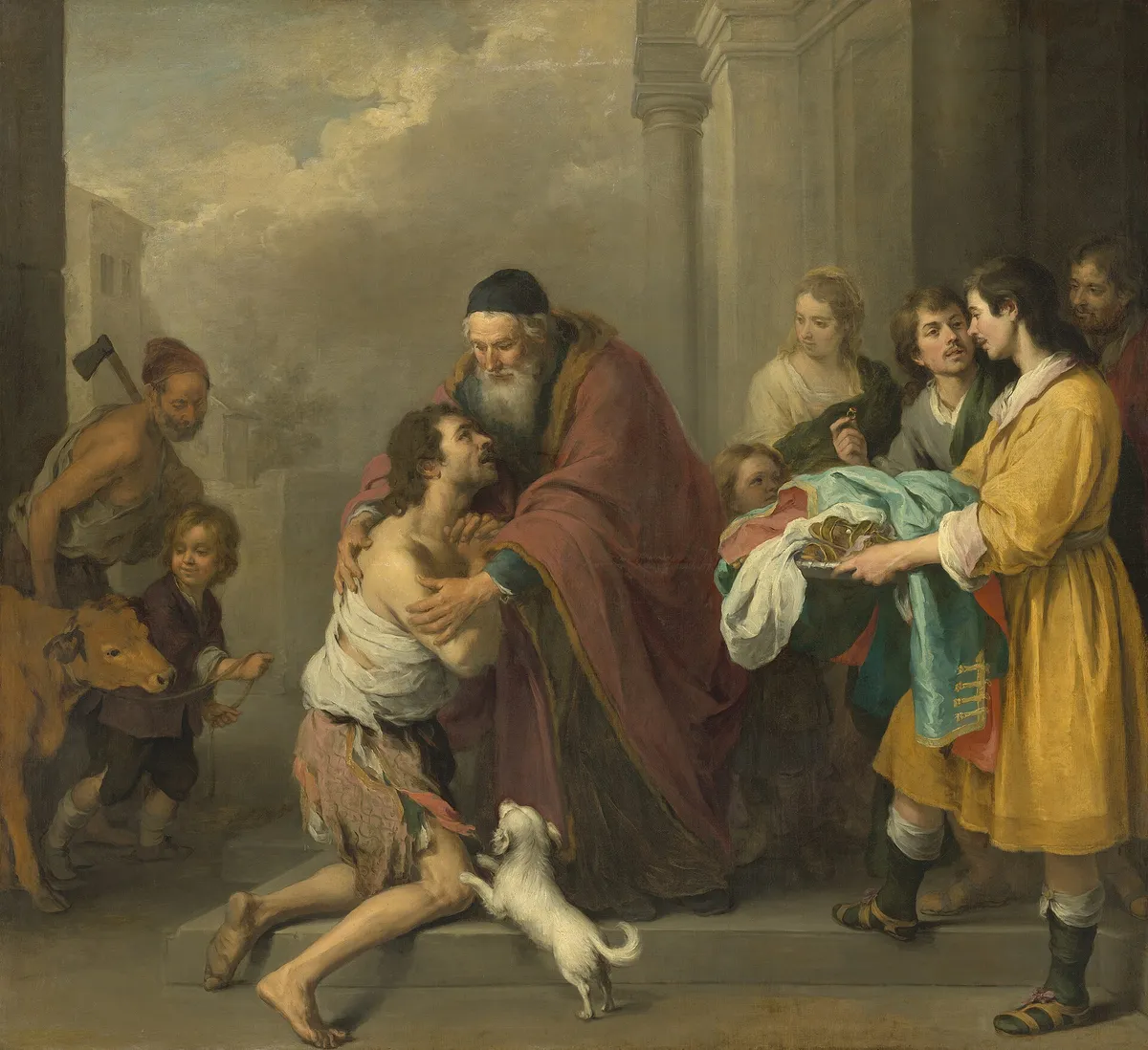
9. The Return of the Prodigal Son by Bartolome Esteban Murillo (1667 to 1670)
Murillo painted the whole household rejoicing. The father, in a heavy red cloak, gathers his kneeling son in his arms; a servant brings a tray with new clothes and the ring; another leads the fatted calf, an axe on his shoulder; children look on, and a small white dog jumps up at the son’s legs, the only one who recognises him at once. It is a picture of welcome, not of judgment.
It was painted between 1667 and 1670 for the church of the Hospital de la Caridad in Seville, a brotherhood that buried the dead and cared for the poor, as one of a series of canvases on the works of mercy. Here the subject is clothing the naked. Taken from Spain during the Napoleonic wars, the painting is now in the National Gallery of Art in Washington. Murillo’s tenderness is the subject of our page on the paintings of Bartolome Esteban Murillo.
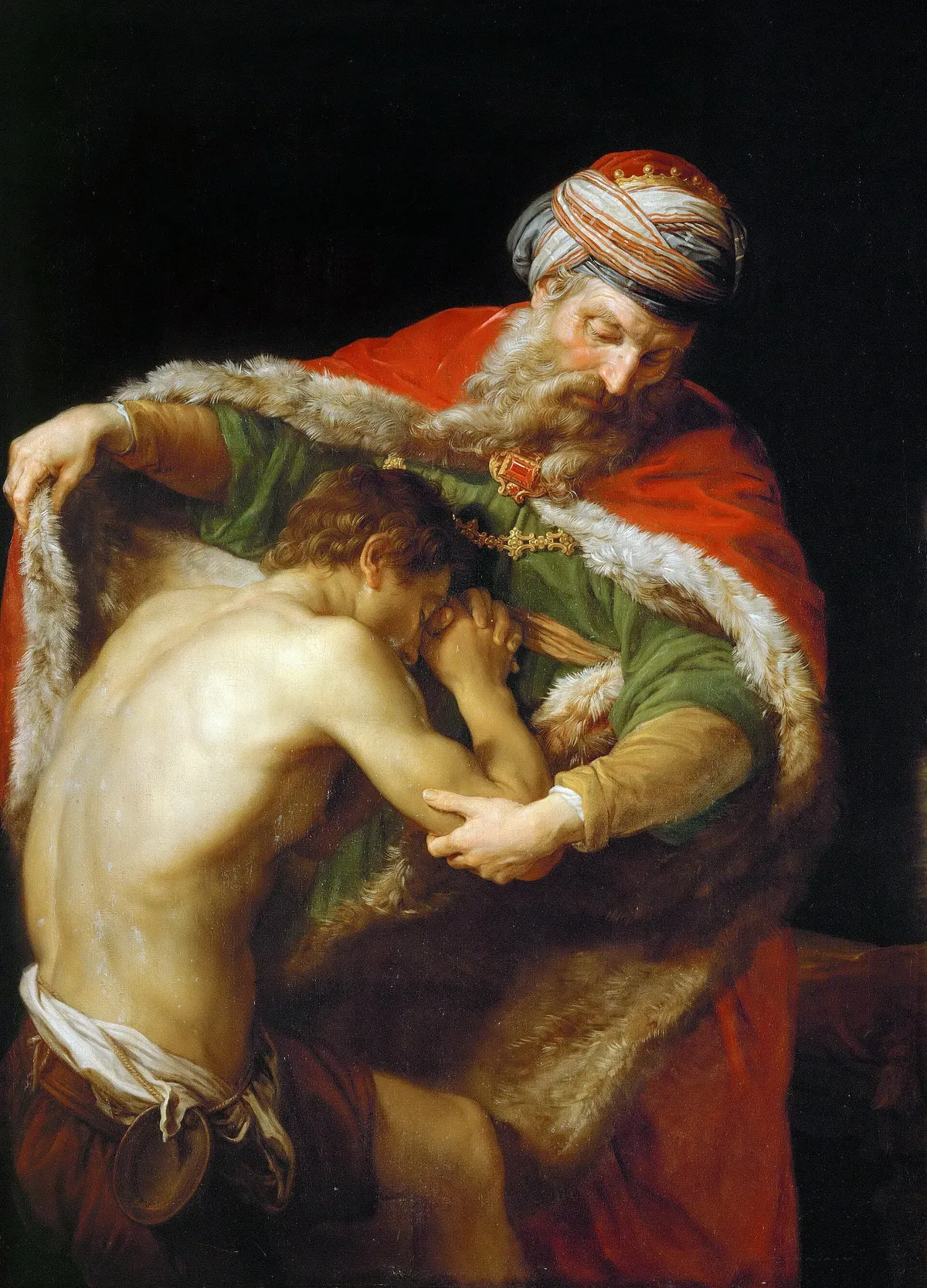
10. The Return of the Prodigal Son by Pompeo Batoni (1773)
A century later in Rome, Pompeo Batoni reduced the scene to two figures against a dark ground. The father, in a striped turban and a scarlet cloak lined with fur, bends over his son and wraps him in the cloak, as if to hide his nakedness from the world. The son buries his face in his father’s chest and weeps. There is no servant, no calf, no brother: Batoni paints only the embrace of Luke 15:20, “he fell on his neck, and kissed him.”
The painting, dated 1773 and now in the Kunsthistorisches Museum in Vienna, is one of the most moving works of the painter best known for his Sacred Heart of Jesus in the Gesu. Both are presented on our page of Pompeo Batoni paintings.
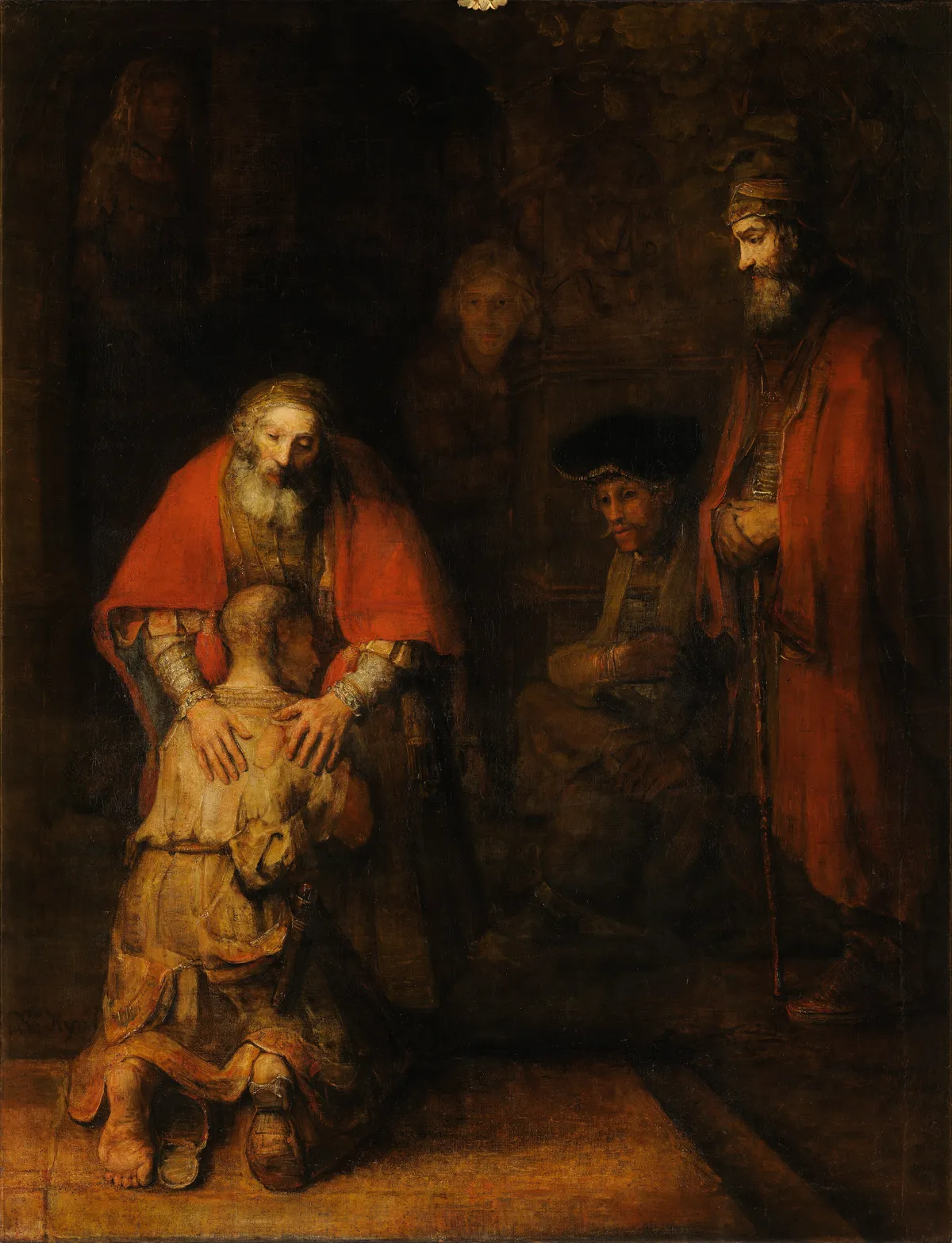
11. The Return of the Prodigal Son by Rembrandt (about 1668)
This is the prodigal son painting, the one that answers when people ask where it is: the Hermitage Museum in Saint Petersburg. Rembrandt painted it in the last years of his life. The son kneels in rags, his head shaved like a prisoner’s, one sandal fallen off. The old father, almost blind, lays his two hands on his back, and the two hands are not the same: one broad and strong, the other slender and gentle. On the right the elder brother stands upright, his hands clasped, lit like the father but separate from him. Rembrandt leaves us to wonder whether he will come in.
We have devoted a full article to it, with its details, its history and the meditation it inspired in Henri Nouwen: Rembrandt’s Return of the Prodigal Son, his last word.
12. The Prodigal Son in Modern Life: The Fatted Calf by James Tissot (1882)
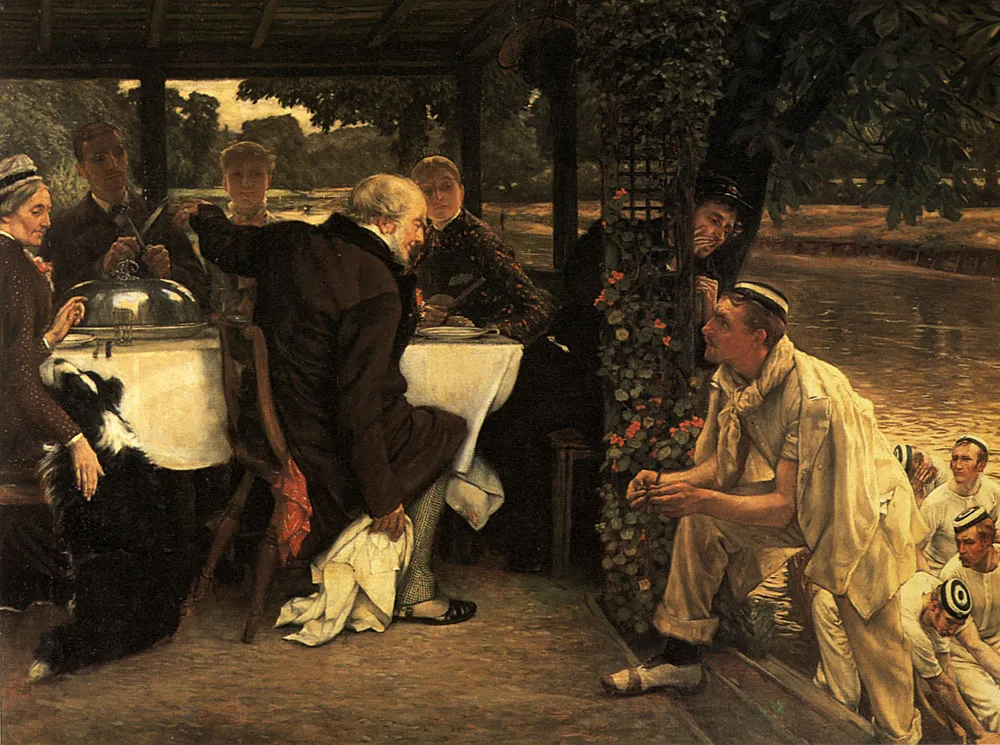
Twenty years after his Venetian departure, Tissot told the parable again, in four paintings set in his own time: The Departure, In Foreign Climes, The Return and The Fatted Calf. He had lived in London since 1871, and the story now unfolds among merchants and clerks on an English riverside. In the last painting the family celebrates the son’s return at a table under a pergola by the water. The old father has left the feast to speak with a young man who sits apart on the bank. Tissot’s etching of the same scene carries, beneath the image, the father’s answer to the elder brother: “Son, thou art ever with me, and all that I have is thine. It was meet that we should make merry, and be glad” (Luke 15:31-32).
The four paintings are in the Musee d’arts de Nantes. A few years later, in 1885, Tissot returned to the Catholic faith and spent the rest of his life illustrating the Gospels.
Summary of the Prodigal Son Paintings Featured in This Article
| Moment of the parable | Work | Artist and date | Where to see it |
|---|---|---|---|
| The departure (Luke 15:12-13) | The Departure of the Prodigal Son in Venice | James Tissot, 1863 | Petit Palais, Paris |
| Riotous living (15:13, 30) | The Prodigal Son | Jan Sanders van Hemessen, 1536 | Royal Museums of Fine Arts of Belgium, Brussels |
| Riotous living | The Prodigal Son in the Tavern | Rembrandt, about 1635 | Gemaldegalerie Alte Meister, Dresden |
| The road (reading debated) | The Wayfarer | Hieronymus Bosch, about 1500 | Museum Boijmans Van Beuningen, Rotterdam |
| Among the swine (15:15-17) | The Prodigal Son amid the Swine (engraving) | Albrecht Durer, about 1496 | National Gallery of Art, Washington, and other museums |
| Among the swine | The Prodigal Son | Peter Paul Rubens, about 1618 | KMSKA, Antwerp |
| Among the swine | The Prodigal Son | Pierre Puvis de Chavannes, about 1879 | National Gallery of Art, Washington |
| The best robe (15:22) | The Return of the Prodigal Son | Guercino, about 1619 | Kunsthistorisches Museum, Vienna |
| The welcome (15:20-23) | The Return of the Prodigal Son | Bartolome Esteban Murillo, 1667-1670 | National Gallery of Art, Washington |
| The embrace (15:20) | The Return of the Prodigal Son | Pompeo Batoni, 1773 | Kunsthistorisches Museum, Vienna |
| The embrace and the elder brother | The Return of the Prodigal Son | Rembrandt, about 1668 | Hermitage Museum, Saint Petersburg |
| The feast (15:23-32) | The Prodigal Son in Modern Life: The Fatted Calf | James Tissot, 1882 | Musee d’arts de Nantes |
What These Paintings Teach Us
Seen in order, the twelve works show how the meaning of the parable shifted with the centuries. The Flemish painters of the sixteenth century saw a warning: Hemessen’s tavern and Bosch’s inn are traps, and the pigs are the wages of folly. Durer and Rubens moved the weight to the moment of conversion, the son on his knees in the dung, discovering that he can still go home. The Baroque masters of the Catholic Reformation, Guercino, Murillo and Batoni, painted above all the father, as an image of God who runs to meet the sinner and gives back his dignity before he has finished his confession. That is why the parable is so often read beside the sacrament of confession, and why Murillo’s canvas was made for a house of mercy.
Rembrandt, at the end, gathered everything into one picture, including the figure most painters forget: the elder brother, who never left and still does not understand. The parable is read at Mass on the Saturday of the second week of Lent, and the Hermitage painting is the image of that day in our Lenten calendar: 40 days of Lent in 40 great paintings. For the other image of the God who goes looking for the lost, see our Good Shepherd paintings, and for the age that painted the return most often, our selection of Baroque Christian paintings.
Important Facts
- The parable of the prodigal son is found only in the Gospel of Luke (15:11-32), after the parables of the lost sheep and the lost coin.
- The word prodigal does not appear in the Gospel. It comes from the Latin prodigus, wasteful, through the traditional title of the parable, the son who squandered.
- Rembrandt’s Return of the Prodigal Son, about 1668, is in the Hermitage Museum in Saint Petersburg; it was bought for Catherine the Great in 1766.
- Rembrandt also painted himself as the prodigal son in the tavern, around 1635, with his wife Saskia on his knee (Dresden).
- Murillo’s Return of the Prodigal Son was painted for the Hospital de la Caridad in Seville to illustrate the work of mercy of clothing the naked.
- The Gospel of the prodigal son is read at Mass on the Saturday of the second week of Lent every year, and on the Fourth Sunday of Lent in Year C.
Frequently Asked Questions
Where is the prodigal son painting?
The most famous prodigal son painting, Rembrandt’s Return of the Prodigal Son (about 1668), is in the Hermitage Museum in Saint Petersburg, Russia. Other major versions are in Vienna (Guercino and Batoni, Kunsthistorisches Museum), Washington (Murillo, National Gallery of Art), Antwerp (Rubens) and Dresden (Rembrandt’s Prodigal Son in the Tavern).
What is the meaning of the prodigal son painting?
The paintings illustrate the parable Jesus tells in Luke 15:11-32: a son who wastes his inheritance, repents among the pigs and comes home, and a father who runs to meet him and forgives him before he can finish his confession. The father is an image of God’s mercy, the younger son of the repentant sinner, and the elder brother, who refuses to join the feast, of those who think they have earned their place.
Is Rembrandt in the prodigal son painting?
Yes. In The Prodigal Son in the Tavern, painted around 1635 and now in Dresden, Rembrandt gave his own face to the son, raising a glass, and his wife Saskia sits on his knee. In his late Return of the Prodigal Son in the Hermitage, he did not paint himself, though many viewers see in the old father something of the painter at the end of his life.
Who painted the prodigal son?
Many great artists painted the parable: Rembrandt (twice), Albrecht Durer, Hieronymus Bosch, Jan Sanders van Hemessen, Peter Paul Rubens, Guercino, Bartolome Esteban Murillo, Pompeo Batoni, Pierre Puvis de Chavannes and James Tissot, among others. Rembrandt’s Return of the Prodigal Son in the Hermitage is the best known.
How much is the prodigal son painting worth?
Rembrandt’s Return of the Prodigal Son has no market value because it belongs to the Hermitage Museum and will never be sold. Like the other versions in this article, it is part of a public collection.
Can you buy paintings by the masters of the prodigal son?
You can buy paintings by these masters at jesuschrist.pictures, in our shop, as canvas reproductions, including Rembrandt’s Christ in the Storm on the Sea of Galilee and Head of Christ, Murillo’s Immaculate Conception and Baptism of Christ, Pompeo Batoni’s Sacred Heart of Jesus and Bosch’s Christ Crowned with Thorns. Each canvas is printed on demand and shipped ready to hang.