Judith and Holofernes: The Story Behind Art’s Most Shocking Beheading
Judith and Holofernes is one of the bloodiest stories in the Bible, and one of the most painted. A beautiful widow walks alone into an enemy camp, charms the general who means to destroy her city, waits until he is drunk, and cuts off his head with his own sword. For more than five centuries painters have been drawn to that terrible, triumphant moment, from quiet Renaissance panels to the screaming violence of Caravaggio and Artemisia Gentileschi. Few subjects let an artist combine beauty, courage, seduction, and horror in a single frame.
The tale belongs to the Book of Judith, part of the Old Testament for Catholic and Orthodox Christians and counted among the apocrypha by others. It is a story of faith under siege and of a woman who saves her people when every man around her has given up hope. This article follows that story scene by scene, and shows how the greatest painters turned it into unforgettable images. For more sacred narratives told in paint, see our guide to famous biblical masterpieces.

Who Was Judith?
The story opens in disaster. The Assyrian general Holofernes, sent by King Nebuchadnezzar to crush every nation that will not submit, has surrounded the small Jewish town of Bethulia. He seizes the springs and waits for thirst to do his work. As the elders prepare to surrender, a wealthy young widow named Judith steps forward. Devout, beautiful, and respected, she rebukes the leaders for their lack of faith and announces that she has a plan of her own.

Early painters often showed her like this serene figure by Giorgione, calm and almost gentle, the sword half hidden and the severed head already beneath her foot. Here Judith is less a killer than a symbol of virtue triumphant over tyranny. To explore this poetic Venetian master, read our article on Giorgione’s paintings.
Into the Enemy’s Tent
Judith lays aside her widow’s mourning, dresses in her finest clothes and jewels, and leaves the city gates with a single loyal maid. She crosses into the Assyrian camp and asks to see Holofernes, telling him that her people have sinned and that God will soon deliver the city into his hands. Charmed by her beauty and her words, the general invites her to a private banquet, certain he will seduce her.

Rembrandt paints this glittering, dangerous moment of waiting, Judith magnificently dressed at the feast, her face unreadable. For three days she comes and goes from the camp, lulling the guards into trusting her. To follow the great Dutch master further, read our article on Rembrandt’s paintings. On the fourth night, Holofernes drinks more than he ever has in his life, and falls into a heavy, helpless sleep.
The Beheading: Caravaggio versus Artemisia
This is the moment that obsessed the Baroque. Alone with the unconscious general, Judith takes his own great sword, prays for strength, and strikes twice at his neck. Caravaggio, in the picture at the top of this article, shows her recoiling even as she cuts, a young girl horrified by what her own hands are doing, while blood jets across the white sheets.

Then there is Artemisia Gentileschi, whose version is fiercer than any man’s. Her Judith does not flinch. She and her maid pin the thrashing general down with real physical effort and saw through his neck like workers at a hard task. Artemisia had been raped as a young woman and saw her attacker tried in a humiliating public court, and many viewers feel that history burning inside this painting. The contrast with Caravaggio is the heart of the whole subject, two geniuses, two utterly different Judiths. To discover her, read our article on Artemisia Gentileschi’s paintings, and to meet the master who shaped her style, our article on Caravaggio’s paintings.
The Escape
The deed done, the danger is far from over. Judith wraps the head in cloth and slips it into the food bag her maid has carried all along, and the two women walk calmly out of the camp as they have every night, supposedly to pray. Instead they hurry back to Bethulia and show the head to the astonished townspeople.

Andrea Mantegna captures this quiet, tense exchange, Judith dropping the head into the sack while her maid holds it open, the violence already behind them. The motif of the two women and their grim bundle became one of the most popular versions of the subject. For more of this sculptural early master, read our article on Andrea Mantegna’s paintings.

Simon Vouet turns the aftermath into something almost glamorous, his Judith glancing back over her shoulder with the sword and the head, half heroine and half pin up. To see more of the painter who brought the Baroque to France, read our article on Simon Vouet’s paintings. When the Assyrians find their leader dead and headless, they panic and flee, and Bethulia is saved.
Judith or Salome?
One confusion runs through the whole history of this subject. Judith holds a severed head, and so does another biblical woman, Salome, who asks for the head of John the Baptist on a platter. The two are easy to mix up, and painters sometimes blurred them on purpose.

This haunting figure by Sebastiano del Piombo has been called both Judith and Salome for centuries, because the artist gives almost no clue. The simple rule is this: a woman with a sword and a head is Judith, while a woman with a head on a dish is Salome. Judith is the brave widow who kills to save her people, Salome the dancing girl who kills on a whim. To follow this Venetian who worked beside Michelangelo, read our article on Sebastiano del Piombo’s paintings.
Heroine, Femme Forte, Femme Fatale
What Judith means has shifted from age to age. Medieval and Renaissance Christians saw her as a model of humility and chastity, a symbol of the Church or even of the Virgin Mary crushing evil. In Florence her image stood for the city’s defiance of tyrants.

Lucas Cranach the Elder turned her into a cool, richly dressed court lady, resting one hand on the head as calmly as on a piece of fruit, all velvet and gold against a black ground. To explore this sharp German master, read our article on Lucas Cranach the Elder’s paintings.
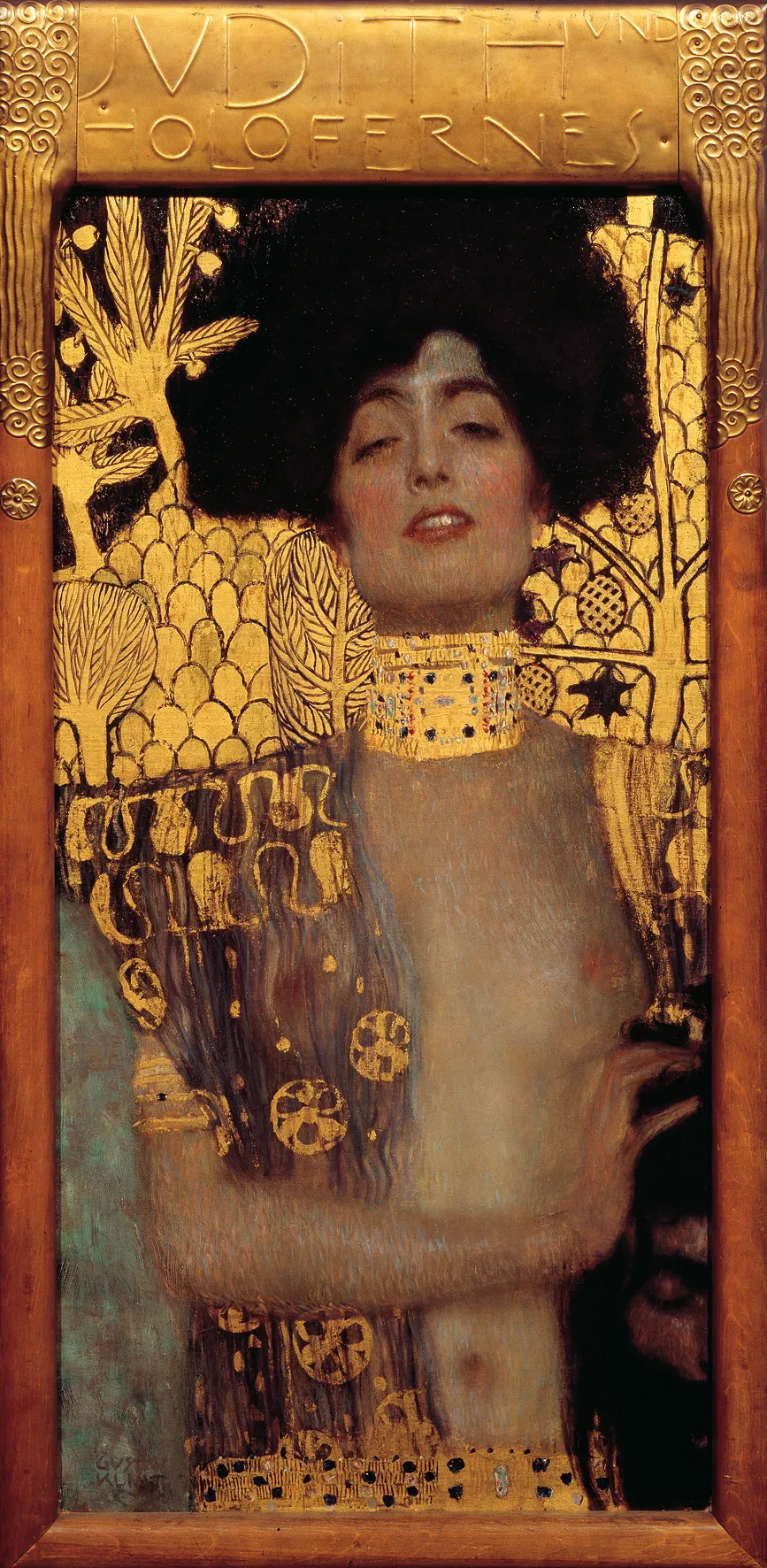
By 1901 the meaning had flipped completely. Gustav Klimt’s golden Judith is no longer a pious widow but a glittering femme fatale, eyes half closed in pleasure, the head of Holofernes pushed almost out of the frame. The heroine of faith had become an icon of dangerous desire, and that double nature, saint and seductress, is exactly why painters never let her go.
Judith and Holofernes Paintings Featured in This Article
| Painting | Artist | Date | Museum |
|---|---|---|---|
| Judith Beheading Holofernes | Caravaggio | c. 1599 | Galleria Nazionale d’Arte Antica, Rome |
| Judith | Giorgione | c. 1504 | Hermitage Museum, Saint Petersburg |
| Judith at the Banquet of Holofernes | Rembrandt | 1634 | Museo del Prado, Madrid |
| Judith Slaying Holofernes | Artemisia Gentileschi | c. 1612 | Museo di Capodimonte, Naples |
| Judith and Holofernes | Andrea Mantegna | c. 1495 | National Gallery of Art, Washington |
| Judith with the Head of Holofernes | Simon Vouet | c. 1620 | Kunsthistorisches Museum, Vienna |
| Judith (or Salome) | Sebastiano del Piombo | 1510 | National Gallery, London |
| Judith with the Head of Holofernes | Lucas Cranach the Elder | c. 1530 | Kunsthistorisches Museum, Vienna |
| Judith I | Gustav Klimt | 1901 | Belvedere, Vienna |
Conclusion
The story of Judith and Holofernes has lasted because it refuses to be simple. It is a tale of faith and of cunning, of a woman who uses the very weapons men underestimate, her beauty and her wit, to do what no soldier could. Painters returned to her again and again because she let them hold opposites in one image, the lovely and the lethal, the holy and the horrifying.
From Giorgione’s calm victor to Caravaggio’s flinching girl, from Artemisia’s unflinching avenger to Klimt’s golden seductress, every age has found the Judith it needed. That is the mark of a truly great subject. It survives every retelling and still has the power to stop us in front of the canvas, half in admiration and half in dread. For another Old Testament tale of a woman and a powerful man, read the Samson and Delilah story.
Important Facts About Judith and Holofernes in Art
- The story comes from the Book of Judith, which is part of the Catholic and Orthodox Old Testament and is regarded as apocryphal or deuterocanonical by Protestants and Jews.
- Judith is identified in art by the sword and the severed head, while a woman holding a head on a platter is instead Salome with the head of John the Baptist.
- Caravaggio painted his Judith Beheading Holofernes around 1599, and it now hangs in the Galleria Nazionale d’Arte Antica in Rome.
- Artemisia Gentileschi painted at least two versions of Judith Slaying Holofernes, the earlier in Naples and a later one in the Uffizi in Florence.
- In Renaissance Florence, Judith and Holofernes was a political symbol of the people’s resistance to tyranny, most famously in Donatello’s bronze statue.
Questions and Answers
What is the story of Judith and Holofernes?
Judith is a beautiful Jewish widow whose town, Bethulia, is besieged by the Assyrian general Holofernes. When the elders are ready to surrender, she dresses in her finest clothes, enters the enemy camp, and wins the general’s trust. At a private banquet he drinks himself into a stupor, and Judith takes his own sword and cuts off his head. She carries it back to her city in a bag, the leaderless Assyrians flee in panic, and her people are saved.
What is the meaning behind Judith beheading Holofernes?
On the surface it is a story of faith rewarded, where God works through the courage of one woman to deliver his people. Painters have read it in many ways: as a triumph of virtue over tyranny, as a symbol of a city’s resistance, and later as a study of the power and danger of female beauty. The same scene can look like holy heroism or like seduction turned deadly, which is why so many different artists were drawn to it.
Is the story of Judith true?
Most scholars treat the Book of Judith as a moral and theological tale rather than strict history, since it mixes up real and imaginary places and rulers. It is set in a stylised past to teach a lesson about faith and deliverance. For Catholic and Orthodox Christians it is part of the Bible, while Protestant and Jewish traditions place it among the apocryphal writings. Its power has always been spiritual and dramatic rather than documentary.
What is the difference between Judith and Salome in paintings?
Both are young women shown with a man’s severed head, which makes them easy to confuse. The key is the attribute. Judith carries a sword, the weapon she used, and often a maid with a sack, and she kills the tyrant Holofernes to save her people. Salome holds a platter or charger, because she received the head of John the Baptist on a dish after dancing for King Herod. Sword and head means Judith; head on a plate means Salome.
Can you buy Judith and Holofernes paintings as canvas prints?
You can buy Judith and Holofernes paintings at jesuschrist.pictures, in our shop, where the great versions are offered as high quality canvas prints. Because the subject is so dramatic, a faithful reproduction lets you bring a work like Caravaggio’s or Artemisia Gentileschi’s Judith into a home, study, or gallery wall. Browse our collection of Christian art reproductions on canvas to find a piece for your home or parish.


