Christian Symbols and Their Meanings: 40 Signs in Great Art
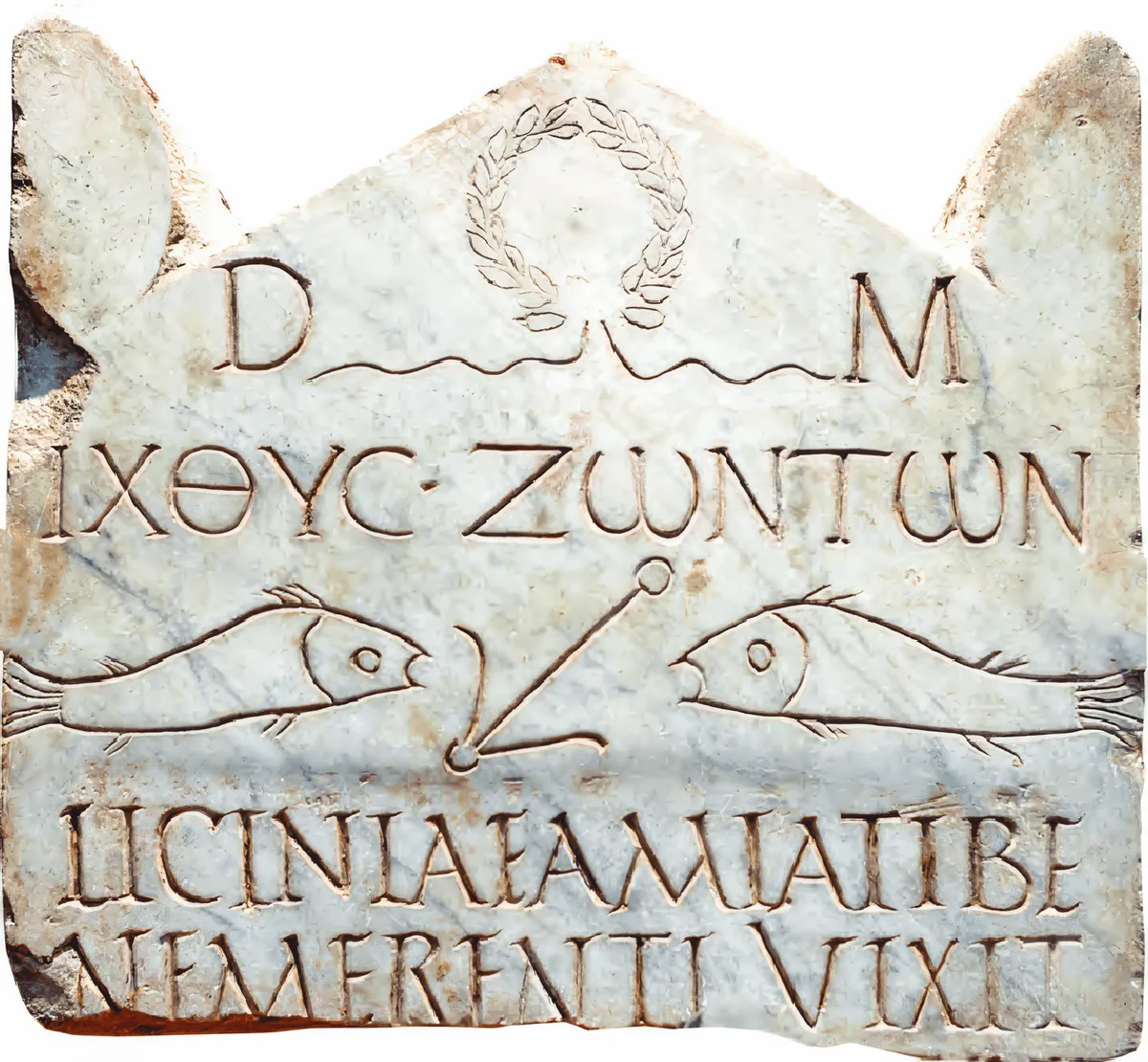
In the early third century, somewhere near the Vatican hill, a family in Rome buried a woman named Licinia Amias. Her tombstone still carries the old pagan formula of every Roman grave, D M, “to the spirits of the dead”. But under it, in Greek, the carver cut two words that no pagan would have understood: ΙΧΘΥΣ ΖΩΝΤΩΝ, “fish of the living”. Below them he drew two fish on either side of an anchor. There is no cross on the stone. The first Christians drew a fish and an anchor long before they dared to show the instrument of execution on which their Lord had died.
Christian symbols and their meanings are a language older than most of the paintings on this site, and every great painter after them learned to speak it. A peacock on a balcony, a goldfinch in a child’s hand, a skull at the foot of a cross, three letters in a burst of light: each is a word in a sentence the painter expected you to read.
This guide gathers forty of those signs, grouped by family, and shows each important one in a real work of art, from the catacombs of Rome to the Baroque ceilings of the Gesu. At the end you will find a summary table and a free coloring page of twelve symbols for children, catechism classes and anyone who wants to learn them by hand.
The Name of Christ: Fish, Anchor and Monograms
The oldest Christian symbols are not pictures of Christ but ways of writing his name. In a world where the faith could be dangerous to profess, a sign that meant nothing to outsiders and everything to believers was a confession in miniature.
1. The Ichthys, or Fish
The Greek word for fish, ichthys, spells out the first letters of a creed: Iēsous Christos Theou Huios Sōtēr, “Jesus Christ, Son of God, Saviour”. The fish also recalled the apostles called to be fishers of men, the multiplication of the loaves and fishes, and the meal the risen Christ shared on the shore of the lake. Around the year 200 the African writer Tertullian called Christians “little fishes” born in the water of baptism. The modern car-bumper fish is the same sign, drawn in two arcs.
2. The Anchor
The anchor was the Christian sign of hope, taken from the Letter to the Hebrews: “Which hope we have as an anchor of the soul, both sure and stedfast” (Hebrews 6:19). It was also a discreet cross, its crossbar hidden in plain sight, which is why it appears so often in the catacombs and on graves like that of Licinia Amias. A sailor’s tool became the promise that the soul would hold through the storm.
3. The Chi Rho
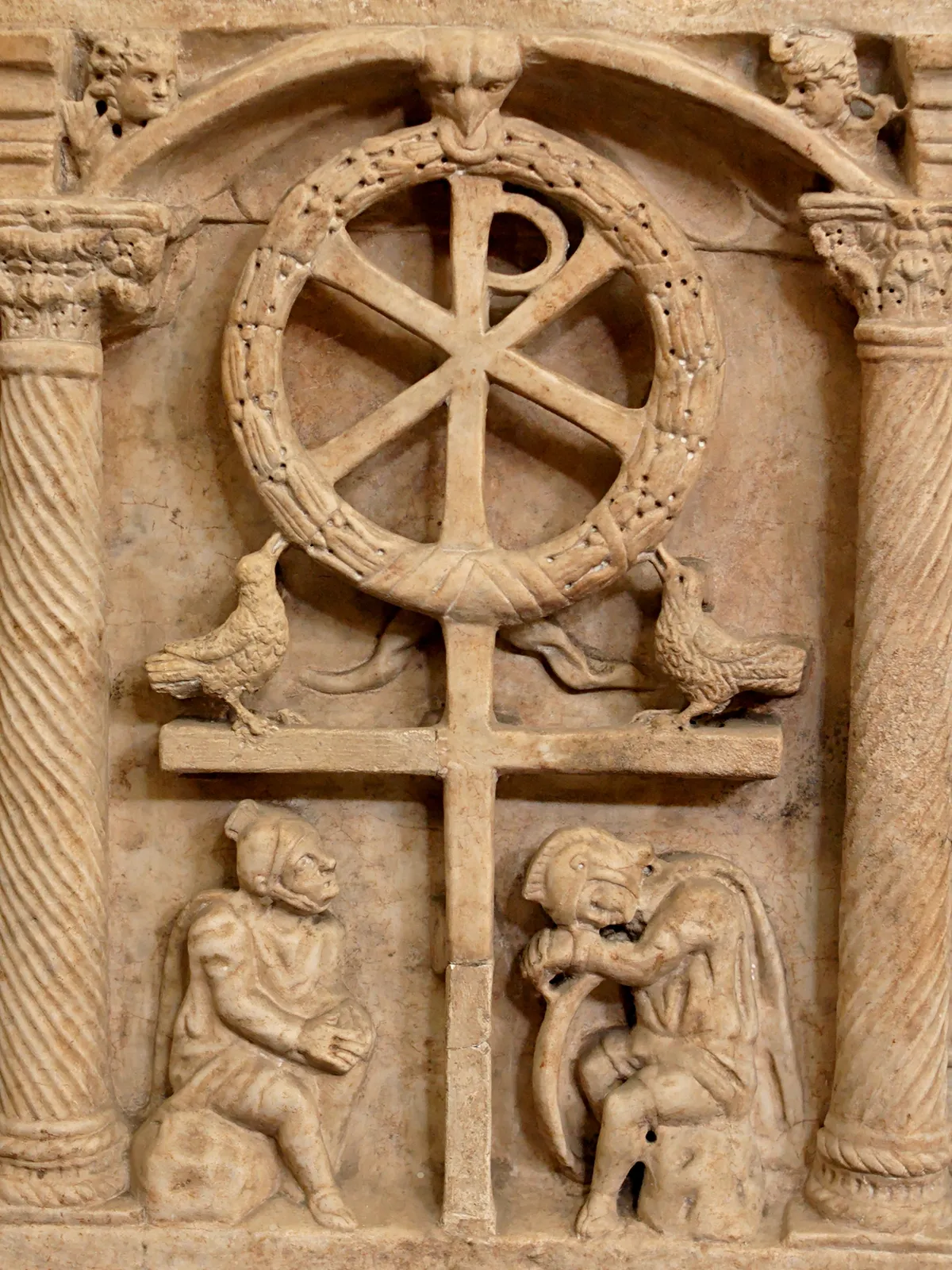
The Chi Rho joins the first two letters of Christ’s name in Greek, Χ (chi) and Ρ (rho), the P set over the X. According to the historians of his reign, the emperor Constantine had it painted on his soldiers’ shields before the battle of the Milvian Bridge in 312, and it became the standard of the Christian empire. On Roman sarcophagi of the fourth century it took the place of the risen Christ himself: set in a victor’s laurel wreath on top of a cross, with the sleeping soldiers of the tomb below, it is the Resurrection told as a sign.
4. Alpha and Omega
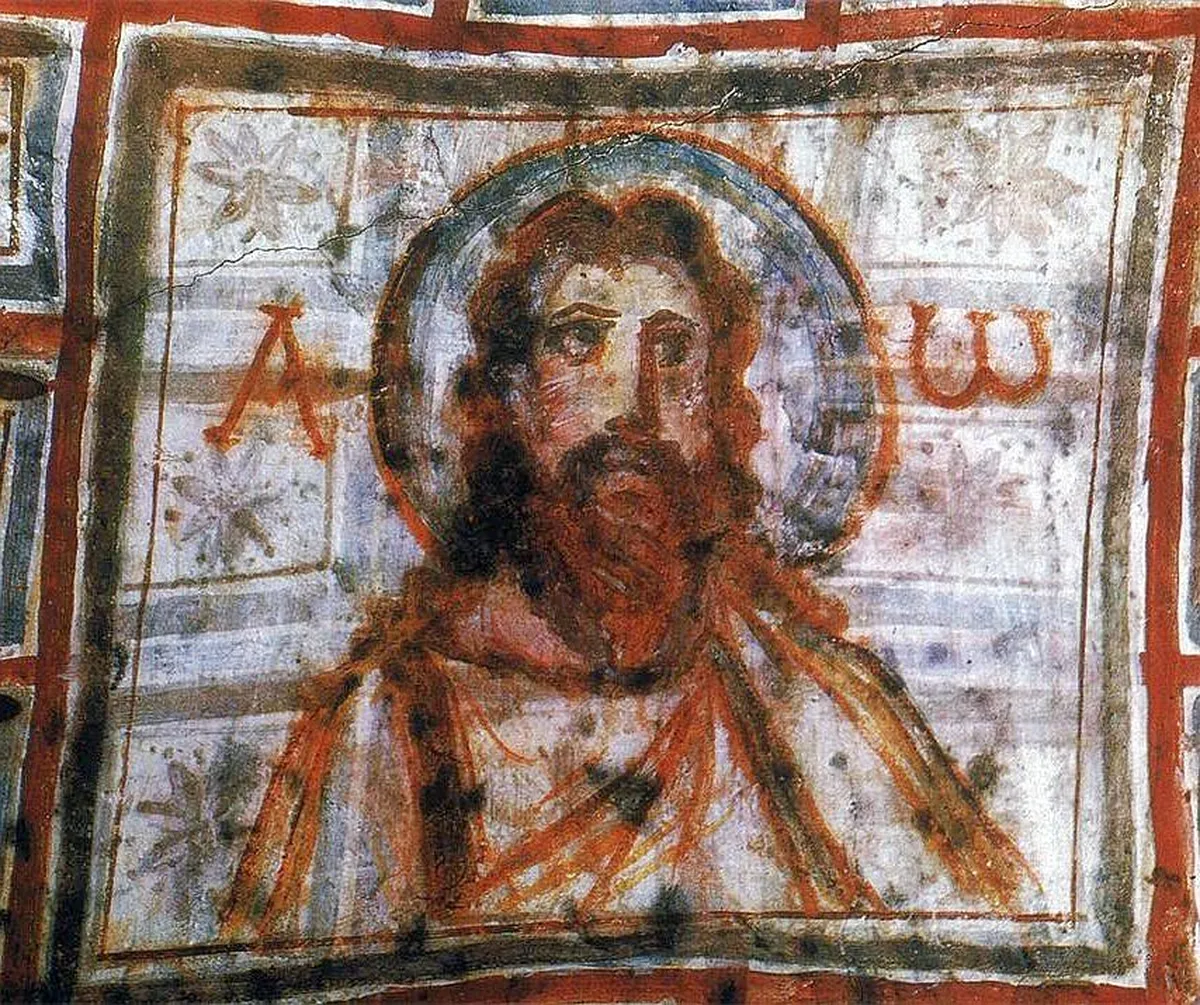
Alpha and omega are the first and last letters of the Greek alphabet. In the Book of Revelation, Christ says: “I am Alpha and Omega, the beginning and the end, the first and the last” (Revelation 22:13). Painters placed the two letters on either side of his head, under the arms of the Chi Rho, or on the Easter candle, where the priest still traces them every Easter Vigil. In the catacomb of Commodilla in Rome, one of the earliest bearded portraits of Christ, painted in the late fourth century, carries them like a signature.
5. The Staurogram
The staurogram, a Greek tau with a rho laid over it, looks like a small figure on a cross. It appears in some of the oldest manuscripts of the Gospels, around the year 200, as an abbreviation of the word for cross, and it may be one of the earliest images of the Crucifixion of all, hidden inside a word.
6. IHS, the Holy Name
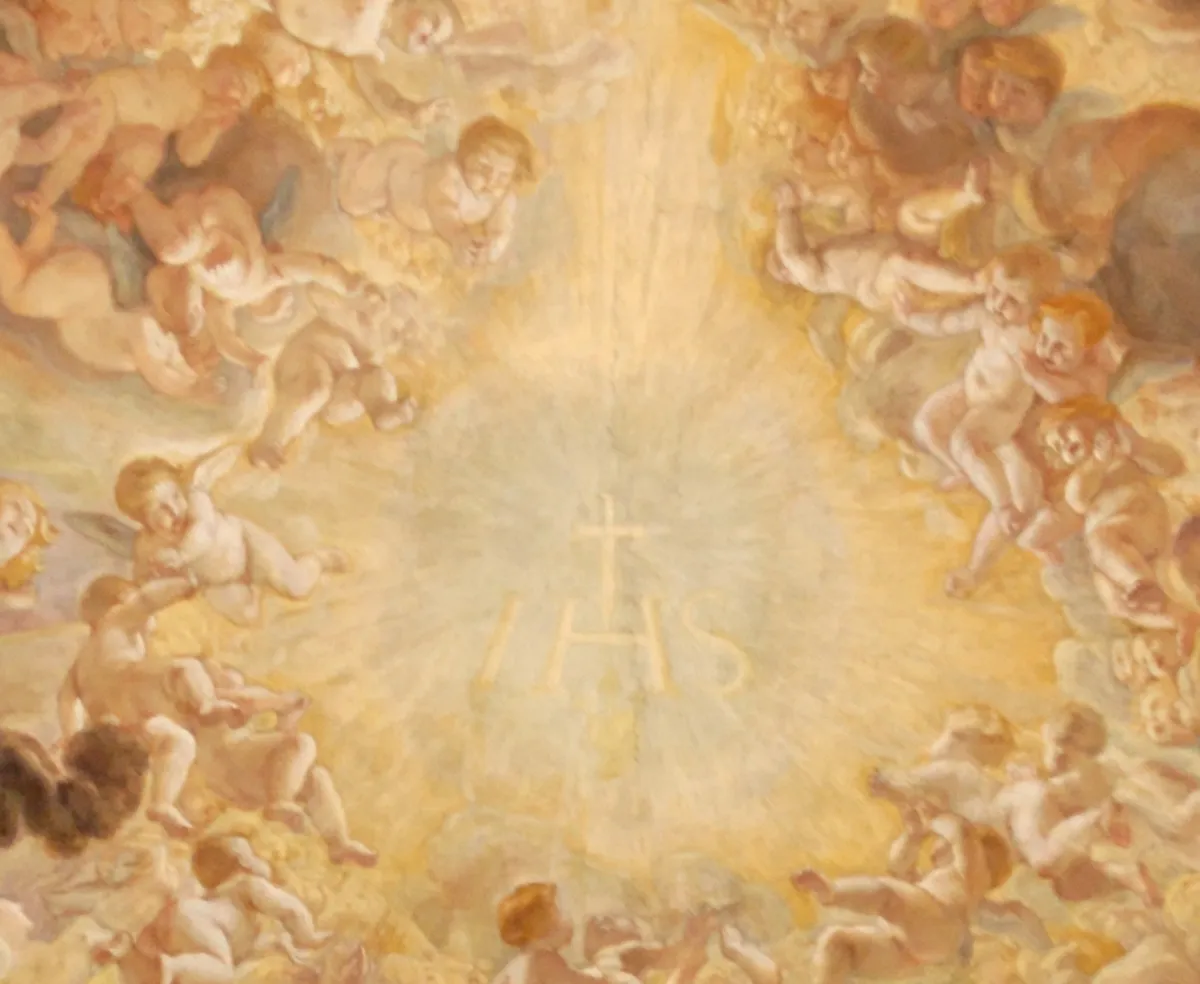
IHS is a monogram of the name of Jesus, taken from its first three letters in Greek, iota, eta and sigma. Later readers gave it Latin meanings, such as Iesus Hominum Salvator, “Jesus, Saviour of mankind”, but those came afterwards. In the fifteenth century Saint Bernardino of Siena preached holding up a tablet painted with the letters in a golden sun, and the Jesuits made it their emblem. On the ceiling of their mother church in Rome, the Gesu, Giovanni Battista Gaulli painted between 1676 and 1679 The Triumph of the Name of Jesus, in which the three letters blaze at the centre of heaven and the damned tumble out of the frame.
7. INRI
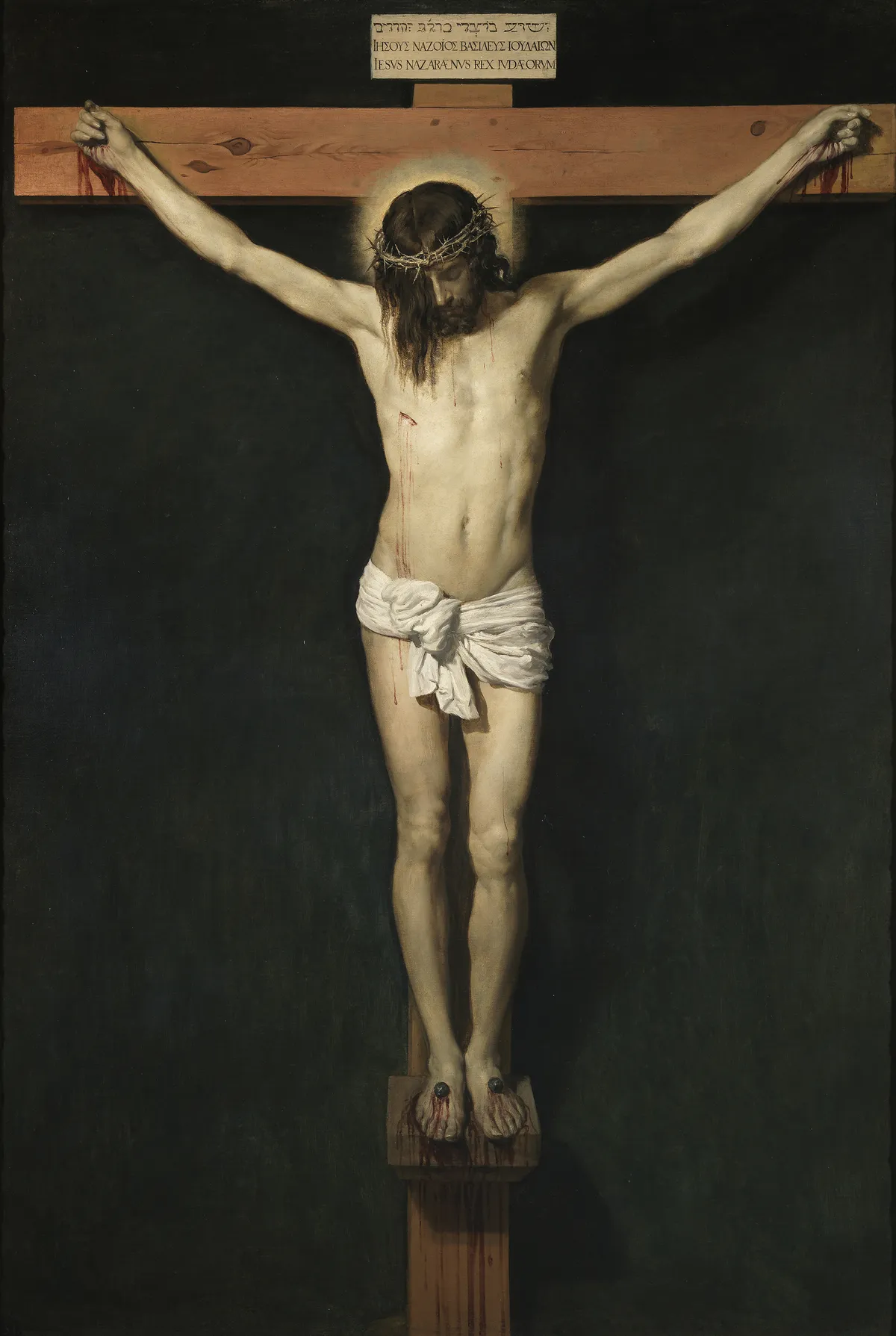
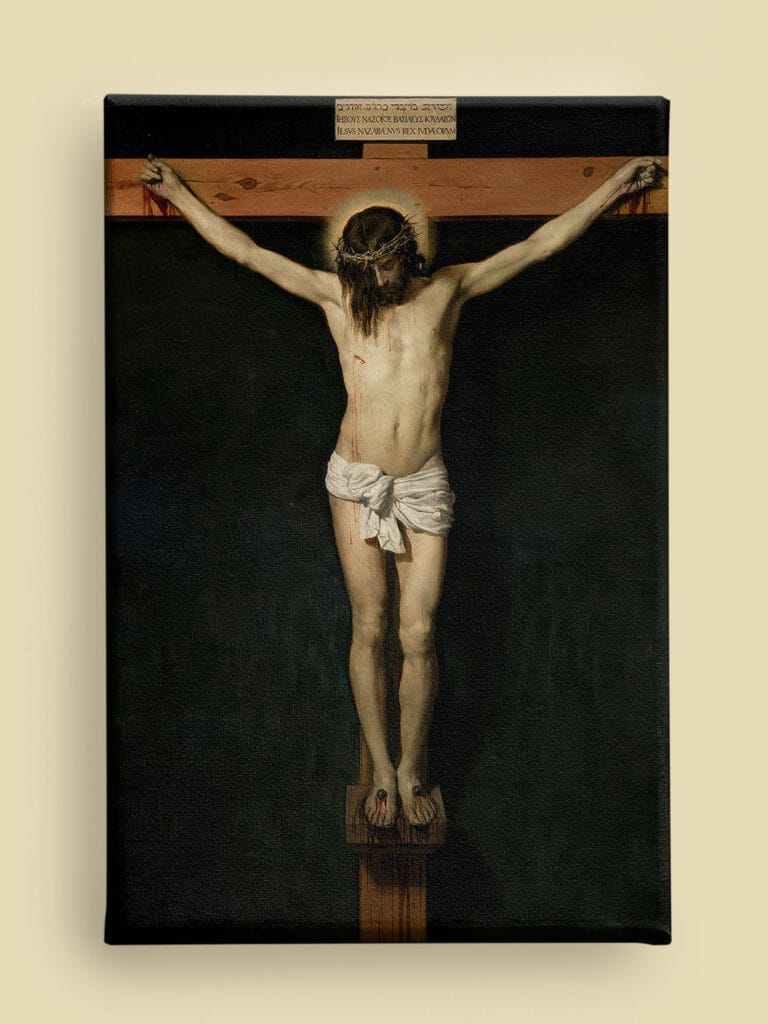
INRI stands for Iesus Nazarenus Rex Iudaeorum, “Jesus of Nazareth, King of the Jews”, the charge Pilate had nailed above the cross. Saint John adds that it “was written in Hebrew, and Greek, and Latin” (John 19:19-20), and some painters reproduced all three lines. Diego Velazquez did so in his Christ Crucified of about 1632, now in the Prado, where the title board catches the light above a body painted with four nails, feet side by side, as his teacher Francisco Pacheco had recommended. Most painters kept only the four Latin initials. More images of the cross are gathered in our selection of famous Crucifixion paintings.
8. The Cross and the Crucifix
The cross became the main Christian symbol only gradually. Before the fourth century it was usually hidden in the anchor, the mast of a ship or the Chi Rho; Christian images of the Crucifixion become common only in the fifth century, and the carved doors of Santa Sabina in Rome and a few ivories are among the earliest. The empty cross speaks of the victory of Easter, the crucifix, with the body of Christ, of the price of it. Both say the same thing from two sides.
Christ in Figures: The Lamb, the Shepherd and the Pelican
A second family of symbols shows Christ through something else: an animal, a profession, a plant. Each one condenses a passage of Scripture into an image.
9. The Lamb of God
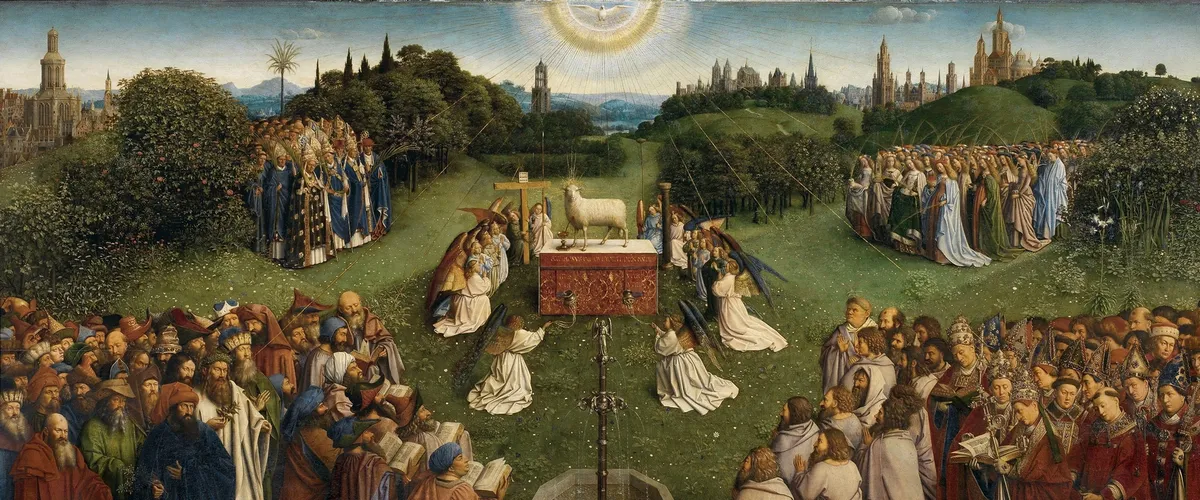
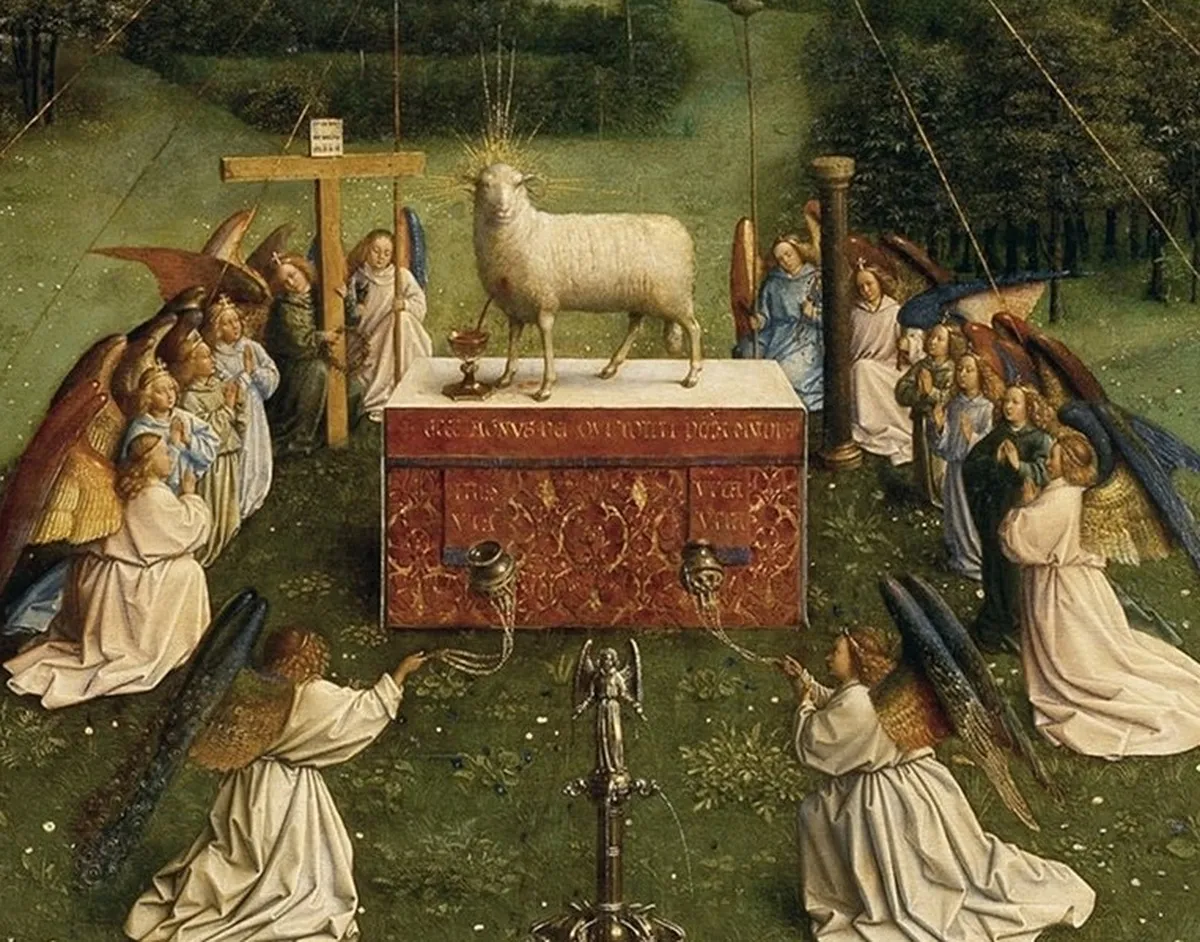
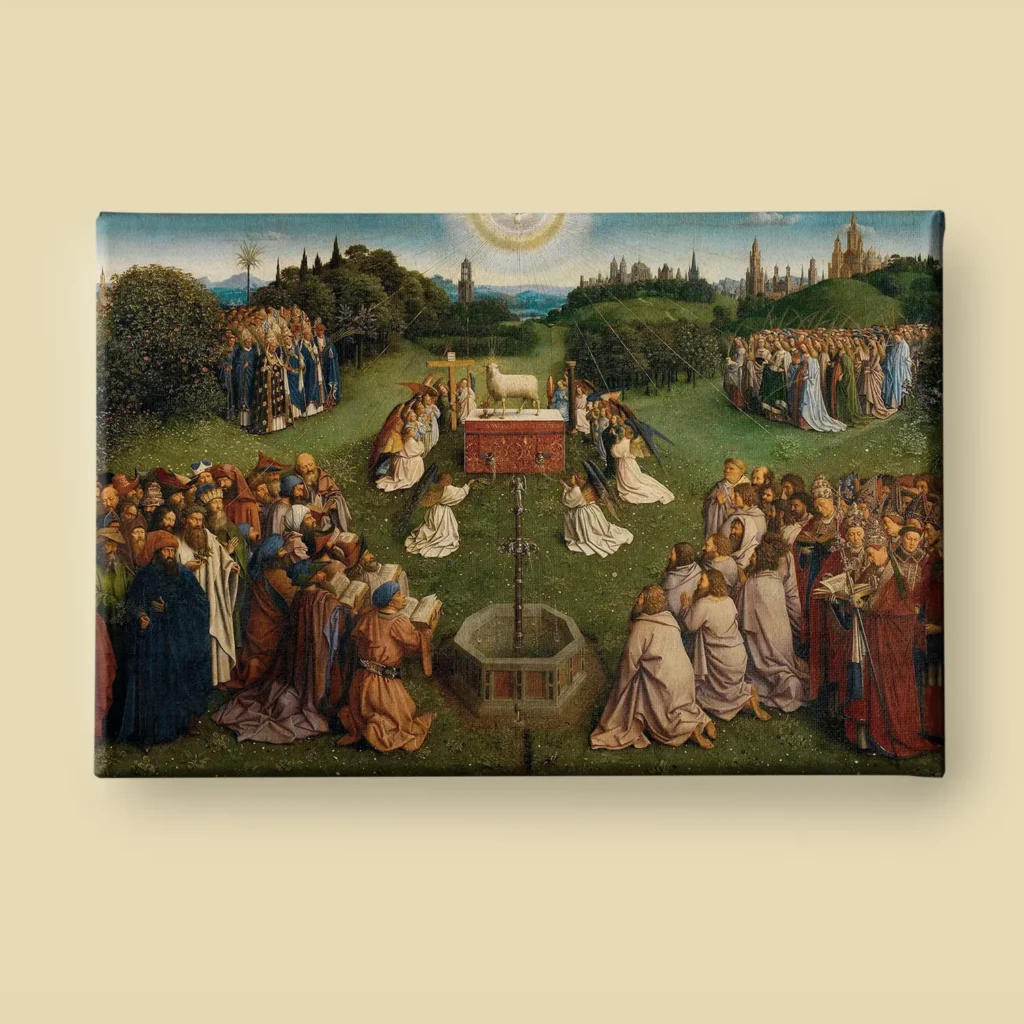
“Behold the Lamb of God, which taketh away the sin of the world” (John 1:29). The lamb recalls the Passover lamb whose blood saved Israel, and the Lamb of the Apocalypse, standing as though slain. The grandest image of it is the central panel of the Ghent Altarpiece by Hubert and Jan van Eyck, completed in 1432. The Lamb stands on an altar inscribed with John the Baptist’s words, Ecce Agnus Dei, its blood flowing into a chalice, while angels kneel around it holding the cross, the column of the flagellation and the other instruments of the Passion. Above, the dove of the Holy Spirit shines in rays of gold; below, the fountain of life flows toward the viewer. A restoration completed in 2019 uncovered the Lamb’s original face, strikingly human, which an earlier painter had covered. Our article on famous Lamb of God paintings follows the subject from Van Eyck to Zurbaran.
10. The Good Shepherd
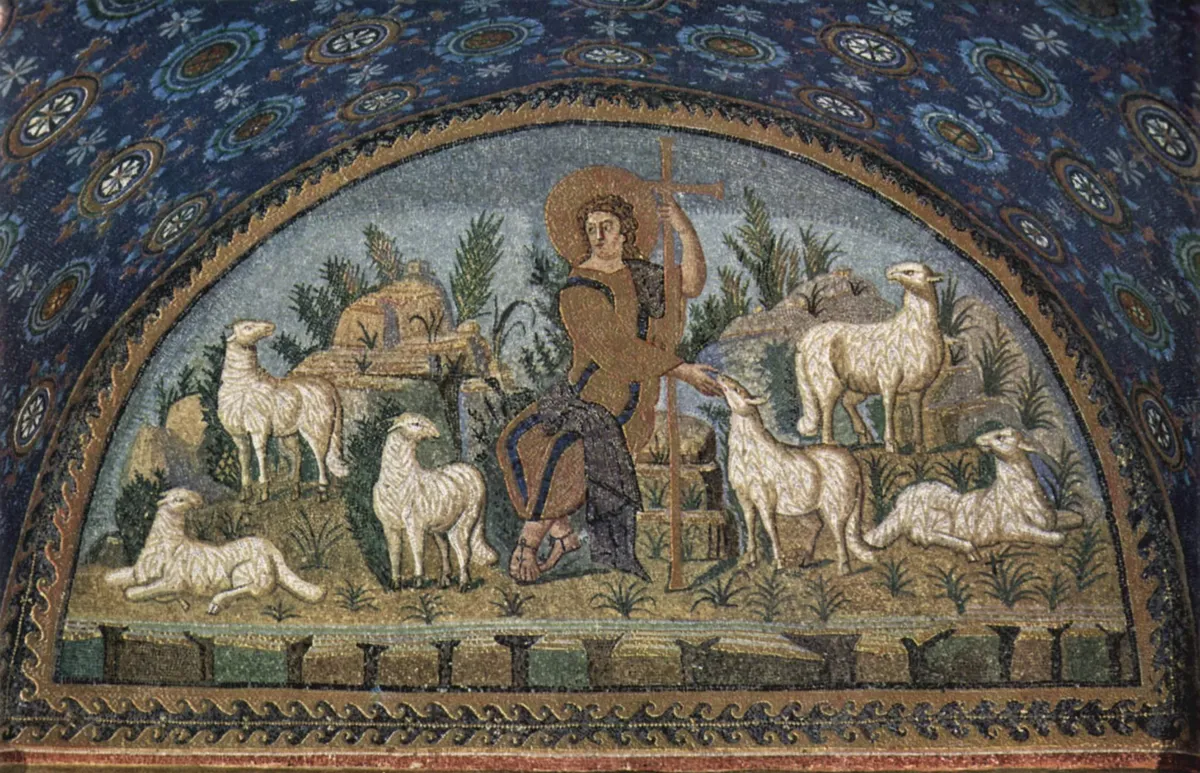
“I am the good shepherd: the good shepherd giveth his life for the sheep” (John 10:11). The young shepherd carrying a lamb on his shoulders is one of the commonest images in the catacombs, borrowed from a pagan figure and given a new meaning. In the Mausoleum of Galla Placidia in Ravenna, in the fifth century, the shepherd has become a king: dressed in gold and purple, seated among his sheep, he holds a tall cross instead of a staff. Our selection of Good Shepherd paintings shows how later painters returned to it.
11. The Pelican in Her Piety
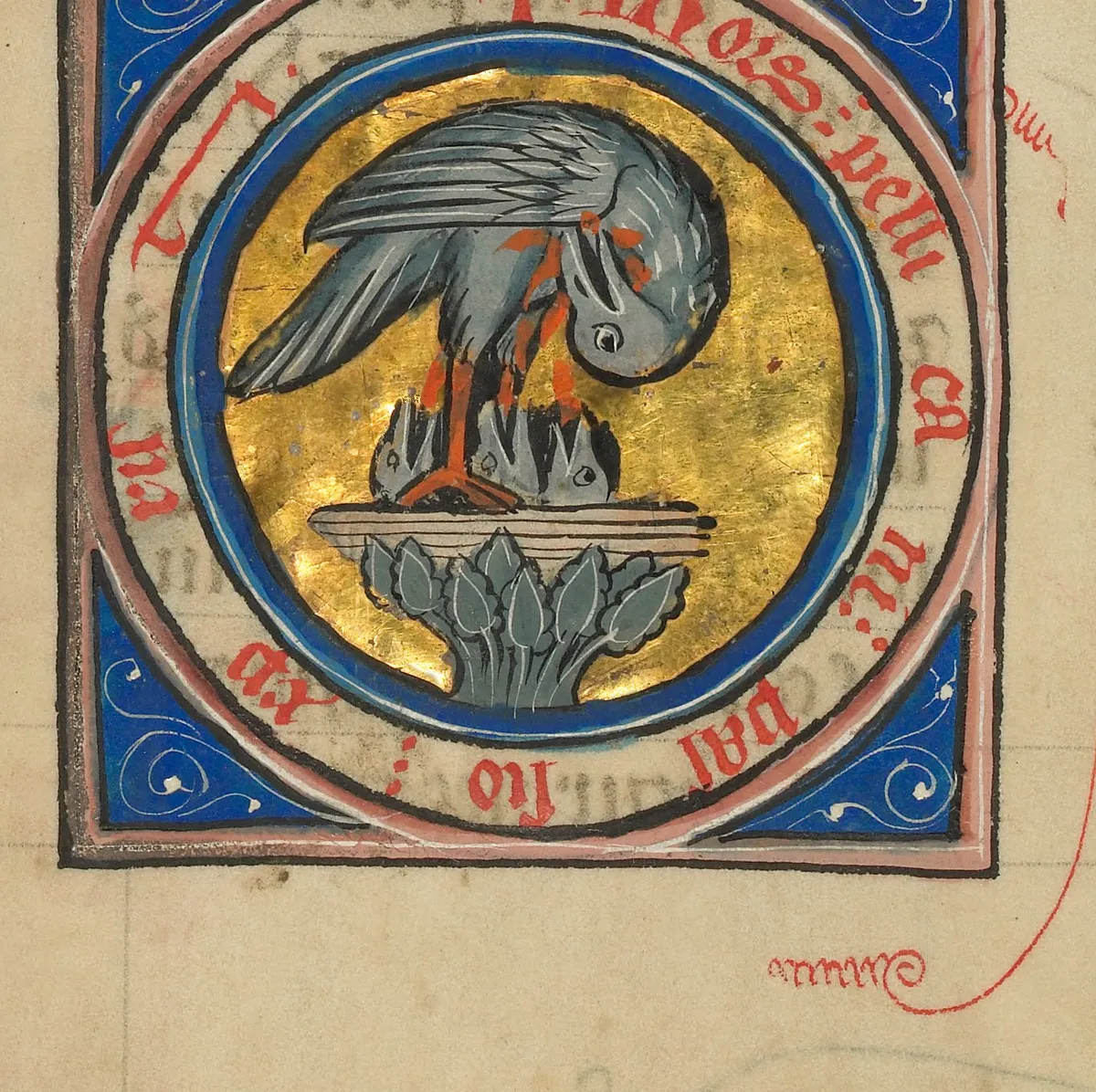
Medieval bestiaries told a strange story: the pelican’s young strike their parent, who kills them in anger, mourns them for three days, then pierces her own breast and revives them with her blood. Christians saw in it Christ, who gives his blood to bring sinners back to life, and the verse of the psalm, “I am like a pelican of the wilderness” (Psalm 102:6). Saint Thomas Aquinas addressed Christ as “Pie pelicane”, loving pelican, in his hymn to the Eucharist, and painters set the bird on top of crucifixes, on tabernacles and on altar frontals. The heraldic name is precise: a pelican “in her piety”.
12. The Phoenix
The phoenix, the mythical bird reborn from its own ashes, was used by Christians from the first century, in a letter of Pope Clement of Rome, as an image of the Resurrection. In apse mosaics it sometimes perches on a palm tree beside Christ.
13. The Lion
The lion stands for Christ as “the Lion of the tribe of Juda” (Revelation 5:5), and also for the Resurrection: according to the bestiaries, lion cubs are born lifeless and woken on the third day by their father’s roar. It is also the sign of Saint Mark, and the companion of Saint Jerome.
14. The Vine and the Grapes
“I am the vine, ye are the branches” (John 15:5). Vines climb the vaults of early churches, and a bunch of grapes, with wheat, became the sign of the Eucharist, the bread and the wine.
The Trinity and the Holy Spirit
15. The Dove
At the baptism of Jesus, the Spirit of God descended “like a dove” (Matthew 3:16). The dove is therefore the Holy Spirit in almost every Baptism, Annunciation and Pentecost, usually descending in rays of light, as above the Lamb in the Ghent Altarpiece. With an olive branch in its beak, it is the dove of Noah and the sign of peace.
16. The Triangle and the Eye of God
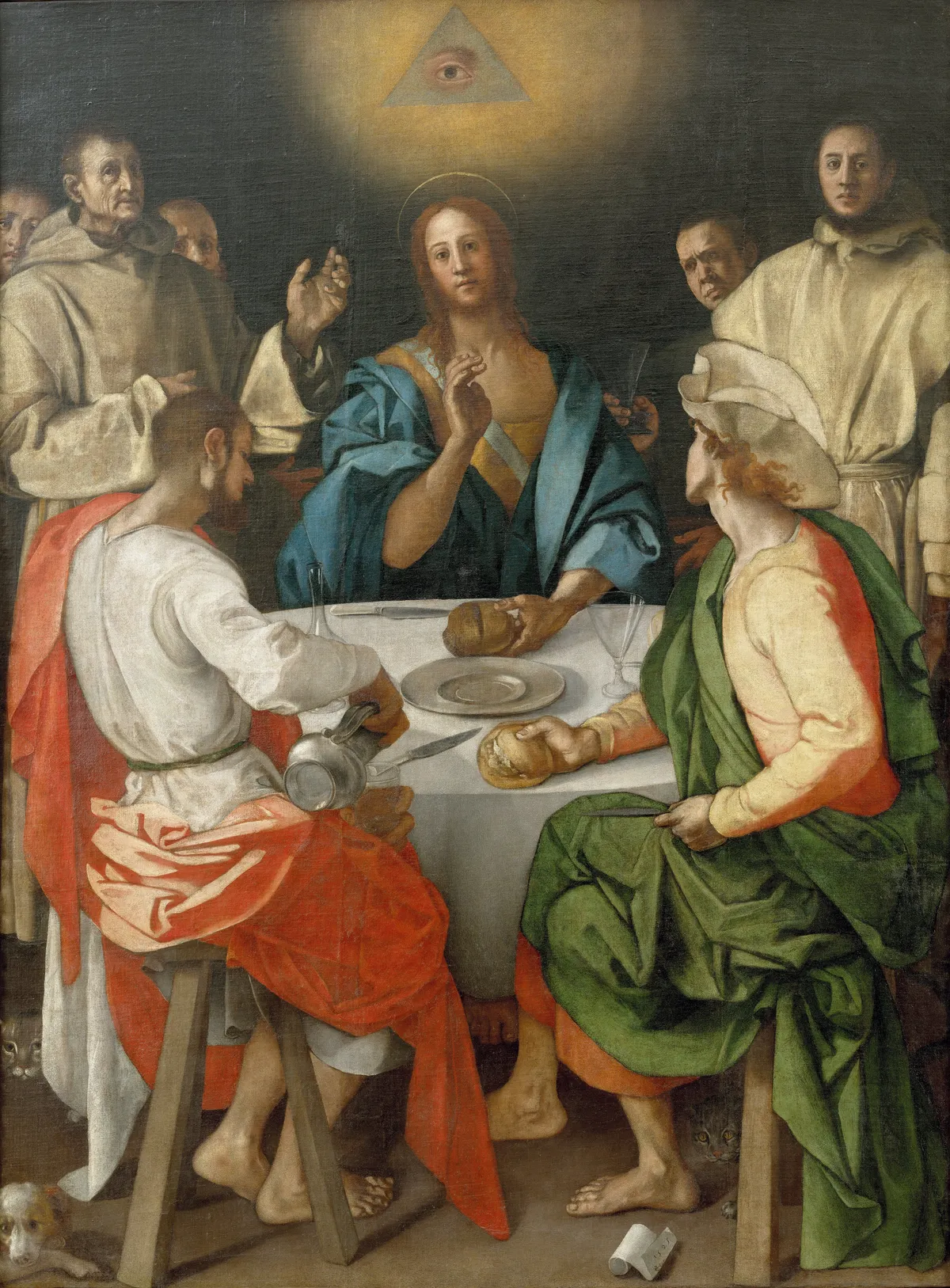
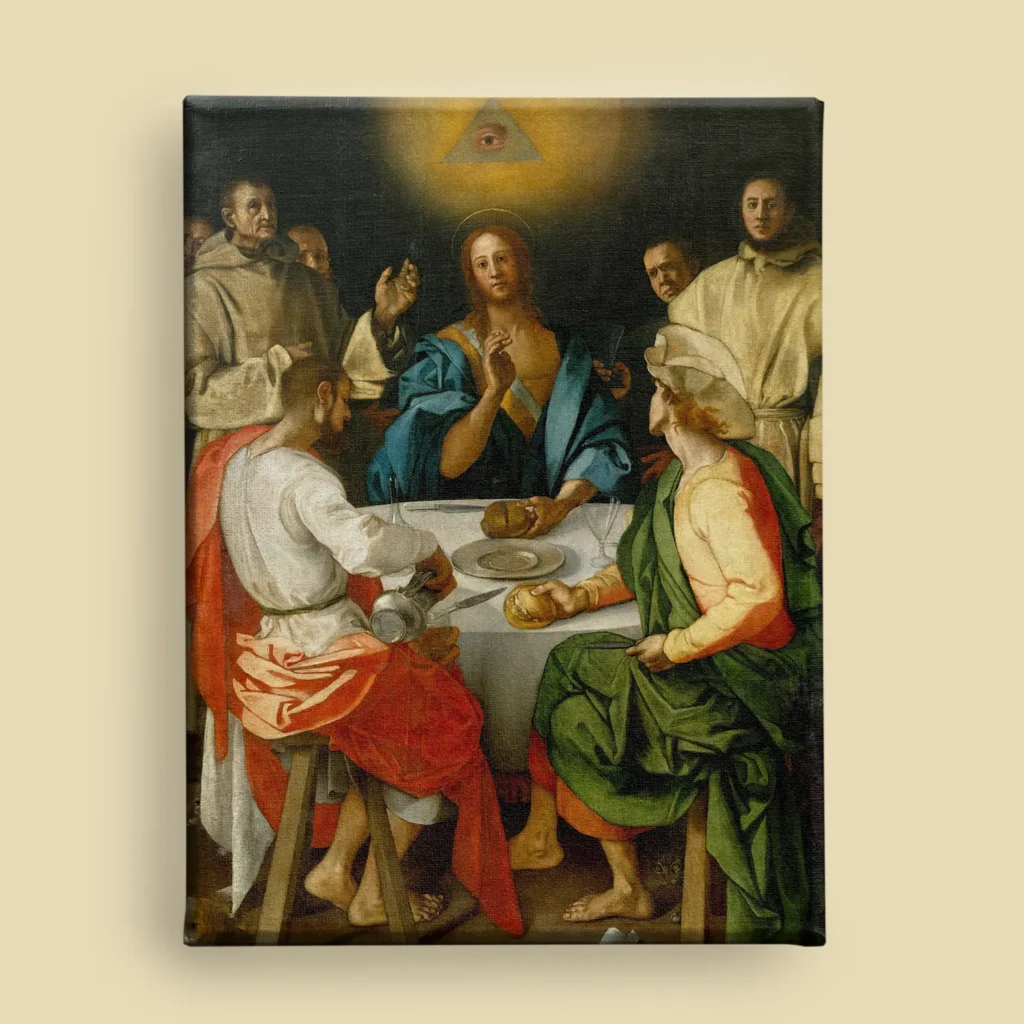
A triangle, three equal sides in one figure, is the simplest sign of the Trinity. From the Renaissance onward painters sometimes placed an eye inside it, the all-seeing eye of God. Jacopo Pontormo painted one in 1525 above the head of Christ in his Supper at Emmaus, made for the Carthusian monks of the charterhouse near Florence, who appear behind the table: the Father watches as the Son breaks the bread. The same eye later appeared on the Great Seal of the United States. More versions of the scene are gathered in our selection of Supper at Emmaus paintings.
17. The Hand of God
Before artists dared to paint the face of God the Father, they showed only a hand coming out of a cloud, blessing, crowning or stopping Abraham’s knife. The Manus Dei appears in mosaics, manuscripts and Romanesque carvings until the Renaissance.
18. The Triquetra, the Trefoil and the Shamrock
The triquetra, three interlaced arcs often woven with a circle, and the trefoil, a three-lobed leaf or arch, both stand for the Trinity in Gothic tracery and Celtic art. According to a legend recorded long after his death, Saint Patrick used a shamrock to explain how one God can be three Persons.
The Passion: Instruments, Thorns and the Sacred Heart
19. The Instruments of the Passion
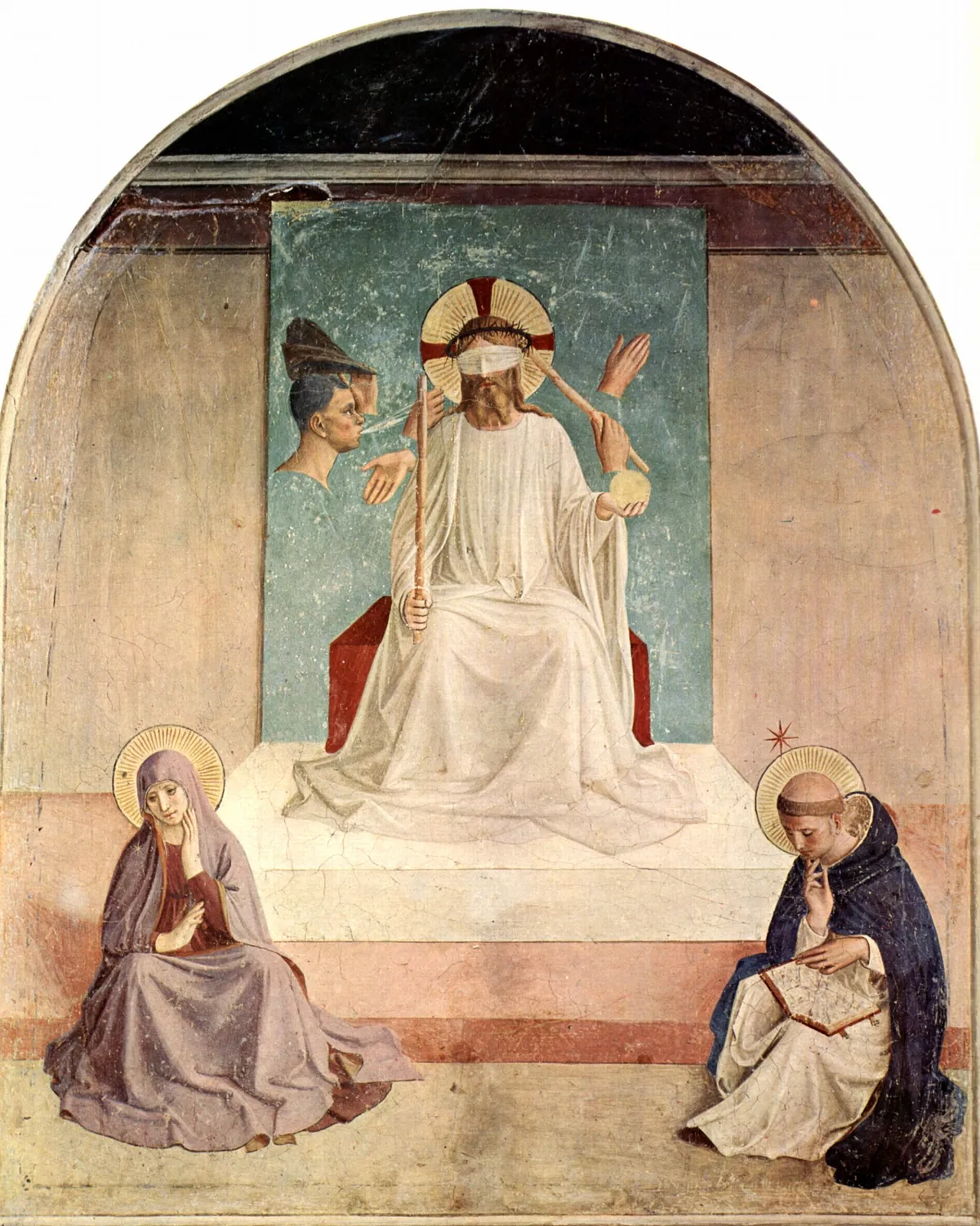
From the late Middle Ages the objects of the Passion were painted on their own, as a list to meditate on, called the Arma Christi, the “weapons of Christ”: the cross, the column and the scourges, the crown of thorns, the nails and the hammer, the lance and the sponge, the ladder, the dice of the soldiers, the purse of Judas, even the cock that crowed. In a cell of the convent of San Marco in Florence, Fra Angelico painted the mocking of Christ almost entirely in such signs: the blindfolded Christ sits on a throne, while disembodied hands slap him and a head floats in the air to spit. Below, the Virgin and Saint Dominic meditate, as the friar in the cell was meant to. More of his work is on our page of Fra Angelico paintings.
20. The Crown of Thorns
Plaited by the soldiers as a mock crown, it became a royal sign: the crown of the King who reigns from the cross. Painters set it alone on a cushion, around the Sacred Heart, or around the head of the dead Christ.
21. The Nails
Three nails or four, depending on the tradition followed: medieval painters usually show three, the feet crossed over a single nail, while some later artists, Velazquez among them, returned to four. Three nails also stand for the Trinity in some Franciscan and Jesuit emblems.
22. The Skull at the Foot of the Cross
Golgotha means “place of the skull”. A pious tradition held that Adam was buried there, so painters often put a skull, sometimes with bones, at the foot of the cross: the blood of the new Adam falls on the old one and washes him. When you see it in a Crucifixion, the painter is telling you that this death reaches back to the very first sin. Our gallery of Adam and Eve paintings tells the other half of the story.
23. The Sacred Heart
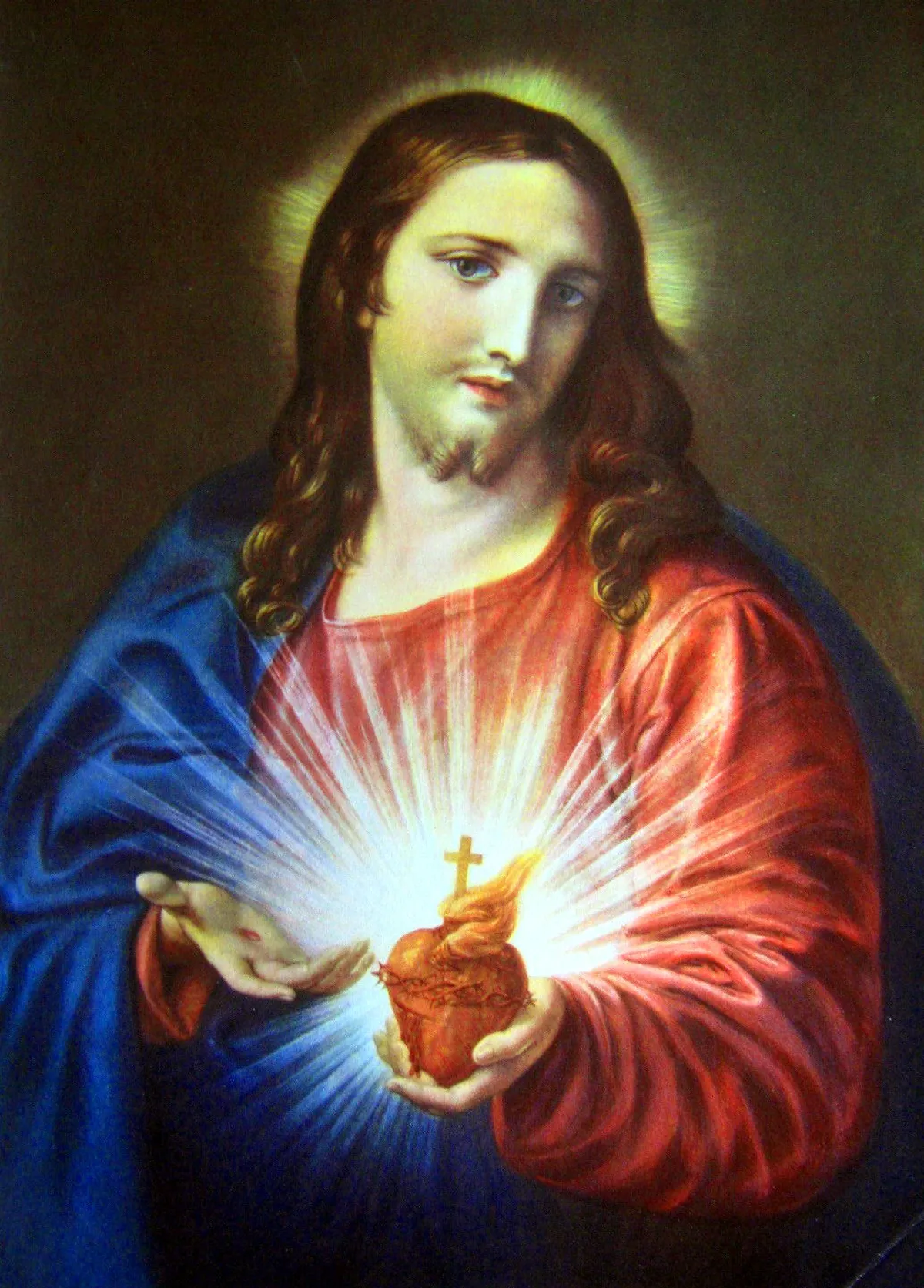
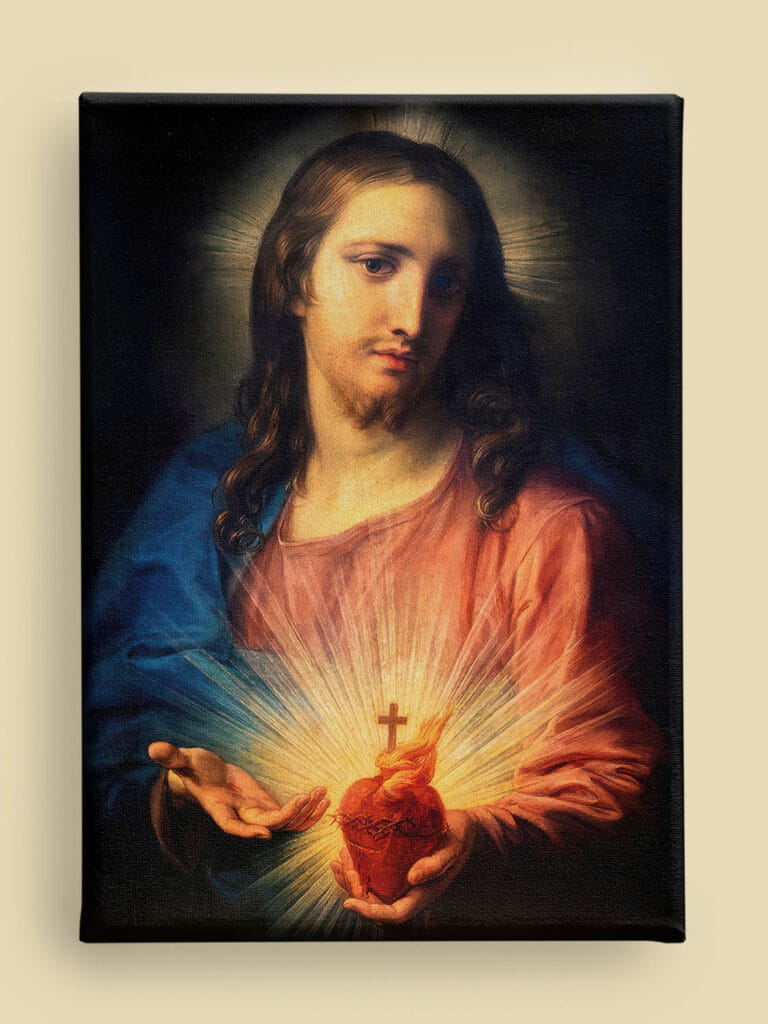
The heart of Christ, burning with love, wounded by the lance, ringed with thorns and topped with a cross, became the best known Catholic symbol of modern times after Christ appeared to Saint Margaret Mary Alacoque at Paray-le-Monial between 1673 and 1675. Pompeo Batoni fixed its image in 1767 in the painting for the Gesu in Rome, copied in millions of holy cards. Our article on the Sacred Heart of Jesus tells its history, and our page on Pompeo Batoni the painter’s.
Life, Hope and Eternity: Birds, Fruits and Flowers
Renaissance painters filled their pictures with animals, fruits and flowers that look like decoration and are not. Learning a dozen of them changes the way you see a whole museum.
24. The Peacock
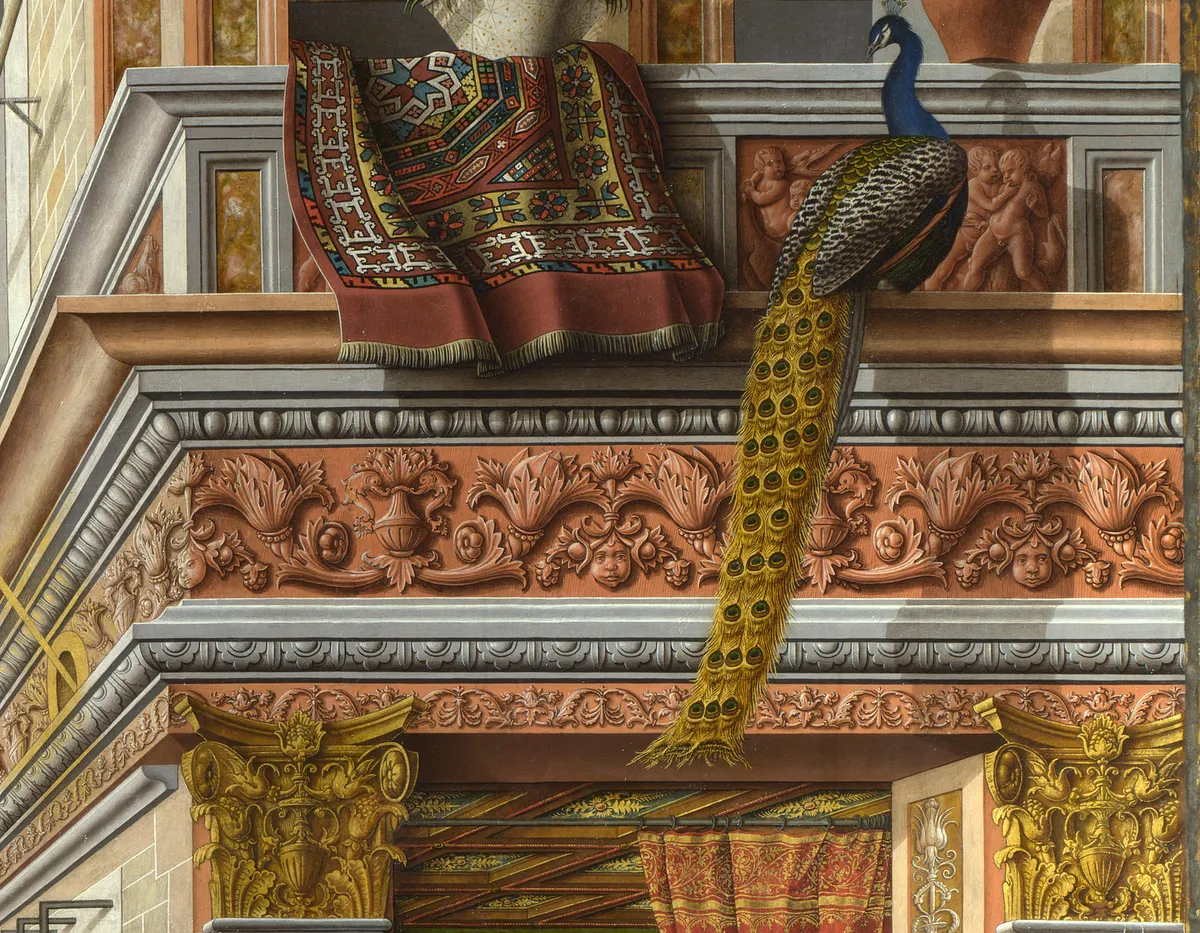
The ancients believed the peacock’s flesh did not decay; Saint Augustine mentions it in The City of God. The bird became a sign of immortality and of the Resurrection, and its hundred eyes were read as the all-seeing Church. In Carlo Crivelli’s Annunciation, with Saint Emidius of 1486, a peacock sits on the ledge above the Virgin’s room, at the very moment the eternal enters time.
25. The Goldfinch
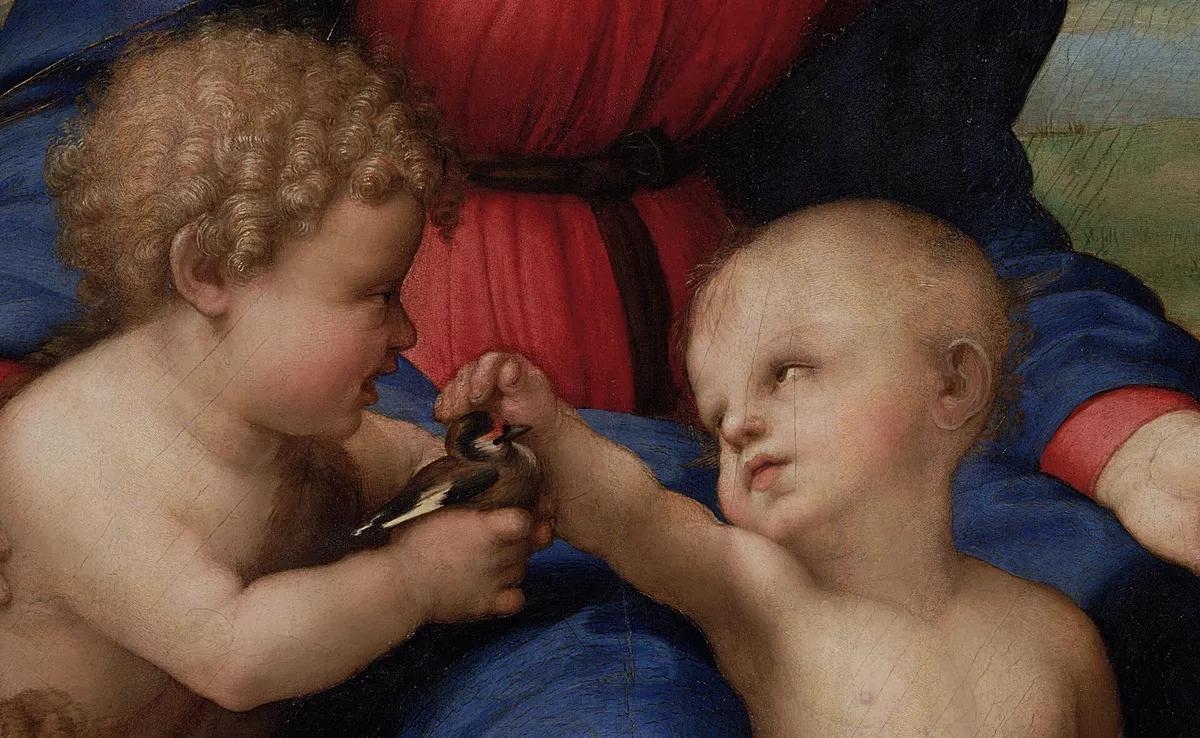
The goldfinch feeds on thistle seeds, among thorns, and a legend says its red face was stained when it pulled a thorn from Christ’s brow on the way to Calvary. In the hand of the Christ Child it is a quiet announcement of the Passion. Raphael painted it about 1505 in the Madonna of the Goldfinch, where the young John the Baptist offers the bird and the Child reaches out to stroke it. Our article on the Madonna of the Goldfinch tells its story.
26. The Apple
In Latin, malum means both apple and evil, which helped the fruit of Genesis, never named in the Bible, become an apple in Western art. In Eve’s hand it is the Fall; in the hand of the Christ Child or the Virgin, the new Eve, it is the sin he came to take away. Crivelli put one in the foreground of his Annunciation for the same reason.
27. The Pomegranate
Its many seeds held in one skin made the pomegranate a sign of the Church, one body of many members; its red juice and its bursting open, a sign of the Passion and the Resurrection. Botticelli placed one at the centre of his Madonna of the Pomegranate, held by the Virgin under the hand of the Child.
28. The Lily
The white lily is purity, and especially the purity of Mary. In almost every Annunciation the angel Gabriel holds one, or a vase of lilies stands between him and the Virgin. It is also an attribute of Saint Joseph, whose staff blossomed, and of chaste saints such as Saint Anthony of Padua and Saint Dominic.
29. The Rose
The rose is Mary’s flower, the “rose without thorns”, and the rosary takes its name from it. Red roses can also mean martyrdom. Our article on Marian iconography explains the colours, flowers and objects that surround the Virgin.
30. Wheat and Bread
Ears of wheat and loaves of bread stand for the Eucharist, the “bread of life” (John 6:35). With the grapes, they frame chalices and tabernacles; on the table at Emmaus, a broken loaf is the moment of recognition.
31. The Candle and the Light
“I am the light of the world” (John 8:12). A burning candle is Christ, faith or the soul before God; a candle just snuffed out, in a still life, is a life that has ended. The Easter candle, marked with the cross, alpha and omega and the year, gathers several symbols at once.
32. The Ship
The ship, and before it Noah’s ark, is the Church carrying the faithful through the waters of the world; the very word nave comes from the Latin navis, ship. The mast with its crossbar is one more hidden cross.
33. The Butterfly
Caterpillar, chrysalis, butterfly: life, death and resurrection. The butterfly appears in some Renaissance paintings of the Virgin and Child, and has become a popular Easter symbol.
The Four Evangelists and the Saints
34 to 37. The Man, the Lion, the Ox and the Eagle
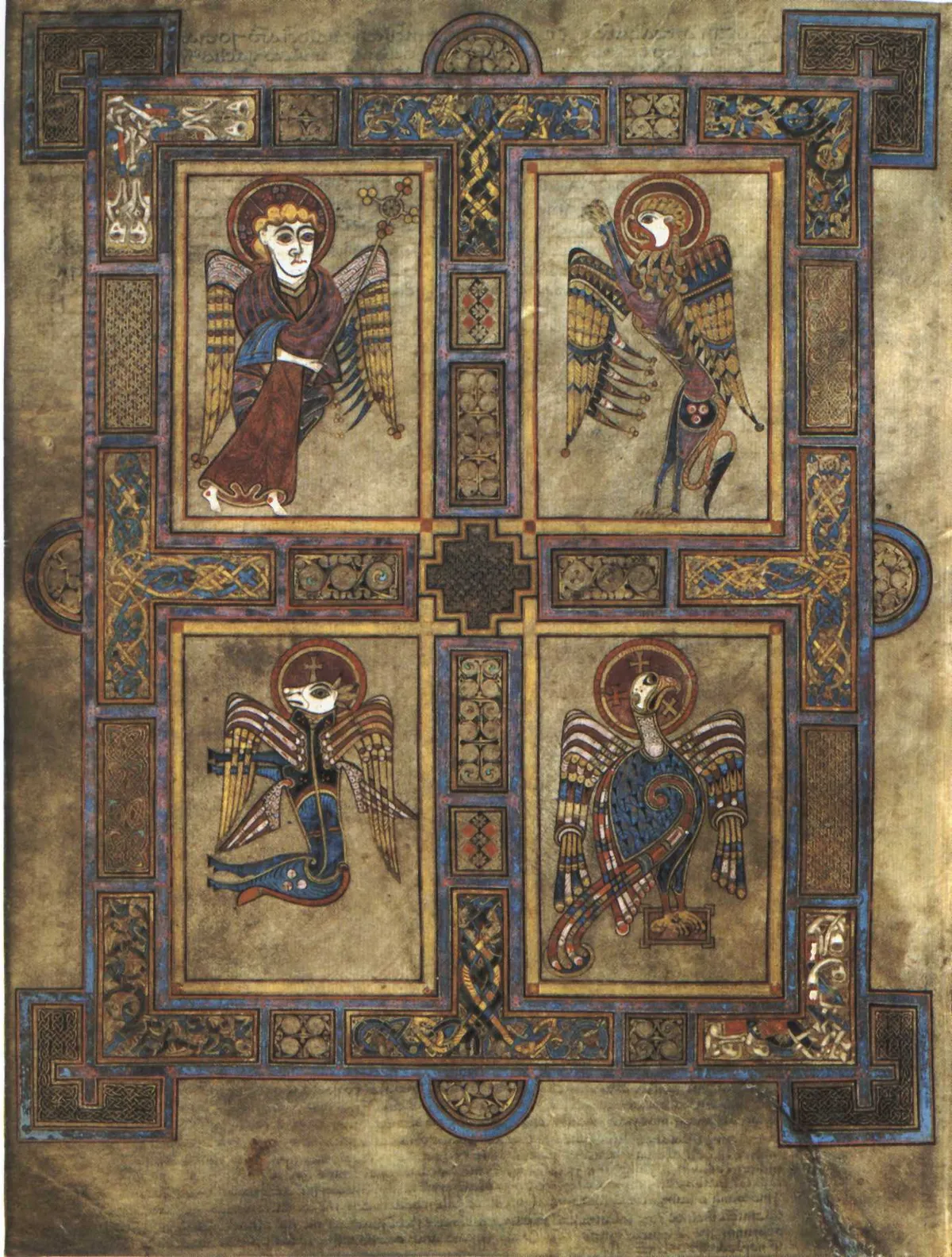
The prophet Ezekiel saw four living creatures with the faces of a man, a lion, an ox and an eagle (Ezekiel 1:10), and the Book of Revelation describes them around the throne of God (Revelation 4:7). Saint Jerome gave each to an evangelist, according to how his Gospel begins: the winged man to Matthew, who opens with Christ’s human ancestry; the lion to Mark, who begins with the voice crying in the wilderness; the ox, the animal of sacrifice, to Luke, who begins in the Temple; and the eagle to John, who soars from the first line, “In the beginning was the Word”. The four appear around Christ in majesty on cathedral portals, in mosaics, and on a famous page of the Book of Kells, painted by Irish monks around the year 800.
38. Saints and Their Attributes
Each saint carries an object, usually the instrument of their martyrdom or a sign from their life, so that people who could not read a name could still recognise them. These are the ones you will meet most often:
| Saint | Attribute | Why |
|---|---|---|
| Peter | Keys | “I will give unto thee the keys of the kingdom of heaven” (Matthew 16:19) |
| Paul | Sword, book | Beheaded in Rome; his letters |
| Andrew | X-shaped cross | Crucified on a saltire cross |
| James the Greater | Scallop shell, pilgrim’s staff | The pilgrimage to Santiago de Compostela |
| John the Evangelist | Eagle, chalice with a serpent | His Gospel; the poisoned cup he blessed |
| John the Baptist | Lamb, reed cross, camel skin | “Behold the Lamb of God” |
| Michael the Archangel | Sword, scales, dragon | Victory over Satan; the weighing of souls |
| Sebastian | Arrows | Shot with arrows by Roman soldiers |
| Lawrence | Gridiron | Roasted on a grill |
| Catherine of Alexandria | Wheel | The spiked wheel that broke when it touched her |
| Barbara | Tower | Imprisoned in a tower by her father |
| Cecilia | Organ | Patron of music |
| Lucy | Eyes on a dish | Her name means light |
| George | Dragon, white flag with red cross | The legend of the dragon |
| Jerome | Lion, red hat, book | The lion he healed; the Latin Bible |
| Francis of Assisi | Stigmata, brown habit | The wounds of Christ he received |
| Mary Magdalene | Jar of ointment | The perfume poured on Christ’s feet |
The martyrs among them often hold a palm, the sign of victory over death. Our pages on Saint Sebastian, female saints in art and the Archangel Michael show these attributes at work.
Signs of Holiness: Halo, Nimbus and Mandorla
39. The Halo
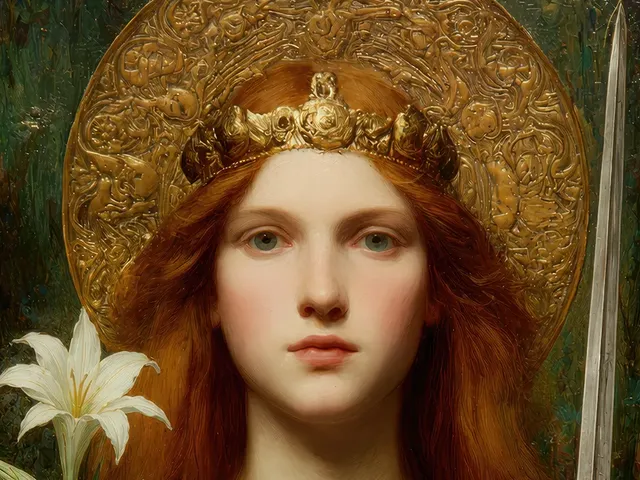
The golden circle around the head, borrowed from images of emperors and sun gods, marks holiness from the fourth century onward. A square halo was sometimes given to a living person, such as a pope who commissioned a mosaic, to show that he was not yet a saint.
40. The Cross in the Halo and the Mandorla
Only Christ wears a halo marked with a cross, the cruciform nimbus; when you see it, you know who the figure is, even as a child in his mother’s arms. The mandorla, an almond-shaped glory surrounding the whole body, is kept for Christ and the Virgin in moments of divine power: the Transfiguration, the Ascension, the Last Judgment, the Assumption. Icons, which keep these signs most faithfully, are explained in our guide to Catholic icons, and hidden symbols in a Flemish home are decoded in our article on the Merode Altarpiece.
40 Christian Symbols, Their Meanings and Where to See Them
| Symbol | Meaning | Where to see it |
|---|---|---|
| Fish (Ichthys) | Jesus Christ, Son of God, Saviour | Stele of Licinia Amias, Rome |
| Anchor | Hope; a hidden cross | Catacombs of Rome |
| Chi Rho | The name of Christ; victory | Passion sarcophagus, Vatican |
| Alpha and Omega | Christ, beginning and end | Catacomb of Commodilla, Rome |
| Staurogram | The cross, inside a word | Early Gospel manuscripts |
| IHS | The Holy Name of Jesus | Gaulli, ceiling of the Gesu, Rome |
| INRI | Jesus of Nazareth, King of the Jews | Velazquez, Christ Crucified, Prado |
| Cross and crucifix | Redemption; the price of it | Doors of Santa Sabina, Rome |
| Lamb | Christ the sacrifice | Van Eyck, Ghent Altarpiece |
| Good Shepherd | Christ who gives his life for his sheep | Mausoleum of Galla Placidia, Ravenna |
| Pelican | Christ who feeds us with his blood | Bestiaries, crucifixes, tabernacles |
| Phoenix | Resurrection | Early apse mosaics |
| Lion | Christ, Lion of Juda; Saint Mark | Portals, Gospel books |
| Vine and grapes | Christ and his Church; the Eucharist | Early church vaults |
| Dove | The Holy Spirit; peace | Baptism and Pentecost scenes |
| Triangle, eye | The Trinity; God who sees | Pontormo, Supper at Emmaus, Uffizi |
| Hand of God | God the Father | Mosaics, Romanesque carvings |
| Triquetra, trefoil, shamrock | The Trinity | Gothic tracery, Celtic art |
| Instruments of the Passion | The sufferings of Christ | Fra Angelico, San Marco, Florence |
| Crown of thorns | The King who reigns from the cross | Images of the Man of Sorrows |
| Nails | The Crucifixion; the Trinity (three) | Crucifixions |
| Skull at the cross | Adam redeemed by Christ | Crucifixions |
| Sacred Heart | The love of Christ | Batoni, the Gesu, Rome |
| Peacock | Immortality, Resurrection | Crivelli, Annunciation, London |
| Goldfinch | The Passion foretold | Raphael, Madonna of the Goldfinch |
| Apple | Sin; its redemption | Eve; the Christ Child |
| Pomegranate | The Church; Resurrection | Botticelli, Madonna of the Pomegranate |
| Lily | Purity; Mary | Annunciations |
| Rose | Mary; martyrdom (red) | Madonnas, rosaries |
| Wheat and bread | The Eucharist | Altars, Emmaus scenes |
| Candle | Christ the light; the soul | Easter candle, still lifes |
| Ship | The Church | Catacombs; the nave of every church |
| Butterfly | Resurrection | Renaissance Madonnas |
| Winged man | Saint Matthew | Book of Kells, folio 27v |
| Lion | Saint Mark | Book of Kells, folio 27v |
| Ox | Saint Luke | Book of Kells, folio 27v |
| Eagle | Saint John | Book of Kells, folio 27v |
| Saints’ attributes | The identity of each saint | Altarpieces, stained glass |
| Halo | Holiness | Almost every sacred image |
| Cruciform halo, mandorla | Christ; divine glory | Icons, Transfigurations |
Free Coloring Page: 12 Christian Symbols
The best way to remember a symbol is to draw it. Our free coloring page gathers twelve of the signs in this guide, from the Chi Rho and the fish to the pelican, the peacock and the keys of Saint Peter, in the style of a medieval manuscript, with a second page that gives the meaning of each one. It works for a catechism class, a homeschool lesson or a quiet evening at home.
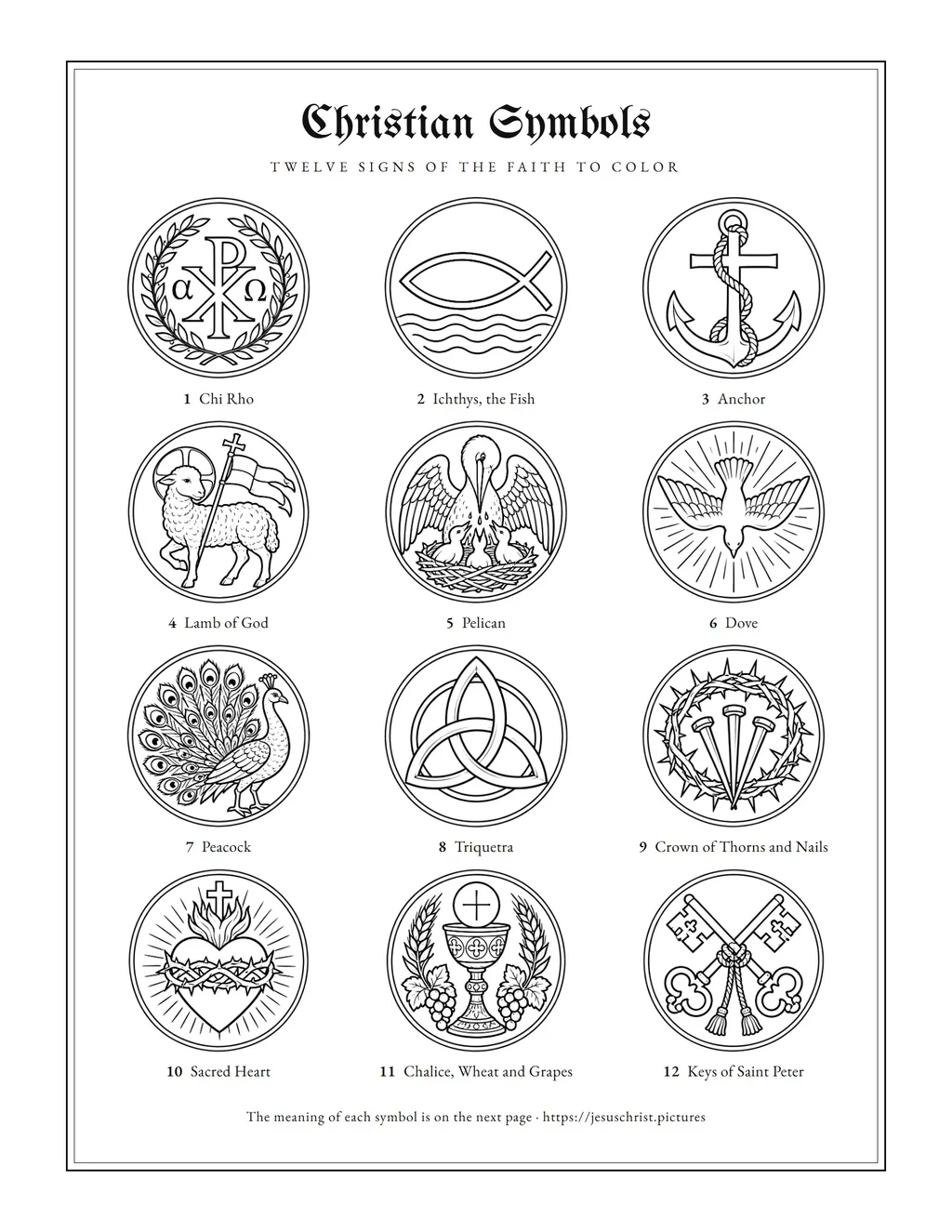
Download the coloring page: PDF, US Letter or PDF, A4. Free, no email needed. More scenes to color are waiting in our Christian coloring pages, and printable prayers in our library of free Christian printables. Children who enjoy finding symbols will also like our Jesse Tree ornaments, where each ornament is a sign from the Old Testament.
Prefer one symbol at a time? Our Christian symbols coloring pages give each of the twelve its own large page, with its meaning and a short story for children.
Conclusion: Learning to Read a Painting
The first Christians scratched a fish on a tombstone because they could not yet write the name of Christ openly. Fourteen centuries later, Crivelli put a peacock on a balcony and an apple in the foreground, and expected the people of Ascoli to understand. In between, painters built a whole vocabulary of signs, and most of it still works: once you know that a goldfinch means the Passion and a skull the old Adam, you will never look at a Madonna or a Crucifixion the same way again.
The next step is to look slowly. Our guide to visio divina shows how to pray with a painting, and our selection of the most famous Christian paintings is a good place to practise reading what you see.
Important Facts About Christian Symbols
- The earliest Christian symbols, the fish, the anchor and the dove, appear in the catacombs and on tombstones of the second and third centuries, before the cross was openly shown.
- The Greek word ichthys, fish, is an acrostic of Iesous Christos Theou Huios Soter, Jesus Christ, Son of God, Saviour.
- The Chi Rho combines the first two Greek letters of Christ’s name; Constantine adopted it before the battle of the Milvian Bridge in 312.
- IHS comes from the first three letters of Jesus in Greek; INRI stands for Iesus Nazarenus Rex Iudaeorum, the title Pilate placed on the cross (John 19:19).
- The four evangelists are symbolised by a man (Matthew), a lion (Mark), an ox (Luke) and an eagle (John), after Ezekiel 1 and Revelation 4.
- Only Christ wears the cruciform halo, a halo marked with a cross.
- Christian images of the Crucifixion become common only in the fifth century; the carved doors of Santa Sabina in Rome are among the earliest.
- The Sacred Heart became a universal Catholic symbol after the visions of Saint Margaret Mary Alacoque (1673 to 1675).
Frequently Asked Questions
What is the most famous Christian symbol?
The cross is the most famous Christian symbol, recalling the death of Jesus and his victory over death. An empty cross stresses the Resurrection; a crucifix, with the body of Christ, stresses the Passion. Before the fourth century, however, Christians rarely showed the cross openly and used the fish, the anchor and the Chi Rho instead.
What are the 3 main symbols of Christianity?
The three most widely used are the cross, sign of the death and Resurrection of Christ; the fish, or ichthys, whose Greek letters spell Jesus Christ, Son of God, Saviour; and the dove, sign of the Holy Spirit and of peace. Many lists add the Chi Rho, the Lamb of God and the alpha and omega.
What are the symbols of the Holy Spirit?
The Catechism of the Catholic Church (694 to 701) names eight symbols of the Holy Spirit: water, anointing with oil, fire, the cloud and the light, the seal, the hand, the finger of God and the dove. Longer lists often add the wind and the breath, from the Pentecost account and from Christ breathing on the apostles.
What does the Christian fish symbol mean?
The fish, ichthys in Greek, is an acrostic: its letters are the first letters of Iesous Christos Theou Huios Soter, Jesus Christ, Son of God, Saviour. Early Christians used it on tombs and rings as a discreet confession of faith, and it also recalls the apostles as fishers of men and the miracle of the loaves and fishes.
What does IHS mean?
IHS is a monogram of the name of Jesus, formed from its first three letters in Greek, iota, eta and sigma. Later it was given Latin readings such as Iesus Hominum Salvator, Jesus Saviour of mankind. Saint Bernardino of Siena spread devotion to it in the fifteenth century, and the Jesuits adopted it as their emblem.
What does INRI stand for?
INRI stands for Iesus Nazarenus Rex Iudaeorum, Latin for Jesus of Nazareth, King of the Jews. It is the charge Pontius Pilate had written above the cross, in Hebrew, Greek and Latin, according to the Gospel of John (19:19-20). Painters usually show only the four Latin initials, though some, like Velazquez, painted all three languages.
What does the Chi Rho mean?
The Chi Rho is a monogram made of the first two letters of Christ in Greek, chi (X) and rho (P), with the P set over the X. The emperor Constantine adopted it before his victory at the Milvian Bridge in 312, and it became a sign of Christ’s victory, often shown in a laurel wreath and flanked by the alpha and omega.
Can you buy art with Christian symbols?
You can buy art with Christian symbols at jesuschrist.pictures, in our shop, as canvas reproductions and fine art posters, including Pompeo Batoni’s Sacred Heart of Jesus, the Sacred Heart in Renaissance style, the Agnus Dei and the Tree of Jesse in the style of medieval manuscripts, and the Christ Pantocrator icon. Each one carries the signs explained in this guide.