Holman Hunt’s Shadow of Death: A Cross Before the Cross
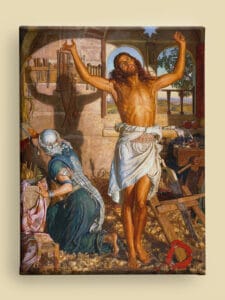
The Shadow of Death is one of the most ingenious religious paintings of the Victorian age, made by William Holman Hunt between 1870 and 1873. It shows Jesus not on the cross but years earlier, as a young carpenter in Nazareth, pausing to stretch his tired arms. As he does, his shadow falls on the wall in the shape of a cross. The painting hangs in the Manchester Art Gallery. The museum records its medium as oil on canvas.
Everything in the scene looks like an ordinary moment in a workshop. Wood shavings cover the floor, tools fill the room, and the bright light of the Holy Land pours in through the window. Yet the whole picture is built around a single, startling idea.
When Jesus raises his arms, his shadow stretches across a wooden rack of tools behind him, so that he seems already nailed to a cross. His mother, kneeling nearby, turns and sees it, a glimpse of the future hidden in the present.
Holman Hunt was a founder of the Pre-Raphaelite Brotherhood. He explored a similar idea of foretold suffering in Millais’ Christ in the House of His Parents.
The History of the Shadow of Death
Holman Hunt worked on The Shadow of Death from 1870 to 1873, during his second journey to the Holy Land. True to Pre-Raphaelite ideals, he wanted to paint the setting from life, studying real carpenters’ tools, Middle Eastern light, and the landscape of Nazareth itself.

The finished painting was a great public success when shown in London. It was bought for Manchester, where it remains a highlight of the city’s gallery. More of the movement can be seen in our wider look at Pre-Raphaelite Jesus paintings.
Christ the Carpenter
At the center stands the young Jesus, stripped to the waist, his body that of a real working man. He has been sawing wood, and he straightens up to ease his back, lifting his arms and tilting his head toward the light.

Holman Hunt paints him with great care, sunburned and weary, far from a remote, idealized figure. This is Christ sharing fully in human labor, in the years of ordinary life before his ministry began. The gesture is natural, the meaning anything but.
The Shadow of the Cross
The heart of the painting is the shadow. As Jesus stretches, his dark silhouette falls on the back wall, his outstretched arms aligning with a wooden tool rack so that the shadow takes the exact shape of a man crucified.

It is a vision of the future cast onto the present. In a single quiet gesture, the painting foretells the crucifixion, the shadow of death that hangs over Christ’s whole life. The everyday workshop becomes a prophecy in light and shade.
The Watching Mother
To the left kneels the Virgin Mary, bent over a casket that holds the gifts once brought by the Magi. She has been looking at them, but now she turns, catching sight of the cross-shaped shadow on the wall.

Her turning figure draws the viewer into the moment of recognition. The treasures of the Nativity and the shadow of the Passion are joined in one glance, the beginning and the end of the story held together. Holman Hunt fills the rest of the room with exact, glowing detail, in the true Pre-Raphaelite manner.
A Prophecy in Paint
The lasting power of The Shadow of Death lies in its idea. Holman Hunt takes the deepest truth of the faith, that Christ was born to die for the world, and hides it inside a perfectly ordinary scene.
He unites sharp realism with rich symbolism, every tool and shaving painted from life, yet all serving a single spiritual message. The result is a painting that rewards both the eye and the mind, a sermon told entirely through a shadow.
Conclusion
In The Shadow of Death, William Holman Hunt turned a carpenter’s workshop into a vision of the cross. The weary young Jesus, the cross-shaped shadow, and the watching mother bind the whole life of Christ into one quiet, brilliant image.
Still in Manchester, it remains one of the most inventive religious paintings of its century, a reminder that the shadow of the Passion fell across even the most ordinary days of Christ’s life.
Artwork Information
| Artwork | Artist | Date | Medium | Current Location |
|---|---|---|---|---|
| The Shadow of Death | William Holman Hunt | 1870 to 1873 | Oil on canvas, 214 x 168 cm | Manchester Art Gallery |
Five Facts About Holman Hunt’s Shadow of Death
- The Shadow of Death is an oil on canvas by William Holman Hunt, kept in the Manchester Art Gallery.
- It was painted between 1870 and 1873, partly in the Holy Land for accuracy.
- It shows Jesus as a young carpenter, stretching after work, his shadow forming a cross on the wall.
- The Virgin Mary kneels nearby at a casket of the Magi’s gifts and turns to see the shadow.
- Holman Hunt was a founder of the Pre-Raphaelite Brotherhood, known for combining realism with symbolism.
FAQ
What does the Shadow of Death depict?
It shows Jesus as a young carpenter in Nazareth, stretching his arms after sawing wood. The Shadow of Death turns the moment into a prophecy, as his shadow forms the shape of a cross on the wall.
What does the shadow mean?
The cross-shaped shadow foretells the crucifixion. It shows that the shadow of death, Christ’s coming Passion, hung over even the ordinary years of his life before his ministry.
Who is the kneeling woman?
She is the Virgin Mary, bent over a casket holding the gifts of the Magi. She turns to see the shadow, joining the memory of the Nativity with the foreshadowing of the cross.
Why did Holman Hunt paint it in the Holy Land?
As a Pre-Raphaelite, Hunt valued truth to nature. He traveled to the Holy Land to study the real light, landscape and objects, so that his sacred scene would be as accurate as possible.
When was the Shadow of Death painted?
He worked on it from 1870 to 1873.
Where is the Shadow of Death today?
It is in the Manchester Art Gallery.
Where can I buy a reproduction of Holman Hunt’s Shadow of Death?
You can buy a reproduction of Holman Hunt’s Shadow of Death at jesuschrist.pictures. The canvas reproduction is in our shop, printed on premium canvas and shipped worldwide.


